‘…he who does not grasp that life is a repetition and that this is the beauty of life has pronounced his own verdict and deserves nothing better than what will happen to him anyway – he will perish.’ (Søren Kierkegaard, 1843).
Kierkegaard's plea for us to value the ‘beauty’ of repetition in life presents something of a challenge in today's ever-changing world. After all, we tend to be apologetic even when repeating ourselves in conversation; to be repetitive is somehow to be boring, predictable, uncreative. The search for something different, for novelty, for discovery seems far more exciting. But perhaps repetition is not quite what we think it is. Its very temporal quality – the fact that experiencing the ‘same’ thing can only occur later on in time – makes this device more dynamic than it may at first appear. Due to the passing of time, our perception of earlier events will change, and repetition can actually make a difference. The philosophical debates surrounding Kierkegaard's ideas form a useful springboard for a temporal art-form like music. More particularly, they find resonance within the late Brahms piano miniatures (for instance in the Drei Intermezzi, op. 117) where highly compressed formal structures exhibit differing kinds of repetitive processes, despite their extreme economy. A limited time frame seems not to permit such an apparent indulgence, as saying something again is bound to take longer. Yet that very process may actually contribute to our perception of timescale being reduced: the effect of repetition is somewhat paradoxical. Indeed, the sheer economy of form in the op. 117 pieces stands in inverse proportion to their heightened expressivity; there is a compensatory balance. A distinction between what can be seen to be compressed and what may be perceived as being expansive – or vice versa – is fundamental to these considerations.
In 1843, the Danish philosopher Søren Kierkegaard (1813–-1855) published a book called Repetition (Danish: Gjentangelsen).Footnote 1 Small in length, but expansive in its thinking, this publication is almost an intermezzo in itself when viewed in relation to his writings as a whole. His concept of repetition evolves in the context of self-development; it addresses the dilemma of how to reconcile the fact that the self changes over time, yet retains its apparent identity.Footnote 2 Much is made of the fact that Kierkegaard adopted a pseudonym for his essay; he dubs the author ‘Constantin Constantius’, thereby literally encapsulating both the constant nature of repetition – and its more subtle element of change (indeed, a change that seemingly applies to ‘us’). Thus stasis and dynamism, similarity and difference, are equally (and visibly) present in his adopted name.Footnote 3 Searching for a constant through repetition, or constantly seeking repetition to gain a sense of security, are implicit here too; there is a reciprocal relationship between the presence of repetition and its perceived results. Thus, the driving motivational force of any repetitive process is neatly portrayed through Kierkegaard's pseudonym: it is an encryption of his underlying philosophy. Despite the complexities of his writings, and the further complexities of those who seek to explain them, there are moments of striking clarity. ‘The dialectic of repetition is easy; for what is repeated has been, otherwise it could not be repeated, but precisely the fact that it has been gives to repetition the character of novelty’Footnote 4. An alignment between repetition and novelty, instead of its more typical associations with sameness (and even monotony), offers an interesting perspective.
Both philosophically and musically, repetition can be shown to define and articulate the passage of time, so the multiple layers of interpretation that derive from Kierkegaard's thinking could be reinterpreted within a musical-analytical context. Of particular relevance is the way in which his philosophy of repetition is based on the concept of a ‘journey’, with its attendant narrative and temporal implications. As such, Kierkegaard's views sit alongside Schoenberg's notion of ‘developing variation’ – the endless reshaping of a basic shape – which has so pervasively (if not repeatedly) been applied to Brahms's compositional process. After all, Brahms was a progressive.Footnote 5 But Schoenberg had a particular agenda here, seeking to link Brahms's position in music history to his own, purposefully charting connections with the past in order to legitimize the future.Footnote 6 The organicism of developing variation is carefully – but very selectively – exemplified by Schoenberg to show its direct relevance to his own freely atonal, or more especially serial, compositional procedures. Considerations of repetition would not have suited his purpose.
However, any search for ‘sameness’ could be seen as a rather retrospective step; the danger of such analytical refocusing is that it appears to be regressive. (It's tantamount to ‘Brahms the repressive’, at least in Freudian terms.) But this is to go back to rather ill-informed definitions of repetition (as stated at the outset) and, due to the passing of time, that's not possible. It also ignores the wider and more creative implications of this essentially narrative process. Indeed, it could be argued that for listeners to perceive Schoenberg's idea of ‘reshaping’, some degree of recurrence of the shape in question has to occur: we only experience variety in relation to the model itself, by measuring one against the other. Moreover, since Kierkegaard's theories make a clear distinction between repetition (as a forward-moving impulse) and recollection (as a backward-looking one), there may be more in common between ‘repetition’ and ‘developing variation’ than their traditional definitions imply. They have a shared dynamic, but are articulated in different ways. Studies of developing variation in Brahms are notably confined to matters of pitch structures, interval patterns and rhythmic shapes;Footnote 7 were they to embrace issues of temporality, narrative and motion then a potentially fruitful dialogue between the effects of developing variation and those of repetition may be opened up.Footnote 8
Brahms's late piano miniatures of opp. 116–119 (some 20 pieces, of which 14 are Intermezzi) actually deploy many kinds of repetition: literal or varied, immediate or delayed, metrically regular or irregular, sequential or non-sequential, motivic, thematic, harmonic, rhythmic, formal and so on. It may be rather surprising that the concept of ‘sameness’ can occur in so many different ways, but philosophically speaking – given the distinction between re-experiencing something, rather than experiencing it again – this is not so unusual. By acknowledging that things cannot actually be the same again, even if they appear to be so (which is not to deny the psychological comfort to be gained from this illusion), then repetition becomes a catalyst for change. (It really isn't the same as we thought it was.) Kierkegaard's distinction between ‘repetition’ – as a dynamic force – and ‘recollection’ – as a point of stasis – offers us a useful starting point.Footnote 9 Essentially, he sees recollection and repetition as the same movement, but in opposite directions. From a musical perspective, these insights may help to inform the distinction between ‘circular’ and ‘linear’ time; circularity is associated with temporal stasis, linearity is characterized by dynamism.Footnote 10
Constantin Constantius relates a story of trying to recreate a memorable journey from the past, only to discover that he cannot regain the experiences and feelings that he had sensed the first time around. Much had changed in his life between these two points in time, yet there is a need, a desire – almost a compulsion – to relive the past.Footnote 11 This proves to be a negative and frustrating encounter; emotionally and psychologically, the author goes round in circles discovering that the only repetition is the impossibility of repetition. However, the dynamic between the backward and forward nature of human perception becomes a crucial matter. ‘Recollection’ is to look backwards and is associated with the melancholy of not being able to recreate this exactly; because it is connected to times past, it is seen as motionless and static: it avoids time (and is passive). ‘Repetition’ involves living in the present. It is the experience of here and now, the act and will to live forwards and, by being in constant movement, is thereby associated with the future: it creates a difference (and is active). Kierkegaard's metaphor of recollection as the equivalent of a visit, and repetition as analogous to a journey is useful. (Indeed it could be qualified in terms of ‘making’ a visit, rather than ‘taking’ a journey, one being a fixed encounter, the other a changing experience.) For Kierkegaard, drawing connections between a cognitive event in the past and its (apparent) recurrence in the present creates a deeper form of knowledge – a more profound level of understanding. Suddenly ternary form sounds a lot more interesting.
Brahms described his Drei Intermezzi, op. 117, (1892) as ‘three lullabies for my sorrows’.Footnote 12 This notion of three-of-a-kind suggests something repetitive in total, and within each piece, clear ternary-form outlines are also in evidence. (A fundamental principle of repetition patterns that operate on differing timescales is immediately established, and this can be evidenced on a number of levels.) However, as a collection, their overall shape is one of progressive intensification; both structurally and emotionally they become increasingly more complex and expansive. There is a creative interplay between the containment of formal repetition and the expressivity of change over time. Opus 117 offers three different perspectives on essentially the same material, embracing the idea of repetition as a dynamic process. Simply noting their tempo indications – Andante moderato, Andante non troppo, Andante con moto – encapsulates the presence of both constancy yet change (Constantin Constantius) that is so central to Kierkegaard's position. Brahms's reference to ‘sorrows’ resonates with the sense of melancholy that Kierkegaard associates with recollection, while the soothing effect of the repetitive qualities evoked by a lullaby suggests that these pieces may move (indeed, lull) the listener into a more positive frame of mind: they form an emotional journey over time. After all, repetition has longstanding associations with ritualistic behaviour.Footnote 13
As an aside, the passing literary influence behind these lullabies is also rather interesting; Brahms quotes from Lady Anne Boswell's lament as an epigram to the first Intermezzo. The German translation of these opening lines, which fit the melody here and give rise to claims of op. 117 as ‘songs without words’ Footnote 14, is taken from a collection of folksong texts published by Johann Gottfried Herder:
Schlaf sanft mein Kind, schlaf sanft und schön!
Mich dauert's sehr, dich weinen sehn.
(Sleep softly my child, sleep softly and well!
It breaks my heart to see you weep.)
Of course, Herder (1744–1803) is best known as a philosopher, and Kierkegaard's extensive knowledge of German contemporary philosophy is well documented.Footnote 15 He read German fluently, made extensive use of this resource and certainly knew Herder's work. So, from a range of viewpoints, Kierkegaard, Brahms and the op. 117 Intermezzi are intertwined. Repetition – and coincidence is just another instance of this – seems to be at the heart of this web of connections.Footnote 16
Recollection and Repetition – Stasis and Dynamism
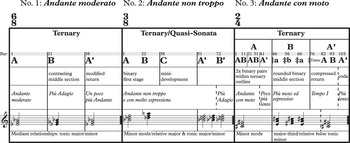
Example 1 summarizes this tripartite collection in terms of formal schemes, principle tonal areas and tempo indications. Essentially, there are three types of ternary form – each a more complex version than the previous; three tonal schemes of mediant relationships that progressively extend the tonal ambit in a systematic manner; and all of this music is contained within three temporal versions of a constant Andante, which increase in terms of their overall activity. Indeed, tonality and tempo not only mark the main contrasts between these pieces, but also articulate the formal schemes within them. The prevalence of the number ‘three’ is highly significant given the ubiquitous use of this interval – motivically, melodically, harmonically and tonally – that makes it so typical of Brahms's compositional style. But the way in which these elegies to ternary form develop the idea of structural recollection into a dynamic process of formal repetition, is partly the result of an increasing preoccupation with binary oppositions as the set of pieces unfold. The outline formal summary of Intermezzo no. 2 reveals a significant stage in this process, with internal binary-form divisions of its outer sections being offset by a ‘central’ passage that develops opening material; the more typical contrast of Section ‘B’ is replaced by the reworking of opening elements. (It marks the only instance in op. 117 where there is no change in tempo indication at this structural point, and suggests some degree of sonata-form thinking.)
Brahms: Three Intermezzi, op. 117: Structural Overview

A tension between the constancy of gestural repetition and the motion of harmonic development emerges here, but one that is held in a careful balance. The last Intermezzo builds upon these ideas, combining potentially competing ternary–binary patterns in a middle section of rounded-binary form: the only literal use of formal ‘repeat marks’ within the collection. Working in tandem with these architectural concerns, is a temporal narrative. The three pieces move from compound duple ( $$\[-->$<>\raster="fx10"<$>
<!--$$
) time, through triple (
 $$\[-->$<>\raster="fx11"<$>
<!--$$
) to a final duple (
 $$\[-->$<>\raster="fx9"<$>
<!--$$
) time signature: a process of simplification through a balance of ‘threes’ and ‘twos’. Indeed, more locally, hemiola rhythmic patterns feature in all three pieces. More locally still, the phrase lengths of the final Intermezzo are based, unusually, on a five-bar model – a pattern made all the more effective by the disruption of a six-bar phrase (see bars 89–92) for its climax (the only use of a forte dynamic in the piece) – suggesting that tempo, metre, phrase lengths and dynamics combine to give a forward-moving impulse to an otherwise more static structural scheme.
Kierkegaard's ideas about the ‘novelty’ and ‘beauty’ of repetition find a direct corollary in the manner with which Brahms treats the ternary-form ‘repeats’ in op. 117. Every instance of these structural restatements involves a balance between old and new, where the expressive effect (beauty) of repetition arises from its new position (novelty) within a framework of familiarity. Listeners experience a degree of change simply because they measure it within a context of direct restatement. The philosophical notion that things can never be the same again due to the passing of time, gains musical credence in the precision with which the material of Section A′ (relative to its original appearance as A) has been modified; in all of these pieces, it is as a direct consequence of events associated with the intervening music of Section B. Essentially, there are harmonic and tonal references which provide the pivotal elements in that process. Any predictability for the listener when re-hearing earlier melodic patterns is offset by an unexpected (harmonic) turn of events that gives novelty; but that very ‘difference’ emerges as a creative reworking of intervening material, transposed in time. The potential stasis of Section A′ gains a sense of dynamism through ‘repetition’ of material selected from Section B. There is almost a simple formula to ‘restatement’ in Brahms's ternary form: A′=A+B–.
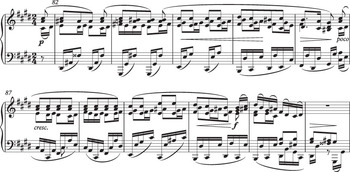
The relevant passage from Intermezzo no. 3 provides a useful example here. Initial melodic material is ‘repeated’ in Section A′ (from bar 82), but in a new harmonic sequence that incorporates the climactic six-bar phrase cited above. Example 2 shows bars 82–92 where events from the opening now articulate a chain of third-related harmonies: D# major – B major – G# minor. Logical enough in themselves, given the repetitive constancy of the interval of a third on all levels in these pieces, this sequence is actually the continuation of tonal motion initiated in Section B: with its submediant emphasis on A major and use of the relative, F# minor. The overall succession of pitch centres in this Intermezzo is that of (typically Brahmsian) descending thirds: C#–A–F#–D#–B–G#. Rather than merely offering a (static) sense of recollection, the ternary form gains a sense of momentum. Reworking a feature that was unique to its ‘middle section’ – but on a different timescale, being harmonic rather than tonal – has transformed our perception of ‘restatement’ into a dynamic process. The fixed nature of the formal architecture contains an on-going narrative of harmonic motion; yet both crucially involve the use of repetition: they are mutually dependent on it.
Intermezzo no. 3, bars 82–93

In this particular context, a further detail is worth noting. The turning point in this ternary form – when the recurrence of its main material is reharmonized – involves non-other than a D#-major sonority (see bar 82 in Example 2). Enharmonically, of course, this is the very E♭ major that opened the first Intermezzo of the set. Its (hidden) repetition at this crucial stage in the work as a whole – at an expressive and structural point of culmination – is surely no mere accident. It seems to support Schoenberg's view of developing variation – the endless reshaping of a basic shape – only it has not been reshaped: it is actually the same sonority. Kierkegaard's assertions about beauty and novelty seem especially apt: this is both a subtle, yet truly dynamic, instance of repetition.
Tonality and Harmony: Contrasts and Connections
No matter how disciplined we try to be when discussing one structural level in Brahms, such as the discussion of form, above, there is an inevitable tendency to stray into other domains: tonality, harmony and melody. It is of course the highly organic nature of his compositional process that accounts for this situation, and it usefully brings us to consider how tonal contrasts and harmonic pivots might contribute to a listener's assimilation of difference and repetition. Throughout op. 117, all the pieces rely on a return to their opening key in order to articulate their ternary-form schemes, though it may be displaced in time as cited above. ‘Displacement’ is an important concept in Brahms's use of repetition; recurrence of the ‘same’ thing – but in a different place – helps explain our sense of a forward-moving impulse in this music of recollection. There is a dynamic quality here, an increased sense of momentum.
Example 3 lists the principal key centres for the Three Intermezzi as a whole. At first glance, there is a distinct lack of repetition. No tonal area within any of the three pieces recurs later on in their succession. A case for developing variation seems compelling as the idea of a progressive intensification, operating over the collection as a whole, is clearly in evidence. From the initial major/minor contrasts of no. 1, based on an E♭ centre throughout, the second piece develops that idea into a tonic-minor/relative major contrast; the final Intermezzo builds on this pattern of mediant relationships: it uses the submediant major (A) and its relative minor (F#) to articulate the rounded binary form of its central section and to extend the tonal ambit overall. However, the forward-moving impulse that gives a sense of continuity to op. 117 can be explained through the presence of pivot notes between its contrasting tonal regions. The recurrence of the same pitch class, placed in a new tonal/harmonic context, allows the listener to measure change in relation to similarity: it is a process of dynamic repetition.
Op. 117: Key Centres and Pivot Notes

Example 3 summarizes this network of reccurences, so we can cite just a couple of instances by way of illustration. Again, as with formal schemes, the second Intermezzo marks a significant turning point. The use of the relative major for its secondary key both repeats the concept of minor/major contrasts of the opening piece and develops this idea, as explained above. But the precise choice of D♭ major is significant locally (D♭ defines the prevailing (B♭) tonic as minor), but both D♭ and its fifth (A♭) are ‘repeated’ – they operate as (enharmonic) pivot notes – within the prevailing C#-minor centre of the final Intermezzo. As part of our experiencing op. 117 as some kind ‘journey’, it seems significant that an earlier, secondary key is later reinterpreted as a tonic: there is a sense of progression. The contrast between (D♭) major and that (C#) minor completes the sense of interconnection between these three ‘lullabies’; it is analogous to the distinction between E♭ major and E♭ minor that initiated the tonal scheme here (within one piece), now being projected on a larger timescale (between the next two pieces). Certainly there is progressive development in the succession of keys involved; there is also clear evidence of developing variation: the endless reshaping of the interval of a third. But all this is underpinned by exact repetition of structural pivot notes, displaced over time. Kierkegaard's fundamental premise, that drawing connections between a cognitive event in the past and its recurrence in the present creates a deeper level of understanding, seems to be especially relevant in this context.
A few harmonic details lend further support to this idea. In each piece, there is a disruption to a pattern of expectation – which ternary form ‘repetition’ sets up – through displacement and denial; and these unexpected turns of events are essentially the result of harmonic reworking. In the first Intermezzo, the simplest of the set, the basic tonal ‘conflict’ between Sections A and B, is that of major versus minor modes. When this issue is resolved, in Section A′, two ‘new’ features are significant: a change in texture involving the use of decorative semiquaver figuration (drawing on a distinctive feature from the central section) and harmonic novelty. That harmonic twist, through striking in context, is subtle and not designed to overturn the emotional reassurance that ‘restatement’ engenders. Yet the shift to G minor (see bar 49) – merely the relative of the dominant, a ‘colouring’ of earlier events – has a number of deeper resonances that make it significant. True, it is yet another example of a mediant relationship – but a very particular one. Chromaticism is an important feature of this piece, especially so in its central section, and the overall E♭ major/minor tonal scheme is encapsulated in the change from G♮ to G♭. Regaining E♭ major (with its crucial mode-defining G♮) is fundamental to a sense of ‘return’ (from bar 38); but this later use of that same pitch class as the tonic of a (new) minor-mode harmony becomes a dynamic repetition: a forward-moving impulse arising from a recurrent event.
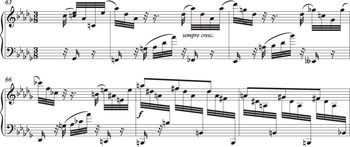
A further instance of harmonic cross-referencing helps to illustrate the larger-scale ramifications of dynamic repetition. As noted above, chromatic music, be it in terms of motivic shapes, voice-leading or harmonic motion, is very characteristic of op. 117 and one of the most striking events of this kind occurs within the harmonic reworkings of Section A′ in the second Intermezzo. Example 4 shows the passage in question (bars 63–68), a sequence of events articulated by a chromatically moving bass line – a structural consequence of the surface neighbour-note figuration upon which the whole piece is based. This is Brahms using developing variation technique in a highly inventive manner: the creative reshaping of a semitone figure. Taken to its harmonic and tonal limits, there is a climactic statement of neapolitan harmony: B major is projected over bars 67–68. It is the peak of an ongoing, localized process of organic growth that can be plotted by following through events in the score.
Intermezzo no. 2, bars 64–68

But what if we fast forward? When this sonority becomes displaced in time, transposed to exactly the equivalent structural point in the third Intermezzo, the direct recurrence of B major offers us a new perspective on the same sonority. This climax of the final piece was cited above (in Example 2), to show that its local harmonic motion was part of a chain of descending thirds, with the phrase length being extended to accommodate them. But that B-major harmony of bars 90–91 (see Example 2) now gains a wider significance when measured in relation to the previous piece. Re-experiencing it in a new context contributes to our sense of increasing expressive intensity – the emotional journey – that these ‘three lullabies’ collectively convey. Repetition has enabled us to gain a deeper understanding. This does not emerge from merely observing how events unfold in the score, but arises from a cognitive re-alignment of material as perceived over time. In other words, this is not just the product of developing variation, but a dynamic repetition.
Three Lullabies: Phrase-structure, Gesture and Rhythm
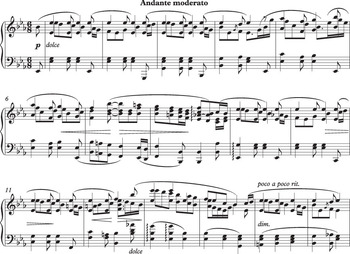
The idea that processes of repetition operate on different timescales in op. 117 is already emerging. Some considerations of more localized examples and their effects help to provide a more comprehensive picture of just how pervasive a compositional device this can be. One of the characteristics of any lullaby is the mesmeric quality that arises from internal repetition patterns. The first Intermezzo, complete with its poetic epigram, is especially striking in this respect; its expressive simplicity, the vocal nature of its material and its position as the generator of later events in the collection assigns a particular significance to its opening events. Example 5 shows the initial 16-bar section for ease of reference. This is clearly repetitive music: the periodicity of phrase structure, the uniformity of rhythmic gestures, the recurrence of melodic and motivic shapes – and an insistent E♭ pedal – are all utilizing structures where variety has been highly restricted. The sheer monotony, rather than having a negative effect, is there to lull us into a sense of tranquillity. By setting up a number of frameworks of reference in this way, any subtle change, any slight dislocation within our pattern-matching processes, are all the more acutely elevated in our experience. An over-riding constancy of image is subject to ever-changing colour and perspective. As a musical manifestation of ‘Constantin Constantius’, a more compelling example would be hard to find.
Intermezzo no. 1, bars 1–16

The immediacy of its descending-scale figure, constantly reshaped to emphasize variety of interval content, is striking. There are some eight (2-bar) iterations of this gesture overall, placed in carefully balanced antecedent/consequent patterns. After a move into, then on to, the dominant (bars 7–8), perhaps the most expressive appearance is the penultimate one (bars 13–14); these recurrent patterns have a cumulative effect. Here the rhythmic insistence of a characteristic  $$\[-->$<>\raster="fx10"<$>
<!--$$
metrical lilt, is undermined by way of a triple metre statement: a hemiola disruption that continues until the end of this section. (Indeed, by making bars 15–16 a direct melodic repetition of bars 3–4, this metrical variation is highlighted further.) Such a localized process proves to be more wide reaching; it prefigures the
 $$\[-->$<>\raster="fx11"<$>
<!--$$
metre of the second Intermezzo and forms part of an on-going temporal impulse that explores duple/triple metrical characters operating throughout op. 117, as outlined above. The balance between developing variation and repetition is crucially interdependent here: they are held in a symbiotic relationship. While repetition patterns, in themselves, may be indicative of circular time – the stasis and constancy of E♭ pitch-class in every bar for instance – they actually articulate a temporal framework within which a subtle process of developing variation can be perceived. It is only by having a constant against which we can measure change, that a sense of ongoing, linear time can be assimilated. Significant moments of repetition act as a kind of structural landmark within the music. Rather as in a journey, where you might stop and take note of a landmark (enjoying a moment of stasis), you may also take stock of where you are, how far you have travelled, how far there is still to go; landmarks denote pace and motion but they also offer a different perspective on surrounding events. This does of course suggest that local, more immediate instances of repetition operate in a different – and less dynamic – way from larger-scale gestural recurrence; this will require some further investigation.
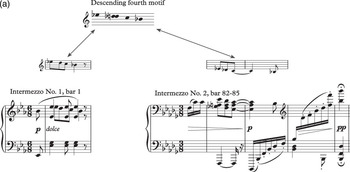
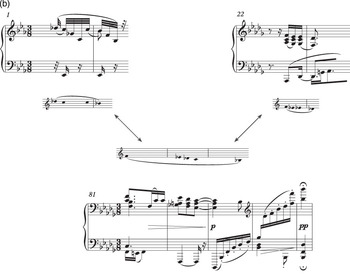
For now, if we consider gestural repetition delayed over time, then another perspective emerges; Example 6a shows the closing events of the second Intermezzo (bars 82–85). Here, the very same descending-fourth figure (the E♭ – B♭ motive so frequently heard in no. 1) is in evidence. (To be precise, it is not exactly the same; the presence of D♭ defines the minor-mode nature of this second piece, as discussed earlier.) Locally of course, it is a final point of resolution for music that has consistently used descending thirds (both minor and major): it offers a degree of synthesis. To illustrate: Example 6b shows both figures (from Sections A and B) with their crucial distinction between semitone and whole-tone intervals, now combined within this perfect-fourth gesture. (Indeed, the overall perfect-fifth descent from the F♮ (in bar 81) to the B♭ (bar 83) directly combines both elements.)
Motivic ‘Repetition’ between op. 117 no. 1 and no. 2

Intermezzo no. 2: Synthesis of Motivic Shapes

It is part of an ongoing process of developing variation, and the narrative immediacy sets it aside from more direct structural repetition that is temporally delayed. As such, it has emerged from within a context of gestural consistency: the second Intermezzo constantly repeats – and occasionally reshapes – its initial figure. This succession of events manipulates a balance between sequential and/or literal repetition patterns in order to play on listener expectations, of development or stasis respectively. However, when viewed on the larger scale, as a further example of a kind of ‘hidden’ repetition, this closing gesture is an important moment. Given the displacement of an earlier event, from the first to the second Intermezzo, it is another example of ‘dynamic’ repetition – of recurrence being used to structural effect. Matters of timescale play a fundamental part in the way in which the listener perceives different aspects of repetition patterns: immediately as circular and static, later as linear and dynamic.
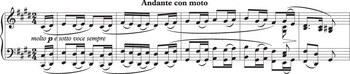
The third Intermezzo offers a useful summation of such localized instances. As the culmination of the increased intensity of expression during op. 117 overall, its central section has the only instance of formal repeat marks in this set, so repetition patterns are especially crucial to this piece, and operate on different structural levels and timescales. Example 7 shows the opening five-bar gesture, with its internal construction based on varied repetition: a 1 + 1 + 2 + 1-bar pattern; this has been carefully shaped to give an arch of increasing intensity which the ‘extra’ (fifth) bar (of harmony, rather than unison) resolves. The overall gesture forms a five-bar antecedent (cadencing on the dominant) to a consequent phrase (confirming the tonic). This material recurs in many guises – repeated, varied, developed – during the course of the piece: five times in Section A; three more times in A′.Footnote 17 The unison voicing and rhythmic uniformity shown in Example 7 provide a backdrop against which the details of interval content, pitch organization, phrasing and metre are thrown into strong relief. It is also the simple starting point for what, in essence, is a series of seven further variations on this model. But in all of these eight statements, despite the changes arising from an ongoing process of developing variation – applied to texture, harmony, tonality and phrase construction – the actual melodic line is directly repeated every time. The listener is asked to measure variety in relation to a constant, both within and between statements of this material. Formally, there is something of a rondo-like quality to the repetition patterns involved, locally they are a kind of ostinato.
Intermezzo no. 3, bars 1–5

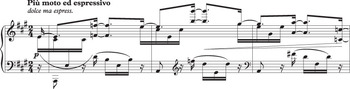
The degree of contrast provided by the rounded-binary-form middle section is marked. If the music of Section A is essentially diatonic, scalic, based on a regular pulse and contained by a limited register, that of Section B is the opposite: chromatic, angular, syncopated and with a very wide tessitura. The expressive palette has moved from material that was essentially melodic and calm to something more rhythmic and agitated. It still has the consistency of a five-bar phrase structure, now using a regular 3 + 2-bar internal pattern, but is made all the more unstable by the features listed above. Example 8 shows the opening three-bar unit of this section; there are five further variants to come: some six statements in total. Focusing in further, these generative three bars comprise three different perspectives on the same object: possibly an encapsulation of op. 117 in its entirety? However we choose to see it, this figure is heard 18 times, which, with the (literal) binary-form repeats, amounts to 36 iterations within 60 bars of music. This passage has the highest concentration of repetition in the whole collection, yet is arguably one of the most emotionally expressive. Rhythmically and metrically these gestural repetitions are identical. However, in terms of pitch, the amount of direct recurrence is limited, with Brahms being sufficiently adroit to allow just enough familiarity to establish clear patterns of expectation. Consequently, a sense of denial – through changes of register, harmony and voice-leading – is all the more effectively created. Once again, it is a carefully measured balance between what is repeated and what is varied that is notable; indeed, an inter-dependence of these two processes is fundamental to the sense of momentum here.
Intermezzo no. 3, bars 46–48

The idea that this final Intermezzo is some kind of a culmination, becomes apparent in more wide-ranging respects. An essential contrast between diatonic and chromatic music that defines the ternary form of this piece, had also characterized the fundamental difference in character between the first and second Intermezzi. It is perhaps not surprising, then, that there is an affinity, some kind of reminiscence, between the opening (chromatic) gestures of no. 2 (see Example 6b) and this central section of no. 3 (see Example 8): a subtle suggestion of large-scale repetition (not just hidden, but disguised). Moreover, the precise manner in which the last piece synthesizes elements from the earlier two – issues of diatoncism/chromaticism, major/minor modes, mediant relationships, surface repetition patterns, formal restatements (within and between its sections) – adds to a sense of progressive intensification that defines the expressive journey of op. 117 as a whole. Perhaps these three lullabies are not merely three-of-a-kind; after all, such a description, carries with it the baggage of conventional ideas about repetition. In fact, they may well constitute a ternary architecture in themselves with the second, more developmental (quasi-sonata), Intermezzzo acting as the main element of contrast, which the last directly reinterprets: a dynamic, structural ‘repetition’ operating on the largest scale. The reworking of earlier ideas in this final Intermezzo does provide a deeper form of knowledge, a more profound level of understanding of everything so far, just as Kierkegaard's philosophy of repetition so eloquently propounded.
Temporal Perceptions: Circularity and Linearity
No matter how carefully you try to construct a line of development when discussing repetition, there is always a danger that you'll end up going round in circles. It's rather like trying to persuade a dog that it should go for a walk – to find that it merely prefers to chase its tail. But if Brahms's three lullabies have had a soporific effect (… let sleeping dogs lie), then why do so many listeners gain an emotionally dynamic experience when hearing them? How is it that these repetitive pieces are so expressive? There is something of a paradox here. What is beyond doubt is that repetition occurs frequently in op. 117, and its pervasiveness is striking. The fact that it occurs on so many different structural levels, and therefore operates on differing but related timescales, seems fundamental to our understanding of its function. On the one hand, these three Intermezzi can be seen to be compressed, yet perceived to be expansive; this is due to a small amount of material being projected over a long period of time. On the other, this music may be shown to be expansive – there is a generosity of scale in its structural repetitions – yet appears to be compressed, because recurrent material includes a direct displacement of earlier events. In either case though, there is a tension between the binary oppositions of economy and extensiveness, held in a creative balance. These competing qualities occur in essentially three domains: an assimilation of similarity and difference, our perceptions of circular and linear time and the cognitive processing of musical events both locally and long term. Progressively abstract, yet mutually interdependent, these temporal characteristics almost form three intermezzi in themselves.
Local repetition patterns are immediately absorbed by the listener; recurrent similarities seem fixed, static – ostinato-like – and generate a sense of predictability that is indicative of circular time. Establishing a framework of familiarity provides a point of reference, so that any changes introduced within such constancy are disproportionately significant: we experience their expressive effect. In this context, it is the economy of direct repetition that facilitates our sense of expansiveness: the slightest hint of variety is elevated in our perception. A small detail becomes a ‘big’ event. The beauty of repetition is in its containment, and the opening 16 bars of the first Intermezzo form an excellent example of this; it is the emergence of an expressive freedom within that formal control that is so telling for the listener. When the ternary-form architecture restates that material, well … things are different. Having experienced contrast and variety in the meantime, an apparent return to the past at first seems reassuring and later offers resolution. But Brahms acknowledges that things cannot be the same again by always introducing some element of novelty into his formal restatements, and this allows our long-term experience of repetition to feel forward-moving and linear. The clinching factor is almost the aural equivalent of hindsight: a retrospective realization. At a certain point, the listener becomes aware that this ‘newness’ is the direct result of revisiting an earlier event that has been displaced in time. It is actually a different kind of ‘sameness’: a dynamic repetition. In temporal terms, what seemed to be circular turns out to be linear: a perceptual transformation has occurred. Moreover, this not only applies within each of the three Intermezzi, but to our experience of the set as a whole; there is a cumulative energy. In an age where pianists are known to take a ‘pick-and-mix’ approach to the late Brahms piano works (selecting pieces from any of the opp 116–119 collections at whim), there is a compelling case that the pieces of op. 117 should be performed together.
The underlying concept of a journey remains fundamental: to Kierkegaard's philosophical ideas, to Brahms's compositional process and to the dynamic repetition of these three Intermezzi. Metaphorically, a journey allows us to plot our movements on a step-by-step level, or to look forward in time to our destination; we may notice significant signposts on the way, or perhaps become aware of new horizons; we can glance behind us and see where we've come from (and even decide that there is no going back); we may consider how the past could affect the future. In reality, we are constantly negotiating between the immediacy of circular events and the postponement of linear motion – with its promise of delayed gratification. It is the interchangeability between circularity and linearity at different moments in time that explains something of the paradox of dynamic repetition – and accounts for its emotional impact. Kierkegaard's claim that life itself is a repetition – and that this is its beauty – might still be rather difficult for us to appreciate fully. But simply restating it now may engender a better understanding than was initially the case, which gives pause for thought: perhaps repetition does make a difference, after all? If we are to become convinced about these ideas, and need evidence of the creative novelty that arises from repetition, then experiencing a performance of Brahms's op. 117 might just manage to persuade us. Only time will tell.