I. INTRODUCTION
Since the discovery of M41S materials by Mobil researchers,Reference Kresge, Leonowicz, Roth, Vartuli and Beck1, Reference Beck, Vartuli, Roth, Leonowicz, Kresge, Schmitt, Chu, Olson, Sheppard, McCullen, Higgins and Schlenker2 ordered mesoporous silicas (OMSs) have attracted much attention because of their high surface area, large adsorption capacity, diverse morphologies, and tunable mesostructural parameters.Reference Corma3–Reference Taguchi and Schuth12 Mesoporous materials were initially synthesized by the self-assembly of cationic surfactants and inorganic species.Reference Kresge, Leonowicz, Roth, Vartuli and Beck1, Reference Beck, Vartuli, Roth, Leonowicz, Kresge, Schmitt, Chu, Olson, Sheppard, McCullen, Higgins and Schlenker2 Later on, amphiphilic block copolymers have also been used as structure-directing agents to synthesize OMSs under neutral or acidic conditions.Reference Bagshaw, Prouzet and Pinnavaia13–Reference Kim, Karkamkar, Pinnavaia, Kruk and Jaroniec23 For example, highly ordered SBA-15-type mesoporous silica-based materials with thick pore walls, large pore diameters, and pore volumes have been synthesized using a triblock copolymer EO20PO70EO20 (denoted P123, where EO is ethylene oxide and PO is propylene oxide) as the template in acidic media, which show higher hydrothermal stability than M41S materials.Reference Zhao, Feng, Huo, Melosh, Fredrickson, Chmelka and Stucky15, Reference Zhao, Huo, Feng, Chmelka and Stucky16
The nature of the surfactant template is important not only in directing the self-assembled mesostructure but also for the hydrothermal stability of resultant mesoporous materials. The hydrothermal stability of SBA-15 synthesized by conventional methodsReference Zhao, Feng, Huo, Melosh, Fredrickson, Chmelka and Stucky15, Reference Zhao, Huo, Feng, Chmelka and Stucky16 under a high temperature (e.g., 800 °C) steam treatment is still far from satisfactory. Extensive studies have revealed that to further enhance the silica condensation in mesoporous walls and thereby to improve the hydrothermal stability of mesoporous materials, increasing the hydrothermal treatment temperature is a simple and effective strategy.Reference Han, Li, Zhao, Song, Yang, Li, Di, Li, Wu, Xu, Meng, Lin and Xiao18, Reference Li, Wang, Guo, Liu, Guo, Zhang, Wang and Lu24–Reference Pan, Yuan, Zhao, Liu, Zhou, Wei, Zhang, Ling, Fan, Wei, Liu, Yu and Bao28 Nevertheless, it is generally accepted that the thermal stability of hydrocarbon surfactants is rather low; thus, a high hydrothermal treatment temperature may cause partial or even complete decomposition of surfactant molecules.Reference Han, Li, Zhao, Song, Yang, Li, Di, Li, Wu, Xu, Meng, Lin and Xiao18 Consequently, the regularity of the mesostructure as well as the surface area and the pore volume can be eventually destroyed. Understanding the decomposition mechanism of surfactants under hydrothermal conditions at the molecular level is thus important to prevent the surfactant decomposition and to design highly stable and highly ordered mesoporous materials for their practical applications.
Recently, Xiao and coworkersReference Wang, Du, Li, Guan, Li and Xiao26, Reference Xiao, Wang, Liu, Zou, Wang, Ji, Song, Li, Meng and Xiao27 investigated the thermal stability of P123 dissolved in acidic solutions at various temperatures (from room temperature to 180 °C) by 1H nuclear magnetic resonance (NMR) spectroscopy. It has been demonstrated that under the high-temperature hydrothermal treatment, the triblock copolymer P123 in acidic solution is not stable and decomposes over 140 °C.Reference Wang, Du, Li, Guan, Li and Xiao26, Reference Xiao, Wang, Liu, Zou, Wang, Ji, Song, Li, Meng and Xiao27 However, these investigations focused only on the decomposition behavior of pure P123 in acidic aqueous solutions. For the as-synthesized mesostructured materials to undergo hydrothermal treatment, the fact that the surfactant micelles are embedded in an inorganic matrix such as silica should be taken into account. Thus, the decomposition behavior of aggregated surfactants in a solid matrix is expected to be quite different from that in a solution. Studying the decomposition behavior of surfactant templates in the as-synthesized mesostructured solids rather than in pure surfactant solutions will provide genuine information reflecting what happens in the preparation process. Such an investigation has not been reported in previous studies. Moreover, although numerous efforts have been devoted to understanding the self-assembly mechanisms of mesoporous silicas such as SBA-15,Reference Wan and Zhao11, Reference Zhao, Feng, Huo, Melosh, Fredrickson, Chmelka and Stucky15, Reference Zhao, Huo, Feng, Chmelka and Stucky16, Reference Ruthstein, Schmidt, Kesselman, Talmon and Goldfarb29–Reference Ruthstein, Frydman, Kababya, Landau and Goldfarb35 such mechanisms have been studied during the initial formation stages of mesostructures in solution between surfactants and silica oligomers. Little attention has been paid to the interaction between surfactants and condensed silica walls in the self-assembled as-synthesized mesostructure (i.e., ordered arrays of micelles embedded within silica matrices). The influence of such interaction upon the decomposition behavior of surfactants in the as-synthesized mesostructured composites is also not understood. Previously, we demonstrated a pH-adjusted high-temperature hydrothermal treatment method to synthesize highly ordered and highly stable mesoporous materials.Reference Pan, Yuan, Zhao, Liu, Zhou, Wei, Zhang, Ling, Fan, Wei, Liu, Yu and Bao28 However, the detailed decomposition mechanism of surfactants has not been systematically studied yet.
The present work aims to understand the decomposition mechanisms of surfactant molecules confined in the mesopores. Herein, by using solid-state 1H magic angle spinning (MAS) NMR spectroscopy and high-vacuum Fourier transform infrared spectrometry (FTIR), we systemically studied the decomposition process of P123 inside the as-synthesized mesostructured solids during the hydrothermal treatment process. The results showed that the decomposition behavior was different from that of P123 in solutions or in air. Moreover, the thermal decomposition of a block copolymer in as-synthesized mesostructured solids in air was also different from that of a pure block copolymer. On the basis of the experimental findings, we proposed a silanol protection mechanism for surfactants in as-synthesized mesostructured solids. While the self-assembly mechanism of SBA-15 in solution is believed to happen through the double hydrogen-bonding interaction (EO···H+···X–···SiOH2+),Reference Zhao, Feng, Huo, Melosh, Fredrickson, Chmelka and Stucky15, Reference Zhao, Huo, Feng, Chmelka and Stucky16 the interaction at the solid inorganic–organic interface is shown simply through hydrogen-bonding between the silanols and the EO moiety of P123. Such hydrogen bonding can protect the surfactants inside the as-synthesized mesostructure against decomposition. Our contribution will shed light on the designable synthesis of highly ordered and highly stable mesoporous materials.
II. EXPERIMENTAL SECTION
A. Chemicals
Triblock copolymer P123 (M w = 5800) was purchased from Sigma-Aldrich (Sigma-Aldrich Co., St. Louis, MO). Tetraethyl orthosilicate (TEOS) and hydrochloric acid (HCl) were obtained from Shanghai Chemical Co. (Shanghai, People’s Republic of China). All the chemicals were used as received without further purification.
B. Synthesis
A typical synthesis is described as follows: 1 g of P123 was dissolved in 30 mL of a 2.0 M HCl aqueous solution, followed by the addition of 2.08 g of TEOS under stirring at 38 °C for 24 h. The resulting white precipitate was filtrated and washed for three times. The product was mixed with 20 g of deionized water, and the pH value of the solution was adjusted to 1.65 using 2.0 M HCl. The mixture was transferred into an autoclave for hydrothermal treatment at 180 °C for 24 h. The final as-synthesized product was collected by filtration, washed with deionized water, and dried in air. The sample was denoted as S-1.65-180(A), where A refers to as-prepared sample, 1.65 denotes the pH value, and 180 denotes the hydrothermal treatment temperature. In addition, SBA-15 was prepared by the traditional method reported by ZhaoReference Zhao, Feng, Huo, Melosh, Fredrickson, Chmelka and Stucky15, Reference Zhao, Huo, Feng, Chmelka and Stucky16 (without filtrating and adjusting pH, and directly hydrothermally treating in 2.0 M HCl solution at different temperatures, while the other synthesis procedures were exactly the same as described above) and denoted as S-2M-T(A), where 2M represents the concentration of HCl and T stands for the hydrothermal treatment temperature (100–180 °C).
All samples were calcined at 550 °C for 5 h to remove the surfactants, and the samples were denoted as S-1.65-180(C) and S-2M-T(C), where C stands for calcination. For selected samples, the block copolymers were extracted from the as-synthesized samples with a mixture of 80 mL of ethanol and 2.4 g of concentrated HCl at 65 °C for three times (stirred for 10 h each time), and the samples were denoted as S-1.65-180(E) and S-2M-T(E), where E denotes extraction.
C. Evaluation of the thermal stability of P123 in acidic solution
The triblock copolymer P123 was dissolved in a 2.0 M HCl solution and treated at various temperatures ranging from 38 to 180 °C. Typically, 1 g of P123 was dissolved in 30 mL of a 2.0 M HCl aqueous solution. After stirring at 38 °C for 24 h, the sample was transferred into an autoclave and kept at 38, 100, 120, 140, 160, and 180 °C for 24 h, respectively. For comparison, the thermal stability of P123 dissolved in weak acidic condition (pH = 1.65, HCl) was also investigated by hydrothermal treatment at 180 °C for 24 h. After being cooled down to room temperature, all the samples were immediately placed in 5-mm NMR tubes with a capillary filled with D2O for locking and measured at 25 °C.
D. Characterization
X-ray diffraction (XRD) patterns were obtained on a Bruker D8 powder x-ray diffractometer (Bruker Optik GmbH, Ettlingen, Germany) using Ni-filtered Cu Kα radiation. Nitrogen adsorption–desorption isotherms were measured on a Quantachrome analyzer (Quantachrome, Boynton Beach, FL) at −196 °C. Before measurements, the samples were degassed at 180 °C in vacuum for 10 h. The Brunauer–Emmett–Teller (BET) method was used to calculate the specific surface areas. The pore volume and the pore-size distribution were derived from the adsorption branches of the isotherms using the Barrett–Joyner–Halenda (BJH) method. The total pore volume, V P, was calculated from the amount of nitrogen adsorbed at a relative pressure of 0.99. The thermogravimetric analysis (TGA) profiles were obtained with the temperature between 100 and 500 °C in air using a Shangping ZRY-1P instrument. 1H NMR spectra were recorded on a Bruker DMX 500 spectrometer (Bruker Optik GmbH, Ettlingen, Germany) using a 5-mm QNP probe equipped with a z-gradient coil. The standard parameters for 1H NMR spectra were used in measurements. Solid-state 1H MAS NMR spectra were recorded with a Bruker DSX 300 instrument (Bruker Optik GmbH, Ettlingen, Germany). The pulse-width, recycling delay, and magic angle spinning rate were 2.2 μs, 7 s, and 14 kHz, respectively. Before measurements, the as-synthesized samples were degassed at 100 °C in vacuum for 24 h to remove adsorbed water. The high-vacuum FTIR spectra were collected with a Nicolet Nexus 470 FTIR spectrometer (Madison, WI). For each spectrum, 64 scans were collected at a resolution of 4 cm−1 over the range of 400–4000 cm−1. Before analysis, the samples were pressed into wafers with the same weight and area and then mounted onto a high-vacuum cell equipped with calcium fluoride windows. The samples were dehydrated in high vacuum (10−6 Pa) at 120 °C for 4 h. The concentration of silanol (Si–OH) groups was measured from the integral area of the Si–OH peak from 3000 to 3800 cm−1 after the complete removal of physisorbed water. The Si–OH concentration of surfactant-extracted sample S-2M-100(E) was considered to be 100% as a benchmark, and the relative Si–OH concentration was calculated by the following equation:

For comparison, the hydroxyls in triblock copolymer P123 were also determined by mixing P123 with potassium bromide (KBr), then pressed into wafers, and dehydrated under high vacuum.
III. RESULTS AND DISCUSSION
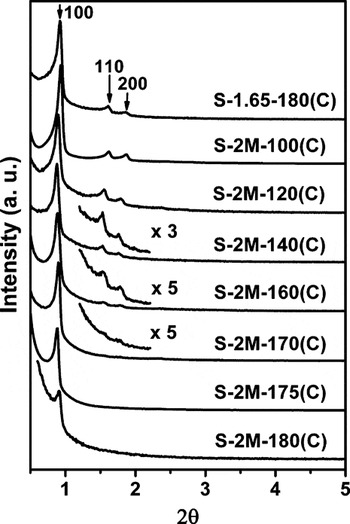
The powder XRD patterns of the calcined mesoporous materials hydrothermally treated under different conditions are shown in Fig. 1. For the S-2M-T(C) samples hydrothermally treated under strong acidic conditions at different temperatures (T = 100, 120, 140, 160, 170, 175, and 180 °C), it can be seen that when the hydrothermal treatment temperature is not higher than 160 °C, the samples (T = 100, 120, 140, and 160 °C) exhibit three well-resolved Bragg peaks indexed as the (100), (110), and (200) reflections associated with a highly ordered two-dimensional (2D) hexagonal mesostructure (space group p6mm). However, the intensity of (110) and (200) diffractions relative to that of (100) diffraction decreases gradually with the increasing hydrothermal treatment temperature, indicating that the mesostructural ordering gradually decreases. When the hydrothermal treatment temperature is increased to above 160 °C, the other three samples (T = 170, 175, and 180 °C) show only one diffraction peak and fail to show periodic arrangement of the mesoporous organization. Additionally, with the increasing hydrothermal treatment temperature, the intensity of (100) diffraction peak decreases gradually, indicating that under strong acidic condition (2.0 M HCl), a relatively high hydrothermal treatment temperature (>160 °C) will cause a remarkable decrease in the mesostructural ordering. The d-spacing (d) of these samples calculated from the first diffraction peaks varies between 9.3 and 10.0 nm (Table I). It is important to note that for the XRD patterns of S-2M-180(C) and S-1.65-180(C), the latter still exhibits three well-resolved peaks indexed as the (100), (110), and (200) diffractions, indicating that by adjusting the hydrothermal treatment pH to a low acidity (pH of 1.65), highly ordered 2D hexagonal mesoporous materials can be successfully synthesized at a high hydrothermal treatment temperature of 180 °C.Reference Pan, Yuan, Zhao, Liu, Zhou, Wei, Zhang, Ling, Fan, Wei, Liu, Yu and Bao28
X-ray diffraction (XRD) patterns of the calcined materials synthesized under different conditions.

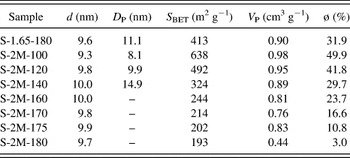
The physicochemical properties of the calcined samples prepared under different conditions.Footnote a

a d = the d spacing; D P = pore diameter; V P = total pore volume; and ø = mass loss (%). Because S-2M-T samples (T > 160) were disordered after the hydrothermal treatment, their pore sizes are not shown in this table.
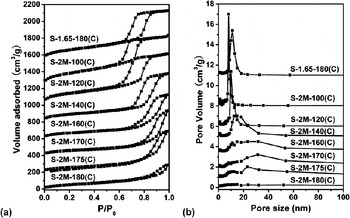
Figure 2 displays the N2 adsorption–desorption isotherms and corresponding pore-size distribution curves of the calcined samples. The structural properties of the calcined samples are summarized in Table I. It can be seen from Fig. 2(a) that all the samples exhibit a typical IV isotherm with a H1 hysteretic loop. For the S-2M-T(C) samples hydrothermally treated under strong acidic condition, with the increasing hydrothermal treatment temperature, the relative pressures (P/P 0) at which capillary condensation takes place are slightly shifted toward higher values, indicating that the pore size is gradually increased with the increasing hydrothermal treatment temperature, as further confirmed by the pore-size distribution curves [Fig. 2(b)]. Moreover, with the increasing hydrothermal treatment temperature, the pore-size distribution curve broadens. The mean mesopore sizes are calculated to be 8.1, 9.9, and 14.9 nm when the hydrothermal treatment temperatures are 100, 120, and 140 °C for S-2M-T(C) samples, respectively. When the hydrothermal treatment temperature is above 160 °C, the pore-size distribution becomes indiscernible. It is noticeable that for the calcined S-2M-180(C) sample, the mesostructure has been essentially destroyed during the high-temperature hydrothermal treatment process. The surface area and the porosity of S-2M-180(C) are the lowest (193 m2/g and 0.44 cm3/g, respectively) among all the samples under study (Table I). By contrast, similar to sample S-2M-100(C) prepared by the traditional method,Reference Zhao, Feng, Huo, Melosh, Fredrickson, Chmelka and Stucky15, Reference Zhao, Huo, Feng, Chmelka and Stucky16 calcined S-1.65-180(C) shows a steep capillary condensation step occurring at a relative pressure (P/P 0) ranging from 0.68 to 0.85, which is characteristic of ordered mesoporous materials with large and uniform mesopores. Calcined S-1.65-180(C) has a BET surface area of 413 m2/g, a pore volume of 0.90 cm3/g, and an average pore size of 11.1 nm (Table I). By combining the XRD and N2 adsorption–desorption results shown above, it can be seen that the hydrothermal treatment temperature and acidity play crucial roles in synthesizing highly ordered mesostructured materials.
(a) N2 adsorption–desorption isotherms and (b) the corresponding pore-size distribution curves of calcined materials prepared under different conditions. For clarity, in (a), the isotherms of S-1.65-180(C), S-2M-100(C), S-2M-120(C), S-2M-140(C), S-2M-160(C), S-2M-170(C), and S-2M-175(C) are offset along the y-axis by 1550, 1200, 1000, 800, 600, 400, and 200 cm3/g, respectively. In (b), the values on the y-axis are increased by 11, 8, 6, 5, 3.5, 2, and 1 cm3/g, respectively.

Previously, we studied the influence of pH and temperature of hydrothermal treatment on the synthesis of mesoporous materials.Reference Pan, Yuan, Zhao, Liu, Zhou, Wei, Zhang, Ling, Fan, Wei, Liu, Yu and Bao28 It has been demonstrated that highly ordered and highly stable mesostructures can be synthesized at an optimum pH of 1.65. In this study, although the mesostructure is shown to be gradually destroyed with the increasing temperature when the hydrothermal treatment is carried out in 2.0 M HCl solution, it offers the possibility to study the surfactant decomposition behavior and, moreover, the correlation between the decomposition of surfactant and the formation of ordered mesostructures.
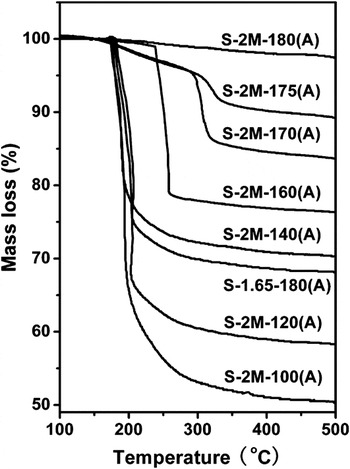
Figure 3 shows the TGA curves of the as-synthesized materials introduced in the experimental section, and the mass loss percentages (ø) in the range of 150–500 °C (listed in Table I) can be attributed to the retained surfactants in the as-synthesized samples. Obviously, for the as-synthesized S-2M-T(A) samples, the amount of the retained surfactant decreases with the increasing hydrothermal treatment temperature, indicating that the high-temperature hydrothermal treatment process will cause the leaching of the surfactant templates from the mesopores and that the extent of leaching increases remarkably with the increasing hydrothermal treatment temperature. It should be noted that when the hydrothermal treatment temperature is below 140 °C, there is only one main mass loss step in the temperature range from 150 to 250 °C, which is characteristic of the decomposition of polymeric surfactant P123 existing inside as-synthesized SBA-15 materials.Reference Berube and Kaliaguine36–Reference Bae and Han40 However, when the hydrothermal treatment temperature is further increased, the as-synthesized samples S-2M-160(A), S-2M-170(A), S-2M-175(A), and S-2M-180(A) exhibit obvious two steps or even multiple steps of mass losses, indicating a different thermal decomposition behavior. By contrast, S-1.65-180(A) exhibits only one main mass loss step in the temperature range of 150–250 °C, similar to S-2M-T(A) samples (T = 100, 120, and 140 °C). Moreover, it is shown by comparing the ø values of as-synthesized S-1.65-180(A) and S-2M-180(A), which are 31.9% and 3.0%, respectively (Table I), that controlling the hydrothermal treatment pH at 1.65 can maintain a higher amount of P123 in the as-synthesized material to support the mesoporous framework and, thereby, produce a relatively ordered mesostructure, as discussed in our previous work.Reference Pan, Yuan, Zhao, Liu, Zhou, Wei, Zhang, Ling, Fan, Wei, Liu, Yu and Bao28
TG curves of as-synthesized materials prepared under different conditions.

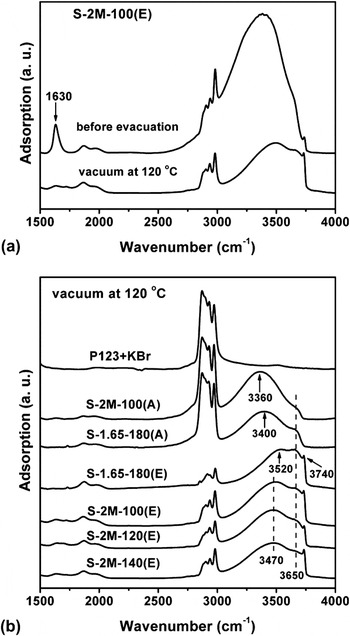
To understand the effects of hydrothermal treatment temperature and acidity on the ø values, we use high-vacuum FTIR to semiquantitatively compare the relative silanol concentrations measured from the integral area of Si–OH band after the complete removal of physisorbed water (Fig. 4). As can be seen from Fig. 4(a), the FTIR spectrum of surfactant-extracted sample S-2M-100(E) before evacuation under vacuum shows one sharp band at 1630 cm−1, assigned to the bending mode of physisorbed water molecules.Reference Blin and Carteret41 The broad adsorption band at 3000–3800 cm−1 is mainly attributed to the stretching OH (νO–H) contributed by both water and silanols. However, after evacuation under vacuum, the band arising from the bending mode of water (1630 cm−1) cannot be detected from the FTIR spectrum [Fig. 4(a)], indicating that the physisorbed water has been completely removed and that the νO–H band can now be used to calculate the concentration of silanol groups.
(a) The Fourier transform infrared spectrometry (FTIR) spectra of surfactant extracted sample S-2M-100(E) before and after evacuation under vacuum and (b) the FTIR spectra of evacuated samples S-2M-100(E), S-2M-120(E), S-2M-140(E), S-1.65-180(E), S-2M-100(A), S-1.65-180(A), and surfactant P123 with KBr.

Figure 4(b) shows the FTIR spectra of P123 with KBr, S-2M-100(A), S-1.65-180(A), S-1.65-180(E), and S-2M-T(E) (T = 100, 120, and 140 °C) after evacuation under vacuum. Compared with P123 and the as-synthesized sample S-2M-100(A), the surfactant-extracted samples S-1.65-180(E) and S-2M-T(E) show weak adsorption bands at 2912, 2949, and 2986 cm−1, assigned to the stretching vibrations of C–H of the surfactant, suggesting that even after three ethanol extractions, the block copolymer surfactants cannot be completely removed.Reference Kruk, Jaroniec, Ko and Ryoo39–Reference Xiao, Li, Jin and Xu42 These bands, however, do not overlap with the νSiO–H band observed at 3000–3800 cm−1, with the latter being influenced not only by the concentration of silanols but also by their type (single or geminal), perturbation (free or H-bonded), and accessibility (surface or internal silanols). For the FTIR spectra of three S-2M-T(E) samples, generally three bands can be observed in the wave number range of 3000–3800 cm−1. The band at 3740 cm−1 is assigned to isolated silanols (single or geminal), the relatively wide and weak band near 3650 cm−1 is assigned to internal silanols (bulk), and the broadest and strongest absorption band (3620–3200 cm−1) centered at 3470 cm−1 is due to H-bonded –OH with various HO···H distances, which may often overlap with the isolated and internal silanol bands.Reference Blin and Carteret41, Reference Nawrocki43 It is also noted that for these three S-2M-T(E) samples, the integral area of the Si–OH adsorbent peak from 3000 to 3800 cm−1 decreases gradually upon increasing the hydrothermal temperature. On the basis of a routine method used in FTIR to quantitatively measure the density of any given functional group, by assuming that the relative silanol concentration of S-2M-100(E) is 100%, the relative silanol concentrations of S-2M-120(E) and S-2M-140(E) are calculated to be 92.3 and 90.7%, respectively, showing that the concentration of silanols decreases with the increasing hydrothermal treatment temperature, which is consistent with the previous reports.Reference Han, Li, Zhao, Song, Yang, Li, Di, Li, Wu, Xu, Meng, Lin and Xiao18, Reference Li, Wang, Guo, Liu, Guo, Zhang, Wang and Lu24–Reference Pan, Yuan, Zhao, Liu, Zhou, Wei, Zhang, Ling, Fan, Wei, Liu, Yu and Bao28
Compared with the surfactant-extracted S-2M-T(E) samples, the as-synthesized sample S-2M-100(A) shows different SiO–H bands in the wave number range of 3000–3800 cm−1. The broadest and strongest H-bonded SiO–H band situated at 3470 cm−1 in the case of S-2M-100(E) shifts toward 3360 cm−1 in the spectrum of S-2M-100(A). It is noted that in this case, both the EO moieties of the block copolymer and the neighboring silanols contribute to the formation of the H-bonded SiO–H band. Moreover, the sharp band at 3740 cm−1 assigned to isolated silanols in the case of S-2M-T(E) cannot be detected in S-2M-100(A). As reflected in the high-vacuum FTIR spectrum, the surfactant P123 has little influence on the νO–H peak in the range of 3000–3800 cm−1 [see Fig. 4(b), P123 + KBr]; thus, the difference in the spectra of P123 for S-2M-T(E) and S-2M-100(A) is not significant to induce their FTIR spectrum difference as described earlier. Moreover, while it can be deduced that the ethanol extraction process during the preparation of S-2M-T(E) may increase the concentration of silanols, it is also reasonable to infer that the silanols still exist in S-2M-100(A). To explain why the isolated silanols observed in S-2M-T(E) cannot be detected in S-2M-100(A), it is postulated that there exists a hydrogen-bonding interaction between the silanols and the EO moiety of P123 at the inorganic–organic interface in the self-assembled as-synthesized mesostructured solids; thus, the isolated silanols cannot be seen. By contrast, the removal of surfactants by ethanol extraction breaks such an interaction, leading to well-observed isolated silanols in the case of S-2M-T(E). It is suggested that the shift of the H-bonded SiO–H peak from 3470 to 3360 cm−1 (in the case of S-2M-T(E) and S-2M-100(A)) is also associated with the enhanced hydrogen-bonding interaction. In the case of S-2M-T(E), generally hydrogen-bonding between adjacent silanols exists. While in the case of S-2M-100(A), in addition to the intersilanol hydrogen-bonding interaction, the hydrogen-bonding interaction between the silanols and the EO moiety is also present. The stronger hydrogen-bonding interaction in S-2M-100(A) leads to the low-frequency shift in FTIR spectrum when compared with that in S-2M-T(E).Reference Camarota, Onida, Goto, Inagaki and Garrone44, Reference Titova and Kosheleva45
By comparing the FTIR spectra of S-1.65-180(E) and S-1.65-180(A), similar differences can be seen as those observed in the comparison between the FTIR spectra of S-2M-T(E) and S-2M-100(A) samples (discussed earlier). Nevertheless, both the H-bonded SiO–H bands for S-1.65-180(E) and S-1.65-180(A) centering at 3520 and 3400 cm−1, respectively, shift toward higher wave number when compared with the same bands for S-2M-T(E) and S-2M-100(A), respectively, indicating a weaker hydrogen-bonding interaction. In addition, from Fig. 4(b), it can be seen that for S-1.65-180(E), the integral area of the Si–OH bands from 3000 to 3800 cm−1 is lower than that of S-2M-100(E) and that the relative silanol concentration of S-1.65-180(E) is calculated to be 81.3%, obviously lower than those of S-2M-T(E) (T = 100, 120, and 140). It is concluded that the high-frequency shift in the FTIR spectra of both S-1.65-180(E) and S-1.65-180(A) can be attributed to the lower Si–OH concentration when compared to those of S-2M-T(E) (T = 100, 120, and 140 °C) and S-2M-100(A), which is caused by the higher hydrothermal treatment temperature that leads to an increase in the condensation of silanols in the pore walls.
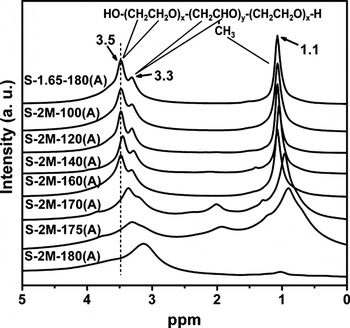
To reveal the decomposition mechanism of P123 inside the as-synthesized mesostructure during the hydrothermal treatment process, the solid-state 1H MAS NMR, one of the most sensitive techniques to investigate the state of organic templates,Reference Bae and Han40 was used. As shown in Fig. 5, the as-synthesized S-2M-T(A) (T = 100, 120, and 140 °C) exhibits two proton peaks at 3.5 and 3.3 ppm corresponding to PEO and PPO blocks in the surfactant, respectively, and one peak at 1.1 ppm is attributed to the methyl groups in the PPO block.Reference Bae and Han40 These peaks do not shift with the hydrothermal treatment temperature, indicating that the thermal decomposition of the triblock copolymer P123 inside mesopores is not significant when the hydrothermal treatment temperature is ≤ 140 °C under strong acidic condition, coincident with the TGA results (Fig. 3). When the hydrothermal treatment temperature was increased to 160 °C, however, a slight shift can be observed for the three peaks of S-2M-160(A). This temperature can be considered as the critical decomposition temperature (T c) at which P123 starts to decompose. The shifts in peak positions become obvious when the hydrothermal treatment temperature is higher than T c, e.g., at 170 °C. Moreover, at even higher hydrothermal temperatures of 175 and 180 °C, the two relatively narrow peaks originally located at 3.3 and 3.5 ppm cannot be observed. Instead, only one broad peak appears in the range of 3–3.5 ppm. The peak originally attributed to the methyl group in the PPO block (at 1.1 ppm) also becomes significantly broad. It is also noted that some new peaks appear in the range of 1–2 ppm, indicating that the template has been decomposed (Fig. 3 and Table I), leading to the collapse of ordered mesostructure caused by the severe condensation and the shrinkage of silica framework during the high-temperature hydrothermal treatment process (Figs. 1 and 2). By contrast, for the as-synthesized S-1.65-180(A), the proton peaks in PEO and PPO show neither shifting nor broadening, indicating that the thermal decomposition of P123 is not significant even after the hydrothermal treatment at 180 °C (i.e., T c > 180 °C). Thus, there still exists a considerable amount of polymeric surfactant inside mesopores, which maintains the ordered mesostructure (Figs. 1–3).
1H MAS NMR spectra of as-synthesized materials prepared under different conditions.

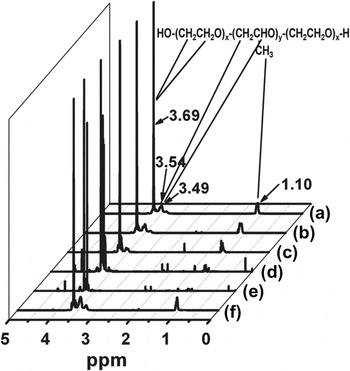
For comparison, the decomposition of P123 dissolved in the strong acidic solution (2.0 M HCl) was also investigated by 1H NMR spectroscopy during the hydrothermal treatment processes at different temperatures (Fig. 6). The 1H NMR spectrum for P123 treated at 38 °C shows a strong and sharp peak at 3.69 ppm attributed to the PEO blocks and some weak peaks at 3.54, 3.49, and 1.10 ppm corresponding to the PPO blocks [see Figs. 6(a), S1, and S2 for details]. When the temperature is increased to 100 °C, the peak at 1.10 ppm assigned to the methyl protons of PPO becomes broad [Fig. 6(b)], and new peaks with weak intensity at 2.09 and 2.22 ppm are observed [Fig. 2S(b)], indicating that P123 dissolved in strong acidic solutions starts to decompose appreciably at this temperature (T c ≈ 100 °C). With further increase of the hydrothermal treatment temperature from 100 to 140 °C, the absolute intensity of peaks assigned to the PPO core appearing at 3.54, 3.49, and 1.10 ppm decreases significantly, and new peaks attributed to small molecules appear in the range of 1.5–2.5 and 3.6–4.4 ppm. The intensity of such new peaks generally increases with temperature (Figs. 6 and 1S), indicating that the decomposition of P123 dissolved in strong acidic solution becomes significant with the increasing temperature. When the temperature is raised to above 140 °C, the peaks appearing at 3.54 and 3.49 ppm in PPO become unobservable, whereas the peaks appearing at 3.69 and 1.10 ppm (assigned to the protons of PEO corona and methyl of PPO, respectively) almost disappear, indicating the substantial decomposition of P123.Reference Wang, Du, Li, Guan, Li and Xiao26, Reference Xiao, Wang, Liu, Zou, Wang, Ji, Song, Li, Meng and Xiao27 Compared with the 1H NMR spectrum of P123 treated at 38 °C under the strong acidic condition [Fig. 6(a)], the 1H NMR spectrum of P123 treated at 180 °C at pH = 1.65 [Fig. 6(f)] still displays the obvious peaks of PEO and PPO, with some very weak signals appearing in the range from 1.60 to 2.40 ppm [see also Fig. 2S(c)], indicating that P123 is relatively stable under the weak acidic condition and that T c is approximately 180 °C at this pH. Comparing the results of the solution 1H NMR and solid 1H MAS NMR spectra of P123 in the samples hydrothermally treated at different temperatures, we can find that the decomposition temperature of surfactant P123 dissolved in the strong acidic solution (2.0 M HCl) is lower than that of P123 inside the as-synthesized mesostructure and that decreasing the hydrothermal treatment acidity can also increase the decomposition temperature of P123.
(a)–(e) Partial 1H NMR spectra of P123 in 2.0 M HCl solution and (f) pH = 1.65 HCl solution after the hydrothermal treatment for 24 h at a temperature of 38, 100, 120, 140, 160, and 180 °C, respectively.

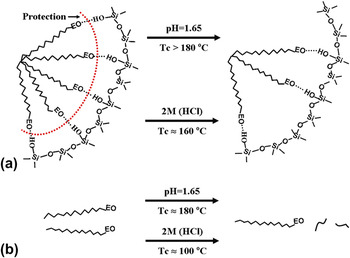
By combining the results of the high-vacuum FTIR, 1H NMR, and 1H MAS NMR characterizations, we propose a silanol protection mechanism to explain the above experimental observations as shown in Scheme 1. It is noted that in the as-synthesized materials, no evidence of chlorides is detected by energy-dispersive x-ray analysis (data not shown). Therefore, there exists hydrogen-bonding interaction between the silanols and the EO moiety of the block copolymer surfactants at the inorganic–organic interface. The hydrogen-bonding interaction plays an important role in protecting the surfactant micelles inside the as-synthesized mesostructure against decomposition during the high-temperature hydrothermal treatment process. Increasing the silanol concentration can significantly enhance the hydrogen-bonding interactions and thus show better “protection” effect; as a result, the T c of surfactants in the as-synthesized composites hydrothermally treated in the solution of pH = 1.65 [>180 °C, Scheme 1(a)] is higher than that of surfactant dissolved in the same acidic solution [≈180 °C, Scheme 1(a)]. The contrast becomes more distinct in a 2.0 M HCl solution. According to the Nernst equation, the reduction potential of oxygen  in solution increases with the increasing acidity and temperature. However, the absolute value is very difficult to measure or accurately calculate in a sealed autoclave at high temperatures and high pressures. The values of T c are about 160 and 100 °C for surfactants with and without the silanol protection, respectively. The difference between the values of T c of surfactants in as-synthesized mesostructured solids hydrothermally treated in solutions of pH = 1.65 and 2.0 M HCl [>180 and ≈160 °C, respectively, Scheme 1(a)] can also be explained by the proposed mechanism. When the hydrothermal treatment pH is 1.65, which is near the isoelectric point of silica, the further condensation of silica during the hydrothermal treatment process is the slowest,Reference Hench and West46–Reference Boissiere, Larbot, Bourgaux, Prouzet and Bunton49 leading to silica walls with the highest silanol concentration and enhanced silanol protection effect.
It should be taken into account that the reduction potential of oxygen at pH = 1.65 is lower than that at 2.0 M HCl, which also benefits the stabilization of P123. As a result, compared to the as-synthesized composite hydrothermally treated in the 2.0 M HCl solution, the sample treated in the solution of pH = 1.65 has a higher T c and a larger amount of surfactants entrapped within the meospores [Fig. 3 and Scheme 1(a)]. For S-2M-T(A) treated at different hydrothermal temperatures, the concentration of silanols as well as the protection effect toward surfactants decreases with the increasing hydrothermal temperature. The decreased silanol concentration together with the increased reduction potential (compared to that at pH 1.65) are both responsible for the low retention of block copolymers inside the mesopores during the hydrothermal treatment process for S-2M-T at higher temperatures (Figs. 3 and 5).Reference Pan, Yuan, Zhao, Liu, Zhou, Wei, Zhang, Ling, Fan, Wei, Liu, Yu and Bao28
It is noteworthy to compare our results to those reported by Xiao and coworkers. By using the solution 1H NMR technique,Reference Wang, Du, Li, Guan, Li and Xiao26, Reference Xiao, Wang, Liu, Zou, Wang, Ji, Song, Li, Meng and Xiao27 they demonstrated that pure P123 dissolved in strong acidic solution (2.0 M HCl) was not stable when the temperature was over 140 °C.Reference Wang, Du, Li, Guan, Li and Xiao26 When the temperature was 180 °C, P123 dissolved in 1.1 M HCl began to decompose after 3 h of hydrothermal treatment and then completely decomposed after 24 h.Reference Xiao, Wang, Liu, Zou, Wang, Ji, Song, Li, Meng and Xiao27 Because ordered mesostructured materials can be obtained at this high temperature (180 °C) under acidic conditions, they further concluded that the surfactants are not indispensable during the hydrothermal treatment process, taking into account the decomposition behavior of pure P123 in acidic aqueous solutions.Reference Xiao, Wang, Liu, Zou, Wang, Ji, Song, Li, Meng and Xiao27 In this work, by using high-vacuum FTIR and solid 1H MAS NMR, we have demonstrated that for the as-synthesized mesostructured materials to undergo hydrothermal treatment, there exists hydrogen-bonding interaction between silanols and block copolymers at the inorganic–organic interface, and such hydrogen-bonding interaction plays an important role in protecting the surfactants against decomposition. As a result, during the hydrothermal treatment under strong acidic solution (2.0 M HCl) at high temperatures (below 160 °C), despite the complete decomposition of pure P123 in the acidic solution, the surfactant P123 within mesopores does not completely decompose and can be retained within mesopores to maintain the preformed organic–inorganic composite mesostructure against framework shrinkage. In addition, on the basis of the results of high-vacuum FTIR, 1H MAS NMR, and TGA, we have demonstrated that the hydrogen-bonding interaction between silanols and P123 is related to the concentration of silanols. By decreasing the hydrothermal acidity to pH = 1.65, the concentration of silanol groups is increased due to the slowest silica condensation rate near the isoelectric point of silica, thus enhancing the hydrogen-bonding interaction and retaining more surfactant within mesopores. This result is in good agreement with our previous report,Reference Pan, Yuan, Zhao, Liu, Zhou, Wei, Zhang, Ling, Fan, Wei, Liu, Yu and Bao28 that is, increasing the surfactant retention plays an important role in protecting the regularity of the mesostructure during the high-temperature hydrothermal treatment process. Thus, our results have provided comprehensive understanding for the decomposition mechanism of P123 in mesostructured solids and a direct correlation between the decomposition of surfactant and the formation of ordered mesostructures.
A proposed silanol protection mechanism schematically showing that the hydrogen-bonding interaction between silanols and EO moiety of the surfactants can protect the surfactants against decomposition during the hydrothermal treatment process. (a, b) compare the T c of surfactants in as-synthesized composites and solutions during the hydrothermal treatment in pH = 1.65 and 2.0 M HCl solutions, respectively.

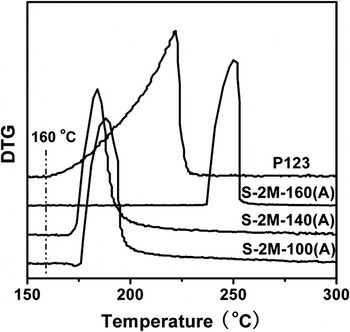
To further support our proposed mechanism, the differential thermogravimetric (DTG) profiles were used to analyze the thermal decomposition process of P123 in solid states. Figure 7 displays the DTG profiles of S-2M-T(A) (T = 100, 140, and 160 °C) and pure P123. It can be seen that for as-synthesized S-2M-100(A) and S-2M-140(A), the initial decomposition temperature (~170 °C) is higher than that of pure bulk P123 (~160 °C), indicating that the hydrogen-bonding interaction between the silanols and the EO moiety can provide a protection effect for P123 against oxidation in air, similar to that shown in the solution case (Figs. 5 and 6). Compared to the peaks in the DTG profiles of P123, the sharper peaks in the DTG profiles of S-2M-100(A) and S-2M-140(A) can be attributed to the better dispersion of P123 in ordered and confined mesopores.Reference Zhao, Huo, Feng, Chmelka and Stucky16, Reference Berube and Kaliaguine36, Reference Kleitz, Schmidt and Schuth50 By contrast, for as-synthesized S-2M-160(A), the decomposition temperature of the major weight loss step (~240 °C) is 80 °C higher than that of pure bulk P123, which can be associated with the occurrence of partially oxidized block copolymers.
Differential thermogravimetric (DTG) curves of as-synthesized samples S-2M-100(A), S-2M-140(A), S-2M-160(A), and pure P123.

IV. CONCLUSIONS
On the basis of the understanding of the thermal and hydrothermal decomposition behavior of block copolymer surfactants at the molecular level, we demonstrate that the decomposition behavior of surfactants in solution cannot be simply set as a standard to evaluate that of surfactant templates in the as-synthesized mesostructured solids (e.g., the effects of cotemplates). For the as-synthesized mesostructured materials to undergo hydrothermal treatment, there exists hydrogen-bonding interaction between silanols and block copolymers at the inorganic–organic interface in the self-assembled as-synthesized mesostructured solids. Such hydrogen-bonding interaction can play an important role in protecting the surfactants against decomposition. As a result, during the hydrothermal treatment process, the T c of P123 inside the as-synthesized mesostructure is higher than that of P123 dissolved in the acidic solution. In addition, increasing the silanol concentration by decreasing the hydrothermal treatment temperature or controlling the hydrothermal treatment pH near the isoelectric point of silica can enhance the hydrogen-bonding interaction and thus shows better “protection” effect. Our proposed silanol protection mechanism for surfactants adds new contributions to understanding the decomposition of surfactant templates during the synthesis of mesostructured materials, which is important for the designed synthesis of a series of highly ordered and hydrothermally stable mesoporous materials with diverse compositions.
ACKNOWLEDGMENTS
This work was financially supported by the National Basic Research Program (973 Program) of China (2010CB226901), NSFC (20573021 and 20825621), SLADP (B108, B113), and the Australian Research Council.