Introduction
Sorghum (Sorghum bicolor L. Moench) is the second cereal crop in Niger after pearl millet. It is used in human as well as animal nutrition. In Niger, sorghum production rarely meets the demand of the growing population. Grain sorghum yields are very low, about 0.28 t/ha, which is far below the genetic potential of the crop compared with countries like the USA (4.3 t/ha), Argentina (4.9 t/ha) and China (3.2 t/ha) (FAOSTAT, 2014). The low production is attributed to abiotic and biotic stresses such as sorghum midge Stenodiplosis sorghicola. According to Hamidou (Reference Hamidou2016), sorghum midge is a panicle insect found in most of sorghum growing environments in Niger where it causes high sorghum grain yield (GY) reduction. In Niger, delay or advance sorghum planting time is one of midge control means used by farmers (Hamidou, Reference Hamidou2016). However, one cannot predict the rainy season in the Sahelian countries like Niger. Hence, early or late environmental stress could drastically impact sorghum GY for early or late planted fields. According to Menezes et al. (Reference Menezes, Saldanha, Santos, Andrade, Júlio, Portugal and Tardin2015), stress caused by environmental factors on final yield of sorghum depends on the growth stage of the crop at which the stress occurs and the genotype being cultivated. The effect of environmental conditions may vary depending on planting date (PD). According to Diawara (Reference Diawara2012), PD has significant influence on GY in sorghum. Early or late planting increases the risk of poor crop establishment resulting in low yield with early planting and water or heat stress at reproductive stages with late planting. The use of indigenous varieties with low-yielding capacity also limits sorghum productivity in Niger. Farmers mostly rely on low-yielding landraces, so sorghum production fails to meet the demand of increasing population and food insecurity remains a major issue (Maman et al., Reference Maman, Mason, Lyon and Dhungana2004). Variation in performance caused by interaction of genotype and environment on farms is probably the main reason why traditional plant breeding has failed to fully benefit resource-poor farmers, especially in marginal and fragile environments (Ceccarelli and Grando, Reference Ceccarelli and Grando2007). To stabilize sorghum production in Niger, identification of good yielding and stable varieties is necessary. Genotype by environment interaction can be evaluated using GGE biplots which graphically display the genotype by environment interaction in a two-dimensional space thereby giving a visual presentation of the relationships between genotypes and environments (Yan et al., Reference Yan, Hunt, Sheng and Szlavnics2000). The objective of this study was to identify new varieties of sorghum with high and stable yield across environments.
Materials and methods
Experimental germplasm
Two hundred and eighty recombinant F5 inbred lines and two local checks were evaluated. The F5 lines were obtained by crossing a local sorghum variety (MDK) to an exotic sorghum midge resistant cultivar from ICRISAT (ICSV88032) and the progeny were advanced using single-seed descent from F1 to F5. The local variety has white grain with good qualities and is widely cultivated by sorghum farmers in Niger. However, this variety is photosensitive and highly susceptible to sorghum midge.
Experimental sites
The study was done during 2015 rainy season at the research stations of INRAN at Konni and Maradi. Both locations are sorghum midge hotspots in Niger. Konni has a latitude of 13°47′23″ North and a longitude of 5°14′57″ East and the average annual rainfall of 589.7 mm with average temperature of 29.3°C. Maradi has a latitude of 13°18′25″ North and a longitude of 7°09′35″ East and the average annual rainfall of 537.4 mm with average temperature of 20.5°C.
Experimental design
The experimental design was an alpha (0.1) lattice with two replications in two different PDs, giving four environments. However, blocking was not significant and the dates were reanalysed using randomized complete block design. Environments 1, 2, 3 and 4 were the first PD at Konni, the second PD at Konni, the first PD at Maradi and the second PD at Maradi, respectively. Two different PDs were used to simulate early or late beginning of the rainy season. The early planting was done upon the first rainfall, while the late planting was done 3 weeks later. Each genotype was grown in a single row of 3 m; the intra- and inter-row spacing was 0.20 m × 0.80 m. The material was subjected to natural infestation of sorghum midge. In order to evaluate midge damage on the panicles, three panicles were covered at emergence using selfing bags. At harvesting, panicle and grain mass were recorded for the three covered and three non-covered panicles. The loss in GY in three non-covered panicles was expressed as a percentage of GYs in covered panicles.
Data collection and analysis
Data were collected on GY. The GY was measured in t/hectare adjusted to grain moisture content at 12%. GGE biplot analyses in GenStat version 18 were performed to identify high yielding and stable cultivars for GY across the four environments.
Results
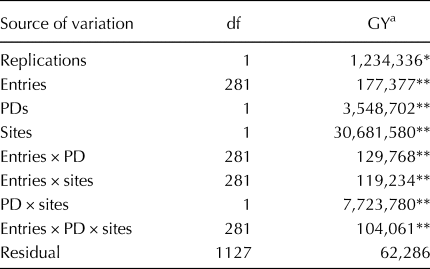
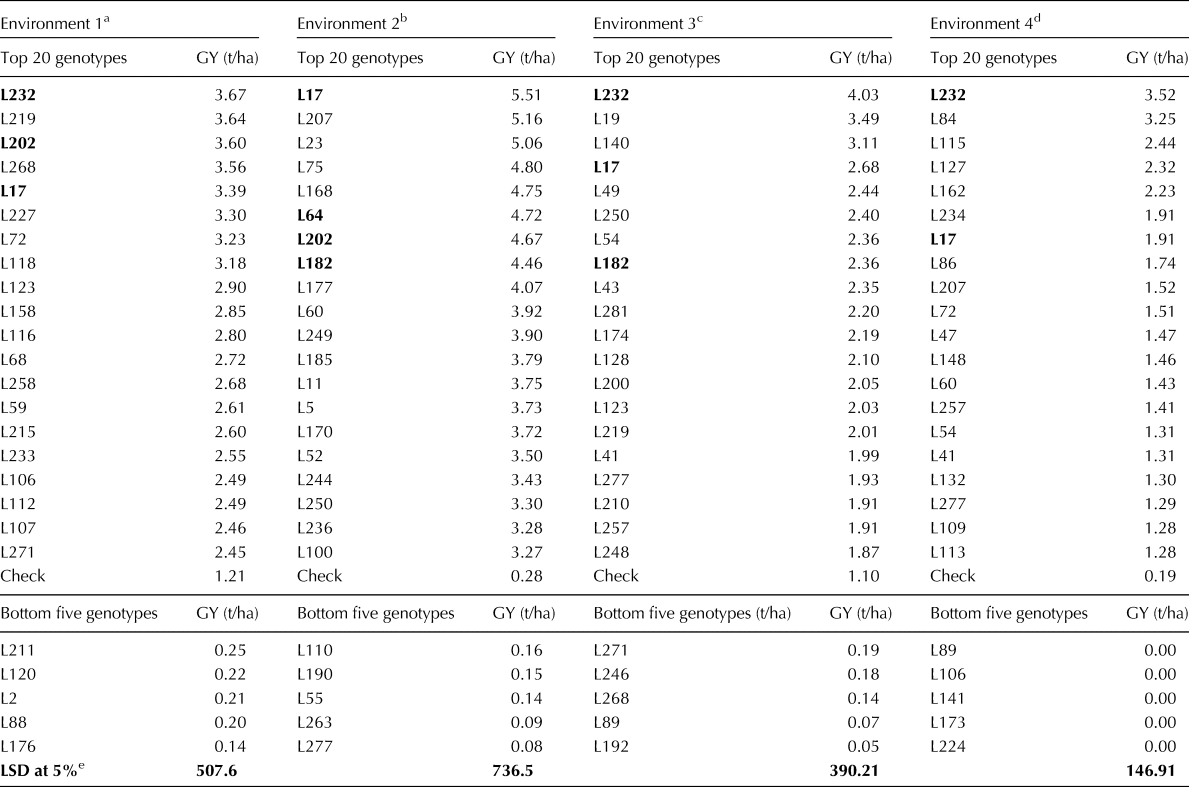
Combined analysis of variance showed significant differences among genotypes for GY (Table 1). The GY varied from 3.67 t/ha to 0.14 t/ha in the first PD at Konni and from 5.51 t/ha to 0.08 t/ha in the second PD. At Maradi, the yield performance varied from 4.03 t/ha to 0.05 t/ha in the first PD and from 3.52 t/ha to 0.00 t/ha in the second PD (Table 2).
Combined mean squares for GY measured in 282 sorghum genotypes evaluated in 2015 rainy season

a GY (t/ha).
*, **Significant at the 5 and 1% probability levels, respectively.
GY performance of the top 20 and bottom five genotypes out of 282 sorghum genotypes evaluated in 2015 rainy season

a First PD at Konni.
b Second PD at Konni.
c First PD at Maradi.
d Second PD at Maradi.
e Least significant difference.
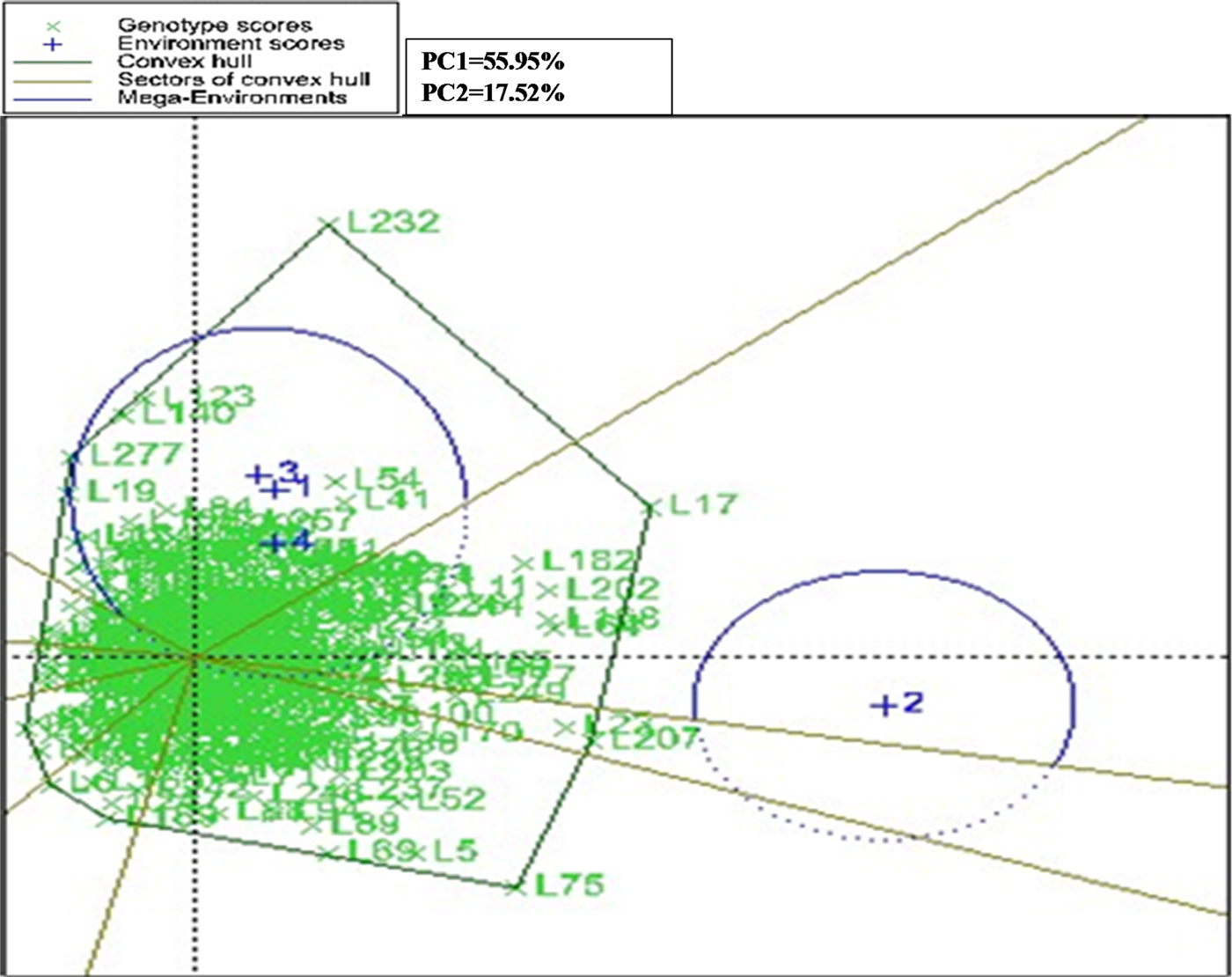
Two mega-environments were observed from the GGE biplot. Environments 1, 3 and 4, representing early planting at Konni, early planting at Maradi and late planting at Maradi, formed one mega-environment while environment 2, representing late planting at Konni, is a different mega-environment. Mega-environment 2 was more discriminating for GY. Genotypes L232, L17, L207 and L75 were superior genotypes in the evaluation (Fig. 1).
Which-won-where view of GGE biplot of GY of different 282 sorghum genotypes evaluated in 2015 rainy season.

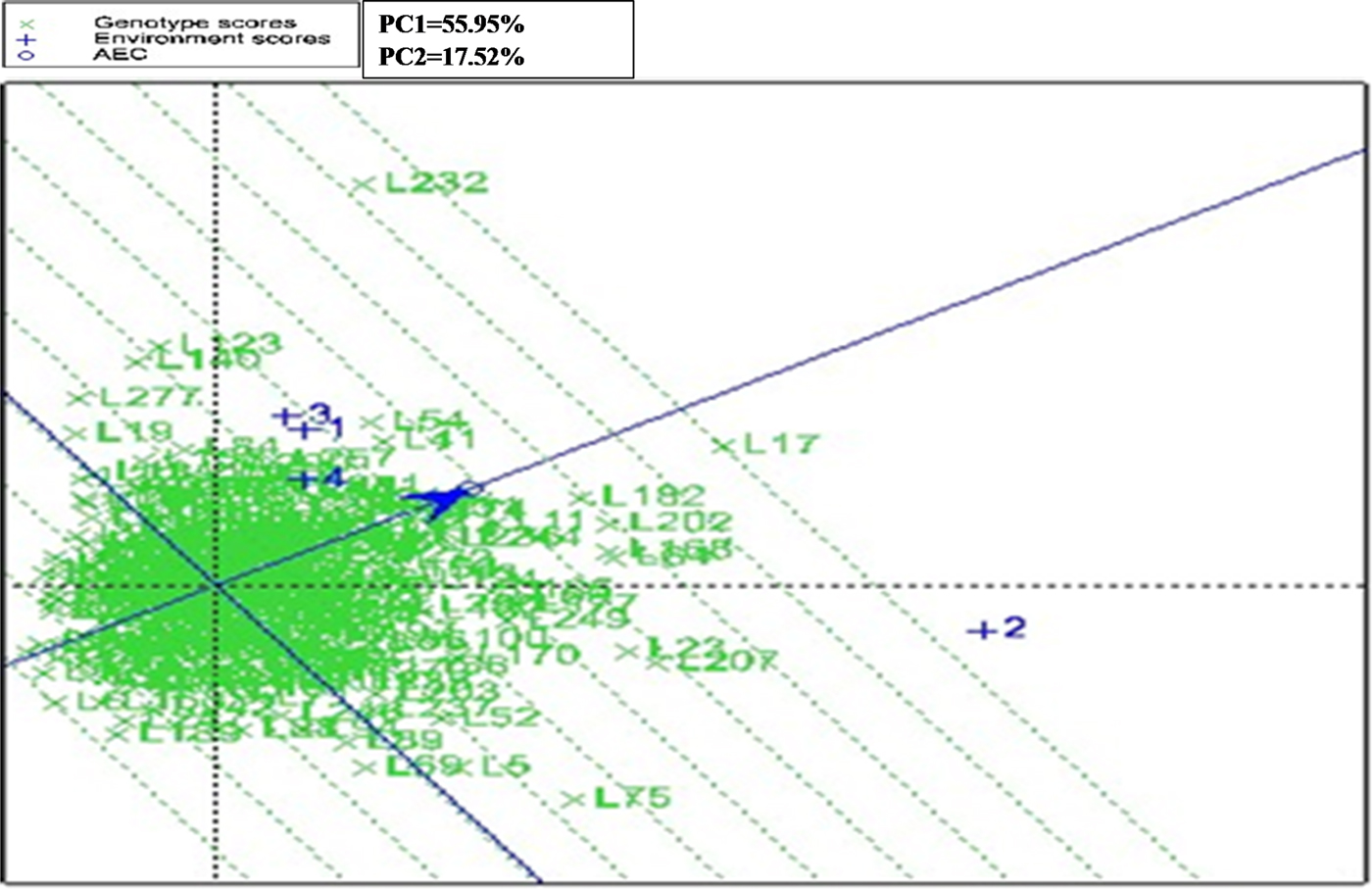
GGE biplot analysis helps in identifying stable genotypes associated with the best environments. Environments 1, 3 and 4, representing the early planting at Konni, early and late planting at Maradi, were located below the average environment coordinate (AEC). Environment 2, representing the late planting at Konni, was located above the AEC (Fig. 2). Genotypes L232, L17, L182, L202, L168 and L64 were above the AEC and closer to average environment axis than other genotypes (Fig. 2) indicating they are the most stable genotypes.
Scoring of 282 sorghum genotypes and the four different evaluation environments.

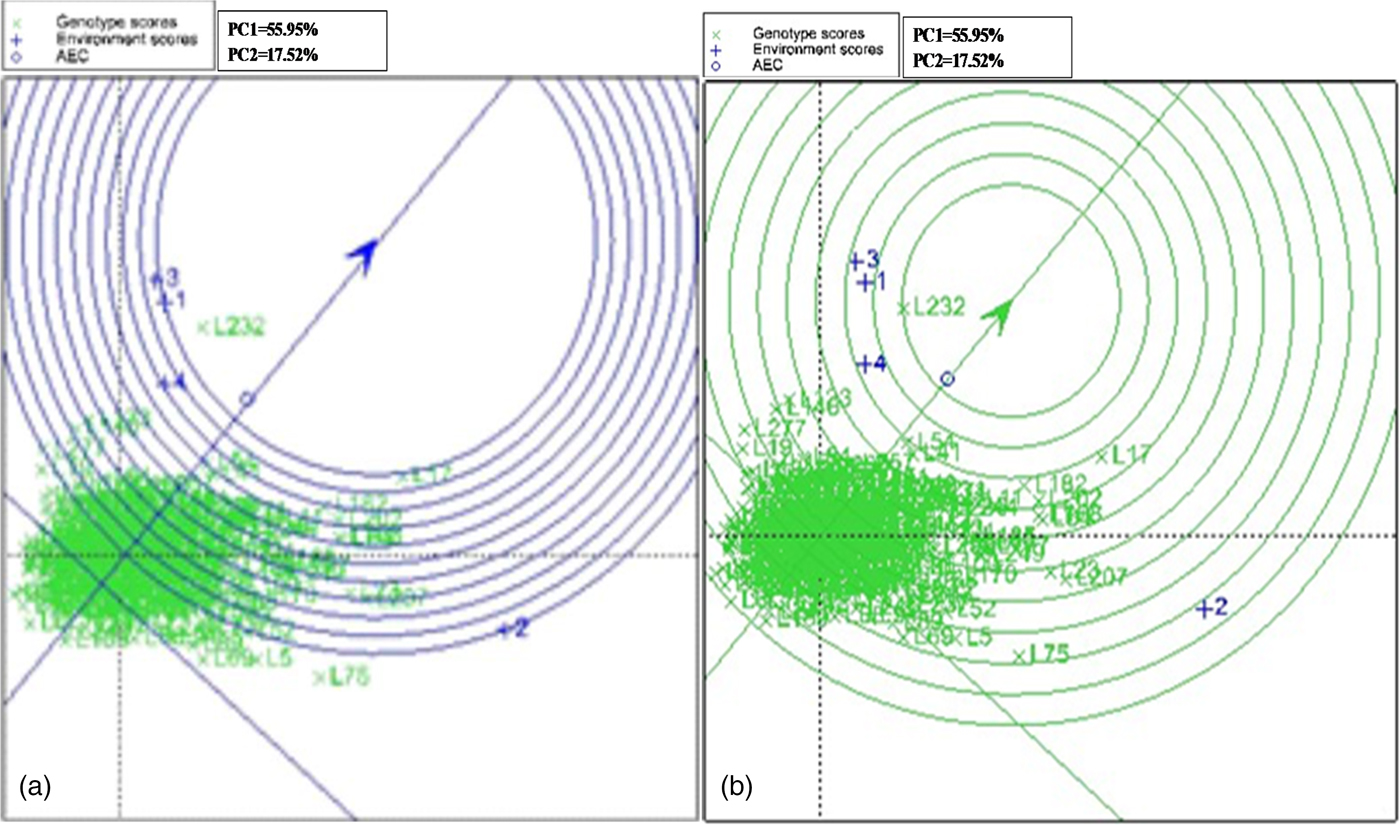
Environment 1, representing the early planting at Konni, was the best environment for GY, followed by environment 3, representing the early planting at Maradi, environment 4, representing the late planting at Maradi and environment 2, representing the early planting at Konni (Fig. 3(a)).
Scoring of four evaluation environments based on an ideal environment (a) and the 282 sorghum genotypes based on ideal genotypes (b).

The arrow pointing at the middle of the concentric circle locates the ideal genotypes. Genotypes closest to the arrow are the best ones. L232 was the best genotype followed by L17, L182, L202, L168 and L64 (Fig. 3(b)).
Discussion
According to the analysis of variances, germplasms were genetically diverse and considerable amount of variability existed in the materials used for this study. This indicates that selection among these germplasms can be successful. Hence the observed variability can be exploited by plant breeder to undertake further hybridization activities. GGE biplots provide information on the mean expression of a trait and its stability. They help to identify the best environments as well as the best genotypes. In this study, two distinct groups of environments for GY evaluation were observed. The first PD at Konni and first and second PDs at Maradi were similar but the second PD at Konni was different from the three other environments. However, the second PD at Konni should be primarily used in the evaluation of sorghum genotypes for GY since it was the most discriminating environment. In an earlier study, Teodoro et al. (Reference Teodoro, Almeida, Daher, Menezes, Cardoso, Godinho and Tardin2016) reported two mega-environments in sorghum evaluated over five different environments; while De Figueirodo et al. (Reference De Figueiredo, Nunes, Parrella, Souza, da Silva, Emygdio, Machado and Tardin2015) documented several mega-environments for green mass yield and total soluble solids in sweet sorghum using GGE biplot analysis.
In terms of GY performance, genotype L232 in environments 1, 3 and 4 and genotype and genotype L17 in environment 2 were the leading genotypes. L232 had 3.67, 4.03 and 3.52 t/h in environments 1, 3 and 4, respectively, while genotype L17 recorded 5.51 t/ha in environment 2. This makes the two genotypes to be identified as the best performing entries of this study. Al-Naggar et al. (Reference Al-Naggar, Abd El-Salam, Hovny and Walaa2018) documented four genotypes based on GY performance and stability.
The second PD at Konni is more discriminating and more representative for GY evaluation. This could be due to the occurrence of higher sorghum midge pressure when there is delay in sorghum planting time in this sorghum midge hotspot. Therefore, this environment should be regarded as the best environment for selecting sorghum for yield under midge infestation. Evaluating sorghum genotypes in this environment could help minimize the cost for experimenting sorghum for high GY in several environments. On the other hands, genotype L17 was the most stable genotype in this environment. Overall, genotype L17 is the best variety identified here because it is high yielding and stable for late planting at Konni were midge pressure is expected to be high. In a similar study, Ezzat et al. (Reference Ezzat, Ali and Mahmoud2010) studied yield stability in sorghum genotypes and identified four genotypes as stable and high yielding.
The first PD at Konni is the best environment for selecting widely adapted genotypes for GY because of low midge pressure. In this environment, L232, L17, L182, L202, L168 and L64 were found to be the best performing genotypes. Based on actual yield and stability, genotypes L202 and L17 were the best performers in the first and second PDs at Konni and genotypes L232, L17 and L182 were the best in the first PD at Maradi where there is lower midge pressure. Genotypes L232 and L17 were the best in the second PD at Maradi where midge pressure was the greatest. Ezzat et al. (Reference Ezzat, Ali and Mahmoud2010) reported four sorghum genotypes as promising cultivars based on GY and yield-stability analysis. Adugna (Reference Adugna2007) recommended four sorghum genotypes out of 15 evaluated in eight environments for growing in Ethiopian dry lowland areas.
Conclusions
Stable genotypes adapted across environments for GY were identified. Environments suitable for evaluating sorghum germplasm for GY were also identified. Overall, lines L232 and L17 were found to be stable for GY under both non-midge and midge pressure conditions whereas the L182, L202 L168 and L64 performed well under non-midge pressure conditions. These lines are promising for high-grain yielding and adaptation in sorghum production areas. These genotypes can also be used as parental materials for GY and/or midge resistance in sorghum improvement programme.
Acknowledgements
The authors acknowledge Alliance for Green Revolution in Africa (AGRA) for funding this work. This work has also been undertaken as part of the CGIAR Research Program on Dryland Cereals.