Introduction
Optimal oviposition theory (preference–performance hypothesis, PPH) predicts that insect females preferentially oviposit on the sites that maximize the survival and performance of their offspring (Jaenike, Reference Jaenike1978), and is also known as ‘mother knows best principle’ (Valladares and Lawton, Reference Valladares and Lawton1991). The ‘decision’ made on suitability of host plants by a plant-feeding insect is therefore critical for its progeny (Gripenberg et al., Reference Gripenberg, Mayhew, Parnell and Roslin2010). Phytophagous insects, particularly Lepidoptera, are good examples for understanding whether oviposition selection by females benefit for their offspring, because developing larvae are often rather immobile, and then they have limited opportunities to explore newer food sites in case the oviposited sites are inappropriate by gravid females. Therefore, females of Lepidoptera insects are likely to maximize their fitness by ovipositing on host plants that will provide a high-quality diet for their offspring (Liu et al., Reference Liu, Scheirs and Heckel2012). However, these Lepidoptera insects live in the habitats where changing environments often occur (Bonebrake et al., Reference Bonebrake, Boggs, McNally, Ranganathan and Ehrlich2010), causing considerable variation in making oviposition decision under such complex situation, and this variation may further affect next generation fitness themselves (Fernandez-Conradi et al., Reference Fernandez-Conradi, Jactel, Robin, Tack and Castagneyrol2018; Pardikes and Forister, Reference Pardikes and Forister2019). Thus, it highlights the importance of understanding how changing conditions influence oviposition selection and offspring performance by female insects when assessing population size, particularly for insect pests in natural and agricultural systems.
Some studies have clearly shown that intrinsic factor of insects themselves such as diet width (Friberg et al., Reference Friberg, Posledovich and Wiklund2015; Masselière et al., Reference Masselière, Facon, Hafsi and Duyck2017), life cycling (Clark et al., Reference Clark, Hartley and Johnson2011), and the experience of larvae or adults (Thöming et al., Reference Thöming, Larsson, Hansson and Anderson2013; Proffit et al., Reference Proffit, Khallaf, Carrasco, Larsson and Anderson2015) remarkably modifies their oviposition preference for host plants, and then influences their fitness. Additionally, some research also have demonstrated that host species, the domestication of host plants, and plant-associated microbes alter choice decisions of herbivorous insects for oviposition and offspring performance (Hagenbucher et al., Reference Hagenbucher, Birgersson, Chattington and Anderson2016; Fernandez-Conradi et al., Reference Fernandez-Conradi, Jactel, Robin, Tack and Castagneyrol2018; Griese et al., Reference Griese, Pineda, Pashalidou, Iradi, Hilker, Dicke and Fatouros2020). Beside these above biotic factors, abiotic stresses, particularly water condition is an important factor in affecting insect oviposition preference and offspring performance (Huberty and Denno, Reference Huberty and Denno2004; Grinnan et al., Reference Grinnan, Carter and Johnson2013). Global climate change is predicted to dramatically alter precipitation patterns and increase the frequency with plants, trees, and crops will be water stressed (Knapp et al., Reference Knapp, Beier, Briske, Classen, Luo, Reichstein, Smith, Smith, Bell and Fay2008; Lenhart et al., Reference Lenhart, Eubanks and Behmer2015; Gely et al., Reference Gely, Laurance and Stork2020). Water availability can be therefore a significant driver of insects at individual, population, and community levels within natural and agricultural ecosystems (Zhu et al., Reference Zhu, Wang, Wang, Fang, Sun and Ren2014; Dong et al., Reference Dong, Wang, Bu, Dai, Zhou, Han, Desneux, Bearez and Desneux2020; Kansman et al., Reference Kansman, Crowder and Finke2021). In fact, to predict population size of herbivorous insects in the context of drought, better understanding the responses of their oviposition preference to water stress, and subsequently affect their fitness is urgently needed.
Many studies have well documented that water-stressed plants cause a reduction in herbivorous insects' growth, survival, and abundance, compared with well-watered plants through inducing anti-herbivore defenses (Hahn and Maron, Reference Hahn and Maron2018; Suárez-Vidal et al., Reference Suárez-Vidal, Sampedro, Voltas, Serrano, Notivol and Zas2019), or reducing their food quantity and nutritional quality (Lenhart et al., Reference Lenhart, Eubanks and Behmer2015). Nevertheless, herbivores that fed on drought-stressed plants has been showed beneficial responses, such as an enhancement in reproductive success due to increasing concentrations of soluble proteins and amino acids in plants (Franzke and Reinhold, Reference Franzke and Reinhold2011). These mixed effects of water stress depend on herbivorous insect species, i.e. sucking herbivores (Kansman et al., Reference Kansman, Crowder and Finke2021; Xie et al., Reference Xie, Shi, Shi, Xu, He and Wang2020) and chewing herbivores (Gutbrodt et al., Reference Gutbrodt, Mody and Dorn2011; Sconiers and Eubanks, Reference Sconiers and Eubanks2017). Thus, making accurate predictions has been difficult because there is high variability in how herbivores' performance responds to water-deficit plants. Moreover, insect oviposition preference could be susceptible to disruption caused by a changing environment, such as drought. For example, a decrease in amount of precipitation lead to an unsuitable location where extremely dry microhabitat for butterfly females (Salgado et al., Reference Salgado, Dileo and Saastamoinen2020). Thus, oviposition preference of insects is positively related to water supply (Scheirs and De Bruyn, Reference Scheirs and De Bruyn2005). However, the mediated effects of water stress to oviposition selection of herbivorous insects are poorly understood. The responses of insect herbivores' preference and offspring performance under drought are observed separately, and conflicts between maternal oviposition choice and larval performance may also arise in responses to drought (Showler and Castro, Reference Showler and Castro2010). Hence, the integration of preference and performance of herbivorous insects should be studied, and yet, the expected overall assessment on how water stress modifies a linkage between preference and performance of herbivorous insects is not always seen (but see Helmberger et al., Reference Helmberger, Craig and Itami2016; Salgado et al., Reference Salgado, Dileo and Saastamoinen2020).
According to the IPCC report (2007), spring and summer precipitation is predicted to decrease by about 35% in northeastern China (Liu et al., Reference Liu, Xu, Henderson and Qi2005), leading to water stress for crops and their insect pests in agroecosystems. Maize, Zea mays is one of the world's main crops for human consumption and animal fodder, and accounts for more than one-third of China's cereal production (FAO, 2018). Moreover, Asian corn borer (ACB), Ostrinia furnacalis, is one of the most destructive insect pests of corn in China and causes ca. 30% yield losses (Wang et al., Reference Wang, He, Zhang, Lu and Babendreier2014). Thus, we hypothesized that water stress modifies oviposition selection of O. furnacalis, and further alters their offspring performance by influencing maize chemical and physical traits. To test this hypothesis, we conducted a manipulated experiment with water deficiency treatments in a greenhouse using a model agroecosystem. Specifically, we asked the following questions: (1) Do water deficit affects female oviposition preference of O. furnacalis for host plants? (2) Do offspring performance, including properties of larvae, pupae, and adults differ between different water treatments? (3) Whether O. furnacalis females show oviposition preference for a host plant that correlates with their own offspring performance?
Material and methods
Plant material and water treatments
Sweet Maize (hybrid Kennian 1) was selected in this study because it is a major fresh market crop in China's commercial production (Chen et al., Reference Chen, Klein, Sheng, Li, Shao and Li2013). Three maize seeds were grown in a plastic pot (45 cm in diameter and 35 cm in height) that were filled with peat soil (Humin substrate, Fenghong Co., Jilin, China). The substrate was covered with 1 cm layer of the sand on these seeds were gently buried. When seedlings were at trefoil stage (late May 2019), they were subjected to three water treatments by periodically adjusting the watering for maintaining different amounts of water in the substrate: (1) well-watered, 700 ml of water every 4 days, achieving 80–70% water capacity of the field; (2) moderately watered-stressed, 450 ml of water every 4 days, keeping 60–55% water capacity of the field; (3) severely watered-stressed, 230 ml of water every 4 days remaining 40–35% water capacity of the field (Gui et al., Reference Gui, Sheteiwy, Zhu, Batool and Xiong2021). The pots were placed inside plastic dishes (40 cm in diameter and 4.5 cm deep) to retain the water drained after watering. To establish and record the difference in soil water content, the moisture at a depth of 8 cm per pot was measured using WaterScout SM 100 sensor (Spectrum Technologies Inc., Alpharetta, GA, USA). Within one and a half months after the start of these water treatments, soil moisture in all pots each treatment was measured every 48 h after irrigation. There were ten pots per water treatment. All maize plants for the experiment were treated in the greenhouse (air temperature 27.5 ± 0.8°C, and relative humidity 63.5 ± 14.2%).
Insect herbivores
In northeast China, O. furnacalis has two generations per year and overwinters as old larvae in maize stems, and oviposit at both spring and late summer. They always oviposit their eggs on two sides of the midrib at the back of host leaves during the night. In this study, eggs and larvae of O. furnacalis were obtained in maize stands in the field, and an O. furnacalis colony was established and reared for five generations using artificial diet in a climatic chamber (26.4 ± 1°C, 70–75% relative humidity, L16:D8). Gravid females were used to oviposition trial, and larvae were used to performance trial in this study.
Oviposition selection of O. furnacalis
Oviposition preference of O. furnacalis for drought-stressed maize plants was evaluated by a three-choice test in the greenhouse at 7–8 maize leaves stage (about 20 June) when first-generation adults of O. furnacalis also oviposit their eggs in the field. In each assay, three pots with one pot per water treatment were assigned together in a pyramidal screen cage (120 cm × 60 cm × 120 cm), in total ten cages for ten replicates. The position of each pot was randomly determined in each cage, and the distance between pots was about 35 cm (fig. S1), and the cages were separated from each other by at least 1.5 m. Two-day-old gravid moths were released into these cages at 7:00 PM, with ten individuals per cage, considering the nocturnal activity of O. furnacalis. We supplied the moths with 70% sugar solution. After 72 h, the introduced females were removed carefully from these cages. The number of egg masses laid on the maize per treatment was recorded, and the number of eggs per egg mass was counted using a stereobinocular microscope (Nikon, SMZ1500, Nikon Instruments INC. Japan).
Performance measurements of ACB
Insect performance was assessed under constant and long day conditions (27.5 ± 1°C, 70–75% relative humidity, L16:D8). The second-instar O. furnacalis larvae were separated into separate jars (35 cm × 20 cm × 15 cm in size) for rearing with watered-treatment fresh maize leaf and stalk that participated in oviposition selection experiment. At the second-third instar stage, these larvae were reared with leaves, and they were reared with stalk from fourth-instar stage considering O. furnacalis as borer pests. The larvae were reared in full-sib groups of 40 individuals in one jar for one replicate per water treatment and allowed to develop until pupation. In total, 1800 individuals (40 larvae/replicate/treatment × 15 replicates × 3 treatments) were used in performance trial. The maize food had equal weight and was sufficient per jar. Every 2 days, the treated maize food in the jars was replaced by fresh one, and frass was removed. Number of survived larvae, pupae, and adults were recorded. The survival rate of larvae was estimated by comparing the number of second-instar larvae with survival larvae, the pupation rate was estimated by comparing the number of survival larvae with the number of pupae, and the eclosion rate was estimated by comparing the number of pupae with the number of adults. Mass of survival larvae per replicate was weighted every 7 days until pupation using a 10,000th analytical balance. Individual larvae mass was calculated as the average of those survival larvae at each measured period, and was used for further analysis.
Plants measurements
As plant growth variables, the length and width of maize leaves, and maize height were measured to the nearest centimeter using a ruled rod, and non-expanded and whitish upper leaves smaller than 3 cm were not quantified. All 30 plant individuals per treatment were measured. Leaf length and width of maize leaves were calculated as the average for the third to fifth leaf in the middle stratum of per maize plant, and we used the average of three individuals each pot for further analysis.
Physiological response to water stress was assessed by water content of whole plant individual. Random ten maize plants per treatment were used. These aboveground maize plants were harvested at 7:00–7:30 AM, and were weighed using an analytical balance (fresh weight). After that, the plant individuals were dried in an oven at 80°C for 48 h and then weighed (dry weight). The water content was calculated as followed: water content = [(fresh weight − dry weight)/(fresh weight)] × 100%.
To investigate the relationships between variations in phytochemistry and insect performance, chemical characteristics, including the content of total nitrogen, free amino acid, total carbon, and soluble sugar of maize were measured. Other random ten maize plants (including aboveground leaf and stalk) per treatment were collected, and were dried in an oven at 80°C for 48 h until constant weight after wrapping in paper bags. The dry maize plants were then grounded in Willey mill equipped with a 1 mm mesh screen before chemical analyses. To identify nitrogen and carbon contents, five samples of 2 mg per plant were measured using an element analyzer (vario EL cube, ELEMENTAR). Content of soluble sugars was determined by anthrone method according to Cerning-Béroard (Reference Cerning-Béroard1975), the standard curve of D-glucose with its results were expressed in mg/g of dry mass. The reading was performed in a spectrophotometer at 630 nm absorbance. Free amino acids content was estimated according to the method described by Yemm et al. (Reference Yemm, Cocking and Ricketts1955). The free amino acid was determined based on a standard curve of l-glutamine, and the results were expressed in μg/g of fresh mass. The reading was carried out in a spectrophotometer at 570 nm of absorbance. Five samples per plants were also used for the measurement of soluble sugar and free amino acid. The average of five samples per plant each replicate was further analyzed.
Data analysis
We pooled oviposition (the number of egg mass and the number of eggs) and performance data (the number of survival larvae, pupae, adults, survival rate, pupation rate, eclosion rate, and larvae weight) of O. furnacalis, and plant trait data (plant height, leaf width, leaf length, water content, N content, C content, free amino acid, and soluble sugars) from each water treatment in each cage for further analysis. We used a one-way analysis of variance (ANOVA) to test for effects of water treatments on the number of survival larvae, pupae, and adults, and survival rate of larvae, pupal rate, erosion rate, leaf width, and free amino acids content after checking the assumptions with the Shapiro–Wilk test for normality and Bartlett's tests of homogeneity of variance. Tukey's multiple comparisons were used for post-hoc analysis of significant differences (P < 0.05). To determine the effects of water treatments on egg mass, the number of eggs, larvae mass, and other plant variables, we used a non-parametric Kruskal–Wallis rank sum test, as the assumptions for an ANOVA were not met. We then used the ‘PMCMR’ package in R for conducting a Kruskal–Wallis post-hoc analysis of significant differences (P < 0.05). Furthermore, to examine the effects of physical and chemical properties of host plants on variables of oviposition and performance of O. furnacalis, and the relationships between oviposition preference and offspring performance, we used linear mixed model with the lm-function of the vegan package. All statistical analyses were performed using R version 3.2.4.
Results
Oviposition selection of gravid O. furnacalis females
The number of egg mass laid by O. furnacalis was significantly lower by 59.3% in severely water-stressed treatment (χ2 = 7.867, P = 0.012; fig. 1a), and the number of eggs was significantly lower by 68.7% in severely water-stressed treatment (χ2 = 12.022, P = 0.002; fig. 1b), compared with well-watered treatments. There was no significant difference in egg mass and the number of eggs between well-watered and moderately water stressed treatments.
The number of egg mass (a) and the number of eggs (b) laid by Ostrinia furnacalis on well-watered (WW), moderately water-stressed (MWS), and severely water-stressed (SWS) maize plants. Box lower margin, inside line, and upper margin represent 1st quartile, median, and 3rd quartile, respectively. Whiskers represent upper and lower bounds of the data and circles represent outliers. Different letters above bars denote significant differences among different treatments (P < 0.05).

Offspring performance of O. furnacalis
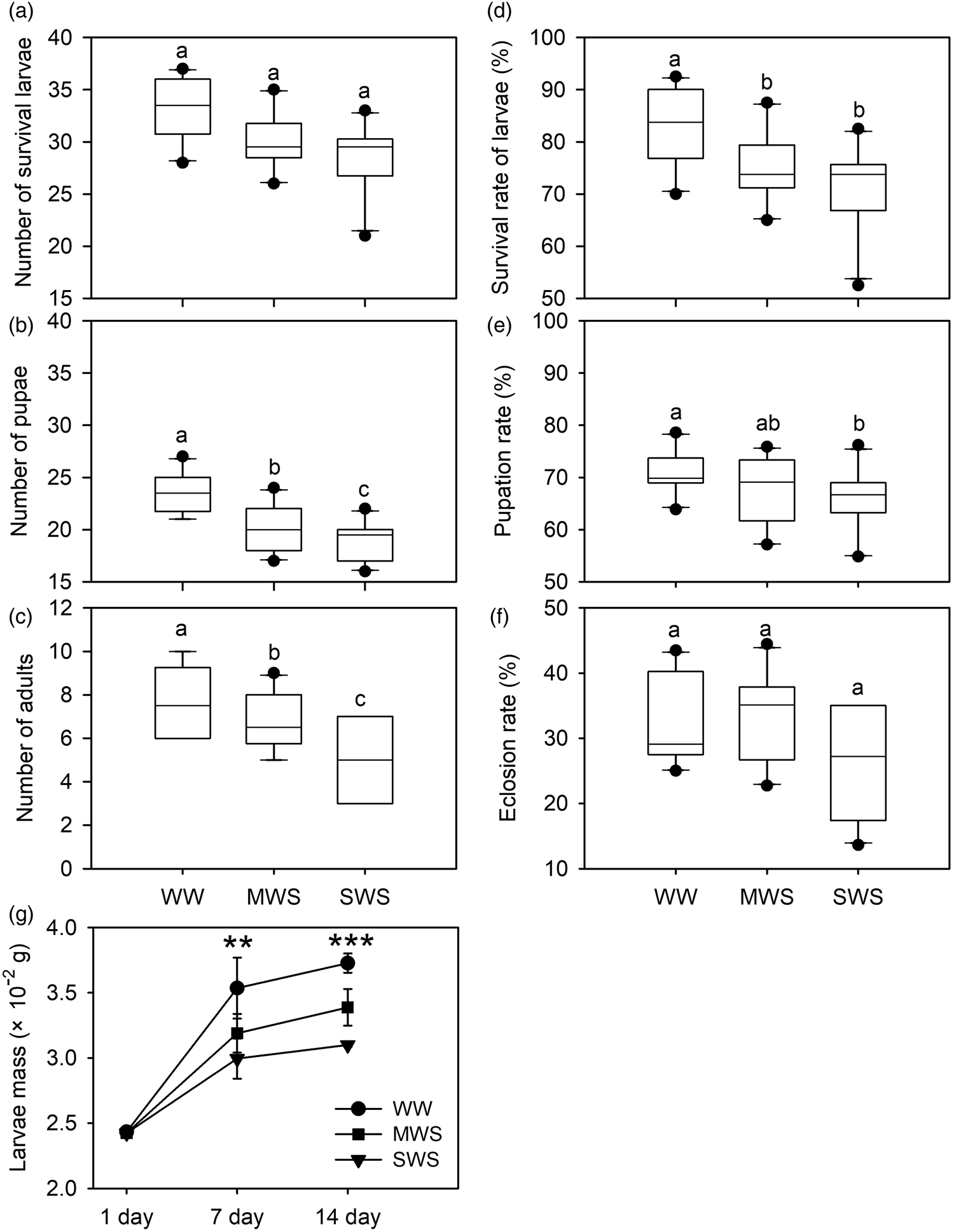
The number of survival larvae, pupae, and adults of O. furnacalis in well-watered treatments were significantly higher than that of moderately and severely water-stressed treatments (F = 6.158, P = 0.006 for larvae number; F = 14.06, P < 0.001 for pupae number; F = 8.957, P = 0.001 for adult number; fig. 2a, b, and c). Survival rate of O. furnacalis larvae in well-watered treatments was greater than that of both moderately and severely water-stressed treatments, and pupation rate in well-watered treatments was significantly higher than that of severely water-stressed treatments, but there was no difference in eclosion rate between the three water treatments (F = 6.158, P = 0.006 for survival rate; F = 4.816, P = 0.016 for pupation rate; F = 2.11, P = 0.141 for eclosion rate; fig. 2d, e, and f). Individual larval mass in well-watered treatments was significantly lower than that of both moderately and severely water-stressed treatments on 7th day, as well as on 14th day (χ2 = 7.95, P = 0.019 for 7th day; χ2 = 18.612, P < 0.001 for 14th day; fig. 2g).
Effects of water treatments (WW: well-watered, MWS: moderately water-stressed, SWS: severely water-stressed) on insect performance, including number of larvae (a), pupae (b), and adults (c), survival rate of larvae (d), pupation rate (e), eclosion rate (f), and larvae mass (g). Box lower margin, inside line, and upper margin represent 1st quartile, median, and 3rd quartile, respectively. Whiskers represent upper and lower bounds of the data and circles represent outliers. Points indicate mean ± SE. Different letters above bars and asterisks denote significant differences among different treatments (P < 0.05).

Physical and chemical properties of maize plants
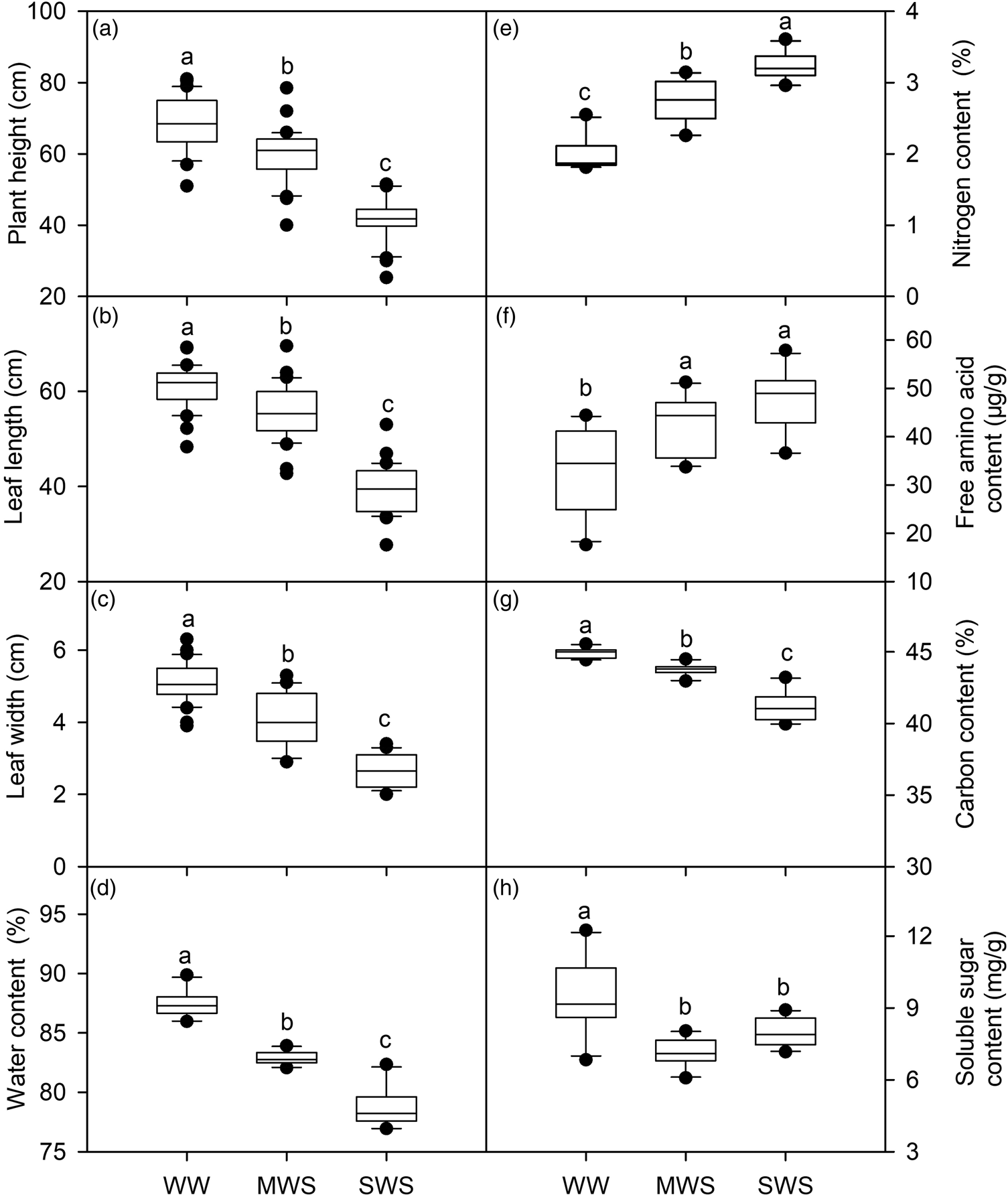
There was an overall significant effect of the water-stressed treatments on maize traits (fig. 3). Maize height in well-watered treatments was significantly higher by 14.2 and 64.2% than that of moderately and severely water-stressed treatments, respectively (χ2 = 24.827, P < 0.001; fig. 3a). Leaf length in well-watered treatments was significantly higher approximately 9.0 and 54.4% than that of moderately and severely water-stressed treatments (χ2 = 23.693, P < 0.001; fig. 3b), and leaf width in well-watered treatments was significantly higher by 25.9 and 91.0% than that of moderately and severely water-stressed treatments separately (F = 106.0, P < 0.001; fig. 3c). Water content in both moderately and severely water-stressed treatments was significantly lower by 5.2 and 10.0% than that of well-watered treatments (χ2 = 25.551, P < 0.001; fig. 3d).
Effects of water treatments (WW: well-watered, MWS: moderately water-stressed, SWS: severely water-stressed) on plant traits, including plant height (a), leaf length (b), leaf width (c), water content (d), N content (e), free amino acid (f), C content (g), and soluble sugar content (h) of maize plants. Box lower margin, inside line, and upper margin represent 1st quartile, median, and 3rd quartile, respectively. Whiskers represent upper and lower bounds of the data and circles represent outliers. Different letters above bars denote significant differences among different treatments (P < 0.05).

N content of maize in well-watered treatments was significantly lower by 38.1% than that of severely-watered stressed treatments, and free amino acid content of maize was lower by 29.3% (χ2 = 23.814, P < 0.001 for nitrogen content; F = 9.112, P < 0.001 for free amino acid; fig. 3e, f). C content of maize in well-watered treatments was significantly higher by 8.2% than that of severely-watered stressed treatments, and significantly higher by 15.9% for soluble sugar of maize (χ2 = 25.293, P < 0.001 for carbon content; χ2 = 15.301, P = 0.012 for soluble sugar; fig. 3g, h).
Relationships between preference and performance of O. furnacalis and maize traits
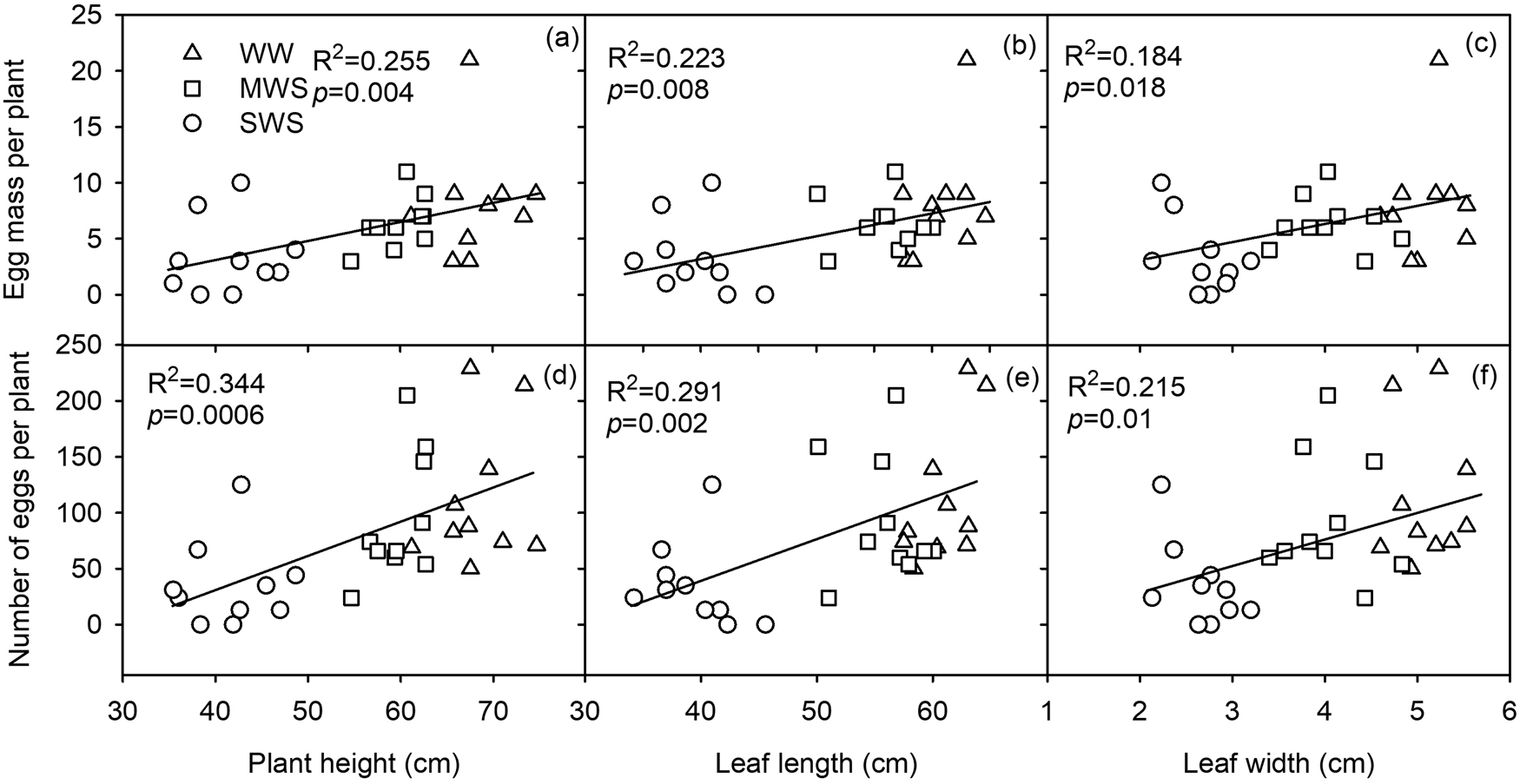
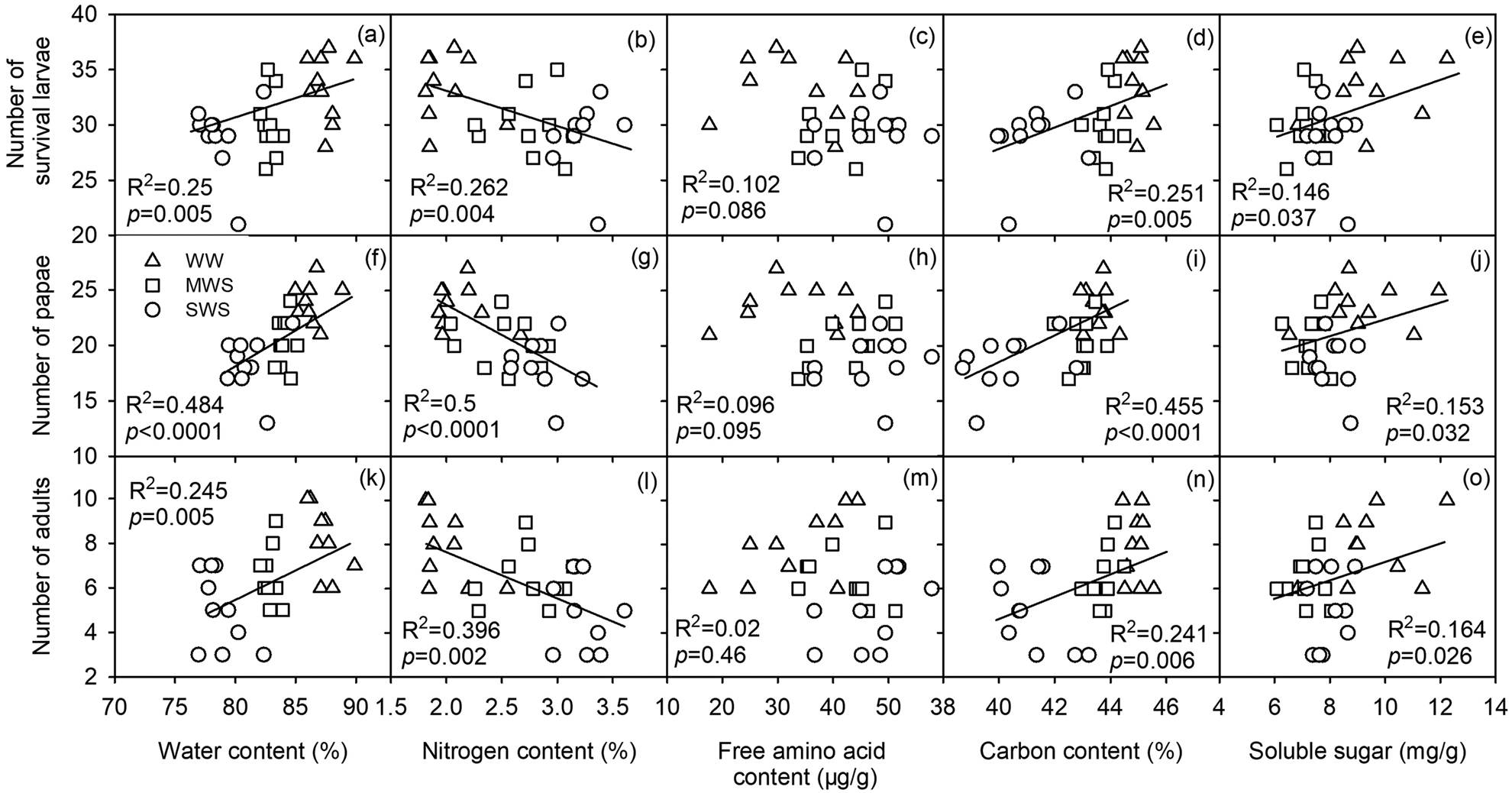
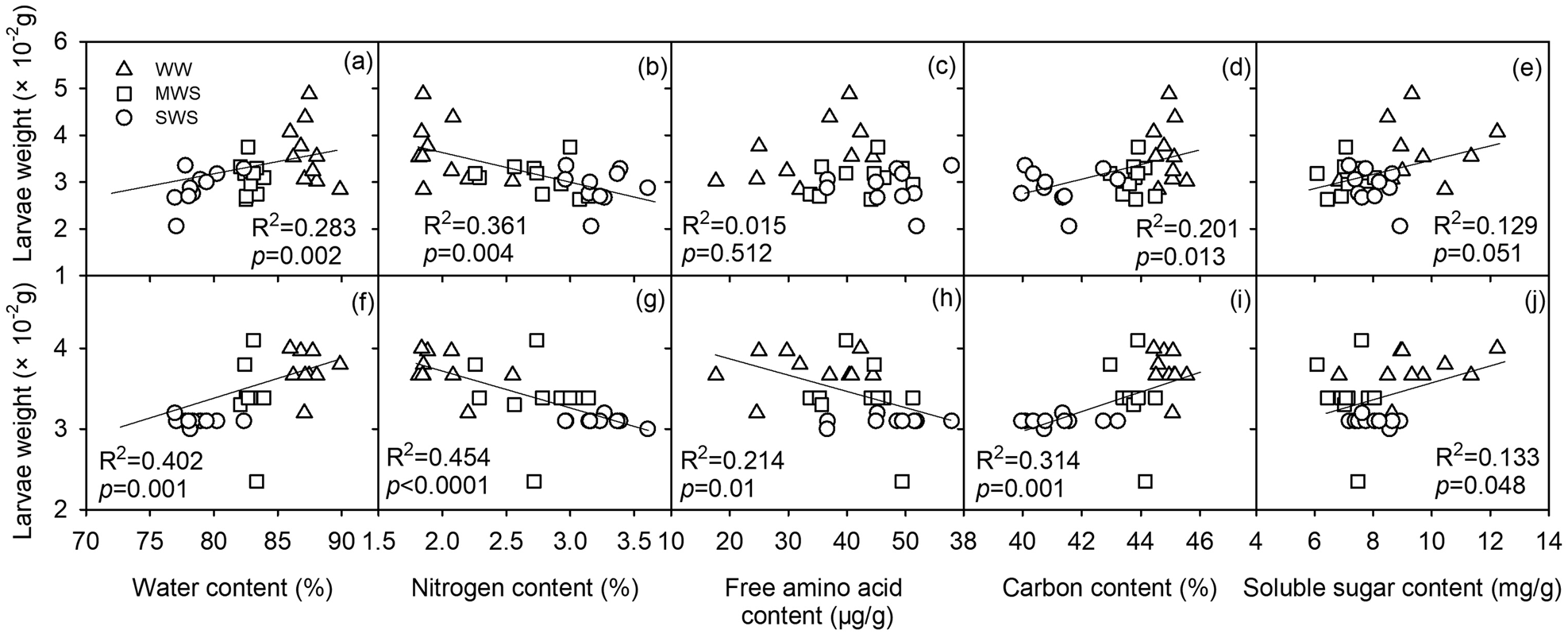
Number of egg mass and number of eggs laid by O. furnacalis were significantly positively correlated with maize height, leaf length, and leaf width (fig. 4). Offspring performance, including the number of survival larvae, pupae, and adults were significantly related with water content, nitrogen content, carbon content, and soluble sugar content of maize plants (fig. 5). Survival rate of larvae and pupation rate were significantly associated with water content, nitrogen content, carbon content, and soluble sugar content, except for no relationships between pupation rate and soluble sugar content (fig. 6). Larvae weight at 7th and 14th were significantly correlated with water content, nitrogen content, carbon content, and soluble sugar content (fig. 7). And moreover, there were also no significant correlations between variables of offspring performance and free amino acid content of maize plants (figs 5–7).
Regression between oviposition preference of Ostrinia furnacalis and traits of maize plants under water treatments. The relationships between egg mass and plant height (a), leaf length (b), and leaf width (c), and the relationships between the number of eggs and plant height (d), leaf length (e), and leaf width (f).

Relationships between maize traits, including water content (a, b, and c), nitrogen content (d, e, and f), and content of free amino acid (g, h, and i), carbon content (j, k, and l), and content of soluble sugar (m, n, and o), and the number of survival larvae, pupae, and adults of Ostrinia furnacalis under water treatments.

Relationships between maize traits, including water content (a, b, and c), nitrogen content (d, e, and f), and content of free amino acid (g, h, and i), carbon content (j, k, and l), and content of soluble sugar (m, n, and o) and survival rate, pupation rate, and eclosion rate of Ostrinia furnacalis under water treatments.

Regression between water content (a), nitrogen content (b), content of free amino acid (c), carbon content (d), and content of soluble sugar (e) and larvae weight at 7th day, and relationships between water content (f), nitrogen content (g), content of free amino acid (h), carbon content (i), and content of soluble sugar (j), and larvae weight at 14th day under water treatments.

Relationships between O. furnacalis performance and oviposition preference
For the number of egg mass laid by O. furnacalis, there was no significant correlation between offspring performance and oviposition preference of O. furnacalis (fig. S2). For the number of eggs for O. furnacalis, the number of pupae and adults were significantly correlated with oviposition preference, as well as survival rate of larvae and pupation rate (fig. S3).
Discussion
It is generally accepted that the choice of the egg-laying site for female insects is an essential driver of their fitness, and they are therefore subject to making relatively accurate decision. One might expect that females preferably choose a site where the risk is as lower as possible and food quality is as better as possible to ensure her higher offspring fitness. Consistent with optimal oviposition theory, our results found that O. furnacalis females preferred to oviposit on well-watered maize plants, and then have better performance, compared to the other two water-stressed maize plants. This finding provides new evidence that females would prefer to lay their eggs on host plants where offspring performance were better, though when facing a challenging choice under environmental stresses.
In this study, well-watered maize plants were more prone to O. furnacalis oviposition. Generally, insects use vision as cues of long distance when finding oviposition site, and thus, plant morphology is one of key cues. Some herbivorous insects, such as wheat stem sawfly Cephus pygmaeus, and leaf beetle Galeruca tanaceti prefer laying their eggs on the stems of taller plants (Randlkofer et al., Reference Randlkofer, Jordan, Mitesser, Meiners and Obermaier2009; El-Sheikh et al., Reference El-Sheikh, Trissi, Sheikh Khamis and El-Bouhssini2019). Consistent with above these insects, O. furnacalis also prefers to oviposit on taller host maize induced by well-watered treatments, because maize with reduction in height and leaf traits (e.g. width and length) in water-stressed treatments may possibly be considered as inacceptable hosts. Therefore, changed plant physical characteristics play an important role in ‘selection decision’. In near distance, odor emitted by host plants is mainly other seeking cues (Webster and Cardé, Reference Webster and Cardé2017). Plants are sessile organisms, and their metabolic capabilities extend far beyond their borders. Particularly, primary and secondary metabolites of plants induced by water stress are closely linked to the emission of plant volatiles (Weldegergis et al., Reference Weldegergis, Zhu, Poelman and Dicke2015; Damodaram et al., Reference Damodaram, Gadad, Parepadlly, Vaddi, Hunashikatti and Bhat2021), which make phytophagous insects to discriminate among plants on the basis of multiple stimuli, and then select optimal host plants to oviposit (Carrasco et al., Reference Carrasco, Larsson and Anderson2015). O. furnacalis females laid more eggs on well-watered plants due to possibly either attractive effects of plant volatile driven by well-watered treatments or repellent effects of plant volatiles induced by water-stressed treatments. However, this mechanistic understanding is not confirmed in this study, and needs to be further explored in the future. Additionally, egg parasitoids are seen to have preference for host plants subjected to severe water stress due to the attraction by the emission of plant volatile profiles induced drought stress, thereby enhancing indirect plant defense (Salerno et al., Reference Salerno, Frati, Marino, Ederli, Pasqualini, Loreto, Colazza and Centritto2017). Thus, vision and olfactory of herbivores, and their natural enemies, or the combination of these three may be responsible for the oviposition preference of O. furnacalis on well-watered maize plants.
Water stress has substantial effects on insect performance by altering quality and other traits of host plants (Gely et al., Reference Gely, Laurance and Stork2020). Some studies have shown that drought improves herbivore population growth and survival (i.e. Allen et al., Reference Allen, Macalady, Chenchouni, Bachelet, McDowell, Vennetier, Kitzberger, Rigling, Breshears and Hogg2010). However, a growing evidence has supported that some insect species exhibit poor performance in response to drought (Huberty and Denno, Reference Huberty and Denno2004; Valim et al., Reference Valim, Teixeira, Santos, Oliveira and Campos2016). Our results also confirmed this phenomenon, with lower number of survival, pupae, and adults for O. furnacalis in water-stressed treatments. For plant-feeding insects, food quality is a key determinant in influencing insect performance, and plant tissues that contain more nitrogen content usually enhance insect growth and development (Franzke and Reinhold, Reference Franzke and Reinhold2011). Although higher nitrogen content of plants in water-stressed treatments was found in this study, the performance of O. furnacalis was negatively related with nitrogen content (fig. 3, figs 5–7). This may attribute to that herbivorous insects need to overcome toxic products derived from secondary compounds for defense when selecting stressed food (Dobler et al., Reference Dobler, Petchenka and Pankoke2011; Pineda et al., Reference Pineda, Pangesti, Soler, Dam, Loon and Dicke2016). For example, increased concentrations of phenolic compounds under drought lead to decreases in insect performance (Gutbrodt et al., Reference Gutbrodt, Mody and Dorn2011; Austel et al., Reference Austel, Eilers, Meiners and Hilker2016). Additionally, severe-watered plants exhibit lower levels of water content within plants in the study (fig. 3), or increase in leaf toughness (Kuglerová et al., Reference Kuglerová, Skuhrovec and Münzbergová2019), which could have detrimental effects on insect performance (Clissold et al., Reference Clissold, Sanson, Read and Simpson2009; Hahn and Maron, Reference Hahn and Maron2018, and figs 5–7 in this study). As discussed earlier, in spite of many relevant studies (Lenhart et al., Reference Lenhart, Eubanks and Behmer2015; Gely et al., Reference Gely, Laurance and Stork2020), it is still unable to predict accurate mechanisms on the different responses of insect performance to water stress, this likely depended on insect species-specific and other factors.
While the majority of cases reported in the literature offer clear support for the PPH (Videla et al., Reference Videla, Valladares and Salvo2012; Landvik et al., Reference Landvik, Niemelä and Roslin2016). Consistently, the relationship between maternal preference and offspring performance in O. furnacalis under water stress was perfectly matched in this greenhouse experiments (fig. S3). In herbivorous insects with limited mobility, particularly Lepidoptera, oviposition decision of female moths is especially crucial because egg-laying site provides enough food sources for their offspring and consequently benefiting offspring growth (Gripenberg et al., Reference Gripenberg, Mayhew, Parnell and Roslin2010). However, there are many exceptions that provide good insight into the importance of different factors in influencing complex egg-laying decisions. For example, specialist butterfly display an oviposition preference for foliage from old-growth host trees, but their offspring performed poorly (Pardikes and Forister, Reference Pardikes and Forister2019). When encountering competition and predation, female moth exhibits preferences contrary to what would be expected based on their offspring fitness (Jones and Agrawal, Reference Jones and Agrawal2019; Garvey et al., Reference Garvey, Creighton and Kaplan2020). Recent research has found that oviposition-induced plant responses could affect offspring performance because plants reinforce or prime their defenses against subsequently feeding larvae after receiving butterfly eggs (Griese et al., Reference Griese, Pineda, Pashalidou, Iradi, Hilker, Dicke and Fatouros2020). Thus, the relationships between preference and performance of Lepidoptera may be complex and variable. Although these studies have demonstrated a connection or disconnection between preference and performance, the reasons that females make such egg-laying choices are often unclear and complicated.
The adaptive and maladaptive host selection decision for insects is remarkably mediated by intrinsic and external factors. However, the vast majorities of laboratory and greenhouse studies rarely consider life-history traits of insects and hosts (but see Clark et al., Reference Clark, Hartley and Johnson2011; Quintero and Bowers, Reference Quintero and Bowers2018). Not all developmental stages of insects and their hosts experience similar environmental changes, particularly in the field. This leads to the enhanced complexity when examining the association between preference and performance (Salgado et al., Reference Salgado, Dileo and Saastamoinen2020). For O. furnacalis, they generally oviposit their eggs on the back of host leaves, and then feed leaves at younger developmental stage. Yet, older larvae bored into the stalk of host plants. Meanwhile, the frequency and amount of precipitation is unpredictable, which cause host plants to suffer uncertain water stress during growing stage. Thus, oviposition and development of O. furnacalis, as well as other insects (Helmberger et al., Reference Helmberger, Craig and Itami2016), may separately encounter host plants with different water conditions in the field, which enhances more complexity and uncertainty for studying the association between preference and performance of O. furnacalis. In this study, both oviposition selection and fitness of O. furnacalis in response to drought is only tested under same water condition. With extreme climatic events becoming more frequent and severe, some herbivorous insect species may display a shift in oviposition preference, or evolve to fine-tune maximization of performance. These strategies have become adapted or maladapted due to changing environment. More experiments are therefore needed for elaborating the important contribution of abiotic and biotic factors, such as life history traits of insect and host plant species, and drought in the field to the preference–performance debate. Such recognition may play important role in predicting population size (Gripenberg et al., Reference Gripenberg, Mayhew, Parnell and Roslin2010), particularly for insect pests under changing climatic conditions in both natural and agricultural systems.
In summary, this study shows that O. furnacalis females have strong oviposition preferences linked to sites with well-watered host plants, and subsequently the preferences appear to be favorable for offspring performance. The result from this study provides new evidence for predicting population dynamics of O. furnacalis under altered precipitation, which further advocate flexible and adaptive control practices to balance O. furnacalis populations in agricultural systems. Thus, preference and performance relationships should be integrated into the monitoring and control of insect pests under climate change. Drought stress has been implicated as a causal factor in outbreaks of phytophagous insects (Tian et al., Reference Tian, Stige, Cazelles, Kausrud, Svarverud, Stenseth and Zhang2011; Bao et al., Reference Bao, Na, Han, Guna, Wang, Liu, Zhang, Wang, Tong and Bao2020). However, our study gives no support to this phenomenon. Our current understanding of the preference–performance problem is still preliminary and future studies need to further highlight the need to assess the consequences of altered precipitation pattern for the association between preference and performance, considering integrating properties of insects and host plants.
Supplementary material
The supplementary material for this article can be found at https://doi.org/10.1017/S0007485321000407.
Acknowledgments
This project was supported by the Program for the Education Department of Jilin Province (JJKH20211292KJ), the Program for Introducing Talents to Universities (B16011), and the Program for Innovative Research Team in University (IRT-16R11), and the Fundamental Research Funds for the Central Universities (2412019FZ029).