Introduction
The cowpea beetle Callosobruchus maculatus (Fabricius) (Coleoptera: Chrysomelidae) is a post-harvest pest of legumes in tropical and subtropical regions. This species uses Vigna beans, e.g. black-eyed beans (Vigna unguiculata (L.) Walpers [Fabaceae]), also known as cowpea, and mung beans (Vigna radiata (L.) R. Wilczek) as nutrition during their larval stage (Fox, Reference Fox1993).
Synthetic insecticides are currently used to control pest insects in stored products but can lead to serious problems such as genetic resistance of insect pests, residual toxicity, vertebrate toxicity, widespread environmental hazards and increasing cost of application (Zettler and Cuperus, Reference Zettler and Cuperus1990; Ewete et al., Reference Ewete, Arnason, Larson and Philogène1996). Natural compounds of plant origin are biodegradable, often have low toxicity for mammals, and are generally less dangerous to the environment than synthetic chemical fumigants if used in small amounts (Keita et al., Reference Keita, Vincent, Schmit, Arnason and Belanger2001).
The Lamiaceae family comprises 200 genera and 4000 species. Many legumes are consumed as food (Zargari, Reference Zargari1990), and others are used in ethnomedicine on the basis of volatile oil content. Furthermore, some plants belonging to this family possess insecticidal properties (Varma and Dubey, Reference Varma and Dubey2001; Papachristos and Stamopoulos, Reference Papachristos and Stamopoulos2002; Kim et al., Reference Kim, Roh, Kim, Lee and Ahn2003).
Zataria multiflora Boiss. (Avishan-e-Shirazi in Persian) is a thyme-like Lamiaceae that grows wild in central and southern Iran (Amin, Reference Amin1991) and is used in traditional folk remedies. The essential oil is obtained by distilling the plant's leaves, roots, fruit, seeds, stems or flowers, and contains a complex chemical that provides its smell and other properties. A study on the chemical composition of two Z. multiflora ecotypes in Iran revealed that carvarol and linalool (77.4 and 90.6%) were the two major oil components in ecotypes A and B, respectively (Saharkhiz et al., Reference Saharkhiz, Smaeili and Merikhi2010). The essential oil of Z. multiflora contains at least 26 different substances that include antimicrobial and antifungal agents, such as thymol, carvacrol, zatrinal, oleanolic acid, betulic acid, rosmarinic acid, p-cymene and γ-terpinene (Shafiee and Javidnia, Reference Shafiee and Javidnia1997; Javidnia et al., Reference Javidnia, Tabatabai and Shafiee1999; Mohagheghzadeh et al., Reference Mohagheghzadeh, Shams-Ardakani and Ghannadi1999, Reference Mohagheghzadeh, Shams-Ardakani and Ghannadi2000).
The genus Satureja (Lamiaceae) (commonly known as savory) includes more than 30 species and is widely distributed across Europe, particularly in the Mediterranean region, and the Middle East. Satureja hortensis L. is widely cultivated in Iran and is used in traditional medicine because of its antibacterial properties, and in cooking (Deans and Svoboda, Reference Deans and Svoboda1989; Zargari, Reference Zargari1990; Amin, Reference Amin1991). The essential oil of S. hortensis contains carvacrol, γ-terpinene, p-cymene and thymol (Tümen et al., Reference Tümen, Baser, Özek and Kirimer2004). In Turkey, the dominant component in the cultivated forms of S. hortensis is carvacrol; in wild-growing forms, thymol is the main component (Tümen et al., Reference Tümen, Baser, Özek and Kirimer2004).
The aim of this study was to investigate the toxicity of Z. multiflora and S. hortensis essential oils applied as a fumigant to eggs and adults of the cowpea beetle C. maculatus, a major pest of stored legumes in Iran.
Materials and methods
Beetle cultures
Cultures of C. maculatus were obtained from our stock culture and maintained in the laboratory on cowpea in plastic containers at 25 ± 1°C and 65 ± 5% relative humidity under dark conditions. The experiments were carried out under the same environmental conditions.
Plant materials
The leaves of the wild plants of Z. multiflora and S. hortensis were collected in April 2010 from the Khuzestan province of Iran. The plant material was dried at room temperature for about 1 week, and then maintained at − 24°C until extraction.
Essential oil extraction method
Dried leaves were subjected to hydrodistillation for 3 h, and the oils were collected using a modified Clevenger-type apparatus. The oils were separated from water, dried with Na2SO4 and stored in sealed vials in a refrigerator.
Bioassays
Toxicity to adult C. maculatus
Twenty adults (1–7 days old) of C. maculatus were placed in 50 ml plastic vials with screw caps. Filter paper (Whatman no. 2, cut into 1 cm diameter discs) was impregnated with oils at doses equivalent to provide fumigant concentrations of 10, 16, 20, 26, 40, 50 and 60 μl/l air. The discs were attached to the vial caps and the caps were screwed tightly onto vials. Control insects were kept under the same conditions without any essential oil. Each dose was replicated five times. The number of dead beetles was counted after 24 h of exposure to essential oils. The Abbott (Reference Abbott1925) formula was used to correct for natural mortality in the controls. Data obtained from dose–response bioassays were subjected to probit analysis (Finney, Reference Finney1971) to estimate LC50 and LC95 values using SAS software version 6.12 (SAS Institute, 1997).
Anti-oviposition activity
Doses of 0, 0.02, 0.05, 0.1, 0.2 and 0.3 μl/g of seeds of each essential oil were applied to 10 g of cowpea seeds, which were shaken thoroughly to ensure a uniform coverage of oil. Two pairs of unmated adults were placed in 280 ml plastic jars with the treated seeds. Five replications were carried out for each dose. The total number of eggs laid was recorded after 5 days. The percentage of oviposition deterrence was calculated according to the following equation:
 $$\begin{eqnarray} Oviposition\ deterrence\,\% = \left (1 - \frac { NE _{ t }}{ NE _{ c }}\right )\times 100, \end{eqnarray}$$
where NE t is the number of eggs in the treatments and NE c is the number of eggs in the control.
The experiment was set up as a complete randomized block design and ANOVA was computed using the SPSS version 16.0 software package. Arcsine square-root transformations were performed on all data to prevent deviations from normality (Underwood, Reference Underwood1997); however, non-transformed data are presented in the figures and tables.
Toxicity to eggs of C. maculatus
Filter paper (Whatman no. 2, cut into 2 cm diameter discs) was impregnated with Z. multiflora and S. hortensis essential oils at doses calculated to provide equivalent fumigant concentrations of 0.7, 1.4, 1.8, 2.1, 2.8, 3.5 and 4.5 μl/l air. Filter paper discs were attached to the lids of 280 ml plastic jars containing 10 cowpeas, each with one C. maculatus egg. Each concentration was replicated five times. Mortality of eggs was determined after 1 week of exposure. Unhatched eggs were counted as dead.
Results and Discussion
Toxicity to adults
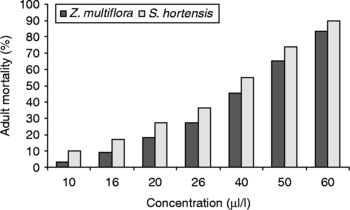
The susceptibility of C. maculatus adults differed according to the concentration of Z. multiflora (F = 127.2; df = 6,14; P < 0.0001) and S. hortensis (F = 234.1; df = 6,14; P < 0.0001) (Fig. 1). After 24 h of fumigation, the mortality rate of adult beetles was found to increase with the essential oil concentrations. At the highest concentration (60 μl/l air), S. hortensis and Z. multiflora oils caused 91.2 and 85.4% mortality, respectively. Vitex pseudo-negundo (Hausskn.) Hand.-Mazz. (Verbenaceae) and Trachyspermum ammi Sprague (syn. Carum copticum) (Apiaceae) essential oil fumigants caused 88 and 100% mortality, respectively, to adult C. maculatus in 24 h at a concentration of 111 μl/l air (Sahaf and Moharramipour, Reference Sahaf and Moharramipour2008).
Percentage mortality of Callosobruchus maculatus adults caused by various concentrations of essential oils from Zataria multiflora and Satureja hortensis

LC50 and LC95 values, presented in Table 1, revealed that S. hortensis (LC50 = 1.5 μl/l; LC95 = 5.94) was slightly more toxic than Z. multiflora (LC50 = 1.76 μl/l; LC95 = 6.47), although there was no significant difference between the two essential oils. Negahban et al. (Reference Negahban, Moharramipour and Sefidkon2007) reported the LC50 and LC95 of Artemisia sieberi Bess. (Asteraceae) as 1.45 and 7.95 μl/l, respectively, which are very similar to the findings of this investigation.
Fumigant toxicity of Zataria multiflora and Satureja hortensis against Callosobruchus maculatus adults

Anti-oviposition activity
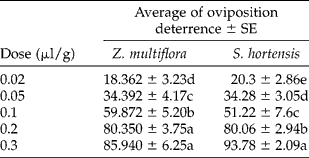
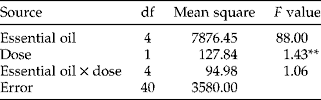
This study showed that the essential oils of the two aromatic plants significantly reduced the number of eggs laid per female compared with that obtained in the controls. Anti-oviposition activity increased as the concentrations of the oils increased (Table 2), but there were no significant differences in the anti-oviposition activity of the two essential oils (df = 4,40; F = 88; P>0.05; Table 3). The mean anti-oviposition activity of Z. multiflora and S. hortensis was 18.4 and 20.3%, respectively, at the lowest dose of 0.02 μl/g. At the highest concentration (0.3 μl/g), the anti-oviposition activity was 85.9 and 93.8% for Z. multiflora and S. hortensis, respectively (Table 2).
Percentage of oviposition deterrence of Callosobruchus maculatus by Zataria multiflora and Satureja hortensis essential oils
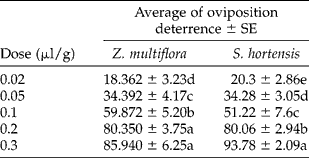
Means in the column followed by the same letter were not significantly different at the 0.05 level when tested by LSD.
Analysis of anti-oviposition activity of Zataria multiflora and Satureja hortensis on adults of Callosobruchus maculatus
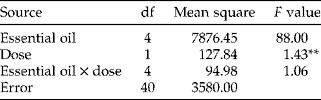
**P < 0.05.
Negahban and Moharramipour (Reference Negahban and Moharramipour2007) and Aboua et al. (Reference Aboua, Seri-Kouassi and Koua2010) reported similar results. Negahban and Moharramipour (Reference Negahban and Moharramipour2007) studied the anti-oviposition activity of Artemisia sieberi and A. scoparia Waldst. & Kit. essential oils on C. maculatus. According to their findings, 100% oviposition deterrence was achieved with a dose of 0.14 μl/g. Similarly, C. capticus and V. pseudo-negundo essential oils had anti-oviposition activity on C. maculatus (Sahaf and Moharramipour, Reference Sahaf and Moharramipour2008). Aboua et al. (Reference Aboua, Seri-Kouassi and Koua2010) reported that oviposition deterrence caused by Melaleuca quinquenervia (Cav.) S.T. Blake (Myrtaceae), Citrus aurantifolia (Christm.) Swingle (Rutaceae) and Ageratum conyzoides L. (Asteraceae) was greater than 90% at a concentration of 6.7 μl/l. This reduction in egg laying could be related to the early death of adult C. maculatus due to essential oil vapours, as was found in studies of Acorus calamus L. (Acoraceae) on Callosobruchus phaseoli (Gyllenhal) (Schmidt et al., Reference Schmidt, Risha and El Nahal1991; Mazibur and Gerhard, Reference Mazibur and Gerhard1999).
Toxicity to eggs
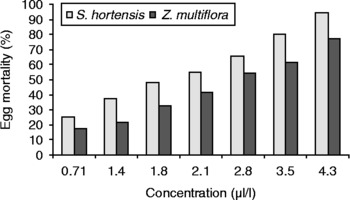
An increase in the mortality of eggs was observed as the concentration of the oils was increased (F = 232.35; df = 5,14; P < 0.001 for S. hortensis and F = 153.42; df = 5,14; P < 0.001 for Z. multiflora). Both essential oils were toxic to C. maculatus eggs; however, S. hortensis showed stronger ovicidal activity. At concentrations of 0.71 and 4.3 μl/l air, Z. multiflora caused 17.2 and 77.3% mortality; however, S. hortensis caused 25.1 and 94.5% mortality at the same concentrations (Fig. 2). Based on the LC50 and LC95 values, the eggs were more susceptible to S. hortensis than to Z. multiflora (Table 4).
Percentage mortality of Callosobruchus maculatus eggs caused by various concentrations of essential oils from Zataria multiflora and Satureja hortensis

Fumigant toxicity of Zataria multiflora and Satureja hortensis against Callosobruchus maculatus eggs

The ovicidal effects of the essential oils in the present study corroborate the findings of Raja and William (Reference Raja and William2008) and Sahaf and Moharramipour (Reference Sahaf and Moharramipour2008), who also reported the egg-hatching inhibition effects of plant essential oils on C. maculatus. Raja and William (Reference Raja and William2008) studied the impact of citronella, citriodora, lemongrass, vetiver and palmarosa oils on adults and eggs of C. maculatus. They believe that high egg mortality may be due to the active toxic agents blocking the micropyle region of the egg chorion, and embryos dying due to the depletion of oxygen or interference with development through the suppression of normal hormonal and biochemical processes (Raja and William, Reference Raja and William2008).
In preliminary experiments (author's unpublished data), there was less effect when eggs were exposed to oils for 24 h. This result is in accordance with Sahaf and Moharramipour (Reference Sahaf and Moharramipour2008) who studied the effects of C. capticus and V. pseudo-negundo essential oils on the egg hatching of C. maculatus. Papachristos and Stamopoulos (Reference Papachristos and Stamopoulos2002) believed that essential oils and their constituent monoterpenoids may act against insects as neurotoxins, and the ovicidal activity may become apparent when the target system (the nervous system) begins to develop.
Conclusions
Bioactive compounds of plant origin with insecticidal and ovicidal properties have been used as grain protection agents against pests in stored products (El-Nahal et al., Reference El-Nahal, Schmidt and Risha1994; Pacheco et al., Reference Pacheco, De Castro, De Paula, Lourencao, Bolonnezi and Barbikri1995; Keita et al., Reference Keita, Vincent, Schmit, Arnason and Belanger2001; Ketoh et al., Reference Ketoh, Koumaglo and Glitho2005; Raja and William, Reference Raja and William2008). Commercial success with these products based on well-known chemistry will probably provide an impetus for the development and commercialization of future pesticides based on essential oils with even greater potency (Isman, Reference Isman2000). According to our results, S. hortensis and Z. multiflora were very toxic to C. maculatus adults and newly laid eggs, and reduced the oviposition of females. Therefore, these essential oils may prove effective in protecting against infestations in pulse grains and may assist in safeguarding the environment and the health of workers and consumers.
Acknowledgements
The author is grateful for financial support of this research from the Ramin Agriculture and Natural Resources University of Iran.