The democratic peace literature has long existed in a paradoxical state. Its central empirical finding, namely that democracies engage in less military conflict with each other than all other types of regime pairings, has remained remarkably robust in the face of numerous theoretical and empirical challenges. A series of recent papers reaffirming this statistical relationship argue that attempts to overturn this empirical association should be greeted with skepticism given the volume of supportive evidence that has accumulated.Footnote 1 At the same time, a lingering theoretical uncertainty over the precise mechanisms by which democracy might promote peace preserves some doubt about the strength of any causal relationship. Consequently, the democratic peace remains a stronger descriptive inference than a causal inference.Footnote 2
This paper blends three interrelated critiques of this literature to challenge the respective claims that there are robust empirical and causal relationships between democracy and peace. All of them highlight the costs of a broad orientation in the field of international relations away from systemic variables and toward domestic explanations of international outcomes.Footnote 3 First, while multiple studies have noted that the democratic peace emerges after World War I, the literature has yet to develop a convincing explanation for why this is the case or account for the complicating theoretical possibility that there is some evidence linking democracy to war in the nineteenth century.Footnote 4 Second, apart from a series of papers that examine the possibility that democracy is caused by peace, the democratic peace literature generally treats democracy as exogenous while simultaneously neglecting a large literature on the sources of democratization in comparative politics.Footnote 5 As a consequence, a role for how broader systemic shocks like those associated with the end of World War I and the Cold War may shape the correlation between democracy and peace by increasing both the number of independent states (and, as a consequence, the number of observations in a statistical sample) in the international system and the proportion of democratic regimes remains largely uninvestigated.Footnote 6 Third, the literature has yet to examine how the presence of hierarchy may complicate any straightforward relationship between regime type and conflict.Footnote 7 For example, what are the statistical implications of treating dyad year observations as independent if great powers utilize these hierarchical relationships to shape the domestic institutional structure and foreign policy choices of subordinate states like the United States and the Soviet Union did respectively in West and East Germany during the Cold War?
These critiques generate two related empirical and theoretical arguments. First, the statistical relationship linking democracy to peace is weaker than generally acknowledged, so weak that it is largely nonexistent. The correlation between democracy and peace is limited to two narrow historical windows, namely the interwar and post–Cold War periods, and dependent on a few high-leverage outlier countries in Europe that contradict rather than confirm the basic theoretical expectations of the democratic peace. A wide range of papers have repeatedly confirmed its existence by neglecting how the omission of significant historical differences in the broader structure of international politics, particularly after World War I, biases the results generated by standard research design decisions in favor of the democratic peace.
Second, reexamining a set of typical results shows that any remaining statistical relationship between democracy and peace cannot be caused by the internal institutions associated with democracy. Instead, the apparent peace among democracies that has been repeatedly confirmed in statistical tests rests on historically specific elements of great power bargains that emerge in the aftermath of major conflicts like World War I, World War II, and the Cold War. These settlements transform the organizational composition of the system in at least three important ways—by creating new states, by reshaping hierarchical orders, and by altering the distribution of regime type in the system. These organizational changes influence aggregate patterns of military conflict by resetting conflicts of political interests among the resulting political organizations and by creating new hierarchical orders in which great powers shape the regime type of subordinate states and impose peaceful foreign policies on them.
This focus on hierarchy and historical variation in great power orders accounts for five components of the statistical relationship between democracy and peace: membership in a great power hierarchy shapes regime type; great powers impose peace on subordinate states within their hierarchical orders; great powers have disproportionately extended some form of a hierarchical relationship to democratic dyads in the post–1918 period; the collapse of multinational empires in the immediate aftermath of World War I and the Cold War dramatically increased the number of independent states and democracies in the system; and a radical change in military conflict participation rates by key European countries—namely Germany, France, and the United Kingdom—in Europe before and after 1945. In short, the “democratic peace” that has emerged in the aftermath of World War I is spurious, nested in a larger great power order that is periodically renegotiated in the aftermath of war and imperial collapse.
Rethinking the Democratic Peace
The first wave of democratic peace research was initially propelled by the simple observation that no two democracies ever fought a war against each other.Footnote 8 Relying on a wide range of empirical strategies that included summary statistics and bivariate analysis, one central finding emerged from this first stage of empirical research. The democratic peace is dyadic—democracies are more peaceful only when interacting with other democratic regimes.Footnote 9 Alternatively, democracies participate in conflict with autocracies at the same rate as all other regime types.
As research indicating that democracies avoided war with each other accumulated, the literature transitioned into a second empirical stage.Footnote 10 It relied on more sophisticated quantitative tests to consolidate support for the dyadic democratic peace and distinguish between candidate explanations focusing on institutional constraints or norms of nonviolent conflict resolution. This stage of empirical research also helped establish consensus or precedents for research design decisions that continue to provide a baseline for new research on the topic. In particular, standard quantitative tests of the democratic peace hypothesis utilize the dyad year as its unit of analysis; include a host of control variables to demonstrate the resilience of the democratic peace in the face of potentially confounding factors like the distribution of power, contiguity, common alliance membership, the similarity of political interests, and international trade; draw on some form of logit or probit because military conflict is operationalized dichotomously; adjust for temporal dependence in observations of military conflict; and utilize the weak-link hypothesis (the lower democracy score of the two states in a dyad) to operationalize dyadic democracy.
An emerging empirical consensus helped activate a third stage of democratic peace research at the end of the 1990s that continues today. Generally motivated by the continuing uncertainty over the causes of the democratic peace, it can be broken into at least three distinct variants. A rationalist tradition has examined how the institutional constraints associated with democracy facilitate peace by revealing private information in a crisis,Footnote 11 by helping to solve the commitment problem,Footnote 12 by shaping the quantity of resources that democracies could marshal in wartime,Footnote 13 and by setting the domestic political costs of both international concessions and leadership removal.Footnote 14 A constructivist variant instead traces peace to the emergence of a shared democratic identity that transcends the uncertainty inherent to the security dilemmaFootnote 15 while resting on moral self-restraint,Footnote 16 mass participation, norms of nonviolent conflict resolution, compromise, and transparency.Footnote 17 More recent work drawing on experimental methods shows that shared democracy shapes voters' preferences, reducing public support for the use of military force.Footnote 18
The fourth stage of research has seen the emergence of alternative theoretical explanations that have delineated some limitations on the democratic peace while ultimately failing to upend the core of empirical consensus. For example, by showing that incomplete democratic transitions can cause military conflict, Mansfield and Snyder suggest that the peace is limited to consolidated democracies.Footnote 19 Cederman points to the strengthening of democratic constraints through war itself to account for the temporal restriction of the democratic peace to the twentieth century.Footnote 20 Multiple studies have shown that some attribute of capitalism conditions the capacity of democracy to promote peace.Footnote 21
While recent research reaffirming the strength of this empirical consensus cautions against future challenges to its validity,Footnote 22 at least three big challenges remain for the democratic peace research program. First, the absence of a strong statistical correlation between democracy and peace prior to World War I poses a much larger set of empirical and theoretical problems for this literature than has been acknowledged.Footnote 23 Most of the attention has been devoted to understanding the transition from a null relationship to a negative one between democracy and peace after World War I. For example, arguments emphasizing shared democratic norms of nonviolent conflict resolution suggest that regime maturity and/or the global population of democracies condition the relationship between democracy and peace because these shared norms take time to achieve critical mass more broadly in the system and to be recognized as credible by other democracies.Footnote 24 Consequently, the growing strength of these pacifying constraints generated by the political development of existing democracies and the growing population of democratic regimes after World War I should not be surprising. But given that some research finds that the relationship shifts from one democracy stimulating conflict prior to World War I to it suppressing military conflict after it,Footnote 25 how robust is the relationship if democracy generates contradictory effects across time?
The timing of this switch to a negative relationship after World War I opens up the possibility that a larger set of systemic factors—beyond just an increase in the proportion of democracies in the system or the growth of democratic constraints within states—account for this anomaly and condition any relationship between democracy and peace.Footnote 26 The end of World War I marked an important watershed in international politics. In addition to transforming the relationship between state and society within its participants, it also marked the emergence of the United States as a global power that championed democracy and unleashed forces associated with self-determination that heightened the difficulties associated with preserving multinational empires.
These changes suggest this literature's second challenge. Apart from some research that examines whether the democratic peace is insulated from a critique about reverse causation (namely that peace causes democracy),Footnote 27 the literature has generally treated democracy as exogenous. Such an assumption further implies that any cause of democracy is likely to be unrelated to the outbreak of military conflict among states. This oversight is particularly important in light of recent research on democratization showing that a number of the international system's attributes, including hegemonic leadership,Footnote 28 power shifts among great powers,Footnote 29 and alliance ties with great powers shape regime type.Footnote 30 For example, Narizny argues that Anglo-American leadership, particularly their victories in World War I, World War II, and the Cold War, was necessary for the proliferation of democracy in the current era. Gunitsky shows that the waves of democratization in the twentieth century are really shocks activated by power shifts among great powers. Rising powers impose their own institutions abroad or alter the configuration of domestic interests in target countries to produce a favorable domestic institutional change. If these hegemonic shocks—like those after World War I and the Cold War—create peace and democracy, then they might render the democratic peace spurious.
The democratization research linking great power alliance ties to regime type suggests a third complication for the democratic peace. If some form of hierarchy enables great powers to shape the regime types of subordinate states, it also might enable great powers to shape the foreign policy choices of those subordinate states including decisions to engage in military conflict. Lake already provides some evidence for this latter possibility, demonstrating that subordinate states are more likely to join military conflict originated by their great power protector.Footnote 31 Similarly, while not examining whether hierarchy shapes regime type or exploring the statistical implications of his critique, Rosato suggests that the democratic peace could instead be caused by American hierarchy in Latin America and Europe during the Cold War.Footnote 32
These three conceptual oversights suggest multiple problems with conventional research design decisions in the quantitative empirical literature on the democratic peace. First, research highlighting the post–World War I emergence of the democratic peace cautions against aggregating observations temporally across what could be very different historical eras. It also suggests an omitted variable bias problem. External factors that increased the number of states and the proportion of democracies in the system after World War I might also be influencing the correlation between democracy and peace. Second, recent research on democratization suggests significant problems with the continuing reliance on single-equation estimates of the democratic peace. The causes of democracy, like membership in a hierarchical order, could also shape the likelihood of conflict among states. Third, research on hierarchy challenges the assumption that dyad year observations created from the population of states that are recognized by the Correlates of War project as possessing legal independence can be treated as statistically independent. At a very minimum, a control variable accounting for these relationships of hierarchy should be incorporated in standard quantitative tests of military conflict if some subordinate states possess limited autonomy over their foreign policy choices.
The existence of hierarchy poses a fourth research design complication concerning the operationalization of military conflict. Most tests of the democratic peace treat the decision to originate a new dispute and the decision to join an existing dispute as observationally equivalent. However, Lake finds that states within a great power hierarchy are more likely to join an existing dispute. This joining decision can inflate observations of military conflict in a manner that enhances support for the democratic peace. For example, subordinate states' decisions to join wars that the US waged against the autocratic states of North Korea, North Vietnam, and Iraq increase sample observations of military conflict in which at least one dyad member was autocratic. This possibility opens a larger set of questions that directly bear on the causal relationship between democracy and peace. Did democratic Turkey join the war against North Korea because of domestic institutional differences or was it instead trying to strengthen its position within the American sphere of influence to counter the threat posed by the Soviet Union?
Finally, the rarity of military conflict opens a fifth research design challenge that also bears on the utilization of statistical evidence to validate a causal relationship between democracy and peace. The coefficient estimates in standard quantitative tests of military conflict are shaped disproportionately by the observations in which conflict is present.Footnote 33 Consequently, the statistical relationship between democracy and peace can be shaped by coding decisions that significantly alter counts of military conflict (such as the decision to include conflict joiners) or high leverage outlying countries that participate in lots of military conflict. If these cases do not coincide with the expectations of democratic peace theory, then they obviously cannot be used to argue that democracy causes peace.
Great Power Settlements and Hierarchy: Inducing Peace Among Democracies
The empirical finding commonly known as the democratic peace after World War I rests on a series of changes to the larger structure of international politics that were fueled partly by the emergence of the United States as a global power. The paradox of the democratic peace literature has remained in large part because these structural changes cannot be understood within the context of a post–Cold War theoretical orientation that tends to focus first on domestic political variation. The outbreak of military conflict among states is shaped by historically specific elements of the international political structure that get negotiated at key order-generating moments following large conflicts. These post-war settlements set the durability of great power peace, shape the number of independent states in the system, set conflicts of political interests among resulting political organizations, influence the regime type of states in the system, and reset hierarchical orders that enable great powers to impose peace on subordinate political organizations.
Historical Variation in Great Power Orders
While many systemic theories of international politics begin with time-invariant concepts like anarchy and polarity, some alternative frameworks open a larger theoretical space for historical variation across international political structure by focusing more on the attributes of settlements that end major conflicts, like those in 1815, 1919, 1945, and 1991.Footnote 34 At least three characteristics of these great power settlements influence subsequent patterns of military conflict among states in the system. First, these bargains remake the territorial status quo in the system. As a consequence, they can either help to resolve prior disputes that gave rise to war—such as whether Prussia or Austria would consolidate leadership over a consolidated Germany—or activate new conflicts of interest among states—such as the loss of German territory in Eastern Europe following World War I. In short, these settlements define national interests with respect to a new international political status quo, set the stage for future political conflict, and, as a consequence, influence military conflict in the system.Footnote 35 While making a prediction about whether a territorial settlement among great powers will inhibit or activate subsequent military conflict in the system depends on the historically specific attributes of an agreement itself,Footnote 36 a more fundamental implication remains. Variation in the robustness of any new territorial equilibrium should help generate different patterns of military conflict across great power orders. This possibility cautions against testing hypotheses on historically aggregated samples without adjusting for some of these sources of variation.
The periodic remaking of the global territorial status quo possesses another fundamental empirical implication for quantitative studies of military conflict. These agreements often adjust multinational empires, which can include managing their dissolution, and create new states.Footnote 37 For example, coinciding with the end of major conflict and decolonization, the number of states in the international system increased from forty-two to fifty-nine to sixty-two and then to 107 to 156 to 191 across successive twenty-year intervals from 1900 to 2000. These changes alter the number of observations in a sample, regardless of whether it's based on state-years or dyad-years. As a consequence, relationships among some group of covariates that are specific to a great power order with a small number of states (namely the nineteenth century) can be completely overwhelmed by the statistical relationship between those same covariates in a different historical period (the post–World War I period) with many more states.
Second, recent contributions to the democratization literature by Boix, Narizny, and Gunitsky show these great power orders also help alter the distribution of regime type across states in the international system.Footnote 38 Narizny argues that the material power Great Britain and the United States held, particularly in the aftermath of major conflicts, enabled them to promote democracy in defeated states, their colonies, and their clients. While victors of the Napoleonic Wars fostered authoritarianism by threatening domestic intervention through the Holy Alliance to prevent the spread of liberalism and nationalism, the United States has steadily increased its support for democracy promotion efforts in the post–1918 period. During the Cold War, the Soviet Union inhibited the spread of democracy in Eastern Europe. Its collapse helped usher in a wave of democratic transitions there.
Similarly, great powers intervene in weaker states to strengthen domestic groups that favor the preservation of some hierarchical contract. This great power influence can take many forms and is often designed to promote the development of similar domestic institutions in target states.Footnote 39 It can include threats of military intervention to prevent a radical change in the composition of government like the United States did in West Germany during the Cold War. It can include military intervention to overturn a domestic revolt as the Soviets did in Hungary in 1956. Or it can include softer forms of support like the targeted dispersal of foreign aid to strengthen domestic coalitions that have already signaled their willingness to preserve the hierarchical relationship with the great power. Designed partially to blunt the growing influence of local Communist parties in Western Europe, Marshall Plan aid during the Cold War exemplifies this. Perhaps most importantly, recent research finding that great power alliance ties influence regime type underscores the risks associated with treating regime as exogenous in studies on the democratic peace.Footnote 40 The same set of systemic shocks at the end of World War I and the Cold War that increased the number of states and the proportion of democracies could simultaneously have helped to promote peace.
Third, international political structure also varies in the scope and form taken by hierarchical bargains struck between great powers and subordinate states. Just as the wave of self-determination after World War I generated new states, great powers maintained influence over the foreign policy interests of these states with modified forms of hierarchy.Footnote 41 For example, the United States set the pace of rearmament in West Germany after World War II. The Soviet Union installed communist regimes in Eastern Europe and intervened repeatedly in them to maintain the cohesion of the Warsaw Pact.
The presence of hierarchy can influence aggregate patterns in the outbreak of military conflict in multiple ways. Lake argues that subordinate states are more likely to join military disputes involving their hierarchical protectors. This possibility provides a theoretical justification to distinguish between states that originate a new military dispute from those that join an ongoing one in empirical tests of military conflict. Hierarchical membership can reduce the likelihood that a subordinate state participates in a military conflict against another state that is either inside or outside of the larger political consortium. This membership provides information about the likelihood of third-party intervention (namely, by the great power protector) and limits the risk that a subordinate state is targeted in a new military dispute.Footnote 42 Great powers can also promote peace by constraining weaker states within their hierarchical order from initiating new disputes to alter the territorial or political status quo. In this way, great powers can help solve the commitment problem by ensuring that states within their hierarchical order uphold existing international settlements. Along these lines, the United States and the Soviet Union promoted peace in Europe during the Cold War by ensuring that West and East Germany abided by the post–World War II territorial status quo.
The Post–World War I Emergence of the Peace Among Democracies
Together these three elements—historical variation in a series of negotiated great power orders that follow major conflicts, endogenous regime type, and the capacity of hierarchy to promote institutional similarity and peace—explain the empirical finding commonly known as the democratic peace. This section identifies seven manifestations of these more general factors to challenge the possibility of a causal relationship between democracy and peace and to understand why the empirical relationship between democracy and peace has long appeared to be so robust after 1918. Important components of these great-power-induced trends, including the distribution of military conflict by regime type and by historical period (1816–1918, 1919–1945, 1946–1991, 1992–2000) and the distribution of dyadic regime pairings by historical period, can be seen in descriptive statistics provided in the supplementary appendix.Footnote 43
First, the number of independent states in the international system increased significantly after World War I, simultaneously creating a sizable difference in sample size between the nineteenth and twentieth centuries. Drawing on the sample used in subsequent regressions, the number of dyad year observations before and after World War I grows from 56,925 (1816–1918) to 468,189 (1919–2000). This growth in state (and dyad) count contributes to the increasing rarity of military conflict after World War II, particularly in the latter part of the twentieth century.Footnote 44 The descriptive statistics in the supplementary appendix show that the highest rate of conflict by regime type and by historical period occurs within democratic dyads over the period from 1816 to 1918. This contradictory relationship gets overwhelmed in standard statistical tests that use historically aggregated samples because there are so many more states (and observations) in the post–1945 period.
Second, the population of democratic dyads in the international system is shocked upward in two historical periods, those immediately following World War I and the Cold War. The proportion of dyad year observations composed of two democracies moves from 2 percent in the period up to 1918 to slightly over 9 percent in the period from 1919 to 1945.Footnote 45 Over 73 percent of democratic dyad year observations in the interwar period (3,062 of 4,169) include at least one state that democratized between 1918 and 1925. The proportion of democratic dyads in the system is then stable until the post–Cold War periodFootnote 46 when it jumps to nearly 23 percent of all dyad year observations (25,205 of 110,700 total dyad year observations). Of the post–1991 democratic dyads, over 40 percent (10,260) include at least one state that democratized from 1988 to 1993.
These two periods in which the proportion of democratic dyads jumps upward possess significant implications for the empirical relationship between democracy and peace because it is restricted to these periods. Peace settlements that ended World War I and the Cold War generated new states, some of which started out as democracies in large part because of the support extended for them by the democratic victors.Footnote 47 Consequently, for these statistically important moments in the 1920s and 1990s, statehood, democratization, and peace were all endogenous or part of the settlements that ended prior conflicts.Footnote 48
The consequences of not modeling important systemic sources of democratization are illustrated with dyads including former Warsaw Pact members after World War II.Footnote 49 Even though these countries were relatively peaceful on average throughout this period, they affect the statistical relationship between democracy and peace differently before and after the collapse of the Soviet Union.Footnote 50 Dyad year observations with these countries weaken the statistical relationship between democracy and peace during the Cold War because they include peaceful autocrats. Cases with these same countries strengthen the statistical relationship between democracy and peace after the collapse of the Soviet empire because they become democratic states that avoid conflict. Consequently, the collapse of the Soviet Union and the withdrawal of its empire in Eastern Europe strengthen the statistical relationship between democracy and peace in single-equation estimates that leave regime type exogenous by transforming nondemocratic dyads that avoid military conflict during the Cold War into democratic dyads that also avoid conflict after the Cold War.
Third, even though the wave of self-determination sparked by the end of World War I heightened the political costs associated with preserving formal empires, great powers adjusted their hierarchical orders so that they included states that possessed legal independence. The British Empire is one such example.Footnote 51 The Correlates of War project classifies Canada, Australia, New Zealand, and South Africa as independent states in 1920. Yet they play a similarly critical role in British war efforts in World War I (as colonies) and World War II (as independent states).
This hierarchical evolution manifests in the increased willingness of great powers after 1918 to increase their formal security obligations to independent states. In the statistical analysis, I capture this element of hierarchy with a dummy variable that takes on a value of 1 if any non-great power member of a dyad possesses a defensive alliance with a great power. Before 1919, at least one member of 22 percent of all dyads was allied to a great power. This proportion increases to 53.4 percent of all dyads after 1918. Moreover, the democratic great powers, particularly the United States, drive these changes. Before 1919, democratic great powers extend security commitments to at least one state in slightly less than 3 percent of all dyads. After World War I, this proportion jumps to nearly 46 percent of all dyads.
Fourth, the post–World War I period is distinguished by the disproportionate extension of these great power spheres of influence to dyads composed of two democracies. Before 1919, at least one state in 5.6 percent of democratic dyads possessed a security guarantee from a great power. After World War I, this proportion climbs to over 70 percent of democratic dyads.Footnote 52 This is a critical difference between the nineteenth- and twentieth-century periods that has helped give rise to the apparent emergence of the democratic peace after World War I.
Fifth, this shift has been accompanied by an important component of continuity in how great powers shape international politics. While the peace negotiations in Paris in 1919 constituted an irreversible political step that subsequently made the forces of nationalism and self-determination fundamentally incompatible with the preservation of formal empires, great powers adjusted but preserved their capacity to influence these newly independent states. Statistical analysis will show that membership in a great power hierarchy increases the likelihood that a subordinate state possesses the same regime type as the dominant state and it decreases the likelihood that a subordinate state will originate a new military dispute in some great power orders. The omission of this great power role in shaping domestic and international politics helps strengthen the statistical relationship between democracy and peace.
Sixth, this great power role in generating the peace among democracies after 1918 can also be seen by disaggregating democratic dyads into four groups and examining conflict participation rates across them. The first includes dyads in which at least one state is within a great power hierarchy.Footnote 53 In the second group of dyads, both states are outside of great power hierarchies but at least one state became democratic in the immediate aftermath of World War I (i.e., from 1918 to 1925).Footnote 54 In the third group of dyads, both states are outside of great power hierarchies but at least one state became democratic after the Soviet empire collapsed.Footnote 55 The final reference group is composed of all remaining democratic dyads in which both states are outside of a great power hierarchy and both states were “old” democracies during the waves of democratization that followed World War I and the Cold War. The first three groups of dyads, all of which are linked to the larger structure of great power politics either through hierarchy or a new great power settlement, make up over 85 percent of all post–1918 democratic dyads (47,552 of 55,740). A new military dispute occurs in 0.19 percent of these dyads. Alternatively, a new military dispute occurs at a rate of 0.35 percent in the remaining 8,188 democratic dyads.
These differences acquire more significance when examining conflict participation rates of dyads composed of either two mixed regimes or one democracy and one mixed regime (shown in the supplementary appendix).Footnote 56 In the period after 1918, dyads composed of one democracy and one mixed regime have a conflict participation rate of 0.32 percent.Footnote 57 The addition of dyadic observations composed of two mixed regimes to this comparison group increases the conflict participation rate for dyads with at least one mixed regime to 0.37 percent. These summary statistics suggest that democratic dyads might participate in military conflicts at the same rate as mixed dyads after adjusting for the presence of hierarchy and for critical historical sources of regime endogeneity in democratic dyads.
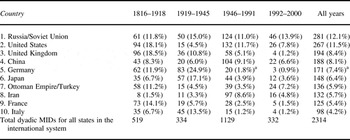
The seventh and final threat to the democratic peace stems from the disproportionate participation of at least one European country in the population of dyadic conflict observations up through 1945. As Table 1 shows, conflict observations are both rare and clustered in a small group of countries. Across the entire sample, slightly over 12 percent of all dyadic conflict observations include Russia. Over 7 percent of all dyadic conflict observations include Germany. These historically aggregated proportions obscure some tighter clustering in periods critical to the emergence of the statistical relationship between democracy and peace. For example, MID participation by Germany, France, and Great Britain changes significantly from the interwar to Cold War periods. While nearly 25 percent of all dyadic conflict observations include Germany from 1919 to 1945, this proportion then collapses during the Cold War to 1.8 percent.Footnote 58 Similar downward trends in conflict participation from the interwar to the Cold War period can be seen for Great Britain (from 10.8% to 5.1%) and for France (5.7% to 2.5%). Observations including Germany, France, and Great Britain possess disproportionate leverage in generating the statistical relationship between democracy and peace after 1918. However, these cases highlight the challenges associated with inferring a causal relationship from prevailing statistical estimates of the democratic peace because the significant changes in the conflict behavior of these states after World War II should be attributed to the organizational changes highlighted here rather than simply the democratic transition in West Germany.
Most frequent participants in dyadic conflict

Notes: Each cell entry is the number of new Militarized Interstate Disputes (MIDs) in which a given country was one of the dyadic participants. The number in parentheses for each cell corresponds to the percentage that this count generates relative to all MIDS for a given time period. The addition of column entries exceeds the total MIDs listed at the bottom of table because there are two participants for each dyadic MID. For example, for the period from 1816 to 1918, there were 1,038 participants in 519 MIDs. a Totals for Germany during the Cold War combine MID participation by West Germany and East Germany.
Testing for a Great-Power-Imposed Peace Among Democracies
This empirical section disaggregates a standard set of supportive statistical results for the democratic peace. It demonstrates that the robustness of this relationship rests on critical research design decisions and a few outlying countries with respect to conflict behavior. I then show that the absence of military conflict among democracies after World War I depends heavily on the organizational change generated by great power settlements and the hierarchical orders that support them.
Research Design
The basic research design is similar to much of the democratic peace literature. It utilizes the dyad year, or a pair of two states in a given year, as the unit of analysis.Footnote 59 I present results from a sample composed of all dyad years from 1816 to 2000.
Dependent variable: all MIDs and fatal MIDs. To ensure the robustness of results across different operationalizations of conflict, I utilize two dependent variables: the outbreak of a new militarized interstate dispute (mid) and the outbreak of a new dispute with at least one fatality (fatalmid).Footnote 60 These variables take on a value of 1 when a new instance of military conflict breaks out in a given year between dyadic participants that are both originating disputants to the conflict. I restrict the coding to include only originating states for two reasons. The first stems from the already described tendency of subordinate states to join disputes involving their hierarchical protector. The conflict itself, particularly when escalating to war, can create incentives to join or abstain by shifting the distribution of power between states. However, these changes may not be captured by standard measurements of power that rely on annual observations. Except observations with missing fatality levels which are coded as missing, all other observations are coded as not having military conflict present. These codings rely on version 3.1 of the militarized dispute data set.Footnote 61
Key independent variables: democracy and hierarchy. The operationalization of regime type follows standard practices in democratic peace research. I utilize the Polity2 score from the Polity IV data set to indicate the regime score for each state in the dyad.Footnote 62 Ranging from -10 to 10, higher values reflect more political liberalization in a state. Drawing on the weak-link hypothesis, dyadic democracy (democracy L) is the lower democracy score of the two states within the dyad.Footnote 63
Great power hierarchy is operationalized differently than in Lake, who relies on US troop deployments abroad.Footnote 64 Given that his data are limited to the American sphere of influence during the Cold War and post–Cold War periods, I try to capture the basic elements of hierarchy with an indicator possessing broader geographic and temporal scope. Lake defines hierarchy as a relationship of dominance and subjugation between two states in which a weaker state subordinates some components of its decision-making authority to a more powerful state. In return, the dominant state supplies public goods, like national security, and recognizes limits on its newly granted authority. I use defensive alliance commitments extended by great powers to weaker states to capture both the security obligation and power disparity dimensions of a hierarchical relationship. great power ally takes on a value of 1 if either non-great power member of a dyad possesses a defensive alliance with a great power. Great powers are defined according to COW criteria. Alliance data are taken from version 3.03 of the alliance data from the COW project.Footnote 65
Control Variables. The remaining control variables are relatively standard in the literature. capratio captures the disparity in military capabilities between the two states in the dyad. Drawn from version 4.0 of the national military capabilities data set, it is defined as the natural log of the more powerful state's CINC score divided by the weaker state's CINC score.Footnote 66 distance is the natural log of the distance in miles between capital cities of the two states in the dyad. contiguity is a dummy variable indicating whether or not the two states in the dyad share a border on land or at sea within 150 miles. greatpower is a dummy variable indicating whether at least one state in the dyad in the year under investigation has been identified by the COW project as a great power. dyadic alliance takes on a value of 1 if both states are members in a common alliance. It is 0 in all other cases. interest sim relies on the unweighted global s-score of alliance portfolio similarity to measure the degree of common political interests possessed by the two states in a dyad. I also incorporate the Carter and Signorino correction for temporal dependence.Footnote 67
Because data for the standard variable utilized to test arguments linking international trade to peace—namely exports plus imports divided by gross domestic product—are not missing at random, I exclude a control variable for economic interdependence. War increases missing economic data so its inclusion threatens to restrict further observations of military conflict. However, the exclusion of this variable that is positively correlated with democracy levels should bias the coefficient estimates in favor of finding support for the democratic peace.
Disaggregating the Democratic Peace
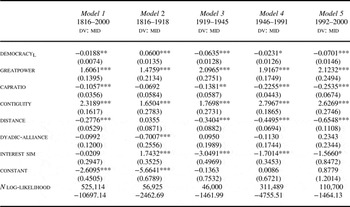
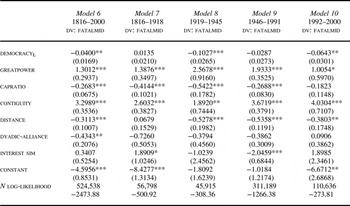
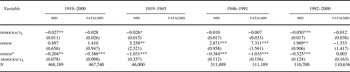
The baseline results estimated via logistic regression are displayed in tables 2 and 3.Footnote 68 The dependent variable in Table 2 includes all MIDs. The dependent variable is restricted to fatal disputes in Table 3. The first model in each table aggregates all observations into a single sample. The samples for the next four models are broken up into four time periods to account for variation in great power orders across the past two centuries. Even though this is an admittedly blunt indicator for the larger great power political order that simply treats each as different rather than measuring the sources and/or degree of difference, it still reveals significant historical variation in the statistical relationship between democracy and peace.
Baseline regressions with MID as dependent variable, disaggregated by great power order

Notes: Top number in each cell is estimated coefficient. Robust standard errors clustered on dyad listed below in parentheses. Two-tailed estimates are conducted for all estimates. * p ≤ .10, ** p ≤ .05, *** p ≤ .01. Variables for t, t2, t3 (not shown) added to all models.
Baseline regressions with fatalmid as dependent variable, disaggregated by great power order

Notes: Top number in each cell is estimated coefficient. Robust standard errors clustered on dyad listed below in parentheses. Two-tailed estimates are conducted for all estimates. * p ≤ .10, ** p ≤ .05, *** p ≤ .01. Variables for t, t2, t3 (not shown) added to all models.
For both dependent variables, the statistical results reflect the conventional wisdom in the aggregated sample (Models 1 and 6). The coefficient on democracy is negative and statistically significant. In short, the likelihood of military conflict in a dyad appears to fall as both regimes become more democratic.
However, the disaggregated samples reveal an important set of questions for this standard result. Two stand out in particular. First, the coefficient on democracy is not negative but positive in the period from 1816 to 1918 for both indicators of military conflict. This estimated coefficient is statistically significant when the dependent variable includes all MIDs (Model 2, Table 2).Footnote 69 Democracy appears to heighten the risks of military conflict before World War I. At the very least, this group of cases cannot be utilized to claim that democracy promotes peace. Given the small number of observations in the pre–1919 sample, it is clear that the null or positive results in this period are simply overwhelmed in combined samples by periods of “democratic peace” that have many more states and more dyad year observations. They also highlight the risks associated with the standard practice of aggregating observations across very different historical periods and underscore the importance of one of the central questions motivating this paper: Why did the democratic peace emerge after World War I?
Second, even in the post–1918 period, the results for the Cold War (1946–1991) differ substantially from the interwar and post–Cold War periods. When the dependent variable includes all MIDs (Model 4, Table 2), the coefficient on democracy remains negative and statistically significant but its relative size shrinks substantially. This period becomes even more problematic when restricting the dependent variable to include only fatal disputes. The estimated coefficient on democracy no longer achieves standard levels of statistical significance (Model 9, Table 3). Very quickly, this historical disaggregation of the standard democratic peace results suggests that the empirical relationship between democracy and peace may be much more limited temporally than generally acknowledged, confined to the period from 1919 to 1945 and then again from 1992 to 2000.
Hierarchy, Joiners, and the Cold War
The Cold War results are perhaps most surprising in this disaggregation because even prominent critics of the democratic peace like Gowa acknowledge its existence then. One way that the neglect of hierarchy helps to preserve the statistical relationship between democracy and peace during this period can be illustrated by altering the dependent variable to include joining states.
As I noted earlier, the capacity of hierarchy to influence joining decisions creates a theoretical need to separate joining and originating states when coding military conflict. Alternatively, the conflation of these distinct state decisions inflates observations of military conflict in dyads composed of at least one autocracy. The statistical separation between democratic dyads and all other dyad types depends critically on the differences in conflict counts between these two groups. Increasing the count of military conflict in dyads with at least one autocracy increases their statistical difference from democratic dyads. For example, the inclusion of joining states in multilateral wars—the most important of which were in Korea, Vietnam, and Iraq—increases dyad year observations of fatal MIDs during the Cold War by 73 percent, from 252 to 436.Footnote 70 But these joining cases may be driven by attributes of hierarchy rather than regime differences.
To examine how this coding decision influences the statistical relationship between democracy and peace during the Cold War, I ran another set of regressions that altered the coding of the dependent variable to include conflict dyads with both originating and joining states. The coefficient estimates for democracy run across the two variations of the dependent variable (mids and fatalmids) can be seen in the supplementary appendix. The negative relationship between democracy and conflict strengthens substantially for all MIDs and fatal disputes when they include joining states. For fatal disputes, this coding change is sufficient to generate the standard statistically significant result linking democracy to peace (β = -0.0664, p < 0.01). These results imply that a robust democratic peace during the Cold War depends partly on a coding decision that risks misattributing the consequences of hierarchy to democracy.
European Outliers, Hierarchy, and the Resolution of the German Problem
This important neglected role of hierarchy in generating the conventional empirical relationship between democracy and peace can be seen in another form of statistical disaggregation done by country rather than historical period. As Table 1 shows, the outbreak of military conflict is highly concentrated in dyads that include a small group of countries. For example, nearly 73 percent (243 of 334) of all dyad year observations of military conflict in the period from 1919 to 1945 include at least one of five states—Russia, Great Britain, Germany, Japan, and Italy. This concentration is particularly important in Europe during the interwar and Cold War eras. Great Britain, Germany, and France show abrupt changes in conflict participation between these two great power orders. How sensitive is the standard democratic peace result to the conflict behavior of these countries? Moreover, can these countries be utilized to affirm a causal relationship between democracy and peace?
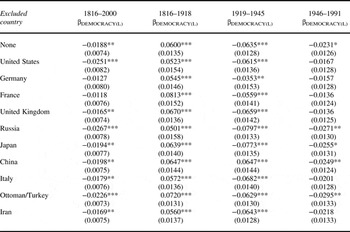
The models in Table 4 examine the impact of these country conflict outliers on the statistical relationship between democracy and peace. The top line of the table simply reports the coefficient estimates for democracy L from the historical disaggregation of the baseline models (1, 2, 3, and 4) found in Table 2. The subsequent rows present the coefficient estimates for democracy L in regressions that drop observations of the conflict outlier countries. The dependent variable in all of these models includes all MIDs. Coefficient estimates for the control variables are suppressed for space reasons.
Country outlier effects on coefficient estimates for democracy L

Notes: The coefficient estimate in each cell is that for the variable democracy L when excluding all dyad year observations that contain the country specified in the far left column. With the exception of these sample changes, the specification of the baseline regression (and all subsequent estimates in the table) remains the same from the models in Table 5. The dependent variable includes all MIDs. Numbers in parentheses are the robust standard errors for the corresponding coefficient estimate. Two-tailed estimates are conducted for all estimates. *p ≤ .10; **p ≤ .05; ***p ≤ .01.
A comparison of the coefficient estimates found in the top row with an estimate found below it in the table provides one means of assessing statistical leverage for any single country in a given period. For example, across the entire aggregated sample, the deletion of all dyadic observations that include Germany (less than 3% of 525,114) is sufficient to render the coefficient on democracy L statistically insignificant. These German effects are most pronounced during the interwar and Cold War periods. The deletion of observations with Germany moves the democracy coefficient from -0.0635 to -0.0353 in the interwar period and from -0.0231 to -0.0157 during the Cold War. The coefficient on democracy is insignificant in the Cold War sample that excludes observations with East or West Germany. Similarly, the deletion of all observations that include France (about 2.1% of 525,114) is sufficient to render the coefficient on democracy L statistically insignificant in the aggregated sample. In all these regressions, changes in statistical significance reflect coefficient estimates pushed closer to 0. Except for the smaller interwar sample, the differences in standard errors are negligible.
This single-country sensitivity is even more pronounced during the Cold War. The deletion of dyadic observations that include the United States, Germany, France, the United Kingdom, Italy, or Iran renders the coefficient on democracy L statistically insignificant. Alongside the prior results showing that the absence of a statistically significant relationship between democracy and conflict when the dependent variable is fatalmids, these regressions create significant doubts about the robustness of the democratic peace during the Cold War.
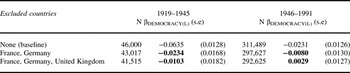
The results in Table 5 extend this outlier analysis by showing how a group of European countries shapes the statistical relationship between democracy and peace during the interwar and Cold War periods. Again the top row of the table reproduces the coefficient estimates for democracy L from the baseline regression that utilizes all MIDs as the dependent variable. The second row excludes all observations in which either France or Germany is in the dyad. The third row excludes all observations containing France, Germany, or the United Kingdom. The deletion of dyadic observations with either France or Germany (6.5% of 46,000) renders the coefficient on democracy L statistically insignificant during the interwar period. A similar restriction pushes the estimated coefficient from -0.0231 to -0.008, that is, nearly to 0 during the Cold War. The addition of cases including the United Kingdom to this excluded group flips the estimated coefficient on democracy L so that it is positive during the Cold War.
Outlier effects (by groups of European countries) on estimates of democracy L

Notes: The coefficient estimate in each cell is that for the variable democracy L when all dyad year observations including at least one of the countries specified in the far left column are excluded from the sample. With the exception of these sample changes, the specification of the baseline regression remains the same as that in Table 2. Robust standard errors reported in far right portion of each cell. Coefficients identified in bold do not reach standard levels of statistical significance (that is, p < .10).
These regressions have significant implications for what is known as the “democratic peace.” Alongside prior models identifying multiple problems with standard democratic peace models that utilize fatal disputes as the dependent variable, they weaken the robustness of the democratic peace when the dependent variable is expanded to include all military disputes. They also open another logical challenge for the conventional wisdom. If the changes in conflict patterns for these groups of countries do not conform to the purported domestic mechanisms used to account for the relationship between democracy and peace, they also make it difficult to rely on aggregated statistical evidence to validate a causal relationship between democracy and peace.
There are at least three reasons to think that the conflict patterns for these outlying countries in Europe reflect the organizational changes I focus on here rather than existing explanations for the democratic peace. First, the complete fall-off in conflict participation for the two German states after World War II can be attributed to hierarchical politics in which great powers impose peace on subordinate states and influence their regime type. The United States and the Soviet Union partitioned Germany, occupied it, shaped the structure of domestic governing coalitions and domestic institutions that emerged in each Germany, exerted strong influence over the respective foreign policies of West and East Germany, and promoted peace by ensuring that the two countries abided by the post-war territorial settlement in Europe.Footnote 71
An argument that this reversal of German conflict behavior occurred because of democratization in West Germany faces multiple challenges. Autocratic East Germany was just as peaceful as democratic West Germany. The emergence of democracy in West Germany itself was not exogenous or driven by internal processes. Instead, the United States rebuilt West Germany politically and economically as part of a larger strategy to counter Soviet influence in Europe.
Second, even though the Nazi program of territorial expansion pursued after 1933 strengthens the statistical relationship between democracy and peace in the interwar period by increasing the count of military disputes with at least one autocratic state in a dyad, it is difficult to hold up the group of observations including interwar Germany as validating a direct causal relationship between democracy and peace for a couple of reasons. Regime type—both the transition to the Weimar Republic and its collapse—in Germany depended on the terms and sustainability of the great power peace rather than the other way around. Woodrow Wilson insisted on democratic reform in Germany as a condition for the armistice in 1918. The United States and Great Britain repeatedly pushed concessions on France that weakened the Versailles settlement throughout the 1920s to sustain the center left coalition critical to the Weimar democracy.Footnote 72 Its constitutional defeat and the emergence of authoritarian institutions in 1933 were designed largely to fulfill the political right's foreign policy goal of overthrowing Versailles.
The collapse of the interwar peace itself directly contradicts a key claim associated with the democratic peace, namely that settlements constructed by democracies should endure.Footnote 73 While the initial Versailles settlement was imposed on Germany in 1919, historians now argue that it underwent important revisions in 1924 and 1925 (namely the Treaty of London over the Dawes Plan and the Locarno Treaty) that incorporated Germany as a full participant.Footnote 74 These adjustments helped to constitute a new European status quo. Most importantly, this settlement stands as a critical test case for the democratic peace because German participation made it one constructed among democracies. Consequently, it should have been particularly robust.
However, a plausible case can be made that the adjusted Versailles settlement collapsed within a decade precisely because of how democratic pressures undermined it.Footnote 75 In this way, the specific terms of the post-war settlement that had been negotiated and adjusted by democracies were incompatible with the preservation of democracy within each of them simultaneously. Britain and France insisted on harsh reparations to avoid the domestic political costs associated with liquidating war expenses through tax increases and public spending cuts.Footnote 76 The United States encouraged its allies to maintain these demands by resisting war debt relief, fearing that it would provoke domestic political resistance to the postponement of post-war tax cuts. Germany resisted paying reparations because of the domestic political costs associated with fiscal austerity to fund international transfers. The end of post–Dawes capital exports from the United States helped reignite this reparations struggle and encouraged Bruning to implement austerity measures that worsened the Great Depression and created political space for Hitler to destroy the Weimar democracy with a nationalist program to overturn Versailles. In short, democracy in the United States, France, and Britain enabled popular anger against Germany to be translated into demands for larger reparations payments that subsequently weakened democracy in Germany. These demands helped activate a conservative backlash within Germany that sought to destroy the Weimar democracy and the European order through violence.
Third, in addition to supporting peace in Europe by settling the German problem, the extension of American hierarchy after World War II also reduced the conflict participation rates of the United Kingdom and France outside of Europe. The United States substituted its military influence in regions formerly within their imperial spheres of influence, like Southeast Europe, the Middle East, and Southeast Asia. American participation in the Vietnam War is a manifestation of this. Consequently, part of the reduction in the conflict participation rates of France and the United Kingdom during the Cold War can be ascribed to their strategic retrenchment that was facilitated by the United States.Footnote 77 Given that great powers participate in military conflict at much higher rates, British and French status as great powers makes them peace outliers during the Cold War and helps to strengthen the statistical relationship between democracy and peace because they were also both democratic.Footnote 78
Hierarchy, Democracy, and Peace
Two additional sets of tests explore how the twin capacity of hierarchy to promote similar regime type and peace complicates any direct causal relationship between democracy and peace. The first separates democratic dyads into two groups and tests for any differences in conflict propensity between them. The first group might be called great-power-supported democracies. It includes all democratic dyads in which one state was allied to a great power, democratized in the immediate aftermath of World War I, or democratized in the immediate aftermath of the Cold War. These dyad year observations comprise over 85 percent of all democratic dyad year observations in the period after 1918. On its own, this simple proportion underscores the risks associated with simply treating regime type as exogenous in statistical models during the twentieth century. These dyads pose a problem for causal claims linking democracy to peace for at least three reasons. First, the absence of conflict within a democratic dyad could be imposed by a great power protector. Second, democracy in one of the states could be endogenous to the hierarchical relationship. Third, for the states that emerged and/or democratized in the immediate aftermath of World War I and the Cold War, peace could have enabled democracy rather than the other way around. Consequently, I created a dummy variable, gpdem, to identify this group of democratic dyads. I then interact it with the weak-link democracy specification to see if the typical democratic peace results depend on this group of democracies that are linked either to a great power hierarchy or to a great power settlement.
The results, both for the aggregated sample from 1919 to 2000 and the temporal disaggregation set by great power orders, are shown in Table 6. Across the entire post–1918 period, the coefficient on democracy L (that is, when great-power-supported democracy is 0) remains statistically significant when the dependent variable is operationalized to include all MIDs. However, this relationship in the aggregated sample again depends on the interwar and post–Cold War periods. The democracy coefficient fails to achieve standard levels of statistical significance in the Cold War sample. The coefficient for democracy L is not significant for the aggregated sample when the dependent variable is restricted to include only fatal disputes. The collapse of the relationship between democracy and conflict is most pronounced during the Cold War. democracy L does not come close to achieving statistical significance with either of the dependent variables (p < 0.54, p < 0.83). These results reinforce the claim that the statistical relationship between democracy and peace breaks down once great power hierarchy and some sources of democratization are adjusted for in the standard single-equation specification normally used to test for the democratic peace.
“Great power supported” democracies and the democratic peace

Notes: Nondirected dyad analysis. gpdem is a dummy variable indicating that a dyad has the following characteristics: both members are democracies; and at least one member is allied to a great power, democratized from 1918 to 1925 (in the 1919–1945 subsample), or democratized from 1988 to 1993 (in the 1992–2000 subsample). Presentation of control variables is suppressed. Results with fatalmid as dependent variable in the interwar period are not presented because gpdem perfectly predicts the absence of a fatal military dispute. Each cell indicates direction of estimated coefficient and its statistical significance (robust standard errors clustered by dyadid). Two-tailed estimates conducted for all estimates. * p ≤ .10; ** p ≤ .05; *** p ≤ .01.
The second test draws on instrumental variable analysis (two-stage probit least squares—2SPLS) to support the claim that hierarchy simultaneously shapes peace and regime type. For space reasons, the statistical table is presented in the supplementary appendix. This model utilizes covariates of democracy to predict its level in the first stage of a set of regressions. It then inserts those predicted values of dyadic democracy in place of the observed values in a second-stage model that uses conflict as the dependent variable. The lower Polity score of the states in the dyad (democracy L) serves as the dependent variable in the first stage of the model and military conflict (fatalmid) is the dependent variable in the second stage. Given my focus on accounting for the apparent correlation between democracy and peace after World War I, I restrict the sample from 1919 to 2000.
This estimation requires a few important changes.Footnote 79 Because I expect that great powers promote domestic institutional similarity within their hierarchical orders, I distinguish hierarchical orders on the basis of whether or not they are led by a democratic or autocratic great power. Dummy variables for each are added to the first and second stages of the model. The set-up for the second (conflict) stage of the model follows that of the baseline single-equation model with two additional exceptions. First, as noted already, observed values for democracy L are replaced with predicted values. This first-stage estimation relies on a model similar to recent contributions to the democratization literature that highlight the role of diffusion in regime transitions.Footnote 80 This specification includes variables capturing the proportion of democratic regimes within the international system and within a state's geographic neighborhood. Second, it also includes the diffusion variables on the right-hand side of the conflict equation.Footnote 81
This test shows that membership in a great power hierarchy appears to have a strong effect on regime type. States within great power hierarchies led by democratic states are more likely to be democratic. Similarly, states within great power hierarchies led by autocracies have lower democracy scores. The diffusion variables behave as expected. As the proportion of neighboring democracies increases, a state's regime score increases as well. Similarly, the global proportion of democracies is positively related to the lower regime score in the democracy.
Most importantly, the twin tendency of hierarchy to shape regime type and peace alters the dyadic relationship between democracy and peace. In the conflict equation, the dummy variable capturing whether at least one member of the dyad possessed a defensive alliance with a democratic great power was negative and statistically significant.Footnote 82 Moreover, the coefficient on democracy L in the conflict equation is positive and statistically insignificant. This finding supports my larger contention, namely that the robust empirical relationship between democracy and peace collapses once the consequences of great power politics and hierarchy on both regime type and peace are explicitly modeled.
Discussion: Cold War Findings as a Challenge to Existing Explanations
These results, particularly those from the Cold War period, pose significant theoretical hurdles to both sides of this debate. First, they challenge evolutionary or time-varying arguments, such as those nested in constructivism.Footnote 83 These theoretical claims attribute the peace among democracies and its emergence in the twentieth century to collective identity formation and the consequent development of norms of nonviolent conflict resolution that have been prompted by learning, war, or growth in the global population of democracies. They rest on the expectation that the empirical relationship between democracy and peace strengthens as the number of democracies in the system increases and/or these norms become more robust over time. By showing that there is no democratic peace during the Cold War, the results presented here contradict such claims by identifying a significant temporal gap in this expected historical progression.
Second, they differentiate the claims made here with a prominent critic of the democratic peace. Gowa has already noted the absence of an empirical relationship between democracy and peace before World War I and attributed the correlation between democracy and peace during the Cold War to common political interests. However, her claims leave the sources of democracy and their implications for the democratic peace unexamined. Moreover, the findings here show no empirical relationship between democracy and peace during the Cold War. Finally, while admittedly connected during the Cold War, my claims focus on organizational change—the construction of hierarchical orders, great power support for regime consolidation, and the collapse of multinational empires into sovereign states—rather than common political interests to explain the apparent relationship between democracy and peace.
Third, these findings do not challenge recent experimental work showing how democracy shapes public opinion, helping to create an apparent aversion to the use of military force against fellow democracies in the contemporary period. By reexamining well-worn data sets with an alternative theoretical perspective, my findings cannot shed any light on the current state of societal preferences within today's democracies. The examination of the democratic peace has obviously played a key role since the end of the Cold War in academic and policy debates, shaping how undergraduates are taught international relations and how American foreign policy has been justified. Future work should examine how the debates themselves have influenced public foreign policy attitudes. However, even if a democratic peace is on the cusp of emerging in the current era, it has not existed in the past.
Conclusion
There has been a pronounced turn to studying domestic factors like regime type rather than the international political structure after the Cold War. This paper has shown some of the costs of this intellectual shift in the research program that perhaps best exemplifies it, that on the democratic peace. My critique has been directed at some of the outstanding theoretical and empirical challenges to the democratic peace—including its emergence after World War I, the continual search for an explanatory consensus, and its neglect of how the endogeneity of regime type could confound its central claims.
I have shown that the empirical support for the democratic peace, nested in recent research on hierarchy and democratization, is much weaker than previously acknowledged. The statistical relationship between democracy and peace rests on research design decisions that neglect a larger role for historically specific structural factors that shape patterns of military conflict in dyads, the number of states in the system, and their regime types. The evolution of hierarchical relationships in the aftermath of World War I, particularly those constructed by the United States, has helped to generate what has been known as the democratic peace. These hierarchical orders help set the number of states in the system, shaped the regime types of subordinate states, limited their participation in military conflict, and altered the conflict behavior of a few outlying countries that play a disproportionate role in generating the statistical relationship between democracy and peace. Quite simply, the international political order is still built and managed by great powers.
Supplementary Material
Supplementary material for this article is available at http://dx.doi.org/10.1017/S0020818315000120.