Introduction
South-East Asia is a biodiversity hotspot (Myers et al., Reference Myers, Mittermeier, Mittermeier, da Fonseca and Kent2000), where the diversity of murid rodents is particularly high, with more than 200 reported species (Marshall, Reference Marshall, Lekagul and McNeely1988; Corbet & Hill, Reference Corbet and Hill1992; Aplin et al., Reference Aplin, Brown, Jacob, Krebs and Singleton2003; Wilson & Reeder, Reference Wilson and Reeder2005). Rodents are hosts of many parasites, but knowledge about their helminth fauna is very limited in this region. Out of 12 countries, only seven (Vietnam, Malaysia, Thailand, Indonesia, the Philippines, Myanmar and Papua New Guinea) have been surveyed for helminths in rodents, whereas no surveys have been conducted in the other countries (Brunei, Cambodia, Lao PDR, Singapore and Timor) (Tubangui, Reference Tubangui1931; Wiroreno, Reference Wiroreno1978; Chenchittikul et al., Reference Chenchittikul, Daengpium, Hasegawa, Itoh and Phanthumachinda1983; Nama, Reference Nama1990; Krivolutsky et al., Reference Krivolutsky, Ki and Viet1991; Smales, Reference Smales2010; Mohd Zain et al., Reference Mohd Zain, Behnke and Lewis2012; but see Chaisiri et al., Reference Chaisiri, Chaeychomsri, Siruntawineti, Ribas, Herbreteau and Morand2010).
Here, we investigated the helminth diversity in rodents from Lao PDR, which were trapped in two localities (in the north and south of Laos), in the wet and in the dry season. Like other South-East Asian countries, Lao PDR faces environmental threats with high deforestation linked to agriculture intensification, development of cash crops and new forestry practices such as the planting of rubber trees and teak trees (Sthongmanivong et al., Reference Sthongmanivong, Fujita, Phanvilay and Vongvisouk2009).
Several studies have investigated the role of extrinsic factors such as temperature, rainfall and season on the level of helminth infection. More rarely, the roles of habitat and the level of human influence have been specifically investigated (Udonsi Reference Udonsi1989; Kataranovski et al., Reference Kataranovski, Vukicevic-Radic, Kataranovski, Radovic and Mirkov2008; Chaisiri et al., Reference Chaisiri, Chaeychomsri, Siruntawineti, Ribas, Herbreteau and Morand2010; Froeschke et al., Reference Froeschke, Harf, Sommer and Matthee2010; Milazzo et al., Reference Milazzo, Cagnin, Di Bella, Geraci and Ribas2010; Lutermann & Bennett, Reference Lutermann and Bennett2012).
The aims of this study were: (1) to provide the first survey of the diversity of gastrointestinal helminths in wild rodents from two provinces of Lao PDR (Luang Prabang and Champasak); and (2) to investigate the effects of two extrinsic factors, season and habitat, on the individual levels of helminth infection, abundance and diversity in these rodent species.
Materials and methods
Collection and examination of rodents for helminths
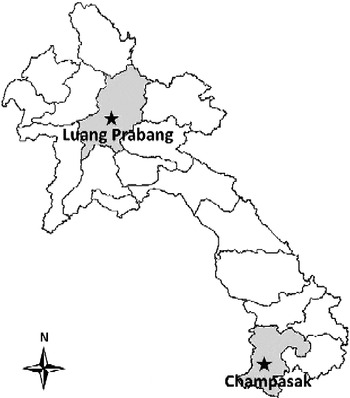
The investigation was carried out in two localities of the provinces of Luang Prabang (19°69′51.83″N; 102°12′34.07″E) and Champasak (15°19′41.39″N; 105°78′22.95″E), Lao PDR (fig. 1). These sampling sites covered from 10 × 10 up to 15 × 15 square kilometres, representing the diversity of landscapes and human pressures in both localities: (1) forest; (2) upland and non-flooded agricultural areas; (3) lowland paddy fields; and (4) human settlement (Jittapalapong et al., Reference Jittapalapong, Inpankaew, Sarataphan, Herbreteau, Hugot, Morand and Stich2010; Chaisiri et al., Reference Chaisiri, Chaeychomsri, Siruntawineti, Ribas, Herbreteau and Morand2012; Ivanova et al., Reference Ivanova, Herbreteau, Blasdell, Chaval, Buchy, Guillard and Morand2012). Rodents were sampled twice in each: in the dry and wet seasons. In each sampling locality, 30 trap lines (composed of 10 traps) were set during four nights by three times (12 nights) for a total 1200 night traps (Herbreteau et al., Reference Herbreteau, Jittapalapong, Rerkamnuaychoke, Chaval, Cosson and Morand2011). Each sampling was performed with an equal trapping pressure in four main habitats described above. Three sampling trap lines were performed for each habitat in each season for the two localities. Additional rodent samples were obtained from local people, particularly within villages.
Map of localities, Luang Prabang and Champasak, Lao PDR.

The trapped animals were euthanized and dissected following the protocol of Herbreteau et al. (Reference Herbreteau, Jittapalapong, Rerkamnuaychoke, Chaval, Cosson and Morand2011). Rodent maturity was categorized as juvenile and adult according to the development of reproductive organs. The stomach, small intestine and large intestine were separated and examined for helminth infection under a stereomicroscope. The collected helminths were preserved in 70% alcohol and identified according to general helminth identification keys (Yamaguti, Reference Yamaguti and Yamaguti1958; Skrjabin et al., Reference Skrjabin, Shikhobalova and Orlov1970; Schmidt, Reference Schmidt1986) and the specific literature on each recovered helminth (Ribas et al., Reference Ribas, Veciana, Chaisiri and Morand2012).
The parasitological terminologies such as prevalence, mean intensity, mean abundance and parasite species richness were reported as quantitative parameters. We used Quantitative Parasitology 3.0 (Rozsa et al., Reference Rozsa, Reiczigel and Majoros2000) to estimate them.
Data analysis
We performed generalized linear models (GLM) to identify the likely variables that may explain the parasitism of rodents by helminths. Selection of the best models was based on Akaike Information Criterion (AIC) using host species, sex, season, habitat and locality as independent variables.
First, GLM using Gaussian distribution of individual helminth species load and identity function was performed to identify the likely variables that may explain the helminth species richness in rodents. Second, we performed GLM using logit function to identify the variables that may explain the helminth infection (positive or negative) among rodents. Third, GLM using negative binomial distribution was performed to identify the variables that may explain the individual helminth abundance among rodents. All analyses were done with the R software (http://www.r-project.org/).
Rodent species with low sample sizes were removed from these analyses: Bandicota indica, Berylymys berdmorei, Niviventer fulvescens, Rattus andamanensis, Rattus losea and Rattus nitidus.
Results
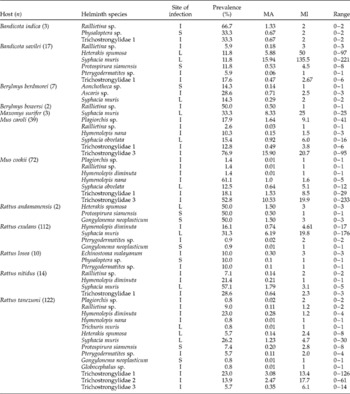
A total of 404 rodents from 13 species were trapped and investigated for helminths. Among them, 266 were parasitized by single or multiple helminth species, giving an overall prevalence of 65.8%. Not all helminths were identified to species level. The highest number of helminth species was found in Rattus tanezumi (n= 14) followed by Mus cookii (n= 7), Mus caroli (n= 6) and Bandicota savilei (n= 6) (see more details in table 1).
The prevalence (%), mean abundance (MA), mean intensity (MI) and range of intestinal helminth species in each of 13 rodent species from Lao PDR.

n, Number of hosts examined; S, stomach; I, small intestine; L, large intestine.
Prevalence, mean abundance and mean intensity of each helminth species according to host species and tissue location are given in table 1. Nineteen helminth species or taxonomic groups were identified. Nematodes were predominant with 14 species, followed by cestodes and trematodes with 3 and 2 species respectively.
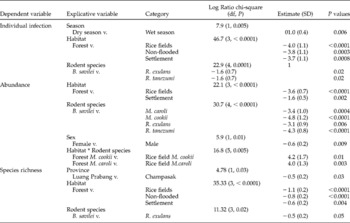
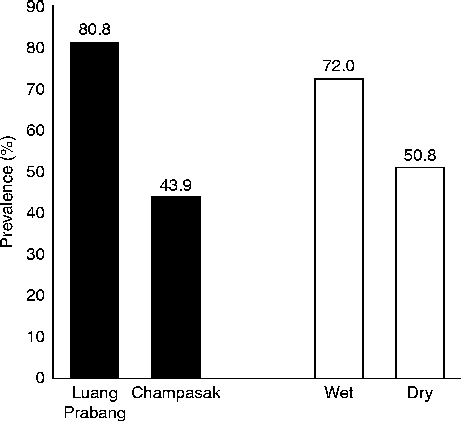
We first conducted a GLM analysis to investigate the effects of host species and their characteristics (sex) and environmental-linked variables (season, habitat and province) on helminth infection (positive or negative), abundance and species richness. There were no effects of host sex and province on the level of individual infection by all helminth species. A significant effect of season, with higher individual level of infection (positive or negative) in the wet season, habitat and host species were observed (table 2, fig. 2). Rodents from forests were significantly more infected than rodents from flooded, non-flooded agricultural areas and human settlement (fig. 3). Two rodent species showed a lower individual level of individual helminth infection (i.e. prevalence): R. tanezumi and Rattus exulans. The last species was found quite exclusively in human habitations.
General linear model of individual helminth infections (with binomial distribution and logit link function), individual helminth abundance (with negative binomial distribution and log link function) and individual helminth species richness (with Gaussian distribution) (Log- Likelihood Type I Test). Selection of the best models were done using Akaike Information Criterion. Analysis of Deviance Table (Type II tests) were given with locality (Luang Prabang versus Champasak), season (wet versus dry), host species (five species), sex and habitat (forest, rice fields, non-flooded and settlement) as explicative variables (only significant values are included).

The prevalence of helminth infections in rodents relative to locality (Luang Prabang (northern) and Champasak (southern)) and season in LaoPDR (wet (March to September) and dry season (October to February)). Note that there was no interaction effect between locality and season on rodent infection by helminths (see table 2).

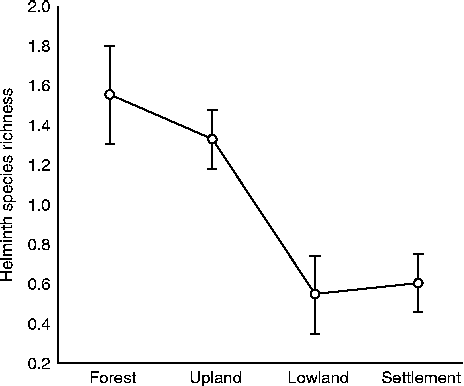
The mean helminth species richness (HSR) in rodent species from four habitat types including forest, upland, lowland and human settlements.

The GLM analysis on the individual helminth abundance showed a slightly different result with habitat, rodent species and sex being selected as explicative variables. Again, rodents from forests showed higher individual helminth abundance, with one rodent species, B. savilei, harbouring a significantly higher number of worms than the other rodent species. There was also a significant influence of sex, with males less infected in terms of individual helminth abundance than females.
The last GLM analysis investigated the effects of the same variables on the parasite species richness at the rodent individual level. Whereas no influence of season and sex was detected, a significant effect of province was observed, with rodents from North Laos (Luang Prabang) harbouring higher helminth diversity than rodents from South Laos (Champasak). Again, a significant effect of habitat was observed, with more helminth parasite species found in rodents from forests than in the other habitats.
Discussion
To our knowledge, this study is the first survey to be conducted in Lao PDR. Consequently, all helminth species are new reports for this country. A high overall prevalence of helminth infection was observed. However, the sample size of several rodent species was low, such as for B. indica and R. andamanensis, to give an accurate estimation of helminth species richness and abundance.
Interestingly, the two mouse species, M. caroli and M. cookii, showed high infection with, respectively, six helminth species (prevalence 92.3%) and seven helminth species (prevalence 90.3%). Similar observations were reported from Thailand for M. caroli (81.8% with five species) and Mus cervicolor (76.5% with nine species) (Chaisiri et al., Reference Chaisiri, Chaeychomsri, Siruntawineti, Ribas, Herbreteau and Morand2012).
Nematodes of the Trichostongylidae family are the dominant parasites, with the highest prevalence, mean abundance and mean intensity, and infecting a wide range of rodent species: B. indica, B. savilei, M. caroli, M. cookii, R. nitidus and R. tanezumi. Similarly, this nematode group was also reported as the dominant helminth parasite in 11 rodent species from Thailand (Chaisiri et al., Reference Chaisiri, Chaeychomsri, Siruntawineti, Ribas, Herbreteau and Morand2012). Most of these nematodes belong to new species and potentially new genera (M.C. Durette-Desset, pers. com.) needing taxonomic description.
Some helminth species are commonly found in other surveys in South-East Asia, such as Echinostoma malayanum, Raillietina sp., Hymenolepis diminuta, H. nana, Trichuris muris, Heterakis spumosa, Syphacia muris, S. obvelata, Protospirura siamensis, Physaloptera sp., Pterygodermatites sp. and Gongylonema neoplasticum (Sinniah, Reference Sinniah1979; Chenchittikul et al., Reference Chenchittikul, Daengpium, Hasegawa, Itoh and Phanthumachinda1983; Namue & Wongsawad, Reference Namue and Wongsawad1997; Claveria et al., Reference Claveria, Causapin, Guzman, Toledo and Salibay2005; Chaisiri et al., Reference Chaisiri, Chaeychomsri, Siruntawineti, Ribas, Herbreteau and Morand2012). In the present study, we report several rarely observed helminth species such as Plagiorchis sp., Aonchotheca sp., Ascaris sp. and Globocephalus sp.
The three cestode species, Raillietina sp., Hymenolepis diminuta and H. nana, have been reported as zoonotic parasites (Tsuchiya & Rohlfing, Reference Tsuchiya and Rohlfing1932; Pradatsundarsar, Reference Pradatsundarsar1968; Areekul & Radomyos, Reference Areekul and Radomyos1970; Tena et al., Reference Tena, Simon, Gimeno, Pomata, Illescas, Amondarain, González, Domínguez and Bisquert1998; Marangi et al., Reference Marangi, Zechini, Fileti, Quaranta and Aceti2003; Chero et al., Reference Chero, Saito, Bustos, Blanco, Gonzalves and Garcia2007). The trematode Echinostoma malayanum has also been reported to infect humans (Maji et al., Reference Maji, Bera, Manna, Nandy, Addy and Bandyopadhyay1993; Belizario et al., Reference Belizario, Geronilla, Anastacio, de Leon, Suba-an, Sebastian and Bangs2007). By hosting these four species, nine of the investigated rodent species – B. indica, B. savilei, Berylmys bowersi, Mus caroli, M. cookii, R. exulans, R. losea, R. nitidus and R. tanezumi – may act as reservoir hosts for potential human helminthiases.
Several studies have emphasized the effect of host sex on parasitic loads, with males usually more infected than females (Addis, Reference Addis1946; Poulin, Reference Poulin1996; Zuk & McKean, Reference Zuk and McKean1996). Nevertheless, some others have shown the opposite trend, with higher infection occurring in females (Behnke et al., Reference Behnke, Barnard, Bajer, Bray, Dinmore, Frake, Osmond, Race and Siński2001, Reference Behnke, Bajer, Harris, Newington, Pidgeon, Rowlands, Sheriff, Kuliś-Malkowska, Siński, Gilbert and Barnard2008). Possible causes of sex bias in susceptibility to parasitic infection are linked to sex differences in the production of sexual hormones or in behaviour. Male immunity can be suppressed by testosterone, which may lead to increased parasitic infection (Folstad & Karter, Reference Folstad and Karter1992; Zuk & McKean, Reference Zuk and McKean1996). Sex-specific behaviour and morphological difference between sexes may induce differential exposures to helminth infection. Larger vital domains, usually those of males, may increase contact with infective stages, either in the environment or in prey (Zuk & McKean, Reference Zuk and McKean1996). Our result showed an opposite pattern, with higher helminth abundance in females, also in accordance with some other studies. For example, females of Rattus rattus in Malaysia were more infected by Hymenolepis diminuta and Mastophorus muris than males (Mohd Zain et al., Reference Mohd Zain, Behnke and Lewis2012).
Parasite species richness was significantly higher during the wet season than in the dry season. The effects of environmental conditions on free-living stages may explain these results. Soil moisture enhances survival and development of eggs and larval stages in the environment (Appleton & Gouws, Reference Appleton and Gouws1996; O'Connor et al., Reference O'Connor, Kahn and Walkden-Brown2007), whereas dry and warm conditions may decrease survival and stop development (Ivoke, Reference Ivoke2009).
The helminth fauna of rodents from Luang Prabang and Champasak provinces is characterized by a high diversity with a total of 19 species. Latitudinal gradient is often invoked as a key factor of parasite diversity (Bordes et al., Reference Bordes, Morand, Krasnov, Poulin, Morand and Krasnov2010). High virus richness in lower latitudes has been recorded in rodents (Bordes et al., Reference Bordes, Guégan and Morand2011). However, an opposite pattern was found for rodent ectoparasites (Krasnov et al., Reference Krasnov, Shenbrot, Khokhlova and Degen2004) and a lack of latitudinal gradient was stressed for helminth species (Bordes et al., Reference Bordes, Morand, Krasnov, Poulin, Morand and Krasnov2010). Higher parasite diversity was observed in Luang Prabang (higher latitude) compared to Champasak (lower latitude). However, other abiotic parameters (rainfall, elevation) may confound any effect of latitude and definitively more sampling sites are needed.
According to Lafferty & Kuris (Reference Lafferty, Kuris, Thomas, Renaud and Guegan1999), environmental disturbances such as habitat alteration and loss of biodiversity affect parasite transmission. Clearing forests for agricultural lands and human settlements dramatically alters the environment of parasites and their host (Patz et al., Reference Patz, Graczyk, Geller and Vittor2000). This aspect in wild rodents is still poorly investigated (Chasiri et al. Reference Chaisiri, Chaeychomsri, Siruntawineti, Ribas, Herbreteau and Morand2012). Our results showed that an increase of human influence (i.e. forest to settlement) is negatively correlated with total parasite species richness, which suggests that the decrease in forest areas impacts parasite transmission. Several helminth species were particularly affected, most of them with indirect life cycles: E. malayanum, Plagiorchis sp., Raillietina sp., H. diminuta, H. nana, Aonchotheca sp., Physaloptera sp., Protospirura siamensis, Pterygodermatites sp. and G. neoplasticum.
Lao PDR experiences dramatic habitat changes due to human activities. Our results suggest that the increase of human influence may have impacted the diversity and abundance of rodent helminths.
Acknowledgements
This study was funded by the French ANR Biodiversity Grant ANR 07 BDIV 012 CERoPath project ‘Community Ecology of Rodents and their Pathogens in a changing environment’ (www.ceropath.org) and by the French ANR CP&ES Grant ANR 11 CPEL 002 BiodivHealthSEA (Local impacts and perceptions of global changes: Biodiversity, health and zoonoses in Southeast Asia) (www.biodivhealthsea.org). The authors gratefully thank the student team of Mahasarakham University for help with gut dissection and parasite examination, and also acknowledge financial support provided by Mahasarakham University. A.R. is a visiting postdoctoral fellow with Fonds Wetenschappelijk Onderzoek - Vlaanderen (FWO). Finally, we thank Kone for great help in the field.