On the edge of the old city of Vidiśā are the ruins of a large temple known as the Bijamaṇḍal. Only the plinth of the temple survives (Fig. 1). On top of the plinth, on the western side, is a small mosque which was constructed in the fifteenth century to judge from the design of the miḥrāb. The pillars used in the prayer-hall are of various sizes and dates and have not been studied comprehensively. One pillar is notable as it carries an inscription of Naravarman, the Paramāra king who ruled from circa ce 1094 to 1134.Footnote 1 A study of the inscription and the pillar on which it is carved provides a point of departure for considering several important questions about the dedication and history of the Bijamaṇḍal. The inscription also draws our attention to the tutelary goddesses of the Paramāra kings, a subject unstudied hitherto.
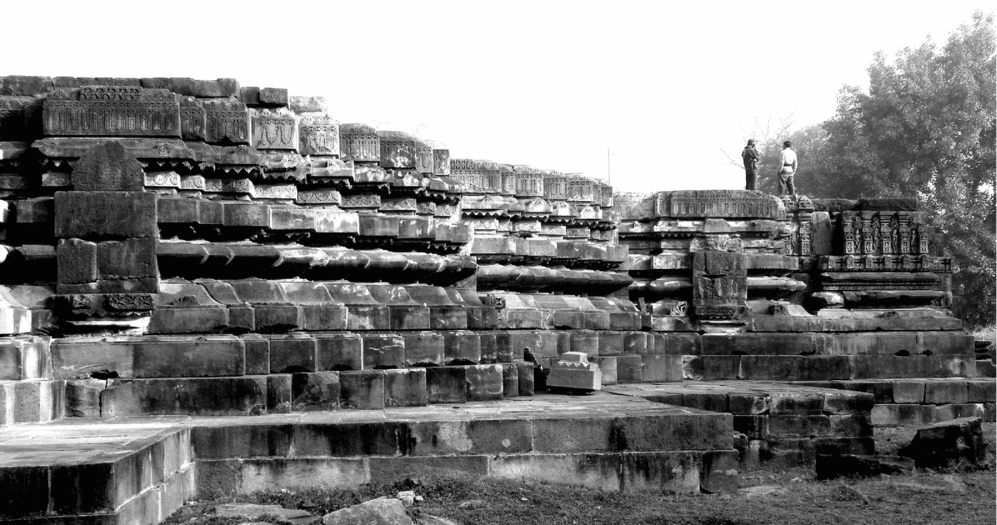
Vidiśā. General view of Bijamaṇḍal from the south. Late eleventh or early twelfth century.

Inscription
The inscription is undated, but mentions king Naravarman by name. The palaeography of the record is compatible with a date in the eleventh or twelfth century. H. V. Trivedi illustrated an estampage of the inscription and gave a line-by-line reading of the text.Footnote 2 Based on this, and on study of photographs made in situ, a fresh transcription is given here. This is presented as a running text to facilitate the reading. A translation is offered for the first time. Mistakes and epigraphic peculiarities, such as the double consonants, have been corrected. Metrically speaking, Verse 1 is vasantatilakā, Verse 2 anuṣṭubh, but the verses are defective. In the translation, I have attempted to stay close to the text, but not literally because a rigid rendering would make some passages impossible to understand.
Text
siddhaṃ ‖
śricarccikāsmaraṇamātrakṛtaprasādātFootnote 3
saṃprāpyate kaliyuge ‘pi dharādhipatyam |
ārādhitā vidhiyutā kusumair vicitraiḥ
sā khecaravaratvarasasiddhipadasya labdhiḥ ‖1‖
iti mahārājādhirājaparameśvaraśrīnaravarmadevasya
nirvāṇanārāyaṇasya paranārīsahodarasya|
carccikākhyā samākhyātā devī sarvajanapriyā
yasyāḥ prasādamātreṇa lebhe saṃsārayogyatām ‖1‖
kṛtir iyaṃ ṭhakurasūpaṭasusutaṭhakkuraṇījāsasutaṭhakkuraśrīmādhavasya ‖
paranārīsahodarasya | dvijasya | māthuravaṃśajasya ‖ maṃgalam | mahāśrīḥ ‖
Translation
Success! Dominion over the world is obtained, even in the Kali age,
thanks to the grace that comes from merely bringing Śrī Carccikā to mind.
Propitiated with lovely flowers while she is under worship, one obtains alchemical
mastery and the state of being the finest of ethereal beings.
So said Mahārājādhirāja Parameśvara Śrī Naravarmadeva, (who is also called)
Nirvāṇanārāyaṇa, (and who is) a son toward other men's women.
The far-famed goddess Carccikā is dear to everyone. Simply through her grace
he became qualified in worldly concerns.
This is a composition of Ṭhakkura Śrī Madhava, son of Ṇījāsa, son of Ṭhakkura Supaṭa.
(He is) like a son toward other men's women, a twice-born man (and) of the Māthura
lineage. Let it be auspicious! Great fortune!
A few remarks can be made on the contents of this record before turning to the main issues it raises. The first point of interest is that the inscription quotes a verse by the king, rather like a poetic anthology. The impression of an anthology is strengthened by the way both verses are numbered 1, rather and 1 and 2. The implication is that the tradition of collecting notable verses was current central India in the eleventh century, about the same time that anthologies were being assembled elsewhere, such as in Bengal where Vidyākara prepared the Subhāṣitaratnakośa in about 1100.Footnote 4 The second point of note is that Naravarman carried the alternate name or biruda of Nirvāṇanārāyaṇa, something not testified from other sources. The Paramāra kings did not make extensive use of birudas like the Cāḷukyas of Gujarāt, a notable situation considering they were neighbours and were in frequent contact. Any evidence pointing to convergence in protocol is therefore deserving of attention. Naravarman is also called parakulāṃganāputra.Footnote 5 This is a conventional term for someone who is well behaved and conducts himself properly towards the wives of other men, behaving as if he was their son. Finally, the person who composed the record was Ṭhakkura Śrī Madhava. He is not known from other inscriptions, but it would appear that he was member of court and an important nobleman in Vidiśā where the temple of Carccikā was located.
Carccikā and Tutelary Goddesses
The goddess Carccikā in the Vidiśā inscription was another name for Cāmuṇḍā in medieval times. This is shown in numerous epigraphic references which show the words are synonymous.Footnote 6 The inscription gives a clear indication that Naravarman was devoted to this goddess and worshipped her for success as a king as well as for spiritual attainments. Other Paramāra records show that this was a dynastic pattern and that each king had a tutelary goddess. The phenomena cannot be explored in detail here, but I would draw attention, by way of example, to the Harsaudā stone inscription of Devapāla. In this record the king is described as a devout man who “was ruling at Dhārā gloriously thanks to the grace of the goddess Limbāryā”.Footnote 7 The goddess is actually shown on the base of the inscribed tablet in a simple, incised line-drawing. The goddess Limbāryā or Limbajā is located in Gujarāt at Delmal (Chanasma tehsil) where she is worshipped by the Jetty or Jethi, a group of brāhmaṇas called Jyeṣṭimalla brāhmaṇas or Caturvedi Moda brāhmaṇas.Footnote 8 These people are known for their military traditions, particularly practicing the art of wrestling and the use of deadly muṣṭi weapons used to deliver fatal blows in hand-to-hand combat. The textual tradition of the Jyeṣṭhimallas and their practices for the worship of Limbāryā is found in the Mallapurāṇa.Footnote 9 B. J. Sandesara has provided a learned introduction to the text in his edition, but the work has not been translated or studied further. That Limbāryā may have been located originally at Dhār is shown by carvings at the well-known Kalikā Mātā temple, prominently located on an hill in the lake called Muñj Talab. In the steps leading up to the temple there are relief panels showing military scenes, including, most importantly, depictions of wrestlers. While a comprehensive examination of goddess-worship under the early Paramāras is needed, it seems likely that they had tutelary goddesses akin to those maintained in later times by the Rājputs at Jaisalmer, Jodhpur, Amber and elsewhere. This is confirmed by the fact that some Paramārs make an annual visit to the Kalikā Mātā at Dhār to invoke her blessings as their kūladevī. By analogy with the traditions surviving around Limāryā, it seems safe to conclude that these goddesses, whatever their individual histories, were propitiated for martial protection and as a way of developing prowess in the arts of war.
Archaeological Considerations
The pillar at Bijamaṇḍal on which the inscription of Naravarman is engraved has implications for the history of the site. Ganguly was the first to suggest that the “fane of Bijamaṇḍal” (in his words) may have originally belonged to the goddess.Footnote 10 This was echoed by Trivedi who said that the pillar with the inscription was originally from a Hindu temple “converted into a mosque some time later”. Trivedi went on to say that the record “goes to indicate that the pillar on which it is incised belongs to the temple of Chachchikā or Chachikā, which may have been constructed on the spot where it stands or near about it, by Naravarman . . . in devotion to the deity”.Footnote 11
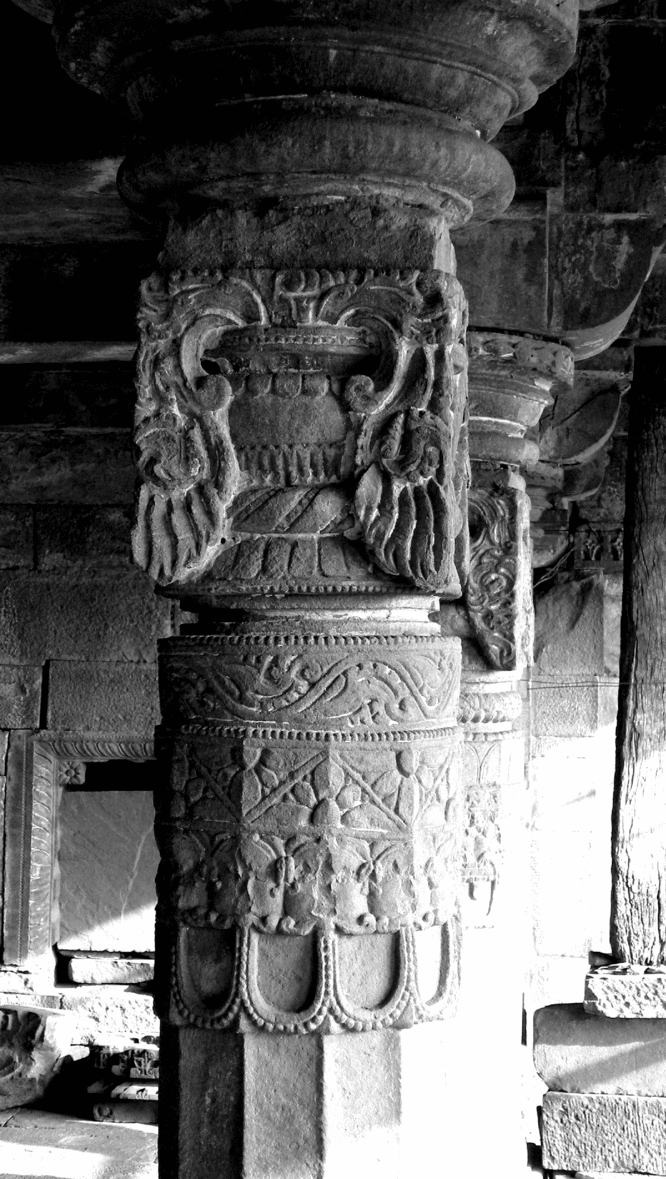
While these proposals are tenable, they lack archaeological precision. In essence, general statements of this kind tell us nothing about the actual history of the Bijamaṇḍal. In the first place, the idea that the temple was converted into a mosque is based on the common story that temples were pulled down to make mosques. Regardless of what may have happened elsewhere, it is safe to conclude that there was no demolition at the Bijamaṇḍal. This is shown by the fact that the temple was left unfinished, something proven by the following points: (a) To judge from the size of the plinth, the Bijamaṇḍal would have been a huge building, equal in size to the largest temples at Khajurāho (Fig. 1). If a structure of this scale was pulled down, one would expect to find hundreds of stone blocks, pillars and architectural parts. However, there are few fragments on the site and in the neighbourhood. There is simply no material at or near the Bijamaṇḍal to show that a large temple stood at this location. To put the matter in simple form: if there was a large temple at Bijamaṇḍal, where has it gone?Footnote 12 (b) The second point showing that the temple was not completed are the large unfinished niches on the plinth, clearly visible in Figure 1. Unfinished sculptures were also found when the base of the structure was cleared of debris in the 1990s. Among the loose pieces was the top of a large gate. This is unfinished on one side, showing the gate was never raised. (c) The pillars used in the mosque include one or two examples of the eleventh or twelfth century, but the majority belong to an earlier time (Fig. 2). The capitals of these pillars have over-flowing pot capitals, with large flowers and drooping petals characteristic of the eighth century. The best preserved building with capitals of this type is the Telikā Mandir in Gwalior, a temple that can be dated to the half of the eighth century.Footnote 13 Now if the Bijamaṇḍal temple was finished in the twelfth century, then we would expect a large number of twelfth-century pillars to have been used when the prayer-hall was built. The small number of twelfth-century pillars and large number of eighth-century pillars shows that pillars of the twelfth century were not available. This confirms that the Bijamaṇḍal was not completed in the time of Naravarman. Why the building was left unfinished may never be known, but it seems likely that the construction was abandoned at the death of Naravarman.
Vidiśā. Bijamaṇḍal, interior. Detail of a pillar, eighth century.

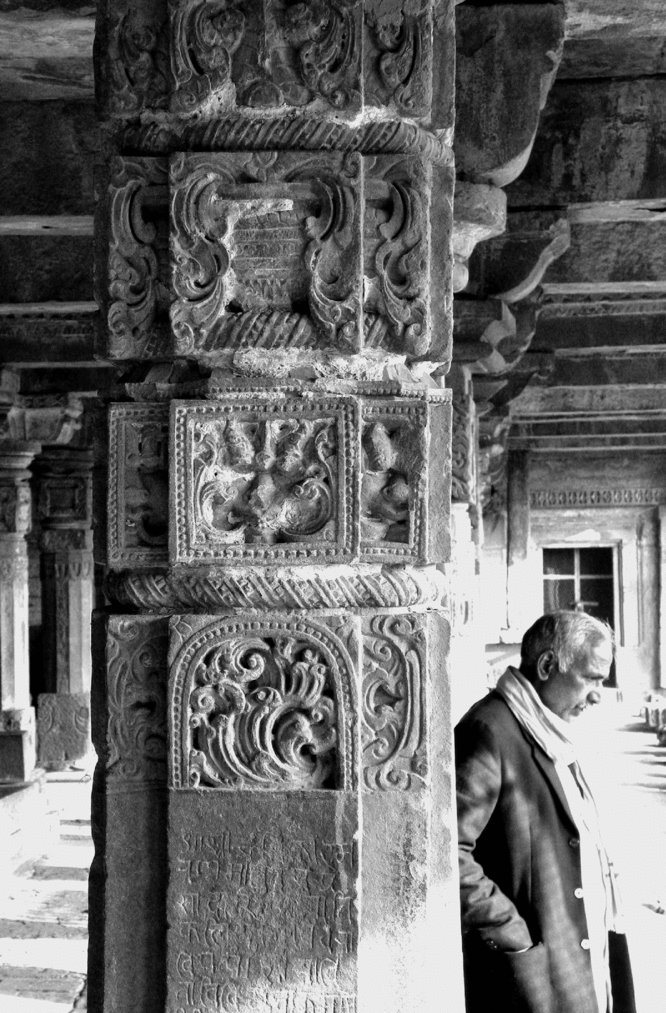
If the temple was left unfinished, the next historical problem is whether the Bijamaṇḍal marks the site of an older temple to Carccikā. The pillar carrying the inscription sheds some light on this problem (Fig. 3). The stylistic development of late Pratīhāra architecture has been argued elsewhere in detail. Following the chronology developed by M. Willis, the Bijamaṇḍal pillar can be placed in the late ninth or early tenth century, that is, coeval with the dated material at Gyāraspur.Footnote 14 In other words, the temple of Carccikā was already two hundred years old by the time of Naravarman. This suggests that when Naravarman adopted Carccikā as his tutelary deity, he began to rebuild her temple on an ambitious scale. This was done in an attempt to construct a building that would do justice to the goddess's new role as the king's special deity. However, as noted already, the building was abandoned. One final problem is the present location of Carccikā. As suggested by Amber in Rājasthān, where the goddess brought from eastern India is actually quite small, we are not necessarily looking for the remains of a huge sculpture. One clear possibility, therefore, is that the image was carried away.Footnote 15 As the rulers of central India were displaced in the fourteenth century, some migrating to different parts of the country, they may have taken the goddess with them as they moved, establishing for her a new temple in their new home.
Vidiśā. Bijamaṇḍal, interior. Detail of the pillar with the inscription of Naravarman, late ninth or early tenth century with later inscription.