Differences in L1 linguistic attention control between monolinguals and bilinguals
A substantial body of literature indicates a bilingual advantage on non-linguistic tasks of executive functioning (e.g. Bialystok, Reference Bialystok2011; Bialystok, Craik, Green & Gollan, Reference Bialystok, Craik, Green and Gollan2009; Costa, Hernández & Sebastián-Gallés, Reference Costa, Hernández and Sebastián-Gallés2008), the underlying mechanisms of which have recently been garnering considerable attention (see Abutalebi & Green, Reference Abutalebi and Green2007; Hilchey & Klein, Reference Hilchey and Klein2011). Quite apart from the discussion of this advantage and its hypothesized origins, there are questions concerning which cognitive aspects of language processing might be affected by bilingualism. Specifically, there is a question of whether the bilingual advantage can be seen in specific linguistic attention control abilities, over and above enhanced executive processing itself. The present research examines whether bilinguals show superior linguistic attention control in their first language compared to monolinguals. Because this paper draws upon research from both cognitive psychology and cognitive linguistics, we will review the effects of bilingualism on executive processing and language abilities, then give an account of some theoretical concepts taken from cognitive linguistics and finally review the brief literature related specifically to linguistic attention control.
Depending on the abilities being investigated, bilinguals have been shown to either over-perform or under-perform compared to their monolingual peers. For example, many studies of vocabulary knowledge report that bilinguals score lower in each of their languages than monolingual speakers of those same languages (for an aggregate analysis see Bialystok & Luk, Reference Bialystok and Luk2012) Additionally, this deficit is found at all ages across the lifespan (Bialystok, Reference Bialystok2001). For instance, studies of language processing in adults have shown disadvantages for bilinguals in tasks that require rapid lexical access and retrieval. That is, even in their dominant language, bilinguals are slower and commit more errors in picture naming, they score lower on verbal-fluency tasks, and experience more interference in lexical decision tasks compared to monolingual participants (for a review see Michael & Gollan, Reference Michael, Gollan, Kroll and de Groot2005).
Although the findings are not consistently replicated (e.g. Kousaie & Phillips, Reference Kousaie and Phillips2012; Paap & Greenberg, Reference Paap and Greenberg2013; see Hilckey & Klein, Reference Hilchey and Klein2011 for a review), there is some evidence that bilingualism may confer an advantage on executive control tasks (e.g. Bialystok, Reference Bialystok2006; Bialystok, Craik, Grady, Chau, Ishii, Gunji & Pantev, Reference Bialystok, Craik, Grady, Chau, Ishii, Gunji and Pantev2005; Bialystok & DePape, Reference Bialystok and DePape2009); For example, research with adults has revealed that bilinguals respond faster than their monolingual counterparts to conflict conditions requiring participants to ignore an irrelevant feature of the stimulus when responding, such as in the incongruent conditions of the Stroop task (Bialystok, Craik & Luk, Reference Bialystok, Craik and Luk2008a), the flanker tasks (Costa et al., Reference Costa, Hernández and Sebastián-Gallés2008; Emmorey, Luk, Pyers & Bialystok, Reference Emmorey, Luk, Pyers and Bialystok2008) and the Simon tasks (Bialystok, Craik, Klein & Viswanathan, Reference Bialystok, Craik, Klein and Viswanathan2004). In other words, bilinguals appear to be less disrupted than monolinguals when required to ignore an irrelevant feature of the stimulus. It has been hypothesized that this “bilingual advantage” stems from a history of managing two concurrently active languages (e.g. Bialystok, Craik & Luk, Reference Bialystok, Craik and Luk2008b; Costa, Hernández, Costa-Faidella & Sebastián-Gallés, Reference Costa, Hernández, Costa-Faidella and Sebastián-Gallés2009; Kroll, Bobb, Misra & Guo, Reference Kroll, Bobb, Misra and Guo2008). Better ability to inhibit conflicting and irrelevant information is thought to be tied to the fact that bilinguals need to hold two lexical representations in mind and inhibit the representation from the irrelevant language (Green, Reference Green1998). Accordingly, research suggests that, for bilinguals, both languages are active when completing word recognition or language production tasks, even when only one language is required (see reviews by Kroll et al., Reference Kroll, Bobb, Misra and Guo2008).
Although having to constantly switch between two language representations may be what confers the advantage in cognitive tasks, most studies demonstrating a bilingual benefit do not examine attention control per se. The majority of these studies fall into the category of inhibition or conflict resolution, rather than controlled switching between task sets. To date, only a handful of studies have directly examined the effects of bilingualism on executive control during task switching, and the results are decidedly mixed, with some studies finding a bilingual switching advantage (for shift cost reaction time: Prior & MacWhinney, Reference Prior and MacWhinney2010, for switch cost accuracy: Garbin, Sanjuan, Forn, Bustamante, Rodriguez-Pujada, Belloch, Hernández, Costa & Avila, Reference Garbin, Sanjuan, Forn, Bustamante, Rodriguez-Pujadas, Belloch, Hernández, Costa and Avila2010), while others have not (Hernández, Martin, Barceló & Costa, Reference Hernández, Martin, Barceló and Costa2013; Paap & Greenberg, Reference Paap and Greenberg2013). Results can also be inconsistent within a study; for instance, an advantage has been found for Spanish–English bilinguals, but not Mandarin–English bilinguals (Prior & Golan, Reference Prior and Gollan2011). Additionally, apart from studies examining switching between languages, no studies have examined task-switching abilities in bilinguals using complex linguistic stimuli. However, it is important to note that the primary goal of the current study is not to examine a possible bilingual advantage in switching per se, but to use a switching task to examine whether speaking two languages affects language performance in a bilingual's first language (L1) compared to monolingual speakers of the same language.
Language is used to draw attention to objects and events by naming them, but it is also used convey how relationships between objects and events are construed by the speaker or writer (Langacker, Reference Langacker1987; Slobin, Reference Slobin, Gumperz and Levinson1996; Talmy, Reference Talmy2000). Talmy (Reference Talmy2000) states that any aspect of a sentence can be highlighted through the “windowing of attention”. For example, the scene of a cat sitting on a chair could be variously described as The cat was sitting on a chair, The chair had a cat sitting on it, and so on. These sentences draw attention to the presence of a cat sitting and of a chair, but attention is directed to different elements (e.g. whether the main focus is the chair or the cat). This “windowing of attention” perspective is related to the longstanding view in the field that language consists of two separate subsystems: the first containing “open-class” elements and the second consisting of “closed-class” elements. Open-class elements are the roots of nouns, verbs and adjectives. They are so called because this category of words can be added to as, for example, recent additions like email, ringtone or computer. Open-class words make up the main content of language. Closed-class elements, on the other hand, make up a much smaller group. This group is generally stable, and difficult to add to. They consist of, but are not limited to, prepositions (e.g. in, with), determiners (e.g. both, some), conjunctions (e.g. and, but) and pronouns (e.g. he, she). Closed-class words provide grammatical relations between content words, and serve a structural purpose. Therefore, it has been proposed that closed-class units are critical elements in determining the structure of language, whereas open-class words generally contribute to the content (Talmy, Reference Talmy2000). Notably, some open-class words, especially verbs, also contribute to shaping the structure of a sentence by, for example, specifying the arguments it takes, and other linguistic devices beyond function words such as word order and the use of inflections also contribute to language structure.
The mechanism within language that directs attention to language itself (i.e. to the concepts and content in a message) is thought to be driven, in large part, by certain relational elements in the closed-class system. These relational devices for directing attention include, among others prepositions, verb aspect, definite and indefinite articles, tense markers and word order. The “referents” of these linguistic elements cannot be experienced in a direct manner (i.e. perceptually) in the way that the referents of nouns, verbs and adjectives can, for example. Instead, these relational devices shape the way the recipient construes the scene. Consider, for example, Owen loved his mother despite her sense of humour compared to Owen loved his mother because of her sense of humour. Despite and because of do not direct attention to specific images or concepts, but they do shape how the reader construes the scene, through defining the relationships amongst the content words. As a message unfolds, attention has to be redirected to the content (semantic information) to update the mental representations. This is done in order to take into account the newly highlighted relationships among the content words. As such, the message receiver, upon encountering these elements, directs the focus of his or her attention frequently and rapidly. The ability to use relational elements to guide attention when processing an incoming message is the main focus of the following study, and has been termed linguistic attention-focusing (Segalowitz, Reference Segalowitz2010).
Especially relevant to this paper is the fact that closed-class words, including relational elements, differ between languages in important ways that open-class words do not (Bowerman, Reference Bowerman, Bloom, Peterson, Nadel and Garrett1996; Bowerman & Choi, Reference Bowerman, Choi, Gentner and Goldin-Meadow2003). This can lead to cross-language processing differences when the speaker attempts to use open-class elements in the second language (L2) as though they functioned in the way they do in the L1 (see De Angelis, Reference De Angelis2005). For example, the preposition à in French can be used in a directional or non-directional sense with expressions of locations or places (e.g. Nous allons à Moncton “We are going to Moncton”, Je suis à l’école “I am at school”). In English, one would use the preposition “to” for a directional sense and “at” for a non-directional sense, a fact that can create problems when French speakers use English (e.g. I was going at school). Content words, on the other hand, generally correspond more on a one-to-one basis. For example, the primary meanings of French avion and English airplane are essentially identical. Additionally, many relational elements also have less concrete meaning such as, He valued honesty above all else, or It was two degrees above freezing. During comprehension, relational elements must be utilized to make sense of the more specific information conveyed by content words. Slobin (Reference Slobin, Gumperz and Levinson1996) hypothesizes that, because relational information must be continually taken into account, it is important that they be expressed by the most structural and obligatory part of language.
The aforementioned ideas regarding relational elements and their attention-directing functions have primarily been based on theoretical linguistic research (e.g. Slobin, l996). However, evidence for dissociable conceptual and structural (or open- and closed-class) systems of language comes from a number of different sources. For example, a number of studies suggest that content and function words may be processed differently during reading. Eye-movement studies have shown that function words are less likely to be fixated during reading of passages (e.g. Chamberland, Saint-Aubin & Légère, Reference Chamberland, Saint-Aubin and Légère2013; Gautier, O’Regan & Gargasson, Reference Gautier, O’Regan and Le Gargasson2000; Roy-Charland, Saint-Aubin, Klein & Lawrence, Reference Roy-Charland, Saint-Aubin, Klein and Lawrence2007). Neuroimaging data shows that the two systems produce different electrophysiological responses. For example, several EEG studies have found that a component called N280 was evoked by closed-class words (Munte, Wieringa, Weyertes, Szentkuti, Matzke & Johannes, Reference Munte, Wieringa, Weyerts, Szentkuti, Matzke and Johannes2001; Neville, Mills & Lawson, Reference Neville, Mills and Lawson1992; Nobre & McCarthy, Reference Nobre and McCarthy1994) whereas an N400 (Nobre & McCarthy, Reference Nobre and McCarthy1994; Van Petten & Kutas, Reference Van Petten and Kutas1991) was evoked only by open-class words. Positron emission tomography studies indicate activation in response to syntactic complexity in different parts of Brodmann area 44 (Caplan, Reference Caplan2001), and functional magnetic resonance imaging experiments (Friederici, Opitz & von Cramon, Reference Friederici, Opitz and Cramon2000; Friederici, Ruschemeyer, Hahne & Fiebach, Reference Friederici, Ruschemeyer, Hahne and Fiebach2003) and the analysis of evoked magnetic fields (Wang, Xiang, Kotecha, Vannest, Liu, Rose, Schapir & Degrauw, Reference Wang, Xiang, Kotecha, Vannest, Liu, Rose, Schapir and Degrauw2008) have shown that the processing of open- and closed-class words may be functionally and structurally separate. Additionally, people suffering from agrammatic aphasia have deficits in the production and comprehension of closed-class units while the open-class system remains intact (Biassou, Obler, Nespoulous, Dordain & Harris, Reference Biassou, Obler, Nespoulous, Dordain and Harris1997; Froud, Reference Froud2001; Swinney, Zurif & Cutler, Reference Swinney, Zurif and Cutler1980).
Some experimental studies of the role of attention in organizing the production of relational elements have also been conducted. For example, Tomlin (Reference Tomlin, Nuyts and Pederson1997) designed a computer animation program called the “Fish Film”. Participants were asked to describe a movie about a darkly coloured fish and a lightly coloured fish as it occurred in real time. In each trial one of the two fish was visually cued in order to attract the participants’ attention. During the movie, one fish ate the other. Results indicated that English speakers varied their sentences based on which fish had been visually cued (Tomlin, Reference Tomlin, Nuyts and Pederson1997). When the dark fish was cued and was then eaten by the light fish the participants said, The dark fish was eaten by the light fish. However, in the same scenario, if the light coloured fish was cued, participants described the scene as, The light fish ate the dark fish. Attention to the cue influenced the choice of the syntactic subject of the sentence and the choice of grammatical voice that mapped onto this assignment.
An additional account comes from Nappa and colleagues (Nappa, January, Gleitman & Trueswell, Reference Nappa, January, Gleitman, Trueswell, Forbus, Gentner and Regier2004) who presented participants with scenes that could be described differently, depending on the use of relational elements (e.g. A dog is chasing a man/A man is running from a dog). Similar to the Fish Film studies, one of the characters was cued. In Study 1 this was done with a cross hair, while Study 2 used a subliminal attention-capture cue. In both studies, participants employed the appropriate relational elements and word order to construct sentences wherein the cued character was the primary subject of the sentence, even when the sentence would not normally be constructed in that manner. For example, most people would naturally say, The man gave the woman a present, rather than The woman received a present from the man, because of the active nature of the verb. In these studies, if the woman had been cued (even subliminally) participants more often produced the latter of the two sentences. These results demonstrate that underlying the grammatical choice there is an attentional component, which illustrates how the cognitive system influences language.
To summarize thus far, the relational elements of language serve to direct and focus one's attention on the possible relationships between elements of linguistic content. These relational elements tend to be represented differently across languages and, thus, a bilingual speaker may process these elements differently from a monolingual speaker, even when comparing relational elements from one's native language. The aim of the current study is to investigate the L1 processing skills of bilinguals versus monolinguals in tasks hypothesized to make linguistic attention-focusing demands. The studies reviewed in the following paragraphs have operationalized linguistic attention focusing by employing a modified version of Rogers and Monsell's (Reference Rogers and Monsell1995) alternating-runs design. Prior to describing them, it is important to briefly review previous research concerning the effects of bilingualism on task-switching.
Recently, Taube-Schiff and Segalowitz (Reference Taube-Schiff and Segalowitz2005a) examined people's ability to switch between the attention-focusing properties of relational elements in one's native language. English monolingual participants switched between two tasks – Task A (making a verticality judgment, e.g. “above”–“below”) and Task B (making a proximity judgment, e.g. “near”–“far”) – in a predictable AABBAABB sequence. Every second trial was a repeat (R) of the previous task type or a switch (S) to the other task type, resulting in an SRSRSR sequence. This sequence allowed the comparison of reaction times (RT) for Repeat and Switch trials within a single condition and, as a result, a shift cost (Switch RT minus Repeat RT) could be calculated. Taube-Schiff and Segalowitz (Reference Taube-Schiff and Segalowitz2005a) found significant shift costs for the relational stimuli, indicating that their implementation of an alternating-runs design was successful in eliciting costs in switching between these attention-demanding linguistic elements.
Segalowitz and Frenkiel-Fishman (Reference Segalowitz and Frenkiel-Fishman2005) used an alternating-runs design similar to that of Taube-Schiff and Segalowitz (Reference Taube-Schiff and Segalowitz2005a) with decontextualized relational stimuli (time adverbials such as “now”, “later” and causal conjunctions such as “because”, “despite”), in order to examine whether linguistic attention control was a significant factor underlying bilingual proficiency. Their results showed that, in a participant's L2, shift costs for relational words correlated strongly with L2 proficiency after controlling for performance in the L1.
In a third study, Taube-Schiff and Segalowitz (Reference Taube-Schiff and Segalowitz2005b) hypothesized that attention control differences in the processing of relational elements may exist between an asymmetrical bilingual's dominant L1 and weaker L2. They had participants complete a relational and non-relational condition, in L1 and L2, using stimuli contextualized in short phrases. As in Taube-Schiff and Segalowitz (Reference Taube-Schiff and Segalowitz2005a), participants switched between classifying spatial location in the vertical dimension (as “higher” or “lower”) and relative spatial proximity (as “close” or “distant”). For the non-relational condition, the switch was between classifying types of vehicles (as being “two-wheeled” or “four-wheeled”) and modes of transportation (as involving “air travel” or “sea travel”). This was done separately in L1 and L2 blocks. Participants showed significantly lower attention control (larger shift costs) for relational words in the L2 block compared to those in L1, and no difference between L1 and L2 shift costs for non-relational (content) words.
Based on these results, and the results from Segalowitz and Frenkiel-Fishman (Reference Segalowitz and Frenkiel-Fishman2005), Taube-Schiff and Segalowitz (Reference Taube-Schiff and Segalowitz2005b) concluded that shift costs in the L2 for non-relational words were not related to the participants’ language skill because they obtained the same effect for the dominant L1 and weaker L2. Therefore the shift costs likely reflected general (i.e. non-linguistic) attention abilities to switch tasks between concept categories (similar, for example, to the letter-digit categories in Rogers & Monsell, Reference Rogers and Monsell1995). In contrast, shift costs for relational stimuli were related to language skill such that smaller switch costs were found for L1 compared to L2. Thus, this was taken as evidence for linguistic-specific attention focussing.
In summary, previous research reports a bilingual advantage in various non-linguistic cognitive abilities; however, to date no study has directly examined a potential language group difference in attention control as it pertains to language processing skills per se and, in particular, to a bilingual's L1. As noted, Segalowitz and colleagues (Segalowitz & Frenkiel-Fishman, Reference Segalowitz and Frenkiel-Fishman2005; Taube-Schiff & Segalowitz, Reference Taube-Schiff and Segalowitz2005a; Reference Taube-Schiff and Segalowitz2005b) reported results suggesting the existence of a form of linguistic attention that is specific to the relational elements of language and that is related to linguistic proficiency in one's L2. This suggests that the processing demands of linguistic attention are influenced by language experience. However, what past research has not examined is whether bilinguals show greater linguistic attention focusing, in the form of lower shift costs on relational elements (as compared to non-relational) than monolinguals, in their “first” language. We therefore designed the present study to compare English monolinguals’ and English–French bilinguals’ ability to switch between relational elements in the first language.
Present study
In the present experiment we used an alternating-runs design similar to that of Taube-Schiff and Segalowitz (Reference Taube-Schiff and Segalowitz2005b), with relational (function words) and non-relational (content words) conditions. We combined the relational and non-relational stimuli in each sentence, so that the stimulus sentences were identical across the two conditions, thereby eliminating any differences between the conditions that could be caused by sentence length or difficulty. In addition, every trial in each condition contained task-relevant and task-irrelevant stimuli, eliciting the need for conflict resolution (similar in logic to the incongruent condition in Roger & Monsell, Reference Rogers and Monsell1995). Each sentence contained a verticality and a proximity function word (relevant for the relational condition) and a size and a category word (relevant for the non-relational condition), along with filler words. For example, They located the little watch far above the window, contains the verticality preposition above, the proximity adverb far, an adjective indicating the size small and the noun watch, which is an inanimate object. For the relational block, in one subtask participants were cued to respond to the proximity adverbs embedded in the sentences (way, far; a bit, just), and in the second subtask they were cued to respond to the verticality prepositions (above, over; below, under). As in Taube-Schiff and Segalowitz (Reference Taube-Schiff and Segalowitz2005b), the non-relational word condition was used as a control block in order to account for general attention control abilities when using non-relational linguistic stimuli. In this condition, participants were cued to respond to either the size adjective (tiny, small; big, fat) or to noun animacy (watch, glove; dog, pig). For both the relational (proximity, verticality) and the non-relational word (size, category) conditions, subtasks followed an AABB alternating-runs design, such that every other trial was either a repeat or a switch trial. Switch trials, as compared to repeat trials, required the participant to shift task sets (in the relational condition from proximity to verticality or vice versa, and in the non-relational condition from size to category or vice versa). These shifts put a burden on the attention control system, resulting in increased reaction times to switch trials as compared to repeat trials. In the current study, we would posit that the relational condition contains an additional attentional burden in that participants are taxed by the attention focusing required by the relational elements over and above the attentional burden required to shift task set. As such, we hypothesize a larger shift cost in the relational condition (where two forms of attention control are required) as compared to the non-relational condition (where a form of more general attention control is required).
Taube-Schiff and Segalowitz (Reference Taube-Schiff and Segalowitz2005a, Reference Taube-Schiff and Segalowitzb), found significant shift costs using similar stimuli embedded in short sentence fragments. The present experiment attempted to replicate this finding, by comparing the L1 performance of bilingual and monolingual participants, using complete sentences, identical in all subtasks in all conditions. Furthermore, the current study directly compared the performance of monolinguals and bilinguals on the L1 version of the task. The rationale for this direct comparison is to examine whether a bilingual advantage will be found for linguistic attention focusing. We also had participants perform several neuropsychological tasks, measuring linguistic and executive control abilities, in order to characterize the two groups on cognitive abilities such as working memory, language proficiency, cognitive conflict resolution, and executive function.
Method
Participants
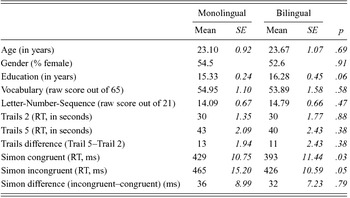
Forty-one adults, ranging in age from 18 to 35 years were tested. Of this group, 22 were English monolinguals (mean age = 23.10, SD = 4.2; female = 12, male = 10), and 19 were English–French bilinguals (mean age = 23.67, SD = 4.6; female = 10, male = 9). Further demographic and cognitive information is summarized in Table 1. Participants were paid CAD$10/hour or received partial credit for course fulfilment for taking part. Inclusion criteria for all participants included self-reported good health, and no prior history of head injury, medical illness, or chronic use of medication that might affect cognitive functioning.
Means and standard error for group demographics and neuropsychological tasks.

Language-related inclusion criteria for bilinguals required moderate to high proficiency in L2 (French) and high proficiency in L1 (English), measured using self-report, and a computerized semantic categorization task (administered during the testing session). Since the neural mechanisms underlying language processing in multilinguals are yet to be fully understood (Abutalebi, Cappa & Perani, Reference Abutalebi, Cappa and Perani2001), only participants with minimal competency in additional languages were retained for the study in order to reduce any possible confounds due to multilingualism. Within the bilingual group, 10 participants reported having learned English first, 7 learned the two languages simultaneously and 2 reported that they had learned French first; however, all bilingual participants rated English to be their dominant language, and they either had attended or were currently attending university in English. As such, in this study, L1 refers to English for all participants. All bilinguals had learned their L2 (French) by the age of nine, and were actively using their L2 in at least one area of their life (e.g. at work, in their home and/or with friends). For monolinguals, some exposure to French was allowed (e.g. taking one or two beginner courses while in school) – given that the majority of Canadians have some exposure to basic French – as long as the participants did not consider themselves fluent or bilingual, or use French regularly in any area of their life.
Self-reported language abilities
Bilingual participants rated themselves on a five-point Likert-type scale for ability in reading, speaking, understanding and writing (where 1 = no ability and 5 = native-like ability) in L1 (English: M = 4.9, SD = 0.03) and L2 (French: M = 4.5, SD = 0.13), confirming that L1 was indeed their dominant language, t(1,17) = 3.908; p = .001. Although self-rated proficiency in L1 was higher than L2, L2 was also quite high, supporting the fact that they were indeed highly proficient. Monolingual participants’ ratings on the five-point scale were significantly higher for L1 (English: M = 5.0, SD = 0.00) than for L2 (French: M = 1.3, SD = 0.55), t(1,18) = 29.265; p < .001, indicating that they had minimal fluency in their L2.
Semantic categorization task
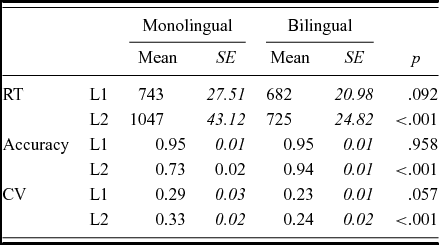
Monolinguals and bilinguals also completed a computerized semantic categorization task (Phillips, Segalowitz, O’Brien & Yamasaki, Reference Phillips, Segalowitz, O’Brien and Yamasaki2004; Segalowitz, Reference Segalowitz2010; Segalowitz & Frenkiel-Fishman, Reference Segalowitz and Frenkiel-Fishman2005) to objectively assess their L1 and L2 abilities. Mean and standard error for reaction time (RT), accuracy, and coefficient of variation (CV) can be seen in Table 2.
Mean and standard error for RT, accuracy and CV data for the semantic categorization task for monolinguals and bilinguals.

Participants were asked to classify words as referring to an animate or inanimate object in separate L1 and L2 blocks. Reaction time in the L1 and L2 conditions was used as a measure of lexical access measurements, while the CV (intra-participant CV, defined as the participants’ SD/(mean RT)) provided a measure of the efficiency, or stability, of lexical access (Segalowitz, Reference Segalowitz2010, Chapter 4; see Segalowitz & Freed, Reference Segalowitz and Freed2004 for evidence that these measures correlate significantly with L2 speaking ability). For completeness, monolingual participants also completed both language blocks and the RT and CV results were used as further confirmation of their lack of L2 language ability.
For the RT data, the L1 means were significantly faster than L2 means for the bilinguals (p = .004). Bilinguals were equally accurate in the two language conditions (p = .256), and performed equally stably in the two languages (p = .431) indicating that they were highly proficient in both of their languages. Importantly, the bilinguals did not differ from the monolinguals in RT (p = .092), accuracy (p = .958) or CV (p = .058) for the L1 block of the task, indicating no significant group differences in L1 proficiency and allowing us to compare the performance of the groups on the L1 experimental task. Monolinguals showed better L1 than L2 scores for RT accuracy and CV measures, (p < .05).Footnote 1
Apparatus
All computerized tasks were presented using Inquisit (Millisecond Software, Version 2.0.61004.7) on a Dell Computer with a 33 cm ×24 cm screen. Participants responded to stimuli using a Logitech gamepad.
Measures
CTMT (Reynolds, Reference Reynolds2002). The Comprehensive Trail-Making Test (CTMT) is a standardized set of five sequencing and visual search tasks. Participants must connect a series of stimuli (Trails 1–3: numbers, Trail 4: numbers expressed as numerals or in word form, Trail 5: numbers and letters) in a specified order as quickly as possible. For this study, we analyzed only Trails 2 and 5. A CTMT difference score (Trail 5 RT minus Trail 2 RT) provides a measure of switching ability, while taking baseline performance into account.
Wechsler Adult Intelligence Scale III (WAIS-III) tasks: LNS & Vocabulary (Wechsler, Reference Wechsler1997)
These tasks were administered according to standardized procedures. The Letter-Number Sequencing (LNS) task assesses working memory and attention. Participants must repeat back increasingly longer series of number and letters, while putting the numbers in numerical order, followed by the letters in alphabetical order. The vocabulary task assesses the ability to comprehend and verbally express vocabulary.
The Simon Task (Bialystok et al., Reference Bialystok, Craik, Klein and Viswanathan2004; Simon & Rudell, Reference Simon and Rudell1967)
This task was used to assess inhibition of an irrelevant stimulus feature (spatial location), and to permit comparison with previous findings noting a bilingual advantage on incongruent compared to congruent trials (e.g. Bialystok et al., Reference Bialystok, Craik, Klein and Viswanathan2004).
Linguistic attention-control task
The present task was a modified version of the design of Taube-Schiff and Segalowitz (Reference Taube-Schiff and Segalowitz2005b), patterned after the Rogers and Monsell (Reference Rogers and Monsell1995) alternating-runs design. Stimuli can be seen in Appendix 1. The main task consisted of a relational and a non-relational condition, each containing two subtasks (A and B). For each condition, the subtasks alternated in an AABB design, such that every other trial was a task repetition (e.g. AABB) or a switch (e.g. AABB). Shift costs are the difference between the RT on repeat trials and those on shift trials. On each trial, a written cue indicating which task to perform appeared at the top of the screen. After 1300 ms, a sentence appeared in the middle of the screen and remained on screen until a response was made. The next trial began after a 250 ms post-trial pause. In order to minimize working memory load, we placed response key assignment reminders at the bottom left and right side of the screen, corresponding to the left and right response buttons on the game pad. In each condition, the key assignment reminders for both tasks remained visible at all times.
The same set of sentences was used in the relational and non-relational word conditions; only the cue indicating which task to perform was different. As such, each sentence afforded any of the four judgment tasks.
The sentences were presented in white Arial font, of 30 logical units in height and a font weight of 700, against a black background. Each sentence had the surface form “Pronoun + past tense verb (indicating a searching action) + “the” + adjective (indicating size) + noun (object of the verb) + relational adverb (indicating proximity) + spatial preposition (indicating vertical position) + “the” + noun (filler word indicating location)”. For example, the sentence could be They located the tiny glove far above the window.
Sentences were constructed a priori in a counterbalanced manner to ensure that all target stimuli were equally often paired together, and equally paired with the filler words. One constraint on counterbalancing was that the stimuli for the two subtasks in each condition were always incongruent with respect to their stimulus-response mappings. As a result, the words indicating large size were always paired with the animal category, small size with the object category, distant with higher spatial location and close with lower. The rationale for this is that all stimulus-response mappings were incongruent, a manipulation known to increase shift cost (Rogers & Monsell, Reference Rogers and Monsell1995).
Task cue words were either red or blue, and written in capital letters, Arial font of 52 logical units in height and a font weight of 800. The cues for the relational condition tasks were the words position and distance. The cues for the non-relational condition tasks were the words category and size. The key assignment reminders corresponded in colour to the relevant task cue. The reminders for the relational tasks were higher, lower, close, distant, and for the non-relational tasks were animal and object, big and small.
Monolingual participants completed the two conditions in English, whereas bilingual participants also completed French versions of the two conditions (results not reported here), for a total of four conditions. A training stage was completed prior to each experimental block. In the training stages, participants practiced each sub-task separately, in order to become accustomed to the task cues and key reminders. Participants completed enough training trials of each task to demonstrate that they understood the task, as determined by the experimenter. Following this, participants completed practice trials simulating the experimental conditions. The practice trials required switching between the two tasks (following an AABB pattern), and also contained “catch trials”. Catch trials were used to encourage participants to read the entire sentence. In a catch trial, a random, non-stimulus word was misspelled. To move past a catch trial, and on to the next trial, required the participant to press the “3” key on the gamepad.
The experimental conditions consisted of 72 experimental trials plus 24 warm-up trials, 12 at the beginning of the condition, and 12 after a break in the middle. Within each of the 12 warm-up trials there were four catch trials. All trials were presented in a counterbalanced manner to account for left and right side responses (no more than four consecutive left or right button presses were ever required). Key assignment and order of conditions were counterbalanced across participants.
Procedure
Participants were contacted by phone to complete a Language and Health Questionnaire to assess that they met all inclusion/exclusion criteria. Participants who met the criteria were tested on one occasion, lasting 1.5–2 hours for bilingual participants, and 1 hour for monolingual participants. The semantic categorization task was administered first, to determine level of proficiency in the two languages. Next, participants completed one practice and one experimental condition of the language-switching task. The order of the conditions was counterbalanced so that half of the monolingual participants completed the relational condition first and half received the non-relational condition first. For the bilingual participants, the order was further divided so that half of the participants completed the L2 conditions first, and half completed the L1 conditions first.
Results
For all statistical tests reported below, the alpha level for significance was set at .05. All t-tests are two-tailed.
Table 1 presents the means and standard errors for all neuropsychological tasks. Independent t-tests revealed that the two language groups did not differ on the Vocabulary task (p = .578), the LNS task (p = .467), or the Comprehensive Trail Making test (Trail 2, p = .881; Trail 5, p = .378; Trail 5–Trail 2, p = .380), but did differ on the Simon task such that bilinguals performed significantly faster than monolinguals on both trial types (congruent trials, p = .029; incongruent trials, p = .048). Importantly, both language groups showed a Simon effect (longer RT on the incongruent trials as compared to the congruent trials; monolinguals, p = .001; bilinguals, p < .001), but the magnitude of the Simon effect did not differ between the groups (p = .781).
L1 Linguistic attention control
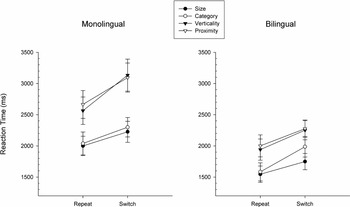
Turning to the main experimental task, only RTs on trials on which a participant responded correctly were used to calculate the means. To remove outliers within each participant's data set, responses faster than 200 ms and slower than two standard deviations above the mean were removed. The means were calculated separately for each of the eight conditions formed by crossing task (proximity, verticality, size, category) by trial type (repeat or switch). Figure 1 represents the means and standard errors for RT for each of the eight conditions, for the two participant groups.
Reaction time (ms) for the Repeat and Switch trials for all trial types (size, category, verticality, proximity) for the Monolingual (left panel) and Bilingual (right panel) groups in L1. Error bars indicate standard error.

Although our overall goal was to examine group differences in shift costs for the relational (proximity and verticality sub-tasks) and non-relational (size and category sub-tasks) conditions, we first had to verify that each sub-task within those conditions elicited a significant shift cost. That is, we needed to verify that RTs on switch trials were significantly slower than on repeat trials within each sub-task type. If so, then we would then be justified in collapsing the two levels of each task together to form fuller data sets for the relational and non-relational conditions. To examine this issue we ran a 2 × 4 × 2 repeated measures ANOVAs, with trial (repeat, switch) and task (proximity, verticality, category, size) as within-subjects factors, and language group (bilingual, monolingual) as a between-subjects factor.
Overall, there was a significant effect of group such that bilinguals performed significantly more quickly than monolinguals, F(1,39) = 6.381, p = .016. There was a significant effect of trial, with performance on switch trials being significantly slower than that on repeat trials, F(1,39) = 79.6, p < .001. There was also a significant task effect, F(3,117) = 30.6, p < .001, and a significant task × trial interaction, F(3,117) = 3.0, p = .033. Although the interaction between task, trial and language group only approached significance, F(3,117) = 2.6, p = .055, analysis of pairwise comparisons indicated that, within each language group, each Task type engendered a shift cost (switch trials had longer RTs than repeat trials), all p < .012. Additionally, pairwise comparisons indicate that, within each language group, the task types that we were interested in collapsing (proximity and verticality into relational, and category and size into non-relational) did not differ from each other for either the repeat trials (all p > .095) or the switch trials (p > .397), except for one instance. For the bilinguals specifically, switch trials of the category and size task types differed significantly (p = .015), with slower RT on the category trials. Therefore, although we collapse the category and size data for the following analyses, we also repeat the analyses, examining shift costs for the four task types separately.
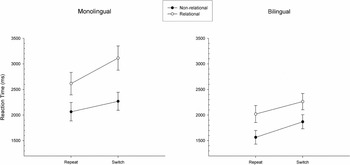
Next we examined the repeat and switch trials for the trial types combined into conditions (relational and non-relational; see Figure 2). Overall, there was a significant effect of group such that bilinguals performed significantly more quickly than monolinguals, F(1,39) = 6.381, p = .016. There was a significant effect of trial, with performance on switch trials being significantly slower than that on repeat trials, F(1,39) = 79.6, p < .001. There was also a significant effect of condition, F(1,39) = 36.1, p < .001, and a significant condition × trial interaction, F(1,39) = 7.2, p = .011. Finally, there was an interaction between condition, trial, and language group, F(1,39) = 8.371, p = .006. This interaction essentially mirrored the main effects above, with the bilinguals performing faster than the monolinguals in all cells (p's < .043) with the exception of switch non-relational trials, where the effect was only marginal (p = .072).
Reaction time (ms) for the Repeat and Switch trials of the relational and non-relational conditions for the Monolingual and Bilingual groups in L1. Error bars indicate standard error.

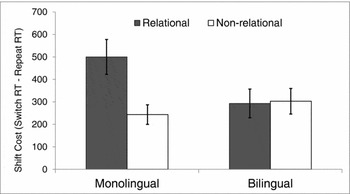
To examine group differences in shift costs for the collapsed relational and non-relational conditions (Figure 3), we calculated a shift cost for each task type (switch RT minus repeat RT) and conducted a repeated-measures ANOVA. The main effect of group did not reach significance: F(1,39) = 0.96, p = .332. The main effect of condition was significant, F(1,39) = 7.2, p = .011, with a higher mean shift cost on the relational condition than the non-relational condition. The interaction between group and condition was also significant: F(1,39) = 8.4, p = .006. Planned comparisons revealed that for monolinguals (Figure 3, left panel), shift costs were significantly larger in the relational condition compared to the non-relational condition, (relational = 499.84 ms; non-relational = 234.44 ms), F(1,39) = 16.7, p < .001, whereas, for the bilinguals (Figure 3, right panel), there was no significant difference between shift costs in the relational and non-relational conditions, (relational = 292.99 ms; non-relational = 302.93 ms), F(1,39) = 0.02, p = .884. Additionally, while the monolinguals and bilinguals did not differ significantly on the non-relational condition, F(1,39) = 0.7, p = .405, the difference between groups for the relational condition fell just shy of the designated alpha-level for significance, F(1,39) = 4.1, p = .051, with the bilinguals having a smaller relational shift cost compared to the monolinguals.
Shift Costs (i.e. Switch RT (ms) minus Repeat RT (ms)) for the relational and non-relational conditions for the Monolingual (left panel) and Bilingual (right panel) groups in L1. Error bars indicate standard error. Note the larger shift cost in the relational condition versus the non-relational condition for the Monolingual group. In contrast, for the Bilingual group, the relational switch cost is lower and is not reliably different from the non-relational switch cost.

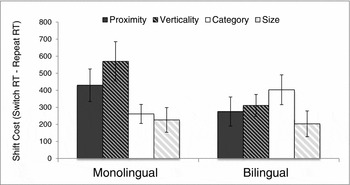
As stated above, because we found that the category and size switch trials differed for the bilinguals, we examined the pattern of shift costs across the four subtask types (Figure 4) rather than collapsing them into relational and non-relational conditions. Therefore we conducted a 4 × 2 repeated measures ANOVA, with task (proximity, verticality, category, size) as a within-subjects factor and language group (bilingual, monolingual) as a between-subjects factor. The main effect of group did not reach significance, F(1,39) = 0.96, p = .332. The main effect of task type was significant, F(3,117) = 3.0, p = .033. The interaction between group and condition trended towards significant, F(3,117) = 2.6, p = .055. Simple effects revealed that for monolinguals, shift costs did not differ between the two non-relational subtasks (size and category: p = .731), nor between the two relational subtasks (proximity and verticality: p = .239); however, the two classes of subtasks generally differed from each other. That is, the non-relational size and category subtasks differed from the relational verticality subtask (p < .001, and p = .016), and generally differed from proximity (size and proximity: p = .027; category and proximity: p = .086). For bilinguals, none of the shift costs differed from each other. Specifically, the non-relational subtasks were not different from each other (size and category: p = .077), nor were the relational subtasks (proximity and verticality: p = .777). Also, the two classes of subtasks did not differ from each other. That is, the non-relational size and category subtasks did not differ from the relational verticality subtask (p = .266, and p = .456), nor from proximity (size and proximity: p = .488; category and proximity: p = .223). This analysis tells us that although the category and size switch trials are significantly different from each other for the bilinguals,Footnote 2 each of the task types follows the pattern of the main shift cost analysis: bilinguals do not show a difference between relational (whether category and size are combined or analysed separately) and non-relational shift costs.
Shift Costs (i.e. Switch RT (ms) minus Repeat RT (ms)) for the proximity, verticality, category, and size task types for the Monolingual and Bilingual groups in L1. Error bars indicate standard error. Note the larger shift cost in the between the task types that make up the relational condition (proximity and verticality) versus the task types that make up the non-relational condition (category and size) for the Monolingual group. In contrast, for the Bilingual group, none of the shift costs are reliably different.

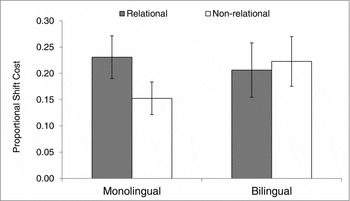
The majority of studies examining task shifting tend to use the shift cost as their main variable for analysis; however, recent research has indicated that the bilingual benefit seen in executive functioning tasks may often be better described as an overall benefit in speed of responding, regardless of the trial type (see Hilchey & Klein, Reference Hilchey and Klein2011). Given that our bilinguals were indeed faster overall than the monolinguals, we wanted to ensure that the same pattern of results could be observed even after accounting for baseline speed differences between the groups. To do so, a proportional shift cost was calculated using switch RT minus repeat RT, divided by repeat RT. The resulting means are shown in Figure 5. We ran the same 2 × 2 ANOVA on the proportional shift costs, with condition (relational, non-relational) as a within-subjects factor and group (monolinguals, bilinguals) as a between-subjects factor. Similar to the results above, planned comparisons revealed that, for monolinguals, proportional shift costs were significantly larger in the relational condition compared to the non-relational condition, (relational = 0.23; non-relational = 0.15), F(1,39) = 4.1, p = .050, whereas for the bilinguals, there was no significant difference between proportional shift costs in the relational and non-relational conditions, (relational = 0.21; non-relational = 0.22), F(1,39) = 0.2, p = .695. These results confirm that the patterns in the RT analysis reported earlier did not reflect baseline speed differences. The monolinguals and bilinguals did not differ significantly on the non-relational condition, F(1,39) = 0.1, p = .709, nor the relational condition, F(1,39) = 1.6, p = .211.
Proportional Shift Costs (i.e. Switch RT (ms) minus Repeat RT (ms) divided by Repeat RT (ms)) for the relational and non-relational conditions for the Monolingual and Bilingual groups in L1. Error bars indicate standard error. Note the larger proportional shift cost in the relational condition versus the non-relational condition for the Monolingual group. In contrast, for the Bilingual group, the relational switch cost is lower and is not reliably different from the non-relational switch cost.

The RT analysis reported above showed that there was a reliable difference for monolinguals in the magnitude of the shift costs engendered by the two sub-tasks within a given condition but not for bilinguals. This suggests that the groups were responding in qualitatively different ways to the two conditions. For the monolinguals, switching within the relational condition was significantly more costly than in the non-relational condition, whereas for the bilinguals, the shift cost in the relational condition did not differ from the non-relational condition. The similarity in the magnitude of the shift costs in the relational and non-relational condition for the bilinguals is consistent with the idea that similar mechanisms might underlie the two costs, whereas the mechanisms might be different in the monolinguals. In order to investigate this possibility, we conducted correlational analyses to determine whether performance on the relational task was independent from performance on the non-relational task. Bivariate correlations between relational and non-relational shift costs were performed for the two groups separately. For the bilingual group the relational and non-relational shift costs were highly correlated, r = .626, p = .004, whereas for the monolingual group the two types of shift costs were not significantly correlated, r = .397, p = .067.
Discussion
The main goal of the study was to address the question of whether bilinguals demonstrate better linguistic attention control in their L1 than monolinguals, due to their experience dealing with different linguistic devices from the relational systems in their two languages. Better linguistic attention control was defined as showing no additional burden on the attention control system when dealing with relational elements of language as compared to non-relational elements. As such, our key question was not whether the two language groups would differ on a task-by-task comparison, but whether, within a group, they treat relational versus non-relational stimuli differently. That is, our goal was to examine how the two stimuli types were processed within each language group. The major findings from this study were that monolinguals had larger shift costs when dealing with relational stimuli as compared to non-relational stimuli, whereas bilinguals showed no difference in shift cost for the two types of stimuli. In other words, the bilinguals were not disadvantaged by the relational stimuli (compared to the non-relational stimuli) as the monolinguals were. Although the goal of our study was not to demonstrate a bilingual “benefit” in processing relational stimuli when comparing bilinguals to monolinguals, it is nevertheless interesting that the magnitude of the shift cost for the relational stimuli was smaller for the bilinguals than the monolinguals when simple cost RTs were compared. Relatedly, we found that performance in the two conditions was highly correlated for bilinguals but was not reliably so for the monolinguals. These findings will be interpreted in turn.
Recall that our conceptualization of the two tasks is the following. The non-relational (semantic) task was designed to elicit switching between task sets in a more general manner, similar to a letter-digit judgment task (albeit with words embedded in whole sentences) that has been used in previous task-switching research (e.g. Rogers & Monsell, Reference Rogers and Monsell1995), where the stimulus items had referents with clear category membership (e.g. vowel, consonant). In contrast, our relational switching task was designed to examine switching between words that direct attentional focus between the relationships between words. In other words, our relational word condition is likely to have imposed a two-fold demand on attentional resources, one for switching between task sets and the other for handling the linguistic attention-focusing demands of the relational word stimuli. We argue that the non-relational word stimuli do not carry these second, linguistic attention-focusing demands. Thus, each task involves an attention control demand, which is to focus attention on the correct task set. In the non-relational case, the task set itself just involves processing simple word meaning. However, in the relational condition, the task sets involve further control of attention (directed by words in the sentence) to the relationships between. Thus, language-specific attention control must be utilized.
As mentioned, the planned comparisons on the shift cost data showed that, for the monolingual group, shift costs were significantly larger in the relational than non-relational word condition. Thus, for the monolinguals, switching between making decisions based on different types of relational information embedded in sentences was more costly than switching between making decisions based on different types of non-relation information. For bilinguals, shift costs did not differ between the two conditions, indicating that they were not additionally burdened by having to switch between making decisions on different types of relational words compared to non-relational words. This is consistent with our hypothesis that bilingualism leads to a difference in linguistic attention control even in one's L1. While the monolingual group showed an increased burden on attention control when switching between relational elements of language (as compared to switching between the non-relational words), the bilingual group performed similarly in the two conditions and switching in the relational condition was less costly for them than it was for the monolinguals. It is of course, important to note that bilinguals were overall faster than monolinguals on both our linguistic attention control task and on the Simon task. As previous research has suggested that the bilingual benefit seen on executive function tasks may be due to faster processing speed (Hilchey & Klein, Reference Hilchey and Klein2011), we felt it important to examine proportional costs (which take baseline speed into account using repeat trials).
Until this point, our approach to interpreting the data has been with a focus on whether switching between the relational stimuli was more or less costly compared to the non-relational stimuli in the bilinguals compared to the monolinguals. Indeed, this viewpoint shows that switching between the relational stimuli is more costly than switching between the non-relational stimuli, but only for the monolinguals (Figures 3 and 5). However, inspection of the proportional data suggests that there is another way to conceptualize the data. The proportional shift cost analysis (Figure 5) indicates that the monolinguals appear to have an advantage over the bilinguals in processing non-relational stimuli. Although the pairwise comparison for this did not reach significance, the idea that monolinguals perform better when dealing with semantic, or content-based stimuli is certainly consistent with the literature demonstrating that bilinguals have more errors in L1 picture-naming, lower verbal-fluency scores and more interference in lexical decision tasks compared to monolinguals (e.g. Michael & Gollan, Reference Michael, Gollan, Kroll and de Groot2005). However, the two viewpoints are not incompatible and it is evident that our main hypothesis still holds: that proficiency in a second language can influence the costs associated with processing non-relational (open class) and relational (closed class) words. More specifically, bilinguals appear to treat relational and non-relational stimuli more similarly than monolinguals, who consistently show a difference between the two types of stimuli – a pattern that can be seen in Figures 2 and 3. Indeed, the findings of even the proportional cost analysis still support our hypothesis for a difference in how the two types of stimuli are treated by the language groups as the monolinguals continue to show higher costs on relational trials compared to non-relational trials, even after differences in overall speed between the groups has been controlled (Figure 5).
Importantly, our results point to group differences in the nature of the relationships between performances in the two conditions. For our bilinguals, the shift costs of the L1 non-relational and relational conditions were similar in magnitude and they were strongly correlated with each other. In contrast, for the monolinguals, the shift cost was greater for the relational condition compared to the non-relational condition, and the two costs were not reliably correlated. If the non-relational condition of the task is taken to reflect general attention control, then the correlation results suggest that, for bilinguals, linguistic attention control shares a common mechanism with general attention control, whereas the two components are distinct in monolinguals. Of course, the results of the current study cannot speak to the direction of the relationship between linguistic attention control and more general attention control. In other words, the results cannot clarify whether or not for bilinguals the ability to manage the attention-directing properties of language in their L1 comes to rely on more general attentional control abilities or whether there is some third variable associated with the two.
The relationship between the two types of attention control for bilinguals is certainly an important question and merits future research. For example, a worthy line of investigation would be to examine the performance of switching between relational linguistic stimuli in bilinguals whose two languages have more similar relational devices and syntactic systems, such as French/Spanish bilinguals, as compared to more distant languages, such as the performance of English/Russian bilinguals, where in Russian the preposition also governs noun suffixes. The value of this research is that it could reveal important differences regarding the structure of the bilingual lexicon in terms of how relational information is stored and utilized. Although a substantial body of research has examined the structure of the bilingual lexicon in terms of semantic/non-relational content (e.g. Dong, Gui & MacWhinney, Reference Dong, Gui and MacWhinney2005), and has confirmed the parallel activation of the two languages (e.g. Kroll, Bogulski & McClain, Reference Kroll, Bogulski and McClain2012), fewer studies have addressed how a bilingual makes use of two differing relational/syntactic systems. There is evidence to show, however, that both relational systems are active and have the ability to prime across languages. For instance, Hartsuiker, Pickering and Veltkamp (Reference Hartsuiker, Pickering and Veltkamp2004) found that after hearing a sentence in Spanish, participants tended to use the same type of sentence (i.e. the same syntactic structure) when subsequently describing a picture in English.
The present research proceeded from the hypothesis that bilingualism could confer a benefit on linguistic attention control. Previous work has focused on how attention mechanisms help keep the bilingual's two languages from interfering with each other (Bialystok, Reference Bialystok2001; Green, Reference Green1998) and on what happens when a bilingual switches from one language to another (e.g. Meuter & Allport, Reference Meuter and Allport1999; Von Studnitz & Green, Reference Von Studnitz and Green2002). Others, including De Bot (Reference De Bot1992) and Levelt (Reference Levelt1995) have addressed the role of attention in terms of focusing on the language itself, or on elements within the language, such as correctly producing phonological or lexical items. The present work complements these approaches by demonstrating the importance of understanding how language itself serves an attention-directing function. The accurate processing of a speaker's (or writer’s) message involves, among other things, the ability to focus and refocus attention on the various elements while building a semantic representation in real time so that the perceiver can correctly share the speaker's perspective or construal of the scene. As stated, relational words are an important vehicle for directing attention to the relationships amongst the other elements in the message. Bilinguals must be able to do so in two language systems which typically differ in the way that these linguistic elements are used for this purpose (Slobin, Reference Slobin, Gumperz and Levinson1996). The hypothesis guiding the present study was that bilingualism demands more flexible processing of relational elements to update the mental representation of the message as a whole in real time, taking into account the construal or perspective features of the message. The results obtained here provided evidence for this view and in doing so they enrich our understanding of how attention control is necessary to language comprehension.
One clear strength of the work is that it is the first time that linguistic attention control has been demonstrated using stimuli embedded in full sentences, and the first time performance in L1 has been compared between monolinguals and bilinguals. However, a major limitation of the current work is that there were no tests examining knowledge of closed-class words as such. Including a measure like the Test for Reception of Grammar (TROG-2; Bishop, Reference Bishop2003) would allow measurement of how the understanding of grammatical, or relational elements contributes to or is necessary for attention control for these elements.
It is important to recall that language proficiency involves, among other things, the ability to focus and refocus attention on the mental representation being built of the incoming message. Bilinguals must be able to do so in two language systems (Slobin, Reference Slobin, Gumperz and Levinson1996). According to Slobin, relational elements are more difficult to master in the L2 than lexical elements, because of their structural (rather than conceptual) role. Relational elements are not, and cannot be, “experienced directly in our perceptual, sensorimotor, and practical dealings with the world” (Reference Slobin, Gumperz and Levinson1996, p. 91) in the same manner as content words. Additionally, relational elements do not correspond directly to each other between languages as directly as do non-relational elements, as alluded to in the introduction. We hypothesize that for a proficient bilingual, the experience of having to deal with different systems of relational elements in their two languages affords them increased attention control specific to their L1.
Appendix 1. Sentence elements from the Language-Specific Attention Control Task