Introduction
Deinstitutionalization for chronic schizophrenic patients is promoted over the past several decades. Cognitive impairment in patients with schizophrenia has a great influence on social adjustments in a community (Mueser, Reference Mueser, Sharma and Harvey2000). To enhance the cognitive function, several studies suggest that a rehabilitation and a remediation should be performed practice in combination with novel antipsychotic treatment (Harvey et al, Reference Harvey2000; Wyke, Reference Wyke, Sharma and Harvey2000). It is also expected that occupational therapy (OT) can clinically intervene focusing on a recovery in a community, such as a reacquisition of life roles and a development of healthy lifestyles for mental illness patients (Krupa et al., Reference Krupa, Fossey, Anthony, Brown and Pitts2009; Gibson et al., Reference Gibson, D’Amico, Jaffe and Arbesman2011; Pizzi, Reference Pizzi2013). A study in OT suggests that the cognitive function will be an important factor to improve interpersonal behaviors in patients with schizophrenia in a community (Morimoto et al., Reference Morimoto, Matsuyama, Ichihara-Takeda, Murakami and Ikeda2012). Cognitive performances are known to decline with age, regardless of the presence of schizophrenia (Tombaugh et al., Reference Tombaugh, Kozak and Rees1999). Furthermore, working and episodic memory, executive function, and psychomotor speed in psychiatrically healthy elderly subjects (aged 70 years and older) are superior to those inpatients with schizophrenia (aged 40–49 years) (Loewenstein et al., Reference Loewenstein, Czaja, Bowie and Harvey2012).
In addition to the change of cognitive functions in schizophrenia and with aging, sleep-onset or maintenance insomnia is a common symptom in schizophrenia patients regardless of the phase of the clinical course (-acute or chronic) (Monti et al., Reference Monti2013). Sleep structure and duration undergo significant alterations with aging in a population-based study (aged 20–80 years, 1,024 individuals) (Moraes et al., Reference Moraes2014). In particular, the sleep disturbances in schizophrenia appear to be caused by irregularities of sleep–wake cycles and circadian rhythms (Pritchett et al., Reference Pritchett2012). Studies in sleep medicine report that dysfunctional circadian rhythms in patients with schizophrenia consist of fragmented sleep epochs, delayed melatonin onsets, high levels of daytime napping, and irregular rest-activity patterns (Martin et al., Reference Martin2001; Wirz-Justice et al., Reference Wirz-Justice, Haug and Cajochen2001; Bromundt et al., Reference Bromundt2011; Wulff et al., Reference Wulff, Dijk, Middleton, Foster and Joyce2012). Furthermore, in a study of psychopathology, the sleep disturbance in patients with chronic schizophrenia is thought to be affected by occupancies of the D2 dopamine receptor and the 5-HT2 serotonin receptor (Staedt et al., Reference Staedt, Dewes, Danos and Stoppe2000). Circadian rhythm systems are determined by zeitgebers, such as light or social relationships (Grandin et al., Reference Grandin, Alloy and Abramson2006). The patients with chronic schizophrenia who have been hospitalized for long-time periods or withdrawn from society may have minimal exposures of a daylight and social interactions in a community. Considering zeitgebers in the patients with chronic schizophrenia, the circadian rhythms in the patients with chronic schizophrenia can be affected by different life environments. Therefore, we hypothesized that cognition and rest-active cycles in the patients with chronic schizophrenia would differ as a function of living environments.
The aim of the present study was to clarify the characteristics of circadian rhythm and cognitive function in the patients with chronic schizophrenia living different environments. We analyzed from two points to clarify the characteristics in the patients with chronic schizophrenia. First, we analyzed the outcomes of the neuropsychological test and the circadian parameter in the patients with chronic schizophrenia and healthy elderly people to compare circadian rhythm patterns and cognition in those with schizophrenia with the cognitive performance and rest-active cycles of healthy older adults. At another point, we carried out correlation analyses of the social functioning level, the cognition and the circadian parameters, and a stepwise linear regression analysis to determine the predictive factors for the social functioning level. Confirmation of the characteristics of cognition functions and circadian rhythms in the patients with chronic schizophrenia will suggest rehabilitative targets in the practice of rehabilitation. Furthermore, the rehabilitative treatment focused on cognitive functions and circadian rhythms in schizophrenia is expected to contribute to improvements of the social function in the patients with chronic schizophrenia.
Methods
Subjects
The subjects in the present study were recruited between February 2013 and November 2013. Ten inpatients and ten outpatients with chronic schizophrenia were recruited at Yokote Kohsei Hospital, a main psychiatric hospital in Akita prefecture, Japan. The diagnosis of schizophrenia was based on the DSM-5 criteria, a detailed clinical interview, and a review of all prior medical records. The inpatients were accommodated in the unit of an open ward, and already provided the psychosocial treatment as OT or social skill training. The outpatients were living at their own home or group home in a community, and already provided the daycare service. The control subjects consisted of 15 healthy elderly people living in Yokote city. The subjects with any organic central nervous system disorder, substance-related disorder, or mental retardation were excluded. The study was approved by the ethics committee of the Department of Health Sciences, Akita University (approval No. 971) and was performed in accordance with the Declaration of Helsinki II. Informed consent was obtained from all the subjects who participated in this study.
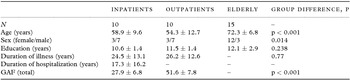
The subjects with schizophrenia were receiving stable doses of antipsychotic medication. Nine of the 20 patients were treated with a single second-generation antipsychotic medication (risperidone, n = 5; aripiprazole, n = 2; olanzapine, n = 2), one was treated with a single first-generation antipsychotic (with levomepromazine), and ten were a combination of antipsychotic drugs. Table 1 lists the subjects’ characteristics.
Characteristics of subjects (mean ± SD)

GAF, The Global Assessment of Functioning Scale.
Age, education showed the p value of the repeated-measurement ANOVA among groups.
Sex showed the p value of the χ2 test.
Duration of illness and GAF showed the p value of the unpaired t-test between groups.
Outcome
We measured the Global Assessment of Functioning (GAF) Scale to assess the clinical status, particularly in the overall level of functioning on a hypothetical continuum of the subjects with chronic schizophrenia.
Circadian rhythm measurements were performed using data wrist actimetry (Actiwatch2 [AW2]) and the Actiware System (Respironics Inc., USA). Each subject wore an activity monitor on the wrist of the non-dominant hand for seven days continuously without AW2 removal (e.g. for showering). The wrist motor activity was recorded and stored at 1-min intervals. The AW2 data were analyzed using Actiware System, version 6.00 (Respironics Inc., USA). After the AW2 data were outputted to an Excel file, a non-parametric circadian rhythm analysis (Witting et al., Reference Witting, Kwa, Eikelenboom, Mirmiran and Swaab1990; Van Someren et al., Reference Van Someren1999) was performed using the average data of seven continuous days. An analysis produces several characteristics of the rest-activity cycle such as the Interdaily Stability (IS), the Intradaily Variability (IV), and the Relative Amplitude (RA), the formulae for which are shown below.
IS quantifies the invariability from day to day, and is calculated using the following formula:
 \begin{equation*}
{\rm IS} = \frac{{n\sum\nolimits_{h = 1}^p {\left( {\bar x_h - \bar x} \right)} ^2 }}{{p\sum\nolimits_{i = 1}^n {\left( {x_i - \bar x} \right)} ^2 }}
\end{equation*}
IV measures the fragmentation of the rhythm, and is calculated using the following formula:
 \begin{equation*}
{\rm IV} = \frac{{n\sum\nolimits_{i = 2}^n {\left( {x_i - x_{i - 1} } \right)} ^2 }}{{\left( {n - 1} \right)\sum\nolimits_{i = 1}^n {\left( {x_i - \bar x} \right)^2 } }}
\end{equation*}
where n was the total number of data, p was the number of data per day (in this study, 24),
 $\bar x_h$
was the hourly mean,
 $\bar x$
was the mean of all the data, and xi
was the individual data point. IS varied between zero for Gaussian noise, which was normal distribution noise, and one for perfect IS. IV also varied between zero for a perfect sine wave and two for Gaussian noise.
RA of day or night activity was calculated from the ratio of the most active 10-h period (M10) to the least active 5-h period (L5) across an average 24-h profile as follows:
 \begin{equation*}
{\rm RA} = \frac{{M10 - L5}}{{M10 + L5}}
\end{equation*}
In addition to these analyses, the daily average activity counts were calculated from the averaged 24-h profiles.
We also measured the Brief Assessment of Cognition in Schizophrenia (BACS), Japanese version (BACS-J) (Kaneda et al., Reference Kaneda2007; Keefe et al., Reference Keefe2008) to assess cognitive function in the groups. Z-scores of BACS-J subtests and composite Z-score were calculated using the overall means and standard deviations of all 292 controls in Japan (aged 10–19, n = 20; aged 20–29, n = 80; aged 30–39, n = 64; aged 40–49, n = 76; aged 50–59, n = 32; aged 60–69, n = 20) to compare all generations with the groups in the present study. The six BACS-J subtests were performed as follow: (1) Verbal memory: Subjects were read a list of 15 words and then asked to recall as many as possible. This procedure was repeated five times. The outcome measure was the total number of words recalled. (2) Digit sequencing (working memory): Subjects were randomly ordered clusters of numbers with steadily increasing trial lengths. They were asked to report the numbers in order, from lowest to highest. The outcome measure was the total number of correct items. (3) Token motor task (motor speed): Subjects were given 100 plastic tokens and asked to pick up one token in each of their hands simultaneously as rapidly as possible for 60 sec and to place the tokens in a container. The outcome measure was the total number of tokens placed in the container. (4) Verbal fluency, Category instances: Subjects were given 60 sec to name as many different animals as possible. Controlled Oral Word Association Test: In two separate trials, subjects were given 60 sec to generate as many words as possible that begin with a given Japanese syllable (“ka” and “ta”). The outcome measure was the total number of unique words generated. (5) Symbol coding (attention and processing speed): In this test, subjects wrote the numerals 1–9 as matches to non-meaningful symbols on a response sheet for 90 sec, based on a key provided to them. The outcome measure was the total number of correct responses. (6) Tower of London (executive functions/reasoning and problem solving): Subjects looked at two pictures simultaneously. Each picture showed three different-colored balls arranged on three pegs, with the balls in a unique arrangement in each picture. The subjects were then required to estimate accurately the total number of times the balls in one picture would have to be moved in order to create an identical arrangement of the balls in the second picture. The outcome measure was the total number of correct responses. A composite score was calculated by averaging all the Z-score values of the six BACS-J subtests, using the means and the standard deviations. Differences between BACS and BACS-J were verbal subtests in English or Japanese such as Verbal memory, Category instances (Version A: supermarket items; Version B: tools) and Controlled oral word association test (Version A: “F” and “S”; Version B: “P” and “R”). Other subtests of BACS-J were the same as the original BACS. Z-scores of subtests were calculated inputting raw data (the total number of correct responses) into an Excel spread sheet in a BACS kit.
Analyses
The age and education distributed the repeated-measurement ANOVA, and the sex was applied to the χ2 test. The duration of illness and GAF distributed according to the unpaired t-test. All data except RA were normally distributed according to the Kolmogorov–Smirnov test, thus allowing parametric tests to be applied. RA allowed non-parametric tests to be applied. The statistical analysis of circadian rhythm parameters (IS, IV) and daily activity counts average and the measures of BACS-J subtests were conducted using an analysis of variance for repeated measures (rANOVAs) with Tukey's honestly significant difference test for post-hoc tests. The Kruskal–Wallis test was used to compare the median of RA among groups. Pearson's correlation and stepwise linear regression were applied to analyze the relationship between GAF and other variable such as circadian parameters and BACS-J. The p value required for inclusion of independent variables in the stepwise linear regression was set at pin = 0.05 and pout = 0.1. SPSS Version 21.0 for Windows (SPSS Inc., Chicago, IL) was used for the analysis, and the level of significance was set at p = 0.05.
Results
Table 1 lists the means and standard deviations for age, sex, education, duration of illness, and duration of hospitalization. The age and sex had significantly differences among groups, and education had no significance. Duration of illness had no significant difference between the inpatients and outpatients. Symptom severity and social capacity according to the GAF were on average 27.9 (SD = 6.8) in the inpatients with chronic schizophrenia and on average 51.6 (SD = 7.8) in the outpatients (Table 1). There were significant differences in the GAF between the inpatients and outpatients with chronic schizophrenia according to the unpaired t-test (Table 1, t = 7.2, p < 0.001).
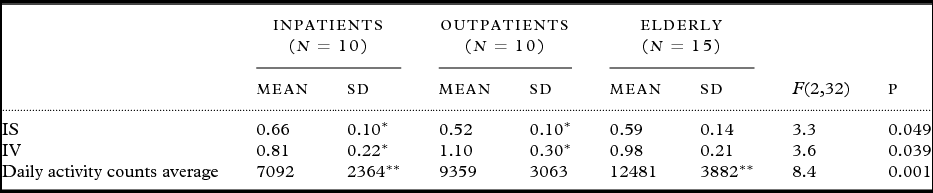
Tables 2 and 3 list circadian rhythm measures. IS (Table 2, F(2,32) = 3.3, p = 0.049), IV (Table 2, F(2,32) = 3.6, p = 0.039), and daily activity counts average (Table 2, F(2,32) = 8.4, p = 0.001) varied significantly among the inpatients, the outpatients, and the elderly people. According to a multiple comparison with the Tukey's honestly significant difference test, the outpatients had a significantly lower IS (Table 2, p = 0.039) and a higher IV (Table 2, p = 0.031) than the inpatients, and the inpatients had a significantly lower daily activity counts average (Table 2, p < 0.001) than the elderly people. IS and IV in the elderly people stayed between the inpatients and outpatients. In addition, RA (Table 3, p = 0.109) had no significant difference among the groups according to a Kruskal–Wallis test as a non-parametric ANOVA.
Circadian parameters (IS, IV) and average daily activity counts among groups

*p < 0.05; **p < 0.01; Tukey's honestly significant difference test.
Table 2 showed the F statistic and p value of the repeated-measurement ANOVA among groups.
The Interdaily Stability (IS) quantified the invariability from day to day using data wrist actimetry for seven days.
The Intradaily Variability (IV) measured the fragmentation of rest-active rhythms using data wrist actimetry for seven days.
The average daily activity counts was calculated from an average 24-h profile using data wrist actimetry for seven days.
Circadian parameter (RA) and Daily activity counts average among groups

Kruskal–Wallis test is a non-parametric test for the analysis of variance for repeated measures (rANOVA).
The Relative Amplitude (RA) was calculated from the ratio of the most active 10-h period to the least active 5-h period across an average 24-h profile using data wrist actimetry for seven days.
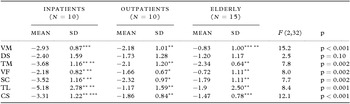
All subjects completed all BACS-J tests. Table 4 lists the means and standard deviations for all BACS-J measures. BACS-J required a mean of 38.3 ± 5.9 min to perform (inpatients, 36.6 ± 5.5 min; outpatients, 39.3 ± 6.8 min; elderly people, 38.7 ± 5.7 min). The tables include the F statistic and the p value of the repeated-measurement ANOVAs. All variables, except for digit sequencing, of the BACS-J differed significantly among the groups (Table 4, Verbal Memory: F(2,32) = 15.2, p < 0.001, Digit Sequencing: F(2,32) = 2.5, p = 0.10, Token Motor: F(2,32) = 7.8, p = 0.002, Verbal Fluency: F(2,32) = 8.0, p = 0.002, Symbol Coding: F(2,32) = 7.7, p = 0.002, Tower of London: F(2,32) = 8.4, p = 0.001, Composite Score: F(2,32) = 12.1, p < 0.001). The inpatients had significantly lower Z-scores for all variables, except digit sequencing, than the other groups according to a multiple comparison with Tukey's honestly significant difference test.
Z-scores of each test from BACS-J among groups

*p < 0.05; **p < 0.01; ***p < 0.001; Tukey's honestly significant difference test.
Table 4 showed the F statistic and p value of the repeated-measurement ANOVA among groups.
Z-scores were calculated using the overall means and standard deviations of all 292 controls in Japan.
Composite scores are calculated by averaging all Z-scores of the six primary tests from BACS-J.
VM: Verbal Memory, DS: Digit Sequencing, TM: Token Motor, VF: Verbal Fluency, SC: Symbol Coding,
TL: Tower of London, CS: Composite Score.
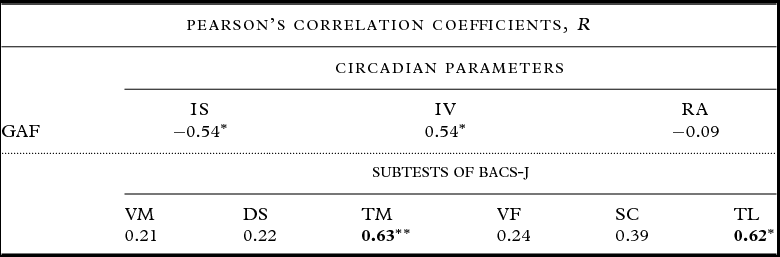
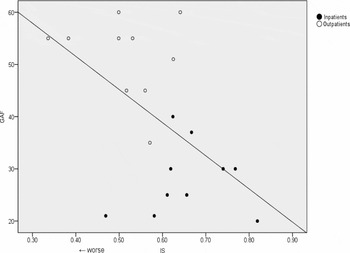
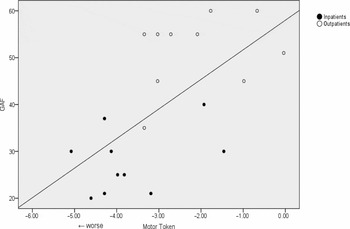
Correlation analyses of circadian parameters (IS, IV, RA) as a dependent variable with GAF had significant results for IS and IV (Table 5, Pearson's correlation analysis, n = 20, GAF, IS: R = −0.54, p = 0.014; GAF, IV: R = 0.54, p = 0.014). Correlation analyses of BACS-J subtests as a dependent variable with GAF had significance in Motor Token and Tower of London (Table 5, Pearson's correlation analysis, n = 20, GAF, Motor Token: R = 0.63, p = 0.003; GAF, Tower of London: R = 0.62, p = 0.004). Stepwise linear regression analysis was executed with five possible predictors (IS, IV, Motor Token, Tower of London, and age). GAF was best predicted by Motor Token (Figure 1, t = 3.11, p = 0.006) and IS (Figure 2, t = −2.39, p = 0.029) with R = 0.740 and R 2 = 0.547.
Correlations of GAF, circadian parameters, and cognitive functioning in patients with schizophrenia

Results in bold are significant; *p < 0.05; **p < 0.01.
IS: Interdaily Stability, IV: Intradaily Variability, RA: Relative Amplitude.
VM: Verbal Memory, DS: Digit Sequencing, TM: Token Motor, VF: Verbal Fluency, SC: Symbol Coding, TL: Tower of London.
Correlation of GAF with IS (R = −0.54, p = 0.014).

Correlation of GAF with Motor Token (R = 0.63, p = 0.003).

Discussion
The results in the present study indicated significant differences in circadian parameters and BACS-J scores among the inpatients, and the outpatients with chronic schizophrenia, and the healthy elderly people. At the circadian rhythm analyses, the outpatients showed highly interrupted circadian patterns, as demonstrated by the stability and the fragmentation of activity indexed using IS, IV, and the inpatients had the most stable rhythms among the groups. Also, the average daily activity counts had significant differences among the groups, particularly with the highest values in elderly people followed by outpatients, and then inpatients. Schizophrenic patients with lower RA exist more in the outpatients (Bromundt et al., Reference Bromundt2011). Also, some in schizophrenia groups show severe circadian misalignment ranging from a phase-advance or delay to non-24-h periods in sleep–wake and melatonin cycles, and the others show highly irregular and fragmented sleep–wake patterns with normally timed melatonin production (Wulff et al., Reference Wulff, Dijk, Middleton, Foster and Joyce2012). The present study suggests that the outpatients with chronic schizophrenia will be more disturbed the rest-active cycle than the inpatients and the elderly. The disturbance of circadian rhythms in the outpatients can be caused by a lack of effective environmental zeitgebers, such as social interactions and daytime activities in a community. Furthermore, the long-term-hospitalized inpatients had extreme rhythm and low daily activity counts among the groups. It is thought that the instability of rhythm variables is almost associated with poorer outcomes. However, the 24-h activity rhythm becomes more rigid and maintaining either active or inactive states for a longer period of time with older age (Luik et al., Reference Luik, Zuurbier, Hofman, Someren and Tiemeier2013). Considering the change of rhythms with aging, the inpatients with chronic schizophrenia can promote more extreme stable rhythms and inactive states for a long time with aging.
The outcomes of the cognitive function in the inpatients had significantly the lowest Z-scores for all variables except for digit sequencing among the groups. Z-scores of all variables except for verbal memory between the outpatients and the elderly had not significantly difference. A previous study related to cognitive function in chronic schizophrenia and with aging reports that the Mini-Mental State scores of institutionalized schizophrenic patients between the ages of 25 and 85 years decreased by three points every ten years (Davidson et al., Reference Davidson1995). Furthermore, in several studies of cognitive function and brain structure, cognitive performances in patients with chronic schizophrenia had significant correlations with cortical changes (Gur et al., Reference Gur1998), and the patients with chronic schizophrenia had significant reductions in the left frontal and temporal regions in the patients (Van Haren et al., Reference Van Haren2007). Our findings suggest that the long-term hospitalization, which does not require the patients to manage their own lifestyle, will promote lower social function level in the inpatients with schizophrenia in addition to the cognition decline with chronic and age. Furthermore, because the outpatients in a community can partially manage their lives by themselves, cognitive function related to social adjustments may be almost equivalent or lower to compare with those in the elderly. Also, the social functioning level (GAF) strongly correlated with circadian parameters (IS, IV), Token motor task (motor speed), and Tower of London (executive functions/reasoning and problem solving) of BACS-J. In addition, the motor speed of BACS-J and IS of circadian parameters were the most powerful variables to predict the GAF in patients with chronic schizophrenia. This finding suggests two rehabilitative targets to enhance social function in patients with chronic schizophrenia. One is the enhancement of cognitive performances as the motor speed and the executive function. A previous study reports that the vocational rehabilitation can enhance the executive function effectively, particularly with shifting ability, flexibility, and inhibitory control (Bio and Gattaz, Reference Bio and Gattaz2011). Also, a follow-up study reports that baseline cognitive performances (i.e. visual memory, sustained attention, and planning performance) predict the social functioning over the follow-up period (Prouteau et al., Reference Prouteau2005). The controlled occupational rehabilitation depending on baseline cognitions in individuals with chronic schizophrenia may be effective therapeutic strategies to enhance the motor speed and the executive function in chronic schizophrenia. Another is the improvement on circadian rhythms as extreme stable rhythms in the inpatients with chronic schizophrenia or instable rhythms in the outpatients. Circadian rhythms are affected by physical or social zeitgebers such as a light exposure, physical activities, social contacts, and activities of daily living (i.e. working, having meals, bedtimes, and watching television) (Grandin et al., Reference Grandin, Alloy and Abramson2006). Therefore, the development of rehabilitation programs is expected to be effective for these zeitgebers. Also, we suggest that the already provided psychosocial treatment should challenge interventions focused on improvements of rhythms and active states in the patients with chronic schizophrenia. In particular, the reacquisition of life roles provided by the OT is expected to promote activations of life rhythms in the patients with chronic schizophrenia.
Limitations of the study
Our cohort comprised a localized group of individuals in different living environments. We characterized circadian rhythms and cognitive functions in the patients with chronic schizophrenia. However, in the discussion of the effects of living environment, the long-term-hospitalized patients would already have greater deterioration of their cognition and poorer social functioning than the outpatients at the primary stage. This discussion of the baseline on their cognitions and social functioning in the patients with chronic schizophrenia was limitations of this study. Further studies will be required.
Conflict of interest
None.
Description of authors’ roles
Yu Kume designed the study and analyzed the collected data for the study. Dr. Takio Sugita helped to recruit the patients and measured GAF. Rest-active monitoring and neurocognitive data were collected by Kenya Oga, Kai Kagami, and Hitomi Igarashi, who are occupational therapists.
Acknowledgments
The authors were supported by the staff at Yokote Kohsei Hospital for their assistance in performing the assessments.