Introduction
Antipsychotic medication is the cornerstone in the treatment of patients with first-episode schizophrenia (FES). Several clinical guidelines recommend continuing antipsychotic treatment in the maintenance phase as well as the acute phase of the disorder (Galletly et al., Reference Galletly, Castle, Dark, Humberstone, Jablensky, Killackey and Tran2016; Lehman et al., Reference Lehman, Lieberman, Dixon, McGlashan, Miller, Perkins and Steering Committee on Practice2004; Yun et al., Reference Yun, Lee, Kang, Nam, Lee, Lee and Chung2019). It has been reported that the majority of patients with FES who had been stable for about 1–2 years exhibited exacerbation after discontinuation of antipsychotic medications (Emsley, Oosthuizen, Koen, Niehaus, & Martinez, Reference Emsley, Oosthuizen, Koen, Niehaus and Martinez2012; Gaebel et al., Reference Gaebel, Riesbeck, Wolwer, Klimke, Eickhoff, von Wilmsdorff and German Study Group on First-Episode2011). It has been demonstrated that recurrent relapses result in a deterioration of long-term clinical outcomes (Acosta, Hernandez, Pereira, Herrera, & Rodriguez, Reference Acosta, Hernandez, Pereira, Herrera and Rodriguez2012; Lieberman et al., Reference Lieberman, Alvir, Koreen, Geisler, Chakos, Sheitman and Woerner1996; Wyatt, Reference Wyatt1997). Several treatment-related risk factors are associated with medication adherence, including ineffectiveness, adverse effects, complexity of medication schedule, type of medication, and route of administration (Acosta et al., Reference Acosta, Hernandez, Pereira, Herrera and Rodriguez2012). Although some studies showed superiority of atypical antipsychotics over typical ones in the treatment adherence, the findings are inconsistent across studies and observed differences are small (Lacro, Dunn, Dolder, Leckband, & Jeste, Reference Lacro, Dunn, Dolder, Leckband and Jeste2002; Meier et al., Reference Meier, Becker, Patel, Robson, Schene, Kikkert and Puschner2010; Velligan et al., Reference Velligan, Weiden, Sajatovic, Scott, Carpenter, Ross and Persistent Mental2009). Although depot or long-acting injectable (LAI) antipsychotics are reported to have higher adherence rates than oral antipsychotics, the number of previous studies related to this issue is relatively small and only a few of them involved patients with FES (Kishimoto et al., Reference Kishimoto, Hagi, Nitta, Leucht, Olfson, Kane and Correll2018; Weiden et al., Reference Weiden, Schooler, Weedon, Elmouchtari, Sunakawa and Goldfinger2009). Of note, because of low incidence rate of schizophrenia and a somewhat decreasing trend, it requires a lot of efforts to obtain the optimal sample size for achieving statistical significance in research studies on FES (Kuhl, Laursen, Thorup, & Nordentoft, Reference Kuhl, Laursen, Thorup and Nordentoft2016).
Current evidence on the continuation of antipsychotic treatment is largely based on the findings from randomized clinical trials (RCTs). However, there are some caveats that should be noted when it comes to the applicability of the findings to real-life patients. The study population of the RCT is highly selective owing to several reasons including strict inclusion and exclusion criteria and voluntary participation of the subjects. Another limitation of the RCT is a relatively short observation period which may be inevitable in performing the RCT. These shortcomings hinder the generalization of the results to the real-world population. The real-world study, complementary to the RCT, has been provided information on long-term effectiveness and safety of a drug in large populations (Blonde, Khunti, Harris, Meizinger, & Skolnik, Reference Blonde, Khunti, Harris, Meizinger and Skolnik2018). With respect to the antipsychotic treatment discontinuation and associated risk for rehospitalization, there are a few previous studies utilizing a real-world database (Decuypere et al., Reference Decuypere, Sermon, Geerts, Denee, De Vos, Malfait and Mulder2017; Taipale, Mehtala, Tanskanen, & Tiihonen, Reference Taipale, Mehtala, Tanskanen and Tiihonen2018; Tiihonen, Tanskanen, & Taipale, Reference Tiihonen, Tanskanen and Taipale2018; Tiihonen et al., Reference Tiihonen, Taipale, Mehtala, Vattulainen, Correll and Tanskanen2019). Despite the remarkable strengths of these previous studies, the generalization of the results should be taken with caution because of the difference in socioeconomic status, race, and healthcare system among countries which would affect a pattern of medical service use such as hospitalization and antipsychotic medication use. Several previous studies have reported a wide variance in mental health service use by world region and associated factors for the service use (Roberts et al., Reference Roberts, Miguel Esponda, Krupchanka, Shidhaye, Patel and Rathod2018; Wang et al., Reference Wang, Aguilar-Gaxiola, Alonso, Angermeyer, Borges, Bromet and Wells2007). Therefore, it would be of further benefit to perform a real-world study with a different dataset for achieving confirmative evidence.
The Health Insurance Review Agency (HIRA) in South Korea provides de-identified claim data to investigators only for the purposes of research. Since all South Koreans have a compulsory health insurance system which is the National Health Insurance or Medicaid service, all information regarding medical service use by South Koreans has been recorded in the claim data (Song, Reference Song2009). Therefore, the claim data reflect a pattern of healthcare service use by the entire population in South Korea. In the claim data, the diagnosis and related signs and symptoms are coded with the Korean standard classification disease diagnostic codes which are based on the International Classification of Diseases, 10th revision (ICD-10). All medical practices which had been performed in medical institutions were also documented. These data have a notable strength of continuous follow-up of patients without dropout because all patients are mandatory to use the National Health Insurance or Medicaid service.
A residual confounding problem derived from selection bias has been an issue in interpreting the results from observational studies. The within-individual analysis has been used to eliminate this problem by using each subject as his or her own control. Different time periods within the same person were compared in the within-individual model, which enables to control time-invariant covariates. The treatment discontinuation and hospitalization repeatedly occur in the course of schizophrenia, with an individual event at a different phase of the illness. The recommended antipsychotics for the treatment and prevention of hospitalization differ according to the stage of the disorder. Thus, it is needed to use all observation periods of schizophrenia patients to investigate the risk of treatment discontinuation and hospitalization associated with all available antipsychotics. The within-individual analysis is suitable for exploring this kind of topic as it allows for examining the recurrent events at different time points. Several previous studies have successfully addressed the issue of rehospitalization associated with antipsychotic treatment, using a nationwide population dataset and the within-individual method (Taipale et al., Reference Taipale, Mehtala, Tanskanen and Tiihonen2018; Tiihonen et al., Reference Tiihonen, Tanskanen and Taipale2018, Reference Tiihonen, Taipale, Mehtala, Vattulainen, Correll and Tanskanen2019).
In this study, we used the HIRA database to investigate the discontinuation of antipsychotic treatment and risk of psychiatric hospitalization associated with antipsychotic treatment in patients with FES. We compared the risk of the treatment discontinuation and psychiatric hospitalization among antipsychotics using the within-individual method. The primary goal of this study was to compare the risk of treatment discontinuation among antipsychotics. Given that the discontinuation of antipsychotic treatment is highly predictive of psychiatric hospitalization, we further sought to evaluate the risk of psychiatric hospitalization associated with antipsychotics use, although the patients can be hospitalized even in the continuation of the treatment. The purpose of assessing the risk of psychiatric hospitalization was to evaluate the real-world effectiveness of antipsychotics when they were in use.
Methods
Study population
We obtained the claim data between 1 January 2007 and 31 December 2016, in the HIRA database. For identifying the incident patients with schizophrenia, the following criteria were applied: (1) the ICD-10 diagnostic code of F20 (schizophrenia) (n = 448 889), (2) exclude the patients who had the exclusion diagnoses before the diagnosis of schizophrenia (n = 400 275) and the exclusion diagnoses were as follows: dementia, psychotic disorder due to another medical condition, substance-induced psychotic disorder, substance intoxication with perceptual disturbances, moderate or severe intellectual disability, and autism spectrum disorder, (3) the patients not having any claim for the ICD-10 diagnostic code of F20 at least during the 2 years before the diagnosis of schizophrenia and the observation period should be more than 1 year (n = 152 379), (4) the onset of age between 18 and 65 years (n = 96 929), (5) no antipsychotic prescription during the preceding 2 years before the diagnosis of schizophrenia (n = 54 423), and (6) more than 28 days of antipsychotic prescriptions during the total observation period (n = 44 396). The final study population consisted of 44 396 incident patients with schizophrenia. The current study was approved by the Institutional Review Board of Asan Medical Center (IRB No. 2018-0131). Informed consent was exempted owing to the use of the anonymous and de-identified data.
Definitions of exposure and outcome
Antipsychotics were grouped according to a type of antipsychotic (typical, atypical) and route of administration (oral, LAI). Online Supplementary Table 1 provides a list of typical, atypical, and LAI antipsychotics included in the current study. We labeled a treatment period as (1) typical (TAP), atypical (AAP), LAI, polypharmacy, or low-dose, and (2) specific antipsychotic or low-dose. The end of the treatment period was defined as (1) change to a different kind of antipsychotic, (2) discontinuation of the antipsychotic treatment, or (3) the end of observation period. The treatment discontinuation was defined as no antipsychotic prescription within 28 days from the expected date of the next prescription. For the treatment period in which more than two antipsychotics were prescribed, olanzapine equivalent dose of each antipsychotic was calculated using the conversion equation from the previous study by Gardner, Murphy, O'Donnell, Centorrino, and Baldessarini (Reference Gardner, Murphy, O'Donnell, Centorrino and Baldessarini2010). The treatment period was categorized as polypharmacy if the mean daily olanzapine equivalent dose of more than two antipsychotics exceeded 5 mg/day, according to a previous study (Uchida, Suzuki, Takeuchi, Arenovich, & Mamo, Reference Uchida, Suzuki, Takeuchi, Arenovich and Mamo2011). We labeled a low-dose treatment period if none of the prescribed antipsychotics exceeded the mean daily olanzapine equivalent dose of 5 mg. Although antipsychotics have been prescribed on a daily basis during hospitalization, the claim data for them are not generated on the actual date of the prescription. Instead, the claim data are created based on information collected within a certain period during hospitalization, i.e. a week or a much longer period. To address this inaccuracy issue of the prescription date in the claim data, we assumed that each antipsychotic treatment started at the first date of each claim data. We discarded the treatment periods of which duration was less than 14 days to control the effect of miscellaneous exposure of antipsychotics on outcomes.
The main outcomes of this study were the discontinuation of antipsychotic treatment and psychiatric hospitalization. The discontinuation was defined as described above; no antipsychotic prescription within 28 days from the expected date of the next prescription. We identified psychiatric hospitalization using the operational condition that the type of admission was general medical or psychiatric and the main diagnosis for the admission was a psychiatric disorder. The events of hospitalization which occurred within less than 30 days after the discharge of the prior admission were disregarded, as it indicated inadequate treatment in the prior hospitalization.
Statistical analysis
We used a stratified Cox proportional hazard regression model. In this within-individual analysis, each subject was utilized as his/her own control. The follow-up time was reset to zero after each outcome occurred. Details on the method were described in previous studies (Lichtenstein et al., Reference Lichtenstein, Halldner, Zetterqvist, Sjolander, Serlachius, Fazel and Larsson2012; Tiihonen et al., Reference Tiihonen, Mittendorfer-Rutz, Majak, Mehtala, Hoti, Jedenius and Taipale2017). Time-variant covariates used for the adjustment were age, order of the treatment period in the entire observation period, order of the outcome event, order of the treatment period in each outcome event, and polypharmacy. Apart from the polypharmacy in terms of the treatment period, a covariate of polypharmacy was defined and scored ‘1’ when more than two antipsychotics were prescribed during a treatment period.
We divided the entire observation period into acute and maintenance phases based on a criterion of 6 months after the diagnosis of schizophrenia. We investigated the risk for the treatment discontinuation and psychiatric hospitalization in the total and maintenance periods. Because we sought to evaluate the risks after the acute symptoms were stabilized, the main interest of the current study was aimed at the risks in the maintenance period. For each outcome event (discontinuation/hospitalization), we calculated the number of events per year and removed outliers based on a criterion of the 1.5 interquartile range above the third quartile of each value. In the comparison among individual antipsychotics, we only included a few of them. The selection of antipsychotics was performed based on the number of the treatment discontinuations and hospitalizations in the total observation period (online Supplementary Tables 2 and 3). We discarded the antipsychotics having a low number of the events because they were likely to yield statistically insignificant findings. The following antipsychotic drugs were included in the comparison among individual antipsychotic drugs: amisulpride, aripiprazole, blonanserin, chlorpromazine, clozapine, haloperidol, LAI paliperidone, olanzapine, paliperidone, quetiapine, risperidone, sulpride, and ziprasidone. In the analysis of the risk of the treatment discontinuation, the TAP group and olanzapine were used as the reference. For the risk of psychiatric hospitalization, we compared the antipsychotic use to no use. The statistical significance level was set at 0.05. R software (ver. 3.5.1) (R Core Team, 2017) and survival (ver. 2.43-3) (Therneau, Reference Therneau2015) were used to perform all statistical tests.
Results
Demographic and clinical characteristics
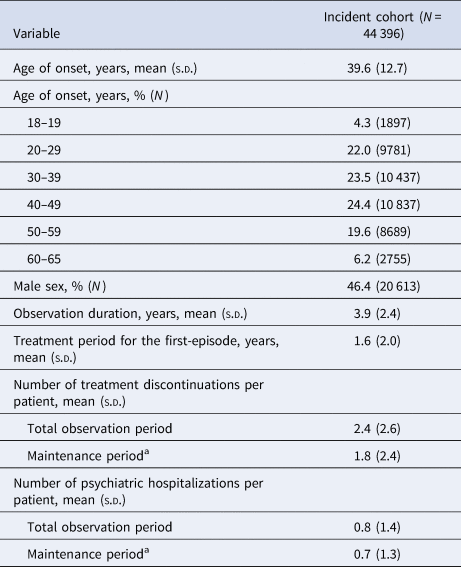
We included a total of 44 396 patients with FES which comprised of 20 613 (46.4%) male and 23 783 (53.6%) female patients. The age of onset (mean ± s.d.) was 39.6 ± 12.7 years. The mean duration of the first-episode and observation period was 1.6 ± 2.0 and 3.9 ± 2.4 years. During the maintenance period, the mean number of the treatment discontinuation and psychiatric hospitalization per patient was 1.8 ± 2.4 and 0.7 ± 1.3. Percents of the patients who had at least one treatment discontinuation and psychiatric admission in the maintenance period were 65.1% and 35.1%, respectively. Further details on demographic and clinical variables are presented in Table 1.
Demographic and clinical characteristics of the incident patients with schizophrenia

a Maintenance period was defined based on a criterion of 6-month after the diagnosis of schizophrenia.
Antipsychotic treatment discontinuation
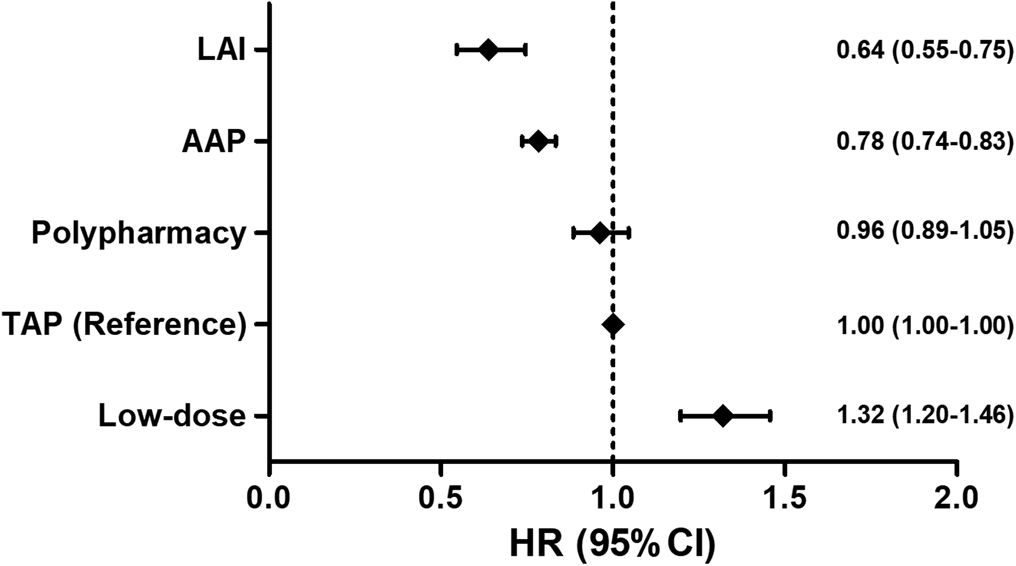
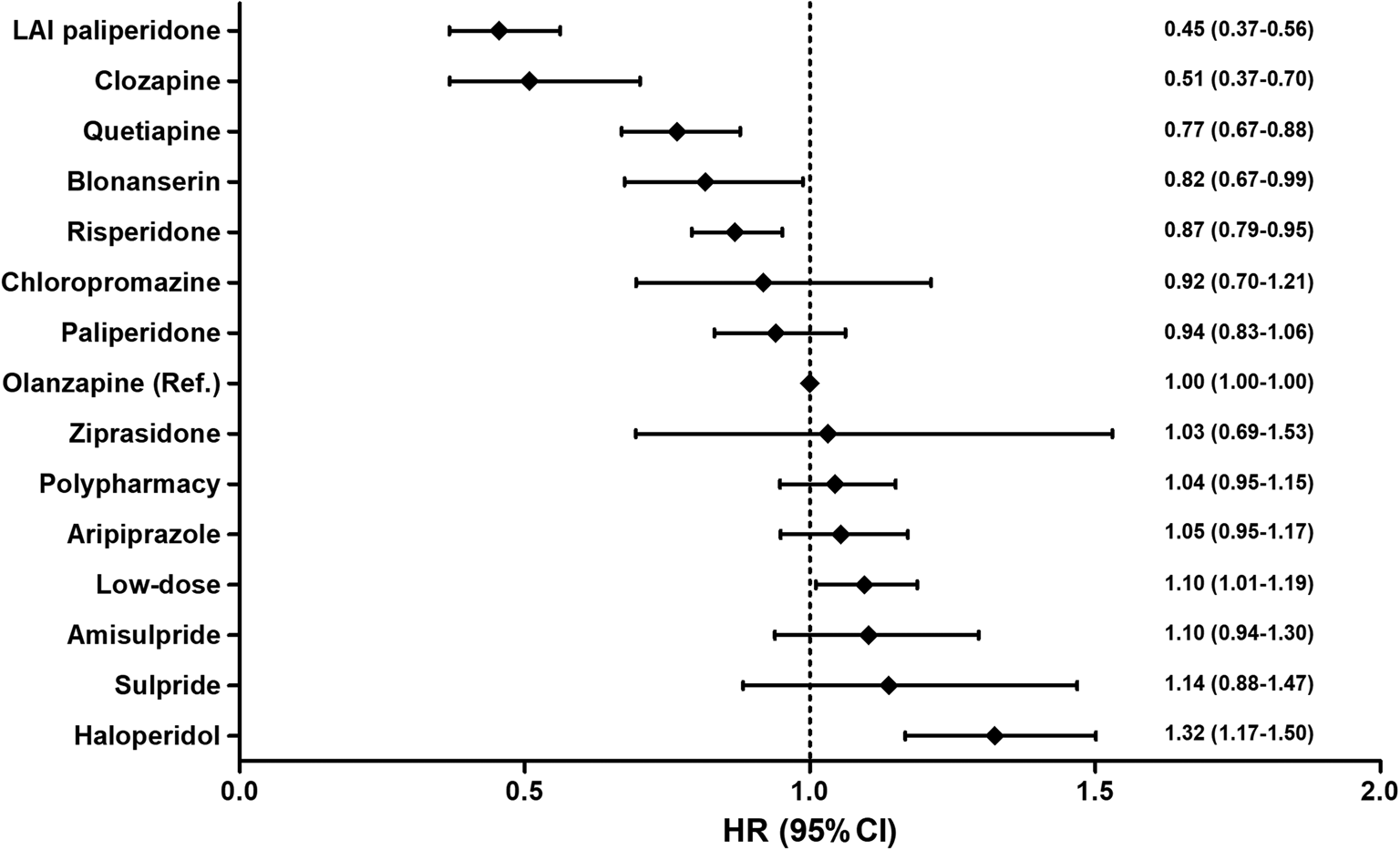
We compared the risk of the treatment discontinuation among antipsychotics, which were defined as per group and specific antipsychotic. Figures 1 and 2 show the risk of the treatment discontinuation associated with antipsychotics use in the maintenance period. The LAI and AAP groups showed a lowered risk of the treatment discontinuation than the TAP group [LAI: hazard ratio (HR) 0.64; 95% confidence interval (CI) 0.55–0.75; p < 0.001; AAP: HR 0.78; 95% CI 0.74–0.83; p < 0.001]. The low-dose group had an increased risk of the treatment discontinuation compared to the TAP group (HR 1.32; 95% CI 1.20–1.46; p < 0.001). Among the individual antipsychotics, LAI paliperidone had the lowest risk compared to olanzapine (HR 0.45; 95% CI 0.37–0.56; p < 0.001). Among oral antipsychotics, clozapine was associated with the lowest risk (HR 0.51; 95% CI 0.37–0.70; p < 0.001) and the highest risk was observed in haloperidol (HR 1.32; 95% CI 1.17–1.50; p < 0.001). There was no significantly higher risk of the treatment discontinuation in polypharmacy in the comparisons between the groups (HR 0.96; 95% CI, 0.89–1.05) and individual drugs (HR 1.04; 95% CI, 0.95–1.15). Online Supplementary Figs 1 and 2 show the risk of the treatment discontinuation in the total observation period. Overall, the results were similar to those in the maintenance period except for the significantly increased risk of polypharmacy in the comparison among the individual drugs (HR 1.25; 95% CI 1.16–1.32).
Comparative risk of treatment discontinuation among antipsychotic groups in the maintenance period. LAI, long-acting injectable; AAP, atypical antipsychotic; TAP, typical antipsychotic; HR, hazard ratio; CI, confidence interval.

Comparative risk of treatment discontinuation among individual antipsychotics in the maintenance period. HR, hazard ratio; CI, confidence interval.

Psychiatric hospitalization
Compared to no use of antipsychotics, any antipsychotic use lowered the risk of psychiatric hospitalization in the maintenance period (HR 0.68; 95% CI 0.65–0.73; p < 0.001). When we categorized into the low-dose and standard-dose groups by 5 mg of the mean daily olanzapine equivalent dose, the low-dose group was associated with a 31% decreased risk (HR 0.69; 95% CI 0.64–0.75; p < 0.001) and the standard-dose group showed a 45% decreased risk (HR 0.55; 95% CI 0.52–0.58; p < 0.001).
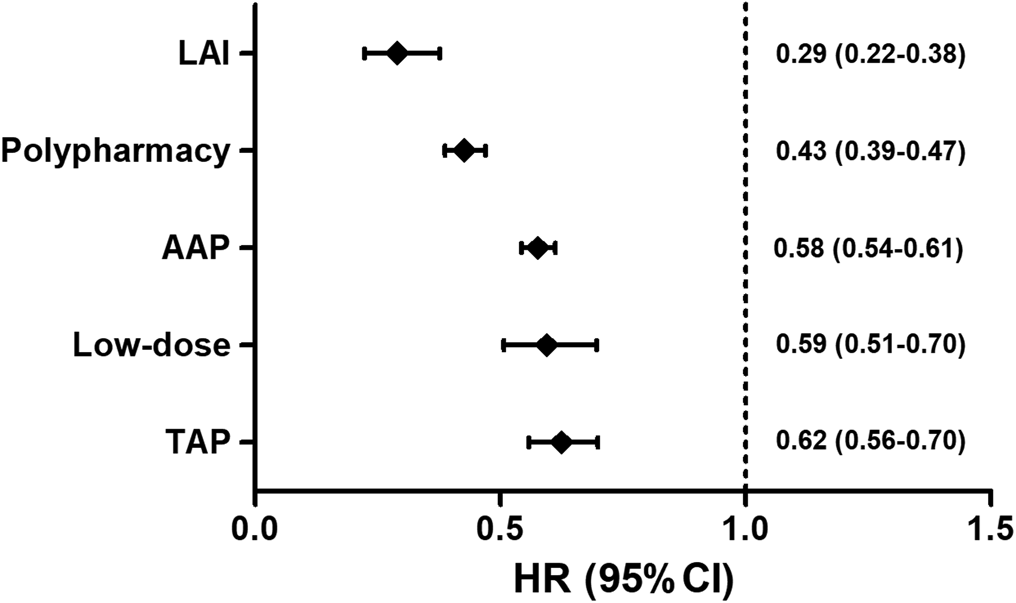
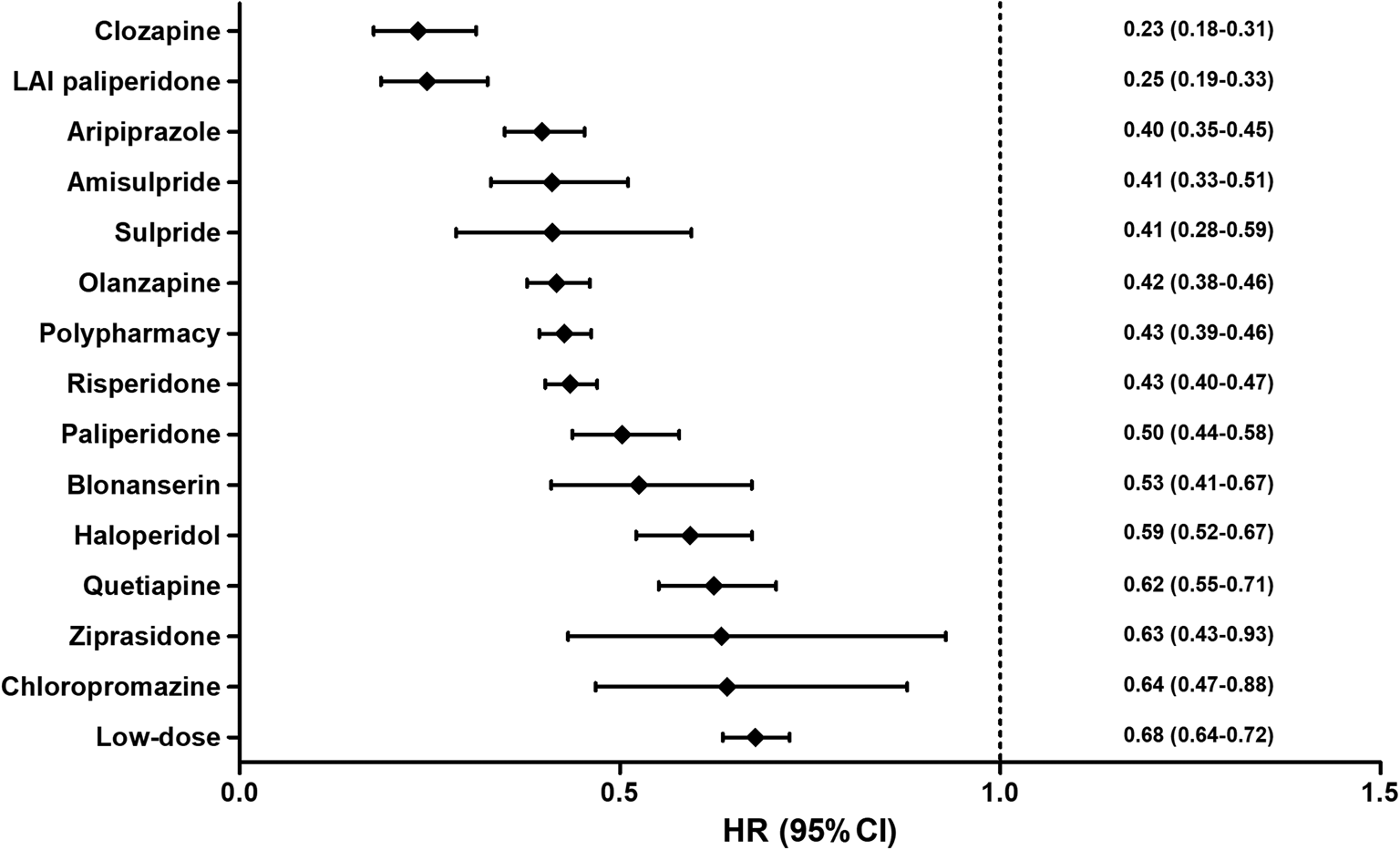
Figures 3 and 4 show the risk of psychiatric hospitalization associated with antipsychotics use in the maintenance period. In the group comparison, the LAI group had the lowest risk compared to no use (HR 0.29; 95% CI 0.22–0.38; p < 0.001). With regard to the comparison between individual antipsychotics, clozapine exhibited the lowest risk compared with no use (HR 0.23; 95% CI 0.18–0.31; p < 0.001), followed by the LAI paliperidone (HR 0.25; 95% CI 0.19–0.33; p < 0.001). The highest risk was observed in the low-dose (HR 0.68; 95% CI 0.64–0.72; p < 0.001). Online Supplementary Figs 3 and 4 present the results in the entire observation period. In the group comparison, the risk of the low-dose group was increased compared to that in the maintenance period (HR 0.81; 95% CI 0.71–0.92; p < 0.001). Among individual antipsychotics, clozapine had the lowest risk (HR 0.25; 95% CI 0.19–0.33; p < 0.001), followed by LAI paliperidone (HR 0.28; 95% CI 0.21–0.37; p < 0.001). The risk of psychiatric hospitalization in the total observation period generally increased than that in the maintenance period, and there was a notable increase in the risk of psychiatric hospitalization in the low dose as a specific antipsychotic (HR 0.89; 95% CI 0.84–0.94; p < 0.001).
Risk of psychiatric hospitalization among antipsychotic groups compared with no use in the maintenance period. LAI, long-acting injectable; AAP, atypical antipsychotic; TAP, typical antipsychotic; HR, hazard ratio; CI, confidence interval.

Risk of psychiatric hospitalization among individual antipsychotics compared with no use in the maintenance period. HR, hazard ratio; CI, confidence interval.

Discussion
We investigated the discontinuation of antipsychotic treatment and risk of psychiatric hospitalization associated with antipsychotics use in the patients with FES, using the HIRA database and within-individual analysis. The risk of the treatment discontinuation and psychiatric hospitalization was compared among the antipsychotic groups and individual antipsychotics. The maintenance period was defined as the period from 6-month after the diagnosis of schizophrenia, which was utilized for the main results. For the risk of the treatment discontinuation, the LAI and AAP groups showed superiority over the TAP group, and LAI paliperidone was associated with the lowest risk compared with olanzapine. With regard to the risk of psychiatric hospitalization compared to no use, all antipsychotics had a significant effect of lowering the risk with a different degree. The LAI group had the lowest risk among the groups, and clozapine was associated with the lowest risk among individual antipsychotics.
As pointed out by previous studies (Kishimoto et al., Reference Kishimoto, Hagi, Nitta, Leucht, Olfson, Kane and Correll2018; Novick et al., Reference Novick, Haro, Bertsch, Anand, Jemiai and Haddad2012; Takacs et al., Reference Takacs, Czobor, Feher, Gimesi-Orszagh, Fadgyas-Freyler, Bacskai and Bitter2019), LAI antipsychotics showed superiority over oral antipsychotics in terms of the treatment discontinuation. The AAP group also had a higher treatment adherence than the TAP group, which was a more remarkable difference than that reported in previous studies (Ascher-Svanum et al., Reference Ascher-Svanum, Zhu, Faries, Lacro, Dolder and Peng2008; Dolder, Lacro, Dunn, & Jeste, Reference Dolder, Lacro, Dunn and Jeste2002). Given that the discontinuation is associated with the ineffectiveness of drugs as well as the adverse effects (Acosta et al., Reference Acosta, Hernandez, Pereira, Herrera and Rodriguez2012) and no significant difference in the reported efficacy of both antipsychotics (Crossley, Constante, McGuire, & Power, Reference Crossley, Constante, McGuire and Power2010), the current results suggested that in real-clinical practice, atypical antipsychotics might have an obvious advantage over typical antipsychotics in terms of the treatment continuation although atypical antipsychotics have a risk of adverse effects such as weight gain, hyperlipidemia, and hypertension (Huhn et al., Reference Huhn, Nikolakopoulou, Schneider-Thoma, Krause, Samara, Peter and Leucht2019). As a specific antipsychotic, LAI paliperidone had the lowest risk of the treatment discontinuation, and clozapine was associated with the lowest risk among oral antipsychotics. There are a lot of research studies reporting superiority of clozapine over other oral antipsychotics in terms of the treatment continuation (Huhn et al., Reference Huhn, Nikolakopoulou, Schneider-Thoma, Krause, Samara, Peter and Leucht2019; Kroken et al., Reference Kroken, Kjelby, Wentzel-Larsen, Mellesdal, Jorgensen and Johnsen2014; Masuda, Misawa, Takase, Kane, & Correll, Reference Masuda, Misawa, Takase, Kane and Correll2019; Rosenheck et al., Reference Rosenheck, Chang, Choe, Cramer, Xu, Thomas and Charney2000). The superiority of clozapine in terms of the treatment continuation might be associated with the tendency of clinicians to prescribe the medication in patients who were likely to adherent. In this study, the highest risk of the treatment discontinuation was observed in haloperidol. A previous study using clinical data obtained at a tertiary hospital compared the time to discontinuation of 10 antipsychotic drugs and showed that the shortest time to discontinuation was observed for haloperidol among them (Oh et al., Reference Oh, Lee, Kim, Kim, Lee, Cho and Kwon2020). An RCT trial comparing the efficacy and safety of olanzapine and haloperidol also showed a greater retention rate in olanzapine-treated patients than that in haloperidol-treated patients (Lieberman et al., Reference Lieberman, Tollefson, Tohen, Green, Gur, Kahn and Group2003). We observed that polypharmacy was not associated with a higher discontinuation risk in comparisons between the antipsychotic groups and individual antipsychotics. All available schizophrenia treatment guidelines recommend antipsychotic monotherapy in the early-phase of treatment owing to potential disadvantages of antipsychotic polypharmacy which were drug–drug interactions, an increased risk of death, and the possibility of discouraging patients from taking pills as prescribed (Fleischhacker & Uchida, Reference Fleischhacker and Uchida2014). Despite the concerns for the possibility of lower treatment adherence in antipsychotic polypharmacy, the current results showed that antipsychotic polypharmacy did not have a significant disadvantage in terms of the treatment continuation compared to antipsychotic monotherapy. However, other potential disadvantages of antipsychotic polypharmacy such as high cost and excessively high total antipsychotics dosages should be considered when clinicians utilize antipsychotic polypharmacy.
With regard to the risk of psychiatric hospitalization, the LAI antipsychotic group showed superiority over the oral antipsychotic groups and LAI paliperidone was associated with a remarkably lower risk compared to oral antipsychotics except for clozapine. The strength of LAI antipsychotics in real practice such as getting the medication less frequently may contribute to better effectiveness in reducing the risk of the hospitalization. In the comparison between the groups, the polypharmacy group had the lowest risk among the oral antipsychotic groups. The current study indicated that the concurrent use of multiple antipsychotics is an effective treatment option in terms of decreasing the risk of psychiatric admission. A previous study by Tiihonen et al., reported the advantage of polypharmacy in lowering the risk of rehospitalization compared to monotherapy, with a different degree of effect size according to antipsychotic combination (Tiihonen et al., Reference Tiihonen, Taipale, Mehtala, Vattulainen, Correll and Tanskanen2019). In line with previous studies (Huhn et al., Reference Huhn, Nikolakopoulou, Schneider-Thoma, Krause, Samara, Peter and Leucht2019; Masuda et al., Reference Masuda, Misawa, Takase, Kane and Correll2019; Taipale et al., Reference Taipale, Mehtala, Tanskanen and Tiihonen2018), we found the effectiveness of clozapine over other oral antipsychotics. Despite a tendency of prescribing clozapine in patients whose illness is more severe and resistant to the treatment, we observed that clozapine was the most effective medication in lowering the risk of psychiatric hospitalization among oral antipsychotics. The low-dose antipsychotic as a specific antipsychotic showed the highest risk of psychiatric hospitalization. Consistent with a previous study (Uchida et al., Reference Uchida, Suzuki, Takeuchi, Arenovich and Mamo2011), the current findings may suggest that a certain dose of antipsychotic drugs is required for the prevention of hospitalization, although the low-dose antipsychotic had a significant difference in the risk compared to no use. However, since the dose reduction was recommended before the discontinuation of antipsychotic treatment and it is not uncommon that relapse occurs in the dose reduction of antipsychotics as well as no use, the current results should be verified by future studies aiming at this specific issue.
We included the HIRA database which is a representative data reflecting medical service use by the entire population in South Korea, which leads to avoiding selection bias to the utmost. Obligatory use of the health insurance system in South Korea enabled to follow-up the patients continuously during the entire observation period. By using the within-individual model, we adjusted confounding factors which is not usually measured and controlled in the observational study, such as genetic variability and life-style difference among individuals. However, there are some limitations that should be considered. First, we assumed the prescription date of antipsychotics which were administered during hospitalization because of the inherent systematic disadvantage of the HIRA database. On the consideration of that the issue regarding the duration between the discontinuation of antipsychotic drugs and the onset of relapse has not yet been determined (Emsley, Chiliza, Asmal, & Harvey, Reference Emsley, Chiliza, Asmal and Harvey2013) and the total duration of hospitalization was relatively short compared to the total observation period, the impact of this inaccuracy issue seemed to be unremarkable. Second, we did not include the entire antipsychotics in the comparison between individual antipsychotics owing to relatively small numbers of the events in some antipsychotic drugs. Previous studies reported a different effect of preventing rehospitalization among LAI antipsychotics according to first- or second-generation (Taipale et al., Reference Taipale, Mehtala, Tanskanen and Tiihonen2018). In South Korea, along with LAI paliperidone, haloperidol, risperidone, and aripiprazole are approved by the FDA of South Korea as depot or LAI antipsychotics. However, we did not include them in the analysis because the number of hospitalizations in the antipsychotic drugs was small compared to that in LAI paliperidone. Third, the findings in the current study were affected by the structure of the health care system in South Korea. Therefore, it should be cautious when generalizing the current results to other populations with a different race, socioeconomic status, and health care system. Fourth, although registry data have the advantage of including large sample size, there is an issue of the susceptibility of including inaccurate diagnosis. We repeated the analyses after applying a strict age criterion of between 18 and 40 years for identifying the FES patients, which reduced the number of the FES patients to 23 337. Overall, the results were similar to those of the analyses using a broader age range of between 18 and 65 years (online Supplementary Figs 5–8). LAI paliperidone and clozapine still showed superiority over the other antipsychotics in terms of the risk of treatment discontinuation and psychiatric hospitalization. Chlorpromazine showed an increase in the risk of treatment discontinuation but with no statistical significance. Compared to the results with the age criterion of between 18 and 65 years, there was an overall increase in the risk of psychiatric hospitalization, except for LAI paliperidone, clozapine, and amisulpride.
In conclusion, LAI antipsychotics were significantly associated with lowering the risk of the treatment discontinuation and psychiatric hospitalization. Among oral antipsychotics, clozapine was associated with higher treatment adherence and better effectiveness in reducing psychiatric hospitalization. The risk of the treatment discontinuation in polypharmacy was not statistically significant compared with monotherapy. Compared with the oral antipsychotic groups, the polypharmacy group showed significant superiority in lowering the risk of psychiatric hospitalization. The current study presented the effectiveness of antipsychotics in a real-world population, which can have a complementary role with the results from the RCT in obtaining conclusive evidence. The issue regarding how an individual antipsychotic is more associated with reducing the risk of each outcome than other drug remained unclear. Therefore, further studies are needed to address this issue.
Supplementary material
The supplementary material for this article can be found at https://doi.org/10.1017/S0033291721001379.
Conflict of interest
None.
Ethical standards
The authors assert that all procedures contributing to this work comply with the ethical standards of the relevant national and institutional committees on human experimentation and with the Helsinki Declaration of 1975, as revised in 2008.