

INTRODUCTION
In recent three years, Chinese and western newspapers have increasingly used network visualizations of the complexity and interdependence of Chinese politics and economics. These illustrations usually show how a Chinese leader—President Xi Jinping, Premier Wen Jiabao or disgraced Zhou Yongkang—is connected to other elites or (shell) companies through coworker or kinship ties.Footnote 1 But even though the term “network” occurs quite often in the academic analysis of informal politics (Tsou Reference Tsou1995) and elite contention in China, scholars have not applied social network analysis (SNA) and its tools and methods to this topic.Footnote 2 As in political science more generally, the term “network” has been used as a metaphor (Ward et al. Reference Ward, Stovel and Sacks2011) for a group of individuals directly or indirectly connected by often ill-defined ties.
In this article, I propose that scholars studying Chinese political elites have much to gain from adopting social network analysis, as it allows to expand the more nuanced view of informal politics found in qualitative analysis to the quantitative study of a large set of elites. I compare different ways of measuring informal elite networks, and conclude that coworker networks are most likely to structure informal politics among contemporary Chinese elites.
Informal politics in China is usually described in terms of factionalism (Nathan Reference Nathan1973; Li Reference Li2001)—the idea of a battle between informal groups of elites, connected to and supportive of each other or a common leader. Critics of this account (Tsou Reference Tsou1976; Dittmer Reference Dittmer1995) usually do not contest the existence of different, conflicting interest within the Chinese regime, nor the role of informal relations in Chinese politics. Instead, they are dissatisfied with its conceptualization as a struggle between distinct, non-overlapping groups of elites for power, claiming that such factional affiliation often fails to predict the individual elite's political behavior (Miller Reference Miller2015).
I suggest that we should conceive of informal politics as competing coalition formation along the ties of an underlying network. This conceptualization allows us to visualize this underlying social structure and the factions enabled by it (see Figures 2–6). More importantly, it provides an inherently more dynamic view of informal politics. The underlying ties may make it easier for certain elites to join a faction, but whether an individual activates this potential depends on more complex strategic considerations. Instead of imagining elite contention as clashes between clearly delineated stable groups, i.e. factions, it becomes a game of strategic alliance formation (Keller Reference Keller2014) among individuals embedded in a restraining or enabling social structure.
The network approach also forces the researcher to be more specific about the meaning and measurement of these underlying connections and the factional ties formed. Take, for instance, the tendency to identify geographic factions. Recently, Li (Reference Li2014, 4) has identified the Shaanxi Gang, as a group of officials who have been born or have family origins in Shaanxi province, or who have spent a large part of their career there. But why should we expect that two high-level officials in the Chinese Communist Party would automatically become allies just because of their association with a province? In fact, as I show in this article, it is coworker ties that best capture the underlying structure. The common geographic origin and the work experience in Shaanxi may therefore simply make it more likely that these individuals have worked together.
In section 2 of this article, I identify two common approaches to inferring factions, which I refer to as exploratory and structured. The former relies on a qualitative analysis of multiple sources, including both publicly available data from newspapers and governments, and information from usually anonymous insiders, i.e. the “sources close to the government.” Under ideal conditions, this approach likely measures some individual alliance ties very accurately. But in most circumstances, it has an overall bias in favor of uncovering ties among individuals who have been identified in advance as particularly important, as I demonstrate in this article. This can cause observers to underestimate lesser-known or new contenders. This approach is also vulnerable to manipulation by the elites observed, who may choose to leak or withhold information about certain ties for strategic reasons.
The structured approach, by contrast, determines the relevant elites and possible factional ties in advance. The latter are often analyzed statistically and defined through shared characteristics, such as common provincial origin, alumni and coworker networks, and shared revolutionary past in the form of having served in the same field army or geographic location before 1949 (Shih et al. Reference Shih, Adolph and Liu2012; Li Reference Li2001; Bo Reference Bo2007). This approach may be coarser, but it enables the researcher to examine a much larger set of elites, thus mitigating the bias in favor of seemingly important individuals.
I argue that the structured approach is better understood as measuring an underlying social structure. Individuals that are more closely connected in this network structure are more likely to appear in the same faction—in other words, they are more likely to have the sort of alliance ties measured more accurately using the exploratory approach.
In section 3, I present examples of both approaches. In section 4, I use two strategies to explore how best to capture this underlying social structure. The first strategy correlates individual ties in a network measured using the exploratory method with network ties inferred from shared traits. The second strategy assesses the overall structure of those structured networks, by examining whether powerful elites (as indicated by their party rank) also hold important network positions. I take a stronger correlation as evidence for a better measurement of the underlying social structure. Neither strategy is designed to explore the causal mechanism, but both lead to the same conclusions regarding the measurement: provincial origin and common school ties are at best unreliable proxies for informal ties in the context of present-day Chinese elites—what matters are coworker relationships. Their precision can be improved further by examining whether the lower-ranked coworker was promoted during that time, or whether certain individuals have worked together in more than one ministry or province. Shared revolutionary experience may have been a powerful connector in the past, but has lost its significance with the passing away of the respective generation. The analysis thus also reveals the changing drivers of Chinese patronage politics, and hints at how one might measure informal power and its importance over time.
This article contributes to the study of Chinese elites by introducing social network analysis and proposing networks as a more suitable conceptualization of Chinese informal politics than factions. It helps observers of the Chinese regime focus on the most relevant measure for the social structure that shapes elite contention in China after 1982: coworker ties. Such ties likely influenced alliance formation in earlier periods or in other countries and settings, thus making this finding of more general interest.
DIFFERENT APPROACHES FOUND IN THE LITERATURE
This section identifies two different approaches to studying informal relationships in the literature on factional struggles in China: a more qualitative analysis of different sources, including insider accounts, that tries to measure them directly—the exploratory approach—and the structured approach, which relies mainly on statistical inference using publicly available data.
UP CLOSE AND PERSONAL: ARCHIVES, BIOGRAPHIES, GOSSIP, AND “SOURCES CLOSE TO THE GOVERNMENT”
The exploratory approach has a long tradition in the research of Chinese politics, and elite contention in particular. Even before Nathan's (Reference Nathan1973) foundational article on factionalism, scholars described and analyzed what is often referred to by its Chinese term, guanxi (Yang Reference Yang1994). Whitson and Huang (Reference Whitson and Huang1973), for instance, studied such ties in the military. Lieberthal and Oksenberg (Reference Lieberthal and Oksenberg1988) described the role of guanxi in the policy-making process and in the interaction and rivalry between different administrative bodies. No description of the elite struggles during the Cultural Revolution (Chang Reference Chang1976; Guo Reference Guo2001), or the Tian'anmen crisis (Nathan and Gilley Reference Nathan and Gilley2003), and certainly no analysis of the Chinese leadership (Li Reference Li2001; Bo Reference Bo2007) would be complete without an account of the complex relationships among the elite actors.
Researchers engaging in such qualitative analysis try to stay as close as possible to the actual alliance tie, or at least to the affective relationship that they see as its basis: in the case of historical periods, they draw on a variety of public documents, interview individuals close to the elites, and scour official and unofficial biographies. Such an analysis will encounter the usual problems associated with a qualitative approach—reliability of witnesses, the lack of access to archives, and selectivity of documents maintained—but it is difficult to see what would be a better method to measure the actual relationships among top leaders: even interviews with the elites themselves—were they accessible and still alive—would be unlikely to be much more precise, given the incentive to dissimulate in such a politically charged environment.
The lack of similar sources on current elites makes the same approach more problematic: observers often are left only with analyzing speeches and public appearances of the elites in question, or rely on newspaper articles written by allegedly well-connected journalists and analysts and on their own network of sources closer to the government.
The qualitative approach requires extensive resources and is very time consuming. This usually results in a focus on a small number of elites—often those who have been identified in advance as being important—which is then expanded to include further individuals discovered in the course of the research. Unlike the relatively structured approach discussed in the next section, this exploratory approach does not determine the nature of the ties or the pool of individuals to examine in advance, and thus allows the researcher more flexibility in including individuals or ties that do not fit pre-specified categories. But such discretion can also lead to bias. The researcher may miss ties to or between apparently less important individuals even if she tries to counteract the bias, because her sources—informers, biographies, or archival documents—are less likely to pay attention to such actors.
Related to this is the need to understand why information about some connections becomes known. It seems likely, for instance, that at least the timing of the revelation of Wen Jiabao's family network is connected to the fall of Bo Xilai—who allegedly was on bad terms with the premier (Garnaut Reference Garnaut2012)—earlier the same year. Serious researchers will of course consider the agenda of their sources, and adjust their assessment of the information accordingly. But even they will struggle to glean the agenda of their source's sources. And how can we ensure that the reliable, but anonymous sources quoted by different researchers do not turn out to be the same honest, but misguided individual? The bias emerging from such data is difficult to assess, and the systematic replication of findings that rely heavily on anonymous and second-hand sources nigh impossible.
KEEPING A DISTANCE: INFERRING TIES FROM PUBLIC DATA SOURCES
This mainly qualitative research has been complemented more recently by the study of a larger set of elites using statistical methods and sources that are publicly available—often in already relatively standardized form, such as short biographies. Studies using this structured approach often try to establish the effect of factional membership on promotions (e.g. Choi Reference Choi2012; Shih et al. Reference Shih, Adolph and Liu2012; Jia et al. Reference Jia, Kudamatsu and Seim2013; Zhang Reference Zhang2014), but also on bank lending (Shih Reference Shih2004), propagating the patron's ideology (Shih Reference Shih2008), or the strength of leaders and contenders (Shih et al. Reference Shih, Shan and Liu2010).
In order to deal with the much larger number of individuals, they are particularly likely to conceptualize informal politics in terms of factions, i.e. informal groups or associations (Dittmer Reference Dittmer1995). In the Chinese context, characteristics thought to establish factional membership are summarized as tongxue, tongban, tongshi, and tongxiang: classmates, co-workers, and individuals from the same hometown or province. Other frequently mentioned characteristics are shared past experience—either because individuals belong to the same age cohort (e.g. the “rusticated youth” sent into the countryside during the Cultural Revolution; Li Reference Li2001) or because of similar formative experiences in the civil war, e.g. serving in the same field army (Whitson and Huang Reference Whitson and Huang1973).
Two of the best-known factions currently said to exist are the “Shanghai Clique” and the “Youth League Faction”—individuals who have worked in the Shanghai or in the Communist Party's Youth League, respectively. The members of the “Tsinghua Clique” are alumni from the eponymous university, while the “Princelings” are all descendants of early party leaders (Li Reference Li2001).
The structured approach can easily examine thousands of elites without bias in favor of better-known individuals: Short biographies with data on the careers and background have become available for a large number of Chinese political elites in both physical and online compilations, issued and cross-checked by government sources or independently collected by researchers or ordinary internet users. Only for lower-level cadres and elites in the military and security sector is the information sometimes sparse or non-existent. The biographical data, at least on the higher-level elites, is also unlikely to be manipulated by the elites themselves.Footnote 3
These sources have other shortcomings, of course: CVs and short biographies do not capture other occasions in which the elites may have formed ties, e.g. during their spare time, or in economic activities beside their official position. They are also less precise when inferring actual patronage or trust ties: coworkers may have been competitors, and students from the same big university may in fact never have met. However, while the measure is imprecise, it is not evident how this would lead to systematic bias.
This discussion may have left the impression that the two methods are two completely separate approaches. But the factionalism literature straddles qualitative and quantitative research and the structured and exploratory approach. Zhang (Reference Zhang2009), for instance, uses internet searches to establish patron–client relationships, while Choi (Reference Choi2012) relies on expert opinions to code factional alignment in statistical analyses. And a close reading of Li's (Reference Li2001) exploratory analysis reveals many references to simple coworker experiences, promotions, and shared elite characteristics to buttress his insider insights. But with a few exceptions (Nathan and Tsai Reference Nathan and Tsai1995; and some illustrations in Huang Reference Huang2006), neither approach explicitly conceptualizes factions as graphs (the mathematical term for networks), that is as set of individuals in which every possible pair has (or does not have) a specific relationship, for example a patron–client relationship, or a friendship tie.
A SYNTHESIS
The structured approach has many attractive features, but its underlying conceptualization of factions as fixed groups determined by a few shared attributes seems to fall short of the complex stories emerging from exploratory studies and historical accounts. There is also no room for strategic action on part of the elites, whose goals and actions apparently are determined solely by shared characteristics, and little discussion or theorizing of individuals who have more than one factional marker (Bo Reference Bo2007), or switch alliances.
I propose that a social network approach might help reconcile the apparent contradiction between the fact that ties established through past shared experiences or common socio-economic background remain largely unchanged over time, while alliances are often fluid. I argue that the former create a social structure among Chinese elites, which grants some individuals easier access to others, and facilitates alliance formation between two individuals that share such a tie. However, whether a tie is used to form an alliance or a faction depends on the strategic considerations of all the actors involved. The network may determine an elite's potential to initiate or join a specific faction—but not if they can or want to use this potential.
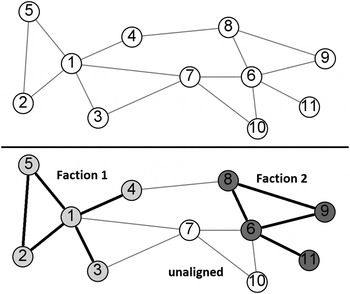
Figure 1 illustrates this idea. The top displays only the underlying social structure among a group of elites. The connections signify an increased propensity to form an alliance—for instance because the two individuals have met while attending the same school. I propose that what observers identify as factions are parts of this network (“connected subgraphs” in SNA terms). In the bottom of Figure 1, two factions that could form along this structure are marked in light and dark grey, and its members are connected through thick black ties indicating that they have activated those ties to recruit each other into the alliance.
Network conceptualization of faction or coalition formation

This conceptualization thus accounts for both the permanence and fluidity of factions. Changing circumstances or a new policy may require expanding the coalition outwards along network ties, or shrinking it by excluding peripheral members. A faction may even break apart—for instance when a central member, such as actor 1 in the light grey faction, is removed. But as long as the underlying structure changes only slowly—and Chinese cadres cannot simply change their place of birth or switch jobs at will—some elites are much more likely to appear in the same coalition, apparently stable allies because of their shared attributes. However, even they may decide, like 4 and 8 in Figure 1, to join competing factions.
The two approaches may thus also focus on different aspects of factional politics. The structured approach is more likely to capture the static, underlying social (network) structure, while the exploratory approach aims to uncover the activated alliance ties connecting the members of the factions that actually emerge. The following section presents an example for each.
EXAMPLES OF THE EXPLORATORY AND STRUCTURED APPROACHES
AN EXAMPLE OF AN EXPLORATORY APPROACH: CONNECTED CHINA
This section serves to illustrate the strengths and weaknesses of the exploratory approach. I have chosen the “Connected China” data because it has been compiled by a team of journalists from a reputable news source and is publicly available (Fathom Information Design and Thomson Reuters 2013)—albeit not in a data format that would allow for statistical analysis. The dataset was therefore coded by hand, from the different displays on the website, and assembled into a single dataset.
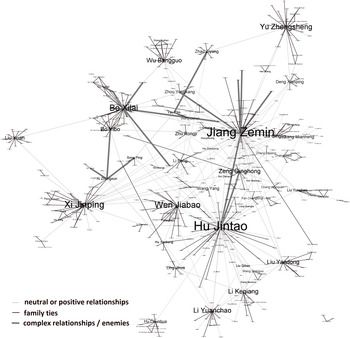
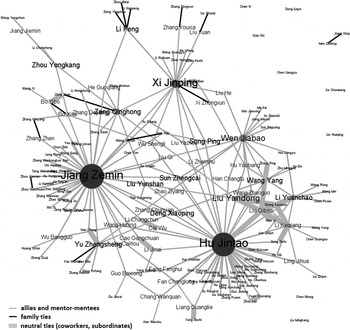
I discuss the network as an illustrative example for the exploratory approach. Other experts will likely disagree with the team's assessment of some of the relationships, but changing a few ties will not influence the overall assessment of the approach more generally. Figure 2 displays the whole network, with different types of lines indicating the kind of relationship between two individuals recorded by the Connected China team. The individuals' positions in this and Figures 3–6 are determined by a force-directed layout (Force Atlas), as implemented in the open-source software gephi (Bastian et al. Reference Matheiu, Heymann and Jacomy2009; Jacomy et al. Reference Jacomy, Venturini, Heymann and Bastian2014). Such commonly used algorithms place individuals that are connected closer to each other, making the interpretation intuitive: individuals that are close in terms of the network ties are also spatially close. Their absolute location—that is whether they are positioned to the right or to the left, at the top or at the bottom—does not have any specific meaning, however. The position of disconnected parts of the network, such as the separated group of three in the lower right corner, also follows no specific rule.
The complete Connected China network

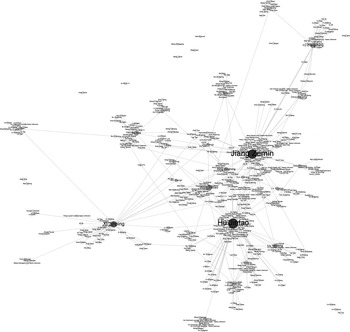
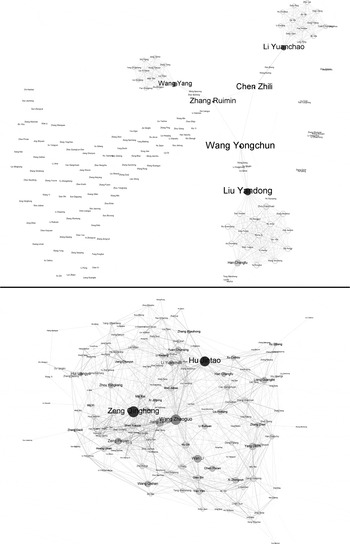
Powerful positions in the Connected China network (positive and neutral relationships only)

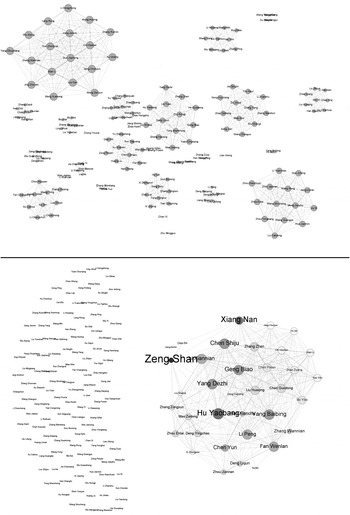
Provincial origin network (top) and field army and base network (bottom) among Central Committee members

Alumni network (top) and coworker network (bottom) among Central Committee members

The Central Committee members' network of neutral, family, and alliance ties

This layout makes it easy to discern the large number of individuals connected to the two former party secretary generals, Jiang Zemin and Hu Jintao, and the slightly smaller clusters around Xi Jinping and several other current or former Politburo members. The layout thus also maps out potential alliances: Hu Jintao's right-hand man Ling Jihua is located close to his patron, while Zeng Qinghong, who fulfilled a similar function for Jiang Zemin (Li Reference Li2015) is placed in the latter's neighborhood.
Thin black lines indicate a wide variety of kinship and family ties, thin grey lines different forms of positive (“ally,” “reportedly close to,” etc.) or positive-neutral (“colleague”) relationships, while thick grey ties mark relationships described either as “rivals” or “complex relationships.” The latter term is used, for instance, for disgraced Politburo Bo Xilai's relation with the English businessman his wife murdered.
Bo is involved in 9 out of the 23 such relationships in the network. But did those negative ties cause Bo's fall? Or have we learnt about his many enemies because of his demise? Such causal questions are difficult to resolve using exploratory network data.
Another notable feature of Figure 2 is the large number of kinship ties, which make up more than half of the ties (327 out of 632). This may be due to the importance of family ties in Chinese politics, but probably also reflects the fact that such ties, having some objective biological basis, are easier for experts to agree on than most of the other types of relationships found in this network. This is not to say that it is easy to uncover the family relations of Chinese elites: the early revolutionaries often adopted the children of fallen comrades and had multiple marriages, resulting in complicated kinship networks. And the children of current elites regularly use pseudonyms when engaging in business or studying abroad.Footnote 4
But there is something worrying about the kinship ties in Figure 2—some seem to be missing. For instance, Ling Jihua is connected to his brothers Ling Zhengce, Ling Wangcheng, and Ling Luxian, but the brothers are not connected among themselves. Apparently, because the investigators are mainly interested in former president Hu Jintao's aide, they only note his ties. Another example for the bias in favor of discovering ties among individuals suspected ex ante to be more important are the three most recent party secretaries, Xi Jinping, Hu Jintao, and Jiang Zemin. They have on average almost 70 ties, while the mean in the network is only 1.34. It is of course possible that more powerful individuals are better connected, but the same discrepancy also pertains to the number of kinship ties (20.67 vs 0.52). It seems rather unlikely that the families of party secretaries in general are that much larger. Similar patterns emerge when comparing other groups of important individuals to the remainder of the network. The Politburo members, for instance, also have more ties and are more likely to be connected among each other than the average dyad. Some of these patterns may reflect true differences between groups of elites, but others are clearly an artifact of the exploratory approach.
The exploratory network also contains a number of Chinese elites that have long since passed away, such as Mao Zedong, Deng Xiaoping, and even Chiang Kai-shek. The influence of such powerful leaders may indeed continue beyond their deaths, but is probably better conceptualized as a characteristic of the surviving individuals. Mao's designation of Hua Guofeng as his successor, for instance, may have granted Hua himself a higher standing among the elites, but this is conceptually different from being an ally of the chairman when he was still alive.
The question of who to include among the living, however, is more complex. The structured approach discussed below usually relies on the positional method of delineating the relevant elites (Putnam Reference Putnam1976), and may examine, for instance, everyone on the Politburo, or all Central Committee members. The exploratory approach most closely resembles what network analysts call “snowball-sampling,” which is known to produce biased samples except under specific circumstances (Heckathorn Reference Heckathorn1997; Gile Reference Gile2011): The researcher starts out with one or a few well-known individuals, records the individuals connected to them, then examines the latter's connections, and so on. The resulting biases are again visible in Figure 2: One would assume, for instance, that if the journalists had started with Mao Zedong, they would have included more of his associates than just his wife Jiang Qing and Xi Jinping's father Xi Zhongxun.
However, snowball samples can be a very useful exploratory tool if the identity of the relevant subjects is not known. The exploratory approach can therefore help identify elites that might be important but do not hold an official position, such as retired officials. Among the 471 individuals in this network are, for instance, relatives whose names are unknown, and even a handful of foreigners, such as Media mogul Rupert Murdoch and other alleged business partners of Jiang Zemin's son. Whether it is appropriate to include such individuals may depend on the research question, but it is advisable to follow a consistent rule.
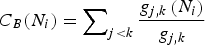
Figure 3 uses the same network without the complex or negative relationships to illustrate how the exploratory network's bias might be problematic once we move to inference or conclusions about the causal effects of specific ties. The size and the intensity of the color of the circles are proportional to the number of ties (degree) and the actor's betweenness centrality, respectively. The latter measure is often associated with informal power, as it captures an individual's strategic position within the network (Padgett and Ansell Reference Padgett and Ansell1993; Brass and Krackhardt Reference Brass, Krackhardt, Ferris and Treadway2012). Betweenness central individuals are often the only or one of few persons connecting two parts of a network, acting as a gatekeeper between them.Footnote 5
The elites with the most connections are past party secretaries, Hu Jintao (84 ties) and Jiang Zemin (74 ties), followed by the new party secretary, Xi Jinping (39 ties). The latter also lags behind his predecessors in terms of betweenness centrality. This may explain why some observers (Radio Free Asia in November 2012Footnote 6) expected Xi to be a rather weak president, beholden to Jiang Zemin and Hu Jintao. But based on the exploratory network, we cannot be sure if Xi Jinping was indeed less connected. Jiang and Hu's longer period in the limelight could have given observers more time to identify their connections. It is also possible that Xi is connected to many individuals who were not seen as important enough to be included in the network—either because Xi hadn't yet maneuvered them into high-level positions, or because the observers didn't recognize their power.
With a more systematic sampling frame for both actors and their ties, it might have been possible to anticipate his rapid consolidation of power. For instance, if one follows the approach proposed in the next section, and constructs a network of coworker ties between the members of the previous and current (17th and 18th) Central Committee, Xi Jinping ranks higher than Hu Jintao in betweenness centrality already at the end of 2012.
COWORKERS, UNIVERSITIES, FIELD ARMIES, AND PROVINCES - THE STRUCTURED APPROACH
In this section, I examine different structural networks between a subset of the actors featured in the Connected China database, namely those 166 who are or used to be members of the Central Committee. I focus on this subset for several reasons. Firstly, the Committee is officially the highest authority in the Chinese Communist Party, and observers agree that it contains the relevant Chinese political elites (Shih et al. Reference Shih, Adolph and Liu2012). Because of their importance, the exploratory approach is more likely to capture their relationship accurately, which will be important for the tests in section 4. Finally, the relevant biographical information is readily available for these elites, while it would be difficult, if not impossible, to gather similar data for some of the other actors, in particular the family members whose names are not even known.
Figures 4 and 5 show four different structured networks: in the network at the top of Figure 4, actors are connected if they were born in the same province. At the bottom is the network of having served in the same field army or lived in the same geographic base regions before the founding of the People's Republic of China. Figure 5 displays the alumni-network at the top, with ties based on shared college or university attendance, while the bottom shows the network between those who have worked in the same unit during their earlier career. The networks were constructed from the dataset compiled by Shih et al. (Reference Shih, Adolph and Liu2012), updated by Lu and Ma (Reference Lu and Ma2015) and Meyer et al. (Reference Meyer, Shih and Lee2014). The units (provinces, ministries and other institutions) in which elites might have worked together are also taken from Shih et al. (Reference Shih, Adolph and Liu2012), but with some minor modifications.Footnote 7
The unusual shape of some of these networks is easily explained: the provincial network consists of separate components because every individual can only be born in one province. He or she is automatically connected with anyone from that same province, but with no one else. Elites from a province where many other elites were born end up having the most connections (i.e. the highest degree) in this network, as indicated by the size of their nodes.
The alumni network looks similar, except that there are a few individuals who received their graduate degree from a different institution than their undergraduate college. These individuals form the bridges between the large clusters of alumni from Tsinghua University (bottom), Peking University (top right), and the Central Party School (top left), and thus tend to be most betweenness central, as indicated by the size of their names and the intensity of the node color. Elites without higher education, or who are the only alumni from a specific university, are left as disconnected individuals in the middle. The field army and base network also contains many disconnected individuals. These are younger elites that had not been active or even born before 1949. As a result, it is the older generation that appears as more powerful in terms of betweenness centrality, and has the most connections. The coworker network probably resembles the Connected China network the most, but is much denser. Most betweenness central and most connected are the two General Secretaries Hu Jintao and Jiang Zemin, the latter's aide Zeng Qinghong, and Wang Zhaoguo, an official who had a remarkable early career and was often seen as a promising contender for the Politburo Standing Committee.
ASSESSING THE DIFFERENT APPROACHES
A COMPARISON BETWEEN EXPLORATORY AND STRUCTURED APPROACHES
The structured networks all look very different, and one may wonder which of the networks or combinations thereof best capture the underlying social structure mentioned in section 2. Unfortunately, we do not have a true measure for the latter, which we could use to evaluate the former. Instead, I propose two different methods: the first assumes that the exploratory approach to identifying ties on a more limited set of elites is a relatively accurate reflection of the underlying structure and therefore searches for the structured network(s) that correlate most strongly with it.
For this test, we only examine the 247 positive or neutral Connected China ties between the 166 Central Committee members. The Committee members have on average more ties: 1.48 instead of 1.34. In other words, the other elites have indeed fewer connections, and may thus indeed be those who were not examined in great detail by the Connected China team.
In Figure 6, the size of the node is proportional to the number of connections (degree), the size of the name and the intensity of the color are proportional to betweenness centrality, the measure capturing a favorable strategic position in the network. The dearth of family ties (in black) is striking, and is unlikely to be explained solely by the secrecy that shrouds that aspect of China's political elites discussed above. It is possible that this sub-network misses indirect family connections, e.g. through wives of Central Committee members who are not themselves members. But it may also just illustrate that factions are not a family affair in current Chinese politics: kinship ties mainly connect political elites to lower levels of the bureaucracy, to economic elites and assets, and to the military.
One way to measure the similarity of two networks among the same set of people is simply the correlation coefficient between their adjacency matrices. Any network can be displayed as a so-called adjacency matrix of dimension n by n, where each cell indicates whether the actor in the row is connected to the actor in the column. The correlation coefficient thus measures how many cells or relationships between the two actors are the same in both matrices.
There is barely any correlation between three of the structured networks and the Connected China network: the correlation coefficient ranges from 0.001 (field army and base network) and 0.025 (alumni network) to 0.032 (province network). Using quadratic assignment procedure (QAP) to calculate the significance level correctly (Krackhardt Reference Krackhardt1987), I find that the latter two are statistically significant. The correlation in the coworker network, however, is considerably stronger (0.158) and statistically significant. Variations of the coworker network, which take into account, for instance, the length of time during which two individuals have worked together, or whether they have done so in different provinces or ministries, reach a correlation coefficient of up to 0.179.
These relations may appear weak, but because only few of the 28,224 possible ties in the Connected China network actually do exist, the coworker network (which is also relatively sparse) correctly predicts about 88% of the relationships.Footnote 8
An alternative way of evaluating the different structured networks is to treat them as an edge covariate term in an exponential random graph model (ERGM). ERGMs are used to establish how a given network differs from a network in which ties have formed at random (see Lusher et al. (Reference Lusher, Koskinen and Robins2012) for a more in-depth explanation). In this specific case, I use it to test whether a tie between two individuals in the Connected China network is more likely when there is a tie between the same individuals in the structured network, holding constant for the effect of ties in other structured networks included in the model.
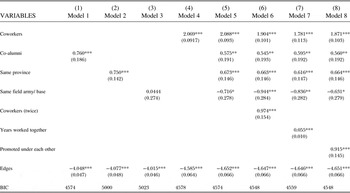
The coefficients in Table 1 can thus be read in a similar way as those of a logistic regression:Footnote 9 while their size is not directly interpretable, the sign and level of significance is. The significantly positive coefficient in model 1, for instance, indicates that in the Connected China network (the dependent variable), ties between individuals that also share a tie in the alumni network (i.e. have attended the same college or university) are more likely than expected at random. Being born in the same province (model 2), and having served in the same field army (model 3) are all positively associated with having a tie in the Connected China network, but the latter is not statistically significant. The results for school and province ties are statistically significant, but not nearly as strongly as the coworker network (model 4). Their coefficients remain statistically significant when added to the coworker network (model 5), but barely increase the predictive power of the model. The Bayesian information criterion (BIC)—a measure to assess if adding additional variables does indeed improve the model, with a lower number indicating a better model—decreases only a little. Examining the coworker experience more closely, however, provides further clues: elites who have worked together at least twice in a different location (model 6) or have worked together for longer time (model 7), or cases where the lower-ranking individual has been promoted during that period (model 8), all have a higher likelihood of being identified as sharing a tie by the Connected China team—even after we have taken into account the presence of simple co-worker ties. These three models also have a lower BIC.
Inferring the inductive network from different deductive approaches

Note: Exponential random graph models of the Connected China network (DV). Standard errors in parentheses. *** p < 0.001, ** p < 0.01, * p < 0.05, + p < 0.1.
In short, the ERGM confirms the findings of the individual correlation analysis: alliances in the Connected China network tend to connect pairs of individuals that share traits, but are most common among current or former coworkers. Examining how long, how often and with what outcome Chinese elites have worked together is thus the best way to capture the underlying social structure, and it is most likely to tell us who is in the same faction with whom.
It is tempting to interpret these results causally, and conclude that coworker ties facilitate alliance formation. But the effect could also be reversed: in particular, powerful leaders may well make sure that their factional allies become their coworkers or subordinates. In order to disentangle the effect, we will at least need to observe both networks over two time periods.
USING CENTRALITY MEASURES TO ASSESS DIFFERENT STRUCTURED APPROACHES
But what if the Connected China network does not in fact capture the “true” network? Is it still possible to assess which structured approach is more likely to be correct? An alternative strategy could measure the expected observable effects of a network, for instance by testing whether provincial leaders with ties to the party secretary are more likely to be promoted (Jia et al. Reference Jia, Kudamatsu and Seim2013), or to receive loans for local development (Shih Reference Shih2004). Such a test is rather indirect, however: if we find no effect, it might be due to a faulty network measure or to the underlying theory about the effect of the connection being incorrect. Also, such tests assess only the measurement of ties to an important leader, not the measurement of the whole network.
In this section, I instead compare the elite's informal power as measured through their network position with their official rank in the party hierarchy.
In the latter, I distinguish between Politburo Standing Committee members (highest rank: 1), regular Politburo members, and remaining full and alternate Central Committee members (lowest rank: 4).Footnote 10 The second test therefore doesn't focus on individual ties, but assesses the accuracy of the overall network, or, more precisely, the relative position of the individuals in it. It assumes that the Central Committee member's official rank in the party is correlated with their informal power, as measured through their network position, and evaluates the structured networks based on how well they reflect that.
Figure 7 shows the correlation coefficient between a Central Committee member's rank and their number of ties (degree) for the different Central Committees starting with the 12th Committee in 1982. Degree in this network might indicate the number of individuals that have a higher likelihood of joining a given elite in the case of internal struggles, because they share a common background as defined in the specific network. Different symbols indicate different combinations of networks.
Correlations between number of connections and party rank in different Central Committees

The school and provincial networks by themselves fare very poorly, with the coefficient varying between +/−0.1 over time. Field army and base ties, alone or in combination with school and province ties, display a weakly negative correlation (between −0.2 and −0.3)—as long as those with such ties are still active, that is before the 15th or 16th Central Committee. As in the previous section, coworker ties perform best: the correlation varies between more than -0.4 in the 12th, and -0.15 in the 18th Central Committee. In general, any network that takes into consideration co-worker ties (the black symbols) tends to fare better than those without.
But degree, the number of each individual's direct ties, may not necessarily be the best measure of informal power. For instance, elites from large provinces or schools may appear more powerful simply because there will likely be more elites with the same background.
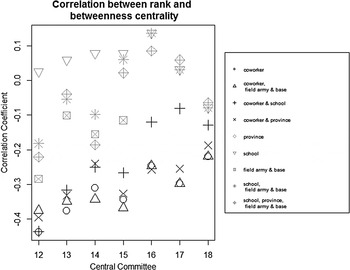
Figure 8 thus shows a similar plot, but with betweenness centrality instead of degree.Footnote 11 As shown in Keller (Reference Keller2014), this centrality measure captures the strategic position of powerful leaders, who can prevent a large number of possible competitors from forming sizeable opposing coalitions. It thus measures the actor's latent power to disrupt unfavorable informal alliances. It is again the coworker network that carries the day: in fact, any network that also takes into consideration coworker ties (the black symbols) fares better than any network without such ties (grey symbols). Field army or base ties also seem to have a weak, but relatively consistent association with rank.
Correlations between betweenness centrality and party rank in different Central Committees

This result makes intuitive sense: coworker and field army/base ties are the connections that are more likely to have been formed through extended interaction. School and province ties may be useful to break the ice in a first meeting, but they are unlikely to sway an actor when making important decisions, such as choosing sides among a group of peers—i.e. the other Central Committee members—with which he or she is already quite familiar.
Both Figures 7 and 8 also display interesting time trends, which hint at how the network approach to informal politics could be used to answer substantive questions: the strength of the correlation between rank and network centrality weakens over time, which may be due to the increasing institutionalization and concurrent decreasing influence of informal politics. There is also a small, but noticeable difference between the even and odd numbered Committees, with the former displaying a weaker correlation. This likely reflects the fact that during the time when a new party secretary is chosen, power is more contested and the new candidate did not yet have time to establish his supremacy, form all the necessary connections, and elevate his supporters to elite status. It takes a few years until the new office holders have reduced the informal power of their retired predecessors, and formal and informal measures of power align again. Centrality measures could thus be used to compare the gap between formal and informal power over time on a systemic level or for individual leaders, or to measure the influence of actors who do not have an official rank. In Keller (Reference Keller2015), for instance, I trace the informal power of current and retired Politburo Standing Committee members in such a manner.
Note, though, that the conceptual distinction between formal and informal power, especially in a coworker network, is not straightforward. For example, one of the reasons the party secretary is often very betweenness-central in recent coworker networks is due to his formal position on the Central Military Commission (CMC). This makes him one of the few civilian cadres who has military coworkers (who, in their turn, are connected to more military coworkers), and he therefore forms one of the few bridges between two otherwise quite separate parts of the coworker network. It is easy to see how this brings informal power—but acting as a liaison between the party and the military is also one of the formal powers granted to CMC members.
The question of causality is even more complicated. “Being connected” likely facilitates rising in the party rank (Shih et al. Reference Shih, Adolph and Liu2012). But holding an important formal position also makes it easier for a leader to elevate actors already connected to him to the Central Committee in the future, or to appoint suitable individuals as his subordinates, thereby increasing his number of coworker ties to other members of the current Central Committee. One solution is to compare the network positions of individuals with the same formal position over time, and control for possible confounders. I have used this approach to shown that specific centrality measures do indeed predict advancement to the Politburo (Keller Reference Keller2015). Here I simply present evidence that coworker networks again appear to capture the underlying social structure more closely than other types of structured networks.
CONCLUSION
In this article, I have argued that the analysis of elite contention in China—and possibly the research of authoritarian regimes in general—could profit from re-conceptualizing informal politics as network based rather than faction based. Instead of assigning different individuals to exclusive, opposing groups that predetermine a fixed loyalty, ideology, and set of political actions, a network approach sees them as embedded in a social structure, a web of relationships created by previous interactions with the other elites, which enables or restrains their alliance formation during internal struggles. To be fair, the qualitative analyses of informal politics among China's leaders have often taken such a more nuanced stance, but quantitative studies have usually dealt with the challenge of analyzing large number of elites by assigning them to groups.
I have identified two different approaches to measuring informal networks and have argued that the exploratory approach may indeed measure individual alliance ties more accurately, but can also be subject to serious bias—a bias that has not been discussed systematically by those applying it. Causal effects of a network measured this way could thus be confounded by the observer's interest, access to sources, and so on. The structured approach is likely less accurate, but the bias may be smaller and easier to assess.
I have tested several such structured approaches, both on the level of individual ties—by comparing them to an exploratory network—and the overall network—by comparing the elite's network position to his or her formal rank in the Party. I have shown that neither provincial origin nor university ties are particularly important in structuring elite competition and coalition formation, despite the frequent talk of such factions. It is the coworker network that most strongly and consistently captures the informal relationships among the Chinese political elites in the reform period. Further refinements of that network, which take into account the amount of time spent as coworkers, the number of different instances, or whether promotions have occurred during that period, increase the predictive power of the models. These findings are consistent with results from my related research, in which I find that the number of coworker and promotion ties to former and current Politburo Standing Committee members increases the chances of an appointment to the Politburo (Keller Reference Keller2015), while school and provincial ties do not have a significant effect.
Thus, this article shows that the qualitative literature on “guanxi” is correct in carefully distinguishing between different forms of connections (Guo Reference Guo2001), such as kinship and coworker relations, instrumental and affective ties, or connections based on having the same provincial origin or having attended the same school. Statistical analyses should therefore make similar distinctions, as already proposed by Zhang (Reference Zhang2014).
By assessing the best method to measure the informal elite network, this article has laid the ground for the examination of substantial and causal claims about the effect of elite networks, and their role in elite contention. I have started to address some of those in my other research, by studying what kind of ties and tie configuration help and hinder elite advancement (Keller Reference Keller2015), or which networks positions make elites particularly vulnerable to purges (Keller and Wang Reference Keller and Wang2015).
Research into the formation of networks and ties would help us disentangle the complex question of causality mentioned on several occasion. The methods and concepts from social network analysis are particularly useful for studying the interdependence between different connections, a phenomenon for which we have ample anecdotal evidence in the case of China: Wen Jiabao's relatives mentioned in the introductory example, for instance, were able to form economic ties exactly because of their kinship ties with the Premier.
The network approach to informal connections also provides an intuitive way of studying indirect connections. For example, none of the companies in the Wen Jiabao network are directly connected to the Premier himself. This helps insulate him from possible accusations of wrongdoing or corruption charges, but may also make him dependent on the relatives acting as intermediaries. Disgraced Politburo member Bo Xilai may have faced exactly such a conundrum: conducting business through his wife made it harder for investigators to implicate him, but probably also prevented him from simply disassociating himself from her once she became a liability.
Social network analysis offers ways to conceptualize and measure such complex relationships in relatively straightforward way, but without the oversimplification that factional analysis is often accused of (Miller Reference Miller2015). It therefore opens up a new approach to study contention among Chinese elites and politics for practitioners and scholars, qualitative and quantitative analysts alike. And while this article introduces social network analysis to the research of Chinese political elites, the same approach could also be applied to the study of authoritarian elites and regimes more generally; a field that has been slow to embrace network analysis so far.Footnote 12