Introduction
Informal payments for health services are widespread in many transition economies in post-communist Europe and the former Soviet Union (FSU). Their existence complements and in some cases significantly contributes to the financing of their health systems (Ensor, Reference Ensor2004; Boikov et al., Reference Boikov, Feeley, Sheiman and Shishkin2000; Bonilla-Chacin, Reference Bonilla-Chacin2003; Thompson and Witter, Reference Thompson and Witter2000). Informal payments have increased in unreformed Siemashko systems (a universal primary care-based model first introduced in the Soviet Union in the 1930s and then replicated in other communist countries) and under health insurance arrangements, replacing centrally planned health care (Chawla et al., Reference Chawla, Berman and Kawiorska1998; Vian and Burak, Reference Vian and Burak2006; Thompson and Witter, Reference Thompson and Witter2000). There is also growing empirical evidence of the extensive nature of informal payments in Russia (see Boikov et al., Reference Boikov, Feeley, Sheiman and Shishkin2000; Shishkin et al., Reference Shishkin, Bogatova, Potapchik, Chernets, Chirikova and Shilova2003; Morozova and Kulibakin, Reference Morozova and Kulibakin1998; Ibragimova et al., Reference Ibragimova, Krasilnikova and Ovcharova2000; Sidorina and Sergeyev, Reference Sidorina and Sergeyev2000, all quoted in Shishkin et al., Reference Shishkin, Bogatova, Potapchik, Chernets, Chirikova and Shilova2003).
Despite their pervasiveness, there is an absence of conceptual and definitional clarity about the causes and characteristics of informal payments, leading to theoretical obfuscation and confusion in subsequent policy evaluations. Ensor (Reference Ensor2004), for example, differentiates between contributions towards the cost of care, extortion of illegal payments by providers misusing their position in the market and legal payments for additional services. Gaál and McKee (Reference Gaál and McKee2005) divide informal payments into largely involuntary monetary exchanges resulting from low morale and insufficient law enforcement, and voluntary donations or gifts rooted in the tradition of expressing gratitude for successful treatment. Moreover, the boundaries between discretionary legal payments applied at different provider units and informal payments are quite often blurred because they concern services that should be nominally free. Such is the case of diagnostic procedures or drugs that are not available in hospitals but can be purchased privately in the pharmacies located at their premises (Shishkin et al., Reference Shishkin, Bogatova, Potapchik, Chernets, Chirikova and Shilova2003), or the food and bed linen that patients or their relatives have to supply themselves (Fotaki, Reference Fotaki2006).
The explanations for the genesis of informal payments also vary. One is that they are temporary side effects of the transition, resulting from under-funding, an absence of institutions, a lack of accountability (World Bank, 2000; Lewis, Reference Lewis, Mossialos, Dixon, Figueras and Kutzin2002; Kornai and Eggleston, Reference Kornai and Eggleston2001) and inefficient law enforcement (Gotsadze et al., Reference Gotsadze, Bennett, Ranson and Gzirishvili2005; TACIS, 2000). Another one points to the legacy of planned socialist economies, in which shadow means were tacitly relied upon to partially alleviate the scarcity of goods and services and to supplement the low salaries of physicians (Ensor, Reference Ensor2004; Allin et al., Reference Allin, Davaki and Mossialos2006; Rose, Reference Rose2006). Informal payments are also seen as a culturally embedded way of showing appreciation, particularly in Central Asia and in the Eastern European cluster of post-communist countries (for example, see Balabanova and McKee, Reference Balabanova and McKee2002; Ensor, Reference Ensor2004). The exchange of services or ‘favours’ between patients and health professionals in addition to or in lieu of payment is quite common in Russia (Shishkin et al., Reference Shishkin, Bogatova, Potapchik, Chernets, Chirikova and Shilova2003).
Seen from the perspective of equity or allocative efficiency, informal payments are an undesirable development causing patients to delay and forgo necessary treatment (Falkingham, Reference Falkingham2004; Gotsadze et al., Reference Gotsadze, Bennett, Ranson and Gzirishvili2005; Belli et al., Reference Belli, Gotsadze and Shahriari2004). Egalitarian policy analysts are particularly concerned with their negative impact on equity of access for vulnerable groups of the population and their ethical implications for health professionals and patients (Kornai and Eggleston, Reference Kornai and Eggleston2001; Vian et al., Reference Vian, Grybosk, Sinoimeri and Hall2006; Vian and Burak, Reference Vian and Burak2006). Libertarians oppose informal payments because of their deleterious effects on governance and trust in new market institutions (World Bank, 1997, 2000). Moreover, by exploiting the weak position of the patient, informal payments lead to inefficiencies (Ensor, Reference Ensor2004: 241) and, as they go unreported, they are not audited or monitored (Lewis, Reference Lewis, Mossialos, Dixon, Figueras and Kutzin2002), and thus cannot be fully integrated into the financing of health care. Users also find it difficult to differentiate between formal payments applied by providers and informal or illegal payments, especially when they expect that health care services should be offered free of charge or covered by their insurance policy (Lewis, Reference Lewis, Mossialos, Dixon, Figueras and Kutzin2002; Ensor and Savelyeva, Reference Ensor and Savelyeva1998). Last but not least, by introducing a bias in favour of hospital and curative services (Balabanova and McKee, Reference Balabanova and McKee2002), informal payments undermine health policy goals and enable doctors to use their power to oppose reforms aimed at curtailing their ‘additional’ source of income (Gaál and McKee, Reference Gaál and McKee2005).
Although liberally minded and egalitarian economists are in agreement about their undesirable effects for the health system and beyond, they appear to justify them as an ‘adverse necessity’ of the transition from a planned to a market economy. Accordingly, informal payments are seen as, firstly, a possible way of relieving pressure on the public purse, allowing the system to function by keeping health professionals within it (Gaál and McKee, Reference Gaál and McKee2005; Gaál et al., Reference Gaál, Belli, McKee and Szócska2006), and, secondly, as a means of empowering users to reward responsive professionals (Chawla et al., Reference Chawla, Berman and Kawiorska1998; Balabanova and McKee, Reference Balabanova and McKee2002). Not so long ago, a theoretical construct of ‘inxit’, modelled on Hirschman's framework of ‘voice’ as a means of changing the system from within that is traded off against the ‘exit’ from the system, was suggested by Gaál and McKee (Reference Gaál and McKee2004). In ‘inxit’, patients use their power of internal exit to avoid services of poor quality by paying informally.
The study seeks to examine the function of informal payments in the framework of the transition from a different perspective and to appraise critically the policy options offered to address this issue. My key contention is that various informal payments, including illegal ones, are tacitly accepted because of the utilitarian determinism underpinning both: market liberalism and communitarian egalitarianism. This I argue, is why the experience of the social insurance scheme in Russia and its inability to curtail the growth of a shadow economy in health care has wider implications for public policy-making, going beyond the peculiarity of the Russian economic and political environment of the 1990s.
The study will put forward four propositions to argue its case. Firstly, the increase in informal payments in Russia has its roots in the failure of the insurance scheme to act as a dependable source of financing health care. Secondly, the process and outcome of these reforms mirror the wider trends of the transition in Russia, with informal payments forming an integral part of the wider shadow economy, which cannot therefore be addressed simply by legalising them as co-payments or via incorporating them into private health insurance. Thirdly, market principles of individual freedom, choice and competition pose a conceptual and empirical challenge when applied to the provision of health services, particularly when there are egalitarian aspirations at stake dating back to pre-revolutionary Russia and the pre-existing Soviet system. Fourthly, the utilitarian gain maximisation principle calling for the greatest balance of collective benefit in egalitarian theories, and the satisfaction of individual preferences in libertarian economics, enable the acceptance of informal payments as a viable policy option.
The remainder of the article is organised around these four propositions. After providing some background information on the implementation of social health insurance and the organisation of health care in Russia, I will outline my theoretical framework. I will then present some findings of the survey conducted in the framework of the EU technical assistance project to the Ministry of Labour and Social Security, conducted in four regions in the Russian Federation. In the discussion section that follows, the proposed analytic schema will be applied to contend the validity of the utilitarian assumptions underlying market libertarian and egalitarian communitarian perspectives, and to reject the idea of the ‘lesser evil’ of informal payments and their intractability. In conclusion, I will argue against the reliance on informal payments as a means of sustaining the illusion of free health care and avoiding the necessity for structural changes in the health care system in Russia.
Background
In the early 1990s, the government of Russia replaced the universally provided and vertically integrated model of financing the health system by introducing a decentralised insurance-based model. The adoption of social health insurance signified a departure from universal taxation in favour of employment-related contributions. The health insurance system was primarily introduced to address the acute budgetary crisis and to secure a reliable source of funding for health care in Russia (Sheiman, Reference Sheiman1994; Shishkin, Reference Shishkin1998). It was also hoped that the other comparative benefits associated with the insurance system, such as higher transparency and protection from political interference, would make it more acceptable to the public (Fotaki, Reference Fotaki2006).
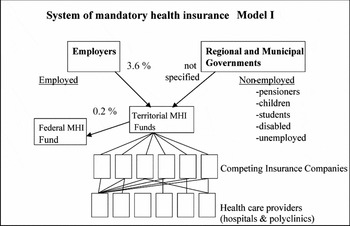
The ‘Law on Health Insurance of the Citizens of the Russian Federation’ was first signed in 1994 and was gradually implemented in different regions of the country, setting out to provide coverage for all residents of Russia. According to the law, a modest payroll contribution of 3.6 per cent was to be paid initially by employers only, while local governments had to contribute an unspecified amount of money to cover the cost of health care for the non-working population, including children, the retired and the unemployed. Individuals were not expected to contribute to their health insurance at this stage. Territorial branches of Mandatory Health Insurance (MHI) were to collect all contributions and allocate the money to competing health insurance companies responsible for contracting various health service providers (both public and private) on behalf of their insured (see Figure 1). Of all the contributions, 0.2 per cent would be transferred to the Federal Fund of MHI for risk sharing among the various regions of Russia.
Mandatory health insurance (with insurers as originally intended).

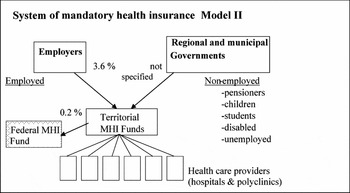
However, the originally envisaged plan was only partly implemented, resulting in various intermediate models developing throughout the Russian Federation, including: (i) competitive models of insurance, with insurance companies receiving money from the territorial MHI funds to act as purchasers of services for their insured as originally intended (see Figure 1); and (ii) direct models implemented in areas and regions with no competitive insurance market, in which branches of the territorial MHI funds assumed the role of insurers (see Figure 2). Finally, in some regions the insurance system never really took off, leaving the provision of health services to the local (and occasionally regional) governments which continued to finance their own hospitals and health centres, known as polyclinics.
Direct model of mandatory health insurance (without competing insurers).

The fragmented implementation and the lack of success of the social health insurance scheme in Russia was largely embedded in the way the policy was conceived and launched. Without securing essential support from potentially powerful opponents and the population, its limited success was not surprising (TACIS, 2000). In addition, policy-makers underestimated the necessity for, and lacked the resolve to proceed with, the restructuring that was necessary to enable the new scheme to work because of a fear of upsetting the powerful interest groups operating in the health system (ibid.). This, as a minimum, should have involved changing the methods of paying providers and the closure of obsolete facilities. The absence of mechanisms for enforcing payment of contributions for the non-working population by local and regional governments (Shishkin, Reference Shishkin1998; TACIS, 2000) has also seriously disabled the viability of the scheme. Competition among multiple insurers which could, in theory, have promoted efficiency and quality of service has not happened either (Shishkin, Reference Shishkin1998; Fotaki, Reference Fotaki2006). However, I argue that the main culprits behind the scheme's failure were the oversimplified and unrealistic assumptions driving the marketisation of health care.
The proposed analytic framework presented below points out major conceptual flaws in the libertarian premises, urged with religious fervour by its proponents, and argues against explaining them as a result of the imperfect implementation. It also decries the utility maximisation principle underpinning market liberalism and communitarian egalitarianism as being the root cause of the acquiescence to informal payments in health care, in Russia and other economies in transition.
Analytic framework
In my proposed schema, I juxtapose two bodies of theories – market liberalism and communitarian egalitarianism – to demonstrate their impact on health policy formulation in post-Soviet Russia. In this way I will describe the health policy development process in Russia as an uneasy journey from the tradition of community-defined egalitarianism harking back to pre-revolutionary Russia. The drastic redistribution established during the Soviet period, which arguably drew on this tradition of communitarian egalitarianism, has not withered in spite of the crude experiments with the marketisation and establishment of the health insurance model in the early 1990s. Let me now briefly analyse the key premises of market liberalism and communitarian egalitarianism, and their influence on the philosophy and organisation of the health service in Russia.
Of the vast array of ethical and political theories underpinning libertarianism, neo-classic economics with property rights, individual freedom, competition and choice driving the market has arguably had the greatest influence on the development of public policies in the last two decades in the West and East (Jordan, Reference Jordan2006). The underlying assumptions about liberty, property and governance, theorised by the Austrian school economists in the 1940s (Hayek, Reference Hayek1944; von Mises, Reference von Mises1949), developed further by the micro-economists of the Chicago school (Friedman and Friedman, Reference Friedman and Friedman1980) and public choice theorists (Buchanan and Tullock, Reference Buchanan and Tullock1962), became the grand narratives dominating contemporary public discourse. After the demise of the collectivist Soviet model, they were presented as ‘the only alternative’ (Fukuyama, Reference Fukuyama1992/2006).
Libertarians, whose views have dominated public policy development in Western Europe and elsewhere (including Russia in the early 1990s), favour the ethics of self-responsibility and posit that political and economic liberty will maximise societal well-being and efficiency. Public choice theorists, on the other hand, while accepting that most people base some of their actions on their concern for others, see self-interest as the dominant driver behind employers', employees' and consumers' actions. In doing so they build on, and complement, the libertarian idea of the individual as an autonomous utility maximiser, laying the foundations for neoclassic micro-economics. However, health care provision sits uneasily with both; the concept of the user of the service as an enterprising and autonomous being and the best judge of her own welfare, and the idea of the (mostly) self-interested health professional (Arrow, Reference Arrow1963). This is because the user of the service rarely, if at all, chooses to ‘consume’ health care, and because of the asymmetry of information between her and the provider generate the need for trust and co-operation. Health care possesses the characteristics of a public good, bringing about benefits and disadvantages for those who use it and those who do not (immunisation is a classic example here). If left to the market alone, it would be undersupplied or would not be produced at all. Furthermore, it is not inconceivable for a health professional to be motivated by altruism and not simply by how to maximise her utility.
Libertarian assumptions have traditionally been opposed to collectivist values such as equity and the supremacy of community-defined needs, in which individual preferences and choices are superseded by the notion of the public good. The concept of demand denoting what services users are prepared to pay for is replaced by that of need, implying what services or goods citizens think they may require at someone else's expense. This, together with the recognition that equality of opportunity may not be sufficient to address the issue of inequality of condition, is at the heart of the redistributive mandate underpinning the modern welfare state and its responsibility for ensuring optimal levels of public service provision. As Risse (Reference Risse2005) puts it, in the welfarist assumption of society, individual fates are tied together, and the benefits of social co-operation outweigh the value of individual liberty. Because of this, common resources have to be distributed to maximise social benefits in such a way that is justified to all.
Similarly, the philosophical tradition of communitarianism is broadly centred on the role of the public sphere in shaping individual values, while communitarian political ideology advances the concept of the positive rights and guarantees of the citizen into the sphere of social policy (see Etzioni, Reference Etzioni1995, for example). These rights could be about universal access to health care and education, about safety, or even about the right to employment, which the government is obliged to enforce at the expense of individual liberty whenever they outweigh the benefits for society as a whole. Thus, communitarians are interested in welfare too, but for them communal rather than individual welfare is at stake (Risse, Reference Risse2005). Although communitarianism should not be confused with the vision of the communist society that permits the use of violence as a means of egalitarian redistribution, in the most extreme version of communitarian thinking, individual needs have no place in how society should be organised.
My argument is that implicit communitarian traditions and the collective idea of welfare overriding individual wants ran deeply through the history of Russian political life, long before the Soviet Union came into being. I also claim that the relative success and longevity of the otherwise coercive Soviet model was largely, if not exclusively, owing to its ability to articulate these values in political terms and to build its institutions around them. Soviet ideology was also successful in marrying communitarianism with its egalitarian political project, leaving a lasting legacy that could not easily be overturned by schemes advocating individual entrepreneurship and the supremacy of self-interest as a route to well-being. Unsurprisingly, the values of libertarian individual freedom and autonomy achieved at the expense of equality were in reality not very high on the public agenda when the market system was introduced in the early 1990s in Russia, a country with a long history of communal governance and strong authoritarian inclinations, termed as ‘democratic-centralism’ in the early Leninist Soviet period (Vlachoutsicos and Lawrence, Reference Vlachoutsicos and Lawrence1996). This seemingly contradicting combination of centralist and grass-roots elements has, according to these authors, developed through centuries of ‘the same extremely adverse conditions which made communitarianism essential to the viability of the village, and made centralism essential to the viability of the state’, although they admit that it later deteriorated into an oppressive and bureaucratic system under Soviet rule (Vlachoutsicos and Lawrence, Reference Vlachoutsicos and Lawrence1996: 315).
Before outlining the implications of my conceptual framework for the analysis of informal payments in the transition from a planned to a market health system, I will first present the methods and findings of the empirical study in the sections that follow. I will then discuss policy options to highlight the development and role that informal payments have assumed in the health system in Russia.
Methods and results
The survey was undertaken during Autumn 1999 and Spring 2000, and was carried out in four (out of 89) regions of the Russian Federation: Murmansk, Yaroslavl, Moscow City and Moscow Region. These regions were chosen to represent different models of health insurance: Yaroslavl and Moscow City regions, the competitive model I (see Figure 1); Murmansk and Moscow Region the direct model II (see Figure 2); and, because of their importance and geographical proximity, Moscow City and Moscow Region. Convenience samples of the population in all four regions were selected, as it was neither possible nor intended to randomise sample selections. Two hundred face-to-face interviews with groups of factory employees (from two enterprises with varying histories of paying contributions to the insurance scheme) and with students and pensioners (whose contributions were likely to be left unpaid by the local governments) were carried out in polyclinics using structured questionnaires and metric scales. A total of 796 responses were received. Trained interviewers approached potential respondents as they came to polyclinics located in enterprises, in community and university centres until a total of 100 employees, 50 pensioners and 50 students were reached in each region. Consent was obtained in all cases. Data were coded and analysed using the SPSS statistical package. The definition of informal payments adopted in this study was solely confined to monetary exchanges between a patient or her relatives and the health professional or institution providing services that should have been free of charge. All other forms of voluntary or involuntary donations in kind were excluded, although it was recognised that substantial costs might be involved in obtaining pharmaceuticals and hospital disposables, or in providing food and bed linen (Fotaki, Reference Fotaki2006).
Below I will present some of the findings from the study (in the form of descriptive statistics), after acknowledging the limitations related to the size and selection of the sample, which is not representative of the population of Russia or even of the regions studied. The bias introduced into the selection of the sample favours the urban population, specifically the employed, students, older people and pensioners who have accessed polyclinics, while it excludes the non-insured and rural population who are more likely to be deterred from accessing health care if they are not able to pay for it. There is also a possibility that patients might have confused informal and illegal under-the-table contributions with the legal payments levied by providers, which was partly addressed by the phrasing of the question (see Table 1). However, this is not a crucial concern as in both cases users may anyway be asked or forced to pay for services and goods that should be provided for free (Shishkin et al., Reference Shishkin, Bogatova, Potapchik, Chernets, Chirikova and Shilova2003). Given the very few empirical studies investigating the nature and extent of informal payments, the research presented here makes an important contribution by offering an insight into patients’ experience of free health services in post-Soviet Russia, even if it is limited to specific user groups and a few geographic areas.
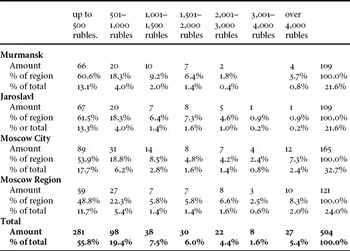
Amounts of money spent on under the table payments for health services in four regions of Russia

Note: 292 people have not given an answer to this question of which 90 were from Murmansk, 90 from Jaroslavl, 34 from Moscow City and 78 from Moscow Region.
Informal payments and their consequences for access to health care
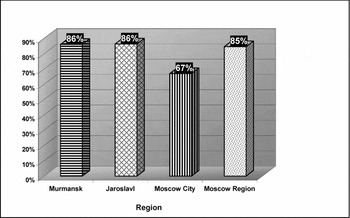
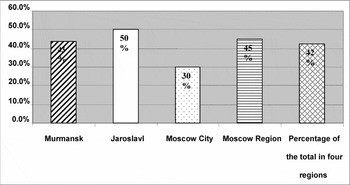
The overwhelming majority, 80.9 per cent, of interviewees across all respondent groups reported having to spend money from their own family budget in order to receive medical services that they or their relatives were entitled to free of charge. A total of 86.9 per cent of all interviewees were social insurance policy-holders and there was no statistically significant difference between various respondent groups. However, there were regional differences, especially in Moscow City, where ‘only’ 67 per cent of interviewees had to spend their own money to pay for ‘free’ health services, and there were also differences in the amounts of money spent between regions (see Figure 3).
Percentages of respondents paying informally for ‘free’ health care in four regions in Russia.

Different responses were also given when question was phrased in terms of ‘under-the-table payments’ as opposed to legal charges for services that should otherwise be provided free of charge or covered by the insurance but were nonetheless levied by hospitals or polyclinics at their discretion, as shown in Table 1. Respondents showed a much greater, and also a varied, reluctance in answering this question because it was deemed sensitive (see Table 1). For example, in Moscow City and Moscow Region they referred to payments of above 3,000 rubles per year (over US $90 in 2000 prices) more often than in Jaroslavl and Murmansk.
Unsurprisingly, the need to pay for services had an impact on access to health services. Half of all respondents from Yaroslavl, and over 40 per cent of respondents in both Moscow Region and Murmansk, reported having to forgo certain medical services. The only exception was Moscow City, where many respondents: ‘were able to pay for the necessary services’ (quoted by 40 per cent of all interviewees) while also the percentage of those who had to pay for ‘free’ services was only 30 per cent when compared with the other three regions (see Figure 4).
Percentages of respondents who had to forgo medical treatment because of the reported inability to pay for services in four regions in Russia.

Is the population ready and willing to co-pay for health care services?
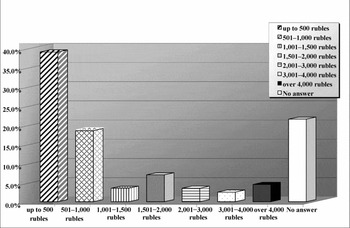
Many respondents (38 per cent of the total sample, n = 796) were willing to pay ‘up to 500 rubles’ (US $15–16 in 2000 prices) per year, if this meant that there would be no need for any additional informal payments (see Figure 5). This response was highest in Murmansk, Jaroslavl and Moscow Region, but was given by only 16 per cent of interviewees in Moscow City. By contrast, the number of respondents willing and able to pay amounts ‘between 1001 and 1500 rubles’ or ‘over 4000 rubles’ per year, was higher in Moscow City (22 per cent) and lower in the other regions (ranging between 1 per cent and 4 per cent).
Amount of money that population is prepared to pay as co-payments in four regions of the Russian Federation (in rubles).

Whose responsibility is health care?
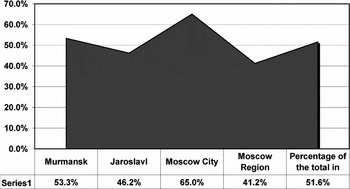
Many respondents felt that the state was responsible for ensuring the provision of health services for the citizens, but quite a few also supported the idea of developing a parallel non-state system alongside a functioning and high-quality public system, mostly in Moscow City (65 per cent) and Murmansk (53.3 per cent) (see Figure 6). There was a degree of agreement with the statement ‘I think the health care system should only be organised by the state’ in all groups across the four regions (measured on a scale of 1 to 6). However, in Moscow City the incidence of the score 5, indicating strong disagreement, was higher, while in the three other regions the average score was 3, indicating moderate agreement. The statement ‘I think it is the duty of the state to provide appropriate health care’ got the highest score in all regions.
Percentages of respondents favouring the development of a non-state health system in four regions in Russia.

Discussion
In this section, I discuss the findings from the study in the light of my analytic framework and review the most commonly proffered policy options for addressing informal payments. I also draw conclusions as to why and how the utilitarian premises of market liberalism and egalitarianism are implicated in the perpetuation of these payments.
Informal payments: a symptom of the growing pains of transition or a stable feature of the health system in Russia?
Findings from our survey demonstrate that an astonishing 80.9 per cent of all respondents (n = 796) have spent their own money in order to receive medical services that were declared as free, including official payments charged by the hospital (for example, for pharmaceuticals, or extra diagnostic procedures) and informal/illegal payments to doctors and other health professionals. Even if we assume that not all of these are illegal contributions falling into the category of ‘under-the-table’ payments, the evidence that the system has (once more) failed to deliver on its promises to provide free and responsive services is overwhelming. What could be the reasons behind this apparent failure of the public health financing system?
The position adopted in this study is that informal payments are only partly related to the transition processes identified by many researchers (Thompson and Witter, Reference Thompson and Witter2000; Ensor, Reference Ensor2004; Allin et al., Reference Allin, Davaki and Mossialos2006; Gaál et al., Reference Gaál, Belli, McKee and Szócska2006), while their fundamental causes go beyond it. The reasons are institutional, historical and political. The Russian Federation was among the first post-communist countries in Europe and the FSU to reform its state-planned and provided health system, replacing it with the social health insurance scheme. However, its implementation proved difficult if not impossible in a country that lacked any experience in the organised health care market, contractual arrangements, financial flows and regulation (Lewis, Reference Lewis, Mossialos, Dixon, Figueras and Kutzin2002; World Bank, 1997). By transplanting the social health insurance idea into the vacuum of necessary institutional arrangements to serve as a mechanistic tool for money collection (Sheiman, Reference Sheiman1994), the scheme was not destined or even perhaps intended to bring either transparency in resource allocation or a higher responsiveness to users' needs. Nonetheless, the lack of explicit regulation and non-enforcement of the existing laws (TACIS, 2000; Fotaki, Reference Fotaki2006), obscure governance arrangements not boding well for accountability, the absence of transparent agreements impeding competition and the effective operation of agent-insurers (Preker et al., Reference Preker, Jakab, Schneider, Mossialos, Dixon, Figueras and Kutzin2002) are only partial explanations for the failure of social health insurance. Crucially, the early days of economic liberalisation and marketisation resulted in a ‘kleptocracy’ rather than a fine-tuned regulation, which is indispensable for the market to function properly. This has produced social dislocation bringing ‘many tears’ more than ‘fulfilling hopes’, contrary to the original assertions and expectations (for example, see Barr, Reference Barr1994). With the market system failing to capture the aspirations underpinning Russian, and to a degree also Soviet polity, and with worsening living conditions for many, it was slowly replaced by centralised state corporatism.
As I argue in my theoretical framework, the historical forms of social organisation, rooted in the tradition of collective governance combined with strong and authoritarian power at its centre (Vlachoutsicos, Reference Vlachoutsicos1998), played an important role in shaping citizens' expectations and the current political system. The embryonic form of health care provision already existed in pre-revolutionary Russia. It was organised by local councils on a communal basis in so-called ‘zemstva’ and offered by the landowner to the rural inhabitants (Eklof et al., Reference Eklof, Bushnell and Zakharova1994). This model was extended to a system of collectivised units, offering comprehensive, albeit very modest, forms of universal health services during the Soviet period, and was combined with a peculiar system of occupational discretion applied (mostly as benefits in kind) to various ‘deserving’ groups (for example, the military, state officials and specialised professional groups). Soviet medicine was often hailed in the past as one of the few redeeming features of an otherwise bleak and totalitarian system and as a model worth emulating; a view that was held by many, including the World Health Organisation (Field, Reference Field, Millar and Wolchik1994).
However, the system was not quite as equitable or as efficient as it was proclaimed to be. Health care intended for the majority of the population was largely driven by crude utilitarianism and considered to be a ‘non-productive sector’ of the Soviet economy, rather than an intrinsic good in its own right worth investing in. Hence, its ‘development’ occurred via increasing the number of rudimentary qualified and underpaid physicians, and via expanding bed capacity (Chernichovsky et al., Reference Chernichovsky, Gur and Potapchik1996) and poorly equipped facilities. The under-funding and inefficiency of the health sector created incentives for various forms of informal payments even during the Soviet Union era, although these forms of circumventing the official law were mostly reserved for elite practitioners and their clients (Field, Reference Field1989; Shishkin et al., Reference Shishkin, Bogatova, Potapchik, Chernets, Chirikova and Shilova2003). Yet it would be a mistake to conclude that the proliferation of informal payments in post-Soviet Russia is simply an exacerbation of a pre-existing phenomenon, as some have argued (Allin et al., Reference Allin, Davaki and Mossialos2006; Rose, Reference Rose2006). It is more likely that they originate in cumulative effects of neglect of the health care infrastructure and under-investment from at least the 1970s and the early 1980s onwards (Rowland and Telyukov, Reference Rowland and Telyukov1991), and the economic collapse of the former political system with the ensuing crisis in public financing in the early 1990s. With an unpaid workforce and deteriorating facilities and shortages of drugs and consumables, out-of-pocket, private legal and informal (frequently illegal) payments were all used initially to counteract the absence of adequate funding in Russia and other post-communist countries in Europe and the FSU (Thompson and Witter, Reference Thompson and Witter2000).
However, there is no doubt that the introduction of the health insurance system has totally failed to counteract the further development of the shadow economy and to prevent the rise of illegal payments which already existed at the periphery of the planned economy (Kaser, Reference Kaser1976; Field, Reference Field1989). Instead of introducing transparency in money flows and user empowerment, it has led to what one Russian researcher termed as ‘state-regulated corruption’ (Rybakov, Reference Rybakov2005). Thus, the shock therapy of economic deregulation and shoddy privatisation implemented in Russia and many other countries undergoing the ‘transition from plan to market’ (World Bank, 1997) was instrumental in turning these emergency measures into a permanent feature of their health care systems. Today informal payments are a common and growing tendency in health delivery in Russia, with patients having to pay or co-pay for medical services officially (for drugs and other services in hospitals and polyclinics) and informally to secure essential services and a basic level of care from doctors or nurses (see Boikov et al., Reference Boikov, Feeley, Sheiman and Shishkin1998; Shishkin et al., Reference Shishkin, Bogatova, Potapchik, Chernets, Chirikova and Shilova2003; Fotaki, Reference Fotaki2006). This has led some other researchers to wonder whether social health insurance was at all compatible with the model of unrestrained privatisation of the early transition in Russia (Burger et al., Reference Burger, Field and Twigg1998; Twigg, Reference Twigg1998).
Yet it should come as no surprise that market liberalisation in health care failed to bring the benefits of competition and individual freedom of choice, such as improved services and user empowerment. The reason is that these outcomes are more likely associated with an exchange of commodities, rather than with the production of public goods. Moreover, introducing competitive social health insurance in Russia could not speak to, and cohere with, a society shaped by communitarian egalitarianism, even in its distorted form. But as the market has not lived up to its expectations, egalitarianism – with its commitment to social justice – has been transformed into an empty statement too. The most prominent example of this is the illusory entitlement of all citizens to ‘free access to comprehensive health care’, which is constitutionally enshrined (Constitution of the Russian Federation, 1998), all the while that informal payments are relied upon as an increasingly attractive and dependable option for financing health care. This gap between rhetoric and reality in the current health policy is not only a simple continuation of the ‘long on promise and short on delivery’ legacy from Soviet times. The ‘market’ that is so created is also ‘parasitic in that it feeds off the budgetary constraints in the finance of medical services’ (Ensor, Reference Ensor2004: 240), not meeting economic efficiency and good governance criteria. This leads me to the conclusion that maintaining informal payments as a dependable source of financing health care turns out to be a political issue, as I will argue in the following section.
Policy options for addressing informal payments: co-payments and private insurance?
The ways of incorporating informal payments into the health financing system have been debated in Russia for some time now. There are increasing calls for an explicit regulation of this informal public–private mix by both libertarians and egalitarians. Policy options proposed by the former envisage increasing the role of private financing in one form or another via co-payments and the promotion of voluntary health insurance (Shishkin, Reference Shishkin1999; TACIS, 2000). Libertarians argue for legalising informal payments in order to reduce the size of the informal economy in health care, and in order to curb the unjustified demand for services (World Bank, 2000; Lewis, Reference Lewis, Mossialos, Dixon, Figueras and Kutzin2002), which, it is argued, will also empower citizens by dispelling the myth of free health care. Egalitarians, on the other hand, nurture some hopes that legalised and modest co-payments may improve access by freeing up some resources for public use, which are presently used by the better off instead of those in greater need who cannot afford them (Gaál and McKee, Reference Gaál and McKee2004, Reference Gaál and McKee2005). In their different ways, both discourses rationalise and normalise informal payments as a semi-legitimate source of financing public health care. Thus, this ‘pragmatic’ approach is not far from the ex-post validation of what would otherwise seem to be an unacceptable practice at both empirical and conceptual levels.
Evidence presented in this and many other studies from economies in transition (for example, Ensor, Reference Ensor2004; Belli et al., Reference Belli, Gotsadze and Shahriari2004; Lewis, Reference Lewis, Mossialos, Dixon, Figueras and Kutzin2002; Vian et al., Reference Vian, Grybosk, Sinoimeri and Hall2006) suggest that informal payments are far from the optimal solution. It is also doubtful whether the practice of introducing co-payments to eradicate informal payments and to provide an alternative source of revenue can be fulfilled. This is because the proportion of the population who would be prepared to co-pay for services, and the amount they would be able to contribute, are not sufficient to serve as a dependable source of finance, as shown in our study (see Figures 4 and 5). On the other hand, if substantial co-payments are introduced they will have a negative impact on equity. Already a sizeable percentage of our respondents, 42 per cent of the total sample, reported a lack of affordability of any paid services (see Figure 4).
Our finding is also supported by another empirical study conducted in 2002 in two regions of Russia, in which older people in rural areas were shown to be unable to afford even the most modest co-payments (Shishkin et al., Reference Shishkin, Bogatova, Potapchik, Chernets, Chirikova and Shilova2003). And, while it is difficult to hypothesise about the size of the unjustified demand, the low level of public health expenditure at around 3 per cent of GDP in post-Soviet Russia (compared to an average of 6–8 per cent in EU countries – see World Bank, 2008) and the findings of the study suggesting that almost 50 per cent of respondents across all groups had to forgo medical treatment because of a lack of money, indicate that the ‘over-consumption’ of health services, implied in libertarian arguments, is unlikely to be a widespread phenomenon in Russia and other FSU countries (Narayan, Reference Narayan2000; TACIS, 2000). Moreover, Falkingham (Reference Falkingham2004) demonstrates that administering and monitoring exemptions from formal co-payments had proven to be both difficult and costly, adding to the burden of payments that users already face in Tajikstan, for example.
The other frequently proposed measure, that of using voluntary health insurance as a potential mechanism for absorbing the bulk of informal payments, cannot be relied on as a remedy either. As shown in our study, private insurance would have serious equity implications for many of our respondents, who could not afford any payments. This is not likely to change even if proposed tax breaks, a common form of subsidy from public money in favour of individuals who can pay, is introduced to encourage its uptake. More importantly, informal activity in health is usually part of the wider informal economy (Tanzi, Reference Tanzi1998), which contributes to reducing the government's overall ability to raise finances through formal channels (Bogetič and Hillman, Reference Bogetić and Hillman1995). It is therefore unclear how these measures if implemented in health services alone might prevent the extortion of illegal payments on top of the legal ones, as evidence has already shown (Falkingham, Reference Falkingham2004).
The acceptance of the ‘transitional necessity’ of informal payments or their legalisation as co-payments, either because they empower users in the view of libertarians or because they serve the greater social good of maintaining provision of services according to the view of egalitarians, is truly perplexing. By considering these alternatives as realistic policy options, market efficiency and the equity principle are both likely to be violated. This double failure of market liberalism and egalitarianism originates in utilitarian premises, running strongly through, and influencing differently, both grand narratives. Utilitarianism morally compels us to act in such a way as to produce the best outcome, whether in the pursuit of Bentham's (Reference Bentham1781/2000) positive utility (conceptualised in terms of a greater degree of happiness) or to minimise negative utility (by avoiding a greater harm: see Hare, Reference Hare1981, for example). Utilitarian considerations were central to the design of the communist and socialist economy, frequently taking priority over other health care as a means to an end rather than as a good with its own intrinsic value. Utilitarianism was frequently called upon in the pre-existing Soviet system to explain away the imperfect reality created for the benefit of the many. Informal payments existing at the fringes of collectivist society, for example, were tolerated as a relatively unimportant and transitional feature in the path towards the idealised (and utopian) future. Conversely, after pluralism and liberalisation prompted a dramatic shift from a planned to a market economy in Russia in the early 1990s, a utilitarian conception of individual liberty was employed once more; this time in the service of the market. Unsurprisingly, spiralling informal payments are seen (again) as a transitional phenomenon that will eventually result in a better overall outcome and as a price worth paying for greater liberty by the market proponents. Paradoxically and yet unmistakably, there is a convergence between libertarians and egalitarians in their approval of informal payments as new, potentially attractive forms of financing health care, in the absence of adequate financing from other sources. Yet the utilitarian belief in the possibility of offsetting individual harm by producing greater gain for the other (many) individuals has to be objected to, not only because of its moral consequences for those individuals who are not in the category of the ‘many’, but also because it is used to justify the totalising discourse of the market which turns out to be no less tyrannical and no less totalitarian in its intent than the ideology it opposes.
Private provision of health care or solidarity or both?
The majority of respondents across the regions studied thought it was the duty of the state to provide appropriate health care, and that even private financing and provision of services should be linked to the state system. It appears that many users of health services still place their expectations of a good public health system with the state, although quite a few respondents from Moscow City favoured the development of a non-state private health system. Yet Moscow City, a separate region and a political and business centre of the country, is an outlier and owes its unique position to much higher incomes. This is why Muscovites taking part in the survey were more likely to be able to afford much higher payments but were also less likely to be asked for informal contributions. The high percentage of respondents from the other three regions declaring difficulties in affording private medical care confirms the existing income gap between the capital city and other regions. Half of respondents in Yaroslavl (with the lowest income levels of all study sites) and over 40 per cent in Murmansk and Moscow Region could not use health services because of their inability to pay for them.
These findings might shed light as to why the idea of a ‘free and comprehensive health care’ persists in policy discourse, even if it has turned into a mere rhetorical pronouncement in reality. This, I argue, is because it taps into the deeply entrenched social aspirations of equality championed by the Soviet ideology, which market liberalism has utterly failed to account for and respond to, and which Russian policy-makers may not be able to abandon overtly as this would undercut their legitimacy. Thus the government is reluctant to adopt co-payments or private insurance as a means of legalising informal payments, not because of their dubious effectiveness but mostly because this would formalise the departure from the idea of ‘universal free health care’. By refusing to do so the government sustains the idea without the necessity to make difficult political decisions such as matching the package of services that the insured are entitled to with the resources available or shifting to more cost–effective forms of service provision, without having to upset the powerful interests in health care.
Concluding remarks
Introducing unbridled individualism and a competitive market ethos into health service provision is not easy or unproblematic. The success of a market-based health system is likely to be even more precarious in a country with long aspirations of communal egalitarianism and a complex history of how the elites abide by or evade it. While a certain amount of fragmentation and inconsistency in current policy outcomes following the introduction of social health insurance and the surge in informal payments may be a result of this uneasy cohabitation between the contrasting ideologies underpinning market liberalism and communitarian egalitarianism, the roots of policy failure lie in the shared utilitarian ancestry underscoring both narratives. Notwithstanding the differences in interpretations about the nature and genesis of informal payments offered by various (libertarian and egalitarian) experts, the proposed policies seem to converge towards their de facto acceptance on the grounds of utility (see Gaál et al., Reference Gaál, Belli, McKee and Szócska2006, for examples).
While having undesirable consequences for equity and efficiency as well as governance, informal payments have turned into a dependable source of financing health system in Russia. The study asserts that despite the level of declared support for moderate cost-sharing by different population groups, it is unlikely that either co-payments or voluntary private insurance will on their own solve the problem of widespread informal payments. To do so there is a need for multi-level and complex interventions dealing with the structure, governance and user expectations of the health care system, moving beyond the declaration of intent to provide free services that is not realistic. However, given the government's lack of willingness to make difficult political decisions, combined with its historically sanctioned role in ensuring the provision of health care to the population, informal payments are likely to remain an indispensable fixture in the ‘free health care’ system in Russia for the time being.
Acknowledgement
I would like to thank Dr Leonid Sholpo and Dr Claudia Nospieckel for their contributions to data analysis. The support from TACIS 9605 EU project is gratefully acknowledged. Any remaining errors are the sole responsibility of the author and do not represent the views of the funding agency and three anonymous referees for their comments.