Introduction
Despite the long-established association between low socio-economic status (SES) and health (Adler et al. Reference Adler, Boyce, Chesney, Cohen, Folkman, Kahn and Syme1994; Anderson & Armstead, Reference Anderson and Armstead1995), low SES has not consistently been shown to be associated with increased risk of major depressive disorder (MDD) (Blazer et al. Reference Blazer, George, Landerman, Pennybacker, Melville, Woodbury, Manton, Jordan and Locke1985; Holzer et al. Reference Holzer, Shea, Swanson, Leaf, Myers, George, Weissman and Bednarski1986; Leaf et al. Reference Leaf, Weissman, Myers, Holzer, Tischler, Barrett and and Rose1986; Bruce et al. Reference Bruce, Takeuchi and Leaf1991; Weissman et al. Reference Weissman, Bruce, Leaf, Florio, Holzer, Robins and Reiger1991; Reiger et al. Reference Reiger, Farmer, Rae, Myers, Kramer, Robins, George, Karno and Locke1993; Kessler et al. Reference Kessler, Zhao, Blazer and Swartz1997, Reference Kessler, Berglund, Demler, Jin, Koretz, Merikangas, Rush, Walters and Wang2003; Alegria et al. Reference Alegria, Bijl, Lin, Walters and Kessler2000). A meta-analysis by Lorant et al. (Reference Lorant, Deliege, Eaton, Robert, Philippot and Ansseau2003) based on studies of the prevalence, incidence and persistence of major depression revealed that low SES individuals had a higher risk of major depression compared to high SES individuals. Despite this finding, there is ample evidence that the prevalence of MDD is lower among racial-ethnic groups (Kessler et al. Reference Kessler, McGonagle, Zhao, Nelson, Hughes, Eshleman, Wittchen and Kendler1994; Breslau et al. Reference Breslau, Kendler, Su, Gaxiola-Aguilar and Kessler2005, Reference Breslau, Aguilar-Gaxiola, Kendler, Su, Williams and Kessler2006; Alegria et al. Reference Alegria, Mulvaney-Day, Torres, Polo, Cao and Canino2007a; Takeuchi et al. Reference Takeuchi, Zane, Hong, Chae, Gong, Gee, Walton, Sue and Alegria2007; Williams et al. Reference Williams, Haile, Gonzalez, Neighbors, Baser and Jackson2007a). The lower prevalence seems to be counter-intuitive because, in general, Blacks, Latinos and Asians historically have lower levels of education and household income and higher unemployment rates compared to Whites (DeNavas-Walt et al. Reference DeNavas-Walt, Proctor and Smith2007).
To explain the lower than expected prevalence of MDD among racial-ethnic groups, the diminishing returns hypothesis posits that the association between racial-ethnic group status and risk of MDD varies according to SES level. The theory suggests that racial-ethnic groups do not experience the same economic returns associated with higher SES achievement as Whites (Farmer & Ferraro, Reference Farmer and Ferraro2005). It follows that, with higher levels of SES, racial-ethnic groups may become more aware of the social and economic inequalities they face despite their economic achievements. This social awareness of constrained opportunities could be internalized and manifest itself in poor health and mental health outcomes (Farmer & Ferraro, Reference Farmer and Ferraro2005). Based on this theory, we expect to see a decreased risk of MDD among low SES individuals and an increased risk of MDD among high SES individuals.
To our knowledge, only one study has examined whether high SES is associated with higher risk of DSM-IV mood disorders among racial-ethnic groups. Breslau et al. (Reference Breslau, Aguilar-Gaxiola, Kendler, Su, Williams and Kessler2006) assessed whether risk of psychiatric disorders among Blacks, Hispanics and non-Hispanic Whites varied according to level of educational attainment. They found a significant higher lifetime risk of DSM-IV mood disorders among Blacks with more than a high school education compared to their White counterparts.
In the present study, we investigated the following: (1) is high SES, as measured by high household income, high level of educational attainment and being employed, associated with an increased risk of MDD; (2) and is there support for the diminishing returns hypothesis, such that an increased risk of MDD is observed among high SES compared to low SES individuals?
Method
Sampling design
We used data from the Collaborative Psychiatric Epidemiology Studies (CPES). A detailed description of the CPES protocol and sampling design has been documented previously (Heeringa et al. Reference Heeringa, Wagner, Torres, Duan, Adams and Berglund2004). In brief, the CPES comprises three national surveys of mental health in the US population: the National Comorbidity Survey Replication (NCS-R; Kessler et al. Reference Kessler, Berglund, Chui, Demler, Heeringa, Hiripi, Jin, Pennell, Walters, Zaslavsky and Zheng2004), the National Study of American Life (NSAL; Jackson et al. Reference Jackson, Torres, Caldwell, Neighbors, Nesse, Taylor, Trierweiler and Williams2004) and the National Latino and Asian American Study of Mental Health (NLAAS; Alegria et al. Reference Alegria, Takeuchi, Canino, Duan, Shrout, Meng, Vega, Zane, Vila, Woo, Vera, Guarnaccia, Aguilar-Gaxiola, Sue, Escobar, Lin and Gong2004). Data collection was conducted by the Survey Research Center of the Institute for Social Research at the University of Michigan. Participants were recruited using two sampling methods: (1) core sampling based on multistage stratified area probability designs, resulting in nationally representative household samples; and (2) high-density supplemental sampling to oversample Census block groups for target ancestry groups (Afro-Caribbean, Chinese, Filipino, Vietnamese and Puerto Rican). Weighting corrections were constructed to take into account joint probabilities of selection under the different components of the sampling design (Heeringa et al. Reference Heeringa, Wagner, Torres, Duan, Adams and Berglund2004).
Procedures
The NCS-R, NSAL and NLAAS interviews were conducted in English and administered face-to-face using a computer-assisted instrument and by telephone (Alegria et al. Reference Alegria, Mulvaney-Day, Torres, Polo, Cao and Canino2007; Takeuchi et al. Reference Takeuchi, Zane, Hong, Chae, Gong, Gee, Walton, Sue and Alegria2007; Williams et al. Reference Williams, Haile, Gonzalez, Neighbors, Baser and Jackson2007b). When requested, NLAAS interviews were conducted in the respondents' native language (Spanish, Chinese, Tagalog or Vietnamese) (Alegria et al. Reference Alegria, Mulvaney-Day, Torres, Polo, Cao and Canino2007a; Takeuchi et al. Reference Takeuchi, Zane, Hong, Chae, Gong, Gee, Walton, Sue and Alegria2007). CPES surveys were conducted between February 2001 and December 2003. Written informed consent was obtained from all participants in their preferred languages and study procedures and protocols were approved by the Internal Review Boards of Cambridge Health Alliance, the University of Washington, the University of Michigan, and Harvard Medical School (Kessler et al. Reference Kessler, Berglund, Chui, Demler, Heeringa, Hiripi, Jin, Pennell, Walters, Zaslavsky and Zheng2004; Alegria et al. Reference Alegria, Mulvaney-Day, Torres, Polo, Cao and Canino2007a; Takeuchi et al. Reference Takeuchi, Zane, Hong, Chae, Gong, Gee, Walton, Sue and Alegria2007; Williams et al. Reference Williams, Haile, Gonzalez, Neighbors, Baser and Jackson2007b).
Sample
The full CPES sample included data from 20013 adults aged ⩾18 years who resided in any of the 50 contiguous states and Washington, DC. The NCS-R sample consisted of 6696 non-Hispanic Whites, 1230 Blacks, 883 Latinos and 189 Asians. The NSAL sample consisted of 3570 African Americans, 1621 Blacks of Caribbean ancestry and 891 non-Hispanic Whites (Williams et al. Reference Williams, Haile, Gonzalez, Neighbors, Baser and Jackson2007a). The NLAAS Latino sample consisted of 868 Mexicans, 495 Puerto Ricans, 577 Cubans and 614 ‘other’ Latinos (Alegria et al. Reference Alegria, Mulvaney-Day, Torres, Polo, Cao and Canino2007a). The NLAAS Asian sample comprised 2095 individuals including: Chinese (n=600), Filipino (n=508), Vietnamese (n=520), and ‘other’ Asian (n=467) (Takeuchi et al. Reference Takeuchi, Zane, Hong, Chae, Gong, Gee, Walton, Sue and Alegria2007). The final response rates for the surveys were as follows: 70.9% (NCS-R), 72.3% (NSAL), and 73.2% (NLAAS).
The NCS-R was administered in two parts. Part I included all respondents (n=9282). To reduce respondent burden, Part II, which included assessments of risk factors, consequences, correlates and additional disorders, was administered to 5692 of the 9282 respondents, oversampling those with clinically significant disorders (Kessler et al. Reference Kessler, Berglund, Chui, Demler, Heeringa, Hiripi, Jin, Pennell, Walters, Zaslavsky and Zheng2004). The current study included Part II respondents only, and the final sample included 16032 respondents (with complete information on all variables in the analyses) who self-identified as non-Hispanic White (n=5044), Black (n=5552), Latino (n=3258) and Asian (n=2178).
Measures
The outcome of interest in our study was meeting 12-month (the occurrence of the depressive event within 12 months of the interview) criteria for MDD measured by the diagnostic interview of the World Mental Health initiative version of the Composite International Diagnostic Interview (WMH-CIDI; Kessler & Ustun, Reference Kessler and Ustun2004), a fully structured diagnostic instrument based on criteria of the DSM-IV (APA, 1994). Previous studies have shown that there are consistent similarities in the core features of MDD across racial-ethnic groups (Simon et al. Reference Simon, VonKorff, Piccinelli, Fullerton and Ormel1999; Ballenger et al. Reference Ballenger, Davidson, Lecrubier, Nutt, Kirmayer, Lepine, Lin, Tajima and Ono2001). To date, clinical reappraisal interviews have been carried out in conjunction with the NCS-R and the NSAL. The Structured Clinical Interview of DSM-IV (SCID; First et al. Reference First, Spitzer, Gibbon and Williams1997), a diagnostic interview that requires clinical expertise to administer, was used in the reappraisal studies. As the SCID does not contain a diagnosis for mania, it cannot be used to generate diagnoses for MDD. However, it can be used to diagnose major depressive episode (MDE). For example, in the NSAL, a comparison of the CIDI and the SCID for 12-month prevalence of MDE revealed fair concordance for African Americans and lower concordance for Caribbean Blacks (Williams et al. Reference Williams, Gonzalez, Neighbors, Nesse, Abelson, Sweetman and Jackson2007b). The clinical reappraisal study for the NCS-R also indicated fair concordance for 12-month MDE (Kessler et al. Reference Kessler, Berglund, Demler, Jin, Koretz, Merikangas, Rush, Walters and Wang2003).
SES
Indicators of SES used in the present study were: (1) annual household income (assessed in the year prior to the survey), (2) educational attainment and (3) employment status. Household income categories (divided approximately into quartiles) were obtained from self-report data and included the following: <US$17000, US$17000–49999, US$45000–79999 and ⩾US$80000. Education was treated as a categorical variable based on self-reported number of years of education (<12 years, 12 years, 13–15 years, ⩾16 years). Categories were created based on a priori hypotheses about significant markers of educational attainment and the distribution of years of education in the sample. Employment status was measured as a categorical variable (unemployed, out of labor force, employed). Participants who reported currently receiving pay for work and who identified as being employed, self-employed or on leave were classified as being ‘employed’. Individuals who reported being unemployed and not receiving pay for work but who reported being students, retired or disabled were classified as ‘being out of the labor force’. All other participants who reported being unemployed and not receiving pay for work were classified as ‘unemployed’.
Demographic measures
Household size, age and marital status were included as demographic measures. Household size was measured as a continuous variable from self-reported data regarding the number of related/non-related individuals living in respondents' households. Age (measured in years) was also assessed as a continuous variable based on the date of the interview and self-reported date of birth. Marital status was analyzed as a categorical variable (widowed/separated/divorced, never married, married). Nativity was assessed as a dichotomous variable (US-born versus foreign-born). Data on nativity in the CPES were available for NSAL and NLAAS respondents only. Thus, White respondents from the NCS-R were excluded from analyses that included nativity.
Statistical analyses
All analyses used SAS-callable Survey Data Analysis (SUDAAN) software Version 9.0.3 (Research Triangle Institute, USA), which provides estimates that account for the incorporation of complex survey sampling methods, including multistage and cluster study designs. Weighted cross-tabulations were used to describe characteristics of the CPES data. Prior to conducting the multivariate analysis stratified by race, we tested for racial differences in the association between SES and MDD. Interaction terms between race and SES variables were created and included race and income, race and education, and race and dummy variables for employment status. Next, a series of logistic regression analyses were conducted to assess the association between the SES and MDD. Our analytical strategy assessed the association between SES and MDD stratified by race and gender, adjusted for household size, age and marital status. We then assessed the independent association between SES and MDD stratified by race and nativity status, adjusted for demographic covariates. χ2 tests were conducted to determine whether there were statistically significant differences in the association between SES and MDD within each racial-ethnic group. All significance tests were evaluated at the 0.05 level with two-sided tests. The decision to stratify analyses by gender was based on the finding that women compared to men have at least two times the risk of MDD (Kessler, Reference Kessler2003; Kessler et al. Reference Kessler, Berglund, Demler, Jin, Koretz, Merikangas, Rush, Walters and Wang2003). Low SES, measured in a variety of ways, has also been shown to be associated with higher risk of depressive disorders among women (Coiro, Reference Coiro2001; Eaton et al. Reference Eaton, Muntaner, Bovasso and Smith2001; Reading & Reynolds, Reference Reading and Reynolds2001; O'Campo et al. Reference O'Campo, Eaton and Muntaner2004). Additionally, the decision to stratify analyses by nativity was based on evidence that nativity may provide a stress buffer between low SES and poor mental health outcomes (Alegria et al. Reference Alegria, Shrout, Woo, Guarnaccia, Sribney, Vila, Polo, Cao, Mulvaney-Day, Torres and Canino2007b).
Results
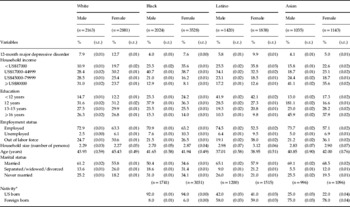
Table 1 shows the sociodemographic characteristics of the sample and the prevalence of MDD stratified by race and gender. As expected, women, across all racial categories, reported a higher prevalence of MDD than men. Among women, the prevalence of MDD was highest among Whites (12.7%), followed by Latinas (9.9%), Blacks (7.6%) and then Asians (5.0%). A similar pattern was found among men.
Descriptive statistics for all variables in the analyses by race and gender

s.e., Standard error.
a Whites were not included in these analyses because of large numbers of missing values on the nativity variable.
Racial and gender differences were also found on the measures of SES. Black women and Latinas were equally likely to report household incomes <US$17000 (35.6% and 35.8% respectively). Asian men (41.1%) and Asian women (35.6%) reported household incomes in the highest strata. Most of those reporting <12 years of education were Latinos and most of those reporting 12 years of education were Blacks. Those reporting the highest levels of education (⩾16 years) were Asian men. Latino men reported the highest rate of employment (74.5%), followed by Asian men (73.7%), White men (72.9%), and then Black men (70.9%). Over 75% of Asians and nearly 60% of Latinos were born in a country other than the USA.
In the analysis with the interaction terms, there were no significant differences between race and household income [χ2(3)=4.57, p<0.21]. However, significant differences were observed between Asians and Whites in the association between education and MDD [χ2(3)=8.175, p=0.042] and being employed and MDD [χ2(2)=18.555, p<0.0001].
Household income
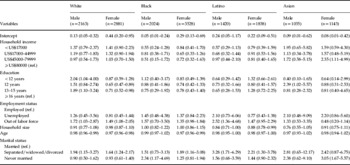
In Table 2, we estimated the association between measures of SES and MDD stratified by race and gender. For Whites, compared to those reporting household incomes of ⩾US$80000, those with incomes <US$17000 had the highest odds of MDD, and the risk decreased in a stepwise manner as household income increased. Significant variation across household income categories was not observed among White men [χ2(1)=0.01–0.129, p=0.917–0.256] and White women [χ2(1)=0.02–2.24, p=0.895–0.134]. Despite these associations among Whites, high compared to low household income was not significantly associated with a decreased risk of MDD among Blacks, Latinos and Asians.
Multivariate logistic regression of SES indicators on 12-month MDD: by race and gender (n=16032)

SES, Socio-economic status; MDD, major depressive disorder; ref., reference.
Values given are odds ratios with 95% confidence intervals in parentheses.
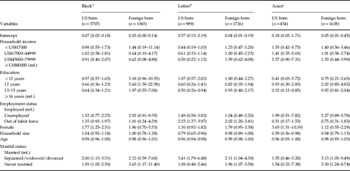
In Table 3 analyses were stratified by race and nativity. Among foreign-born Latinos and US-born and foreign-born Asians, there was an elevated risk for MDD among those reporting household income levels <US$80000. However, the association between household income and MDD among these groups was not statistically significant.
Multivariate logistic regression of SES indicators on 12-month MDD: by race and nativity (n=9579)

SES, Socio-economic status; MDD, major depressive disorder; ref., reference.
Values are odds ratios with 95% confidence intervals in parentheses.
Whites were not included in these analyses because of large numbers of missing values on the nativity variable.
a Adjusted for African American and Afro-Caribbean ethnicity.
b Adjusted for Mexican, Puerto Rican, Cuban and other Latino ethnicity.
c Adjusted for Chinese, Filipino, Vietnamese and other Asian ethnicity.
Educational attainment
Although not entirely uniform, an association between educational attainment and MDD was observed among White men (Table 2). Specifically, White men who reported <12 years of education compared to White men with ⩾16 years of education had higher odds of MDD [odds ratio (OR) 2.04, 95% confidence interval (CI) 1.04–4.00]. A similar elevated risk existed for White men with 13–15 years of education (OR 1.89, 95% CI 1.10–3.24). In each of these cases, White men with <12 years [χ2(1)=5.33, p=0.020] and those with 13–15 years [χ2(1)=4.32, p=0.037] of education had a significantly higher risk for MDD. Among Black, Latino or Asian men, we found that high compared to low levels of education were not significantly associated with a decreased risk of MDD.
The results for women revealed that low educational attainment was associated with decreased risk of MDD among White women (Table 2). White women with 12 years of education (OR 0.65, 95% CI 0.47–0.89) and those with 13–15 years (OR 0.71, 95% CI 0.52–0.98) had a lower risk of MDD compared to those with ⩾16 years. Significant differences were present for White women with 12 years [χ2(1)=7.42, p=0.006] and with 13–15 years [χ2(1)=4.51, p=0.033]. Among Black, Latina and Asian women, low compared to high levels of education were not significantly associated with an elevated risk of MDD.
In Table 3, there was a significant association between educational attainment and MDD among foreign-born Blacks, where an increased risk of MDD was observed among those with <16 years of education [χ2(1)=5.93, p=0.014]. For other racial-ethnic groups, there was a decreased risk of MDD as educational attainment increased. None of these associations were statistically significant.
Employment status
Unlike income and education, being unemployed or out of the labor force was consistently associated with a higher risk of MDD, with three exceptions, unemployed White women, unemployed Latinas, and Asian women who were out of the labor force (Table 2). Significant differences were present among White men [χ2(1)=4.32, p=0.036], White women [χ2(1)=6.01, p=0.014] and Latino men [χ2(1)=8.76, p=0.003] who reported being out of the labor force.
Among all groups, those who were unemployed reported higher odds for MDD compared to those who were employed (Table 3). Being out of the labor force was also associated with higher odds for MDD among most groups except US- and foreign-born Asians. Significant differences were present only among US-born Latinos [χ2(1)=7.92, p=0.004) and foreign-born Latinos [χ2(1)=6.97, p=0.008] not in the labor force.
Discussion
In this study, we examined two research questions: (1) is high SES, as measured by high household income, high level of educational attainment, and being employed, associated with an increased risk of MDD; and (2) is there support for the diminishing returns hypothesis, such that, an increased risk of MDD is observed among high SES compared to low SES individuals?
Regarding the first question, we found no statistical evidence that high household income was associated with lower risk of MDD among any racial-ethnic group. The non-significant effect of household income on MDD suggests that income alone is not responsible for the increased risk of MDD (Weissman et al. Reference Weissman, Bruce, Leaf, Florio, Holzer, Robins and Reiger1991; Blazer et al. Reference Blazer, Kessler, McGonagle and Swartz1994; Williams et al. Reference Williams, Gonzalez, Neighbors, Nesse, Abelson, Sweetman and Jackson2007b). Epidemiologic data have demonstrated that, although there are differences in the expression of depression symptoms across racial-ethnic groups, there are consistent similarities in the core features of MDD across racial-ethnic groups (Simon et al. Reference Simon, VonKorff, Piccinelli, Fullerton and Ormel1999; Ballenger et al. Reference Ballenger, Davidson, Lecrubier, Nutt, Kirmayer, Lepine, Lin, Tajima and Ono2001). Thus, a possible explanation for this finding may include the fact that the course and the consequential effects of MDD may be similar for those who suffer from MDD, irrespective of income level.
The non-significant effect of household income must be interpreted in light of a study design limitation. Our analysis reflects the cross-sectional association between household income and MDD. Longitudinal data analysis has shown that social causation, rather than social selection, may in part explain why low income individuals may be at increased risk for MDD (Ritsher et al. Reference Ritsher, Warner, Johnson and Dohrenwend2001). However, studies have shown that causation and selection are not mutually exclusive processes and may both be influential over the lifespan (Nestadt et al. Reference Nestadt, Bienvenu, Cai, Samuels and Eaton1998; Kessler et al. Reference Kessler, Berglund, Demler, Jin, Koretz, Merikangas, Rush, Walters and Wang2003). Unfortunately, the cross-sectional nature of our data precludes us from examining this causal pathway. This could, in part, explain our non-significant results.
For educational attainment and MDD, we found significant associations between a high level of education attainment and lower risk of MDD among White men. Among White women, there was a significantly reduced risk of MDD among those with <16 years of education. Despite these findings among Whites, similar patterns were not observed among the other racial-ethnic groups. A potential explanation for these findings may be that years of education, a traditional measure of social stratification, may effectively model the association between SES and MDD among Whites (Lynch & Kaplan, Reference Lynch, Kaplan, Berkman and Kawachi2000). Conversely, education may not translate to economic opportunity for racial-ethnic groups (Farmer & Ferraro, Reference Farmer and Ferraro2005). This suggests that education as a measure of SES in this study fails to capture the context in which SES may influence MDD. This finding further suggests the need to adopt modeling approaches that more accurately capture the context in which SES may influence MDD among different groups. One potential approach may be the inclusion of SES measures during both distal and proximal periods of the life-course, because early-life and contemporary SES have an influence on MDD (Mutaner et al. Reference Mutaner, Borrell, Chung, Avison, McLeod and and Pescosolido2008). Based on the cross-sectional nature of our data, it is not possible to determine whether assessment of SES at different time points during the life-course may be a modeling approach better suited to assess the association between SES and MDD among racial-ethnic groups. Future studies are needed to determine whether this modeling approach improves our understanding of the SES-MDD association among racial-ethnic groups.
Another potential modeling approach may be the inclusion of alternative measures of social stratification. Research suggests that the inclusion of ‘neomaterial’ determinants (proximal physical or biological risk or protective factors) and ‘psychosocial’ determinants (i.e. perceived social status) may be more instrumental in explaining the association between SES and MDD (de Castro et al., unpublished observations). These determinants may be relevant in the association between SES and MDD because depression is clearly affected by sociopsychological risk factors that cluster among individuals of low SES (i.e. stressful life events) (Mutaner et al. Reference Mutaner, Eaton, Miech and O'Campo2004). Additional studies are needed to determine whether these assessments of stratification are relevant to understanding the role of SES in MDD among racial-ethnic groups.
Our results also revealed an association between being out of the labor force and an increased risk of MDD among Whites and Latino men. In analyses by nativity, significant differences were present among both US-born and foreign-born Latinos who reported being out of the labor force. These findings are consistent with earlier studies reporting that being out of the labor force was associated with 12-month MDD (Kessler et al. Reference Kessler, Berglund, Demler, Jin, Koretz, Merikangas, Rush, Walters and Wang2003; Alegria et al. Reference Alegria, Shrout, Woo, Guarnaccia, Sribney, Vila, Polo, Cao, Mulvaney-Day, Torres and Canino2007b). Our findings suggest that being out of the labor force may adversely affect individual mental health because of the effects of economic hardship. In addition, environmental features of work postulated to promote psychological well-being (e.g. interpersonal contact, skill use, physical security, and valued social position) may also explain why being out of the labor force may increase the risk of MDD (Warr, Reference Warr1987).
With regard to our second research question, we found no evidence to support the diminishing returns hypothesis. Consistent with previous epidemiologic studies, we found a lower prevalence of 12-month MDD among Blacks, Latinos and Asians compared to non-Hispanic Whites (Kessler et al. Reference Kessler, McGonagle, Zhao, Nelson, Hughes, Eshleman, Wittchen and Kendler1994; Breslau et al. Reference Breslau, Kendler, Su, Gaxiola-Aguilar and Kessler2005, Reference Breslau, Aguilar-Gaxiola, Kendler, Su, Williams and Kessler2006; Alegria et al. Reference Alegria, Mulvaney-Day, Torres, Polo, Cao and Canino2007a; Takeuchi et al. Reference Takeuchi, Zane, Hong, Chae, Gong, Gee, Walton, Sue and Alegria2007; Williams et al. Reference Williams, Haile, Gonzalez, Neighbors, Baser and Jackson2007a). Our findings suggest that an increased risk of MDD was not observed among high compared to low SES individuals. Thus, despite the low prevalence of MDD among racial-ethnic groups, there is no empirical evidence to support that the association between racial-ethnic status and MDD varied by SES level. Previous research offers possible explanations for the protective factors (e.g. ethnic identification, social support) that are likely to result in the lower prevalence of MDD (Herd & Grube, Reference Herd and Grube1996; Wallace & Forman, Reference Wallace and Forman1998; Varon & Riley, Reference Varon and Riley1999; Ellison et al. Reference Ellison, Boardman, Williams and Jackson2001; Mossakowski, Reference Mossakowski2003; Lee & Newberg, Reference Lee and Newberg2005; Williams & Neighbors, Reference Williams, Neighbors, Kupfer, Schatzber and and Stein2006). Future studies should continue to explore the social context of racial-ethnic groups to understand why these groups experience a lower prevalence of MDD despite their economic disadvantage.
The findings from this study should be interpreted in the light of several limitations. First, the survey was not translated into ‘other’ Asian languages, which may have excluded from the study non-English-speaking Asians who did not belong to target ancestry groups. In addition, Caribbean immigrants included in the sample had to self-identify as Black as well as speak English. These restrictions may have excluded non-English-speaking Caribbean Blacks. Consequently, the findings are most generalizable to target Asian ancestry groups and English-speaking Black Caribbeans. Second, our analyses relied on the WMH-CIDI instrument to document psychiatric disorders. Although this diagnostic instrument allowed us to compare MDD among racial-ethnic groups, the prevalence of the disorder among immigrant groups may have been underestimated, especially if immigrants expressed their problems in unique ways that were not identified by DSM-IV. This may be a particular issue as culture can affect both the clinical presentation of specific psychiatric disorders and the ability to recall or report symptoms (Alegria et al. Reference Alegria, Takeuchi, Canino, Duan, Shrout, Meng, Vega, Zane, Vila, Woo, Vera, Guarnaccia, Aguilar-Gaxiola, Sue, Escobar, Lin and Gong2004; Williams et al. Reference Williams, Gonzalez, Neighbors, Nesse, Abelson, Sweetman and Jackson2007b).
Despite these limitations, the findings suggest that the association between indicators of SES and 12-month MDD is complex because associations differed by racial-ethnic status, gender and nativity. Future studies should continue to explore how sociocultural status across the life-course influences how race-ethnic groups experience MDD, and also other forms of psychiatric ill-health.
Acknowledgements
This research was supported by National Institute of Mental Health (NIMH) Research Grants MH06220, MH62207, MH62209, HD049142 and RWJ DA18715 with generous support from SAMHSA and OBSSR. The National Survey of American Life (NSAL) was supported by the NIMH (U01-MH57716) with supplemental support from the National Institutes of Health Office of Behavioral and Social Science Research; the National Institute on Aging (5R01 AG02020282) with supplemental support from the National Institute on Drug Abuse; and the University of Michigan. Preparation of this article was also aided by grants from the NIMH (1P01 MH58565, 1T32 MH67555 and 5TMH16806). This publication was also made possible by grant no. 1KL2RR025015-01 from the National Center for Research Resources (NCRR), a component of the National Institutes of Health (NIH) and NIH Roadmap for Medical Research. Its contents are solely the responsibility of the authors and do not necessarily represent the official view of NCRR or NIH. We thank the NLAAS writing group for assistance with earlier versions of the manuscript.
Declaration of Interest
None.