Introduction
People who live in squalor present an intriguing set of complex problems that pose clinical, social, and ethical challenges, particularly given that assistance is infrequently sought or vehemently refused. Severe domestic squalor refers to living environments that are so unclean, messy, and unhygienic that people of similar culture and background would consider extensive clearing and cleaning to be essential (Snowdon et al., Reference Snowdon, Halliday and Banerjee2012). A dichotomy exists among healthcare professionals that leads to either non-interventional or paternalistic approaches toward the person living in squalor. The former approach is based on the belief that the person is an autonomous individual who has the right to lead the lifestyle of their choice, while the latter results from viewing an individual as lacking capacity to make decisions about their living conditions.
Squalor is not recognized as a distinct disorder in the Diagnostic and Statistical Manual of Mental Disorders Fifth Edition (DSM 5; American Psychiatric Association, 2013) and is presented heterogeneously, often in conjunction with a separate primary diagnosis. Symptoms of extreme self-neglect, squalor, social withdrawal, apathy, syllogomania (pathological hoarding of rubbish), and lack of shame have been described as features of many psychiatric and general medical conditions, including personality disorder, dementia, alcohol-related brain injury, physical disability, obsessive compulsive disorder, and intellectual impairment (Reifler, Reference Reifler1996; Drummond et al., Reference Drummond, Turner and Reid1997; Williams et al., Reference Williams, Clarke, Fashola and Holt1998; Snowdon and Halliday, Reference Snowdon and Halliday2011). The labeling of this cluster of symptoms as Diogenes Syndrome (Clark et al., Reference Clark, Mankikar and Gray1975; Cybulska and Rucinski, Reference Cybulska and Rucinski1986) has caused consternation as it was felt that the arching principles of Diogenes, the philosopher, which were autonomy through self-sufficiency and contentment unrelated to material possessions, were misrepresented (Reifler, Reference Reifler1996; Snowdon, Reference Snowdon1997). Despite some uncertainty about the terminology, frontline community workers instantly recognize a squalid household when they enter the one.
Macmillan and Shaw (Reference Macmillan and Shaw1966) reported that 47% of community-based participants living in squalor presented with a normal mental state and this received further support by Clark et al. (Reference Clark, Mankikar and Gray1975, p. 367) who found that 50% of Diogenes Syndrome patients had high IQ with “high levels of intellectual preservation.” In more recent years this view has come under some challenge with Wrigley and Cooney (Reference Wrigley and Cooney1992, p 40) finding that two-thirds of their sample did not present with a “normal mental state,” and Halliday et al. (Reference Halliday, Banerjee, Philpot and Macdonald2000) reporting that 70% of their squalor participants, identified through a cleaning service, were diagnosed as having a mental disorder. In a further study, the vast majority (95%) of participants with moderate to severe domestic squalor were found to have dementia, substance abuse, or alcohol-related brain damage, psychiatric, or physical illness (Snowdon and Halliday, Reference Snowdon and Halliday2011).
Our clinical experience has led us to observe that individuals who live in squalor frequently exhibit poor initiative, drive, and motivation. We hypothesize that their indifference to their living conditions and unconventional problem-solving are suggestive of executive dysfunction where the frontal lobe-based functions of planning, insight, self-control, and social interaction are impaired (Luria, Reference Luria1973; Stuss and Benson, Reference Stuss and Benson1984; Stuss, Reference Stuss1992; Lezak et al., Reference Lezak, Howieson and Loring2004). Orrell et al. (Reference Orrell, Sahakian and Bergmann1989) similarly found that frontal cognitive impairments may be the common denominator in participants living in squalor. Substantial overlap between frontotemporal dementia and Diogenes syndrome and hoarding behavior has been observed (Lebert, Reference Lebert2005) and squalor has been detected in people having dementia characterized by executive dysfunction (Beauchet et al., Reference Beauchet2002). In a study of six patients with Mini-Mental State Examination (MMSE) scores of above 24, who were living in squalor, frontal executive dysfunction was the predominant finding, suggesting its central role in squalor (Gregory et al., Reference Gregory, Halliday, Hodges and Snowdon2011).
People living in squalor resist assessment and treatment (Hanon et al., Reference Hanon, Pinquier, Gaddour, Said, Mathis and Pellerin2004) and frequently present in crisis situations where a comprehensive cognitive evaluation is not the main priority. This leads to reliance on the MMSE as the sole cognitive assessment, which may not be able to detect subtle impairment (Faustman et al., Reference Faustman, Moses and Csernansky1990) and lacks sensitivity to frontal lobe-based problems of executive function (Malloy et al., Reference Malloy1997). This study aims to provide an overview of the neuropsychological impairment of a large case series of people that were assessed to be living in squalor.
Methods
Identification of sample
The study was approved by the Human Research Ethics Committee at the lead site, and was advertised through a series of oral and poster presentations at conferences and seminars. Clinicians from local health networks were invited to submit reports that detailed the neuropsychological profiles of patients they had assessed during the course of their clinical work who were deemed to be living in squalor. As neuropsychology assessments do not form part of the routine management of squalor, our sample consisted of assessments that were requested based on clinical necessity.
Once a clinician indicated an interest in participating in this study, institutional ethics approval was gained from their service and reports were submitted. Following ethics approval in early 2010, clinicians submitted existing reports, and continued to submit new reports on participants of squalor as they presented over the three-year data collection period. Neuropsychological assessments were supplemented by medical record searches, whenever required or possible, in order to obtain information on patients’ demographics, medical and psychiatric histories, and the results of any neuroimaging studies.
Determining the suitability for inclusion
As this study used reports generated during normal clinical practice, we did not have a chance to standardize assessments or the assessments used, nor rigidly determine the definitions of squalor. The submitted reports were screened to ensure the presence of a sufficiently detailed description of the home environment to enable the premises to be characterized as “squalid.” In the absence of universally accepted criteria at the time we commenced this study, a broad definition of squalor was adopted and we looked for indicators such as the need for extensive cleaning, the presence of Occupational Health and Safety concerns, the presence of decaying organic matter and excrement, vermin infestation, dilapidation, disconnected utilities, and odor. The neuropsychology assessment reports were screened for sufficient details in terms of comprehensive examination of key neuropsychological domains and for the presence of adequate cooperative effort from the patient that are required in such lengthy investigation. Neuropsychology reports were included if they contained examination of basic attention, visuospatial reasoning, information processing speed, memory function, and executive function.
The included reports
A total of 72 neuropsychology reports and three specialist psychogeriatrician cognitive assessment reports were received from three aged care services and two aged psychiatry services in metropolitan Melbourne. Three medical reports unaccompanied by neuropsychology reports were excluded from analysis. One patient had two neuropsychology reports from two different health services. One report was excluded from analysis on the basis of insufficient documentation of squalor and the other was excluded because the patient did not engage sufficiently to enable formal testing of each cognitive domain. After screening, the neuropsychology reports of 69 individuals (49 from aged care services, 16 from aged psychiatry services, three from acute medical services, and one from a memory clinic) constituted the sample and underwent analysis.
Information extracted from reports
The reports were reviewed by one of the authors (Sook Meng Lee) and information was extracted across the following categories.
Basic demographics, medical history, and physical function
Patient's age, gender, marital status, type of accommodation, social support, income source, and education level were recorded. Information on referral sources and on the location of the patient at the time of neuropsychological assessment was gathered. Evidence of hoarding, known medical and psychiatric diagnoses, and level of physical function were recorded.
Neuropsychology assessment, MMSE, and neuroimaging
We were not able to present results at the test level due to variability in clinical practice; rather we have brought together the neuropsychological opinion of performance in each domain and presented it as a standard dichotomous outcome of “Normal” or “Impaired” as documented in the reports. We have also extracted information regarding likely diagnosis, and any comments on insight and capacity. Reduced capacity was inferred if the neuropsychological reports indicated that the person was unable to accept, appreciate, and evaluate information with a demonstrable understanding of its concomitant consequences (Moye and Marson, Reference Moye and Marson2007). In patients where MMSE and neuroimaging data were presented, these results were included in the analysis, and wherever possible, medical records were reviewed for additional or corroborating information.
Statistical analysis
Descriptive data were presented as mean values, ranges, frequencies, and percentages. Collected data were analyzed for any gender effects and group differences were analyzed using SPSS v18 (SPSS Inc., 2009). α = 0.05 was used to allow for the identification of differences for future prospective work to focus upon.
Results
Basic demographics, medical history, and physical function
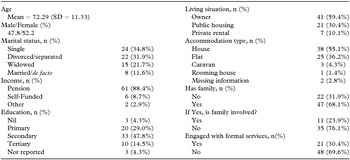
Demographic characteristics of the sample are shown in Table 1. Age of the patients ranged from 41–96 years with a mean age of 72.3 years (SD = 11.3). Twenty per cent of the patients in the sample were aged less than 65 years (n = 14: ten females and four males). There were similar number of males (n = 33, 47.8%) and females (n = 36, 52.2%). Only eight patients (11.6%) were in a current relationship, with the rest being single (34.8%), divorced or separated (31.9%), or widowed (21.7%). Males were more likely than females to be single (24% vs. 13%, χ 2 = 13.4, p < 0.05). The majority were owner or occupiers (59.4%) and lived alone (71.0%). The vast majority (84.1%) had no carers, and 69.6% had no formal services. None were in current employment, and most were on a pension (88.4%). Only a small number were self-funded (8.7%). Three patients had no education, while 65.2% were educated to either secondary or tertiary level.
General demographics of the sample

Patients were observed to present with one or more comorbidities, with the most frequently observed being musculoskeletal (40.6%), cardiovascular (36.2%), cerebrovascular (34.8%), or a urinary tract disease (31.9%). One-third of the sample (32.4%) was recorded as having normal physical function. Known visual (17.4%) and hearing impairments (10.1%) were relatively common and at rates in keeping with previous work (Macmillan and Shaw, Reference Macmillan and Shaw1966). Yet these were likely to be under-reported in our sample, as they were not assessed specifically. Alcohol and substance abuse were only reported in 50.72%, and 18.8% of the sample respectively; where these were assessed, alcohol abuse affected 71.4% of the sample, and substance abuse was reported in 30.7%.
Patients were referred for neuropsychological assessment via a number of routes. None of the patients were self-referred, and a number were referred by neighbors (8.7%), in-home community-based services (17.4%), or hospital-based aged care outreach services (31.9%). The majority were referred for neuropsychology assessments during inpatient admissions (72.5%) and underwent their assessment in hospital (68%). Patients presented to hospital for multiple reasons, including extreme self-neglect and poor nutrition, fractured neck of femur, hepatic encephalopathy, strokes, and non-healing leg ulcers.
Psychological and psychiatric history
The reported frequency for affective disorders was 36.2%, anxiety disorders 7.2%, and schizophrenia 11.6%. Fourteen patients (20.3%) had known personality disorders, and 23.2% of the sample was reported to have experienced psychological trauma resulting from either physical or sexual abuse.
Self-neglect, squalor, and hoarding
All the patients in our sample were known to live in squalor at the time of neuropsychology assessment and nearly all (95.7%) showed signs of self-neglect. The reports indicated that 40.5% of the sample had hoarding behaviors that preceded squalor.
Neuropsychology assessment
The majority of the sample (77%) was estimated to have been of average or higher premorbid intelligence and 57.9% were fully oriented to time, person, and place. MMSE data were available for 52 patients and the mean score was 25.29 (SD = 3.96). Most of the patients (72.5%) did not understand the reason for the neuropsychological assessment and nearly all the sample (92.8%) lacked insight into their domestic situation. The neuropsychological reports showed that 89.6% of the sample evidenced poor capacity. Over three-quarters of the sample (78.3%) were not agreeable to intervention, and application for the appointment of a guardian was recommended in 66.7% of the patients.
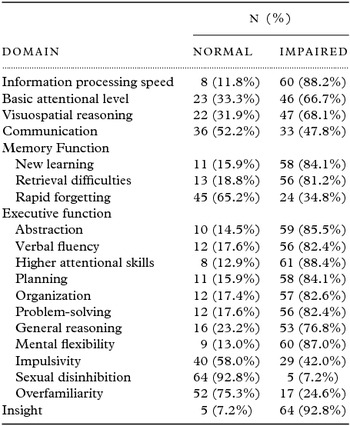
Neuropsychological assessment data are summarized in Table 2. One-third of the patients (33.3%) had a normal basic attentional level and 32.0% had normal visuospatial reasoning. Information processing speed was normal in only 11.8% with 66.2% of the patients assessed as having significant slowing. Memory was assessed across three modalities. Over 80% of the sample had impairments in tests of new learning (84.1%) and information retrieval (81.2%), although rapid forgetting was not as widely reported (34.8%).
Neuropsychological domains, capacity, and insight

The majority of the patients (92.8%) showed some level of executive dysfunction with 44.9% considered significantly impaired and 30.4% moderately impaired. Impairments were noted in abstraction (85.5% of patients), verbal fluency (82.4%), higher attentional skills (88.4%), planning (84.1%), organizational skills (82.6%), problem-solving (82.4%), general reasoning (76.8%), and mental flexibility (87.0%). Forty-two per cent of the patients showed signs of impulsivity, 7.2% were sexually disinhibited, and 24.6% were overfamiliar. Communication was relatively well preserved with 76.8% of the patients assessed as having normal function or only mild impairment. There were no significant differences between genders across the various neuropsychological domains.
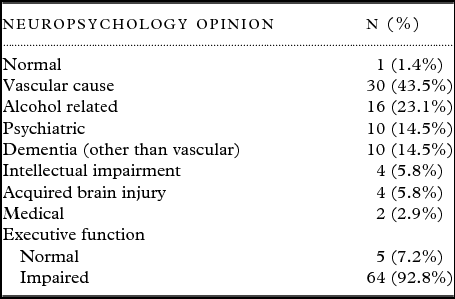
Neuropsychological opinions are summarized in Table 3. Underlying aetiologies that were implicated for the deficits present included vascular causes (n = 30, 43.5%), alcohol (n = 16, 23.1%), psychiatric conditions (n = 10, 14.5%), and dementia other than vascular (n = 10, 14.5%). In only one patient, a hoarder, neuropsychology assessment failed to identify any abnormalities. In 15 patients, mixed aetiologies were implicated. Five out of the 69 patients were considered to have normal executive function and all of these had symptoms of hoarding preceding the development of squalor.
Neuropsychological opinions

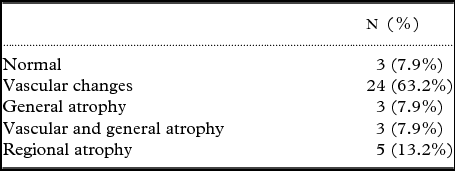
Neuroimaging results for 38 participants were available for analysis (Table 4). Computed tomography (CT) brain scans were the most frequent investigation performed (n = 34). One of the patients underwent single photon emission computed tomography (SPECT), which showed non-specific cerebral atrophy and it was likely that a CT brain scan was also conducted but we were unable to locate it. His neuropsychology assessment was suggestive of frontotemporal dementia. One patient had CT brain, magnetic resonance imaging (MRI), and positron emission tomography (PET) scan, all of which were normal. She had a diagnosis of schizophrenia and was found living in squalor unrelated to hoarding. The three patients who had MRI were likely to have had CT brains as well, but we were unable to locate the results. Three patients had normal neuroimaging results. Vascular changes, including periventricular white matter ischaemia, lacunar infarcts, and territorial infarcts, were reported in 27 of the 38 patients. Of the 13 patients with territorial infarcts, 12 involved the frontal lobes. Atrophy was reported in 11 instances: non-specific atrophy in six, and regional atrophy, including frontotemporal and frontal-parietal atrophy, in five patients.
Available neuroimaging results (n = 38)

Discussion
This is one of the few studies to investigate the neuropsychological profiles of people who live in squalor. The results show that squalor is associated with impaired cognition across a number of domains, with the most prominent finding being executive impairment, essentially a dysfunction of planning, insight, self-control, and social interaction (Luria, Reference Luria1973; Stuss and Benson, Reference Stuss and Benson1984; Stuss, Reference Stuss1992; Lezak et al., Reference Lezak, Howieson and Loring2004). Memory performance lent further support with the pattern of greater retrieval difficulties in the absence of rapid forgetting on the memory domain indicative of executive dysfunction (Kopelman, Reference Kopelman2002). Executive function is primarily attributed to the frontal lobes, and the impaired higher order executive processes seen here indicate the involvement of the dorsolateral-prefrontal cortex (DL-PFC) (Funahashi, Reference Funahashi2001). Orbitofrontal involvement appears less likely as impulsivity, sexual inappropriateness, and overfamiliarity were not as common (Berlin et al., Reference Berlin, Rolls and Iversen2005). This pattern of impairment supports previous work (Gregory et al., Reference Gregory, Halliday, Hodges and Snowdon2011).
The sample can be summarized as being elderly, single, and living alone with a low level of formal service engagement and little family involvement. The majority (77%) had at least an average level of premorbid intelligence and, where it was available, high MMSE scores (n = 52, M = 25.29, SD = 3.96). Despite this, nearly all the patients showed signs of self-neglect (97%) and lacked insight (93%). None of the sample was self-referred for assessment, 78% of the patients were not agreeable to intervention, and 90% could be regarded as lacking capacity. Hoarding behavior was comorbid with squalor in 40% of the participants. The neuropsychological assessments demonstrated problems with executive dysfunction in 93% of the sample. Of the neuropsychological domains that were assessed, communication was relatively well preserved. Presence of good verbal skills, and thus a tendency of patients to be articulate and “present well,” along with high MMSE scores, may confound inexperienced assessors. It may seem incongruous that the sample can present with a relatively high MMSE score and yet lack capacity and insight; however, this pattern of results strongly illustrates that the MMSE score is not sensitive to the presence of executive impairment.
Vascular disease was the most common underlying pathological process (43%) proposed by neuropsychologists in our study, and was supported with 71% of the 38 patients where neuroimaging was available showing vascular abnormality, including periventricular white matter ischaemia, lacunar infarcts, and territorial infarcts. The neuroimaging findings cannot be interpreted in isolation, given that a high background rate of cerebral white matter lesions would be expected in this age group (de Leeuw et al., Reference de Leeuw2001).
A number of limitations need to be considered when interpreting the findings presented here. The first revolve around the study sample. As this study relied on the submission of selected clinical reports with its attendant risk of recall bias, and the majority of the assessments (68%) were conducted during an inpatient admission, the sample may not be representative of community dwelling people living in squalor. It is also possible that this sample only represents a proportion of hospital patients who live in squalor, as a neuropsychology assessment would only be required for participants needing a mental capacity determination to a high level of certainty. Those with a clearer cognitive profile would not have required a neuropsychological assessment. The study design imposed some further restrictions as we were unable to standardize the neuropsychological assessments; however, the reports indicated that participating neuropsychologists adopted similar psychometric testing and reporting methods in relation to various cognitive domains. These limitations need to be balanced against the problems inherent in conducting home-based neuropsychological assessments in squalid conditions, the extreme difficulty in working with people in the community who live in squalor, and the low likelihood of obtaining consent to involve them in a prospective research study. Capacity is not routinely assessed and can be global, but is increasingly recognized as being context-dependent. The basic principles of capacity are well known and include the need for a person to be in possession of all information relevant to the decision at hand, and to be able to understand and evaluate that information with an awareness of the benefits and risks associated with their choices (Moye and Marson, Reference Moye and Marson2007). In this study 89.6% of the respondents were judged not to meet these criteria.
While there are limitations that temper the strength of our conclusions, the results highlight the clinical importance of assessing executive function in those living in squalor. This will allow treatments, interventions, and behavioral management strategies to be appropriately implemented. At present there are no standard guidelines for the management of patients living in squalor and neuropsychology assessment does not form part of routine management. The results indicate that cognitive screening using the MMSE is not adequate and should at the least be supplemented by assessment of frontal executive function.
Conclusions
People with impaired insight are frequently difficult to engage, and efforts to collaboratively work with people who live in squalor often fail for this reason. While it might be conceivable for a person to truly wish to live in unsanitary conditions, such cases are likely to be extremely rare, and it is more likely that squalor represents a loss of capacity. While the principles of autonomy and self-determination must be respected, it is inappropriate to invoke the fig leaf approach to management in circumstances where an adequate cognitive assessment has not, in fact, been performed.
Many clinicians rightly feel uncomfortable in pursuing coercive treatment pathways in relation to those living in squalor. The results of our study highlight the important role of executive impairment in those living in squalor and indicate that these options should not be disregarded entirely, particularly considering the lack of insight and concerns about capacity. The MMSE is clearly insufficient to detect the executive function impairment evidenced in this group. While a full neuropsychological assessment is expensive and may not be readily available, clinicians asked to assess those living in squalor should be familiar with a comprehensive suite of bedside tests of frontal executive function, with which to inform management or prompt consideration of more detailed neuropsychological testing. Future research would benefit by conducting a more rigidly controlled prospective study that includes community dwelling people who live in squalor and healthy controls, and conducting more extensive neuroimaging to gain a better understanding of this condition.
Conflict of interest
None.
Description of author's roles
Sook Meng Lee transcribed data from neuropsychology reports and medical files, analyzed the data, and wrote the paper. Matthew Lewis assisted with statistical analysis and in preparing the paper for publication. Deborah Leighton, Ben Harris, and Brian Long submitted more than eight reports each and provided neuropsychology advice toward the paper. Stephen Macfarlane initiated and designed the study, supervised data collection, and cowrote the paper.
Acknowledgments
We would like to thank Inna Brodsky, Asawari Henderson, Jo-Anne Buchanan, Jennifer McDowall, Jane Khoo, Chris Hutchinson, Natalie Genardini, and Rosario Lina Forlano for submitting neuropsychology reports. We would also like to thank Melissa Lin and Remina Doh for compiling case notes for the Caulfield Hospital sample.