Implications
According to our results, crude glycerin up to 6% could be added to the diet from confirmation of pregnancy without affecting the performance of pregnant sows. Our results also suggest a relationship between the inclusion of glycerin in the diet and the serum concentrations of feed intake regulating hormones, such as acyl ghrelin and leptin; but more studies are needed to increase the understanding of interactions between diet composition and hormone concentration.
Introduction
Biodiesel production from renewable sources has increased steadily over the past decade in the European Union (United States Department of Agriculture Foreign Agricultural Service (USDA-FAS), 2013) as a result of energy and environmental concerns and policies. The main by-product of the biodiesel industry is crude glycerin, which represents about 10% (w/w) of the biodiesel produced (Thompson and He, Reference Thompson and He2006). The continued growth in biofuel production has led to a search for alternative ways of using this by-product, including an evaluation of its nutritive value for animal feeding. The use of crude glycerin in animal feeds is limited by the glycerol content, which is usually higher than 80%.
Glycerol is a precursor of glucose in the liver (Krebs and Lund, Reference Krebs and Lund1966). During gestation, glucose is the major energetic substrate for placental and fetal growth. During lactation, glucose is the principal precursor of lactose in the mammary gland (Boyd et al., Reference Boyd, Kensinger, Harrell and Bauman1995), where it is the limiting source for the synthesis of lactose. Additionally, glycerol may stimulate water intake and improve heat stress tolerance, especially for lactating sows (Schieck et al., Reference Schieck, Kerr, Baidoo, Shurson and Johnston2010a). Therefore, crude glycerin incorporated in pregnant and lactating sow diets may improve sow and litter performance, although little information is available.
On the other hand, the physiological status of sows during gestation and lactation involves different energy balances, which, in turn, can affect those hormones related to feed intake (Valros et al., Reference Valros, Rundgren, Spinka, Saloniemi, Rydhmer, Hultén, Uvnäs-Moberg, Tománek, Krejcí and Algers2003; Pére and Etienne, Reference Pére and Etienne2007; Dong et al., Reference Dong, Xu, Tang, Li, Jiang and Zou2009). Sow performance may depend on the ability to regulate the metabolism and feed intake, which is thought to be regulated by hormones such as insulin, ghrelin, leptin and cortisol (Martínez et al., Reference Martínez, Valera, Villodre, Madrid, Orengo, Tvarijonaviciute, Cerón and Hernández2014).
The objective of this research was to determine the effect of dietary addition of crude glycerin on sow and litter performance, as well as to evaluate the serum concentrations of hormones related to energy metabolism and feed intake in sows during gestation and lactation.
Material and methods
The experimental procedures were in compliance with the European Union regulations concerning the protection of animals used for experimental and other scientific purposes (EU Directive 2010/63/EU).
General procedures and experimental diets
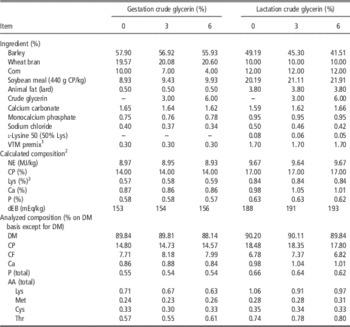
This experimental trial was performed from December 2011 to March 2012 on a commercial farm located in Huércal-Overa (Almería, Southeastern Spain). A total of 63 pregnant sows (Landrace×Large White) of mixed parity (parity 2–5) were used in the experimental period, which covered gestation and lactation. After confirmation of pregnancy by ultrasonography at 28-day post-insemination, the sows were randomly assigned to one of three dietary treatments, balanced on parity, with an average initial BW of 190 kg. A total of 21 sows were allotted to the same glycerin level throughout pregnancy and lactation. Experimental diets contained 0, 3 and 6% crude glycerin (G0, G3 and G6, respectively) (Table 1). All diets were manufactured using the same batch of ingredients. The crude glycerin used in this experiment (glycerol, 87.42%; methanol, 0.05%; moisture, 7.98%; ash, 5.87%; Ca, 0.04%; P, 0.01%; Na, 2.01%; Cl, 3.06%; and K, 0.05%) was obtained from a biodiesel production facility (Abengoa Bioenergía San Roque, Cadiz, Spain), which used vegetable oils as feedstock. The gestation and lactation diets were formulated to be isoenergetic and isoproteic. The feed formulation was based on net energy (NE) and standardized ileal digestible amino acid (SID AA) values according to the recommendations of the Spanish Foundation for the Development of Animal Nutrition-Fundación Española para el Desarrollo de la Nutrición Animal- (FEDNA, 2006). In the formulation of both diets, the energy value of crude glycerin for sows, with 85% glycerol content, was 12.05 MJ NE/kg (FEDNA, 2010).
Ingredients and composition of diets (as-fed basis)

dEB=dietary electrolyte balance.
1 For gestation, supplied per kg of diet: vitamin A (trans-retinyl acetate), 12 500 IU; vitamin D3 (cholecalciferol) 2000 IU; vitamin E (dl-α tocopheryl acetate), 20 mg; vitamin K3 (bisulfite menadione complex), 2 mg; vitamin B1 (thiamine-mononitrate), 1 mg; riboflavin , 5 mg; pyridoxine (pyridoxine HCl), 2.5 mg; vitamin B12 (cyanocobalamin), 0.020 mg; niacin, 25 mg; pantothenic acid (D-Ca pantothenate), 12.5 mg; choline (choline chloride), 300 mg; D-biotin 0.1 mg; Zn (ZnO), 100 mg; Mn (MnSO4.H2O), 80 mg; Fe (FeSO4.7H2O), 100 mg; Cu (CuSO4.5H2O) 10 mg; Se (Na2SeO3), 0.22 mg; I (KI) 0.5 mg; Co (2CoCO3. 3 Co(OH)2. H2O), 0.5 mg, 3-phytase (EC 3.1.3.8) 500 FTU.For lactation, supplied per kg of diet: vitamin A (trans-retinyl acetate), 12 000 IU; vitamin D3 (cholecalciferol) 2000 IU; vitamin E (dl-α tocopheryl acetate), 40 mg; vitamin K3 (bisulfite menadione complex), 2 mg; vitamin B1 (thiamine-mononitrate), 1 mg; riboflavin , 5 mg; pyridoxine (pyridoxine HCl), 2.5 mg; vitamin B12 (cyanocobalamin), 0.030 mg; folic acid, 2.5 mg; niacin, 25 mg; pantothenic acid (D-Ca pantothenate), 12.5 mg; choline (choline chloride), 250 mg; D-biotin 0.3 mg; Zn (ZnO), 100 mg; Mn (MnSO4.H2O), 80 mg; Fe (FeSO4.7H2O), 100 mg; Cu (CuSO4.5H2O) 10 mg; Se (Na2SeO3), 0.22 mg; I (KI) 0.5 mg; Co (2CoCO3.3 Co(OH)2. H2O), 0.5 mg, 3-phytase (EC 3.1.3.8) 500 FTU. Saccharomyces cerevisiae NCYC Sc 47 5×10¹² CFU.
2 According to FEDNA (2010).
3 Standardized ileal digestibility of lysine.
Housing, management and data collection
During gestation, sows were housed in individual stalls (2.2 m long×0.6 m wide). Five days before farrowing, the sows were moved to farrowing rooms and placed in individual crates (2 m long×1.5 m wide) to prevent piglets from being crushed. Each gestation and farrowing crate was equipped with a feeder and a nipple drinker. The piglet area was heated by under-floor heating.
From 28 days post-insemination, sows were fed 2.5 kg of their respective dietary treatments once a day (at 0800 h). From the third day postpartum, the sows were fed a lactation diet twice a day (at 0800 and 1600 h). The initial amount of feed (2.5 kg) was adjusted for each lactating sow by increasing the amount supplied by 0.5 kg when no refusal was observed for 2 consecutive days until reaching the maximal feed intake. The refused feed was weighed and removed every morning, and feed intake was recorded by subtracting the rejected feed from the feed offered.
Sows were weighed at days 28 and 110 of gestation, within 24 h after farrowing, and at weaning. During weighing, backfat thickness was measured at the P2 position (last rib, 65 mm from the center line of the back) using an ultrasound scanner (Lean-meater; Renco Corporation, Minneapolis, Minnesota, USA) to assess body condition and BW changes. At farrowing, the number of piglets born and born alive per litter was recorded. Within the first 48 h, litters were cross-fostered within each dietary treatment to adjust litter size to 11–12 piglets per sow. All subsequent piglet deaths were recorded daily for each litter. From 7 days of age, suckling piglets had access to a commercial pre-starter diet. Piglets were weaned at 21 days post-farrowing. The litter weight was recorded at birth, after cross-fostering and weaning.
On day 100 of the gestation and on day 11 postpartum, eight sows were randomly selected from each dietary treatment to analyze ghrelin (total and acylated), insulin, leptin and cortisol concentrations. Blood samples were collected via jugular venipuncture into 4 ml tubes (BD Vacutainer) at 0 and 30 min after morning feeding. After centrifugation at 3000×g for 10 min at 4°C, the serum was collected and stored at −85°C until further analysis.
Chemical analyses
The dry matter (DM) content of the diets was determined by drying a sample in a convection oven at 105ºC for 8 h (method 934.01; AOAC, 2005). Diet samples were ground through a 1-mm screen, and analyzed for CP and crude fiber content by the Kjeldahl [984.13 (A-D); AOAC, 2005] and AOAC (962.09; AOAC, 2005) methods, respectively.
The mineral content of the diets was determined by dry ashing using a muffle furnace at 550°C. Ashes samples were solubilized with 50 ml of 0.6 N nitric acid and subsequently filtered. The P content was determined by the Molibdate-Vanadate method (Ministerio de Agricultura, Pesca y Alimentación (MAPA), 1998), and the Ca content by atomic absorption spectroscopy (Solaar M Series; Unicam, Cambridge, UK).
Amino acids in feeds were determined by hydrolyzing the samples with 6 N HCl for 22 h at 112±2°C in glass tubes under an N atmosphere. Cystine and methionine were analyzed as cysteic acid and methionine sulfone, respectively, by oxidation with performic acid for 16 h at 0°C (Llames and Fontaine, Reference Llames and Fontaine1994). Tryptophan was not determined. The AA were separated by reverse-phase HPLC column (Waters, Milford, MA, USA) controlled by a Breeze 2 system (Waters). The hydrolysates were derivatized with 6-aminoquinolyl-N-hydroxysuccinimidyl carbamate to determine primary amino acids, which were recorded on a Waters AccQ.Tag (3.9 mm×150 mm). Regarding the mobile phases used, solvent A was aqueous solution of Waters AccQ.Tag Eluent A, and solvent B was a 60/40 (v/v) mixture of acetonitrile and HPLC-grade water. The fluorescent detector was adjusted to an excitation wavelength of 250 nm and an emission wavelength of 395 nm. Amino acids were quantified by comparing the peak area of the samples with those of an internal standard (α-aminobutyric acid).
The moisture content of crude glycerin was determined by the Karl-Fischer method (2001.12; AOAC, 2005). The mineral composition of crude glycerin was analyzed by atomic absorption spectroscopy as described for diets. The total glycerol and methanol content of crude glycerin were analyzed by gas chromatography (TRACE GC Ultra, Thermo Electron Corporation, Rodano, Italy), using a 30 m×0.25 mm×0.25 μm capillary column (Tracsil TR-FFAP; Teknokroma, Barcelona, Spain) equipped with a flame ionization detector, as described by Madrid et al. (Reference Madrid, Villodre, Valera, Orengo, Martínez, López, Megías and Hernández2013).
Serum insulin and acylated and total ghrelin were quantified in duplicate using commercial RIA kits (PI-12K, GHRT-88HK and GHRT-89HK, respectively; Linco Research, Saint Charles, MO, USA), which were validated for use in porcine plasma by Reynolds et al. (Reference Reynolds, Elias and Whisnant2010). Leptin concentration was measured by the Linco Multi-species assay Kit (Linco Research) previously validated for porcine plasma (Govoni et al., Reference Govoni, Galeati, Castellini and Tamanini2005). Cortisol was analyzed by chemoluminiscence as described by Escribano et al. (Reference Escribano, Fuentes-Rubio and Cerón2012). The intra-assay coefficients of variation were <15% in all the assays. Pig serum pool dilutions resulted in linear regression equations for all the kits, with correlation coefficients close to 1. The Runs test revealed no deviation from linearity.
Statistical analysis
Sow and litter performance data were analyzed by one-way ANOVA using the General Linear Model procedure of SPSS software (SPSS Inc., Chicago, IL, USA), with sow or its litter as the experimental unit. The effect of dietary treatment on pre-weaning mortality was analyzed as a binomial response variable (piglet dead or alive at weaning) using the Chi-square test. Hormone-related data were analyzed using a mixed model to account for effects of dietary treatment, sampling time (at 0 and 30 min after feeding), animal and residual. The dietary treatment, sampling time and the first order interaction were considered as fixed effects, whereas animal, and residual were considered random effects. The normality of blood data was previously checked by using normal distribution plots. For each period (gestation and lactation), Pearson’s correlation coefficients were calculated between the concentrations of the hormones studied within each sampling time. Comparisons among groups were assessed using a Bonferroni post-hoc test. All reported means are least square means. The significance level and tendency were set at P⩽0.05 and P⩽0.10, respectively.
Results
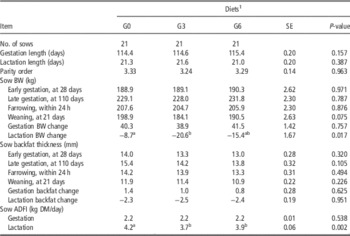
Table 2 shows the effect of incorporating crude glycerin in feed on sow performance. BW at 28 days and 110 days of gestation, and BW change during gestation were not affected by dietary treatment. Dietary treatment also had no effect on the backfat depth or feed intake of pregnant sows. The feed intake was similar for all treatments, averaging 2.2 kg DM/day. During lactation, there were no differences in BW or backfat depth at farrowing. However, there was a tendency for BW at weaning to differ between dietary treatments (P=0.075). Sows fed 3% glycerin showed lower BW after 21 days of lactation than sows fed the control diet. The tendency for BW at weaning was also reflected in BW change of lactating sows (P=0.017). Sows fed the G3 diet showed the greatest loss of BW; although the BW change was not different between glycerin-fed sows, or between sows fed 6% glycerin and those fed the G0 diet. In addition, glycerin-fed sows had a lower feed intake than those fed the control diet (P=0.007). The average daily feed intake (ADFI) for lactating sows fed the G3 and G6 diets was 12% and 7% lower, respectively, than for the sows fed the G0 diet.
Effect of adding glycerin to feed on sow performance

ADFI=average daily feed intake; DM=dry matter.
a,bWithin a row, means without a common superscript differ significantly (P<0.05).
1 Dietary treatments were 0, 3 or 6% crude glycerin inclusion (G0, G3 and G6).
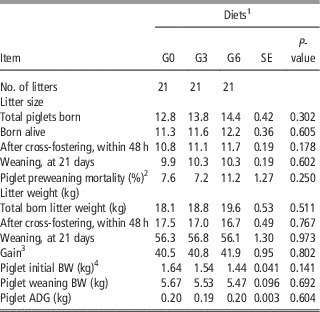
The effects of glycerin on litter performance are presented in Table 3. The average number of piglets born and born alive per litter was 13.7 and 11.7, respectively, with no difference between dietary treatments. At farrowing, litters were cross-fostered to adjust litter size and avoid initial differences among dietary treatments. There was also no effect on litter size at weaning. In addition, the amount of glycerol in the diet did not affect pre-weaning mortality of the piglets, the weight of litters after cross-fostering, or the weight of litters at weaning. The pre-weaning weight gain of litters, corrected by the weight of dead piglets, and the ADG of piglets were similar for all treatments, with an average of 41.1 and 0.2 kg/day, respectively.
Effect of adding glycerin to feed on litter performance

ADG=average daily gain.
1 Dietary treatments were 0, 3 or 6% crude glycerin inclusion (G0, G3 and G6).
2 Calculated for each litter from the number of piglets after cross-fostering.
3 Corrected by the weight of dead piglets.
4 Piglet weight after cross-fostering.
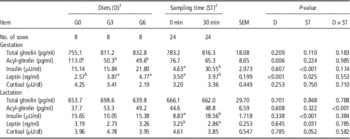
The effect of adding glycerin to feed on the serum concentrations of hormones related to energy metabolism and feed intake is presented in Table 4. At 100 days, pregnant sows fed the diets supplemented with glycerin showed lower concentrations of acyl-ghrelin and higher concentrations of leptin (P<0.001). Insulin and cortisol were not affected by dietary treatment. In lactation, there were no differences between dietary treatments for any of the hormones measured. The effect of measurement time (before or after feeding) was also examined. The serum concentrations of both insulin and leptin changed 30 min after feeding (P<0.05). Insulin concentrations were higher after feeding in both pregnant and lactating sows (P<0.001), while the leptin concentrations, before and after feeding, depended on the physiological status of the sows. Feeding led to an increase in leptin concentration in pregnant sows (P=0.025) and a decrease in lactating animals (P=0.031). No differences in concentration for the other hormones studied were found, although there was a tendency for cortisol concentrations to be lower in lactating sows after feeding than before feeding (P=0.052). In general, diet and sampling time interactions were not significant, except in the case of acylated ghrelin in lactating sows (P<0.001). The acyl-ghrelin at different times (0 and 30 min) remained unaffected by the G0 diet; but acyl-ghrelin concentrations decreased or increased after feeding for sows fed G3 and G6 diet, respectively (−21.5 and +31.2 pg/ml; P<0.05).
Effect of glycerin addition and sampling time on serum concentration of total and acylated ghrelin, insulin, leptin and cortisol in sows during gestation and lactation

a,bWithin a row, means without a common superscript differ significantly (P<0.05).
1 Dietary treatments were 0, 3 or 6% crude glycerin inclusion (G0, G3 and G6).
2 Measurement time with respect to feeding time: before (0 min) and 30 min after feeding.
Pearson’s correlation coefficients were calculated between each of the hormones studied in pregnant and lactating sows within sampling time: before (0 min) and 30 min after feeding. Before feeding, the total ghrelin concentration of sows during gestation was negatively correlated with acyl-ghrelin (r=−0.47; P=0.029), and the concentration of acyl-ghrelin was positively correlated with cortisol (r=0.81; P=0.001). Thirty minutes after feeding, total ghrelin still showed a negative correlation with acyl-ghrelin (r=−0.48; P=0.045), and the concentration of cortisol was negatively correlated with leptin (r=−0.73; P=0.003). During lactation, total ghrelin and acyl-ghrelin concentrations were correlated with insulin (r=0.50; P=0.005) and cortisol (r=0.61; P=0.015) at 0 min, respectively. After feeding, the concentration of leptin in lactating sows was negatively correlated with total ghrelin (r=−0.59; P=0.001) and positively correlated with insulin (r=0.46; P=0.015).
Discussion
Several authors have evaluated the effects of adding crude glycerin to weanling (Groesbeck et al., Reference Groesbeck, McKinney, DeRouchey, Tokach, Goodband, Dritz, Nelssen, Duttlinger, Fahrenholz and Behnke2008; Zijlstra et al., Reference Zijlstra, Menjivar, Lawrence and Beltranena2009) and growing-finishing pig diets (Kijora et al., Reference Kijora, Bergner, Kupsch and Hagemann1995; Lammers et al., Reference Lammers, Kerr, Weber, Bregendahl, Lonergan, Prusa, Ahn, Stoffregen, Dozier and Honeyman2008a; Della Casa et al., Reference Della Casa, Bochiccio, Faeti, Marchetto, Poletti, Rossi, Garavaldi, Panciroli and Brogna2009; Mendoza et al., Reference Mendoza, Ellis, Mckeith and Gaines2010). However, studies with sows fed diets containing crude glycerin have rarely been conducted (Schieck et al., Reference Schieck, Kerr, Baidoo, Shurson and Johnston2010a).
In our study, the inclusion of up to 6% crude glycerin in the diets of pregnant sows did not affect any performance variable. Moreover, taking into account that all diets were offered in restricted amounts during gestation, and there was no feed leftover, ADFI did not differ among treatments. To our knowledge, there are no previous studies regarding the effects of glycerin supplementation in diets for sows during gestation with which to compare these results. However, it is important to highlight that the amount of crude glycerin added to diets was relatively low compared with other studies in piglets and growing-finishing pigs. The inclusion levels tested in this study did not exceed the maximum level recommended by FEDNA (2010) for pregnant sows (6%).
During lactation, glycerin-fed sows had a lower ADFI than those fed the control diet. In contrast, Schieck et al. (Reference Schieck, Kerr, Baidoo, Shurson and Johnston2010a) reported that lactating sows fed a 3% glycerin diet had greater feed intake than those fed 6% glycerin, although no differences in ADFI were found when glycerin-supplemented diets were compared to a control diet. Crude glycerin inclusion in the diets of growing-finishing pigs has also provided conflicting results as regards growth performance. Some studies found enhanced ADG and ADFI in pigs fed glycerin (Kijora et al., Reference Kijora, Bergner, Kupsch and Hagemann1995; Schieck et al., Reference Schieck, Shurson, Kerr and Johnston2010b), while others reported negative effects (Della Casa et al., Reference Della Casa, Bochiccio, Faeti, Marchetto, Poletti, Rossi, Garavaldi, Panciroli and Brogna2009) or no effects on the growth rate and feed efficiency (Lammers et al., Reference Lammers, Kerr, Weber, Bregendahl, Lonergan, Prusa, Ahn, Stoffregen, Dozier and Honeyman2008a; Mendoza et al., Reference Mendoza, Ellis, Mckeith and Gaines2010). The variability of these results may be attributed partially to differences between levels and sources of crude glycerin, and to the ingredients replaced. The chemical composition of crude glycerin can vary widely depending on the feedstock source and the manufacturing process. In this line, American researchers evaluated 10 sources of crude glycerin from various biodiesel facilities. Crude glycerin sources originating from soybean oil averaged 84% glycerol, with a minimal variability among the six vegetables sources (Kerr, Reference Kerr2011); while sources from commercial plants using different animal fat as initial feedstock ranged from 52% to 94% glycerol. In our study, crude glycerin, obtained from vegetable oils, showed a high quality to be employed in animal feeding taking into account its glycerol (87.42%) and methanol (0.05%) contents. On the other hand, the effect of crude glycerin inclusion on the manufacturing process, physical aspects affecting feed intake, has been scarcely described in pigs in the literature (Groesbeck et al., Reference Groesbeck, McKinney, DeRouchey, Tokach, Goodband, Dritz, Nelssen, Duttlinger, Fahrenholz and Behnke2008; Madrid et al., Reference Madrid, Villodre, Valera, Orengo, Martínez, López, Megías and Hernández2013). In this sense, the lower feed intake found in sows fed glycerin may suggest a reduction in the palatability of the diets.
When feeding lactating sows, the aim is to minimize the loss of body mass by providing them with energy and nutrients. Crude glycerin has an energy content similar to that of corn, and can be used by the pig as a source of energy when included in the diet (Lammers et al., Reference Lammers, Kerr, Weber, Dozier, Kidd, Bregendahl and Honeyman2008b; Kovács et al., Reference Kovács, Zsédely, Kovács, Virág and Schmidt2011). Moreover, glycerol is a precursor of glucose, which participates in lipogenesis and can prevent protein catabolism (Tao et al., Reference Tao, Kelley, Yoshimura and Benjamin1983). However, in our study, lactating sows fed G3 diet showed a higher BW loss, although this difference was not observed in backfat thickness, which was similar among treatments. The lower BW at weaning of sows fed 3% glycerin could be attributed to the lower ADFI of these sows. Conversely, Schieck et al. (Reference Schieck, Kerr, Baidoo, Shurson and Johnston2010a) found that dietary crude glycerin did not affect either BW changes or backfat depth during lactation. Moreover, these authors evaluated the incorporation of up to 9% crude glycerin, which exceeds the upper level of 5% recommended by FEDNA (2010) for lactating sows.
Glycerol is highly gluconeogenic, glucose being the limiting source for the synthesis of lactose, and consequently for milk production. In fact, dietary crude glycerin has been shown to increase the milk lactose content in sows, although this was not reflected in milk yield (Schieck et al., Reference Schieck, Kerr, Baidoo, Shurson and Johnston2010a). Additionally, glycerol stimulates the intake of water, which is necessary for the mammary gland to produce milk. These effects led us to hypothesize that the dietary supplementation of crude glycerol during lactation might improve litter performance. Our results showed that the addition of up to 6% crude glycerin to sow diets has no detrimental effects on litter traits, which did not differ from those obtained with the control diet. Schieck et al. (Reference Schieck, Kerr, Baidoo, Shurson and Johnston2010a) reported a linear decrease in litter BW gain as the glycerol content of the diet increased from 0 to 6%, which was probably related to the lower ADFI of sows fed 6% glycerin. However, in our study, litter performance was not affected by the dietary addition of crude glycerin, despite the lower ADFI observed in sows fed glycerin. Probably, the higher BW loss in sows fed containing glycerin counteracted the lower feed intake found, which could partially explain the lack of differences in litter performance.
Several hormones related to metabolism and feed intake were examined in gestating and lactating sows, when different energy balances are to be expected. The results showed that dietary glycerin affected acyl-ghrelin and leptin concentrations in pregnant sows, but not for insulin and cortisol, or any of the hormones measured during lactation.
In general, previous studies on glycerin in the diets of growing-finishing pigs found no differences between treatments in insulin (Orengo et al., Reference Orengo, Villodre, Madrid, Martínez, López, Megías, Valera and Hernández2014), cortisol (Lammers et al., Reference Lammers, Kerr, Weber, Bregendahl, Lonergan, Prusa, Ahn, Stoffregen, Dozier and Honeyman2008a) or glucose (Hansen et al., Reference Hansen, Hernandez, Mullan, Moore, Trezona-Murray, King and Pluske2009). Likewise, Schieck et al. (Reference Schieck, Kerr, Baidoo, Shurson and Johnston2010a) found that increasing crude glycerin levels in the diet of lactating sows had no effect on plasma glucose. Insulin reduces blood glucose concentrations by enhancing glucose uptake by the cells, while cortisol increases plasma glucose in response to stress and its low concentration in blood (Koopmans et al., Reference Koopmans, van der Meulen, Dekker, Corbijn and Mroz2005). In this study, pregnant sows fed diets containing glycerin had lower concentrations of acyl-ghrelin and higher concentrations of leptin at 0 min, suggesting that dietary supplementation of glycerin may have exerted a satiating effect. Ghrelin is a fast-acting hormone that stimulates appetite by acting as a meal initiation signal for the short-term regulation of the energy balance (Klok et al., Reference Klok, Jakobsdottir and Drent2007; Steinert et al., Reference Steinert, Feinle-Bisset, Geary and Beglinger2013), and whose the acylated form is considered the biologically active form (Kojima et al., Reference Kojima, Hosoda, Date, Nakazato, Matsuo and Kangawa1999). On the other hand, leptin is involved in the long-term regulation of the energy balance, and is capable of inhibiting feed intake (Barb et al., Reference Barb, Yan, Azain, Kraeling, Rampacek and Ramsay1998).
The circulating concentrations of insulin and leptin were also dependent on the measurement time (0 and 30 min after feeding). The postfeeding serum concentrations of insulin in sows during gestation and lactation were higher. This was not unexpected taking into account that insulin usually increases after feeding to provide energy to the cells (Koopmans et al., Reference Koopmans, van der Meulen, Dekker, Corbijn and Mroz2005). Regarding leptin, the postprandial concentrations depended on the physiological status of the sows: the feeding caused an increase in leptin during gestation, while led to a decrease during lactation. This interaction effect was also described by Martínez et al. (Reference Martínez, Valera, Villodre, Madrid, Orengo, Tvarijonaviciute, Cerón and Hernández2014), who suggested a higher satiety in sows during gestation, a period in which the energy balance is more likely to be positive. Leptin concentrations increase when an individual has a positive energy balance, acting as a satiety signal that decreases appetite and food intake in humans (Klok et al., Reference Klok, Jakobsdottir and Drent2007).
The regulation and interactions between these hormones have previously been described in humans (Klok et al., Reference Klok, Jakobsdottir and Drent2007) and other species (Ma et al., Reference Ma, Lin, Lin, Qin, Pereira, Haymond, Butte and Sun2012). Most studies on the relationship between food intake-regulating hormones and diet have focused on understanding the underlying mechanisms involved in obesity and its related disorders in humans (Schwarz et al., Reference Schwarz, Rigby, La Bounty, Shelmadine and Bowden2011). In this study, the strongest correlation was found between the concentration of acyl-ghrelin and cortisol in both pregnant and lactating sows at 0 min. In this sense, several studies in mice and humans have found that serum ghrelin concentrations increase in stress conditions (Chuang et al., Reference Chuang, Perello, Sakata, Osborne-Lawrence, Savitt, Lutter and Zigman2011; Stengel et al., Reference Stengel, Wang and Taché2011), which are also known to increase the plasma concentrations of cortisol. Our results showed that pregnant sows fed diets containing glycerin had lower concentrations of acyl-ghrelin at 0 min, together with a strong positive linear correlation between acyl-ghrelin and cortisol. These findings could suggest that dietary supplementation of the gestation diet with glycerin may have also reduced hunger pangs and improved welfare; although relatively little is known about any interactions between these hormones and diet composition, and how some ingredients could modulate concentrations of the hormones regulating feed intake.
Based on the results of the present study, up to 6% crude glycerin could be used to partially replace corn in diets for pregnant sows. Furthermore, the addition of crude glycerin seems to affect the serum concentrations of some feed intake-regulating hormones. However, further research is needed to determine the effects of crude glycerin on the energy balance in relation to the physiological status of the animal.