




No CrossRef data available.
Completing a Financial Revolution: The Finance of the Dutch East India Trade and the Rise of the Amsterdam Capital Market, 1595–1612
Published online by Cambridge University Press: 01 September 2004
Abstract
The article analyzes the evolution of the Amsterdam capital market as a consequence of Dutch overseas expansion and the introduction of transferable VOC shares. Offering investors prospects of speculative gains without serious loss of liquidity, these instruments created a booming secondary market offering a wide range of allied credit techniques. By 1609 this market had become sufficiently strong to dictate terms for new public debt issues. These findings show that, contrary to commonly held notions about the emergence of secondary markets, private finance took precedence over public finance in the Dutch Republic.
Information
- Type
- ARTICLES
- Information
- Copyright
- © 2004 The Economic History Association
Capital markets exist to accumulate and distribute savings. Their performance depends on the successful marrying of two inherently opposed requirements. Savers want liquidity, i.e., the possibility of converting their assets back into cash at low cost and short notice. On the other hand, investors need continuity, an assured supply of capital for the duration of the venture concerned.1
A balanced analysis of the role of capital markets appears in Levine, “Financial Development.”
On the mobilization of capital for early modern states see: for the Dutch Republic: Tracy, Financial Revolution; and 't Hart, Making of a Bourgeois State; for England: Dickson, Financial Revolution; and North and Weingast, “Constitutions”; for France: Hoffman, Postel-Vinay, and Rosenthal, Priceless Markets; on the mobilization of capital for business corporations and merchants: Ehrenberg, Zeitalter der Fugger; and Chaudhuri, English East India Company.
Compare Parker, “Emergence.”
De Roover, Money; Van der Wee, “Anvers”; and Schnapper, Rentes. More recent contributions on the importance of liquidity for the development of financial markets are: Michie, “Invisible Stabilizer”; and Neal, “How it all Began.”
Economic historians consider England's financial revolution of the late seventeenth and early eighteenth century a landmark in the rise of modern financial systems for it combined the consolidation of public debt with the creation of a secondary market for government bonds.5
Dickson, Financial Revolution; and Neal, Rise. Compare for a general overview of the literature on the rise of modern financial systems: Sylla, “Financial Systems.”
Compare for the development of public finance in the Habsburg Netherlands: Tracy, Financial Revolution. Marjolein 't Hart and Wantje Fritschy have detailed the development of public finance in the later sixteenth and seventeenth century: 't Hart, Making; Fritschy, “Public Finance Revolution”; 't Hart, “Merits”; and Fritschy and Van der Voort, “From Fragmentation.” On Venice see Müller, Venetian Money Market. On Genoa see Heeres, Gênes, pp. 147–62. On Florence see Braudel, Civilisation matérielle, vol. 2, chapter 1.
Neal, Rise, pp. 14–16, and “How it all Began.” Compare also Jonker, “Competing.”
Neal, “How it all Began,” pp. 122–23.
True, there was no bustling secondary market for public debt in the Dutch Republic. State archives and notarial records do reveal transfers of government bonds, but there were no prices quoted in Amsterdam's price journals, and bonds were rarely pledged as collateral.9
Incidental transfers of public annuities and bonds from the 1570s onwards have been documented by Tracy, Financial Revolution, p. 90 note 50, p. 119.
Neal, Rise, pp. 10, 16. Compare also Dickson, Financial Revolution, pp. 459–64.
This article uses company records, notarial deeds, government ordinances, and the business papers of an Amsterdam merchant to reconstruct the finance of Dutch East India trade between 1595 and 1612. Despite many publications on the early stages of Dutch colonial expansion, we still know very little about the actual capital requirements of the first voyages to Asia.11
Van Dillen, Aandeelhoudersregister, pp. 5–11, 34–45; De Korte, Financiële verant-woording; and Gaastra, Geschiedenis, pp. 23–29.
Even the most detailed studies on the social and economic background of VOC shareholders are generally silent on the issue of financial techniques. Compare Van Dillen's very elaborate analysis of the shareholders of the Amsterdam chamber of the VOC in Aandeelhoudersregister and several more detailed case-studies: Vaz Dias, “Deelname Marranen”; Stols, “Zuidelijke Nederlanden”; and Degryse, “Zuid-Nederlands kapitaal.” See analyses of the shareholders of the Middelburg chamber in Unger, “Inschrijvingsregister; and Enthoven, Zeeland. For Enkhuizen, see Willemsen, “Beleggers.”
General studies on Dutch East India trade include: Van der Chijs, Geschiedenis; Van Dillen, Oudste aandeelhoudersregister; Gaastra, Geschiedenis VOC. On the legal status of the VOC and the early companies see: Van der Heijden, Ontwikkeling; and Mansvelt, Rechtsvorm. On the VOC's business organization see: Steensgaard, “Dutch East India Company.”
Van Dillen, “Isaac le Maire.” See also Smith, Tijd-affaires. A notable exception is Willemsen, (“Beleggers,” pp. 75–79), who reconstructed the first ten years of trading in shares of the Enkhuizen chamber.
FUNDING OPTIONS IN DUTCH LONG-DISTANCE TRADE
At the turn of the seventeenth century, the Dutch Republic emerged as Europe's leading economy.15
On the Dutch commercial expansion between 1580 and 1650, and the dominant role of Amsterdam in Dutch foreign trade, see Israel, Dutch Primacy; and De Vries and Van der Woude, First Modern Economy.
The expansion of trade, both in Europe and overseas, set new capital requirements for merchants in Amsterdam. Trips to Italy, West Africa, or South America pioneered during the late 1580s and 1590s took much longer to complete than the Baltic run, the artery of the Dutch Republic's foreign trade. As often as not, Baltic ships did two to three round trips in the sailing season, but a single voyage to Italy or West Africa and back took ten to 12 months. Fitting costs were further increased by the need to carry heavy armament, something ships in Northwestern Europe rarely required; potential threats from Dunkirk or other privateers were usually parried by sailing in convoy, if necessary with navy protection.
Funding options for long-distance trade in late-sixteenth-century Amsterdam were not really different from those used by businessmen today: merchants could finance their firm with retained earnings; with credit, for instance by drawing bills, selling bonds or accepting deposits; or through raising equity by seeking fresh partners or issuing shares.16
Neal, “Finance of Business”, notably pp. 153–57.
Neal, Rise, pp. 5–7.
Jonker and Sluyterman, At Home, pp. 29–30.
For the first voyages to Italy, West Africa, and the Caribbean, reinvesting profits and widening partnerships, with active or sleeping partners, were the two principal funding strategies. At about 25,000 guilders per ship the outlay for such expeditions was hardly astronomical, well within the means of temporary partnerships. The Leiden merchant Daniel van der Meulen had a string of such ventures to Italy with three or four colleagues, whereas the Guinea trips in which Claes van Adrichem from Delft took part numbered even more participants.19
Jonker and Sluyterman, At home, pp. 24–25, 30; and Kernkamp and Klaassen-Meijer, “Rekeningen.”
Hart, “Italië-vaart,” p. 48.
As West African trade grew, it spawned larger partnerships running more than just a single ship. Eventually this led to the establishment of more permanent companies selling equity shares.21
Van Gelder, “Scheepsrekeningen”; Unger, “Nieuwe gegevens,” p. 199; Kernkamp and Klaassen-Meijer, “Rekeningen,” pp. 5, 14; Pace Israel, Dutch Primacy, pp. 60–61, 63–65, who considers the West African trade to have been very capital intensive.
De Vries and Van der Woude, First Modern Economy, pp. 358, 403.
On partenrederijen, see Riemersma, “Trading and Shipping Associations”; and Hart, “Rederij.” In the first decades of the seventeenth century a similar business organization was used in whaling (see Muller, Noordsche Compagnie; and Hart, “Eerste Nederlandse tochten”); sawmills (see Van Dillen, Bronnen bedrijfsleven, vol. 2, nrs. 1250, 1445); and peat digging (see Keikes, “Veenexploitaitie”). On milling societies in the seventeenth century, see Duplessis, “Probate inventories”; and Ankum, “Bijdrage geschiedenis olieslagerij.”
We know far less about yet another funding option for long-distance trade: deposits and bonds. Any merchant firm would have interest-paying current accounts with its correspondents and thus possess some deposits. In addition, we may assume that businessmen would sometimes accept deposits from family members or close friends, as a cover against temporary shortfalls caused by business fluctuations or by family circumstances such as succession and estate arrangements, or as a favor to render cash surpluses profitable for someone without direct access to the market. Evidence for such deposits has to be drawn from the relevant business records. The ledgers of Hans Thijs, an Antwerp merchant who migrated to Amsterdam during the 1590s, suggest that deposits could supply a major part of funding. From 1592, when the estate of Thijs's father was finally wound up, Thijs had as a rule 10,000–20,000 guilders of family deposits at his disposal. At his death in 1611 deposits totaled 34,000 guilders on total assets of 255,000, or just over 13 percent.24
Gelderblom, Zuid-Nederlandse Kooplieden, p. 144.
Prinsen Lzn, “Notarisprotocol,” pp. 163–64.
Bonds also appear to have been used fairly widely. These IOUs, or bills obligatory as they were called, originated in rebates on the purchase of goods. They surfaced in the Low Countries during the fifteenth century. Herman van der Wee has shown how bills obligatory developed into negotiable bearer instruments in Antwerp.26
Van der Wee, “Anvers.” pp. 1071–081; GAA NA (Amsterdam City Archives, Notarial Archives) 1/522, 12-07-1585; GAA NA 9/7, 28-01-1591; GAA NA 8/147v-148, 08-10-1591; GAA NA 8/200, 14-02-1592; GAA NA3/494, 31-03-1599. Dutch terms for debt instruments had not really crystallized at the time, as they appear to have done in England, where a clear distinction existed between obligations as bonds, in other words legally enforceable securities pledged to lenders, and obligations as private debt contracts, in other words informal promissory notes. See Postan, “Private Financial Instruments,” pp. 35–37; and Trevor-Roper, “Elizabethan Aristocracy,” 281–88. The Dutch term “obligatie” covered more or less any debt instrument ranging from private promissory notes to formal debt paper issued by city councils. We have preferred to use the term bond for formal debts embodied in a ledger entry or a formal document, rather than translating “obligatie” into the equally vague English term obligation.
Postan, “Private,” pp. 57–58; and Van der Wee, “Monetary systems,” p. 301. Compare, for example, the cession of 25 bills obligatory signed by various merchants from the Antwerp merchant Wouter de Schot to his brother-in-law, Balthasar Jacot, also a merchant from Antwerp GAA NA 3/494, 31-03-1599.
Van der Wee, “Anvers,” pp. 1080–81.
However, from the 1540s onwards, merchants also issued IOUs to borrow money for periods up to 12 months.29
Van der Wee, Growth; and De Smedt, “Antwerpen.” Technically one should make a distinction between deposits and bonds. Whereas a lender could recover the former at short notice, a few weeks at most, the latter had a fixed maturity with an option for renewal. De Roover, “Anvers,” pp. 1037–38.
Antwerpse Costuymen, 1582, Title LI-13, p. 390; published at: http://www.kulak.ac.be/facult/rechten/Monballyu/Rechtlagelanden/Brabantsrecht/brabantsrechtindex.htm.
A general discussion of credit instruments used in Amsterdam in the seventeenth century appears in Spufford, “Access to Credit,” pp. 304–05.
Van der Burg and 't Hart, “Renteniers.” These “obligaties” were generally described by the interest paid to bearer every year. Compare, for example, GAA NA 1/249, 11-04-1582; and GAA NA 1/436, 25-04-1584. For the town council bonds specimens, see GAA NA 23/263bis, 01-11-1595; GAA NA 23/352, 06-06-1596; and GAA NA 5B/146, 29-03-1607.
The first explicit reference to IOUs as a means to fund commercial enterprise comes from the 1594 estate of an Amsterdam broker.33
The maturity of these “obligaties”, quoted as 648 guilders and 108 pounds Flemish was set at one year, which would imply interest rates of 6 percent and 8 percent, respectively. Besides these two bills, the estate contained two “bekentenissen” or IOUs, one of 648 guilders or 8 percent, and one of 300 guilders plus interest (GAA NA 32/254-261, 15 November 1594).
Wallert, Ontwikkelingslijnen; and Dehing and 't Hart, “Linking the Fortunes,” p. 42; The testimony in GAA NA 196/71, 27 August 1608.
Evidence for the use of bills obligatory is not limited to legal provisions dealing with them. The Thijs ledgers suggest that bonds were indeed sufficiently common to offer a sound and flexible funding option. During his early career in Poland, Thijs set up his jewelry trade relying on funds supplied by private investors on IOUs for a total of up to 10,000 guilders. We have seen how he switched to using family deposits from 1592, but six years later Thijs again began to seek additional funding by borrowing heavily on the market. Until the autumn of 1602 he wrote IOUs to 24 different creditors, for a total of 30,000 guilders. The bonds covered amounts of up to 4,200 guilders at 7–8 percent interest and a maturity of three to 12 months; many of them were rolled over on expiry. On Thijs's death in 1611, bonds totaled 100,580 guilders or almost 40 percent of total assets.35
On the business career of Hans Thijs, see Gelderblom, Zuidnederlandse kooplieden, pp. 123–44, 163–71, 197–204.; On his financial transactions, see Gelderblom, “Governance.”
GAA NA 567/61v, 25-09-1620; the items listed in Van der Meulen's estate do not reveal bonds: Prinsen, “Uit het notarisprotocol,” passim.
In brief, available traditional methods of business organization and finance possessed sufficient scope and stretch to power the increasingly capital-intensive ventures in Europe, to Africa, and into the Caribbean. The next step, Asia, posed a formidable challenge, however.
FINANCING THE ASIAN TRADE
From 1595 onwards, expeditions to Asia changed the demand for capital in three key respects. First, at 100,000 guilders per ship, the sums needed were two to four times the amount of trips to, say, Africa or the Caribbean.37
Jonker and Sluyterman, At Home, p. 43; and Unger; “Nieuwe gegevens.”
Bruijn, Gaastra, and Schöffer, Dutch-Asiatic Shipping, vol 2, pp. 3–17. Compare also Jonker and Sluyterman, At Home, p. 43.
In 1613 final dividends were paid to shareholders in the eight ships that sailed with Van Neck in 1598, the ten ships that sailed with Van Neck in 1600, the five ships with Wolfert Hermans (1601), and the 14 ships with Warwijck (1602): Leiden University Library, Bibliotheca Thysiana (BT) 119, Ledger Hans Thijs 1603-1609, sheet added to carta 182.
The solution for these problems was found in the adaptation of existing forms of business organization. The early ventures to Asia were associations of merchants, but they differed from the first voyages to Italy or West Africa in being run by a committee.40
Once the Africa merchants of Amsterdam were united in the Generaele Compagnie van Guinea in 1599, this company was also run by a committee of “bewinthebbers” (directors): GAA NA 94/223, 05-07-1603; GAA NA 108/208-208v; GAA NA 196/744, 02-05-1611. Compare also Unger, “Nieuwe gegevens,” p. 99.
In their recent handbook (First Modern Economy, p. 385), De Vries and van der Woude argue that bewindhebbers (directors) bore unlimited liability, while participanten were sleeping partners with limited liability. This analysis goes back to Van der Heijden (Ontwikkeling, pp. 69–77) and Mansvelt (Rechtsvorm, pp. 44–51), who claimed that the voorcompagnieën differed from both the partenrederij and the VOC in that the directors had an obligation to provide additional funds in case the companies ran a deficit. However, the evidence for this claim (Mansvelt, Rechtsvorm, p. 47) is thin and inconclusive. The one case in which the directors of a voorcompagnie were asked to supply additional capital, and did so without asking for contributions from their sub-shareholders, might very well be explained by their desire or willingness to raise their own stakes in a very profitable venture. In any case, the Thijs ledgers suggest that sub-shareholders could be asked (or volunteered) to raise the value of their shares whilst preparations for a voyage were underway (BT 119, Ledger Hans Thijs, 1598-1603, fol. 28, 88). Moreover, the claim about unlimited liability runs counter to the fact, established by Mansvelt himself, that all shareholders in partenrederijen, including the directors, bore limited liability: their share in profits and losses was proportional to their investment, and they never stood to lose more than the capital they invested (Mansvelt, Rechtsvorm, pp. 28–38). Even if the rules governing the relationship between individual participants and “their” director differed from the rules that governed the association between directors that constituted a voorcompagnie, the limited liability of all involved was secured. For maritime law allowed investors in partenrederijen (in other words the directors of the early companies) to abandon their part in case their losses exceeded initial investment, while customary law stipulated that participants in any company never risked more than their investment (Mansvelt, Rechtsvorm, pp. 31–32; and Van der Heijden, Ontwikkeling). On the legal status of the voorcompagnieën, see also Van Brakel, Hollandsche Handelscompagnieën, pp. 162–65; and Van Dillen, “Nieuwe Gegevens”, p. 351, and, Aandeelhoudersregister, pp. 23–24, 26–27.
GAA NA 105/73v-74, 9 November 1606.
Bruijn et al., Dutch-Asiatic Shipping, pp. 3–17; Gaastra, Geschiedenis, p. 25; and Van Goor, Nederlandse Koloniën, pp. 29–30.
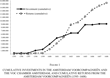
This concentrated spurt of investment is the more remarkable for the fact that it outpaced immediate returns, at least in Amsterdam. Although the early voyages eventually proved very profitable, the sector as a whole ran a negative cash flow until 1602. This becomes apparent from a reconstruction of the cumulative investments and returns in Amsterdam's early companies, including the local chamber of the VOC. Figure 1 shows cumulative investments in various ventures at an estimated 1.4 million guilders in 1599, and 5 million guilders two years later. Notably in 1600 and 1601 total revenue of the early voyages lagged about 1.5 million guilders behind total investment. Hence the determined efforts the initiators of new trips made to find fresh sources of capital.

CUMULATIVE INVESTMENTS IN THE AMSTERDAM VOORCOMPAGNIEËN AND THE VOC CHAMBER AMSTERDAM, AND CUMULATIVE RETURNS FROM THE AMSTERDAM VOORCOMPAGNIEËN (1595–1608)
However, the successful fundraising of the voorcompagnieën did not solve cash flow strains. Rather, they were shifted to individual investors. The ledgers of Hans Thijs show him working several options to mobilize capital, either through a more intensive use of existing channels, or through tapping into a wider public of savers. Between 1598 and 1602 Thijs invested 15,950 guilders in all but one of Amsterdam's voorcompagnieën. In addition, he raised his shares in shipping companies from 3,000 guilders in 1598 to 18,000 guilders in 1603. Moreover, in these years annual turnover of his jewelry trade tripled to 16,000 guilders.
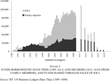
To finance these commitments Hans Thijs reinvested profits, borrowed money, and sold a third of his shares in shipping and colonial companies to his father-in-law. As for the borrowing of money, Amsterdam's market for bonds proved sufficiently viable for Thijs to bypass his first source of credit, family members. Although deposits of relatives remained at about 10,000 guilders, by August 1602 Thijs had sold 30,000 guilders' worth of bonds to 24 different merchants and merchants' widows (Figure 2). Clearly, the money market helped Thijs to raise additional funds, and we may safely assume that other participants in colonial companies did the same to finance their investments. With buyers of bonds accepting a safe return of 7 percent to 8 percent on their savings, these investors were able to pursue the much higher expected returns from colonial trade.

FUNDS BORROWED BY HANS THIJS (1589–1611) AND HIS HEIRS (1612–1619) FROM FAMILY MEMBERS, AND FUNDS RAISED THROUGH SALES OF IOU
The evolving pattern of trade with Asia led to a merger of the various pioneer companies into the VOC in the autumn of 1602. Even though various pioneer voyages were still underway, the flotation of the VOC went smoothly with share subscriptions amounting to 6.4 million guilders. Just below half of this capital was supplied by Middelburg, Rotterdam, Delft, Hoorn, and Enkhuizen together. The Amsterdam chamber alone raised over 3.6 million guilders in shares. As before, the company directors operated as underwriters canvassing buyers. However, the investment market had developed so rapidly that this device had lost much of its importance: only 29 percent of the capital at the Amsterdam chamber was subscribed in this way, so most savers could be reached without recourse to personal relations.44
Company directors subscribed 80 percent of the shares of participants who did not appear before the company's clerks in the autumn of 1602: Van Dillen, Aandeelhoudersregister, passim.
Undoubtedly, many merchants who had invested in the pioneering voyages used their revenues to buy shares in the East India Company. Hans Thijs, for example, subscribed for 12,000 guilders in August 1602, which he paid up step by step out of returns from the voorcom-pagnieën.45
The business ledgers of Hans Thijs reveal he paid his stock in the VOC in four installments. The first installment of 25 percent was due by October 1603, the second and third installment (33.3 percent each) were due by May and September 1605, respectively. The last installment was due by January 1607 (BT 119, Ledger Hans Thijs 1603-1609, fol. 87).
Van Dillen, Aandeelhoudersregister, pp. 38–39.
However, the installment schedule shifted the cash flow problem from the share subscribers to the company's board. The sailing of the VOC's expeditions was roughly timed to fit the four installments, but the board really needed the money months in advance to pay for the rigging and outfitting of the ships. Directors solved this problem by offering shareholders 8 percent interest on capital furnished before the calls.47
NA (National Archives, The Hague) 1.04.02 Inv. Nr 99, fol. 12; A standard bill obligatory to bearer was drafted for this purpose by the company directors on 28 February 1603 (fol. 57). Thus much earlier than in 1621, as was suggested by Smith, (Tijd-affaires, p. 47).
The ledgers of the Amsterdam Chamber reveal interest payments of 14,908 guilders in April 1604, 18,937 guilders in October 1605, 30,051 guilders in April 1606, and 16,191 guilders in May 1608 (NA 1.04.02, Inv. Nr. 7142, fol. 203, 357, 444, 604.
NA 1.04.02, Inv. Nr. 7142, fol. 7ff; NA 1.04.02 Inv. Nr. 225, draft resolutions of the Amsterdam chamber, 19-11-1603, 25-10-1607.
NA 1.04.02, Inv. Nr. 7142, fol. 1-609.
THE RISE OF A SECONDARY MARKET
The pioneering voyages taught two important lessons about the long-distance trade to Asia. First, the scale of operations would have to be bigger, requiring substantially more investment in ships and staff; second, operations would have to assume some form of permanence, for only a lasting concern with stores, yards, fortifications etc. would be able to gain a competitive edge over the English and the Portuguese. To meet these requirements, the new company stipulated that shareholders pledge their capital for a period of ten years. As a corollary, the shares were made transferable by clauses laying down a procedure for transferring ownership by matching entries in the company ledgers. Shareholders could now liquidate their holding as and when required, so these provisions in effect created a secondary market in VOC shares.51
The charter's full text is in: Van der Chijs, Geschiedenis, pp. 118–35.
Until then the market for equity claims had remained rather thin. Before 1602 very few participants in shipping companies and colonial companies sold their interests. Trade in parten and in shares in the early Asian ventures was limited to a narrow circle of insiders, i.e., a dozen or perhaps two in the case of shipping companies, and a few dozen in the case of the voorcompagnieën. For others, gathering information about the true state of affairs was simply too complicated. The shares in the early colonial companies were thus not very liquid, that is to say, they were not easy to sell at any given moment when the holder might require cash.52
This is not to say that shares in the voorcompagnieën could not be transferred, as Van Brakel claimed in 1908 (Van Brakel, Hollandsche handelscompagnieën, p. 153). The notarial archives of Amsterdam hold about a dozen transfers of shares in the Asian expeditions between 1597 and 1606: GAA NA 33/107-108, 10-09-1597; GAA NA 10/59, 7 and 14 March 1598; GAA NA 33/396, 08-05-1600; GAA NA 34/152, 14-06-1602; GAA NA 96/224v, 07-04-1604; GAA NA 101/46, 02-08-1605; GAA NA 101/55v-56, 13-08-1605; GAA NA 103/75, 28-06-1606; GAA NA 103/165, 31-08-1606; GAA NA 105/52, 31-10-1606.
Hart, “Rederij,” pp. 108–09. Compare for example: GAA NA 24/274, 01-10-1598; GAA NA 11/2v, 09-09-1600; GAA NA 103/75, 28-06-1606.
The VOC effected a radical change in three respects. First, the spread of share-ownership was much wider than ever before. The Amsterdam chamber had more than 1,100 initial subscribers on an estimated adult population of no more than 50,000 people. The huge profits of some Asian expeditions had created a keen public interest, to the point of attracting even small savers investing up to 150 guilders. Second, the charter's clear rules about ownership and transfer of shares fulfilled key requirements for a transparent market.54
The case for secure property rights as the conditio sine qua non for economic growth has been convincingly made by Douglass C. North. See, for example, his Structure. The beneficial effects of secure property rights on the development of capital markets have recently been spelled out by De Soto, Mystery.
Smith, Tijd-affaires, pp. 31–32, 37, 44–45; To make sure the directors were present, they were fined one guilder for not showing up (NA 1.04.02 Inv. Nr. 225, fol. 32).
The scrips that some collectors today consider the world's “oldest shares” are nothing of the kind: they are quittances for the last installment: Van Dillen, Aandeelhoudersregister, pp. 32–33.
However, the chore and cost of transfer via the VOC office did have unforeseen consequences, as will become clear from discussing the third point: because subscribers had a period of several years in which to pay up their commitment, the VOC shares had a built-in speculative element from the start. Several merchants subscribed to more shares in the new company than they were planning to hold on to. Reinforced by the ever fluctuating prospects of trade, this element provided a natural breeding ground for forward trading, which the hassle of transferring ownership did little to diminish, because it created an incentive to buy or sell for future delivery and then complete the transaction by mutual clearing, that is settling the balance of claims outstanding rather than transferring any shares.57
Smith, Tijdaffaires, pp. 44–45; traders also had to find ways to get around the fact that the VOC office was sometimes closed for protracted periods, either because the office staff had to accompany directors on business elsewhere in the Republic, say to a meeting in Middelburg, or because the seasonal pressure of work such as the annual drafting of the accounts, which by the later seventeenth century could take as much as two weeks; An example of the former instance in: BT 215 A1, Letter from Jacques de Velaer to Anthoni l'Empereur, 03-04-1609; compare Smith, Tijdaffaires, p. 45.
Repo transactions imply a cash payment in return for the transfer of a security. The contract is completed when the borrower returns the money with interest, and repossesses the security. Jonker, Merchants, pp. 90–93.
Compare the notarial deeds published in Van Dillen, “Isaac le Maire,” pp. 46–47, 78–83, 89–91.
The principal notary involved was Jan Franssen Bruyningh, well known for his activities on Amsterdam's market for shipping services: Christensen, Dutch Trade. Other notaries included Frederick van Banchem, Pieter Bruyns, Willem Benningh, Cornelis Meurs, Jacob Meerhout, Palm Mathijsz, and Jacob Gijsbertsz (NA 1.04.02 Inv. nr. 7066/303ff).
Compare Neal, “How it all Began,” pp. 122–23.
Speculative trade in VOC shares appears to have begun immediately after flotation in August 1602. Prices of 14–15 percent above par, presumably for shares in the Amsterdam chamber, have been recorded for September 1602. In following months prices declined to around 104 percent.62
Smith, Tijd-affaires, p. 40; and Van Dillen, “Isaac le Maire,” p. 15.
NA 1.04.02 Inv. nr 7066, Journaal van Actiën VOC Amsterdam (1602-1612), fol. 72-440.
Copies of this form dating from 27 August 1604 are found in the business papers of Hans Thijs (BT 112, Nr. C-2); The standard form had already been drafted in February 1603, however (NA 1.04.02, Inv. nr. 99, fol. 55–56).
Klerk de Reus, “Geschichtlicher Ueberblick,” p. 12.

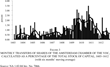
MONTHLY TRANSFERS OF SHARES OF THE AMSTERDAM CHAMBER OF THE VOC, CALCULATED AS A PERCENTAGE OF THE TOTAL STOCK OF CAPITAL, 1603–1612
In the first few years after the establishment of the VOC, transfers show a marked pattern of peaks and troughs. Some months saw no transfers at all, while in others mounting transfers must have kept the company clerks very busy. These first transfers appear to have been driven less by regular securities trading than by individual investors facing a liquidity squeeze. Indeed, several peaks coincided with successive calls for capital in the spring of 1603, in December 1604, and in December 1605. Only in 1606, after 90 percent of the capital had been paid, did transfers assume a smoother pattern. To be sure, the company's board gave investors considerable leeway in meeting their obligations. Some paid the whole amount at once, others waited for the official calls, a third group clearly concluded a private agreement for spreading payments over as much as 12 installments.66
Van Dillen, Aandeelhoudersregister, p. 37.
In November 1603 the Amsterdam Chamber repossessed and then resold shares worth 28,000 guilders from 13 shareholders who had failed to pay their first installment: NA 1.04.02. Inv. Nr. 7066 fol. 82-90.
The liquidity squeeze encountered by some of the shareholders is exemplified by the case of Pieter Lintgens, the single biggest investor in the VOC with subscriptions of 60,000 guilders in the Amsterdam chamber and another 45,000 guilders in the Zeeland chamber. This position was clearly a speculative one, i.e., Lintgens did not have the money in 1602 but expected to fund his commitment from future earnings and rising stock prices. This strategy no doubt built on the observation that most of the voorcompagnieën had begun to pay dividends about two years after the expeditions had sailed. Following these precedents, a first VOC dividend might justifiably be expected in the spring of 1605, by the time when the second call fell due. Lintgens managed to meet the first call by spreading his payments in three installments, but he could not meet the next payment. Thus, in April 1605 he sold half his share in the Amsterdam chamber. Just before the third call in December 1605 he sold his remaining stock, for there were no dividend payments whatever on the horizon.68
NA 1.04.02. Inv. Nr. 7066 fols 77, 78, 81, 91, 93, 94, 97, 100, 103, 104, 112, 115, 116, 118, 119, 120, 123; and Van Dillen, Aandeelhoudersregister, pp. 40–41.
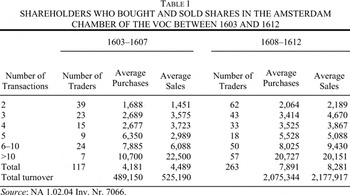
Although only seven shareholders bought and sold stock more than ten times between 1603 and 1607, in the next five years their number rose to 57. Total turnover of shareholders buying and selling their stock quadrupled from 0,5 to 2 million guilders (Table 1). Among these speculative traders were six members of the oldest documented bear syndicate, led by former VOC director Isaac Lemaire.69
It should be noted that stock transactions of Isaac Lemaire and of one other member of his bear syndicate, Vincent Benning, are not included in Table 1, for these two merchants only sold shares. In 1610 Lemaire did away with 69,400 guilders worth of shares, while in the same year Vincent Benning sold shares worth 750 guilders (NA 1.04.02/7066, fol.182-199, 201).
Van Dillen, “Isaac le Maire,” passim.
Calculated on the basis of: NA 1.04.02 Inv. nr 7066. The very nature of forward trading implies that the company's registers did not necessarily reflect all of the syndicate's contracts concluded for purchases or sales. However, because this is also true for other traders, the registers may very well reflect the actual share of the bear syndicate in total turnover in the futures market.

Meanwhile, trade in VOC shares was not limited to the Amsterdam chamber. The rules for the transfer of stock applied to all chambers, so it comes as no surprise that investors in Middelburg, Rotterdam, Delft, Hoorn, and Enkhuizen also traded their shares in the first decade of the seventeenth century. This is evident not only from incidental transfers registered with Amsterdam notaries, but also from the VOC administration in Enkhuizen.72
See, for example, the notarized transfers of shares in the Delft Chamber: GAA NA 98/53v, 17-05-1604; GAA NA 105/35, 11-10-1606; GAA NA 105/112v, 07-12-1606; GAA NA 106/64v-65, 18-12-1606; and the Enkhuizen chamber: GAA NA 105/121, 14-12-1606.
On a total capital of 567,000 guilders, stock transfers amounted to 168,685 guilders (Willemsen, “Beleggers,” p. 78). Population figures for Enkhuizen (7,750 in 1561; 21,878 in 1622) are from: Lucassen and Lourens, Inwoneraantallen, p. 60.
Willemsen, “Beleggers,” pp. 76–79.
DISCOVERING THE BENEFITS OF A SECONDARY MARKET
VOC shares proved popular with investors not only because of prospective dividends, but also because they could easily be sold in case of liquidity constraints. This liquidity of VOC shares had unexpected consequences for the Amsterdam capital market in the early seventeenth century. The regular trade in VOC shares turned them into an increasingly attractive collateral for loans on the Amsterdam money market. To be sure, at the turn of the seventeenth century money could be borrowed against almost anything. The 1582 Antwerp Costuymen already contained provisions relating to the issuing of IOUs on collateral of goods or property.75
Antwerpse Costuymen, 1582, Title LIII-9, pp. 399–400.
GAA NA 209/101, 02-04-1610; GAA NA 200/349 18-10-1619.
For merchandise, see GAA NA 108/165, 29-08-1607; and GAA NA 120/70v, 02-06-1610. For jewelry, see GAA NA 32/402 (22-04-1596); and GAA NA 120/121-121v, 06-09-1610. For ships, see GAA NA 96/159, 26-01-1604. For shipping shares, see GAA NA 212/179v, 10-10-1617.
In 1631, 19 notaries declared before the Amsterdam city council, that a lender could not claim the property of a mortgaged good from a third party if the latter had bought it in good faith from the borrower. The notaries added that this had been the case as long as they could remember. Considering that one of them had been working in Amsterdam since 1595, there is little doubt that money lending on the security of movable goods was already common practice in Amsterdam before 1600: Noordkerk, Handvesten, vol 2, p. 536.
Jonker, Merchants, p. 111.
Consequently, merchants were keen to use alternatives to evade these complications. Public debt issues provided one obvious vehicle. However, two of the three main varieties then common, life and term annuities, had a clear drawback in generally being made out to named persons. Transfer was cumbersome and subject to a special tax, which limited the usefulness of these securities as collateral. The third form, obligations or bonds, suffered no such handicaps. Intended as short-term credit paper, they ran for three to six months and could be either to a specific person or to bearer. The States of Holland initially used obligations as an expediency, but soon found that the market allowed them to roll over such paper on expiry. Indeed, in 1609 attempts by the States of Holland to convert an outstanding loan foundered on the holders' unwillingness to accept annuities for them. But even if the 4 million guilders worth of public bonds in 1609 measured up to the VOC shares available to investors in Amsterdam at the time, there is no firm evidence in the form of notarial deeds documenting transactions or transfers, nor any indications on regular prices to suggest an active secondary market in the period under investigation.80
Houtzager (Lijfen losrenteleningen, pp. 132, 135,136, 142) gives figures for 1609 (4,356,001 guilders), 1616 (5,218,547 guilders); 1618 (5,276,159 guilders), and 1630 (10,531,071 guilders). See also Tracy, Financial Revolution, pp. 207–08; and Dormans, Tekort, pp. 24, 58–61, 136, 201. Based on interest payments, Wantje Fritschy has recently estimated the total value of bonds of the States of Holland at 14 million guilders in 1609. However, she does not provide conclusive evidence on the relative share of annuities and obligations in these interest payments: Fritschy, “Financial Revolution,” p. 78.
As it turned out, VOC shares offered an ideal loan collateral: a claim on a company known to all; very liquid, so easy to sell in case of default; with daily price quotations for quick valuation; and with ownership easily ascertained.81
Compare on the use of VOC and WIC shares as collateral in the eighteenth century: Riley, International Government Finance, p. 31.
Vaz Dias, “Deelname,” pp. 43–58.
GAA NA 108/166, 29-08-1607.
GAA NA 20h/75, 07-03-1607.
The extent to which shares in the early companies and the VOC were pledged as collateral for loans is difficult to establish. IOUs were generally private contracts, arranged without a public notary, so very few have survived. However, there are several indirect indications for this particular use of company stock. Notarial transactions of shares contained a standard formula that guaranteed buyers the absence of collateral claims, a clear sign that shares were used to cover loans.85
The formula read: “vrijen ende vrij te waren van alle actie ende aensprake die sijnnent halven daer op soude mogen wezen gedaen.” Compare for example: GAA NA 33/215a, 20-10-1598; GAA NA 106/64v-65, 18-12-1606
Van Dam, Beschryvinge, p. 143, italics added.
Van Dam, Beschryvinge, p. 147.
Smith, Tijd-affaires, p. 61.
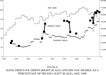
The Thijs ledgers demonstrate that at least this merchant quickly realized the advantages of using VOC shares as loan collateral. Thijs began to circulate IOUs in 1598 to finance the expansion of his business, including investments in the voorcompagnieën (see Figure 2). From 1602 onwards there is a clear relationship between Thijs's borrowing on the money market and the amount of VOC shares he owned. Figure 4 shows his debts and the value of shares as a percentage of the outstanding IOUs, the bottom line taking the shares at nominal value, the top line taking them at market price, i.e., multiplied by the nearest price data available. The data show that Hans Thijs's debts rose in tandem with his share holdings, which suggests he used the shares as collateral.

HANS THIJS'S IOU DEBTS (RIGHT SCALE) AND HIS VOC SHARES AS A PERCENTAGE OF HIS IOUs (LEFT SCALE), 1602–1609
Until the summer of 1605, Thijs used this method prudently, his 26,000 guilders' worth of shares covering no more than 20–30 percent of debts. By the summer of 1605, this ratio had risen to 40–50 percent, at which it remained stable until the summer of 1608, when Thijs's debts peaked at about 70,000 guilders. He used part of this money to buy additional shares, raising his VOC stake from 26,000 guilders to more than 40,000 guilders in 1609, simultaneously reducing his debt to around 60,000 guilders. This brought the ratio of debt to nominal share value to 75 percent by the end of 1609.
By that time rising share prices probably enabled Thijs to rely exclusively on shares to back his IOUs. Calculating the market value of VOC shares before the 1620s is a hazardous undertaking, for we only have scattered references from a variety of sources. However, the available data do suggest a clear trend. During the summer of 1605, the share price rose from about 105–106 percent to 125–140 percent on news about successes against the Portuguese in the Moluccas.89
Van Dillen, “Le Maire,” pp. 34–37.
Gelderblom, Zuid-Nederlandse kooplieden, p. 144.
THE FRUITS OF INNOVATION
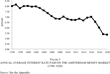
The creation of a vigorous market in VOC shares coincided with falling interest rates on short-term borrowing (Figure 5). Standing at 8 percent a year between 1596 and 1602, short rates dropped to 6.75 percent by 1608, at which they remained more or less stable for the next seven years.91
Note that these interest rates differ from those cited by Peter Spufford from unpublished work by Pit Dehing: 10 percent on average between 1600 and 1604, 8 percent in 1610, 6.5 percent on average between 1610 and 1614, and 6.25 percnet in 1620: Spufford, “Access.”

ANNUAL AVERAGE INTEREST RATE PAID ON THE AMSTERDAM MONEY MARKET (1596–1620)
Our reconstruction of VOC finance bears out two complementary explanations for the declining interest rates on the Amsterdam money market. First, the lower price of credit probably reflects a growing supply. Immigration was one source. Between 1585 and 1620 the Amsterdam merchant community grew from less than 500 people to about 1,500. The immigration of Antwerp merchants alone increased the city's capital stock by an estimated 50 percent.92
Gelderblom, “From Antwerp.”
The net result of one of the early voyages to West-Africa was 50 percent on an investment of 40,000 guilders for two years: Van Gelder, “Scheepsrekeningen,” pp. 248–57. To be sure, shipping within Europe was considerably less profitable. W. Brulez (“Scheepvaartwinst”) has estimated net returns to be 10 percent at most, an estimate supported by evidence on the profitability of Hans Thijs's trade (Gelderblom, Zuid-Nederlandse kooplieden, pp. 280–83, 290).
Second, the drop in interest rates demonstrates the success of Amsterdam's secondary market, funneling a tidal wave of capital into productive purposes, notably short-term loans, by virtue of a vigorous securities trade with allied credit techniques. The VOC shares were a crucial innovation here, improving the match between supply and demand by providing a convenient and highly liquid collateral. They were widely recognized as solid due to the company's huge size and its close connections to the States-General. The lure of exotic riches created a ready market for them. Ownership and price were easily established; in case of default foreclosure and sale were easy. In other words the use of VOC shares as collateral lowered information and enforcement costs, it mobilized funds that otherwise would have remained idle, and thus pushed up market volume and lowered interest rates. In this capacity the securities-based credit mechanism would have served to balance supply and demand between markets with very different rhythms of investment and returns, say between the Baltic run, hectic from March to September but dormant in winter, and the Mediterranean and West African trade with their 12-month cycles. Merchants now had an option to employ their temporary surplus cash remuneratively at little risk. Rentiers and widows also had a new opportunity to invest their savings.
The Thijs and Bosschaert papers demonstrate to good effect how impersonal credit techniques widened credit circles. Hans Thijs sold IOUs to 70 different creditors, only ten of whom can be identified as belonging to his network of commercial agents or fellow jewelers. This small group bought 30 percent of Thijs's outstanding debt between 1595 and 1610. The rest was taken by a very diverse group of people, including 24 merchants from the Northern Netherlands and nine merchants' widows. The same was true for the Antwerp merchant Paulus Bosschaert. In 1620 he owed 60 percent of his outstanding debt to 38 fellow immigrants, and the remaining 40 percent to 27 Amsterdam merchants.94
GAA NA 567/61v, 25-09-1620.
A REVOLUTION COMPLETED
The rapid development of a secondary market in company shares more or less coincided with the emergence of new patterns in public finance amounting to the creation of a secondary market in public debt. By the 1590s the States of Holland found that life and term annuities, issued on the security of tax revenues, no longer sufficed to finance its needs as the war with Spain imposed ever rising burdens. The States began selling bonds as short-term expediencies, initially for small amounts and directly to merchants. Within a decade or so a regular system of sales through tax receivers and loan contractors had developed. Because the bonds were regularly rolled over on expiry rather than redeemed, this debt rapidly became medium- to long-term in fact, if not in intention. Bonds were made out to bearer and could thus be transferred more easily than annuities, which were made out to named persons and subject to a transfer fee. By 1609 an estimated four million guilders had been raised in this way, a substantial amount but still only a fraction of the States' debt. In 1618 the amount of bearer bonds issued stood at 5.2 million guilders, or 20 percent of the total debt.95
Houtzager, Lijfen losrenteleningen, 132, 135,136, 142).
Dormans, Tekort, pp. 58–59.
Over time, the rising amount of public bonds in circulation would to all likelihood have engendered an increasingly lively secondary market of the sort Dickson described for Britain. As things happened, the introduction of VOC shares moved developments into a higher gear. The prospects of speculative gains without serious loss of liquidity created a booming secondary market offering a wide range of allied credit techniques.
Thus, the course of events in Holland after 1600 runs counter to common opinion about the importance of a publicly traded government debt as the origin of secondary markets. The VOC shares provided the crucial breakthrough, not government bonds. As a matter of fact, though, the secondary market itself resulted from a fortuitous conjunction between public and private finance. On the one hand it was preceded by decades of carefully managed public debt issues. By the 1580s annuities were sufficiently well established to serve as trusted instruments for a diverse public, including merchants, widows, orphans, and charity institutions.97
Tracy, Financial Revolution, pp. 156–63; and 't Hart, “Renteniers.”
On the importance of futures trading, see Levine, “Financial Development”; and Jonker, “Competing in Tandem.”
Finally, the precocious development of the Amsterdam securities market as documented by us does raise the pressing question why its evolution subsequently seems to have stalled. The VOC did not capitalize on the opportunities created. Until the company's demise in 1795, the board used bonds to meet its financial needs whereas judging by share prices and dividends, shares would have been the better option for most of this period. Moreover, only two other limited-liability joint-stock companies were successfully floated in the republic: the West Indische Compagnie, a monopoly company for the Atlantic trade, in 1621, and the Maatschappij voor Assurantie, Disconto en Beleening der Stad Rotterdam, an insurance company, in 1720. Public borrowers showed no rush to exploit the new opportunities either. The amount of bearer bonds in the total debt of Holland rose gradually, as we have seen, but such bonds were issued in very large amounts at once only in 1672, when a simultaneous attack from France, Britain, and two German princes created emergency circumstances. The market began to show its full potential only during the second half of the eighteenth century, when Amsterdam financiers launched a string of innovations ranging from stock substitution schemes to unit trust funds and large scale foreign bond issues. What happened during this long period of apparent stagnation? We hope to present an answer in due time.
Appendix: Interest Rates on the Amsterdam Money Market, 1595–1620
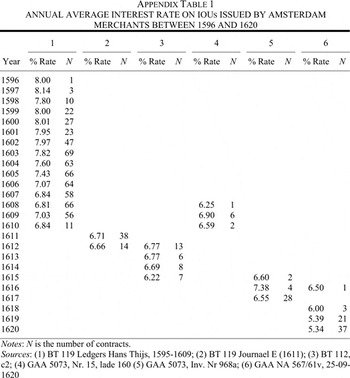
Our reconstruction of the price paid for credit on the Amsterdam money market is based on one large, and five smaller series of debt contracts. The business administration of the Antwerp merchant Hans Thijs contains references to almost 600 IOUs sold or rolled over by Thijs between 1598 and 1609 (1).99
BT 119 Ledgers Hans Thijs, 1595–1609
BT 119 Journael E (1611)
BT 112, c2
See Gelderblom, “Governance”)
GAA 5073), Nr. 15, lade 160
GAA 5073, Inv. Nr 968a
GAA NA 567/61v, 25-09-1620
The references numbered 2–6 do not explicitly mention the interest rate paid on IOUs. Rather, merchants added the interest to the principal in one entry. However, because principals always were round figure (900, 1,200, 1,500, 2,400, and so on), the interest rate could be inferred from these entries. The few cases in which this procedure yielded a highly unlikely outcome were not included in the time series. To calculate the annual average interest rate, all debt contracts were weighed according to their size. For the complete series of IOUs of Hans Thijs (1), weights were also attributed according to the maturity of the loans. Figure 5 is based on Appendix Table 1, which contains the annual average interest rate calculated from the six different series of contracts. In case two figures for one year appear (1608–1610, 1612, 1616) the interest rate in Figure 5 is calculated with data from both series.

The authors would like to thank Wantje Fritschy, Larry Neal, Nico van Horn, Jean-Laurent Rosenthal, Jan Luiten van Zanden, three anonymous referees, and the participants of the Economic and Social History Seminars at Utrecht University and the Free University of Amsterdam for their helpful comments and suggestions. Abbreviations in the text: NA, National Archives The Hague; BT, Biblioteca Thysiana (University Library Leiden); GAA, City Archives Amsterdam; GAA NA, Amsterdam City Archives, Notarial Archives.
References
Ankum L. A.
1960
“Een bijdrage tot de geschiedenis van de Zaanse olieslagerij.”
Tijdschrift voor geschiedenis
73
39–
57,
215–
51.Google Scholar
Brakel S. van.
1908
De Hollandsche handelscompagnieën der zeventiende eeuw; hun ontstaan; hunne inrichting.
The Hague:
Nijhoff,
Braudel Fernand.
1979
Civilisation matérielle, économie et capitalisme, Xve–XVIIIe siècles. nol. 2, Les jeux de l'echange.
Paris:
Armand Colin,
Bruijn Jaap R.,
Femme S. Gaastra, and
1979
Ivo Schöffer, eds.
Dutch-Asiatic Shipping in the 17th and 18th Centuries, vol. 2, Outward-bound Voyages from the Netherlands to Asia and the Cape (159—1794).
The Hague:
Nijhoff,
Brulez Wilfrid.
1979
“De scheepvaartwinst in de nieuwe tijden.”
Tijdschrift voor geschiedenis
92
1–
19.Google Scholar
Burg Martijn van der, and
Marjolein 't Hart.
2003
“Renteniers and the Recovery of Amsterdam's Credit (c. 1578–1605).” forthcoming in
Urban Public Debts: Urban Government and the Market for Annuities in Western Europe (14th–18th Centuries),
edited by Marc Boone,
Karel Davids, and
Paul Janssens.
Turnhout:
Brepols,
Chaudhuri K. N.
1965
The English East India Company: The Study of an Early Joint-Stock Company 1600–1640.
London:
Cass,
Chijs. J. A. van der.
1856
Geschiedenis der stichting van de vereenigde O. I. Compagnie en der maatregelen van de Nederlandsche regering betreffende de vaart op Oost-Indië.
Leiden:
Engels
Christensen Aksel E.
Dutch Trade to the Baltic about 1600.
Copenhagen:
Einar Munksgaard/The Hague Nijhoff,
Dam Pieter van.
1927
Beschryvinge van de Oostindische Compagnie (1701),
edited by F. W. Stapel.
The Hague:
Nijhoff,
Degryse Karel.
1997
“Zuid-Nederlands kapitaal in de VOC en de voorcompagnieën.”
Archief. Mededelingen van het Koninklijk Zeeuwsch Genootschap der Wetenschappen,
49–
64.Google Scholar
Dehing Pit, and
Marjolein 't Hart.
1997
“Linking the Fortunes, Currency and Banking 1550–1880.” In
A Financial History of the Netherlands,
edited by Marjolein 't Hart,
Joost P.B. Jonker,
Jan Luiten van Zanden,
37–63.
Cambridge:
Cambridge University Press,
De Smedt Helma.
1970
“Antwerpen en de opbloei van de Vlaamse vérhandel tijdens de 16e eeuw. Rijkdom en inkomen van de Antwerpse koopman Jan Gamel volgens zijn staat van goed, 1572.”
Unpublished Dissertation,
Katholieke Universitieit Leuven,
Dickson P. G. M.
1967
The Financial Revolution in England, a Study in the Development of Public Credit 1688–1756.
Oxford:
Oxford University Press,
Dillen Johannes G.
1930
“Nieuwe gegevens omtrent de Amsterdamsche compagnieën van verre.”
Tijdschrift voor Geschiedenis
45
350–
59.Google Scholar
Dillen Johannes G.
1930
“Isaac le Maire en de handel in actiën der Oost-Indische Compagnie.”
Economisch-Historisch Jaarboek
16
1–
165.Google Scholar
Dillen Johannes G.
1933
Bronnen tot de geschiedenis van bedrijfsleven en het gildewezen van Amsterdam 1512–1632. vol. 2. 1612–1632.
The Hague:
Nijhoff,
Dillen Johannes G.
1958
Het oudste aandeelhoudersregister van de Kamer Amsterdam der Oost-Indische Compagnie.
The Hague:
Nijhoff,
Dormans E. H. M.
1991
Het Tekort, Staatsschuld ten Tijde van de Republiek.
Amsterdam:
NEHA,
Duplessis Robert S.
1988
“Probate Inventories, Investment Patterns and Entrepreneurial Behaviour in the Zaanstreek (Holland) 1690–1709, 1740–1749.” In
Inventaires après décès et ventes des meubles, aports à une histoire de la vie économique et quotidienne XIVe–XIXe siècle,
edited by M. Barlant,
A. J. Schuurman, and
P. Servais,
97–
108.
Louvain la Neuve:
Ehrenberg Richard.
1922
Das Zeitalter der Fugger.
Jena:
Gustav Fischer Verlag,
Enthoven' Victor.
1996
Zeeland en de opkomst van de Republiek. Handel en strijd in de Scheldedelta c. 1550–1621.
Victor Enthoven,
Fritschy Wantje, and
René van der Voort.
1997
“From Fragmentation to Unification, Public Finance, 1700–1914.” In
A Financial History of the Netherlands,
edited by Marjolein 't Hart,
Joost P. B. Jonker, and
Jan Luiten van Zanden,
64–
93.
Cambridge:
Cambridge University Press,
Fritschy Wantje.
2003
“A ‘Financial Revolution’ Reconsidered: Public Finance in Holland during the Dutch Revolt, 1568–1648.”
The Economic History Review
56, no.
1
57–
89.Google Scholar
Gaastra Femme.
2003
De geschiedenis van de VOC.
Zutphen:
Walburg Pers,
7th ed.
Gelder H. E. van.
1916
“Scheepsrekeningen van enkele der vroegste Guinea-vaarten”,
Economisch-Historisch Jaarboek
2
239–
57.Google Scholar
Gelderblom Oscar.
Zuid-Nederlandse kooplieden en de opkomst van de Amsterdamse stapelmarkt (1578–1630).
Hilversum:
Verloren,
Gelderblom Oscar.
2003
“From Antwerp to Amsterdam: The Contribution of Merchants from the Southern Netherlands to the Rise of the Amsterdam Market.”
Review. A Journal of the Fernand Braudel Center
26, no.
3
247–
82.Google Scholar
Gelderblom Oscar.
2003
“The Governance of Early Modern Trade: The Case of Hans Thijs (1556–1611).”
Enterprise & Society
4, no.
4
606–
39.Google Scholar
Goor Jur van.
1997
De Nederlandse koloniën. Geschiedenis van de Nederlandse expansie, 1600–1975.
The Hague:
SDU Uitgevers,
Hart Marjolein 't.
1993
The Making of a Bourgeois State.
Manchester:
Manchester University Press,
Hart Marjolein 't.
1997
“The Merits of a Financial Revolution, Public Finance 1550–1700.” In
A Financial History of the Netherlands,
edited by Marjolein 't Hart,
Joost P. B. Jonker, and
Jan Luiten van Zanden,
11–
36.
Cambridge:
Cambridge University Press,
Hart Simon.
1957
“De eerste Nederlandse tochten ter walvisvaart.”
Jaarboek Amstelodamum
49
27–
64.Google Scholar
Hart Simon.
1977
“Rederij.” In
Maritieme Geschiedenis der Nederlanden, vol. 2,
edited by L. M. Akveld,
S. Hart, and
W. J. van Hoboken,
106–
25.
Bussum:
De Boer Maritiem,
Heers Jacques.
1961
Gênes au XVe sieclè. Activité économique et problèmes sociaux.
Paris:
S.E.V.P.E.N.,
Heijden E. J. J. van der.
1908
De ontwikkeling van de naamlooze vennootschap in Nederland vóór de codificatie.
Amsterdam:
Van der Vecht,
Hoffman Philip T.,
2000
Gilles Postel-Vinay, and Jean-Laurent Rosenthal.
Priceless Markets: The Political Economy of Credit in Paris, 1660–1870.
Chicago:
University of Chicago Press,
Houtzager D.
1950
Hollands lijf- en losrenteleningen vóór 1672.
Schiedam:
HAV Bank,
Israel Jonathan I.
1989
Dutch Primacy in World Trade, 1585–1740.
Oxford:
Oxford University Press,
Jonker Joost.
1996
Merchants, Bankers, Middlemen: The Amsterdam Money Market during the First Half of the 19th Century.
Amsterdam:
NEHA,
Jonker Joost.
2003
“Competing in Tandem: Securities Markets and Commercial Banking Patterns in Europe during the Nineteenth Century.” In
The Origins of National Financial Systems, Alexander Gerschenkron Reconsidered,
edited by D. Forsyth and
D. Verdier,
64–
86.
London:
Routledge,
Jonker Joost, and
Keetie Sluyterman.
2000
At Home on the World Markets: Dutch International Trading Companies from the 16th Century until the Present.
The Hague:
SDU Uitgevers,
Keikes W. H.
1942
“Veenexploitaitie in Drente met Amsterdamsch regentenkapitaal in de 17e eeuw.”
Jaarboek Amstelodamum
39
11–
20.Google Scholar
Kernkamp J. H., and
A. J. Klaassen-Meijer.
1958
“De rekeningen betreffende de exploratietocht van den Swerten ruyter naar het Middellandse Zeegebied in 1589/1590.”
Bijdragen en Mededelingen van het Historisch Genootschap
73
3–
54.Google Scholar
Klerk de Reus G. C.
1894
“Geschichtlicher Ueberblick der admininistrativen, rechtlichen und finanziellen Entwicklung der niederländisch-ostindischen Compagnie.”
Verhandelingen van het Bataviaasch Genootschap van Kunsten en Wetenschappen,
47Google Scholar
Korte J. P. de.
1983
De jaarlijkse financiële verantwoording in de Verenigde Oostindische Compagnie.
Leiden:
Nijhoff
Levine R.
1997
“Financial Development and Economic Growth: Views and Sgenda.”
Journal of Economic Literature
35, no.
2
688–
726.Google Scholar
Lucassen Jan, and
Piet Lourens,
1997
Inwoneraantallen van Nederlandse steden ca. 1300–1800.
Amsterdam:
NEHA,
Mansvelt W. M. F.
1922
Rechtsvorm en geldelijk beheer bij de Oost-Indische compagnie.
Amsterdam:
Swets & Zeitlinger,
Michie R. C.
1998
“The Invisible Stabilizer: Asset Arbitrage and the International Monetary System since 1700.”
Financial History Review
5, no.
1
5–
26.Google Scholar
Müller R. C.
1997
The Venetian Money Market: Banks, Panics, and the Public Debt. Baltimore:
Johns Hopkins University Press:
Muller S.
1874
Geschiedenis der Noordsche Compagnie.
Utrecht:
Van der Post,
Neal Larry.
1981
“The Finance of Business during the Industrial Revolution.” In
Economic History of Britain Since 1700, vol. 1,
edited by R. Floud and
D. McCloskey,
151–
81.
Cambridge:
Cambridge University Press,
Neal Larry.
The Rise of Financial Capitalism: International Capital Markets in the Age of Reason.
Cambridge:
Cambridge University Press,
1990
Neal Larry.
2000
“How it all Began: The Monetary and Financial Architecture of Europe during the first Global Capital Markets, 1648–1815.”
Financial History Review
7,
no. 2
117–
40.Google Scholar
Noordkerk Hermanus.
1748
Handvesten ofte Privilegien ende octroyen, mitsgaders willekeuren, costuimen, ordonnantien en handelingen der stad Amstelredam etc.
deel I-III.
Amsterdam,
North Douglass C.
1981
Structure and Change in Economic History.
New York and London:
Norton,
North Douglass C., and
Barry Weingast.
1989
“Constitutions and Commitment: The Evolution of Institutions Governing Public Choice in Seventeenth-Century England.”
This JOURNAL
49,
no. 4
803–
32.Google Scholar
Parker G.
1974
“The Emergence of Modern Finance in Europe 1500–1750.”
In The Fontana Economic History of Europe.
Vol. 2. The Sixteenth and Seventeenth Century,
edited by Carlo Cipolla,
527–
94.
Glasgow:
Fontana,
Postan Michael M.
1930
“Private Financial Instruments in Medieval England.”
Vierteljahrschrift für Sozial- und Wirtschaftsgeschichte
23
26–
75.Google Scholar
Prinsen Lzn J.
“Uit het notarisprotocol van Jan van Hout.”
Oud Holland
26
1908
149–
64.Google Scholar
Riemersma J. C.
“Trading and Shipping Associations in 16th Century Holland.”
Tijdschrift voor Geschiedenis
65
1952
330–
38.Google Scholar
Riley J. C.
1980
International Government Finance and the Amsterdam Capital Market 1740–1815.
Cambridge:
Cambridge University Press,
Roover Raymond de.
1953
“Anvers comme marché monétaire au XVIe siècle.”
Revue Belge de Phililogie et d'Histoire
31,
no. 4
1003–
47.Google Scholar
Roover Raymond de.
1948
Money, Banking and Credit in Medieval Bruges.
Cambridge, MA:
The Mediaeval Academy of America,
Schnapper B.
1957
Les rentes au XVIe siecle, histoire d'un instrument de credit.
Paris:
S.E.V.P.E.N.,
Smith M. F. J.
1919
Tijd-affaires in effecten aan de Amsterdamsche beurs.
The Hague:
Nijhoff,
Soto Hernando de.
2000
The Mystery of Capital: Why Capitalism Triumphs in the West and Fails Everywhere Else.
New York:
Basic Books,
Spufford Peter.
1995
“Access to Credit and Capital in the Commercial Centres of Europe.” In A Miracle Mirrored: The Dutch Republic in European Perspective,
edited by Karel Davids and
Jan Lucassen,
303–
37.
Cambridge:
Cambridge University Press,
Steensgaard N.
1982
“The Dutch East India Company as an Institutional Innovation.”
In Dutch Capitalism and World Capitalism,
edited by M. Aymard,
235–
57.
Cambridge:
Cambridge University Press,
Stols Eddy.
1973
“De Zuidelijke Nederlanden en de oprichting van de Oost- en Westindische Compagnieën.”
Bijdragen en Medelingen betreffende de Geschiedenis der Nederlanden
88
1–
18.Google Scholar
Sylla Richard.
2002
“Financial Systems and Economic Modernization.”
This JOURNAL
62,
no. 2
277–
92.Google Scholar
Tracy J. D.
1985
A Financial Revolution in the Habsburg Netherlands. Renten and Renteniers in the County of Holland, 1515–1565.
Berkeley:
University of California Press,
Trevor-Roper H. R.
1951
“The Elizabethan Aristocracy: An Anatomy Anatomized.”
The Economic History Review 2nd series,
3,
no. 3
279–
98.Google Scholar
Unger W. S.
1940
“Nieuwe gegevens betreffende het begin der vaart op Guinea.”
Economisch-Historisch Jaarboek
21
194–
217.Google Scholar
Unger W. S.
1950
“Het inschrijvingsregister van de Kamer Zeeland der Verenigde Oost-Indische Compagnie.”
Economisch-Historisch Jaarboek
24
1–
33.Google Scholar
Vaz Dias A. M.
1936
“De deelname der Marranen in het oprichtingskapitaal der Oost-Indische Compagnie.”
Jaarboek Amstelodamum
33
43–
58.Google Scholar
Vries Jan de, and
Ad van der Woude.
1997
The First Modern Economy: Success, Failure and Perseverance of the Dutch Economy, 1500–1815.
Cambridge:
Cambridge University Press,
Wallert J. A. F.
1996
Ontwikkelingslijnen in praktijk en theorie van de wisselbrief 1300–2000.
Amsterdam:
NIBA/Chimaira,
Wee Herman van der.
1963
The Growth of the Antwerp Market and the European Economy.
The Hague:
Nijhoff,
Wee Herman van der.
1967
“Anvers et les innovations de la technique financière aux XVIe et XVIIe siècles.”
Annales ESC 22,
no. 5
1067–
89.Google Scholar
Wee Herman van der.
1977
“Monetary, Credit and Banking systems.”
The Cambridge Economic History of Europe,
vol. 5,
edited by E. E. Rich and
C. H. Wilson,
290–
392.
Cambridge:
Cambridge University Press.
Willemsen R. Th.
1998
“Beleggers in een nieuwe compagnie. Het aandeelhoudersregister van de Kamer Enkhuizen der VOC.”
In Souffrir pour parvenir. De wereld van Jan Huygen van Linschoten,
edited by R. van Gelder,
J. Parmentier, and
V. Roeper,
65–
79.
Haarlem:
Arcadia,
CUMULATIVE INVESTMENTS IN THE AMSTERDAM VOORCOMPAGNIEËN AND THE VOC CHAMBER AMSTERDAM, AND CUMULATIVE RETURNS FROM THE AMSTERDAM VOORCOMPAGNIEËN (1595–1608)
FUNDS BORROWED BY HANS THIJS (1589–1611) AND HIS HEIRS (1612–1619) FROM FAMILY MEMBERS, AND FUNDS RAISED THROUGH SALES OF IOU
MONTHLY TRANSFERS OF SHARES OF THE AMSTERDAM CHAMBER OF THE VOC, CALCULATED AS A PERCENTAGE OF THE TOTAL STOCK OF CAPITAL, 1603–1612
SHAREHOLDERS WHO BOUGHT AND SOLD SHARES IN THE AMSTERDAM CHAMBER OF THE VOC BETWEEN 1603 AND 1612
HANS THIJS'S IOU DEBTS (RIGHT SCALE) AND HIS VOC SHARES AS A PERCENTAGE OF HIS IOUs (LEFT SCALE), 1602–1609
ANNUAL AVERAGE INTEREST RATE PAID ON THE AMSTERDAM MONEY MARKET (1596–1620)
ANNUAL AVERAGE INTEREST RATE ON IOUS ISSUED BY AMSTERDAM MERCHANTS BETWEEN 1596 AND 1620
 You have
Access
- 103
- Cited by