




No CrossRef data available.
The Promise and Pitfalls of Community Resilience
Published online by Cambridge University Press: 18 December 2013
Abstract
An important shift in terminology has occurred in emergency preparedness, and the concept of community resilience has become ubiquitous. Although enhancing community resilience is broader than preparedness, and emphasizes a distinct set of activities and participants, the terms are often used interchangeably. The implications of this shift have not been fully explored. This commentary describes the potential promise and pitfalls of the concept of community resilience and recommends strategies to overcome its limitations. We believe that resilience has the power to dramatically change this field in immense, positive ways, but some important challenges such as confusion about definitions and lack of accountability must first be overcome. (Disaster Med Public Health Preparedness. 2013;7:603-606)
Information
- Type
- Commentary
- Information
- Disaster Medicine and Public Health Preparedness , Volume 7 , Issue 6 , December 2013 , pp. 603 - 606
- Copyright
- Copyright © Society for Disaster Medicine and Public Health, Inc. 2013
References
1.
US Department of Health and Human Services. National Health Security Strategy of the United States of America. Washington, DC: US Department of Health and Human Services; 2009.Google Scholar
2.
Chandra, A, Acosta, J, Meredith, L, etal. Understanding Community Resilience in the Context of National Health Security. Arlington, Virginia: RAND Corporation; 2010.Google Scholar
3.
Schoch-Spana, M, Courtney, B, Franco, C, Norwood, A, Nuzzo, J. Community resilience roundtable on the implementation of Homeland Security Presidential Directive 21 (HSPD-21). Biosecur Bioterr. 2008;6(3):269-278.CrossRefGoogle ScholarPubMed
4.
Castleden, M, McKee, M, Murray, V, Leonardi, G. Resilience thinking in health protection. J Public Health (Oxf). 2011;33(3):369-377.CrossRefGoogle ScholarPubMed
5.
Burkeman, O. Memo exposes Bush's new green strategy. The Guardian website. March 3, 2003.Google Scholar
6.
Select Bipartisan Committee to Investigate the Preparation for and Response to Hurricane Katrina. A Failure of Initiative: The Final Report of the Select Bipartisan Committee to Investigate the Preparation for and Response to Hurricane Katrina. Washington, DC: US House of Representatives; 2006.Google Scholar
7.
Colten, C, Kates, R, Laska, S. Three years after Katrina: lessons for community resilience. Environment. 2008;50(5):36-47.Google Scholar
8.
Committee on Increasing National Resilience to Hazards and Disasters. Disaster Resilience: A National Imperative. Washington, DC: National Academies Press; 2012.Google Scholar
9.
Mason, B. Community Disaster Resilience: A Summary of the March 20, 2006 Workshop of the Disasters Roundtable. Washington, DC: National Academies Press; 2006.Google Scholar
10.
Homeland Security Advisory Council. Community Resilience Task Force Recommendations. Washington, DC: US Department of Homeland Security; 2011.Google Scholar
11.
Levac, J, Toal-Sullivan, D, O'Sullivan, TL. Household emergency preparedness: a literature review. J Community Health. 2012;37(3):725-733.CrossRefGoogle ScholarPubMed
12. Personal Preparedness in America. Findings from the 2009 Citizen Corps National Survey. Washington, DC: Federal Emergency Management Agency; December 13, 2012.Google Scholar
13.
Price-Robertson, R, Knight, K. Natural Disasters and Community Resilience: A Framework for Support. Melbourne, Australia: Australian Institute of Family Studies; 2012.Google Scholar
14.
Chandra, A, Acosta, J, Stern, S, etal. Building Community Resilience to Disasters: A Way Forward to Enhance National Health Security. Santa Monica, California: RAND Corporation; 2011.CrossRefGoogle ScholarPubMed
15.
Chandra, A. Bridging government and nongovernment to build community resilience in Los Angeles County. Paper presented at: Dynamics of Preparedness Conference. October 22–24, 2012; Pittsburgh, PA.Google Scholar
16.
Norris, F, Stevens, S, Pfefferbaum, B, Wyche, K, Pfefferbaum, R. Community resilience as a metaphor, theory, set of capacities, and strategy for disaster readiness. Am J Community Psychol. 2008;41(1–2):127-150.CrossRefGoogle ScholarPubMed
17.
Eisenman, D, Glik, D, Maranon, R, Gonzales, R, Asch, S. Developing a disaster preparedness campaign targeting low-income Latino immigrants: focus group results for Project PREP. J Health Care Poor Underserved. 2009;20:330-345.CrossRefGoogle ScholarPubMed
18.
Morrow, B. Community resilience: a social justice perspective. Miami Florida: Community and Regional Resilience Initiative. 2008.Google Scholar
19.
Keim, M. Building human resilience: the role of public health preparedness and response as an adaptation to climate change. Am J Prev Med. 2008;35(5):508-516.CrossRefGoogle ScholarPubMed
20.
Bonanno, G. Loss, trauma, and human resilience: Have we underestimated the human capacity to thrive after extremely aversive events?
Am Psychol. 2004;59:20-28.CrossRefGoogle ScholarPubMed
21.
Aguirre, B. Dialectics of vulnerability and resilience. Georgetown J Poverty Law Policy. 2007;14(39):1-18.Google Scholar
22.
Simon, J, Murphy, J, Smith, S. Building resilience: appreciate the little things in life. Br J Social Work. 2008;38:218-235.Google Scholar
23.
Nelson, C, Beckjord, E, Dausey, D, Chan, E, Lotstein, D, Lurie, N. How can we strengthen the evidence base in public health preparedness?
Disaster Med Public Health Prep. 2008;2(4):247-250.CrossRefGoogle ScholarPubMed
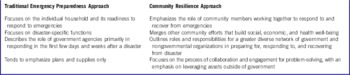
Table The Contrast Between Traditional Emergency Preparedness and a Community Resilience Approach
 You have
Access
- 12
- Cited by
An important shift in terminology has occurred in emergency preparedness, and within this shift, the concept of community resilience (CR) has become widespread. Although enhancing CR is broader than preparedness, and emphasizes a distinct set of activities and participants (Table), 1 , Reference Chandra, Acosta and Meredith 2 the terms are often used interchangeably.Reference Schoch-Spana, Courtney, Franco, Norwood and Nuzzo 3 , Reference Castleden, McKee, Murray and Leonardi 4 The implications of this shift have not been fully explored, and it is concerning because language matters. In 2003, the political strategist Frank Luntz advised Republican politicians to refer to climate change instead of global warming because it is less frightening and therefore less likely to incite the public.Reference Burkeman 5 In contrast, the field of emergency preparedness, which suffered major setbacks in disasters such as Hurricane Katrina, 6 , Reference Colten, Kates and Laska 7 has promoted the concept of resilience to create forward momentum and re-energize the field.
The Contrast Between Traditional Emergency Preparedness and a Community Resilience Approach
A variety of disciplines including engineering, economics, and ecology have explored the concept of resilienceReference Castleden, McKee, Murray and Leonardi 4 , 8 ; yet its application to the field of emergency preparedness is relatively new. A literature search on MEDLINE revealed that more than 80% of the articles that discussed resilience in the context of preparedness were published after 2007. Some authors report that the concept first became salient among federal agencies after the introduction of the National Resilience Development Act in 2003.Reference Mason 9 This bill required the Department of Health and Human Services and the Federal Emergency Management Agency to engage in efforts to increase community resilience to terrorist attacks. Other sources report that CR first gained currency in 2005, with the United Nation's adoption of the Hyogo Framework for Action. 8
Regardless of its precise beginnings, the concept of resilience is now firmly embedded in national policy documents and doctrine 1 , 10 ; however, the practical implications for public health and emergency management are not known. Similar to the example of global warming, it is questionable if we are well-served by this shift in thinking. In this commentary, we explore the potential promise and pitfalls of the concept of CR and recommend strategies to overcome its limitations. We believe that resilience has the power to dramatically change this field in immense, positive ways, but some important challenges must first be overcome.
The Promise of Community Resilience
Community Resilience Can Inspire People and Re-invigorate the Field
Experts frequently describe the challenges in communicating about preparedness to a public that is disengaged and focused on day-to-day crises such as community violence and economic hardship. A major disaster such as 9/11 or Hurricane Katrina can serve as a teachable moment, but the window quickly closes and apathy returns. Messages about preparedness appear to raise awareness but do not result in change in behavior. Studies in the United States disclose that only 30% to 40% of Americans have emergency supplies or family communication plans.Reference Levac, Toal-Sullivan and O'Sullivan 11 Also, although millions have been spent on preparedness messaging since 9/11, we have actually witnessed declines in certain preparedness activities. In 2009, 44% of individuals in the United States reported having a household emergency plan, which was down from 58% in 2003. 12
CR represents a refreshing change and, as such, can help energize the field. The Australian government has described it as an “appealing” concept that speaks to our inner strength and fortitude.Reference Price-Robertson and Knight 13 Preparedness, in contrast, conjures up psychologically disturbing images that people would like to avoid. Strengthening resilience also has the benefit of not only helping individuals cope with the stress of disasters but also with day-to-day crises; thus, resilience is relevant to our daily lives. While it is not known if resilience will inspire individuals in the way we intend what is certain is that preparedness has not been particularly successful at motivating individual action.
CR expands the number of participants who are active in these endeavors and works to achieve ongoing capacity building in the community. Efforts to build CR solicit all members of the community, including governmental and nongovernmental organizations and individuals,Reference Chandra, Acosta and Stern 14 and bridge preparedness and broader strategies of health promotion and disease prevention. 1 , Reference Chandra, Acosta and Stern 14 While government may be the convener of resilience-building activities, it is not solely responsible for their implementation. The fact that resilience is an umbrella concept that aligns the interests of disparate participants allows us to learn from different sectors, pool resources, and delegate important roles and responsibilities.
Community Resilience Can Lead to Greater Efficiencies
Because CR work engages traditional public health partners and broadly promotes population wellness, it can expand the capabilities of entities within and outside of emergency preparedness.Reference Chandra, Acosta and Stern 14 A true CR approach takes an existing activity (eg, outreach with community health workers) and adds an extra component (eg, risk communication) rather than requiring public health to invest in a new activity. This approach not only leverages existing public health structures, but helps reduce the disconnection that has occurred between traditional public health and emergency preparedness. As health departments experience greater fiscal constraints, the key to survival is the ability to leverage work in other areas and engage in activities with dual benefit for both routine and disaster times. Furthermore, the call to move from me to we has benefits beyond enhancing a community's capacity to withstand and recover from a disaster.Reference Chandra 15 Strong social networks and social connectedness are critical predictors of individual and community health in daily life.Reference Norris, Stevens, Pfefferbaum, Wyche and Pfefferbaum 16
Community Resilience Addresses the Needs of Vulnerable Populations
The field of emergency preparedness is often criticized for treating the needs of vulnerable populations as an afterthought. For example, calls to stockpile supplies are often oblivious to the economic realities of low-income populations.Reference Eisenman, Glik, Maranon, Gonzales and Asch 17 In contrast, the early work on resilience has embraced concepts of social vulnerability and equity.Reference Morrow 18 Resilience strategies, for example, focus less on acquiring supplies than leveraging existing assets such as the vast social networks of minority communities.
The Pitfalls of Community Resilience
In spite of efforts to catalog and refine various definitions of CR, the term has been described as vague and fuzzy. 10 Some have noted that the concept may be so popular precisely because of its malleability.Reference Schoch-Spana, Courtney, Franco, Norwood and Nuzzo 3 As such, numerous meetings convened to strengthen CR become mired in the meaning of the term. These discussions, while important, distract stakeholders from the actual task at hand: to better prepare communities to respond and recover from incidents. Key questions that should be addressed include the following:
• How does CR differ from preparedness?
• Is it necessary to disturb a system to assess its resilience?
• Does previous disaster experience make a person more resilient (eg, the inoculation hypothesis) or more vulnerable?
It may be impossible to develop a simple definition of CR that answers all of these questions; however, it is possible to limit the discussion by focusing on more specific, component parts such as workforce development, risk communication, and the like. Confusion about the nuances of the definition of CR cannot justify inaction.
Another problem with promoting a malleable concept is that stakeholders can conduct business as usual but report that they are actually advancing CR. Because almost any activity to promote health can be described as serving the CR agenda, entities can take credit for supporting the mission without exerting special effort. By specifying the precise, novel activities that are needed at the various stages of the CR process, this challenge can be overcome.
CR can be seen as intrinsic to human nature and therefore less amenable to change. One interpretation of CR is that it captures some sort of underlying human hardiness or innate quality.Reference Schoch-Spana, Courtney, Franco, Norwood and Nuzzo 3 , Reference Mason 9 , Reference Keim 19 If this is indeed true, it could be argued that resilience building is unnecessary or unlikely to yield significant benefits. However, the literature of individual resilience suggests that some capacities can be developed.Reference Bonanno 20 – Reference Simon, Murphy and Smith 22 The same should hold for CR.
No Entity Is Clearly Accountable for Community Resilience
Precisely because CR expands the groups of participants who are actively engaged in emergency preparedness, no one sector is ultimately responsible. 8 As explained in the National Health Security Strategy, “The actions required…are beyond the scope of a single department, policy, or level of government.” 1 The risk in describing CR as the responsibility of everyone is that it will become buried among competing priorities. Greater specificity is required to operationalize CR and assign roles to different stakeholders (eg, who should lead, support).
Community Resilience Is Difficult to Measure
CR has the same challenges of measurement that confronted preparedness, including a lack of a robust base of evidence.Reference Nelson, Beckjord, Dausey, Chan, Lotstein and Lurie 23 In addition, there is a lack of clarity about the appropriate level of measurement (eg, individual, household, organization, community) and unit of analysis (eg, zip code, neighborhood, county). 8 Without improved measures, it will not be possible to evaluate which strategies are effective, track progress of key players, or advance the science of resilience.
Whether the shift in terminology was a conscious, strategic decision by policymakers or one that emerged organically over time, CR is firmly embedded in US policy and seems to be permanent. We argue that CR is a promising development for this field because it is inspiring and demands more from all of us. Only by overcoming its ambiguity and acting in the absence of overwhelming evidence can we achieve the ultimate vision of CR: communities that are able to withstand and recover from adversity.
Funding and Support
This work was performed under contract for the Assistant Secretary for Preparedness and Response, US Department of Health and Human Services. The opinions expressed in this paper are of the authors and are not necessarily endorsed by the Department of Health and Human Services.