INTRODUCTION
That the U.S. Supreme Court enjoys high levels of diffuse support among the public is well established (Caldeira and Gibson, Reference Caldeira and Gibson1992; Clawson and Waltenburg, Reference Clawson and Waltenburg2009; Davis Reference Davis1994; Gibson and Caldeira, Reference Gibson and Caldeira1992, Reference Gibson and Caldeira2009; Gibson et al., Reference Gibson, Caldeira and Baird1998). What is less certain though is the origin of the public’s deep commitment to it. Theory suggests that diffuse support is the product of political socialization (Caldeira and Gibson, Reference Caldeira and Gibson1992; Casey Reference Casey1974; Easton Reference Easton1965; Easton and Dennis, Reference Easton and Dennis1969). Early on one learns that the Court is different; it is not “just another political institution,” (Gibson and Caldeira, Reference Gibson and Caldeira2011, p. 199) and its members are not “just politicians in robes” (Gibson and Caldeira Reference Gibson and Caldeira2011, p. 208) guided by their own self-interest and ambition. Rather, the Court is perceived as objective, and the justices reach principled decisions according to “the law,” the Constitution, or precedent. This image of the Court is then reinforced, perhaps even amplified, by its media portrayals (Baird and Gangl, Reference Baird and Gangl2006; Davis Reference Davis1994; Gibson et al., Reference Gibson, Caldeira and Baird1998; Gibson et al., Reference Gibson, Lodge and Woodson2014). Several scholars have pointed out that the mainstream media’s coverage of the Court emphasizes the so-called “legal myth”—“that judicial decisions are based on autonomous legal principles, . . . [and c]ases are decided by the application of legal rules formulated and applied through a politically and philosophically neutral process of legal reasoning” (Scheb and Lyons, Reference Scheb and Lyons2000, p. 929; see also Davis Reference Davis1994; Spill and Oxley, Reference Spill and Oxley2003). Importantly, this emphasis on procedural fairness and neutrality contributes to the Court’s institutional legitimacy. And given the drumbeat of these legitimacy-bolstering cues in the media’s coverage of the Court, “[t]o know the courts is to love them, because to know them is to be exposed to a series of legitimizing messages focused on the symbols of justice, judicial objectivity, and impartiality” (Gibson et al., Reference Gibson, Caldeira and Baird1998, p. 345).
But what if these reinforcing cues and messages are not present in the media, or the Court is covered in such a way that it and the justices are framed as being politically oriented and motivated? Given the literature’s suggestions regarding the positive effects of traditional mainstream media coverage on the Court’s institutional credibility (see Baird and Gangl, Reference Baird and Gangl2006), we would expect that turning this coverage on its head would depress the Court’s diffuse support among those individuals exposed to that type of coverage.
In this paper, we put that expectation to the test. We begin by laying out our analytical argument and making the case for looking at the effect of exposure to the Black press on levels of diffuse support for the Court. Our central argument is that unlike the mainstream media, the Black media are less likely to include legitimizing symbols of the Court when reporting the Court’s rulings; and, therefore, exposure to the Black media reduces people’s diffuse support for the Court. Extant studies have established a link between media messages and an individual’s attitudes about the Court (Baird and Gangl, Reference Baird and Gangl2006; Gibson and Caldeira, Reference Gibson and Caldeira2011; see especially Johnston and Bartels, Reference Johnston and Bartels2010). The experimental studies, however, suffer from limitations of external validity, and correlational designs tend to underestimate the stability of preexisting beliefs (Bartels Reference Bartels1993). The methodology we employ, coarsened exact matching (Blackwell et al., Reference Blackwell, Iacus, King and Porro2009), is a powerful methodology to estimate treatment effects in observational studies. It directly matches on observations after coarsening selected variables into “substantively meaningful groups” based on intuition or prior knowledge (Black et al., 2009, p. 527; Iacus et al., Reference Iacus, King and Porro2011, Reference Iacus, King and Porro2012). After we present the results of our statistical analysis, we conclude by taking stock of our findings and discussing their implications for understanding the elements of an individual’s diffuse support for the Court.
AN ARGUMENT FOR BLACK MEDIA EFFECTS
Of the three national political institutions, the Supreme Court is the most reserved in its interactions with the media and the public. Other than its written opinions, it makes little effort to explain its decisions, let alone open its decisional processes for observation (but see Davis Reference Davis2011).Footnote 1 Moreover, the Court keeps control of the information made available to the press and public about it and its outputs. Thus, the Court makes its own image, and by and large the press is a willing accomplice in this process (see Davis Reference Davis1994). As a result, the Court as objective expositor of “the law,” and the justices as principled defenders of the Constitution are themes enshrined in typical Court coverage. After all, the Court does not refer to itself as driven by politics in its majority opinions.
This portrayal of the Court likely contributes to its diffuse support among the public. The press’ tendency to include symbols of judicial power and authority in its reports on the Court seemingly primes the public to associate Court decisions with legitimate outputs and principled behavior (Gibson et al., Reference Gibson, Lodge and Woodson2014). Indeed, it is the belief that the justices are exercising their decisional discretion in a principled fashion (i.e., sincerely and not out of strategic self-interest) that seems to be most important to maintaining the Court’s institutional credibility (Gibson and Caldeira, Reference Gibson and Caldeira2011). Thus, if press reports begin to emphasize that the justices behave strategically and that Court decisions are the product of the justices’ self-interest, the Court’s institutional credibility will suffer. As James Gibson and Gregory Caldeira (2011) put it, “To the extent that there is a threat to [the Court’s diffuse] support, it comes from events that challenge the view that the Court is a uniquely nonpolitical political institution” (p. 200).
Christopher Johnston and Brandon Bartels (2010) test this proposition when they examine the effect of differential exposure to sensationalist media. They note that the modern, “sensationalist media” (i.e., political talk radio and cable news) is more apt to engage in political criticism of Court decisions than its traditional mainstream counterpart, and that exposure to sensationalist coverage tends to erode political trust (p. 261). They find that differentially high rates of sensationalist media exposure significantly depress individual levels of diffuse support for the Court. Thus, it seems clear “that the seemingly ubiquitous ‘to know the courts is to love them’ effect is actually conditional on the type of media to which one is exposed” (Johnston and Bartels, Reference Johnston and Bartels2010, p. 262).
Our analysis takes their study as a point of departure and burnishes and bolsters their findings. Before we run a regression model to analyze the effect of media exposure, we use the method of coarsened exact matching (see Blackwell et al., Reference Blackwell, Iacus, King and Porro2009; Iacus et al., Reference Iacus, King and Porro2012) to account for people’s likelihood of media exposure. In doing so, we reduce model dependence and the resulting bias of media effect estimates (we discuss this methodology in greater detail below). Moreover, we test for the effect of media exposure that is likely to be the product of deeply embedded, habitual behavior, thereby increasing the likelihood that we are assessing the effect of a sustained media message on diffuse support for the Supreme Court—a highly stable prior attitude (see Bartels Reference Bartels1993; Zaller Reference Zaller1992).Footnote 2 Specifically, we examine the effect of exposure to the Black press.
The nature of the Black press’ reporting is qualitatively different from the reporting of its mainstream counterpart. Having its origins in the nineteenth century, the Black press began as a journalism focused on abolition. Even today, it remains largely a “cause” journalism, dedicated to articulating the “Black voice” in news reports (Huspek Reference Huspek2004, Reference Huspek and Huspek2010; Squires Reference Squires2012; Vercellotti and Brewer, Reference Vercellotti and Brewer2006; Wolseley Reference Wolseley1971).Footnote 3 Its consumers seek it out for its fuller, more nuanced, and “correct” alternative to stories on issues of special salience to Black Americans than the stories provided by the mainstream media (Clawson et al., Reference Clawson, “Neil” Strine and Waltenburg2003a; see also Clawson and Waltenburg, Reference Clawson and Waltenburg2009; Huspek Reference Huspek2004, Reference Huspek and Huspek2010; Mastin et al., Reference Mastin, Campo and Somjen Frazer2005; Towner et al., Reference Towner, Clawson and Waltenburg2006; Vercellotti and Brewer, Reference Vercellotti and Brewer2006). In other words, the Black press is a “significant ‘counterpoint and counterpart’ to the White [mainstream] press” (Huspek Reference Huspek2004, p. 218).
Several studies have shown that the Black press and the mainstream press use different narratives to represent and interpret social issues and political events in their news reports (Browne et al., Reference Browne, Delia Deckard and Rodriguez2016; Dolan et al., Reference Dolan, Sonnett and Johnson2009; Jacobs Reference Jacobs1996; Wang and Armstrong, Reference Wang and Armstrong2012). Through a comparison of newspaper coverage of immigration issues in the Atlanta Journal-Constitution, a mainstream press, and the Atlanta Daily World, a Black press, Irene Browne and colleagues (2016) find that in their crime discourse of immigration, the former features immigrants as criminals more often, whereas the latter tends to focus on illegal conduct of law enforcement officials such as racial profiling. Comparing the coverage of the Rodney King crisis by the Black-owned Los Angeles Sentinel and the metropolitan Los Angeles Times between March and September 1991, Ronald Jacobs (Reference Jacobs1996) finds that as the release of the Christopher Commission report brought the crisis to an end, the Los Angeles Times transformed the image of “divided and politically motivated” local officials in its previous coverage into one of a political leadership “being open and cooperative” and “motivated by the duty of office and concern for the public” (p. 1260). The Los Angeles Sentinel, however, “did not construct the commission report as a bridge toward the legitimation of local government leaders” (Jacobs Reference Jacobs1996, p. 1263). Instead, it continued to focus on the racial bias in the political system and insisted on unity in the Black community and its indispensable role in the fight for justice.
Now, as a “counterpoint and counterpart” to the White press’ portrayals, exposure to the Black press can affect attitudes about institutions. Michael Huspek, for example, writes that the White press provides coverage that reaffirms attitudes toward “dominant institutions, thereby encouraging its readers to uncritically consume a steady offering of dominant code-based messages” (2004, p. 219). The Black press, on the other hand, provides information that often is not reported in the mainstream press. In the process, “it educates its readers with information, opinion, and analysis and lays the semantic groundwork for critique of and active engagement with dominant social institutions” (2004, p. 234).
With respect to the Supreme Court, although the mainstream press’ coverage tends to emphasize prevailing images and symbols of it as an objective and neutral interpreter of the Constitution (Baird and Gangl, Reference Baird and Gangl2006; Scheb and Lyons, Reference Scheb and Lyons2000; Solberg and Waltenburg, Reference Solberg and Waltenburg2014; Spill and Oxley, Reference Spill and Oxley2003), the Black press, with its mission to report stories from a “Black angle,” should be more apt to discuss the Court and justices in political terms, emphasizing the effect of the Court’s outputs on Black lives and interests. The somewhat limited research on the Black press’ portrayal of the Court is consistent with this expectation. John Richardson and Karen Lancendorfer (2004), for example, show that a newspaper’s Newsroom Diversity Index is related to the manner in which the Court’s decisions in the University of Michigan affirmative action cases are framed. The greater the newsroom’s diversity index measure, the less likely the “No Preferential Treatment” frame was used, a frame emphasizing the ruling’s objectivity and neutrality toward all races involved in the legal dispute (Richardson and Lancendorfer, Reference Richardson and Lancendorfer2004).
Terri Towner and colleagues (2006) find that journalists working for minority presses are aware of the particular interests and concerns of their readership and frame their stories accordingly (p. 124). Consequently, their reporting tends to “cover the Court more directly as a political actor that renders decisions with real and substantial policy implications [emphasis ours]” (Towner et al., Reference Towner, Clawson and Waltenburg2006, p. 128). A content analysis of media coverage of the Adarand v. Pena (1995) decision by three mainstream and twenty-two Black newspapers shows that 62% of the reports in the Black press focused on the implications of the decision, while 47% of the reports did so in the mainstream press (Clawson et al., Reference Clawson, “Neil” Strine and Waltenburg2003a, p. 788). By lambasting the Court’s Adarand v. Pena decision as being “wrong-headed” (New Pittsburgh Courier 1995, p. A6) and as a “ruling [that] comes at a time when Republican leaders in Congress are trying to eliminate most affirmative action” (Los Angeles Sentinel 1995, p. A1), the Black press to a large extent described the decision as “assaults on affirmative action” out of “their mean-spirited intentions to undo many gains won for Blacks during the civil rights struggles of the past” (New York Amsterdam News 1995, p. 9) and cast it as “potentially the most damaging” blow to “long standing efforts to overcome at least some of the effects of centuries of discrimination…practice against African-Americans” (Afro-American Red Star 1995, p. A4). These harsh, political criticisms appearing in the Black press belie the legal myth that the Court is a nonpolitical institution and that judicial decisions are made in a principled fashion.
In contrast, the mainstream press was more likely to carry neutral, balanced reports of the decision, using both pro- and anti-affirmative action voices and quoting legalistic terms from the justices’ written opinions (Clawson et al., Reference Clawson, “Neil” Strine and Waltenburg2003a). Here is an example:
The standard the court used for Georgia’s black majority district and the federal affirmative action plan is known as judicial “strict scrutiny.” That means, to pass constitutional muster, [the] government must prove that it had a “compelling interest” in adopting a race-based program and that the program or policy was “narrowly tailored” to that compelling interest. (Biskupic Reference Biskupic1995, p. A1)
The Black press, however, was more likely to eschew “anti-affirmative action counterbalance” in their reports and to blame Justice Thomas for undermining Black interests (Clawson et al., Reference Clawson, “Neil” Strine and Waltenburg2003a, p. 791). Even more noteworthy was the fact that the Black press did not shy away from shattering the myth of legality regarding the Court:
In it he [Loren Siegel, Director of the Department of Public Education, the American Civil Liberties Union] stated, “The Supreme Court is oblivious to, or intentionally chooses to ignore, the ongoing pernicious effects of racial discrimination in American society. By hiding behind legal formalisms and technicalities, the Court has sent a distressing signal that it, like so many other parts of society, is fatigued by the effort to achieve racial equality. It is prepared to walk away from a job that is still far from completion” (Wilson Reference Wilson1995, p. 1).
A majority of the present Supreme Court has set a stark, unsettling and potent direction away from the time-honored concept of equality of opportunity for Black, hispanic and poor citizens and “Equal Justice Under Law.” No amount of legal pettifoggery and pious and unctuous judicial shibboleths can either obscure or diminish this lugubrious, clear and present reality (Banks Reference Banks1995, p. A5).
Some reports from the Black press even belittled the Adarand v. Pena decision, commenting that “the Supreme Court sent back the case for further consideration with a complicated and meaningless set of standards for the trial court to apply” (Bay State Banner 1995, p. 4). As such, “[o]ther avenues will obviously have to be explored if any vestige of affirmative action is to survive” because the Court’s decisions on affirmative action “make it clear that little sympathy for the principle can be expected from this source” (Afro-American Red Star 1995, p. A4).
Finally, Towner and Rosalee Clawson (Reference Towner, Clawson and Davis2014) show there are systematic differences in the mainstream and Black press’ coverage of the Court’s Ricci v. DeStefano (2009) decision, with the latter relying much more on the “Remedial Action” frame, and its emphasis on actively pursuing policies to redress past and current discriminatory practices. They conclude these differences “stem from the varying goals of the mainstream and black press” (p. 57).
It seems clear, therefore, that the Black press is much less likely to provide the steady drumbeat of messages that the Court is special, that it is not “just another political institution,” (Gibson and Caldeira, Reference Gibson and Caldeira2011, p. 199) and that its members are not just another set of self-interested politicians. Instead, the Black press’ coverage of the Court very much challenges “the view of the Court as a uniquely nonpolitical political institution”—the very threat Gibson and Caldeira (2011, p. 200) identify as particularly damaging to the Court’s institutional credibility. Furthermore, in this vein the Black press bears a strong resemblance to the sensationalist media that, as Johnston and Bartels (Reference Johnston and Bartels2010) point out, tends to provide negative coverage of political institutions (including the Court), to accentuate ideological battles within the Court, and to “acknowledge the political nature of judicial decision making to a larger degree” (p. 263; see also Spill and Oxley, Reference Spill and Oxley2003).
Exposure to the Black press, then, is an excellent test of the effect of the media environment on diffuse support for the Court. Inasmuch as Blacks have high rates of exposure to Black media sources (Dawson Reference Dawson2001), and that media consumption is probably an inveterate behavior, consumers of the Black media are likely exposed to the “distinctive, consistent media messages presented over relatively long periods of time” (Bartels Reference Bartels1993, p. 275) that would be necessary to demonstrate that where one gets news about the Court affects one’s attitudes about it (Johnston and Bartels, Reference Johnston and Bartels2010).
DATA AND METHODOLOGY
To test the effect of exposure to the Black media on diffuse support for the Supreme Court, we use the 2003 Blacks and the U.S. Supreme Court Survey (BSCS) (Clawson et al., Reference Clawson, Tate and Waltenburg2003b).Footnote 4 The 2003 BSCS, a random digit dial telephone survey, was conducted before and after the Court ruled on the University of Michigan affirmative action cases in 2003 (Gratz v. Bollinger 2003; Grutter v. Bollinger 2003). It collected information on socioeconomic variables, political attitudes, social values, and exposure to the Black and the mainstream media for 626 respondents living in neighborhoods with a 15% or greater Black population density. After dropping respondents with missing values on variables relevant to our research interest, we retain 489 observations. Among them, about 30% are White, and the remainder are Black.
The 2003 BSCS provides us with an unequaled opportunity to examine how the exposure to different media affects diffuse support for the Court. Unlike other commonly used surveys such as the American National Election Studies (ANES) and the General Social Survey (GSS), the 2003 BSCS includes the set of five items that Caldeira and Gibson (Reference Caldeira and Gibson1992) developed to measure the public’s “willingness to support elemental changes in the powers, process, and structures of the high bench” (p. 639).Footnote 5 Moreover, the 2003 BSCS includes media exposure questions that identify sources of both the Black media and the mainstream media. Specifically, it includes four questions asking respondents to report how many days in the past week they read a Black newspaper, read a mainstream newspaper, watched a Black news program on television, and watched a mainstream news program on television.Footnote 6 We are aware of the over-report bias in survey-based estimates of news exposure (Prior Reference Prior2009). In this study, however, we focus on the effect of exposure to the Black media rather than the effect of frequencies of exposure to the Black media. Thus, the possibility of respondents’ inflated self-report of their news exposure does not cause a validity problem. Although respondents tend to inaccurately recall exactly how many days they had read a Black newspaper and had watched a Black news program on television, it is by no means hard for them to recollect whether they had had exposure to the Black media or not.
Dependent Variable. The dependent variable is diffuse support for the Supreme Court. To operationalize it, we conducted a principal component factor analysis of the five Caldeira and Gibson (Reference Caldeira and Gibson1992) items and generated the first unrotated factor score.Footnote 7 A higher factor score indicates greater diffuse support for the Court.Footnote 8 In the sample under analysis, the median score of diffuse support is about 0.096. The Wilcoxon rank-sum test results suggest that we reject the null hypothesis that the medians of diffuse support among Blacks (median = -0.125) and Whites (median = 0.548) are not statistically different (z = 5.932, p < .001).Footnote 9 That is, on average, Black respondents tend to display lower levels of diffuse support for the Court than do White respondents.
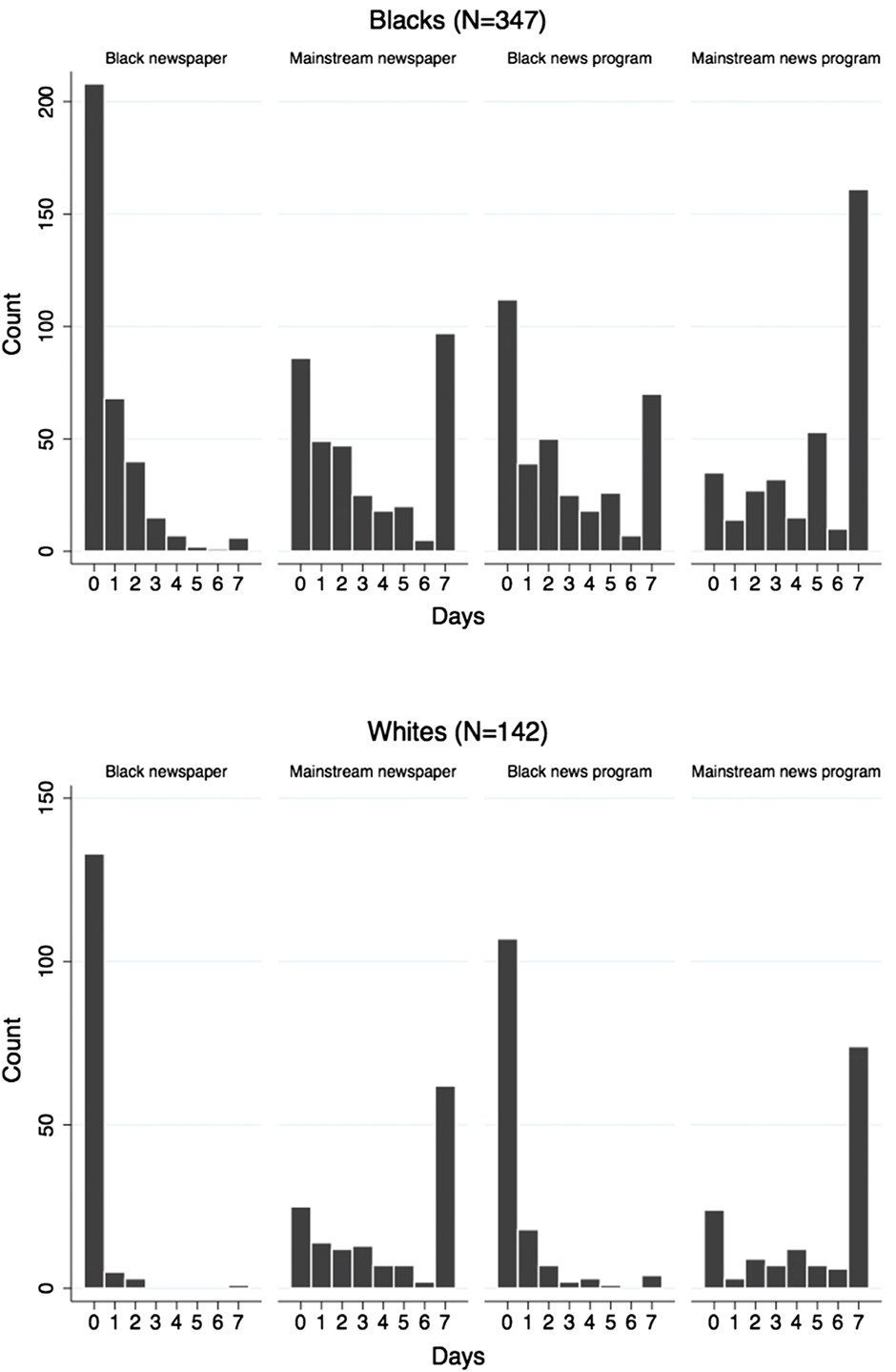
Treatment Variable. The key independent variable in our analysis is exposure to the Black media (1 = exposure). This dichotomous variable is transformed from the measure of the frequencies of Black media exposure, which is the arithmetic mean of the number of days a respondent reported reading a Black newspaper and watching a Black television news program. Those who have not read a Black newspaper and have not watched a Black news program in the past week are in the no exposure group. Figure 1 below shows that although a substantial portion of Black and White respondents reported no exposure to the Black media, both Blacks and Whites are more likely to watch a Black news program than to read a Black newspaper. Among the 489 respondents in our analysis, 62% had some exposure to Black newspapers and television programs. The rate of exposure to the Black media, however, differs between Whites and Blacks: 28% of the 142 White respondents and 76% of the 347 Black respondents in our analysis had some exposure to the Black media.
Frequencies of Media Exposure by Race
Note: The upper panel plots the frequencies of Black respondents’ exposure to Black newspaper (Mean = 0.804, SD = 1.350), mainstream newspaper (Mean = 3.167, SD = 2.795), Black news program (Mean = 2.732, SD = 2.685), and mainstream news program (Mean = 4.830, SD = 2.481). The lower panel plots the frequencies of White respondents’ exposure to Black newspaper (Mean = 0.127, SD = 0.672), mainstream newspaper (Mean = 4.127, SD = 2.865), Black news program (Mean = 0.585, SD = 1.420), mainstream news program (Mean = 4.782, SD = 2.747).

Control Variables. When analyzing the effect of media exposure on diffuse support, we also include a number of standard controls. Given the literature’s conclusions concerning the effects of mainstream media exposure, we include a measure of it in our analytical model. We operationalize mainstream media exposure as the number of days a respondent reported reading a mainstream newspaper and watching a mainstream television news program. Thus, mainstream media exposure is a count variable, with 0 indicating no exposure to the mainstream media and 7 indicating daily exposure to the mainstream media. As Figure 1 shows, both Blacks and Whites are more likely to consume mainstream media than Black media, and both racial groups are more attentive to mainstream news programs on television than to mainstream newspapers. More importantly, our data reveal that unlike the Black media exposure variable, exposure to the mainstream media is nearly universal. Only 6% of the BSCS respondents reported having no exposure to mainstream media.
In today’s media environment there is a surfeit of entertainment options readily available; thus, people may choose not to pay attention to political news when they read the newspaper and watch television (Prior Reference Prior2005; Stroud Reference Stroud2008). This selective avoidance of political news renders studies of the effect of media exposure on support for political institutions more complex. Simply put, people who are more interested in politics are more likely to pay attention to political news and are therefore more likely to be influenced by the political cues embedded in the news. Accordingly, we control for a respondent’s political interest. We operationalize it as an ordinal variable with values ranging from 1 “Hardly at all” to 4 “Most of the time.”Footnote 10 Over half of the respondents report that they follow politics most of the time. We also control for Black political membership. We assume that Black political activists might be more apt to consume political news in the Black media. We measure Black political membership as a dummy variable, indicating whether a respondent is a member of any organization working to improve the status of Black Americans.
We control for several standard demographic variables—sex, race, age, and educational attainment. Sex is coded 0 for male and 1 for female. Race is coded 0 for Whites and 1 for Blacks. Age has thirteen groups ranging from very young adults to the elderly.Footnote 11 Educational attainment has eight categories documenting levels of education from less than four years of schooling to college graduate or more.Footnote 12 People with higher educational attainment are more likely to be attentive to the Court and to be knowledgeable about the Court’s activities. Caldeira and Gibson (Reference Caldeira and Gibson1992) point out that both attentiveness to the Court and political knowledge are positively associated with diffuse support for the Court (but see Gibson et al., Reference Gibson, Lodge and Woodson2014; Johnston and Bartels, Reference Johnston and Bartels2010).
We also include partisanship and political ideology. Although Caldeira and Gibson (Reference Caldeira and Gibson1992) found no relationship between partisanship and diffuse support for the Court, their study revealed that some salient issues such as residential racial segregation, abortion, and pornography are associated with diffuse support. The 2003 BSCS did not ask respondents’ opinions on an array of salient issues,Footnote 13 but we believe that, to some extent, partisanship and ideology act as a proxy for public opinions on various controversial issues. Hence, we control for party identification and ideology to avoid omitted variable bias. Partisanship is a categorical variable, assuming values from -3 “strong Democrat” to 3 “strong Republican.” Political ideology is also a categorical variable with values ranging from -3 “very liberal” to 3 “very conservative.”
The last set of variables measure attitudes towards the political system. Specifically, we control for the respondent’s commitment to social order, support for democratic norms, and trust in the federal government. As Caldeira and Gibson (Reference Caldeira and Gibson1992) argued, the Court is often regarded as the preeminent institution protecting civil liberties. Therefore, those who prioritize civil liberties over social order would be more likely to support the Court. In the same vein, Caldeira and Gibson (Reference Caldeira and Gibson1992) expect those committed to democratic norms to display higher levels of diffuse support because the Court is “a congenial institution” that “is most directly concerned with ensuring the rule of law in this system” (p. 648). Commitment to social order and support for democratic norms are measured as the first unrotated factor scores from a principal component analysis of several indicators respectively.Footnote 14 For the commitment to social order scale, a high number indicates lower commitment to liberty. For the support for democratic norms scale, a high number suggests more support for the rule of law. Finally, John Scheb and William Lyons (1999) point out that attitudes toward the federal government affect institutional support for the Court, especially for those who are less attentive to the Court. We measure trust in the federal government as an ordinal variable, ranging from 1 “Never” to 4 “Just about always.”
Data Matching and Empirical Models. An ideal way of assessing the effect of exposure to the Black media is to execute a classical experiment in which we would randomly sample subjects from a given population and randomly assign them to the treated and control groups. Subjects in the treated group would be exposed to the Black media, while subjects in the control group would not.
This is fine in theory; however, we cannot conduct a classic randomized experiment if for no other reasons than time and financial constraints. Simply put, the effect of media exposure is rather gradual (see Bartels Reference Bartels1993). Consequently, an experiment to measure this effect would have to run for years. The alternative method is to use observational data and then analyze them with a standard regression model. Although analysts attempt to control for all possible confounding variables, differences between the treated and control groups in observational data oftentimes still exist. When used to analyze observational data, the standard regression approach is subject to the problem of high degrees of model dependence (Ho et al., Reference Ho, Imai, King and Stuart2007; King and Zeng, Reference King and Zeng2006).
To ensure that the treated and the control groups are relatively balanced, and to limit the ill-effects of model dependence, we use coarsened exact matching (CEM) to preprocess the 2003 BSCS. CEM directly matches on observations after coarsening selected variables into “substantively meaningful groups” based on intuition or prior knowledge (Black et al., 2009, p. 527; Iacus et al., Reference Iacus, King and Porro2011, Reference Iacus, King and Porro2012). CEM generates a multivariate imbalance statistic (L1) that measures the full joint distribution of pre-treatment covariates in the treated and control groups based on a multivariate histogram of the matched data (Iacus et al., Reference Iacus, King and Porro2012). A comparison of the L1 statistic before and after the matching procedure shows the degree to which CEM reduces the joint imbalance in the raw data. Specifically, the L1 statistic equals 1 if the data are perfectly unbalanced—i.e., the characteristics in the treated and control units are totally different. CEM yields an L1 statistic of 0 if the matched data are perfectly balanced, and if this were the case, a simple difference-of-means test would suffice for testing the treatment effect. After matching the data with the CEM procedure, we use a parametric model to account for the remaining imbalance in the post-CEM data and to statistically examine the relationship between the treatment of Black media exposure and diffuse support for the Court (Blackwell et al., Reference Blackwell, Iacus, King and Porro2009). Based on the matched data preprocessed by CEM, the estimated coefficient of the treatment effect has less model dependence and higher reliability (Iacus et al., Reference Iacus, King and Porro2011, p. 355).
Applying the CEM procedure to the BSCS data, we identify exposure versus no exposure to the Black media as our treatment variable. To ensure the balance between the treated and control groups, it is important to include possible predictors of both the treatment and the dependent variables in the matching process (Ho et al., Reference Ho, Imai, King and Stuart2007). Numerous scholars have noted that facing a wealth of media sources, people choose media outlets that match their beliefs and that share their political predispositions (Klapper Reference Klapper1960; Stroud Reference Stroud2008). Therefore, we use a set of demographic, political orientation, and media exposure variables that are possible predictors of selective exposure to the Black media and diffuse support for the Court to coarsen the raw data (Stroud Reference Stroud2010). As discussed above, these variables include age, education, sex, race, partisanship, political ideology, and mainstream media exposure.
We opted not to include Black political membership in the coarsening procedure. Its inclusion in the matching process did not change the significant effect of our treatment variable in the subsequently estimated regression model;Footnote 15 it did, however, substantially reduce the size of the matched sample, cutting it in half. In addition, we did not include trust in the federal government in the matching process because it could be affected by our treatment variable. Finally, we chose to exclude political interest, commitment to social order, and support for democratic norms from the matching process because they are tangentially related to respondents’ propensity to the treatment.Footnote 16 Details on how we coarsen variables included in the CEM procedure are discussed in the online Appendix.
Since the dependent variable is continuous, we simply specify an Ordinary Least Squares (OLS) model to adjust for the remaining imbalance after performing the CEM procedure. In the regression model, we include a set of controls including demographic variables, partisanship, political ideology, Black political membership, trust in the federal government, political interest, commitment to social order, and support for democratic norms. We test the hypothesis that exposure to the Black media reduces diffuse support for the Supreme Court, ceteris paribus.
EMPIRICAL FINDINGS
A simple comparison of the pre- and post-CEM L1 statistics reveals the degree to which CEM improves the multivariate imbalance. For the treatment (exposure versus no exposure to the Black media), CEM improves the multivariate balance in the treated and control groups from 0.99 to 0.47 and results in 80 matched observations. Among the eighty respondents in the matched sample, 54% of the sixty-five Blacks and 53% of the fifteen Whites had some exposure to the Black media. Moreover, as indicated by the Wilcoxon rank-sum test results (z = 1.703, p = 0.089), the median scores of diffuse support for the Court among Black and White respondents in the matched sample are not statistically different at any level smaller than 8.9%.
To be sure, a substantial proportion of the raw data is discarded in the matching procedure. However, as Christina Boyd and colleagues (2010) point out, “While it may seem counterintuitive, balanced data that are comparable—even if smaller in number—are preferable to a complete sample for the purpose of estimating causal effects” (p. 398, n25). Stefano Iacus and colleagues (2012) explain why: “smaller CEM matched data sets eliminate much heterogeneity, resulting also in causal estimates with smaller variances” (p. 23).
Aside from the multivariate imbalance statistic, CEM also computes univariate imbalance statistics—i.e., the imbalance in each of the pretreatment covariates between the treatment and control groups. Although univariate imbalance is not our key concern, regarding the pre-treatment variables that we use to preprocess the raw data with CEM before estimating our regression model, there are significant improvements in univariate imbalances as well.Footnote 17 Before CEM, race has the most imbalanced unidimensional distribution, while other variables are relatively balanced.Footnote 18 This is almost certainly a consequence of the sampling strategy used in the 2003 BSCS and the resulting overrepresentation of Blacks. This overrepresentation is indicated by the high imbalance in the unidimensional distribution of race; however, it is not of great concern for us because CEM reduces the imbalance not only in the multidimensional distribution but in the unidimensional distribution of race as well. After CEM, the imbalance in the unidimensional distribution of race reduces to 0. For that matter, the unidimensional distributions of all other variables are also maximally balanced after CEM.
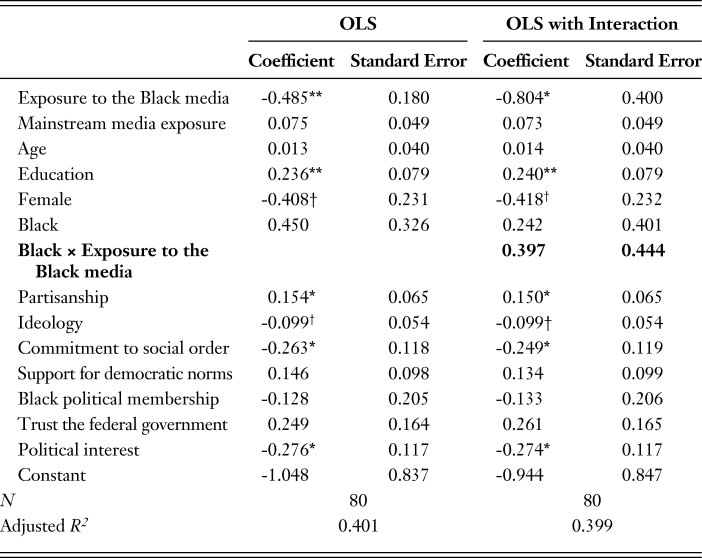
Estimating our model on the matched sample allows us to analyze the effect of Black media exposure on diffuse support for the Court.Footnote 19 Along with the pretreatment variables, we included commitment to social order, support for democratic norms, Black political membership, trust in the federal government, and political interest to account for the remaining imbalance in the matched data.Footnote 20 Table 1 presents the regression estimates. Several results deserve to be highlighted. First, and of greatest interest here, there is evidence that the nature of the media to which one is exposed affects one’s level of diffuse support for the Court. As we hypothesized, Black media exposure is negatively associated with diffuse support (b = -0.485); moreover, this relationship is statistically significant. This is a substantial effect, amounting to a drop of half of a standard deviation in an individual’s diffuse support score. And although mainstream media exposure fails to attain conventional levels of significance, its effect is signed in a theoretically consistent direction.
Impact Estimates of Black Media Exposure on Diffuse Support for the U.S. Supreme Court

** p < 0.01; *p < 0.05; †p < 0.10
Second, we find that race does not have an impact on an individual’s diffuse support for the Court after controlling for media exposure and other covariates. In other words, Blacks and Whites do not differ from each other in terms of their diffuse support for the Court if we account for media effects and other forces. It is of course possible that Blacks and Whites differ in terms of their responsiveness to the Black media. To control for this, we re-estimated the regression model with an interaction term for race and Black media exposure. The interaction term failed to approach even the most forgiving levels of statistical significance (see Table 1). Therefore, the model without an interaction term for race and Black media exposure is parsimonious and preferred. Substantively, the lack of a significant effect of race suggests that it may be too simplistic to use race per se as a proxy to study how different social experiences shape the public’s deep commitment to the Court. To be sure, race matters, in no small part because the lived experiences of Blacks tend to be quite different from the lived experiences of Whites. Blacks and Whites, however, are not monolithic groups. And in the case of diffuse support for the Court, the informational environment in which individuals are embedded contextualizes their social experiences and hence influences their perceptions of the Court, regardless of their race.
Third, our results indicate that certain demographic variables are related to levels of diffuse support for the Court. Consistent with prior research, more educated people are more likely to extend higher levels of diffuse support to the Court. Meanwhile, women are less supportive of the Court. This effect, however, is not significant at the 0.05 level using a two-tailed test.
Fourth, contrary to Caldeira and Gibson’s findings (1992), our data illustrate that partisanship and political ideology have a significant influence on diffuse support for the Court. Specifically, being Republican increases diffuse support, whereas being conservative diminishes diffuse support. At first blush, this may seem rather odd, but it is not inconsistent with the conclusions of Bartels and Johnston (Reference Bartels and Johnston2013). They found that “conservatives tend to ‘punish’ the Court for ideological incongruence” (p. 194). Thus, conservatives, disappointed and frustrated with the liberal decisions of a Republican-packed and ostensibly conservative Court would be less supportive of the Court; meanwhile, less ideologically oriented Republicans would invest the Court with greater institutional credibility, given its strong Republican identity.
Fifth, commitment to social order has a significant, negative influence on diffuse support for the Court. This result is consistent with previous findings that people who are weakly committed to liberty are less likely to extend higher levels of diffuse support to the Court (Caldeira and Gibson, Reference Caldeira and Gibson1992). In other words, people who value social order highly are less likely to have higher levels of diffuse support for the Court. Our results, however, do not lend support for previous findings that support for democratic norms has a significant influence on diffuse support for the Court (Caldeira and Gibson, Reference Caldeira and Gibson1992).
Finally, political interest turns out to be negatively associated with public diffuse support for the Court. The regression results indicate that those who pay a lot of attention to governmental and public affairs show less support for the Court. This surprising and counterintuitive result, together with our findings on the effects of partisanship and ideology discussed above, however, may be a consequence of distributions of those variables in the matched sample and therefore, should be interpreted cautiously.Footnote 21 Ultimately, the statistically secure and correctly signed effect of black media exposure is the finding of genuine substantive consequence in this analysis.
DISCUSSION AND CONCLUSIONS
Our analysis points to several phenomena worthy of greater attention. To begin, our finding that exposure to the Black media is significantly associated with lower levels of diffuse support for the Supreme Court contributes to the growing literature on the media’s role in shaping attitudes toward the Court and its outputs. Gibson and Caldeira (Reference Gibson and Caldeira2011) have demonstrated that the greatest peril to the Court’s institutional credibility among the mass public lies in its portrayal as a political institution. And that is how the Black media generally portrays it (see Towner et al., Reference Towner, Clawson and Waltenburg2006). Thus, like Johnston and Bartels (Reference Johnston and Bartels2010), we have shown that when media exposure is not accompanied with positive, legitimacy bolstering symbols and messages, the Court’s diffuse support is not burnished; in fact, it seems to be eroded.
This possibility, in turn, raises a question worthy of further analysis: what effect do disappointing Court rulings have on individuals with different types of media exposure? Specifically, when the Court hands down an unpopular decision, do individuals with high and enduring levels of exposure to sources that portray the Court in the manner of the Black or sensationalist media see their approval for the Court fall farther and rebound less fully than their counterparts who largely consume the mainstream media? Positivity Theory, our results, and those of Johnston and Bartels suggest this would be the case. And this might have long-run consequences for the Court. Rorie Solberg and Eric Waltenburg (Reference Solberg and Waltenburg2014) have shown that there is an increasing tendency among the mainstream media to present a new myth of the Court, one which emphasizes elements of the justices’ personalities and the political dimensions of a decision alongside the traditional myth, which reports on the Court as an objective interpreter of the Constitution. They point out that this braiding of myths could begin to chip away at the foundation of the Court’s institutional credibility.
Our findings highlight the invalidity of treating the differences between Blacks and Whites as a simple given. Scholars invariably take into account race when they analyze the sources of public attitudes. With respect to studies of diffuse support for the Court, the assumption underlying the consideration of race is that there is a difference between Blacks as Blacks and Whites as Whites in their levels of diffuse support for the Court. This assumption, however, is erroneous (or at least simplistic) in the sense that it is not race per se that conditions an individual’s evaluation of the Court. Rather, how the media reports the Court’s decisions and rulings affects people’s sentiments toward the Court. Blacks are more likely to watch Black television programs and read Black newspapers. Hence, Blacks are more likely to be exposed to information that is critical of the Court and does not include common legitimizing cues and symbols. We argue that if there is any significant difference between Blacks and Whites with respect to their diffuse support for the Court, it is due to the informational environment to which they are exposed. In the end, scholars should move beyond simply stating that Blacks and Whites differ. They should think carefully about how and why those differences exist.
On a related point, the informational environment in which Black and White Americans process their attitudes about the High Court may well affect individual levels of institutional support for elements of the broader legal system—local courts and the police, for example. In a study of the effect of Black Americans’ experiences with the legal system on their perceptions of Supreme Court legitimacy, Gibson and Michael Nelson (2016) cite the work of Tom Tyler and his coauthors (2014) that it is “the perceived fairness” of interactions with the legal system rather than direct personal contacts alone that shape attitudes toward legal institutions, and that “vicarious experiences” strongly inform personal attitudes about those institutions for Black Americans (Gibson and Nelson, Reference Gibson and Nelson2016, pp. 5–6). This suggests that how the media cover legal authorities’ interactions with different groups of citizens can affect the levels of institutional credibility those authorities may enjoy. Indeed, that we found media effects on levels of diffuse support for the Supreme Court, a legal institution that traditionally has been insulated from the rough and tumble world of bare-knuckle politics, suggests that media effects would be even more telling for many of the other elements of the broader legal system.
Consider the components of the criminal justice system, for example. Although local police departments and criminal courts may not be understood as political institutions, per se, it is also extremely unlikely they enjoy the Supreme Court’s image as that “uniquely nonpolitical political institution” (Gibson and Caldeira, Reference Gibson and Caldeira2011, p. 200) and thus do not possess the same guardrails protecting their institutional credibility from media effects as does the High Court. Given the weight of vicarious experiences on the perceived fairness of the legal system, exposure to stories in the Black media portraying Black Americans’ interactions with the criminal justice system as unfair or unjust should erode these institutions’ credibility as surely as exposure to the Black media’s coverage of the Court militated against its levels of diffuse support.
Finally, we acknowledge that there are some limitations in our study. First, respondents of the 2003 BSCS were sampled from neighborhoods with a 15% or greater Black population density. Hence, the White respondents in our analysis might not represent the national sample. In spite of that, the effect of Black media exposure on diffuse support should be generalizable for the Black population. Second, more than a decade has passed since the 2003 BSCS was conducted. But as we already noted, to our knowledge, the 2003 BSCS is the only survey data we can use to study the effect of exposure to the Black media on people’s diffuse support for the Court. Future research may collect more recent data to test the theory we posited in this paper and to analyze whether there are any changes in the effect of exposure to the Black media on people’s diffuse support for the Court.
SUPPLEMENTARY MATERIAL
To view supplementary material for this article, please visit https://doi.org/10.1017/S1742058X17000194
ACKNOWLEDGMENT
The authors thank Sara C. Benesh, Rosalee A. Clawson, Aaron M. Hoffman, James A. McCann, Rorie S. Solberg, and three anonymous reviewers for their helpful comments on earlier drafts of this paper.