In Canada, provincial governments are responsible for the provision of most publicly funded health services, particularly physician and hospital services. Alberta (644,390 sq. km; population 3.3 million) has a regionalized healthcare delivery system with nine regional health and two provincial boards (cancer and mental health) that fund or deliver hospital, public health, continuing care, and other services. The two metropolitan health regions (in Calgary and Edmonton) also provide specialized tertiary services to all residents of the province.
The province administers the Alberta Health Care Insurance Plan, which funds physician services and oral surgery, largely provided on a fee-for-service basis, and other benefits such as drugs, ground ambulance, chiropractic, optometric, and podiatry. While universal coverage is provided for physician and oral surgery services, for other benefits, coverage may be limited to seniors or other defined groups.
In 2006/07, the health regions and provincial boards received $6.0 billion or 58 percent of the $10.3 billion health ministry budget and $1.9 billion (18 percent) was devoted to physician services. These are the two largest components of the ministry budget. Health care accounts for an increasing proportion of the total government spending. Today it is 36 percent of Alberta's provincial budget, whereas it was 30 percent in 1999/2000 and 26 percent in 1990/91 (6).
There is much in the literature about technical and scientific aspects of health technology assessment (HTA), but less on dissemination of findings and how these findings are used by decision makers. Increasingly HTA will play a more important role in informing health policy decisions, especially those decisions relating to the allocation of funds. This study gives details of a decision-making process that is now in operation and that helps determine which health services or technologies should be publicly funded.
The Alberta Health Technologies Decision Process (Decision Process) is the provincial Government's response to recommendations from an Expert Advisory Panel to Review Publicly Funded Health Services (Expert Panel), made in its report Burden of Proof (3). This report recommended a process and structure for advising on public funding of health services. The rationale for these recommendations reflected the situation that faces many healthcare systems. Funding is limited and the cost of delivering the basket of publicly funded health services continues to increase. Government, health authorities, and other agencies are faced with difficult decisions when allocating their available financial resources. Many new health services and technologies are more expensive than those that they may replace or complement. The higher cost of many of these new technologies is one reason the cost of providing health care continues to increase.
In July 2003, the Alberta Government accepted the review process recommended by the Expert Panel. It rejected creation of a new agency in favor of strengthening existing processes, which would be implemented incrementally by working with key stakeholders. The Government was also committed to collaboration on development of a national health technology strategy, the details of which have since been published (7). The Government remains committed to the use of evidence in determining which health services are in the publicly funded basket, as demonstrated by the release of Getting on with Better Health Care: Health Policy Framework in 2006 (4;5). The Decision Process, by bridging the realms of research, scientific evidence, and public policy analysis, allows the Government to make evidence-informed decisions about the funding of health services. This process includes defined, close links between relevant policy areas, organizations undertaking HTA, and advisory groups.
METHODS
Approach to Implementation
Responsibility for implementing the government response to the Expert Panel's recommendations rested with Alberta Health and Wellness (the provincial health ministry). The approach taken was to design a decision process and implement it as the details of each step were formulated.
Development and implementation included consultation with health authorities, HTA agencies, universities, medical associations, and others (Reference Hummingbird8). Processes used by the Ontario Health Technology Advisory Committee and the California Health Benefits Review Program were examined. The Ontario and California processes were of interest because they strive for very short turnaround times for preparation of HTAs or scientific reports.
An Alberta Advisory Committee on Health Technologies (Committee) was established by the Ministry to advise on the operation of the Decision Process. The Committee includes persons from the health ministry, health authorities, medical association, universities, and the provincial HTA agency. It advises on criteria for selecting technologies for review, procedures for conducting reviews, and linkages with related activities and processes. It also recommends technologies for provincial review and may comment on findings from the reviews.
The Ministry established the Health Technologies and Services Policy Branch to implement and support the Decision Process and the Committee. The Branch is also tasked with helping to build the capacity for HTA in Alberta. Unlike the Ontario Model, the Ministry does not produce comprehensive HTA reports. Since 1995, the Alberta approach has been to rely on an arms-length agency to do this work.
The Ministry has provided grant funding to the Institute of Health Economics (IHE), the University of Alberta, and the University of Calgary for each to build its HTA-related capacity. The agreement allows each of these external partners to publish the results of their work, contributing to the transparency of the process.
Scope
The Decision Process focuses on technologies requiring review provincially or nationally. Although most health technologies are within its scope, the focus is on medical and acute care services. Drugs are largely excluded, because they are addressed through separate administrative processes. A drug would be within the scope of the process if its introduction required provision of a physician or hospital or hospital-like services (e.g., verteporfin for injection). Six to ten technologies are selected each year to undergo complete provincial reviews, where the costs to the health system of providing the service or the burden of illness is high, consistency across health regions is important, public or media interest exists, or coordination among programs is significant. Many, if not most, medical goods, technologies, and services will continue to be introduced through review processes established by health authorities or as part of existing programs.
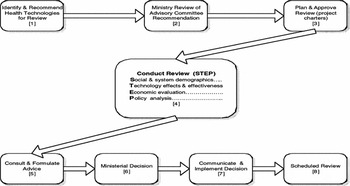
The overall process, illustrated in Figure 1, was tested in a pilot project, a review of laparoscopic adjustable gastric banding. Development and implementation of the process was undertaken in collaboration with those involved in HTA at the Alberta Heritage Foundation for Medical Research, the IHE, the Universities of Alberta and Calgary, and health authorities. The process has been continuously refined as new projects have been undertaken.
Alberta health technologies decision process conceptual framework.

Main Steps in the Decision Process
Figure 1 shows the major steps in the Decision Process from selection of a technology for review through implementation to a follow-up, scheduled review.
Identification and selection of health services for provincial review (steps 1 and 2) relies on the advice of the Committee. Technologies are identified through referrals from the Ministry, providers, and other advisory groups; periodic canvass of health authorities and other key stakeholders; and environmental scanning. The selection criteria include consideration of impact on individual and population health, estimates of incremental cost to health system, and feasibility of conducting a review. Technology briefing notes in a standard format are prepared for each technology being considered by the Committee.
The Committee may recommend a technology for provincial review, referral for review at a national or regional level, that it not be reviewed, or some other course of action. Its recommendations are tabled with the Ministry, which allows the Ministry to ensure that reviews align with its priorities.
Once a health service is selected for provincial review, a project charter (step 3: Plan and approve review) is prepared. This charter specifies the questions and issues to be addressed and the responsibilities of the HTA agency involved and the Alberta Health and Wellness' review manager; describes project resources, and identifies expert and stakeholder participants. A standard template for project charters has been developed and is modified based on the specific issues to be addressed in each review. In addition, private sector management consultants with public policy experience are retained to assist with the analysis and consultation on policy options under consideration.
The actual review (step 4) involves preparation of one or more reports by an external partner or partners (universities or the IHE) or contracted consultants. The approach used is a variant of the STEEPLE Model, which in turn was developed in parallel with the development of the Decision Process (Reference Brehaut and Juzwishin2). This model developed at the Alberta Heritage Foundation for Medical Research covers Social/demographic, Technological, Environmental, Economic, Political, Legislative and Ethical considerations. The model is intended to be a checklist for policy makers and others in ensuring that the broad spectrum of issues with an impact on the policy-making process have been taken into account. Both models identify the areas of information and evidence that can usefully inform a specific decision. A typical provincial review includes analyses and/or reports on the following topics: Social and System Demographics, Technological Effects and Effectiveness, Economic Evaluation, Public Policy Analysis.
The external HTA partners are responsible for managing and completing this STEP analysis with focus on the scientific evidence for the first three components in accordance with the project charter. Preparation of the technological effects and effectiveness analysis relies on existing or specially requested HTA reports, which review the body of scientific and clinical knowledge relating to a specific health service. The economic evaluation usually involves some original data analysis. One key responsibility of the Alberta Health and Wellness review manager is facilitating timely access to Ministry data sets and other information. The review manager also establishes a small committee with clinical, program, and other experts that advises the Ministry on various aspects of the review and considers drafts of the various reports. The HTA Manager appointed by the external partner is free to seek additional expert input, have reports circulated for external review, and take other quality assurance actions.
The findings from these four analyses (STEP) are summarized in a synthesis report that is shared with key stakeholders for comment. The synthesis report summarizes the findings of the longer STEP reports prepared by the HTA partner; provides additional policy analysis; proposes policy/funding options for consideration by key stakeholders; and, as appropriate, applies the Expert Panel's three screens (technical, socioeconomic, and fiscal) for determining what should be publicly funded (3). A contracted consultant usually prepares this report. Our experience has been that Ministry officials and those with policy experience have additional knowledge and insights that allow scientific evidence to be placed within a broader context, helping to add contextual and colloquial “evidence.” The synthesis report, usually approximately 10 pages in length, is reviewed by the expert advisory group and the HTA partner. These reports are written for the decision makers who may not have relevant clinical and program knowledge.
The contracted consultant also prepares a short report summarizing feedback from the consultation (step 5). Health authorities, medical associations, and bodies regulating the practice of medicine, clinicians and programs with a direct stake, and various advisory groups are provided with the synthesis report (and the STEP or HTA reports on request) and asked to provide responses to specific questions as well as general comments.
A final recommendation on the technology is formulated by Ministry staff, based on all material assembled throughout the process, and forwarded for decision (step 6). A standard briefing format for the Ministry's Executive Committee and Minister has been developed that includes a summary of the scientific evidence. In addition, a complete set of reports prepared during the review is provided.
Generally, the Deputy Minister communicates the decision to the health authorities, who are often responsible for implementation (step 7); other stakeholders and those involved in the review are also notified. For some health services, responsibility for implementation may reside within the Ministry. Lastly, the Committee considers whether a scheduled review (step 8) of the health services is required and its timing (new evidence or technologies may emerge over time). The goal is to take a technology from selection (step 1) to decision (step 6) in approximately 6 months, allowing approximately 90 days for the provincial review and another 30 for consultation.
RESULTS
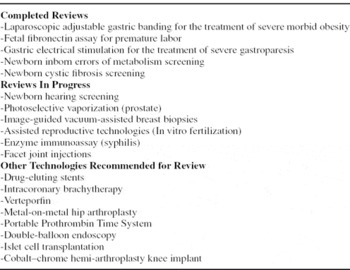
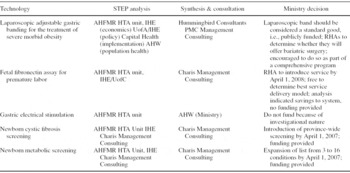
Forty-one technologies have been referred to the Alberta Advisory Committee on Health Technologies since its establishment in September 2004. Nineteen have been selected for provincial review (see Table 1). Five reviews have been completed, with four leading to new items being added to the list of publicly funded services. Table 2 summarizes the decisions made in each case. Two reviews (laparoscopic adjustable gastric banding for the treatment severe morbid obesity, fetal fibronectin assay for premature labor) resulted in approval of the technology for use in the publicly funded health system, although no new dollars were provided. Two reviews (newborn screening for cystic fibrosis, newborn screening for inborn errors of metabolism) resulted in the provision of new funding for the technologies. The results of these two reviews were announced by the Minister as part of the Healthy Children and Youth initiative (1). The fifth completed review (gastric electrical stimulation for the treatment of severe gastroparesis) determined that the technology was still in an investigational stage and under the terms of the statutes governing Alberta's health system was not eligible for inclusion. Reviews of six more technologies are nearing completion, and eight others are planned to start in 2007.
Health Technologies Selected for Provincial Reviews

Completed Provincial Reviews: Contributors and Ministry Decisions

AHFMR, Alberta Heritage Foundation for Medical Research; AHW, Alberta Health and Wellness; IHE, Institute of Health Economics; RHA, regional health authority; UofA, University of Alberta; UofC, University of Calgary.
The initial reviews have taken longer to complete than the target of 90 days for STEP analyses and 30 days for consultations. The shift to grant funding rather than review-specific contracts with the HTA partners and additional staff recruited to the Health Technologies and Services Policy Branch is expected to improve the timeliness.
As well, capacity building aspects of the agreements with the external HTA partners are having an impact. The two universities have been successful in attracting four additional researchers to work with their HTA units.
DISCUSSION
The Alberta Health Technologies Decision Process provides a coherent, explicit, and more transparent approach for deciding on coverage and funding of health services that are a priority from the provincial perspective. It was initiated from the policy side and links evidence from assessment to appraisal through to decision. It aims to strengthen the evidentiary base used for a particular set of funding decisions and enhance its use in related processes.
The linking of evidence to policy and decision making in the Decision Process happens in four ways:
(i) Decision makers, the Executive Committee of Alberta Health and Wellness (the Ministry), consider the recommendations of the Alberta Advisory Committee for Health Technologies and actively agree to a review before it is started.
(ii) Project charters are used to obtain an agreement between the Ministry and the external partner, respecting the scope and timing of the analysis that the partner will undertake, clarifying the understanding between the two parties, and ensuring the issues and needs of the decision maker are addressed.
(iii) The familiarity with the public sector and its workings, legislation, and expectations that policy consultants and ministry staff bring to the review help in shaping and assessing policy options, adding significant value in linking evidence to policy.
(iv) Sharing the synthesis report, which summarizes the evidence and discusses policy options, with policy and decision makers within the Ministry, health authorities, and other stakeholders provides other information beyond the research evidence that can be considered in formulating recommendations for Ministry consideration.
Of course nothing worthwhile is without challenges, lessons have been learned from the work completed to date, and the approach continues to evolve. For example, the pilot review of laparoscopic adjustable gastric banding did not include the STEP framework that is now in use. The original framework included five elements: population health impact, technological effectiveness, economic evaluation, implementation issues, and policy analysis. We found that some elements could be combined or addressed more fully at other points in the process, for example, the comprehensive review of implementation issues and plans or, the shift of the fiscal screen for the decision process out of the review step to the consultation step, as we believe that those who manage the budgets are in the best position to assess affordability.
The synthesis reports are considered to be in the public domain. To date, they have been circulated to all key stakeholders and to others upon request. All who review the reports are free to provide their comments to the Ministry. This step could be enhanced to more widely disseminate the reports, as it is difficult to identify all the groups and individuals, particularly clinicians, with a potential interest in a review.
The government's commitment to increasing the role of scientific evidence in this decision making and Alberta's existing HTA capacity with its connections to an international community of practice have been vital to implementing the Decision Process and will continue to be important in sustaining this initiative. As we proceed, more attention will have to be devoted to how and when to engage the public and industry in the reviews.
The Decision Process approach will likely be refined as the National Health Technology Strategy is implemented. This strategy includes establishment of a Health Technology Analysis Exchange with the national and provincial HTA agencies expected to be members and creation of the Health Technology Policy Forum with senior officials from Canadian health ministries participating. The forum is particularly relevant from the perspective of the Decision Process and its Advisory Committee. On several occasions the Advisory Committee has believed that technologies did not require provincial review or preparation of HTA reports, but rather consideration at a national level with a policy focus. These would have been referred to the forum if it had existed. These technologies tend to be highly specialized services or ones where understanding of how jurisdictions are dealing with their diffusion would be beneficial.
POLICY IMPLICATIONS
This study describes the approach in one jurisdiction to more explicitly link the HTA and evidence to decision making and recognizes that information other than research evidence can influence decision making. The Alberta Health Technologies Decision Process has greater chance for success in informing policy, because it recognizes that policy and decision makers in government prefer to incorporate or balance other factors and information beyond hard evidence when making decisions (Reference Brehaut and Juzwishin2;Reference Lomas, Culyer, McCutcheon, McAuley and Law9;Reference McCutheon10). The Alberta Model takes the position that best practice in policy work requires openness to the kinds of evidence that can or should be used to inform a decision and that the social and political sciences have as much to offer as the natural or physical sciences. As Brehaut and Juzwishin (Reference Brehaut and Juzwishin2) put it, “The task of mediating in the policy-making environment is not an easy one; however, being clear about what constitutes the credible evidence in each case makes the task easier”.
Use of the STEP Model and the project charters help to establish this balance in specific reviews. The project charters also mediate the trade-offs among time, cost, and quality of the evidence assembled for a review. Health technology reviews are complex enough that one can usually have two of the elements, but rarely all three. In developing the charter, both policy makers and researchers confront the need to balance the quality of the evidence they are seeking with the time and funds needed to assemble it. In the policy world, timeliness is almost always paramount. The target of 90 days for the STEP analyses means that the HTA component of many reviews will rely on rapid assessments, suggesting some trade-off of depth of analysis in favor of timeliness. The charter spells out the accommodation both sides make to ensure that the results are useful, but within that window of time that the public policy process makes available.
In other words, the Alberta Model is simply a strategy to enhance the prominence of evidence, while enabling decision makers to do the balancing required for policy formulation. For example, for reasons of social and economic policy, the government may be inclined to support health technologies that represent home-grown innovation that have yet to be shown to be effective or cost-effective. Although escalating costs of providing health services are a concern for government, it is also committed to being a leader and innovator, which may require investments in new and more expensive technologies.
The Decision Process provides a clearer focus within the ministry, a clear and transparent approach to reaching decisions on certain technologies, and is an aid to improved planning and operational decisions for the province. We will continue to make improvements to the process as we go. So while we are entering a steady state, that steady state includes continuous quality improvement.
CONTACT INFORMATION
Henry Z. Borowski, MA (henry.borowski@gov.ab.ca), Director, Health Technologies and Services Policy Branch, Alberta Health and Wellness, 10025 Jasper Avenue NW, Edmonton, Alberta, Canada T5J 1S6
Jon D. Brehaut, MA, MBA (jon.brehaut@telus.net), Partner, Public Policy and Management, Hummingbird Consultants, 3 Hummingbird Court, Sherwood Park, Alberta, Canada T8A 0A4
David M. Hailey, PhD (dhailey@ozemail.com.au), Adjunct Professor, Department of Community Health Sciences, University of Calgary, 3330 Hospital Drive NW, Calgary, Alberta, Canada T2N 4N1; Senior Advisor, Institute of Health Economics, 1200, 10405 Jasper Avenue, Edmonton, Alberta, Canada T5J 3N4