Introduction
Pasqueflower (Pulsatilla chinensis (Bge.) Regel], belonging to the Ranunculaceae family, is a traditional Chinese medicine with dry root. The main active ingredient of P. chinensis is anemoside B4, which is often used in the treatment of cancers and inflammatory diseases (Kang et al., Reference Kang, Shen, Zhang, Su, Yang, Liu and Xu2019).
Due to the continuous excavation of its clinical value, the wild resources of P. chinensis are increasingly exhausted and rising in prices. Therefore, large-scale artificial cultivation is urgently needed. At present, P. chinensis is mainly reproduced sexually. Its seeds are small, its embryo development is not complete, and seeds are in a state of morphophysiological dormancy. Under natural conditions, the germination rate is low and non-uniform, and the seeds are easy to become mouldy during germination, thereby seriously restricting the development of P. chinensis industrialization.
Seed germination is at the initial stage of whole plant growth. The physiological and biochemical state of the seed during germination directly affects the post-emergence plant state and biomass. Seed germination is regulated by external and internal factors, including plant hormone signalling (Shu et al., Reference Shu, Liu, Xie and He2016), light signalling (Xu, Reference Xu2020) and abiotic and biotic stresses (Verma et al., Reference Verma, Ravindran and Kumar2016). Among these, the plant hormone abscisic acid (ABA) maintains seed dormancy and inhibits seed germination, whereas gibberellin (GA) breaks seed dormancy and promotes seed germination. The dynamic changes in ABA and GA content are the core factors to maintain seed dormancy or initiate seed germination. Previous studies have shown that ABA and GA regulate seed dormancy or germination mainly by balancing their ratio (ABA/GA), that is, ABA/GA determines whether seeds are dormant or germinating; a high ratio of ABA/GA indicates seed dormancy, otherwise it is seed germination (Shu et al., Reference Shu, Liu, Xie and He2016). Light often controls the induction of seed germination, or breaking of seed dormancy, through the regulation of hormone metabolism and signalling pathways (Yang et al., Reference Yang, Liu and Lin2020). Biotic or abiotic stresses, such as waterlogging/flooding, drought, heat, cold and salinity, bacteria, fungi, viruses, nematodes and insects (Verma et al., Reference Verma, Ravindran and Kumar2016; Zhou et al., Reference Zhou, Chen, Meng, Chandrasekaran, Luo, Yang and Shu2020), directly or indirectly affect the changes in these signalling pathways (Daszkowska-Golec, Reference Daszkowska-Golec2011; Nakashima and Yamaguchi-Shinozaki, Reference Nakashima and Yamaguchi-Shinozaki2013; Ibrahim, Reference Ibrahim2016; Mhamdi and Van Breusegem, Reference Mhamdi and Van Breusegem2018; Vishal and Kumar, Reference Vishal and Kumar2018; Seneviratne et al., Reference Seneviratne, Rajakaruna, Rizwan, Madawala, Ok and Vithanage2019).
RNA-seq is a technique for high-throughput sequencing of the mRNAs of a certain species, which is a collection of all RNAs transcribed in a specific functional state or a certain developmental stage (Delatte et al., Reference Delatte, Wang, Ngoc, Collignon, Bonvin, Deplus, Calonne, Hassabi, Putmans, Awe, Wetzel, Kreher, Soin, Creppe, Limbach, Gueydan, Kruys, Brehm, Minakhina, Defrance, Steward and Fuks2016). In particular, when genome information of the species is unknown, the genetic information obtained by sequencing could be used for mining of the functional genes of the species (Jensen et al., Reference Jensen, Schultink, Keegstra, Wilkerson and Pauly2012), sequence comparison and expression abundance analysis (Guo et al., Reference Guo, Liu, Zheng, Huang, Zhang, Gong, He, Ren, Zhong, Fei and Xu2011; Wang et al., Reference Wang, Zeng, Iyer, Bryant, Mockler and Mahalingam2012). In recent years, transcriptome sequencing technology has been increasingly used in the exploration of seed germination mechanisms of medicinal plants, such as Glycyrrhiza uralensis (Guan et al., Reference Guan, Ge, Xu, Wang, Gao, Zhang, Peng, Zhang and Xie2021) Gentiana crassicaulis (Kang et al., Reference Kang, Zhao, Ni, Li, Zhao and Liu2021) and Pinellia ternate (Li et al., Reference Li, Peng, Wang, Sun, He, Song, Zhang, Tang and Huang2020a).
This study aimed to use the transcriptome data of P. chinensis seed germination to analyse the key signalling pathways, related functional genes and important regulatory factors. It also aimed to establish the foundation for exploring the molecular mechanism of P. chinensis seed germination.
Materials and methods
Plant material and treatments
Seed were collected from wild P. chinensis and grown in Yangguangzhan (113.128926°E, 37.1422345°N) in Taiyuan City, Shanxi Province. Samples of P. chinensis seeds were authenticated by Professor Guoyue Zhong of Jiangxi University of Chinese Medicine. After pre-treatment, the seeds were sown on two layers of filter paper and placed in a controlled environment chamber set at 25°C and 12 h in the dark/12 h in the light.
Samples were taken 0, 2, 4 and 6 d after imbibition. Seeds were rinsed 2–3 times with PBS buffer. Surface moisture was absorbed, and the samples were frozen immediately in liquid nitrogen and stored at −80°C for transcriptome sequencing. Of the total of four treatments, each treatment was replicated three times.
RNA extraction, library construction and transcriptome sequencing
Total RNA was extracted from the 12 samples by using the Illumina Novaseq 6000 sequencing platform at Shanghai Majorbio Bio-pharm Biotechnology Co., Ltd. Sequencing experiments were performed using OmniPlant RNA Kit for library construction. The concentration and purity of the extracted RNA was tested by Nanodrop2000, RNA integrity was detected by agarose gel electrophoresis, and RIN was measured by Agilent2100. A single library construction required total RNA ≥ 1 μg, concentration ≥ 35 ng μl−1, OD 260/280 ≥ 1.8 and OD 260/230 ≥ 1.0.
Magnetic beads with oligo(dT) for A-T base pairing with polyA were used to isolate the mRNA from the total RNA. Then, fragmentation buffer was added to randomly fragment the mRNAs, and small fragments of approximately 300 bp were isolated by magnetic bead screening. Under the action of reverse transcriptase, random hexamers were added to reversely synthesize one-strand cDNA by using mRNA as a template, followed by two-strand synthesis to form a stable double-strand structure. The double-stranded cDNA structure was a sticky end filled with End Repair Mix to make a blunt end, and then an ‘A’ base was added to the 3′ end to connect a Y-shaped adapter. Finally, the following steps were performed for Illumina onboard sequencing: (1) library enrichment, PCR amplification for 15 cycles; (2) addition of 2% agarose gel to recover the target band; (3) TBS380 (Picogreen) quantification, mixed in accordance with the data ratio; (4) bridge PCR amplification on cBot to generate clusters and (5) Illumina platform sequencing (PE library, read length 2 × 150 bp).
De-novo assembly and functional annotation
For transcriptome studies without reference genomes, after high-quality RNA-seq, data were obtained, all quality-controlled sequencing reads needed to be assembled de novo to generate contigs and singletons. The software used was Trinity (https://github.com/trinityrnaseq/trinityrnaseq/wiki) (Grabherr et al., Reference Grabherr, Haas, Yassour, Levin, Thompson, Amit, Adiconis, Fan, Raychowdhury, Zeng, Chen, Mauceli, Hacohen, Gnirke, Rhind, di Palma, Birren, Nusbaum, Lindblad-Toh, Friedman and Regev2011). After splicing was performed on Trinity, the assembly results were evaluated. The initial assembly sequence obtained generally needs to be optimized, filtered and re-evaluated. (1) TransRate (http://hibberdlab.com/transrate/) (Smith-Unna et al., Reference Smith-Unna, Boursnell, Patro, Hibberd and Kelly2016) and CD-HIT (http://weizhongli-lab.org/cd-hit/) were used to optimize filtering (Li and Godzik, Reference Li and Godzik2006). (2) For assembly evaluation, the software Benchmaking Universal Single-Copy Objects was used (http://busco.ezlab.org) (Simão et al., Reference Simão, Waterhouse, Ioannidis, Kriventseva and Zdobnov2015).
All transcripts obtained from the transcriptional group sequencing were compared with six databases (NR, Swiss-Prot, Pfam, COG, GO and KEGG databases) to obtain annotation information in each database and apply appropriate statistics to each database annotation. The Plant Transcription Factor Database was used to annotate transcription factors (TFs). (http://planttfdb.cbi.pku.edu.cn/) (Jin et al., Reference Jin, Tian, Yang, Meng, Kong, Luo and Gao2017).
Analysis of DEGs
The transcripts per million reads (TPM) values of all genes were used to analyse the correlation between each of the samples (Conesa et al., Reference Conesa, Madrigal, Tarazona, Gomez-Cabrero, Cervera, McPherson, Szcześniak, Gaffney, Elo, Zhang and Mortazavi2016). DESeq2 (Robles et al., Reference Robles, Qureshi, Stephen, Wilson, Burden and Taylor2012) was used for the analysis to further reveal the molecular events that occur during seed development, with expression levels expressed as |log2FC| > = 1 and adjusted P-value (P adjust) < 0.001 (Li et al., Reference Li, Zhang and Wang2014; Love et al., Reference Love, Huber and Anders2014; Gao et al., Reference Gao, Xue, Xue, Liu, Ren, Wang and Zhang2020), in at least one of the comparisons where DEGs were considered for further analysis.
DEGs were analysed for functional enrichment, including GO and KEGG enrichments (Ashburner et al., Reference Ashburner, Ball, Blake, Botstein, Butler, Cherry, Davis, Dolinski, Dwight, Eppig, Harris, Hill, Issel-Tarver, Kasarskis, Lewis, Matese, Richardson, Ringwald, Rubin and Sherlock2000; Kanehisa and Goto, Reference Kanehisa and Goto2000). Goatools was used for unigene/transcript GO enrichment analysis using Fisher's exact test. When P adjust < 0.05, the function was considered to be significantly enriched. The KEGG pathway was used for unigene/transcript enrichment analysis, and the calculation principle was the same as that in GO functional enrichment analysis. When P adjust < 0.05, the KEGG pathway was considered to be significantly enriched.
Proteins are involved in most biological processes in cells (Keskin et al., Reference Keskin, Tuncbag and Gursoy2016), but they rarely act on their own but mostly in complexes (Alberts, Reference Alberts1998; Charbonnier et al., Reference Charbonnier, Gallego and Gavin2008). Therefore, to fully understand the function of proteins, their interactions must be explored (Struk et al., Reference Struk, Jacobs, Sánchez Martín-Fontecha, Gevaert, Cubas and Goormachtig2019). Protein–protein interactions (PPIs) are an important aspect of plant systems biology (Struk et al., Reference Struk, Jacobs, Sánchez Martín-Fontecha, Gevaert, Cubas and Goormachtig2019). Identification of the interactors of a protein could help predict its function. In plants, most physiological processes are regulated by complex signal transduction pathways required for development, differentiation and adaptation to changing environments (Vanstraelen and Benková, Reference Vanstraelen and Benková2012). Identification of key protein players and their interaction networks provides important insights into the regulation of plant developmental processes and how plants interact with their environment (Struk et al., Reference Struk, Jacobs, Sánchez Martín-Fontecha, Gevaert, Cubas and Goormachtig2019). In the present study, the interactions between phytohormone signalling-related proteins were searched by using STRING (https://string-db.org/cgi). These protein interaction networks were visualized using Cytoscape software (Doncheva et al., Reference Doncheva, Morris, Gorodkin and Jensen2019).
Using the transcriptome sequencing results, the coding sequence (CDS) information of the core protein gene was obtained. The CDS of the gene was blasted in Nucleotide BLAST (https://blast.ncbi.nlm.nih.gov/Blast.cgi) to obtain the similarity sequence.
On this basis, Mega was used to calculate the similarity of sequences and construct a phylogenetic tree of genes. Among them, when using MEGA 11 software to build the best model of its phylogenetic tree, the number of bootstrap repetitions is 1000 times, and the tree-covering method is the neighbour-joining method (NJ).
qRT-PCR analysis
According to the sequenced transcriptome data of P. chinensis seeds during germination, the TPM value of gene expression was greater than 50, and the TPM value between samples was basically the same as the screening standard (Ma et al., Reference Ma, Cui, Wang, Jia, Duan, Du, Wang and Chen2019). The relative amounts of these genes were verified using qRT-PCR. The primer sequences were provided by Majorbio Bio.
The RNA was extracted from different samples following the instructions in the OmniPlant RNA Kit. The purity and concentration were checked by NanoDrop2000, and the integrity of the total RNA was examined using 1% agarose gel electrophoresis. The RNA was synthesized into cDNA in accordance with HiScript Q RT SuperMix for qPCR (+gDNA wiper, Novizan). The qRT-PCR reaction was performed using an ABI7500 fluorescence quantitative PCR instrument (Applied Biosystems, USA) and ChamQ SYBR Color qPCR Master Mix (2X) (Nanjing Novizan Biotechnology Co., Ltd). The following were used for the qRT-PCR reaction system: cDNA, 2 μl; upstream and downstream primers, 0.8 μl; 2X ChamQ SYBR Color qPCR Master Mix 10 μl, 50X ROX Reference Dye2, 0.4 μl and ddH2O, 6 μl. The cycle conditions were as follows: pre-denaturation at 95°C for 5 min, followed by cycling for 40 rounds (melting at 95°C for 5 s, annealing at 55°C for 30 s and extension at 72°C for 40 s). After the above steps were completed, a 96-well plate with the sample added (10-fold dilution of cDNA) was placed in the ABI 7500 fluorescence quantitative PCR machine for reaction. The gene expression changes between different sample materials were calculated using the 2−ΔΔCt method, with three biological replicates (Livak and Schmittgen, Reference Livak and Schmittgen2001).
Hormone treatment
After pre-treatment, the seeds were soaked in different concentrations of gibberellic acid (GA3) and abscisic acid (ABA) at room temperature for 12 h. The control group (CK) was soaked with distilled water for 12 h. The GA3 treatment concentrations were 50, 100, 150 and 200 mg l−1, and the ABA treatment concentrations were 0.1, 1.0, 10 and 100 mg l−1. The seeds were placed on a double-layer moistened filter paper (9-cm Petri dish) for germination light was provided for 12 h d−1, the temperature was (25 ± 1)°C, and each treatment was repeated three times. The following germination parameters were calculated as follows:
a. Germination rate = germination number/total number of grains*100%;
b. Germination potential = the number of seeds germinated within the specified number of days/the total number of seeds*100% (Shi et al., Reference Shi, Zhang, Yu and Wei2005);
c. Germination index
 $( {\rm Gi}) = \sum ( {{\rm Gt}/{\rm Dt}} ) $ (Li and Piao, Reference Li and Piao2010) with Gt is the normal number of germinated seeds on each day and Dt is the corresponding germination days.

Results
Analysis of phenotypic traits of P. chinensis seeds during germination
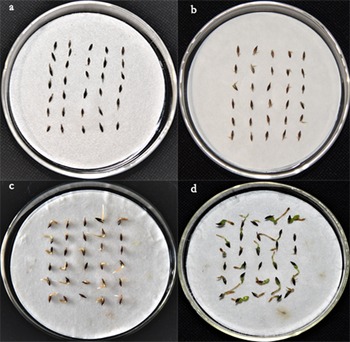
P. chinensis seeds have a dormancy phenomenon. Their mature seeds contain immature embryos and the seed germination rate is extremely low under natural conditions. In the early stage of the research, the germination rate of the seeds was improved, and the germination time was shortened by treating the seeds of P. chinensis with seed priming technology. On the basis of the pre-treatment, the seeds were placed on a double layer of wet filter paper for germination treatment, and samples were taken at 0, 2, 4 and 6 d of the germination treatment. During the process of seed germination, the characteristic appearance changed significantly (Fig. 1). After 2 d of germination, some seeds grew radicles that broke through the seed shells. After 4 d, the seed radicles extended to 1–2 cm. After 6 d of treatment, the seeds grew out of the seed shells, with 1–2 leaves.
Four different stages of seed germination, times after imbibition: (a) 0 d; (b) 2 d; (c) 4 d and (d) 6 d.

Transcriptome data analysis
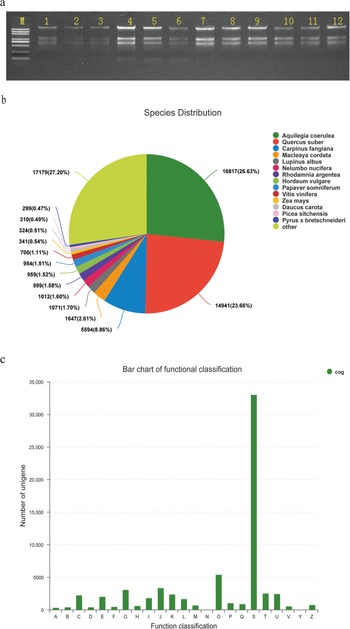
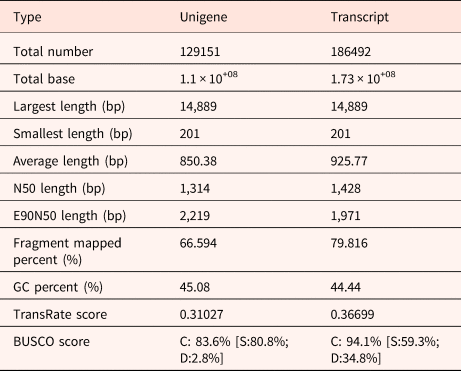
In this paper, four stages in the germination process of P. chinensis seeds were selected to understand the transcriptional regulation mechanism during the germination process of P. chinensis seeds. Transcriptome sequencing analysis was performed, and the sampling was repeated three times (see supplementary Table S1). A total of 510,005,732 pieces of raw data were obtained, filtered and analysed. Finally, a total of 505,527,940 pieces of clean data were obtained, of which Q20 and Q30 were divided into 97.50 and 92.86%, and the GC content was 46.43% (see supplementary Table S2). The sequencing results were good, and band quality was assessed (Fig. 2a). A total of 129,151 unigenes were assembled by Trinity, of which the largest length was 14,889 bp, the shortest length was 201 bp, the average length was 850.38 bp, N50 was 1314 bp and E90N50 was 2219 bp. The GC content was 45.08% (Table 1).
RNA integrity and transcriptome data functional annotation. (a) Sample agarose gel electrophoresis detection; (b) NR species annotation and (c) COG database annotation.

Transcriptome de-novo assembly results

All genes and transcripts obtained by transcriptome assembly were compared with six major databases (NR, Swiss-prot, Pfam, COG, GO and KEGG databases) to comprehensively obtain functional information of genes and transcripts and perform statistics on the annotations of each database (see supplementary Table S3). A total of 76,222 (59.53%) bands were annotated in all six databases. Most annotated data were obtained from the COG database, with 63,414 (49.52%) bands being annotated. The KEGG database had the least annotation information, and 38,670 (30.20%) bands were annotated. By aligning with the NR database, checking the similarity of the transcript sequence of this species with that of similar species and the functional information of homologous sequences was possible. The distribution of band annotation species is shown in the NR database (Fig. 2b). Among the species with high matching degree of similar bands, Aquilegia coerulea had the highest proportion, followed by Quercus suber, Carpinus fangiana and Macleaya cordata.
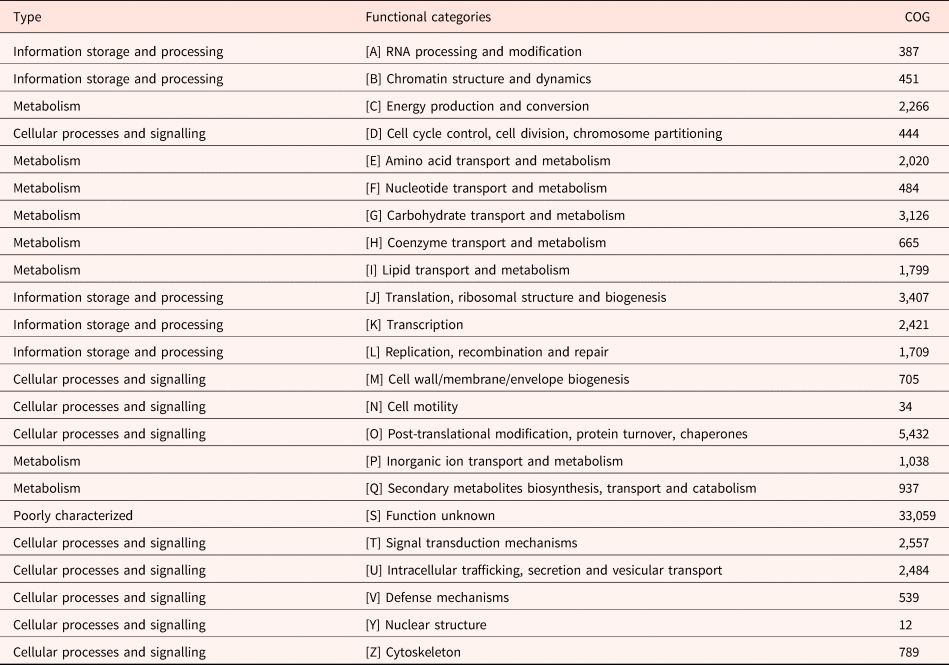
All unigenes were annotated by the COG database to further assess the completeness of the de-novo transcriptome assemblies and predict gene function. The COG classification of all unigenes was divided into 23 functional categories, mainly including carbohydrate transport and metabolism, translation, ribosomal structure and biogenesis, post-translational modification, protein turnover, chaperones, signal transduction mechanisms, intracellular transport, secretion and vesicular transport (Table 2 and Fig. 2c). Among them, the proportion of genes with functions unknown was relatively large, and few gene studies during the germination process of P. chinensis seeds were found. Relevant annotation references are lacking, thus needing further strengthening.
COG database annotation results

DEG analysis
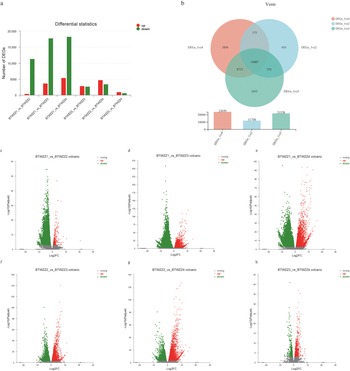
Based on the quantitative expression results, DEG analysis was performed to obtain DEGs between the two groups (see supplementary Table S4 and Fig. 3). The differential analysis software used DESeq2, and the screening thresholds were |log2FC| > = 1 and P adjust < 0.001.
(a,b) Expression differences and Venn analysis of different groups. (a) Statistics of expression difference and (b) Venn analysis of different groups. The significant DEGs with |log2FC| > = 1 and P adjust < 0.001. (c–h) Differential gene volcano maps. (c) BTWZZ1_vs_BTWZZ2; (d) BTWZZ1_vs_BTWZZ3; (e) BTWZZ1_vs_BTWZZ4; (f) BTWZZ2_vs_BTWZZ3; (g) BTWZZ2_vs_BTWZZ4; (h) BTWZZ3_vs_BTWZZ4.

DEGs GO enrichment and KEGG enrichment analysis
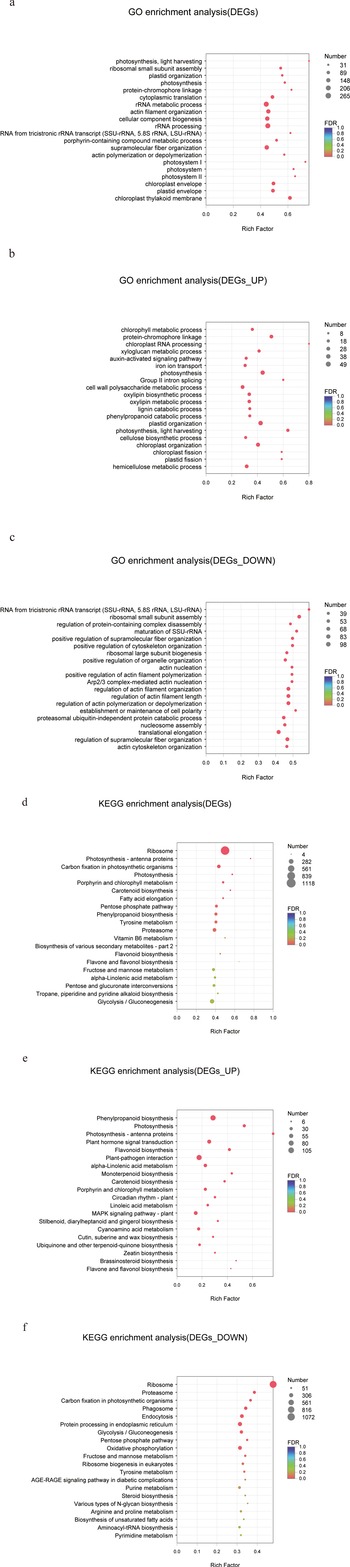
The up-regulated DEGs are mainly involved in chlorophyll metabolic process, protein-chromophore linkage, chloroplast RNA processing, xyloglucan metabolic process, auxin-activated signalling pathway and other functions were used to create a differential gene set for GO enrichment analysis (Fig. 4b). The down-regulated DEGs were mainly enriched in RNA from tricistronic rRNA transcript (SSU-rRNA, 5.8S rRNA and LSU-rRNA), ribosomal small subunit assembly, regulation of protein-containing complex disassembly, maturation of SSU-rRNA and positive regulation of supramolecular fibre organization (Fig. 4c).
(a–c) GO enrichment analysis. (a) DEGs; (b) DEGs_UP and (c) DEGs_DOWN. (d–f) KEGG enrichment analysis. (d) DEGs; (e) DEGs_UP and (f) DEGs_DOWN.

KEGG enrichment analysis was carried out on the differential gene set, and a total of 138 pathways were enriched, mainly in ribosome, photosynthesis–antenna proteins, carbon fixation in photosynthetic organisms, photosynthesis, porphyrin and chlorophyll metabolism and other pathways (Fig. 4d). Among them, the up-regulated DEGs were enriched in phenylpropanoid biosynthesis, photosynthesis, photosynthesis–antenna proteins, plant hormone signal transduction, flavonoid biosynthesis and other pathways (Fig. 4e). The down-regulated DEGs were mainly enriched in ribosome, proteasome, carbon fixation in photosynthetic organisms, phagosome and endocytosis (Fig. 4f).
DEGs involved in plant hormone signal transduction pathway
The distribution and signal transduction of hormones during seed germination are crucial to the development of embryo and endosperm. The differential expression, mutation and modification of hormone signal transduction-related genes are important factors affecting seed development (Rajjou et al., Reference Rajjou, Duval, Gallardo, Catusse, Bally, Job and Job2012; Gazzarrini and Tsai, Reference Gazzarrini and Tsai2015).
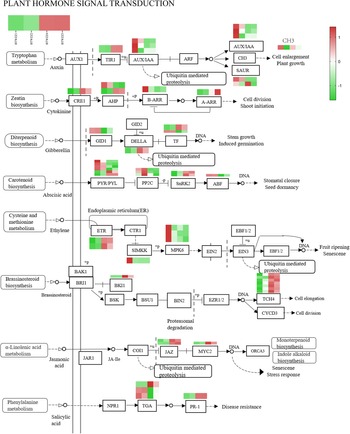
Within the pathway of plant hormone signal transduction (map04075), 87 DEGs were significantly enriched, most of which were involved in auxin, cytokinin, gibberellin, abscisic acid, ethylene, brassinosteroid, jasmonic acid and salicylic acid pathways (Fig. 5).
Functional enrichment of DEGs in plant hormone signal transduction pathways.

In the auxin pathway, auxin influx carrier 1 (AUX1), transport inhibitor response 1 (TIR1), AUX/IAA and SAUR (SAUR family protein) have been reported to be involved in seed germination, plant development processes, repressing early auxin response and cell elongation. In this study, 25 genes were enriched in the auxin pathway, including 1 enriched in AUX1, 1 in TIR1, 10 in IAA, 3 in GH3 and 10 in SAUR. Among them, seven orthologs of IAA and one of AUX1 were up-regulated compared with those in BTWZZ_1.
In the cytokinin pathway, one AHP (histidine-containing phosphotransfer protein) and two ARR-B (two-component response regulator ARR-B family) showed higher expression levels in BTWZZ_1 and BTWZZ_2 than in BTWZZ_3 and BTWZZ_4, whereas others were expressed in an opposite trend.
In gibberellin signalling, two orthologs of PIF4/PIF3 encoding for phytochrome-interacting factor 4 were continuously up-regulated compared with those in BTWZZ_1.
A total of 13 genes were enriched in the abscisic acid signalling pathway, PYL (abscisic acid receptor PYR/PYL family), protein phosphatase 2C (PP2C), serine/threonine-protein kinase SRK2 (SnRK2) and ABA-responsive element binding factor (ABF) showed a large difference in expression.
In the ethylene pathway, ethylene receptor (ETR), CRT1 (serine/threonine-protein kinase CTR1), cyclin-dependent kinase 7 (CDK7), mitogen-activated protein kinase kinase 4/5 (MKK4_5) and mitogen-activated protein kinases (MAPKs) were presented remarkably by multiple genes, especially the MAPK gene family, which was significantly down-regulated.
In addition, some DEGs involved in the SA, BR and JA signalling pathways were expressed in up- or down-regulated patterns.
PPI network analysis
A total of 87 DEGs were enriched in the plant hormone signal transduction pathway. The DEGs were matched with the STRING database (https://cn.string-db.org/) to further study the key regulators in this pathway, and 65 proteins were identified. The number of edges was 238, and the average node degree was 7.32. Cytoscape was used to construct a PPI network map, where different colours represented different types of hormone-related proteins. Each of the functional modules was tightly connected clusters, in which the thicker lines represented stronger associations between the genes, including 16 auxin-related proteins; 11 abscisic acid-related proteins; 7 ethylene-related proteins; 6 cytokinin-related proteins; 6 gibberellin-related proteins and 19 other types, such as salicylic acid, brassinosteroid and jasmonic acid signalling pathways protein. The first six core proteins were AUX1 and IAA19 (auxin signal transduction pathway), ABI1 and ABI5 (abscisic acid signal transduction pathway), RGA1 and GAI (gibberellin signal transduction pathway).
Conservation analysis of core gene sequences
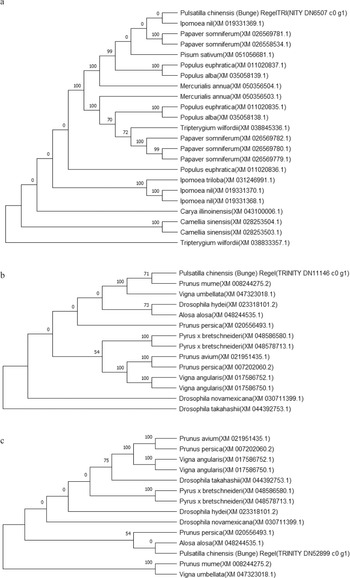
In order to determine whether the above six core protein genes are similar and conserved within other species, the CDS obtained from the transcriptome (see supplementary Table S5) were used to perform BLAST in the NCBI database to obtain similar gene sequences. AUX1, ABI1 and ABI5 obtained multiple similar sequences (>100) after blasting, IAA19 obtained two sequences, RGA1 obtained six sequences and GAI obtained two sequences. Among them, AUX1, ABI1 and ABI5 were compared with the sequence of the first 10 species (see supplementary Tables S5–S8), and MEGA11 was used to construct the phylogenetic tree of AUX1, ABI1 and ABI5 (Fig. 6). In general, the sequences of the same species clustered well together, with high homology and similarity, indicating that AUX1, ABI1 and ABI5 genes are relatively conservative in the evolution process. According to neighbour-joining phylogenetic analysis on the basis of AUX1 sequences, bootstrap of each node showed that P. chinensis was close to Ipomoea nil and Papaver somniferum. ABI1 sequence analysis showed that P. chinensis was close to Prunus mume. And ABI5 phylogenetic analysis showed that P. chinensis was close to Alosa alosa and Prunus persica.
Phylogenetic tree. (a) AUX1; (b) ABI1 and (c) ABI5.

Expression profile analysis by qRT-PCR
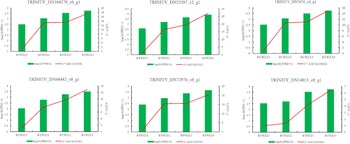
Six DEGs were randomly selected for quantitative real-time PCR (qRT-PCR) to validate their expression levels during the process of seed germination in P. chinensis (Bunge) Regel. The RT-qPCR results showed that the transcriptional levels of the tested genes were in a correlated trend with the respective abundance estimated by RNA-seq (Fig. 7), suggesting relative rationality and accuracy of the transcriptome analysis in this study.
qRT-PCR confirmation of DEGs.

Effects of hormone treatments on seed germination
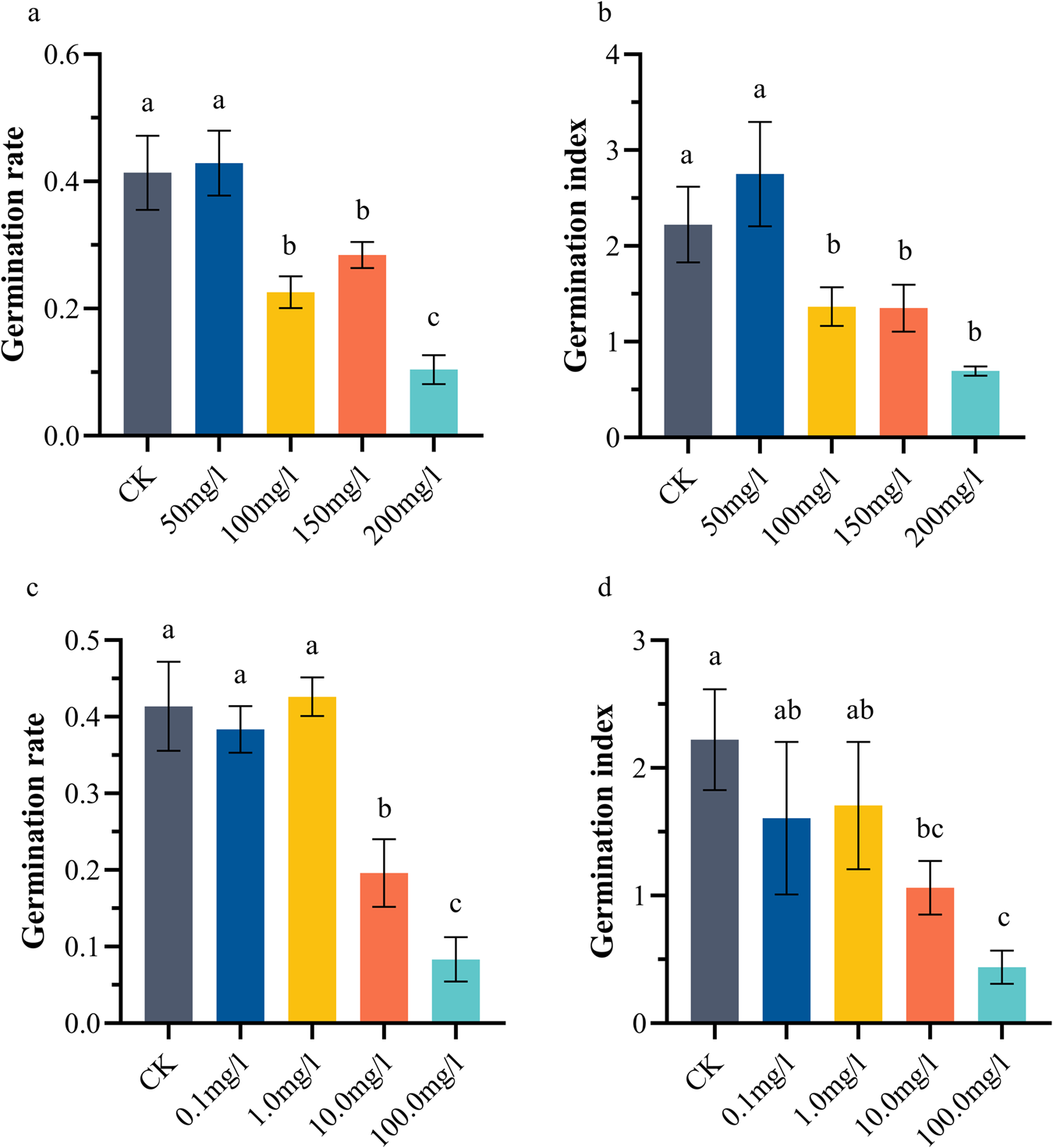
The one-way analysis of variance was performed on the three germination parameters, and the results showed that the germination rate and germination index of seeds treated with different concentrations of GA3 and ABA were significantly different from those of the control group (Fig. 8). Compared with the control group, 50 mg l−1 GA3 did not show a significant difference in the seed germination rate but continuing to increase the concentration of GA3, the germination rate of P. chinensis seeds decreased significantly, and the highest concentration of gibberellin almost completely inhibited germination. Especially at the 200 mg l−1 GA3, in the late stage of germination, the seeds displayed mildew in a large area. There were also significant differences in the germination index of seeds treated with the different concentrations of GA3. Compared with the control group, the germination index of seeds in the 50 mg l−1 gibberellin treatment group was increased, and the germination index of seeds in the high concentration of gibberellin treatment was decreased. After ABA treatment of seeds for 12 h, the germination rate of seeds in the low concentration treatment group (0.1 mg l−1, 1.0 mg l−1) showed no significant difference compared with the control group. Continuing to increase the concentration of abscisic acid decreased the germination rate significantly compared with the control group, as did the germination index.
Germination of seeds treated with different concentrations of hormone. (a) Germination rate of seeds treated with different concentrations of GA3; (b) Germination index of seeds treated with different concentrations of GA3; (c) Germination rate of seeds treated with different concentrations of ABA; (d) Germination index of seeds treated with different concentrations of ABA.

Discussion
Seed dormancy is a complex adaptive characteristic of plants, a physiological feature that adapts to environmental changes, and an environmental adaptive response mechanism that enables seeds to be stored for a long time and maintain a certain viability, thereby ensuring the reproduction and survival of species (Finkelstein et al., Reference Finkelstein, Reeves, Ariizumi and Steber2008; Pipatpongpinyo et al., Reference Pipatpongpinyo, Korkmaz, Wu, Kena, Ye, Feng and Gu2020). As a protection mechanism, plant seeds not only protect themselves but also bring certain challenges to agriculture, forestry production and even the conservation of endangered wild species (Ying, Reference Ying2013).
In recent years, many studies have shown that seeds may still be in a dormant state when they mature, and the degree of dormancy gradually decreases with the passage of storage time (Walck et al., Reference Walck, Baskin and Baskin1999; Holdsworth et al., Reference Holdsworth, Bentsink and Soppe2008; Graeber et al., Reference Graeber, Nakabayashi, Miatton, Leubner-Metzger and Soppe2012). The phenomenon of seed dormancy is common, but the causes are complex. They are mainly divided into external and internal factors. The external factors include environmental factors, such as light, climate, soil, water and changes in the rhizosphere microbial community (Huang et al., Reference Huang, Cui, Yang and Li1993). The internal factors include seed coat disorders, germination inhibitors, hormonal regulation and embryo immaturity (Liping, Reference Liping2016).
Depending on the type of dormancy, different methods are used to break it. P. chinensis has small seeds and incomplete embryo development. The germination rate is low and non-uniform under natural conditions, and it is easy to be mildewed when germinating (Li and Zhongyun, Reference Li and Piao2010; Wang et al., Reference Wang, Zhang, Zhang, Yu and Song2013). At present, GA3, low temperature, ultrasonication, polyethylene glycol (PEG) 6000 and other treatments are mainly used to break the dormancy of Pulsatilla seeds, improving the germination rate and potential, and shorten the germination time. However, no report could be found on the molecular mechanism of its germination (Shi et al., Reference Shi, Zhang, Yu and Wei2005; Li and Zhongyun, Reference Li and Piao2010; Wang et al., Reference Wang, Zhang, Zhang, Yu and Song2013).
In recent years, increasing applications of transcriptome sequencing research have been used in the exploration of plant seed dormancy, germination and storage mechanisms (Graeber et al., Reference Graeber, Nakabayashi, Miatton, Leubner-Metzger and Soppe2012; Vishweshwaraiah et al., Reference Vishweshwaraiah, Prakash and Gowda2018). Especially when the genome information of the species is unknown, the genetic information could be obtained through transcriptome sequencing to realize the mining of species’ functional genes in a specific period. Thus, comparing the gene expression of P. chinensis seeds at different germination stages may be important to elucidate the germination mechanism. This study was the first report on the application of transcriptome sequencing technology to explore the germination mechanism of P. chinensis seeds and mine the regulatory network of dormancy and germination.
Plant hormones are key regulators of plant growth, development and signalling networks involved in response to different biotic and abiotic stresses (Durbak et al., Reference Durbak, Yao and McSteen2012; Verma et al., Reference Verma, Ravindran and Kumar2016; Qi et al., Reference Qi, Jiang, Guo, Chen, Ouellet, Zong, Wei, Wang, Zhang, Xu, Kong, Deng, Wang, Chen, Jiang, Lan, Li, Wei and Zheng2019). In this study, a total of 13 DEGs were enriched in the ABA metabolic pathway (Fig. 4e), including two abscisic acid receptor PYR/PYLs (TRINITY_DN10555_c0_g1, TRINITY_DN16857_c0_g1) and protein phosphatase 2C (TRINITY_DN8843_c0_g2). The expression levels (TPM) of two serine/threonine-protein kinase SRK2s (TRINITY_DN17614_c0_g1, TRINITY_DN1152_c0_g2) in BTWZZ_3 and BTWZZ_4 were significantly higher than those in BTWZZ_1 and BTWZZ_2. However, abscisic acid receptor PYR/PYL (TRINITY_DN120981_c0_g1, TRINITY_DN23200_c0_g1, TRINITY_DN9858_c0_g1 and TRINITY_DN1893_c0_g1), protein phosphatase 2C (TRINITY_DN11296_c0_g1 and TRINITY_DN4643_c0_g1) and ABA-responsive element binding factor (TRINITY_DN52899_c0_g1) were found to be significantly higher in BTWZZ_1 and BTWZZ_2 than in BTWZZ_3 and BTWZZ_4.
Moreover, the GA metabolism GID1, GID2 and SLY1 gene families exhibited higher expression in BTWZZ_1 and BTWZZ_2. The PIF3 and PIF4 gene families also exhibited up-regulation in BTWZZ_3 and BTWZZ_4. The DELLA proteins (TRINITY_DN8581_c0_g1 and TRINITY_DN55822_c0_g1) behaved differently in the four stages of seed germination (Fig. 4d).
Other plant hormones, such as auxin, ethylene, salicylic acid and brassinosteroids are likely to be involved in seed germination and dormancy (Li et al., Reference Li, Jia, Yu, Yang, Chen, Chen and Hu2018; Moravcová et al., Reference Moravcová, Tůma, Dučaiová, Waligórski, Kula, Saja, Słomka, Bąba and Libik-Konieczny2018; Kim et al., Reference Kim, Warpeha and Huber2019). AUX1 is an auxin-importing carrier that regulates auxin input positively. It regulates the distribution of auxin in different parts of plants, providing an important guarantee for plant growth and development and thereby regulating physiological processes, such as plant embryonic development, organ formation and plant directional growth. Auxin has also been implicated in the regulation of germination through histone modification (Wang et al., Reference Wang, Chen, Li, Cao, Ding, Zhang, Zuo, Xu, Xu, Deng, Xiang, Soppe and Liu2016). Karrikins, a family of small molecules discovered in wildfire smoke, play a key role in seed dormancy release and may have complex interactions with phytohormones, especially IAA (Meng et al., Reference Meng, Shuai, Luo, Chen, Zhou, Yang and Shu2016). Sometimes, dormancy release by after-ripening correlates with a decline in ABA content and an increase in IAA content during imbibition, as was shown in rice (Du et al., Reference Du, Cheng, Cheng, Wang, He, Wang and Zhang2015).
Furthermore, mutations in etr1 showed increased dormancy and a delay in germination in comparison with the wild type in Arabidopsis, also resulting in increased sensitivity to ABA with respect to inhibition of germination (Subbiah and Reddy, Reference Subbiah and Reddy2010). The brassinosteroid receptor kinase, BRI1, was also considered to play a key role in seed germination, especially in cold stratification (Kim et al., Reference Kim, Warpeha and Huber2019).
The process of seed dormancy and germination is regulated by various endogenous hormones and environmental factors (Shu et al., Reference Shu, Liu, Xie and He2016). Abscisic acid and gibberellins are the main plant hormones that regulate seed dormancy and germination. Recent studies have shown that auxin may also play an important role in the regulation of seed dormancy and germination (Belin et al., Reference Belin, Megies, Hauserová and Lopez-Molina2009; Liu et al., Reference Liu, Zhang, Zhao, Feng, Li, Yang, Luan, Li and He2013; Shu et al., Reference Shu, Liu, Xie and He2016; Shuai et al., Reference Shuai, Meng, Luo, Chen, Qi, Yang and Shu2016; Li et al., Reference Li, Zhou, Xiong, Ren, Han, Wang, Zhang, Fan and Liu2020b). On this basis, different concentrations of GA3 and ABA were selected to treat seeds, and the germination of seeds was observed. Increasing concentrations of ABA decreased the germination index of seeds while seed vigour was reduced. The germination rate and germination index of seeds treated with gibberellic acid at a concentration of 50 mg l−1 increased, but there was no significant difference compared with the control group. When the concentration of gibberellin was increased, the germination rate and germination index of seeds decreased. This may be related to the pre-treatment of the seeds (the relevant patent is being applied for in this part), and the seeds after the pre-treatment are easier to germinate. Judging from the current literature, P. chinensis seeds have dormancy characteristics, long germination period and irregular germination (Shi et al., Reference Shi, Zhang, Yu and Wei2005; Gu et al., Reference Gu, Zhang, Wang and Zhang2014).
Conclusion
This is the first report on the application of transcriptome sequencing technology to explore the germination mechanism of P. chinensis seeds. In this paper, Trinity was used to assemble clean data obtained by transcriptome sequencing. The clean data was compared with six major databases to obtain functional information of genes and transcripts. The NR species annotation results showed that the sequencing results had the highest match with Aquilegia coerulea, but only 26.63% of the genes annotated to this species. In addition, the COG classification function statistics found that the number of genes with unknown function was the largest, up to 33,059. This result also shows to a certain extent that there are few studies on the genes of P. chinensis, and the molecular mechanism of its seed germination needs more attention. During the four stages of seed germination, the DEGs were mainly enriched in 138 pathways, of which the differentially expressed up-regulated genes were enriched in the phenylpropanoid biosynthesis pathway, and the differentially expressed down-regulated genes were mainly enriched in the ribosome pathway. GO functional enrichment analysis found that the up-regulated differential genes were mainly enriched in chlorophyll metabolic process, and the down-regulated differential genes were mainly enriched in tricistronic rRNA transcript (SSU-rRNA, 5.8S rRNA, LSU-rRNA). Sixty-five DEGs were significantly enriched in plant hormone signal transduction pathway, including 16 auxin-related proteins, 11 abscisic acid-related proteins, 7 ethylene-related proteins, 6 cytokinin-related proteins, gibberellin 6 protein-related proteins and 19 others. The differential protein PPI interaction analysis on these pathways found that the first six core proteins were AUX1, IAA19 (auxin metabolism pathway); ABI1, ABI5 (abscisic acid metabolism pathway); RGA1 and GAI (gibberellin metabolism pathway).
Supplementary material
To view supplementary material for this article, please visit: https://doi.org/10.1017/S0960258523000089.
Supplementary Table S1. Sample RNA quality test results
Supplementary Table S2. Quality control analysis of sequencing data
Supplementary Table S3. Transcriptome data functional annotation results
Supplementary Table S4. Statistical result table of DEGs
Supplementary Table S5. The CDS of the six core protein genes
Supplementary Table S6. Analysis of AUX1 gene homology
Supplementary Table S7. Analysis of ABI1 gene homology
Supplementary Table S8. Analysis of ABI5 gene homology
Data availability statement
The datasets presented in this study can be found in online repositories. The names of the repository/repositories and accession number(s) are: NCBI SRA BioProject, accession no: PRJNA890172.