Introduction
Over the past several decades, natural disasters have occurred frequently in China, with far-reaching impacts on people's lives and health (e.g., Zhou, Li, Wu, & Wu, Reference Zhou, Li, Wu and Wu2014). In addition to physical injury, many disaster victims experience mental health problems such as (PTSD) (e.g., Liang, Cheng, Ruzek, & Liu, Reference Liang, Cheng, Ruzek and Liu2019; Yen & Hsu, Reference Yen, Hsu, Martin, Preedy and Patel2016), which impede recovery efforts and compound the social and economic fallout of the disaster (e.g., Ahern, Kovats, Wilkinson, Few, & Matthies, Reference Ahern, Kovats, Wilkinson, Few and Matthies2005; Schoenbaum et al., Reference Schoenbaum, Butler, Kataoka, Norquist, Springgate, Sullivan and Wells2009). Thus, the healing of victims’ psychological state is an important focus of postdisaster work, along with the reconstruction of material well-being in disaster areas. Interventions for children and adolescents have gained increasing political and public attention because of the susceptibility of young people to the impacts of disasters (Belfer, Reference Belfer2006). However, large-scale indiscriminate or nonspecific interventions are often inadequately resourced, and cannot meet individual needs in the context of considerable individual differences (e.g., Fan et al., Reference Fan, Zhou, Mo, Zhang, Xie and Liu2016; Fernandez et al., Reference Fernandez, Vicente, Marshall, Koenen, Arheart, Kohn and Buka2017; Watson, Brymer, & Bonanno, Reference Watson, Brymer and Bonanno2011). Postdisaster psychological services need to be more specific, targeted, and focused, and the first and most important step is to disentangle individuals with various types of symptom presentations from those that do not have such symptoms (e.g., Litz, Gray, Bryant, & Adler, Reference Litz, Gray, Bryant and Adler2002).
Several recent studies have adopted longitudinal approaches to explore the characteristics of various trajectories of posttraumatic reactions in subgroups (e.g., Bonanno & Diminich, Reference Bonanno and Diminich2013; Fan, Long, Zhou, Zheng, & Liu, Reference Fan, Long, Zhou, Zheng and Liu2015), and have distinguished adolescents with various reaction presentations (e.g., Fan et al., Reference Fan, Long, Zhou, Zheng and Liu2015; La Greca et al., Reference La Greca, Lai, Llabre, Silverman, Vernberg and Prinstein2013; Marshall, Frazier, Frankfurt, & Kuijer, Reference Marshall, Frazier, Frankfurt and Kuijer2015; Osofsky, Osofsky, Weems, King, & Hansel, Reference Osofsky, Osofsky, Weems, King and Hansel2015; Weems & Graham, Reference Weems and Graham2014). Systematic reviews of PTSD trajectories (e.g., Galatzer-Levy, Huang, & Bonanno, Reference Galatzer-Levy, Huang and Bonanno2018; Lai, Lewis, Livings, La Greca, & Esnard, Reference Lai, Lewis, Livings, La Greca and Esnard2017; van de Schoot et al., Reference van de Schoot, Sijbrandij, Depaoli, Winter, Olff and van Loey2018) have identified several common subgroups: resilient (low stable symptoms across time), recovery (initially moderate to severe symptoms that declined gradually), delayed (initially low symptoms that elevated gradually), and chronic (moderate to severe symptoms that remained stable).
In addition to PTSD, positive changes have also been reported in some traumatized individuals (e.g., Weems et al., Reference Weems, Osofsky, Osofsky, King, Hansel and Russell2018; Wood & Tarrier, Reference Wood and Tarrier2010). This extended understanding of trauma does not only focus on concerns about negative consequences, but also considers positive reactions (e.g., Linley & Joseph, Reference Linley and Joseph2004; Wood & Tarrier, Reference Wood and Tarrier2010), including posttraumatic growth (PTG). In this context, PTG describes “positive psychological changes experienced as a result of a struggle with highly challenging life circumstances” (Tedeschi & Calhoun, Reference Tedeschi and Calhoun2004). PTG has been widely observed in individuals following natural disasters, and shows heterogeneity in developmental paths among different individuals (e.g., Kilmer & Gil-Rivas, Reference Kilmer and Gil-Rivas2010; Zhou, Wu, & Zhen, Reference Zhou, Wu and Zhen2018c). Previous studies have also examined the various trajectories of PTG to distinguish distinct groups (e.g., Tsai & Pietrzak, Reference Tsai and Pietrzak2017; Tsai, Sippel, Mota, Southwick, & Pietrzak, Reference Tsai, Sippel, Mota, Southwick and Pietrzak2016), including: constantly increasing PTG, constantly decreasing PTG, stable low PTG, and stable high PTG (e.g., Danhauer et al., Reference Danhauer, Russell, Case, Sohl, Tedeschi, Addington and Avis2015; Tsai et al., Reference Tsai, Sippel, Mota, Southwick and Pietrzak2016; Tsai & Pietrzak, Reference Tsai and Pietrzak2017; Wang, Chang, Chen, Chen, & Hsu, Reference Wang, Chang, Chen, Chen and Hsu2014; Zhou, Zhen, & Wu, Reference Zhou, Zhen and Wu2019).
While various symptom presentations can be differentiated by PTSD or PTG trajectories (e.g., Galatzer-Levy et al., Reference Galatzer-Levy, Huang and Bonanno2018; Tsai & Pietrzak, Reference Tsai and Pietrzak2017), previous studies have tended to categorize individuals into subgroups according to the characteristics of single valence reaction outcomes (e.g., PTSD or PTG). However, PTSD and PTG can co-exist in traumatized individuals (e.g., Tedeschi & Calhoun, Reference Tedeschi and Calhoun2004), indicating that positive health endpoints are not the opposite of negative endpoints. Ignoring one of these two types of valence in posttraumatic reactions when examining subgroup characteristics may prevent a comprehensive understanding of the characteristics of each trajectory subgroup, and may hamper the differentiation of various psychological presentations. Moreover, previous studies considered stable low levels of PTSD symptoms across time as resilience (e.g., Galatzer-Levy et al., Reference Galatzer-Levy, Huang and Bonanno2018; Lai et al., Reference Lai, Lewis, Livings, La Greca and Esnard2017; van de Schoot et al., Reference van de Schoot, Sijbrandij, Depaoli, Winter, Olff and van Loey2018). In fact, resilience consists of two components, including similar exposure to stress and more positive psychological functioning compared with others (e.g., Osofsky et al., Reference Osofsky, Osofsky, Weems, King and Hansel2015; Sroufe, Reference Sroufe1997; Weems & Graham, Reference Weems and Graham2014). Hence, the view that resilience is “a stable low level of PTSD symptoms” under the same exposure to trauma may lead to a biased understanding of resilience because it neglects individuals’ positive functions and assumes that positive functions and negative symptoms are mutually exclusive. Specifically, the developmental theory of resilience proposes three kinds of resilience: (a) regaining normal functioning following a period of exposure to traumatic experiences, often described in terms of recovery, bouncing back, or normalization; (b) maintaining effective functioning under highly adverse conditions, sometimes referred to as stress resistance; and (c) achieving better than expected outcomes over time since trauma, indicating growth that goes beyond the level of functioning before trauma (e.g., Masten & Obradovi, Reference Masten and Obradovi2006; Reference Masten and Obradovic2008). This theory suggests that resilience has many facets, involving changes in both negative and positive posttraumatic outcomes. Nevertheless, to date, few studies have disentangled the three kinds of resilience in an integrated perspective of positive and negative aspects, despite recovery, resistance, and growth differing from each other. Therefore, the current study sought to examine the joint trajectory patterns of PTSD and PTG following trauma, using an integrated perspective that considers changes in both negative and positive posttraumatic reactions to distinguish different kinds of resilience.
In addition, a two-component model of PTG suggested that PTG has two aspects – constructive and illusory components – and that the former may be related to fewer symptoms and the latter may help to make a person's struggle more bearable in a long-term framework (e.g., Maercker & Zoellner, Reference Maercker and Zoellner2004). However, this theory has not been examined in adolescents, and its applicability to adolescents is unclear. Compared with adults, the cognitive abilities of children and adolescents are immature and malleable (e.g., Tedeschi & Calhoun, Reference Tedeschi and Calhoun2004), resulting in greater susceptibility to the impacts of natural disasters (e.g., Margolin, Ramos, & Guran, Reference Margolin, Ramos and Guran2010). Cognitive immaturity and malleability also cause variability in the encoding and appraisal of trauma, as well as attributions about trauma (e.g., Hasan & Power, Reference Hasan and Power2004), and the PTSD and PTG of children and adolescents may correspondingly develop in diverse ways. Thus, exploring the developmental processes of PTSD and PTG among children and adolescents is of great importance. To fill these gaps in current knowledge, advance our knowledge of the characteristics of each trajectory subgroup, and inform our understanding of the constructive and illusory aspects of PTG (e.g., Zoellner & Maercker, Reference Zoellner and Maercker2006), the first aim of the current study was to examine joint PTSD and PTG trajectories in children and adolescents over time following an earthquake. Previous studies reported that there are four trajectory types of PTSD: resistance, chronic, recovery, and delayed symptoms (e.g., Bonanno, Brewin, Kaniasty, & La Greca, Reference Bonanno, Brewin, Kaniasty and La Greca2010, Reference Bonanno, Westphal and Mancini2011; Masten & Osofsky, Reference Masten and Osofsky2010; Weems, Reference Weems2008; Weems & Graham, Reference Weems and Graham2014). In addition, it has been reported that PTG exhibits four trajectory types: constantly increasing, constantly decreasing, stable low, and stable high (e.g., Danhauer et al., Reference Danhauer, Russell, Case, Sohl, Tedeschi, Addington and Avis2015; Tsai et al., Reference Tsai, Sippel, Mota, Southwick and Pietrzak2016; Tsai & Pietrzak, Reference Tsai and Pietrzak2017). Based on Tedeschi and Calhoun's (Reference Tedeschi and Calhoun2004) theoretical assumption that PTSD and PTG co-exist in individuals in a positive relationship, in the current study we hypothesized that there are four joint trajectory types of PTSD and PTG: stable high PTSD and PTG, stable low PTSD and PTG, increasing PTSD and PTG, and decreasing PTSD and PTG.
The notion that PTSD and PTG have heterogeneous trajectories is supported by many previous studies (e.g., Fan et al., Reference Fan, Long, Zhou, Zheng and Liu2015; La Greca et al., Reference La Greca, Lai, Llabre, Silverman, Vernberg and Prinstein2013; Marshall et al., Reference Marshall, Frazier, Frankfurt and Kuijer2015; Osofsky et al., Reference Osofsky, Osofsky, Weems, King and Hansel2015; Weems & Graham, Reference Weems and Graham2014; Zhou et al., Reference Zhou, Zhen and Wu2019). However, this raises the question of why posttraumatic reactions show various trajectories over time. Dose–response, threshold, and unpacking dose effects may account for this question. Specifically, dose–response effects suggest that there is an increase in symptoms with increased levels of trauma severity (e.g., Norris et al., Reference Norris, Friedman, Watson, Byrne, Diaz and Kaniasty2002; Pine, Costello, & Masten, Reference Pine, Costello and Masten2005), but symptoms may gradually elapse over time, reflecting a recovery process (e.g., Masten & Osofsky, Reference Masten and Osofsky2010). In contrast, under a very high level of traumatic exposure, some individuals’ upper threshold that copes with stress and evokes symptoms will be surpassed (e.g., Masten & Osofsky, Reference Masten and Osofsky2010), causing them to show persistent high levels of symptoms that are no longer dependent on the severity of trauma exposure (e.g., Klasen et al., Reference Klasen, Oettingen, Daniels, Post, Hoyer and Adam2010). In addition, some individuals may be exposed to ongoing adversity after a major traumatic event, and unpacking dose effects would be expected to lead to worsening symptoms over time with additional exposure (e.g., Betancourt et al., Reference Betancourt, Borisova, Williams, Brennan, Whitfield and de la Soudière2010; Masten & Osofsky, Reference Masten and Osofsky2010). In addition to this theoretical assumption, one solution is to identify vulnerability markers to enable the prediction of individual trajectories of stress reactions (e.g., Karstoft, Armour, Elklit, & Solomon, Reference Karstoft, Armour, Elklit and Solomon2015). This approach could inform appropriate preventive and treatment strategies for traumatized individuals.
Drawing on the shattered assumptions theory (Janoff-Bulman, Reference Janoff-Bulman2010), trauma exposure and fear may be two important markers of psychological outcomes following traumatic events. Janoff-Bulman (Reference Janoff-Bulman2010) suggested that, although people usually have a stable cognitive system (e.g., stable perceptions of personal worth, trust in others and a sense of justice or predictability in the world), when they encounter traumatic events, their stable cognitive system may be challenged. As a result, these people may perceive themselves to have less personal worth, show distrust in others, and lose their sense of control or predictability in the world. In these ways, cognitive disequilibrium can form between the period before and after trauma, eliciting traumatized individuals’ negative cognitions regarding the self, others, and the world, resulting in PTSD. To address this cognitive disequilibrium, cognitive models of PTG (Calhoun & Tedeschi, Reference Calhoun, Tedeschi, Calhoun and Tedeschi2006) suggest that traumatized individuals may exhibit deliberate rumination on trauma experiences and reconstruct their understanding of a posttraumatic world, eventually eliciting PTG. Therefore, people with severe trauma exposure tend to report severe PTSD symptoms or stable high PTG (e.g., Donoho, Bonanno, Porter, Kearney, & Powell, Reference Donoho, Bonanno, Porter, Kearney and Powell2017; Lenferink, Nickerson, de Keijser, Smid, & Boelen, Reference Lenferink, Nickerson, de Keijser, Smid and Boelen2020; Pietrzak et al., Reference Pietrzak, Feder, Singh, Schechter, Bromet, Katz and Southwick2014; Tsai et al., Reference Tsai, Sippel, Mota, Southwick and Pietrzak2016; Tsai & Pietrzak, Reference Tsai and Pietrzak2017). In addition, the shattered assumptions theory (Janoff-Bulman, Reference Janoff-Bulman2010) also suggests that cognitive disequilibrium can cause people to lose their sense of control in the world, eliciting more posttraumatic fear and finally resulting in more PTSD (e.g., Zhou, Wu, Yuan, Chen, & Chen, Reference Zhou, Wu, Yuan, Chen and Chen2015b). Fear, however, can increase individuals’ mental stress and encourage them to rethink traumatic events, creating opportunities for meaning making (e.g., Ying et al., Reference Ying, Lin, Wu, Chen, Greenberger and An2014). Hence, people with more fear may experience more PTSD or PTG (e.g., Dikmen-Yildiz, Ayers, & Phillips, Reference Dikmen-Yildiz, Ayers and Phillips2018; Zhou, Wu, Li, & Zhen, Reference Zhou, Wu, Li and Zhen2018a).
The previous studies discussed above have focused on the trajectories of a single posttraumatic reaction, overlooking the specific characteristics of combined posttraumatic reactions in traumatized individuals, limiting understanding of the role of these factors in posttraumatic psychological presentations. To address this gap in current knowledge, the second aim of the current study was to examine whether traumatized children and adolescents with different joint trajectories of posttraumatic reactions differed in terms of trauma exposure and fear. Based on existing theories (Calhoun & Tedeschi, Reference Calhoun, Tedeschi, Calhoun and Tedeschi2006; Janoff-Bulman, Reference Janoff-Bulman2010) and empirical findings (e.g., Dikmen-Yildiz et al., Reference Dikmen-Yildiz, Ayers and Phillips2018; Donoho et al., Reference Donoho, Bonanno, Porter, Kearney and Powell2017; Lenferink et al., Reference Lenferink, Nickerson, de Keijser, Smid and Boelen2020; Pietrzak et al., Reference Pietrzak, Feder, Singh, Schechter, Bromet, Katz and Southwick2014; Tsai & Pietrzak, Reference Tsai and Pietrzak2017; Zhou et al., Reference Zhou, Wu, Li and Zhen2018a,Reference Zhou, Wu and Zhenc), in the current study we hypothesized that trauma exposure and fear would be associated with the stable high PTSD and PTG group as well as the increasing PTSD and PTG group.
Method
Participants and sampling procedures
The Ya'an earthquake occurred on April 20, 2013. This earthquake was a destructive natural disaster that occurred in Sichuan, China, 5 years after the Wenchuan earthquake in 2008. During the Ya'an earthquake, 196 people were killed, 11,470 were injured, and more than 1.5 million were affected. The current study focused on Lushan County in Sichuan province, which was the area most severely affected by the Ya'an earthquake. We first contacted the local education authority and informed them of the aims and methods of our investigation, and advised them that we could provide psychological services if required. With the approval of the local education authority and local schools, we chose one primary school, one junior middle school, and one senior middle school in Lushan County, and randomly selected several classes from each school. All students from the selected classes that attended school on the date of the assessment were recruited to participate in this study. In total, 876 children and adolescent survivors participated in the investigation at 6 months after the earthquake (Time 1 [T1]). We also conducted a longitudinal investigation at 12 months (T2) and 18 months (T3) after the earthquake with these 876 participants. Because some students had dropped out or transferred to another school after the first wave measurement, it was difficult to conduct a longitudinal investigation for all students. In total, 827 (94.4%) of the original sample participated in the second assessment (T2), and the third assessment (T3) included 775 (88.5%) of the original participants.
The mean age of participants at T1 was 13.03 (standard deviation [SD] = 21.79) years (range 8.0–19.0 years). Of the 876 participants, 460 (52.2%) were female and 416 (47.5%) were male. All participants had experienced the Ya'an earthquake; 7.6% had been trapped and 13.5% had been injured in the earthquake. The homes of 67.6% of participants were either severely damaged or completely destroyed in the earthquake. Finally, 45.3% of participants reported that family members or friends were trapped in the earthquake, and 71.8% reported that family members or friends were injured.
This study was approved by the Research Ethics Committee of Beijing Normal University, and was conducted in accordance with the requirements of the participating schools. All students from the selected classes who attended school on the date of the survey were recruited to participate. There were no exclusion criteria, and no compensation was provided. The purpose of this study and the voluntary nature of students’ participation were highlighted before the survey, and written informed consent was obtained from participants and their guardians. Assessments were conducted at the three time points under the supervision of the researchers. After the questionnaire packets were completed, participating students were told that school psychologists or teachers were available to provide psychological/counseling services if needed.
Measures
PTSD
Participants’ PTSD was assessed using the Child PTSD Symptom Scale (Foa, Johnson, Feeny, & Treadwell, Reference Foa, Johnson, Feeny and Treadwell2001), a 17-item self-report scale designed to assess PTSD symptoms according to the fourth edition of Diagnostic and Statistical Manual of Mental Disorders (DSM-IV) in relation to the most distressing event experienced by children and adolescents. The scale has three subscales that measure intrusive, avoidance, and hyperarousal symptoms. Respondents are asked to rate the frequency of symptoms experienced during the last 2 weeks on a 4-point Likert scale from 0 (not at all) to 3 (almost always). This scale was found to have good reliability in the current study (Cronbach's α = 0.94). We set 16 as the cutoff score for screening probable PTSD cases, as suggested by Nixon et al. (Reference Nixon, Meiser-Stedman, Dalgleish, Yule, Clark, Perrin and Smith2013).
PTG
PTG was measured using a modified version of the Posttraumatic Growth Inventory (PTGI) (Zhou, Wu, Fu, & An, Reference Zhou, Wu, Fu and An2015a). The original PTGI was developed by Tedeschi and Calhoun (Reference Tedeschi and Calhoun1996), and consists of 21 items on five subscales: personal strength, new possibilities, relating to others, appreciation of life, and spiritual change. The 21 items are scored on a 6-point scale from 0 (no change) to 5 (a very great degree of change). The modified PTGI has 22 items on three subscales including perceived changes in self (nine items; that is, I'm more likely to try to change things which need changing), changed sense of relationship with others (seven items; that is, A sense of closeness with others), and changed life philosophy (six items; that is, An appreciation for the value of my own life). The procedures of revising the PTGI consisted of two steps (Zhou et al., Reference Zhou, Wu, Fu and An2015a). First, the original PTGI was translated into Chinese and back-translated into English to ensure that the translated version maintained the original meaning. Second, some revisions were made to items based on Chinese culture, including rewording some items to enhance comprehension among adolescent survivors of the earthquake and adding an item (belief regarding the existence of uncontrollable power) to the subscale for changed philosophy of life. The revised PTGI has been reported to show adequate applicability in Chinese children and adolescents following earthquakes (e.g., Wang, Wu, & Lan, Reference Wang, Wu and Lan2020; Zhou et al., Reference Zhou, Wu, Li and Zhen2018a; Zhou et al., Reference Zhou, Zhen and Wu2019). In the present sample, the internal reliability of the modified PTGI was good (Cronbach's α = 0.94). We set 66 as the cutoff score for screening probable PTG cases, as suggested by Reference Zhou, Wu and ZhenZhou et al. (2018c).
Trauma exposure
The trauma exposure questionnaire developed by Wu, Zhang, Lin, and Zang (Reference Wu, Zhang, Lin and Zang2013) was used to measure the severity of participants’ traumatic experiences. This questionnaire comprises 18 items, for which participants evaluate whether they had personally seen death, physical injuries caused by the earthquake (e.g., head injury, leg injury), or entrapment of parents, friends, teachers, or others during the earthquake. Because of the small number of participants that had witnessed the death of parents, friends, teachers, or others during the earthquake, that variable was not included in this study.
Subjective fear
Subjective fear was measured with the Subjective Fear Questionnaire (Wu et al., Reference Wu, Zhang, Lin and Zang2013). This questionnaire includes eight items that measure fear or worry about the death of parents, friends, teachers or others in relation to the earthquake. Each of the eight items is scored dichotomously (0 = no and 1 = yes). In this study, the internal reliability of the questionnaire was good (α = 0.86).
Data analysis
We used multiple-process growth mixture modeling (MPGMM) in Mplus (Muthén, Reference Muthén, Collins and Sayer2001, Reference Muthén and Kaplan2004) to examine the joint trajectories of PTSD and PTG. MPGMM assumes individuals follow heterogeneous trajectories of change that are quantitatively and qualitatively different. Based on repeated measures, MPGMM permits simultaneous estimation of growth parameters (i.e., intercept and slope) of different but related outcomes (e.g., Archambault & Dupéré, Reference Archambault and Dupéré2017). This joint development model allowed us to distinguish subgroups of participants with distinct PTSD and PTG trajectories. To identify participants’ membership in these joint trajectories, MPGMM classifies each individual in a probabilistic manner (e.g., Archambault, Eccles, & Vida, Reference Archambault, Eccles and Vida2010).
As the course of development of PTSD and PTG may be influenced by participants’ age (e.g., Osofsky et al., Reference Osofsky, Osofsky, Weems, King and Hansel2015; Zhou et al., Reference Zhou, Zhen and Wu2019), we used a conditional MPGMM that controlled for age. Because three waves of measurement were conducted (at 6, 12, and 18 months after the Ya'an earthquake), time scores (e.g., 0, 1, 2) in the linear conditional model were used to determine the slope of PTSD and PTG. To determine the optimal number of latent classes, all solutions were evaluated and compared by fit statistics, interpretability, and theoretical considerations. A good model fit was indicated by: low Bayesian information criterion (BIC), Akaike information criteria (AIC), and sample size-adjusted BIC (adjBIC) values; high entropy; a significant Lo–Mendell–Rubin adjusted likelihood ratio test (ALMR-LRT); and a significant bootstrap likelihood ratio test (BLRT). For a given model, nonsignificant ALMR-LRT and BLRT tests suggested that a model with one fewer class would provide a better fit. Finally, multinomial logistic regression was used to assess whether gender, having been trapped or not, having been injured or not, house damaged or not, trauma exposure, and subjective fear at T1 predicted the membership of joint PTSD and PTG trajectories. This approach reduced bias and corrected for potential uncertainty in trajectory assignment (e.g., Brook, Pahl, & Ning, Reference Brook, Pahl and Ning2006), and was not strongly affected by classification errors when average posterior probabilities of trajectory group membership exceeded 0.70 (e.g., Dekker et al., Reference Dekker, Ferdinand, Van Lang, Bongers, Van Der Ende and Verhulst2007).
Before performing MPGMM, we assessed whether the missing data pattern was random in PTSD and PTG at the three time points. Little's missing completely at random test revealed the data were missing at random (χ² [29] = 21.10, p = .856); therefore, missing data were treated with full information maximum likelihood estimates (FIML) in the modeling. We used chi-square and t tests to analyze the attrition from T1 to T3 by comparing the 775 participants with data at T3 with those who did not participate at T3. There was no significant difference between genders (χ² [1] = 2.90, p = .089), having been trapped or not (χ² [1] = 0.00, p = .997), having been injured or not (χ² [1] = 0.34, p = .558), house damaged or not (χ² [1] = 0.61, p = .437), trauma exposure (t = −1.23, p = .221), and subjective fear (t = −0.11, p = .914) at T1. These results indicated a normal distribution of attrition, which confirmed the FIML to be used in modeling.
Next, the measurement equivalence test was used to assess the comparability for repeated measures in the PTSD and PTG scales (Table 1). A measurement model with factor loadings constrained to be equivalent across the three waves was compared with a less constrained model. For PTSD and PTG, metric invariance was supported (ΔComparative Fit Index(CFI) < 0.01 and ΔTucker–Lewis Iindex(TLI) < 0.01), indicating equivalence of relationships between items and their respective latent construct for PTSD and PTG across time. This showed that MPGMM was appropriate for examining the joint developmental course of PTSD and PTG.
Measurement equivalence tests for posttraumatic stress disorder and posttraumatic growth

CFI = Comparative Fit Index; PTG = posttraumatic growth; PTSD = posttraumatic stress disorders (PTSD); TLI = Tucker–Lewis Index.
Results
Descriptive statistics and correlations
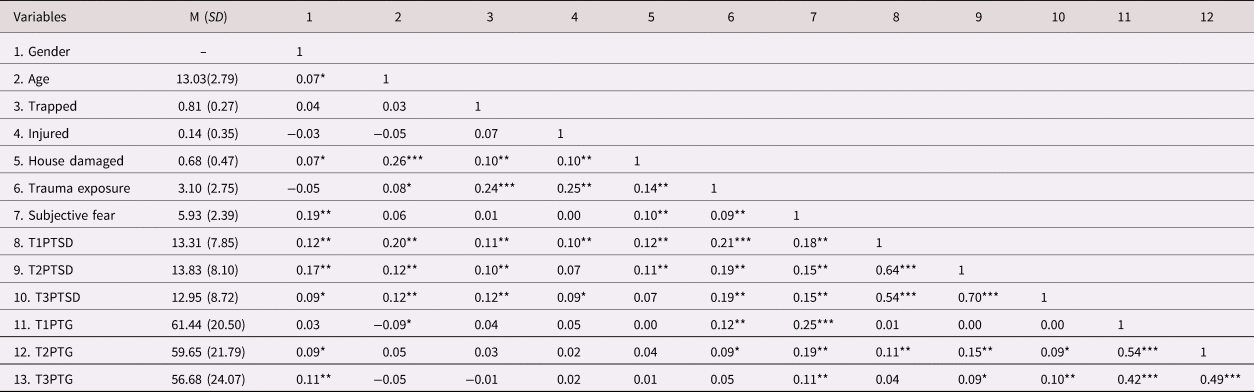
Results of descriptive statistics and correlations among the main variables are presented in Table 2. The mean values were: 13.31 (SD = 7.85), 13.83 (SD = 8.10), and 12.95 (SD = 8.72) for PTSD for T1, T2, and T3, respectively; and 61.44 (SD = 20.50), 59.65 (SD = 21.79), and 56.68 (SD = 24.07) for PTG at T1, T2, and T3, respectively. The prevalence of PTSD and PTG were 32.8% and 48.1% at T1, 37.6% and 44.4% at T2, and 34.7% and 38.2% at T3, respectively. T1 PTSD was significantly positively related to PTG at T2 but not at T2 and T3; T2 PTSD was significantly positively related to PTG at T2 and T3 but not at T1; and T3 PTSD had a significant association with PTG at T2 and T3 but not at T1. All predictors at T1 (e.g., gender, age, having been trapped or not, having been injured or not, house damaged or not, trauma exposure, and subjective fear) had significant relationships with PTSD across the three time points. However, only gender was significantly positively related to PTG at T2 and T3, age at T1 was significantly and negatively associated with PTG at T1 but not at T2 and T3, trauma exposure at T1 was significantly and positively associated with PTG at T1 and T2, and subjective fear at T1 was significantly and positively associated with PTG across the three time points.
Descriptive statistics and correlations among main variables

Note: * p < .05, ** p < .01, *** p < .001.
Joint PTSD and PTG trajectories
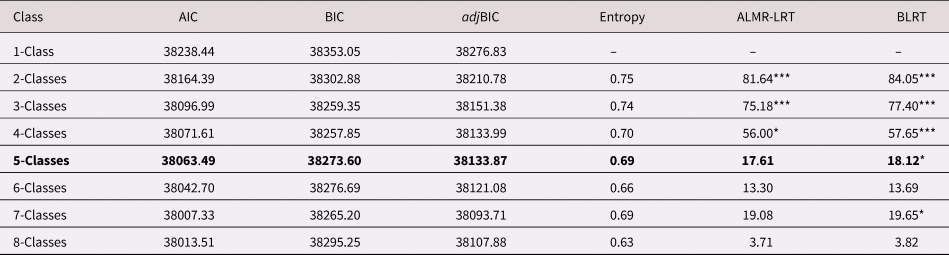
We tested different conditional MPGMMs that included up to eight classes controlled for age (Table 3). ALMR-LRT and BLRT were significant in the two- to five-class models and the seven-class model, meaning these five models should be considered. The sample size in the seven-class model was less than 5%, which indicated the seven-class model was nonstable and should be excluded from further consideration. Comparison of the two-, three-, four-, and five-class solutions revealed a decreasing tendency of AIC and adjBIC, which suggested the five-class solution should be considered first. Further, the six-class solution showed a nonsignificant ALMR-LRT and BLRT; given that a nonsignificant ALMR-LRT and BLRT indicated that a solution based on one fewer class may be acceptable, we selected the five-class solution as the optimal model. The classification of the final model is presented in Table 4. This classification table was based on the average latent class probabilities in the five-class model. The average probability in each latent class was more than 0.75, which confirmed that the five-class model provided an acceptable classification.
Fit statistics for the different growth mixture models

Note: *p < .05, **p < .01, ***p < .001.
AIC = Akaike information criteria; BIC = Bayesian information criterion; adjBIC = sample size-adjusted BIC; ALMR-LRT = Lo–Mendell–Rubin adjusted likelihood ratio test; BLRT = bootstrap likelihood ratio test.
Average latent class probabilities for the five-group model

Developmental course of PTSD and PTG in five classes
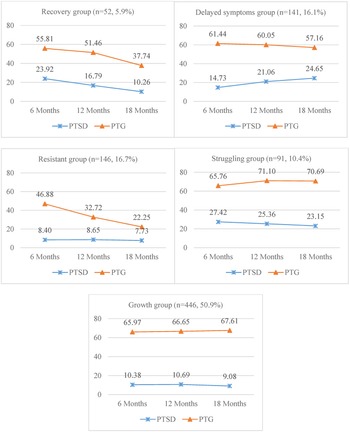
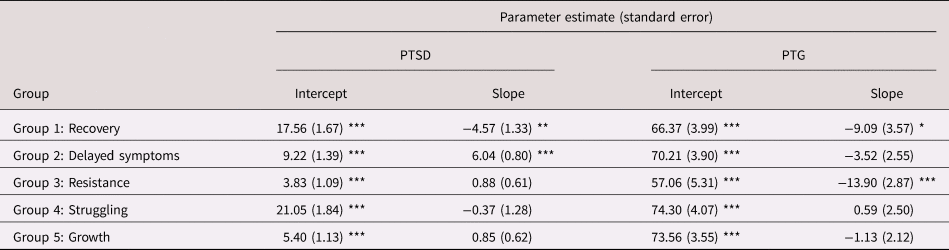
Figure 1 illustrates five joint PTSD and PTG trajectories. Table 5 presents the intercept and slope of change of PTSD and PTG. We defined these PTSD and PTG trajectories based on the cutoff scores for PTSD (i.e., 16) and PTG (i.e., 66) and their intercepts and slopes (Figure 1). Consistent with our hypotheses, we found distinct joint PTSD and PTG trajectories. In the first trajectory group, PTSD and PTG showed a decreasing tendency over time. Participants’ PTSD met the clinical criteria for the disorder at 6 months after earthquake, but their clinical symptoms disappeared over time. This suggested that these participants’ posttraumatic reactions (regardless of being positive or negative) showed a decreasing tendency. This group was named the recovery group, and comprised 52 (5.9%) participants.
Developmental course of posttraumatic stress disorder and posttraumatic growth in each group in the five-class model.

Statistics for the selected five-group model

Note: *p < .05, **p < .01, ***p < .001.
PTG = posttraumatic growth; PTSD = posttraumatic stress disorder.
In the second group, participants’ PTSD showed an ascending trend over time, wherein the participants’ PTSD scores were below the cut-off value at 6 months but above the cut-off value at 12 and 18 months after the earthquake. Their PTG was consistently at a stable mild level but below the cutoff value. Participants in this group were mainly characterized by initially minimal/no symptoms followed by elevated PTSD symptoms. Thus, this group was labeled the delayed symptoms group (n = 141, 16.1%).
Participants in the third group had stable PTSD that was lower than the cutoff score, and a low PTG level that showed a decreasing tendency. This suggested that those in this group were resistant in terms of their earthquake experience, and showed less negative and positive posttraumatic reactions from beginning to end. Therefore, this group was labeled the resistant group (n = 146, 16.7%).
In the fourth group, PTSD remained stable but was above the cutoff value from 6 to 18 months; PTG also remained stable and PTG scores were equal to or above the cutoff score across three time waves. Hence, the typical characteristics of this group meant that participants were struggling with distress and their growth was accompanied by symptoms, consistent with the notion of “growing up in pain.” Therefore, this group was named the struggling group (n = 91, 10.4%).
Consistent with our hypothesis, we found a fifth growth group, which included the largest number of participants (n = 446, 50.9%). This group was characterized by stable low PTSD and high PTG. As expected, this group showed consistently low PTSD symptoms and high levels of PTG over time, which suggested more positive changes and less negative reactions than the other groups.
Predictors of joint PTSD and PTG trajectories
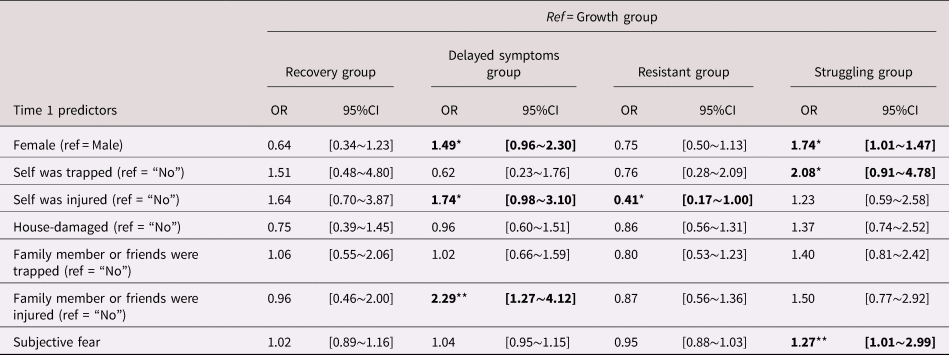
Because there were more participants in the growth group than in the other groups, we assessed why most participants showed growth following the earthquake. To examine this question, we set the growth group as the reference group and performed multinomial logistic regression to assess the relationships of gender, trauma exposure, and subjective fear at T1 in these groups. Table 6 shows the multinomial logistic regression results. The results suggested that the above predictors did not differentiate the recovery and growth groups. Compared with the growth group, girls were more likely to belong to the delayed symptoms and struggling groups, those who had been trapped were more likely to be in the struggling group, and those who had been injured were more likely to belong to the delayed symptoms group and less likely to belong to the resistant group. Participants with injured family members or friends were more likely to be in the delayed symptoms group, and those with more subjective fear were more likely to be in the struggling group.
Results of the multinomial logistic regression: predictors of posttraumatic stress disorder and posttraumatic growth trajectory membership

Note: * p < .05, ** p < .01.
Ref = reference group.
Discussion
The current study was the first to examine the joint PTSD and PTG trajectories in traumatized children and adolescents by adopting an integrated perspective of positive and negative valence reactions and considering the co-existence of PTSD and PTG (e.g., Tedeschi & Calhoun, Reference Tedeschi and Calhoun2004). We found five distinct joint PTSD and PTG trajectories, consistent with the findings of previous studies that posttraumatic reactions were heterogeneous over time following trauma (e.g., Bonanno & Mancini, Reference Bonanno and Mancini2012; Karstoft et al., Reference Karstoft, Armour, Elklit and Solomon2015; Tsai & Pietrzak, Reference Tsai and Pietrzak2017; Weems et al., Reference Weems, Osofsky, Osofsky, King, Hansel and Russell2018). Moreover, the current findings suggested that growth rather than resistance is a common trajectory in individuals over time since trauma. Furthermore, this finding suggested that gender, trauma exposure, and fear may have predictive roles in joint PTSD and PTG trajectories, meaning that these variables may be important factors affecting the variability of posttraumatic reactions (e.g., Fan et al., Reference Fan, Long, Zhou, Zheng and Liu2015).
Specifically, we identified recovery (5.9%), struggling (10.4%), delayed symptoms (16.1%), resistant (16.7%), and growth (50.9%) groups. Participants in the recovery group showed constantly decreasing PTSD and PTG, indicating that posttraumatic reactions can return to the original level regardless of whether they were negative- or positive-valence reactions. This finding supported the conclusion that recovery connotes a significant but relatively short-lived disruption in normal functioning caused by a trauma experience, then a gradual return to the normative baseline (e.g., Bonanno & Diminich, Reference Bonanno and Diminich2013). This result may be related to children and adolescents’ cognitive and emotional development over time, as they master more strategies to cope with traumatic events. The struggling group was characterized by high PTG and chronic PTSD, indicating that these participants were struggling with their trauma experiences (e.g., Chen & Wu, Reference Chen and Wu2017; Pat-Horenczyk et al., Reference Pat-Horenczyk, Saltzman, Hamama-Raz, Perry, Ziv, Ginat-Frolich and Stemmer2016), and supported the co-existence of PTSD and PTG in traumatized individuals (e.g., Tedeschi & Calhoun, Reference Tedeschi and Calhoun2004). This finding suggested that PTG might involve dissociation as a way of avoiding the emotional pain resulting from the trauma (e.g., Lahav, Bellin, & Solomon, Reference Lahav, Bellin and Solomon2016; Lahav, Ginzburg, & Spiegel, Reference Lahav, Ginzburg and Spiegel2020), and PTG of individuals in this subgroup may reflect illusory perception, making their struggle more bearable (e.g., Maercker & Zoellner, Reference Maercker and Zoellner2004). Individuals in the delayed symptoms group had stable-mild levels of PTG and delayed PTSD symptoms, with a typical characteristic being the exacerbation of existing symptoms across time (e.g., Andrews, Brewin, Philpott, & Stewart, Reference Andrews, Brewin, Philpott and Stewart2007; deRoon-Cassini, Mancini, Rusch, & Bonanno, Reference deRoon-Cassini, Mancini, Rusch and Bonanno2010). A potential explanation for this finding is the sensitizing effect of repetitive trauma exposure. Thus, prior trauma exposure may engender individuals’ negative assumptions and sense of helplessness, which may increase their susceptibility to later traumatic experience, finally leading to worsening distress (e.g., Breslau, Chilcoat, Kessler, & Davis, Reference Breslau, Chilcoat, Kessler and Davis1999; Zhou, Wu, Wang, & Tian, Reference Zhou, Wu, Wang and Tian2018b). Specifically, shortly after the Ya'an earthquake, individuals in this group did not show salient PTSD symptoms, but in the long term, they became susceptible when they encountered subsequent secondary disasters (e.g., landslides and aftershocks), thus showing ongoing distress and increased symptoms.
The resistant group showed low PTSD and PTG over time, although PTG showed a decreasing tendency. One possible reason for these results is that individuals in this group may have viewed potentially stressful situations as meaningful, had a commitment to values and life goals after stressful situations, believed that they could control stressors, tended to appraise stressors as changeable (e.g., Jakšić, Brajković, Ivezić, Topić, & Jakovljević, Reference Jakšić, Brajković, Ivezić, Topić and Jakovljević2012), were less likely to be affected by trauma, and therefore showed low PTSD (e.g., Waysman, Schwarzwald, & Solomon, Reference Waysman, Schwarzwald and Solomon2001) and PTG. The growth group was characterized by stable high PTG and stable low PTSD over time following the trauma experience. This indicated these individuals were able to cope with adversity or negative outcomes in such a way that they did not stay “down and defeated,” and took something useful or constructive from their experience that enhanced their well-being (e.g., Feeney & Collins, Reference Feeney and Collins2015). This finding raises the interesting issue of how to differentiate growth from resistance. Theoretically, resistance can serve as a resource in stressful life events (Lundman et al., Reference Lundman, Aléx, Jonsén, Norberg, Nygren, Santamäki Fischer and Strandberg2010), and equates to the absence of symptoms (e.g., Bonanno & Diminich, Reference Bonanno and Diminich2013). However, individuals who exhibit higher levels of resistance may be less inclined to experience PTG than those who exhibit lower levels of resistance because they interpret circumstances and events as less aversive (e.g., Tedeschi & Calhoun, Reference Tedeschi and Calhoun2004). However, in addition to the absence of symptoms, growth suggests the achievement of positive developmental outcomes (e.g., Rutter, Reference Rutter2006; Wyman, Sandler, Wolchik, & Nelson, Reference Wyman, Sandler, Wolchik and Nelson2000). Therefore, the optimal solution for differentiating growth and resistance may be the presence of positive function, as found in the current study. Unlike prior studies (e.g., Galatzer-Levy et al., Reference Galatzer-Levy, Huang and Bonanno2018; van de Schoot et al., Reference van de Schoot, Sijbrandij, Depaoli, Winter, Olff and van Loey2018), we found that the majority of participants were in the growth group (50.9%) rather than the resistance group. One potential explanation for this finding was that most participants experienced the Wenchuan earthquake before the Ya'an earthquake because of the close proximity of the two locations. This might have meant that they learned how to cope with similar traumatic experiences and adjust to the self, others, and the world following trauma. That is, exposure to stressors or adversities may decrease vulnerability through a steeling effect (e.g., Rutter, Reference Rutter2012); following exposure, people might be more likely to learn how to cope with subsequent trauma, and therefore showed growth following the second earthquake. This may also explain why we did not find a distress group with stable high PTSD and low/mild PTG over time.
To address our second aim, we examined factors that might predict the development of growth (e.g., gender, having been trapped, having been injured, trauma exposure, and subjective fear). We found that, compared with the growth group, girls were more likely to be in the less-growth groups (e.g., delayed-symptoms and struggling groups). Compared with males, previous studies have reported that females are more likely to use emotion-focused coping (e.g., Armour et al., Reference Armour, Elhai, Layne, Shevlin, Durakovic-Belko, Djapo and Pynoos2011) and negative coping (e.g., Fan et al., Reference Fan, Long, Zhou, Zheng and Liu2015), be more reactive to stress, and have stronger perceptions of threat and loss of control (e.g., Dedovic, Wadiwalla, Engert, & Pruessner, Reference Dedovic, Wadiwalla, Engert and Pruessner2009), suggesting that they may be particularly susceptible to disasters, exhibiting more psychological distress and less growth.
We found that children and adolescents that had been trapped were more likely to be in the struggling group, as they continued to struggle with trauma. Having been trapped might generate a traumatic memory directly associated with the trauma event (e.g., Tang, Liu, Liu, Xue, & Zhang, Reference Tang, Liu, Liu, Xue and Zhang2014). The activation of a traumatic memory can serve several functions, including: (a) providing an opportunity to highlight important trauma information by directing attention (e.g., Goodman, Quas, Goldfarb, Gonzalves, & Gonzalez, Reference Goodman, Quas, Goldfarb, Gonzalves and Gonzalez2019; Krans, Näring, Becker, & Holmes, Reference Krans, Näring, Becker and Holmes2009), (b) providing a warning signal for impending danger and preparing the person for action (e.g., Ehlers et al., Reference Ehlers, Hackmann, Steil, Clohessy, Wenninger and Winter2002), and (c) protecting self-coherence (e.g., Conway, Singer, & Tagini, Reference Conway, Singer and Tagini2004; Krans et al., Reference Krans, Näring, Becker and Holmes2009). These functions inform the process of that individual's struggle with trauma.
Moreover, compared with the growth group, injured children and adolescents were more likely to be associated with delayed symptoms, which was consistent with previous studies (e.g., Cheng, Liang, Zhou, Eli, & Liu, Reference Cheng, Liang, Zhou, Eli and Liu2019) and suggested that injured children and adolescents may show serious distress symptoms (e.g., Forresi et al., Reference Forresi, Soncini, Bottosso, Di Pietro, Scarpini, Scaini and Righi2019; Hsu, Chong, Yang, & Yen, Reference Hsu, Chong, Yang and Yen2002; Kolaitis, Reference Kolaitis2017). Being injured can be considered a measure of personal life threat (Perrin et al., Reference Perrin, DiGrande, Wheeler, Thorpe, Farfel and Brackbill2007), and a person who has been injured may perceive a greater risk of dying than someone exposed to other types of trauma (e.g., Cheng et al., Reference Cheng, Liang, Zhou, Eli and Liu2019). Therefore, those who were injured may have perceived more life threat than those who were not, and thereby showed more serious PTSD symptoms (e.g., Heir, Blix, & Knatten, Reference Heir, Blix and Knatten2016; Lancaster, Cobb, Lee, & Telch, Reference Lancaster, Cobb, Lee and Telch2016; Tran & Beck, Reference Tran and Beck2019). However, in contrast to previous studies, we found that the delayed symptom group was characterized by high PTG. This indicated that injury or perceived life threat may be an important factor for PTG (e.g., Cordova, Cunningham, Carlson, & Andrykowski, Reference Cordova, Cunningham, Carlson and Andrykowski2001; Kunz, Joseph, Geyh, & Peter, Reference Kunz, Joseph, Geyh and Peter2017; Su, Chow, Yen, & Chuang, Reference Su, Chow, Yen and Chuang2020), activating individuals’ cognitive processing (e.g., Caspari et al., Reference Caspari, Raque-Bogdan, McRae, Simoneau, Ash-Lee and Hultgren2017), helping the individual to reframe their understanding of the posttraumatic world and resulting in PTG (e.g., Kilmer & Gil-Rivas, Reference Kilmer and Gil-Rivas2010; Lafarge, Usher, Mitchell, & Fox, Reference Lafarge, Usher, Mitchell and Fox2020). For this reason, injured children and adolescents were less likely to be classified in the resistant group compared with the growth group. The difference between the growth and resistant groups reflected positive changes that were found in the growth group but not the resistant group. This finding suggested that children and adolescents with injured family members or friends were more likely to be in the delayed symptoms group compared with the growth group. A potential explanation for this finding is that these traumatized individuals might have received less support from their family members or friends because those support providers were injured and required care. Social support can provide resources (e.g., Kaniasty, Reference Kaniasty2020), which in turn facilitates cognitive and emotional processing of trauma events (e.g., Dworkin, Ullman, Stappenbeck, Brill, & Kaysen, Reference Dworkin, Ullman, Stappenbeck, Brill and Kaysen2018; Robinaugh et al., Reference Robinaugh, Marques, Traeger, Marks, Sung, Beck and Simon2011); therefore, support from family or friends may attenuate distress severity (e.g., Stanley et al., Reference Stanley, Hom, Chu, Dougherty, Gallyer, Spencer-Thomas and Joiner2019). In contrast, low levels of support from family and friends may be associated with greater PTSD severity over time.
We also found that children and adolescents with more fear were more likely to belong to the struggling group. A potential explanation for this finding is that posttraumatic fear indicates that people's view of the world has been challenged (e.g., Zhou et al., Reference Zhou, Wu, Li and Zhen2018a), which may elicit repetitive thinking about traumatic clues, in accord with the shattered assumptions theory (e.g., Janoff-Bulman, Reference Janoff-Bulman2010). This cognitive process represents the continuing struggle and process of understanding the trauma that traumatized individuals have experienced (e.g., Taku, Calhoun, Cann, & Tedeschi, Reference Taku, Calhoun, Cann and Tedeschi2008).
Several limitations involved in the current study should be noted. First, this study considered simultaneous positive and negative functions, but only considered PTSD and PTG. More positive and negative function variables should be examined in future studies to elucidate the characteristics of various trajectories. Second, although this study used a longitudinal design, we did not assess the other stressful events experienced across the study period. Results regarding the effect of these factors on posttraumatic reaction trajectories should also be interpreted with consideration of the restricted time frame (e.g., Fan et al., Reference Fan, Long, Zhou, Zheng and Liu2015). Third, the factors influencing the joint PTSD and PTG trajectories only included gender, trauma exposure, and subjective fear; more factors should be assessed in terms of differentiating distinct joint trajectories of PTSD and PTG. Fourth, although we used PTSD and PTG cutoff scores to classify their levels, these were only assessed by a self-reported questionnaire rather than diagnostic interviews or other reports. This might have introduced reporting bias. Moreover, it was difficult to exclude the impact of age variance, despite controlling for age in our data analysis. Future studies should examine a larger sample to examine the joint trajectories of PTSD and PTG among participants in different age phases.
Despite these limitations, to the best of our knowledge, the current study was the first to examine joint PTSD and PTG trajectories to elucidate the essential characteristics of posttraumatic reactions. This reflects the achievement of positive developmental outcomes and avoidance of maladaptive outcomes under adverse conditions (e.g., Rutter, Reference Rutter2006; Wyman et al., Reference Wyman, Sandler, Wolchik and Nelson2000), but not low distress symptoms over time as described in previous studies (e.g., Bonanno & Diminich, Reference Bonanno and Diminich2013; Bonanno, Westphal, & Mancini, Reference Bonanno, Westphal and Mancini2011; Fan et al., Reference Fan, Long, Zhou, Zheng and Liu2015; Self-Brown, Lai, Thompson, McGill, & Kelley, Reference Self-Brown, Lai, Thompson, McGill and Kelley2013).
This study provides a new perspective for future empirical studies in posttraumatic trajectories, and contributes to the development of trauma psychology research. Moreover, we found that growth rather than resistance is the common characteristics for children and adolescents following trauma, and the growth also indicated the co-existence of high levels of positive changes and low levels of distress severity, distinguishing a struggling group and a resistant group. This finding extended those of previous studies investigating PTSD trajectories (e.g., Bonanno et al., Reference Bonanno, Westphal and Mancini2011; Bonanno & Diminich, Reference Bonanno and Diminich2013; Fan et al., Reference Fan, Long, Zhou, Zheng and Liu2015; Kilmer & Gil-Rivas, Reference Kilmer and Gil-Rivas2010; Self-Brown et al., Reference Self-Brown, Lai, Thompson, McGill and Kelley2013; Tsai et al., Reference Tsai, Sippel, Mota, Southwick and Pietrzak2016; Tsai & Pietrzak, Reference Tsai and Pietrzak2017) because previous studies excluded positive function from negative outcomes. Furthermore, this study also considered co-existing characteristics of PTSD and PTG (Tedeschi & Calhoun, Reference Tedeschi and Calhoun2004), and showed that PTG and negative outcomes can co-exist with PTSD from a longitudinal perspective.
From a practical clinical perspective, this study provides an integrated perspective for psychological services involving traumatized individuals. First, this study suggests that psychological intervention on the psychological distress of children and adolescents should adopt a developmental perspective because their distress showed different types of trajectories across time. Second, our findings suggest that psychological services should consider the improvement of positive outcomes as well as focusing on the relief of negative function. Third, we found distinct joint PTSD and PTG trajectories, suggesting a need for specific and targeted psychological services for different groups of children and adolescents over time after disasters. Furthermore, the emphasis of psychological services should focus on relieving PTSD severity in individuals in the delayed symptom group and promoting growth in the recovery and resistant groups, as well as providing help for coping with traumatic experiences.
Funding Statement
This work was supported by the General Project for Humanities and Social Sciences Research of the Ministry of Education of China [grant numbers 19YJA190012].
Conflicts of Interest
None.