Implications
Our study shows that the use of diets containing maize oil improves the polyunsaturated fatty acid (PUFA) content of rabbit meat, and the PUFA n-6 content in particular. Some of these PUFAs in the perirenal fat and, to a lesser extent, in the intramuscular fat, undergo desaturation into precursors of eicosanoids. These products are important regulators of cellular functions with inflammatory, atherogenic and prothrombotic effects. The addition of Curcuma longa further enhances the PUFA n-3 content and this improves the nutritional value of rabbit meat with consequent beneficial effects on the consumers’ health, particularly for people with metabolic diseases.
Introduction
In developed countries, much attention has been paid to the influence of diet on human health and well-being and people tend to exercise control over their fat intake and the fat composition of food. Therefore, one of the main aims of researchers is to produce healthy meat to reduce saturated fatty acids (SFAs) and increase mono and polyunsaturated fatty acids (MUFA and PUFA) in fat deposits. Unlike saturated fats, the consumption of meat enriched with MUFA and PUFA decreases the risk of atherogenic plaque in the arteries of consumers and contributes to the prevention of cardiovascular disease and metabolic disorders.
Different vegetable oil sources have been used in rabbit diets to increase the lipid unsaturation level (Dalle Zotte, Reference Dalle Zotte2002). As far as fat composition is concerned, rabbit meat could be a very useful food in human diets, because it is relatively lean and has a lower level of cholesterol than other meats.
However, increasing the degree of unsaturation of rabbit tissues by dietary manipulation accelerates oxidative deterioration during meat processing and storage (Dalle Zotte, Reference Dalle Zotte2002) and there has been an increasing interest in the use of antioxidants in rabbit feed formulas (Hernández, Reference Hernández2008). PUFAs are particularly susceptible to oxidative breakdown, which leads to the production of peroxides and eventually to rancidity (Enser, Reference Enser1984); the susceptibility of muscle lipids to oxidation is also influenced by the presence of antioxidants.
Dietary supplementation has been proved to be a simple and convenient strategy to introduce a natural antioxidant that may effectively inhibit oxidation reactions (Botsoglou et al., Reference Botsoglou, Florou-Paneri, Christaki, Giannenas and Spais2004). Antioxidants (vitamin E or C and their combinations) have been widely used as food additives to provide protection against the oxidative degradation of food (Selim et al., Reference Selim, Abdel-Khalek, Nada and El-Medany2008). The search for natural antioxidants, especially of plant origin, has increased notably in recent years to obtain functional food, through the inclusion of essential fatty acids (FAs), vitamins and antioxidants in the rabbit diets, in order to assess the effects on the meat (Cavani et al., Reference Cavani, Petracci, Trocino and Xiccato2009).
Curcuma longa (CL) has been used for hundreds of years as a flavour, colour and preservative, and it has been applied for the prevention and cure of the skin, and for hepatic conditions, ulcers and digestive disorders. Recently, it has attracted a great deal of attention due to its significant medicinal potential. Curcuma has been found to have anti-inflammatory, anti-infectious and anti-tumorous properties (Jain et al., Reference Jain, Shrivastava, Nayak and Sumbhate2007). Arafa (Reference Arafa2005) has shown an attenuation of hypercholesterolaemia in rats fed curcumin. Zhang et al. (Reference Zhang, Liu, Wo, Zhang, Jin and Ding1999) have reported increased LDL-receptor amounts in vascular smooth muscle cells of rats that were treated orally with a turmeric extract. Supplementation with CL reduces oxidative stress and attenuates the development of fatty streaks in rabbits fed a high cholesterol diet (Quiles et al., Reference Quiles, Mesa, Ramírez-Tortosa, Aguilera, Battino, Gil and Ramírez-Tortosa2002). CL can be used satisfactorily in rabbit mixed feeds with maize oil (MO) supplementation (Zunino et al., Reference Zunino, Meineri and Peiretti2010), and this has resulted in a better digestibility of dry matter (DM), organic matter and gross energy (GE) than a control diet. In rabbit mixed feeds with palm oil (PO) supplementation, CL has decreased acid detergent fibre (ADF) digestibility and increased ether extract (EE) digestibility. The use of curcuma in rabbit diets has been evaluated, because of its effects on lipid metabolism, by Wientarsih et al. (Reference Wientarsih, Chakeredza and ter Meulen2002), who observed enhanced fat and cholesterol excretion mediated through an acceleration of the lipid metabolism from the extrahepatic tissues to the liver.
This study was thus undertaken to evaluate the effect of the inclusion of CL in rabbit diets on the performance, carcass characteristics, meat stability and quality and of the lipid traits in the fat and muscle of growing rabbits fed mixed feeds with PO rich in SFA or MO rich in MUFA and PUFA.
Material and methods
Animals and diets
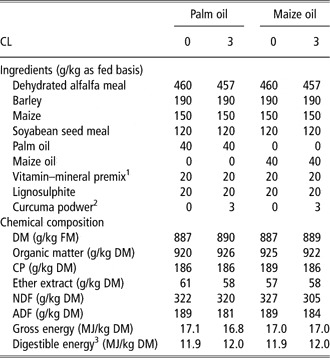
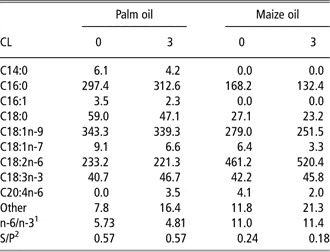
The study was carried out at the CISRA (Centro Interdipartimentale Servizio Ricovero Animali) experimental rabbitry of the University of Turin according to the guidelines for applied nutrition experiments on rabbits (Fernández-Carmona et al., Reference Fernández-Carmona, Blas, Pascual, Maertens, Gidenne, Xiccato and García2005). Forty weaned crossbred rabbits, aged 9 weeks; with a mean weight of 1512 ± 174 g were randomly assigned to four groups of 10 (five male and five female rabbits each) with equal initial weight variability. The animals were housed individually under standard conditions, at a temperature of 22°C ± 2°C, in wire cages at a height of 90 cm from the concrete floor. Four isonitrogenous and isoenergetic diets were formulated with 40 g/kg PO and 40 g/kg MO, with or without CL supplementation (3 g/kg), respectively. The CL powder was obtained from Elika Distribuzioni (Turin, Italy). All the diets were pelleted and stored in the dark to avoid auto-oxidation of the lipid sources. The ingredients and chemical composition of the four diets are shown in Table 1, whereas the FA profile of the four experimental diets is reported in Table 2. The digestible energy content of the diets was calculated according to the regression proposed by Fernández-Carmona et al. (Reference Fernández-Carmona, Cervera and Blas1996).
Ingredients and composition of the experimental diets with or without CL

CL = Curcuma longa; DM = dry matter; FM = fresh matter.
1Per kg of diet: vitamin A 200 UI; α-tocopheryl acetate, 16 mg; niacin, 72 mg; vitamin B6, 16 mg; choline, 0.48 mg; dl-methionine, 600 mg; Ca, 500 mg; P, 920 mg; K, 500 mg; Na, 1 g; Mg, 60 mg; Mn, 1.7 mg; Cu 0.6 mg.
2Proximate composition: DM, 896 g/kg FM, organic matter, 920 g/kg DM, CP, 78 g/kg DM, fat, 70 g/kg DM, crude fibre, 51 g/kg DM, nitrogen-free extract, 838 g/kg DM and gross energy, 18.3 MJ/kg DM.
3The digestible energy content of the diets was calculated according to the regression proposed by Fernández-Carmona et al. (Reference Fernández-Carmona, Cervera and Blas1996).
FA profile (g/kg of total FA) of the diets

FA = fatty acid; CL = Curcuma longa.
1n-6/n-3 = polyunsaturated FA series n-6/polyunsaturated FA series n-3 ratio.
2S/P =saturated FA/unsaturated FA ratio.
After 1 week for adaptation to the diets and cages, the animals were fed ad libitum for 24 days. The rabbits had free access to clean drinking water. The pelletted feed was placed in mangers twice a week.
The rabbits were weighed individually at weekly intervals, whereas the feed consumption was recorded daily; the feed efficiency was estimated as the ratio between consumption and weight gain. Rabbit mortality was zero during the test.
Carcass evaluations and analytical determinations
At the end of the experimental period, the rabbits from each group were weighed and slaughtered without fasting. The carcasses were prepared by removing the skin, feet, paws, genital organs, urinary bladder and digestive tract, as recommended by Blasco et al. (Reference Blasco, Ouhayoun and Masoero1993). The carcass was weighed and the weight of the skin and limbs, head, liver, kidneys, heart and lungs was recorded and expressed as a percentage of slaughter weight (SW). The forelegs, hind legs, breast and ribs, loins and abdominal wall were weighed. Their weight was expressed as a percentage of commercial carcass weight.
The Longissimus dorsi muscle and perirenal fat samples were collected 24 h post mortem from the carcass and immediately frozen at −20°C until analysed.
All muscle samples were analysed for thiobarbituric acid reactive substances, according to the Witte et al. method (Reference Witte, Kraus and Bailey1970).
The proximate composition of the diets and meat were determined according to the Association of Official Analytical Chemists Procedures (2004). The meat and diet samples were analysed to determine DM, total N content, ash by ignition to 550°C and EE using the Soxhlet method. The diet samples were also analysed to determine NDF without sodium sulphite or α-amylase, and ADF, as described by Van Soest et al. (Reference Van Soest, Robertson and Lewis1991), expressed exclusive of residual ash, ADL determined by solubilisation of cellulose with sulphuric acid, as described by Robertson and Van Soest (Reference Robertson and Van Soest1981), and GE by means of an adiabatic bomb calorimeter (IKA C7000, Staufen, Germany).
Lipid extraction was performed on the diets and the tissue samples according to Hara and Radin (Reference Hara and Radin1978), whereas the transesterification of the FAs was carried out according to Christie (Reference Christie1982), with the modifications described by Chouinard et al. (Reference Chouinard, Corneau, Sæbø and Bauman1999).
The FAs were analysed as their methyl esters. The analysis was carried out by means of gas chromatography, as reported by Peiretti et al. (Reference Peiretti, Mussa, Prola and Meineri2007). The saturation (S/P), atherogenic (AI) and thrombogenic (TI) indexes were calculated according to Ulbricht and Southgate (Reference Ulbricht and Southgate1991) as follows:

where MUFA and PUFA are monounsaturated fatty acids and polyunsaturated fatty acids, respectively.
Statistical analyses
The data were analysed as a factorial arrangement of two dietary oil sources (palm v. maize oil) and two levels of CL in the mixed feed (0 v. 3 g/kg) together with the interaction. The experimental analysis unit of all the data was an individual rabbit. The performance, carcass characteristics, meat composition and lipid traits were evaluated by means of the GLM procedure of the SPSS software package (version 11.5.1 for Windows, SPSS Inc., USA). The data were presented as the means of each group and the standard error of the means together with the significance levels of the main effects and interactions. No block, sex effect or interaction was found.
Results
Chemical and FA composition of the diets
As expected, the chemical composition of the four diets was similar for the GE and the other components (Table 1). As far as the FA profile of the diets is concerned (Table 2), the most abundant FAs in the PO diets were oleic acid (OA, C18:1n-9) and palmitic acid (PA, C16:0), whereas the MO diets were rich in linoleic acid (LA, C18:2n-6). The FA pattern of the diets was characterised by higher percentages of SFA and MUFA and lower percentages of PUFA in the PO diets than in the MO diets. Moreover, the n-6/n-3 ratios in the two MO diets were higher than those of the two PO diets, due to their low LA content. The SFA/unsaturated FA (UFA) ratio in the PO diets was more than double than that of the MO diets.
Growth performance and carcass traits
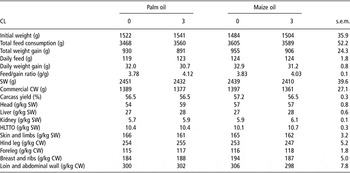
The growth performance and main carcass traits were not affected by the oil source or by CL supplementation (Table 3). The mortality was nil in all the treatments and all the diets. The curcuma diets were consumed without any palatability problems.
The performance and carcass characteristics of growing rabbits fed the experimental dietsFootnote 1

CL = Curcuma longa; SW = slaughter weight; CW = carcass weight; HLTTO = heart, lung, thymus, trachea and oesophagus.
1 The effects of oil, CL and oil × CL were not significant (P > 0.05).
Meat quality
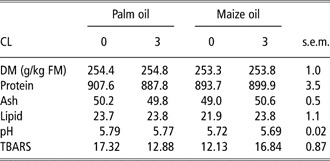
The chemical composition, pH and oxidative status of the L. dorsi muscle of the rabbits fed the experimental diets are reported in Table 4. None of these parameters was affected by the oil source or by the CL supplementation.
Chemical composition (g/kg DM), pH and TBARS (mM MDA/kg DM) of the Longissimus dorsi muscle of rabbits fed the experimental dietsFootnote 1

DM = dry matter; TBARS = thiobarbituric acid reactive substances; MDA = Malondialdehyde; CL = Curcuma longa; FM = fresh matter.
1 The effects of oil, CL and oil × CL were not significant (P > 0.05).
FA composition
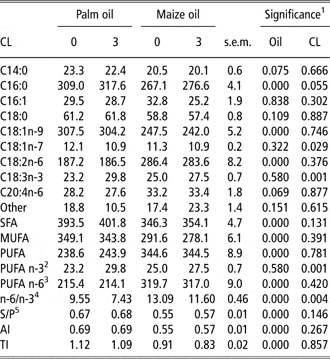
The L. dorsi muscle and perirenal fat showed different FA compositions (Tables 5 and 6, respectively). The FA profile in the tissues mainly reflected the dietary oil sources.
FA composition (g/kg of total FA) and indexes related to human health in the Longissimus dorsi muscle of rabbits fed the experimental diets

FA = fatty acid; CL = Curcuma longa; SFA = saturated FA; MUFA = monounsaturated FA; PUFA = polyunsaturated FA; AI = atherogenic index; TI = thrombogenic index.
1Effects of oil × CL was not significant (P > 0.05).
2PUFA n-3 = PUFA series n-3.
3PUFA n-6 = PUFA series n-6.
4n-6/n-3 = PUFA n-6/PUFA n-3 ratio.
5S/P = SFA/unsaturated FA.
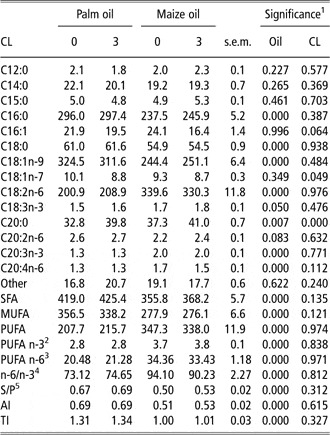
FA composition (g/kg of total FA) and indexes related to human health in the perirenal fat of rabbits fed experimental diets

FA = fatty acid; CL = Curcuma longa; SFA = saturated FA; MUFA = monounsaturated FA; PUFA = polyunsaturated FA; AI = atherogenic index; TI = thrombogenic index.
1The effects of oil × CL was not significant (P > 0.05).
2PUFA n-3 = PUFA series n-3.
3PUFA n-6 = PUFA series n-6.
4n-6/n-3 = PUFA n-6/PUFA n-3 ratio.
5S/P = SFA/unsaturated FA.
Figure 1 reports, in decreasing order and in log scale, the average FA content of the perirenal fat, muscle and feeds. A clearly different pattern distinguishes the trends of the perirenal and the intramuscular fat, if the dietetic nature of the oil supplement is disregarded. Many FAs in the perirenal fat originated from de novo FA synthesis, that is, C12:0, C15:0, C20:0, C20:2n-6 and C20:3n-3, but these were absent in the muscle. As for the exogenous FAs, there were two exceptions concerning α-Linolenic acid (ALA, C18:3n-3) and arachidonic acid (AA, C20:4n-6), which clearly appeared to be concentrated in the muscle in a mode alike or more than proportional to the feed supplement concentration.
Comparative plot of the average fatty acid composition of the tissues and feeds.

The rabbits fed the more saturated PO diets presented significantly higher PA and OA contents and a lower LA content in their L. dorsi muscle than in the muscle of the rabbits fed the more unsaturated MO diets (Table 5). As a consequence, the SFA and MUFA contents were higher in the muscles of the rabbits fed the PO diets than in those of the animals given the MO diets. The total PUFA and PUFA n-6 contents were higher in the muscles of the rabbits fed the unsaturated MO diets than in those of the animals given the PO diets.
The CL supplementation increased the levels of ALA and the PUFA n-3 content, whereas it depressed the vaccenic acid (VA, C18:1n-7) content.
The FA composition of the perirenal fat depot was influenced to a great extent by the dietary oil and, to a lesser extent, by the CL supplement (Table 6). The main variations affected the PA, OA, LA, ALA, AA, C18:0, C20:0, C20:2n-6 and C20:3n-3 contents. There were several FAs in the perirenal fat and these were more featured than in the intramuscular fat. In the same way as in the muscle, the PA and OA contents were higher, whereas LA was lower in the fats of the rabbits fed the PO diets than in those of the animals given the MO diets. ALA was detected in lower percentages in the perirenal fat than in the L. dorsi muscle. Some FAs that were not found in the muscle (C12:0, C15:0, C20:0, C20:2n-6 and C20:3n-3) were detected in the perirenal fat, although most were in very low percentages.
The effect of CL supplementation decreased the VA content and increased the C20:0 content in the perirenal fat.
The nutritional quality of meat and fat has been evaluated in terms of the n-6/n-3 ratio, the SFA/UFA ratio, the AI and the TI (Tables 5 and 6). The n-6/n-3 ratio was lower in the L. dorsi muscle and perirenal fat of the rabbits fed saturated oil diets, whereas the other parameters were significantly higher in both tissues of the rabbits receiving the PO diets. The CL supplementation was only found to influence the n-6/n-3 ratio in the L. dorsi muscle.
Discussion
As far as the ingredients of the four diets are concerned, they only differed according to the type of oil and the presence or lack of CL. The chemical composition and GE of the diets were therefore similar.
The perirenal fat reflected the dietary FA composition more than the intramuscular fat, which is in agreememt with previous reports (Ouhayoun et al., Reference Ouhayoun, Kopp, Bonnet, Demarne and Delmas1987; Bernardini et al., Reference Bernardini, Dal Bosco and Castellini1999). The PUFA depot is in fact pre-eminent in the adipocytes, whereas lipids play a functional role in the muscle tissue (Bernardini et al., Reference Bernardini, Dal Bosco and Castellini1999).
The composition of the dietary fat source can modify the FA composition of rabbit tissues to a great extent and can play different roles in the quality of the carcass and meat (Cobos et al., Reference Cobos, Cambero, Ordóñez and de la Hoz1993; Fernández and Fraga, Reference Fernández and Fraga1996). Many of these researches used diets that contained high-LA fat sources. Similarly in this study, the effect of the different dietary oil or seed oil source did not seem to significantly affect the growth performance, the main carcass traits or the meat lipid content of rabbits to any extent (Peiretti et al., Reference Peiretti, Mussa, Prola and Meineri2007; Peiretti and Meineri, Reference Peiretti and Meineri2008). Fernández and Fraga (Reference Fernández and Fraga1996) have shown that the SW and dressing proportion are not affected by dietary fat sources, whereas Gondret et al. (Reference Gondret, Mourot, Lebas and Bonneau1998) have found that different vegetable fat sources (coconut, palm and sunflower oil) do not affect growth performance, the main carcass traits or the carcass and meat lipid, with the exception of the lipid content of L. dorsi muscle, which was significantly lower in the coconut diet, compared to the other two diets.
Dal Bosco et al. (Reference Dal Bosco, Castellini, Bianchi and Mugnai2004) has found that the proximate composition of fresh meat is not significantly affected by the dietary antioxidant treatment.
In our study, a marked difference in the PA, OA and LA contents in the depot lipids (intramuscular lipids and perirenal fat) has been observed between the rabbits receiving a source of oil rich in SFA or in MUFA and PUFA; moreover, the FA contents of the depot lipids in the rabbits fed unsaturated diets are similar to those reported in the literature (Cobos et al., Reference Cobos, Cambero, Ordóñez and de la Hoz1993; López-Bote et al., Reference López-Bote, Rey, Ruiz, Isabel and Sanz Arias1997). Enriching the diets of rabbits with soya, sunflower oils or soyabeans increases the proportion of UFAs compared to those obtained using conventional diets (Cobos et al., Reference Cobos, Cambero, Ordóñez and de la Hoz1993). Hernández et al. (Reference Hernández, Cesari and Pla2007) have studied the FA composition of the leg meat of rabbits fed three diets enriched with 30 g/kg animal fat, 30 g/kg linseed oil and 30 g/kg sunflower oil, respectively. These authors found higher percentages of LA and ALA in the meat of the animals fed the diet enriched with linseed oil and sunflower oil, respectively, than in the meat of the animals fed the diet enriched with animal fat.
However, a dietary enrichment with vegetable oils does not always increase the unsaturation index of the intramuscular lipids. López-Bote et al. (Reference López-Bote, Rey, Ruiz, Isabel and Sanz Arias1997) have observed that the addition of olive oil or sunflower oil does not significantly change this parameter and even reduces the PUFA n-3 concentration in polar lipids, compared to rabbits fed non-enriched diets.
As far as the effect of CL integration in the diets is concerned, there are two aspects that should be considered: its contribution of PUFA to the diet and its known antioxidant effect.
In our study, with regard to the effect of the dietary contribution of PUFA due to CL, we have found that CL supplementation of the MO and PO diets increases the ALA contents and reduces the n-6/n-3 ratio in rabbit meat. It is possible that curcumin is involved in desaturase activites. According to Rise et al. (Reference Rise, Ghezzi, Levati, Mirtini, Colombo and Galli2003), it totally inhibits the Δ6 and Δ5 desaturation steps, preserves the level of ALA, and decreases cholesterol synthesis. In a prolonged administration to rabbits, Wientarsih et al. (Reference Wientarsih, Chakeredza and ter Meulen2002) have observed that Curcuma xanthorrhiza significantly decreases LDL and triglyceride concentrations. Curcuma inclusion has led to an increase in the 3-hydroxy-3-methylglutaryl coenzyme (HMG-CoA) reductase inhibitor activity (Wientarsih et al., Reference Wientarsih, Chakeredza and ter Meulen2002) and the inhibition of HMG-CoA reductase resulted in a decrease in cholesterol synthesis in rat cells (Amin et al., Reference Amin, Gustafson, Weinacht, Cornell, Neuenschwander, Kosmider, Scotese, Regan and Perrone1993). The critical enzymes for producing PA, C18:0 and OA to maintain homoeostasis, are FA synthase, elongase and desaturase. These enzymes link the PA, C18:0 and C20:0 non-essential FAs in a network of pathways (Bassilian et al., Reference Bassilian, Ahmed, Lim, Boros, Mao and Lee2002). The present research has shown that CL decreases the VA content in both intramuscular and depot fats, probably because of its desaturation to ALA, and the desaturase step in the muscle in fact progressively yields more ALA. This has not occurred in the perirenal fat, but the elongase activity has operated at the same time to produce more C20 chains. This finding is in agreement with the favourable modification of triglycerides provided by curcuma, even at low levels, which could be beneficial for young animals.
However, the impact of FA modification on the tissues induced by CL on the oxidative stability of fresh meat has not been significant in this study. This effect of CL should be evaluated with unpelletted diets or pelleted by the cold extrusion method, in order to avoid a possible degradation of curcumin in the heating pressure process. The latter aspect is very important as diets rich in PUFA are more susceptible to oxidation than diets containing SFAs, because of the high temperatures that are used in the feed pelleting process.
The prevention of lipid oxidation in muscle-based food can be achieved through the addition of natural antioxidants, such as vitamin E, as dietary supplements. In recent years, different studies have examined the effects of extra dietary supplementation with vitamin E on the deposition of α-tocopherol in tissues, on meat quality characteristics, on oxidative stability and on the shelf life of rabbit meat (López-Bote et al., Reference López-Bote, Rey, Ruiz, Isabel and Sanz Arias1997; Dal Bosco et al., Reference Dal Bosco, Castellini and Bernardini2001; Lo Fiego et al., Reference Lo Fiego, Santoro, Macchioni, Mazzoni, Piattoni, Tassone and De Leonibus2004).
The effect of the synergetic dietary supplementation of vitamins C and E has also been investigated, and has shown to lead to an increase in the vitamin content and a reduction in the oxidation of lipids (Castellini et al., Reference Castellini, Dal Bosco and Bernardini2001; Lo Fiego et al., Reference Lo Fiego, Santoro, Macchioni, Mazzoni, Piattoni, Tassone and De Leonibus2004; Selim et al., Reference Selim, Abdel-Khalek, Nada and El-Medany2008).
The addition of CL further enhances the PUFA n-3 content in the intramuscular fat and this improves the nutritional value of rabbit meat. Further research, using higher levels of CL supplementation, will help solidify the benefits of its use.
Acknowledgement
The research was in part financed by Italian University funds ‘Ministero dell'Università e della Ricerca – Fondo ex-60%’.