Introduction
Epilepsy is the third most common neurological disorder after dementia and stroke amongst older people.Reference Wallace, Shorvan and Tallis1 A diagnosis of epilepsy can have a profound effect on a person's physical health, psychological wellbeing and functional ability. Epilepsy is more likely to develop in later life and, with an increasingly ageing population, it is important that clinicians appreciate the specific factors to address when assessing and managing an older person with epilepsy. The clinical presentation of seizures in this group is often atypical and subtle, making diagnosis challenging. Clinicians frequently experience difficulties acquiring accurate accounts of events that are often crucial when making a secure diagnosis, and it is worth the effort of acquiring a corroborative account wherever possible. A comprehensive history and physical examination with targeted investigations is fundamental when diagnosing epilepsy in this group. Drug treatment can be a challenge as age-related physiological changes can affect the pharmacodynamics and pharmacokinetics of medications, and this complexity is compounded by a scarcity of randomized evidence for treating this age group. This article aims to provide an overview of epidemiology, aetiology and the current recommendations for assessing and managing epilepsy in older people.
Search methods
We identified references for this review through searches of publications listed by PubMed, MEDLINE and Ovid from 1 January 1990 to 1 December 2013. We used the search terms ‘epilepsy’, ‘older adults’, ‘anti-epileptic drugs’, ‘efficacy’ and ‘seizures’. References were also identified from relevant review articles, national guidelines and textbooks. Only articles published in English were reviewed. We excluded articles published in non-peer-reviewed journals. The final reference list was based on relevance to the topics covered in the review especially older adults.
Definitions
Epilepsy is a common neurological disorder, characterized by a propensity to have recurrent and unprovoked seizures. It can be distinguished from acute symptomatic seizures, which have an identifiable and immediately preceding cause.
The International Seizure Classification SchemeReference Berg, Berkovic, Brodie, Buchhalter, Cross, Van Emde Boas, Engel, French, Glauser, Mathern, Moshé, Nordli, Plouin and Scheffer2 divides seizures into two main groups according to the putative source of the epileptic discharge. Those originating from localized cortical areas are classified as partial (focal) seizures and those characterized by bilateral involvement of the cortex are classified as generalized seizures.Reference Scadding and Losseff3 Seizures can also be classified with or without loss of awareness/consciousness.
Seizures without loss of consciousness include myoclonus, simple partial subjective seizures (aura) and simple partial motor seizures. Myoclonus is sudden irregular jerk caused by involuntary muscle activity and in the awake-state requires further investigations. Aura is designated as a ‘focal seizure without impairment of consciousness or awareness involving subjective sensory or psychic phenomenon only’. Simple partial motor seizures are tonic, clonic or dystonic and designated as ‘focal motor seizures without impairment of awareness or consciousness’.
Seizures with loss of consciousness include absences, complex partial seizures and tonic–clonic seizures. Absences were previously known as ‘petit mal’, last seconds and are uncommon in older age. Complex partial seizures are designated as ‘focal seizures with impairment of consciousness or awareness’ and are common in older adults. Tonic–clonic seizures are generalized seizures, with or without warning and associated with post-ictal confusion.
Epidemiology
Compared with a younger population, older people are more likely to develop seizures and this risk increases with age.Reference Wallace, Shorvan and Tallis1, Reference Stephen and Brodie4, Reference De La Court, Breteler and Meinhardi5 They may be provoked by an acute illness, or present without an obvious cause. The annual incidence has been estimated at 85 per 100,000 for people aged 65–69 years, increasing to 159 per 100,000 in people aged over 80.Reference Wallace, Shorvan and Tallis1 The risk is significantly increased in people with cerebrovascular disease and dementia.Reference Mendez and Lim6 The prevalence of epilepsy in older people is 0.7–1.2%,Reference De La Court, Breteler and Meinhardi5 but this figure is likely to be an underestimate due to difficulties recognizing and diagnosing seizures in this population. The incidence of status epilepticus increases with age and these events in older people have a high mortality of up to 38%.Reference Delorenzo, Hauser and Towne7
Data from Health Episode Statistics show a total of 17,695 patients admitted to hospital in England with seizures aged 60 and above in 2012–2013.8 As the population ages, the number of older people with epilepsy is expected to rise, which in turn will have a significant impact on health care resources and services.
Clinical presentation in older adults – could this be epilepsy?
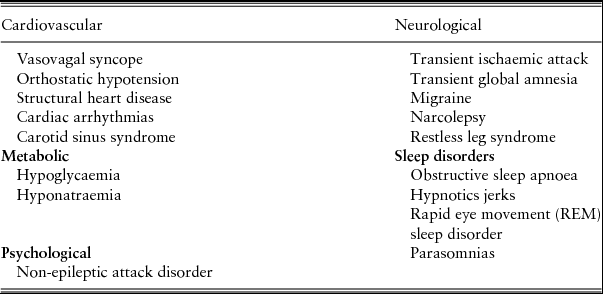
Older people with seizures may present to a variety of medical professionals due to the difficulties recognizing the condition and the multiple differential diagnoses (Table 1). A secure diagnosis of epilepsy in older people can be a challenge as the clinical presentation may be non-specific or subtle. Poor recollection of events may result from co-existing cognitive impairment or a disturbance of consciousness at the time of the event. The most common seizure types in older people are partial seizures, either simple (consciousness preserved) or complex (consciousness impaired) which can contribute to the difficulties in diagnosing this condition. A witness account is therefore invaluable when determining the cause of a collapse or ‘funny turn’.
Differential diagnosis of epilepsy in older people

Data from the Veterans Affairs Cooperative Study found that epilepsy as a diagnosis was considered initially in 73.3% of patients ultimately diagnosed with epilepsy. Other initial diagnoses included blackouts, syncope, dizziness and dementia and the mean time to diagnosis was 1.7 years. Factors contributing to these delays in diagnosis were felt to be the infrequent occurrence of generalized tonic–clonic seizures, partial complex seizures with subtle presentations, patients being unaware of seizures and the frequent presence of co-morbidities, which can all confound and delay the diagnosis.Reference Rowan, Ramsay and Collins9
Seizures in older people should be considered if a patient presents with any of the following:
• recurrent episodes of loss of consciousness;
• transient confusion;
• behavioural changes;
• unexplained ‘absences’ or staring;
• twitching and involuntary movements;
• recurrent episodes of sleep disturbance;
• frequent falls with no recollection;
• ‘strange’ feelings.
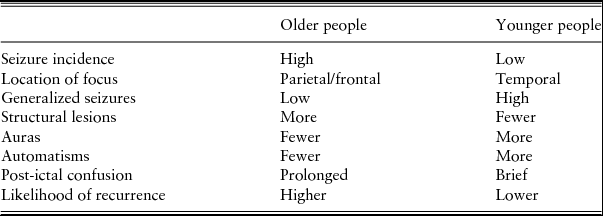
Table 2 illustrates differences in seizure presentation between older and younger patients.Reference Burn, Dennis and Bamford10
Difference in seizure presentation between older and younger people
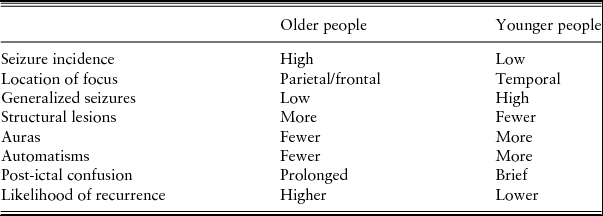
Adapted from Collins (2006).Reference Collins, Shapiro and Ramsay11
Aetiology in older adults
Acute symptomatic seizures are those provoked by an immediately preceding cause and are almost always generalized tonic–clonic seizures. These seizures usually stop occurring if the causative circumstance is corrected. Acute symptomatic seizures can be precipitated by systemic infections and by those affecting the central nervous system. Hypoglycaemia, hyperglycaemia, hyponatraemia, uraemia, hepatic failure and hypothyroidism are all recognized metabolic causes and medications including antibiotics, antidepressants, antipsychotics, opiates and steroids can lead to seizures. The risk of medication-induced seizures is increased with polypharmacy, intercurrent illness and high doses. Alcohol and benzodiazepine withdrawal can precipitate seizures and must be considered in the older population. Less common causes include hypertensive encephalopathy and cerebral vasculitis.
The most common identifiable cause of epilepsy in older people is cerebrovascular disease, the incidence of which increases with age. Neurodegenerative disorders such as dementia, tumours and trauma should also be considered. The Veterans Administration Cooperative Study found that 24.6% of the patients in that study were classified as having seizures of unknown cause.Reference Rowan, Ramsay and Collins9
Seizures at the onset of a stroke occur in 2% of stroke patients and these patients are more likely to have post-stroke seizures.Reference Burn, Dennis and Bamford10 There is an 11.5%Reference Collins, Shapiro and Ramsay11 risk of having a seizure in the 5 years following a stroke and seizures are more likely to complicate a stroke if the stroke involves the cortex, is haemorrhagic, large, multi-focal or initially presents with a seizure.Reference Burn, Dennis and Bamford10 Conversely, there is an increased risk of stroke in those with late-onset epilepsy.Reference Lancman, Golimstok, Norscini and Granillo12
Alzheimer's dementia is associated with a sixfold increased risk of seizures compared with a control populationReference Cleary, Shorvon and Tallis13 and 10–22% of patients with Alzheimer's dementia have had at least one unprovoked seizure. Most seizures in elderly patients are partialReference Hesdorffer, Hauser, Annegers, Kokmen and Rocca14 and the increased incidence of generalized seizures in patients with dementia may be due to secondary seizures following unrecognized partial seizures.
Gliomas, menigiomas and brain metastases are the most common tumours causing seizures in older people,Reference Hiyoshi and Yagi15 although the presence of an abnormality on imaging may be an incidental finding.
Up to 18% of epilepsy in older people can be attributed to trauma,Reference Hesdorffer, Hauser, Annegers, Kokmen and Rocca14 which is often due to falls in older people. Subdural haematomas, loss of consciousness, significant amnesia and brain contusion have all been identified as risk factors for subsequent epilepsy following trauma.Reference Roberts, Godfrey and Caird16
Diagnostic evaluation
Under- and over-diagnosis of epilepsy in older people occurs due to the difficulty differentiating between causes of ‘funny turns’. The diagnosis relies heavily on the clinical history and a corroborative account of the event or events. The true extent of misdiagnosis is unclear and the true prevalence of epilepsy in older people is difficult to quantify with certainty. Events may be under-reported by patients or their carers and cognitive impairment can inhibit the patient's ability to recall events. Observer accounts may not be available if the patient lives alone and they may be mis-diagnosed. Over-diagnosis can occur if incorrect assumptions are made, such as incontinence, myoclonus and convulsions only occur during seizures.
History
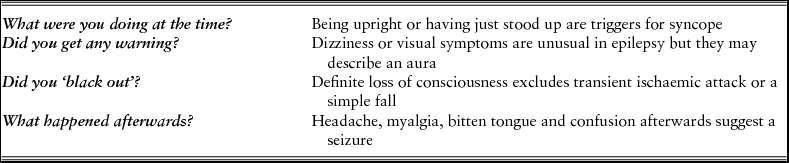
A thorough history from the patient and observer can be crucial when considering the diagnosis. Episodes are paroxysmal, stereotyped and unpredictable. Typical involuntary movements or absences may be described, but more subtle symptoms such as intermittent confusion, behavioural change or frequent falls should prompt further consideration of the diagnosis. The possibility of previous events should be explored by asking about previous episodes of collapse or confusion. Key questions to ask the older patient presenting with falls, faints or funny turns are listed in Table 3.Reference Annegers, Hausen, Coan and Rocca17
Key questions to ask the older patient with falls, faints and funny turns
Adapted from Epilepsy in Later Life: A Good Practice Guide (2008)18 with permission.
Examination
Physical examination should focus on the cardiovascular and neurological system to assess for the presence of differential diagnoses, including orthostatic hypotension, arrhythmias and valvular heart disease. Routine blood tests to check electrolytes, glucose, liver and thyroid function should be performed. An electrocardiogram assessing for conduction abnormalities or arrhythmias and postural blood pressures should be reviewed. More specialist investigations, including tilt-table testing and ambulatory electrocardiography, should be guided by the clinical presentation. There may be false positives and an abnormal test result may not exclude the diagnosis of epilepsy.
Neuroimaging
National Institute for Health and Care Excellence (NICE) guidance19 advises that magnetic resonance imaging (MRI) is the imaging of choice to identify structural abnormalities. Computerized tomography (CT) can be used to assess for gross pathology if MRI is not available or contra-indicated. A CT would also be appropriate in the acute setting to establish if a seizure is caused by an acute illness or neurological lesion. Age-related changes including atrophy and small vessel disease are common findings and should not routinely be interpreted as the cause of seizures.
Electroencephalogram
NICE guidance19 states that electroencephalography (EEG) should not be used in isolation to make a diagnosis of epilepsy. This is in part due to the test's variability of sensitivity (26–56%) and specificity (78–98%). NICE guidance also states that an EEG should not be performed in the case of probable syncope due to the possibility of a false-positive result. A negative EEG cannot be used to rule out the clinical diagnosis of epileptic seizures.
Management
It is important to exclude seizures with an identifiable precipitating cause, as these symptomatic seizures often do not require anti-epileptic medications if the cause can be identified and treated.
The Multicentre study of Early Epilepsy and Single Seizures trial recommends that treatment with anti-epileptic medication should be considered if there is focal neurological involvement or a risk of recurrence following first seizure.Reference Marson, Jacoby, Johnson, Kim, Gamble and Chadwick20 It is also important to consider the risk of physical and cognitive consequences of seizure recurrence when considering initiation of treatment.
The goal of treatment in epilepsy is to have complete seizure control with minimal side-effects to enable the patient to return to normal physical health and function. The frequency of recurrent seizures is less in older people than in the general populationReference Ramsay, Rowan and Pryor21 and up to 75% can expect to remain seizure free.Reference Bagshaw, Crawford and Chappell22 The diagnosis should be explained to the patient and any carers to increase understanding and it is important to give patients advice about driving, lifestyle factors and information about how they can access support.
The decision to start anti-epileptic medications should be discussed with patients and any carers to consider the risks and benefits of treating or of watchful waiting. Complicating factors in older people include altered pharmacokinetics and pharmacodynamics, poor renal function, polypharmacy, co-morbidities and cognitive impairment. It is important to review medications such as antidepressants and antipsychotics, as many can reduce the seizure threshold in older people.
Monotherapy, using medications with minimal cognitive and sedative adverse effects, is the preferred option, with medications starting at low doses and being titrated up.19 Change in pharmacokinetics and higher sensitivity to adverse events, lower glomerular filtration rates, changes in body fat, albumin, and cytochrome P450 occur with ageing and need to be considered. In addition, concomitant diseases such as hypertension are common in this age group and often require medication, increasing the possibility of drug interactions with anti-epileptic drugs.Reference Schmidt and Schachter23 There is a perception that older people are more susceptible to adverse effects. However, this is difficult to prove due to the lack of randomized trials. The therapeutic options are increasing, but there is still a paucity of randomized multicentre controlled trials assessing monotherapy and adjunctive treatment in older patients.
In a multicentre, double-blind trial, elderly patients with newly diagnosed epilepsy were randomized to treatment with lamotrigine or carbamazepine. The adverse event rate was higher with carbamazepine. Lamotrigine was found to have a lower rash rate and less somnolence. Although there was no difference between the medications in the time to first seizure, a greater percentage of patients treated with lamotrigine remained seizure free. The study concluded that lamotrigine could be regarded as an acceptable choice as initial treatment for elderly patients with newly diagnosed epilepsy.Reference Brodie, Overstall and Giorgi24 However, another multicentre double-blind study assessed the effectiveness, efficacy and tolerability of lamotrigine and sustained-release carbamazepine and found comparable effectiveness, with higher seizure-free rates for carbamazepine and better tolerability for lamotrigine. The difference may have been due to the use of a sustained release formation of carbamazepine.Reference Saetre, Perucca and Isojärvi25
A further multicentre randomized double-blind study of elderly patients with newly diagnosed seizures assigned patients to gabapentin, carbamazepine or lamotrigine, to assess tolerability and efficacy. The main issue was adverse drug reactions limiting patient retention. Seizure control was similar throughout the groups, but tolerability was better with lamotrigine and gabapentin.Reference Rowan, Ramsay and Collins9
NICE guidance for newly diagnosed seizures in adults suggests carbamazepine, lamotrigine, levetiracetam and pregabalin for focal seizures and lamotrigine, sodium valproate and levetiracetam for generalized seizures.19
Psychosocial impact
There is extensive advice available on the Epilepsy Society website26 on subjects such as how to improve personal safety, caring for people with epilepsy and about driving.
In the UK, after a seizure of any kind a patient must stop driving and inform the Driver and Vehicle Licencing Agency (DVLA).27 After an isolated seizure, a patient may be able to drive after 6 months if there have been no further seizures and there are no clinical factors or results from investigation which suggest a high risk of having another seizure. To drive with a Group 1 driving licence (cars and motorcycles), patients must be completely seizure free for one year, with or without taking anti-epileptic medications. If the seizures only occur at night, or if the seizures have never affected a patient's consciousness or ability to control a vehicle, they may be able to drive after one year. Group 2 licences (LGV and Lorries) require the patient to be seizure free for 10 years without taking anti-epileptic medication.
In later life, the social and functional effects of epilepsy can be profound and diverse. Increased falls, confusion and loss of confidence can all lead to social isolation and a loss of independence. Depression and anxiety are associated with epilepsyReference Haut, Katz, Majur and Lipton28 and it is important that medical professionals recognize that these issues can have a substantial negative effect on quality of life.
Conclusion
Epilepsy in older people is common and, with the number of elderly people set to rise, there are significant implications for healthcare resources. Despite this, there is a relatively small amount of research on the subject and a significant lack of randomized evidence to guide current practice. It is widely recognized that diagnosis of this condition in older people is problematic due to the subtle ways in which patients may present and the range of differential diagnoses that must be considered. Multiple co-morbidities, cognitive impairment and social isolation all confound these difficulties. The aim of treatment with medications is to have complete seizure control with minimal side-effects, to enable the patient to return to normal physical health and ensure quality of life is maintained. The prognosis in this age group is good, and with appropriate treatment the majority of elderly people will remain seizure free.
Conflicts of interest
None