

Introduction
Purchasing a mortgage to buy a home is the largest financial transaction many households ever make. Even if a consumer searches initially for a low interest rate, which is far from guaranteed (Lee & Hogarth, Reference Lee and Hogarth2000), there are likely to be times during the lifetime of the mortgage when switching to a better deal would generate substantial savings. Willingness to refinance with another provider is hence important for consumer welfare and the proper functioning of a competitive market. However, given the complexity of mortgage products, length of repayment terms and non-linear relationship between payments and interest rates, the decision to switch is not straightforward.
This paper describes a laboratory experiment that offers insight into consumers’ willingness to switch and difficulties with switching, while testing the effectiveness of online advice about switching provided by a regulator. The experiment was conducted in collaboration with the regulator to assist a change in policy and hence constitutes an example of empirically informed regulation (Sunstein, Reference Sunstein2011). In summer 2018, an addendum to Ireland's Consumer Protection Code (2012) was announced. The new regulations mandate providers to notify consumers on variable-rate mortgages when they have the potential to move to cheaper interest rates and, importantly for the current study, to direct consumers to a specific advice webpage hosted by the government agency responsible for enforcing competition and consumer protection law in Ireland (the Competition and Consumer Protection Commission; CCPC). This website provides comprehensive information about the switching process and contains tools to help consumers to find cheaper interest rates. The current experiment was conducted ahead of the regulations coming into force in January 2019 and was designed to test this advice and, if necessary, to inform changes to it. Working closely with the relevant regulator, the main aim was therefore to test a necessary condition for the policy to be effective: that the website advice is useful to potential mortgage switchers. (Of course, a positive result is not a sufficient condition for the overall regulation to be effective, which would also require that the mandate increases the number of potential switchers who read the advice.)
While the primary goal was to determine whether the mandated advice helped consumers, the experiment had several other motivations. A second was diagnostic: we aimed to investigate the attractiveness of specific attributes of a modern mortgage product. We measured expressed willingness to switch to alternative mortgages while manipulating mortgage attributes, including ‘cashback’ offers. As we describe below, cashback has become a prominent feature of mortgage markets in multiple countries in recent years and raises some consumer protection concerns. A third motivation was to assess the extent and role of perceived hassle in consumers’ willingness to switch – a potentially important factor that has received little attention in previous studies involving mortgage consumers. We sought to test the role of hassle through two manipulations. First, we attempted to prime some consumers to consider the hassle of switching by asking them to list all of the actions they would need to take in order to switch. The hope was that this would make these actions salient when judging the attractiveness of switching. In fact, this variable revealed substantial variability in participants’ knowledge of the switching process. Consequently, we treat the variable primarily as a measure of knowledge or certainty about the switching process, rather than as an experimental manipulation. The second way we estimated the hassle was by asking participants to make some judgements for themselves, considering everything they would need to do in order to switch, and to make other judgements for a friend who was interested only in getting a good deal. The logic of this ‘buyer's agent’ manipulation was that differences between these judgements could be attributed to the transaction costs of switching.
Lastly, we wanted to gain insight into comprehension of mortgage products. We used an incentivized test to gauge understanding after participants had read the online advice in order to identify specific areas of difficulty for consumers. This test had the added benefit of providing a measure of mortgage comprehension that could be used to test whether better understanding is associated with willingness to refinance – albeit not a causal test.
The paper therefore offers several contributions to the literature on behaviourally informed financial regulation. In using a sample of mortgage-holders to test how online advice provided by a regulator affects evaluations of mortgage offers, perceptions of transaction costs and consumers’ self-assessed competence to switch, the experiment provides evidence in relation to the potential effectiveness of a specific regulatory mandate. By measuring the attractiveness of different mortgage attributes, assessing the role of hassle in the switching process and identifying aspects of mortgages that consumers find hardest to understand, the experimental findings constitute helpful evidence for consumer policy-makers beyond the specific policy context. Lastly, the present study demonstrates how a laboratory experiment can provide useful behavioural evidence for policy by pre-testing an intervention, investigating specific decision-making mechanisms and assessing consumer capability (Lunn & Ní Choisdealbha, Reference Lunn and Ní Choisdealbha2018).
Background
Although mortgages constitute a majority of consumer debt and substantial savings can often be made from switching to a lower annual percentage rate (APR), the rates at which mortgage-holders do so are notoriously low. Even considering the transaction costs of switching (Klemperer, Reference Klemperer1987), the vast majority of consumers who have the potential to make large savings from refinancing fail to do so in both European and US markets (e.g., Miles, Reference Miles2004; Campbell, Reference Campbell2006; Bajo & Barbi, Reference Bajo and Barbi2014; Andersen et al., Reference Andersen, Campbell, Nielsen and Ramadorai2015; Devine et al., Reference Devine, Frost and McElligott2015; Johnson et al., Reference Johnson, Meier and Toubia2016).
Younger and more educated mortgage-holders with higher incomes are more likely to be among the minority of consumers who do take advantage of the savings to be made from switching (Andersen et al., Reference Andersen, Campbell, Nielsen and Ramadorai2015; Brunetti et al., Reference Brunetti, Ciciretti and Djordjevic2015; Keys et al., Reference Keys, Pope and Pope2016). Less is known about how different features of the mortgage might be associated with the propensity to switch. Bajo and Barbi (Reference Bajo and Barbi2014) found that, among mortgage-holders in Italy with high incomes and educational attainment, those with high principals and long repayment terms were more likely to make optimal refinancing decisions, especially when large decreases in APR were available. Other work has investigated consumers’ judgements when purchasing a mortgage. One frequent factor shown to influence decisions is steep time discounting: weighting short-term financial outcomes substantially more strongly than long-term ones. For example, although some consumers who anticipate higher future incomes choose mortgages with lower introductory rates in order to back-load costs and smooth consumption, these same rates may also attract short-sighted consumers who do not have the same expected income gains (Cocco, Reference Cocco2013; Agarwal et al., Reference Agarwal, Amromin, Chomsisengphet, Landvoigt, Piskorski, Seru and Yao2015; Atlas et al., Reference Atlas, Johnson and Payne2017; Gathergood & Weber, Reference Gathergood and Weber2017; Amromin et al., Reference Amromin, Huang, Sialm and Zhong2018). The risk of being unable to meet future repayments is exacerbated by the complexity of mortgages as a financial product. Consumers who do not understand some features of their contract are more likely to hold back-loaded mortgages (Bucks & Pence, Reference Bucks and Pence2008).
While steep time discounting might reduce consumers’ desire to obtain long-term gains from lower interest rates, it can also be leveraged to encourage switching. Following regulatory attempts to make switching easier, banks have begun to entice consumers to their products with immediate cash incentives, advertised as a fixed lump sum or as a proportion of the outstanding mortgage. These ‘cashback offers’ have become prevalent in mortgage markets in Ireland, the UK and Canada, and they have the potential to exploit consumers who may be enticed by upfront benefits, without perhaps appreciating the longer-term costs (e.g., Rowe et al., Reference Rowe, Wright and Wootton2015). Indeed, mortgages with cashback offers in these three countries typically have higher interest rates than those without, with total cost differences of up to €30,000 over the lifetime of the mortgage (King & Singh, Reference King and Singh2018).
Of course, consumers might favour mortgages with cashback offers for strategic reasons, such as liquidity constraints or to pay for the legal fees associated with switching. However, when King and Singh (Reference King and Singh2018) presented experimental participants with two mortgage offers with equivalent immediate financial consequences (e.g., a mortgage of €300,000 with €6000 cashback and a required deposit of €50,000 versus a lower-interest mortgage with no cashback and a deposit of €44,000), they preferred the cashback offer. Importantly, the perceived attractiveness of the cashback offer diminished when differences in total costs were made salient.
Research questions
To the best of our knowledge, no experimental research has examined how varying different attributes of a mortgage offer affects how attractive consumers perceive switching to be. This is important background knowledge for policy-makers seeking to encourage switching to better-value products. As such, our first research question was exploratory in nature:
(1) What attributes of a mortgage offer affect consumer perceptions of switching offers?
Time preferences may also reduce switching if consumers perceive substantial transaction costs, which we refer to as the ‘hassle’ of switching. Upfront time, financial and psychological commitments required to refinance may be aversive, given that the primary financial benefits will not be experienced until later in the lifetime of the mortgage. Importantly, these costs need not be perceived accurately in order to act as a barrier to switching. One survey of over 2000 mortgage-holders found that, of those who had considered switching, half cited concerns with the complexity of the process as a reason not to, whereas far fewer of those who had switched thought the process was overly complicated (Central Bank of Ireland, 2017). Policy-makers looking to reduce perceived transaction costs and to give helpful advice to potential switchers can hence benefit from greater insight into the relationship between perceptions of the switching process and willingness to switch. Thus, our second research question targeted consumers’ perceptions of the switching process:
(2) How much does the perceived hassle of switching influence willingness to switch?
One signal that perceived hassle may exceed actual transaction costs is the finding that consumers who score higher on measures of financial literacy tend to be more likely to switch (e.g., Johnson et al., Reference Johnson, Meier and Toubia2016). While these consumers may perceive the switching process more accurately, they may also find it personally more manageable or feel more competent to execute it successfully. Moreover, a significant minority of consumers report being unaware of the exact costs involved and cite a lack of information as a reason not to engage (Keys et al., Reference Keys, Pope and Pope2016; Central Bank of Ireland, 2017), despite the fact that these consumers have previous experience with purchasing a mortgage. One issue with using measures of financial literacy to predict financial behaviour is the discrepancy between perceived financial ability and objectively measured ability (e.g., Kramer, Reference Kramer2016), which may be especially important for mortgage decisions. It is well established that people are more likely to take ambiguous bets if they perceive themselves as competent in that domain (i.e., the ‘competence hypothesis’; Heath & Tversky, Reference Heath and Tversky1991). If consumers perceive the switching process as ambiguous or uncertain, only those who feel competent to make decisions about their mortgage may attempt to do so, regardless of the actual hassle involved. Hence, we were also interested in the following:
(3) How much does competence (either perceived or objectively measured) influence willingness to switch?
Importantly, consumer understanding of mortgage products can be improved via carefully constructed communication. For example, information disclosures can help consumers to choose cheaper mortgage products (Nicholson et al., Reference Nicholson, Skelton and Tarr2018) and behaviourally informed disclosures can improve comprehension of different mortgage features (Lacko & Pappalardo, Reference Lacko and Pappalardo2010). Hence, it is plausible that simple but comprehensive information about mortgage switching may improve perceptions of transaction costs and aid understanding of mortgage products in general, thereby increasing the likelihood that consumers will switch and obtain the associated long-term savings.
This possibility was one explicit goal of the addendum to consumer protection policy announced by the Central Bank of Ireland in June 2018. The provisions of this addendum increased transparency for consumers. At the end of a fixed-rate period, providers must now notify consumers with a summary of available interest rates that could provide savings. Consumers on variable rates must be notified regularly of rates to which they could switch and save money. Of central importance for this paper, providers must now direct their consumers to the relevant section of the CCPC's website, which explains the switching process, outlines factors to consider when choosing between mortgage products and contains a price comparison tool. Hence, our aim was to examine whether the advice provided by the regulator is effective at a specific point in the process of deciding to refinance: when the consumer is considering refinancing and evaluates potential alternative mortgages, making comparisons between the attributes of their own mortgage and others available in the market. Working closely with the CCPC, we designed the experiment to explore how mortgage-holders perceive different types of switching offers and how this perception changes after reading the advice from their website. Hence, our final and overarching research question was:
(4) Do the answers to (1), (2) and (3) change if the mortgage-holder reads consumer advice on switching their mortgage?
Method
The study was conducted in line with institutional policy for the ethical conduct of research.
Participants
Participants were 110 mortgage consumers recruited by a market research agency to be broadly representative of the local adult population of mortgage-holders. To ensure sufficient statistical power, each participant rated 24 mortgage offers, giving 2640 observations in total (see Brysbaert & Stevens, Reference Brysbaert and Stevens2018; Goulet & Cousineau, Reference Goulet and Cousineau2019). There were 52 women and 58 men, aged 24–64 years (M = 43.05 years, SD = 8.80). Sixty-five (59%) were educated to degree level or higher, 97 (88%) were in full-time employment and the median reported income (after tax) was €2501 to €3500 per month. They undertook the experiment on individual laptops in groups of 5 to 10, but were unable to see each other's screens and were instructed that each participant would see different offers throughout. They received a €30 fee for taking part and were entered into a draw for one of five €100 shopping vouchers.
Design, materials and procedure
The experiment was programmed using PsychoPy (Peirce, Reference Peirce2007; code and materials available at https://osf.io/pev8b) and proceeded over three stages. After a demonstration of how to use the experimental programme, in Stage 1 participants rated their willingness to switch to a series of mortgage offers, which took approximately 25 minutes. They were then given a 5–10-minute tea break before continuing with the experiment. In Stage 2, they used a simulated price comparison tool, the purpose of which was to test some features of the regulator's website. In Stage 3, they were presented with multiple-choice questions (MCQs) that probed their comprehension of mortgages. Lastly, they completed an unrelated experiment on energy efficiency certificates before answering some general background questions. For the purpose of this paper, we focus on the rating task in Stage 1 and the MCQs in Stage 3.
Stage 1 consisted of four blocks of rating tasks. We employed a within-groups, pre–post design to test the effect of the consumer advice: after the first two blocks, each participant read advice adapted from the CCPC website, and they then completed two final blocks. Hence, participants acted as their own controls (see Charness et al., Reference Charness, Gneezy and Kuhn2012).
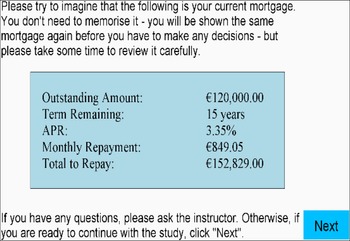
Within each block, participants were endowed with an example of a typical mortgage. They were informed of the total outstanding, monthly repayments, APR and remaining term for this endowed mortgage, and they were instructed that it had reached the end of its fixed term. The participants were then presented with a series of six alternative mortgages and their task was to rate how likely they would be to begin the switching process for each of them. To avoid participants making relative judgements between the different alternatives, we asked them to imagine on each trial that that offer was the best alternative available to them. That is, they were to assess how likely they would be to start the switching process if the offer in front of them was the best alternative available. The same wording was used for offers that would save the participant money as well as ones that would not. It is possible that using the term ‘best’ inflated absolute ratings, but since the primary comparisons are relative rather than absolute, any potential influence of the term ‘best’ would be constant and hence not alter the results. In addition, because the decision over whether to switch is likely to be driven by the strength of the mortgage-holder's willingness to do so, we treated the decision over whether to switch as if it is on a spectrum rather than a dichotomous choice. Participants responded on a scale from 1 (‘Definitely would not’) to 7 (‘Definitely would’). This response format and the overall design had the added benefit of allowing variation in responses, meaning that we could detect subtle differences in the influence of different attributes on decisions.
The mortgages presented within each of the four blocks varied according to a number of experimental manipulations, which were designed to answer each of the above research questions.
(1) What attributes of a mortgage offer affect consumer perceptions of switching offers?
Endowed mortgages were set at the typical switcher's mortgage in Ireland: €220,000 with 22 years left until full repayment. We kept this amount and term for two of the endowed mortgages, but to test whether term until repayment matters for switching we shortened it on the other two to 15 years (with an outstanding amount of €120,000). Half of the participants were randomly assigned to see the 22-year mortgage first and the other half saw the 15-year mortgage first. The endowed mortgages always had an APR close to the middle of the range of available mortgages in the switching market in September 2018 (3.05–3.75%), and the monthly repayments and total to repay information were calculated based on this randomly selected APR. An example endowed mortgage is depicted in Figure 1.
Example endowed mortgage. APR = annual percentage rate.

Alternative mortgages varied on several key attributes. First, the APR was randomly selected from the full range of available APRs in the switching market in September 2018 (2.3–4.5%). The experiment was designed such that there were six alternative mortgages for each endowed one: two from the lower end of the range (2.3–3.0%), two from the same middle range (3.05–3.75%) and two from the higher end of the range (3.8–4.5%). Within each of these range bands, one mortgage was described as fixed (for 3 years) and the other was variable.
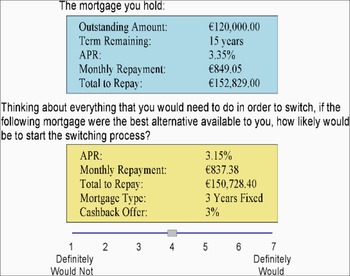
Because all major Irish mortgage lenders advertised cashback offers in September 2018, we included a cashback offer on each alternative. In line with market rates and advertisements, we varied on each offer the cashback amount and how it was presented. One mortgage within each range band had a ‘low’ cashback offer, equal to 2% of the outstanding mortgage amount, and the other had a ‘high’ cashback offer, equal to 3% of the amount. For half of the participants, cashback offers were advertised in this percentage form, while for the other half cashback was expressed as a euro amount. Figure 2 shows an example offer rating task.
Example offer rating task. The endowed mortgage is €120,000 to be repaid over 15 years. The offered mortgage annual percentage rate (APR) is from the middle of the range, it is fixed for 3 years and the cashback offer is high and in percentage form.

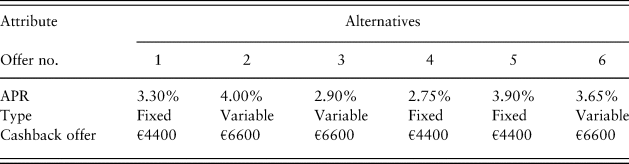
The alternative mortgages were presented in random order. An example summary of a block of offers is presented in Table 1. In this summary, the cashback is presented in euros (rather than percentage form) and correlates with the type of APR. For this participant, high cashback on the 22-year mortgage was associated with a fixed APR, so high cashback on the 15-year mortgage was associated with the variable APR. Overall, the design was such that the correlations between the varied attributes were zero, allowing us to isolate the effects of each attribute on participants’ judgements.
(2) How much does the perceived hassle of switching influence willingness to switch?
Example alternative offers for an endowed 22-year mortgage (of €220,000).

APR = annual percentage rate.
As noted above, we estimated the impact of the perceived hassle of switching through two manipulations. First, to prime one group of participants with the hassle of switching, half of the participants were told at the beginning of the experiment that the mortgage switching process is similar to the mortgage application process. They were asked to take some time to think about the mortgage application process that they went through to get their own mortgage and about what they think would be involved in switching their mortgage to another provider. They were then asked to write everything they could think of into a document that was open on the laptop. They were given 5 minutes for this task. The other participants were given no such task. We initially hypothesized that participants who reflected on the switching process would be more conscious of the hassle involved and be more likely to factor it into their subsequent judgements. However, upon inspection of the lists generated by participants, we noted high levels of variability in how much participants knew about the switching process – some participants listed many transactions (as many as 10), whereas others listed few (just 1 or 2). Hence, rather than treating this variable as an experimental manipulation, we instead test the association between knowing a lot about the switching process and willingness to refinance compared to knowing little.
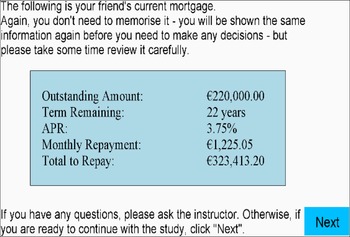
Second, to test whether removing consideration of the hassle altered their judgements, we varied whether the participants were asked to rate the alternative mortgages for themselves or for a friend who was interested only in getting a good deal, as shown in Figure 3. We reasoned that differences in ratings between the ‘Own’ judgements and these ‘Friend’ judgements amounted to a measure of the perceived hassle involved in switching. Accordingly, in the first block, participants were asked to imagine that the endowed mortgage was their own and to rate the subsequent switching offers, thinking about everything they would need to do in order to switch, while in the second block, the endowed mortgage was described as their friend's mortgage, and they were asked to rate whether they thought their friend should switch given that their friend cared only about obtaining a good deal.
(3) How much does competence (either perceived or objectively measured) influence willingness to switch?
Example Friend mortgage. APR = annual percentage rate.

We assessed competence in two ways. First, we asked participants to rate their confidence in their ability to judge mortgage offers on a scale from 1 (‘Not at all confident’) to 7 (‘Very confident’). We refer to this measure as ‘perceived competence’. We collected it at three points: before making any judgements; after making the first two blocks of judgements but before reading the consumer advice; and after reading the advice. This approach allowed us to estimate perceived confidence before engaging with the rating task, once they were familiar with the task and after reading the advice.
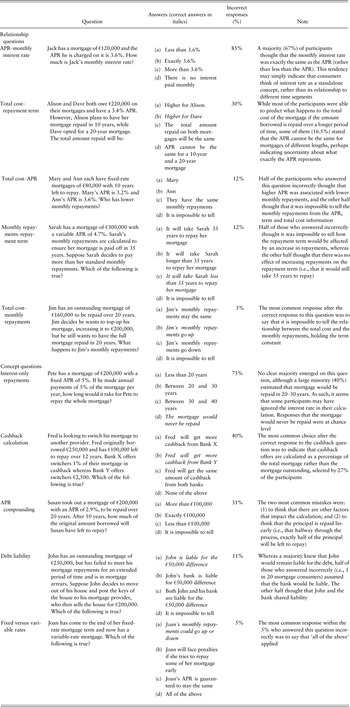
Second, in Stage 3, we assessed objective understanding of mortgages through a series of incentivized MCQs. Some of the questions were adapted from previous research (e.g., Gathergood & Weber, Reference Gathergood and Weber2017; details can be found in the Supplementary Online Appendix). Five questions probed comprehension of how different features of a mortgage are related: three tested understanding of the respective relationships between the monthly repayments, the repayment term and the total cost, while the other two tested understanding of how the APR relates to the monthly interest rate and the total cost. The other five questions probed conceptual knowledge: the difference between fixed and variable rates, debt liability, APR compounding, interest-only mortgages and how cashback is calculated. Importantly, we constructed the questions such that none needed any calculations, but instead required participants to demonstrate understanding of the general mechanism. For example, the question about the APR and total cost relationship was:
Mary and Ann each have fixed-rate mortgages of €80,000 with 10 years left to repay. Mary's APR is 3.2% and Ann's APR is 3.6%. Who has lower monthly repayments?
(a) Mary
(b) Ann
(c) They have the same monthly repayments
(d) It is impossible to tell
In this question, the participant needs only to understand that, all else equal, the person with the lower APR has lower monthly repayments. Questions were presented in random order and possible responses were randomized (except for ‘All of the above’ responses, which were always presented as the last option). Participants were instructed to try their best and were told that each correct answer would earn them another entry into the draw for the shopping vouchers. As well as allowing us to estimate the impact of comprehension on switching and to control for objective comprehension whilst estimating the impact of perceived competence, these questions allowed us to measure understanding in a sample of consumers who have: (1) purchased a mortgage; and (2) read the mandated advice about how to switch. The responses therefore give insight into the product comprehension of real mortgage consumers and gaps that might remain in their understanding despite having read the official advice.
(4) Do the answers to (1), (2) and (3) change if the mortgage-holder reads consumer advice on switching their mortgage?
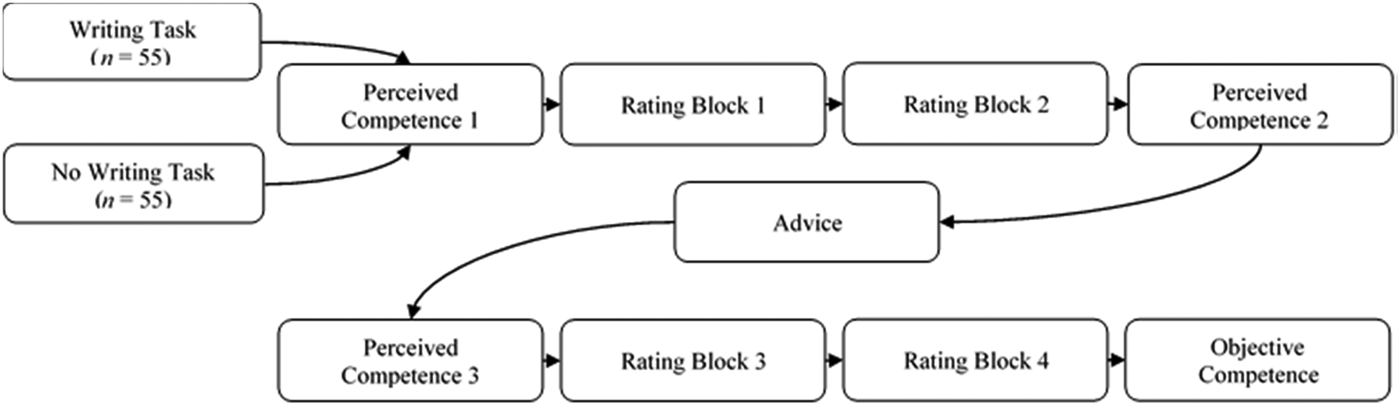
To test the impact of consumer advice, a booklet was adapted from the information on the CCPC's ‘Switching Your Mortgage’ webpages (available in the Supplementary Online Appendix; original content available at https://www.ccpc.ie/consumers/money/mortgages/switching-lenders-or-mortgage). It had four main sections: (1) Things to Consider, which outlined the importance of understanding one's current mortgage and defined the difference between fixed and variable rates; (2) Costs Involved, which described the types of fees that may be applied and provided estimates; (3) Special Offers, which compared the long-term effects of high cashback offers and interest rates; and (4) How to Switch, which summarized the required documentation and the length of the switching process. Participants were given the booklet to read for up to 10 minutes after completing the first two sets of ratings. Figure 4 presents a flow chart of the experimental design.
Experimental design flow chart.

Results
Mortgage attributes
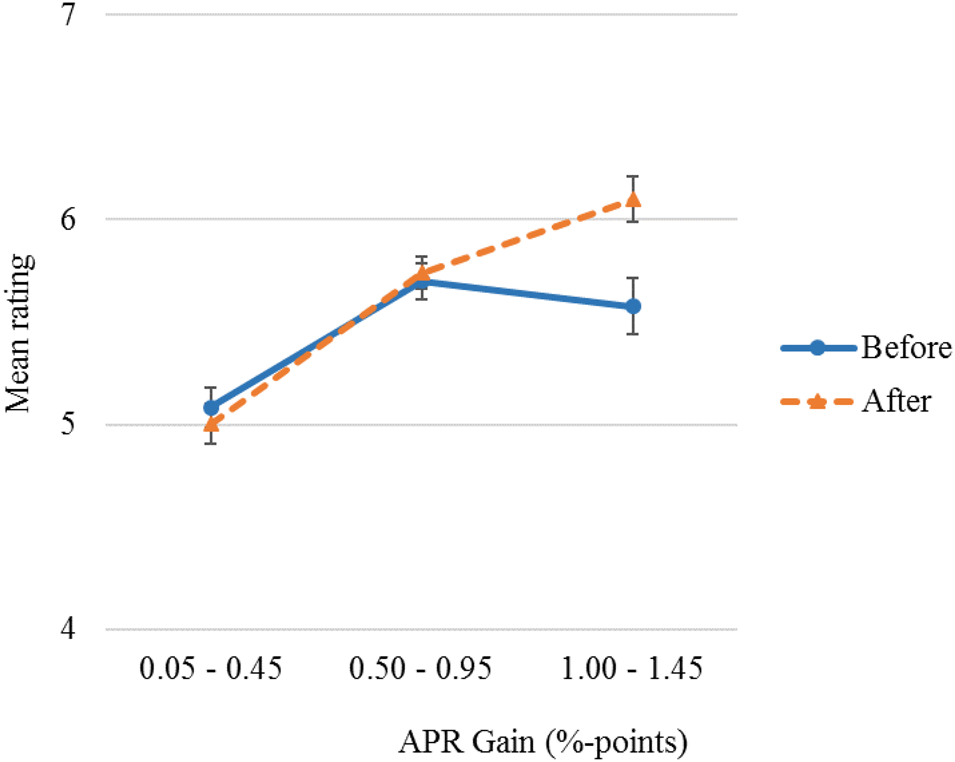
Data and analysis code are available at https://osf.io/pev8b. Participants used the full range of the scale when rating mortgage offers. The mean rating was 3.88 (Mdn = 5, SD = 2.19). A primary relationship of interest was between ratings and the difference in APR between offers. Examination of descriptive data revealed a step-jump once the offer had a lower APR than the endowed mortgage. Considering this alongside the broader regulatory goal of encouraging homeowners to switch to better-value mortgages, we focus our analysis on offers where there was an APR gain.Footnote 1 The relationship between mean ratings and the APR gain was also not smooth, with departures from linearity and some evidence of discontinuities close to salient gains (0.5 and 1.0 percentage points). For the main analysis, therefore, we grouped offers into three categories of APR gain: 0.05–0.45, 0.50–0.95 and 1.00–1.45. The results that follow are not sensitive to these precise boundaries. Variation in mean ratings by these categories of APR gain is shown in Figure 5. Participants responded with diminishing sensitivity to the APR gain, especially prior to reading the advice.
Mean ratings for willingness to switch to offers with lower annual percentage rate (APR), before and after reading switching advice. Error bars are standard errors.

For offers with an APR gain, ratings were left-skewed, with the majority falling between 5 and 7, plus a tail of ratings at 4 and below. We combine these lower ratings into a single category and employ the resulting four-category variable as our primary dependent variable, with 0 indicating a rating of 4 or below and 3 indicating a maximum positive rating of 7. Mean scores on this variable across participants were approximately normally distributed (Shapiro–Wilk, p = 0.191), consistent with normal variation in the underlying propensity to switch. We use mixed-effects ordered logistic regression to estimate the influence of the various independent variables, assuming a normally distributed random effect across participants (a random intercept model), with robust standard errors clustered by participant. Eleven participants who produced only ratings that were all 5 or below or 6 and above are dropped from the analysis presented below. Our results are not sensitive to this exclusion or the abovementioned estimation strategy, which is employed to maximize variation in the dependent variable while satisfying normality assumptions. Closely similar results can be obtained using the full sample, ordinal models across the full range of ratings, estimation via ordinary least squares, or generalized linear models with a binary dependent variable defined at one of various cut-offs on the rating scale (as outlined in the Supplementary Online Analyses).
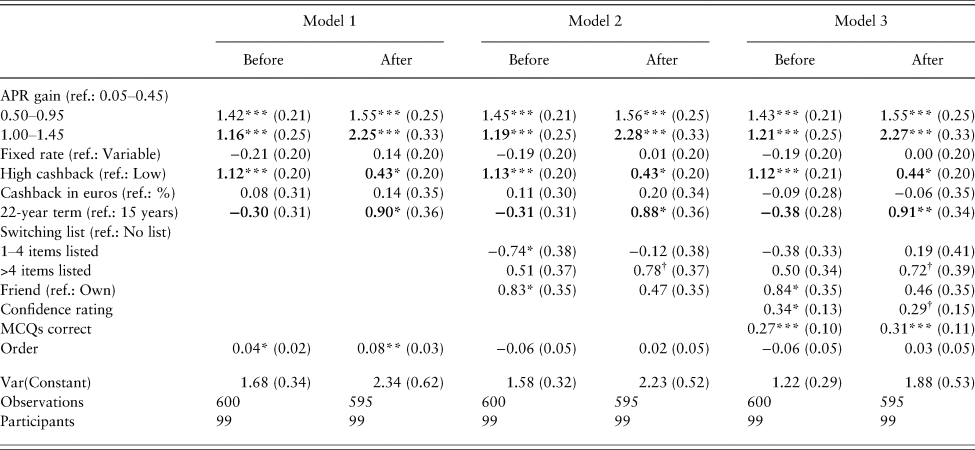
The results of the main regressions are presented in Table 2. Originally, we fitted models with a full set of interaction terms between each independent variable (e.g., APR) and a dummy variable indicating whether the rating was obtained before or after the participant read the advice. These results are available in the Supplementary Online Appendix, but for ease of interpretation we present here two models for each analysis: one that demonstrates how participants evaluated the offers before reading the advice and one after reading the advice. We note in bold in Table 2 the coefficients that interacted with the advice variable in the full interaction models (at p < 0.05), indicating a significant change in the effect after the participants read the advice. In all models, we also include controls for the order in which participants rated each mortgage. (Controls for sequence effects, i.e., the rating given to the previous offer, and for the interaction between block and order were non-significant and had no effect on the other coefficients. For brevity, we include these in the Supplementary Online Materials only.)
Mixed-effects ordered logit models predicting willingness to switch.

Pairs of coefficients in bold indicate a significant (p < 0.05) change from before to after.
†p < 0.10; *p < 0.05; **p < 0.01; ***p < 0.001.
APR = annual percentage rate; MCQ = multiple-choice question.
In Model 1, willingness to switch is regressed on the various attributes of the mortgage offers subject to experimental manipulation: the APR gain, whether APR was variable or fixed, whether cashback was high or low, how cashback was presented and the mortgage term remaining. Before reading the advice, participants gave significantly higher ratings when there was an APR gain (p < 0.001), but in keeping with the descriptive results in Figure 5 they displayed strong diminishing sensitivity. In fact, the coefficient for offers with APR gains of 1.00 percentage point and above is lower than for gains of 0.50–0.95 percentage points. Participants were also more willing to switch to a high-cashback offer (p < 0.001). Given the non-linear effect of APR gain, it is not possible to benchmark this estimated coefficient on cashback perfectly against an equivalent difference in APR, but a reasonable and conservative approximation can be calculated. Comparing with the coefficient estimated for the first 0.50-percentage point APR gain, the implication is that participants’ decisions, on average, equated the additional cashback with an APR gain of 0.39 percentage points.Footnote 2 For the typical switcher's mortgage of €220,000 over 22 years at 3.2% APR, this implies an exchange of €2200 now for €11,800 repaid over the lifetime of the mortgage – equivalent to a loan with an effective interest rate of 24.2%. Before reading the advice, ratings were unaffected by whether the mortgage rate was variable or fixed, whether the cashback was expressed in percentage or euro terms or whether the remaining mortgage term was 15 or 22 years. With respect to the latter, for a given interest rate, the overall monetary saving is higher the longer the outstanding term. Extending the model to include an interaction between APR gain and term reveals that this too is non-significant.
After reading the advice, participants gave greater weight to the APR gain, while sensitivity to gains in APR increased. A test for equality of coefficients finds that APR gains of 1.00 percentage point and above were rated more highly than those of 0.50–0.95 percentage points (χ2(1) = 5.98, p = 0.01). The full interaction model confirms that the increase in ratings given to the best APR gains after reading the advice is highly significant (β = 0.90, p = 0.002). The coefficient on cashback more than halved – a significant reduction (β = –0.67, p = 0.009). After reading the advice, participants also became sensitive to the term of the mortgage, giving significantly higher ratings to offers over 22 versus 15 years (β = 1.11, p = 0.041).
Perceived hassle
Model 2 tests the variables designed to gauge the impact of the perceived hassle involved in the mortgage switching process. Participants asked to reflect on what the switching process would entail listed between 1 and 10 items (M = 4.4, Mdn = 4, SD = 2.1). We introduce a variable for whether they listed a low or high number based on a median split – other categorizations yield a similar effect. Participants who listed few items had a significantly lower inclination to switch relative to the control group who were not asked to reflect on the process at all and especially relative those who listed a large number of items. At first sight, this may appear counterintuitive: hassle ought to be greater for those who perceive a greater number of effortful tasks or stipulations. However, the results are in keeping with the notion that much of the perceived hassle surrounds the uncertainty of not knowing exactly what is required to switch mortgage and, perhaps, the need to discover and process this information. This possibility is supported by the fact that the significantly lower ratings among participants who listed few items were no longer evident once they had read the advice.
The importance of perceived hassle is confirmed also by significantly higher ratings given to offers in respect of a friend as opposed to oneself. Again, this effect was no longer significant once the advice had been read, although the interaction model does not reveal a significant change in the coefficient, which remains positive. In principle, reflecting on the switching process might have magnified the difference between ratings for a friend and for oneself, but an additional test of the interaction between the two measures produces no significant effect. Relating these effects to APR gain, using the same conservative comparison as for cashback above, the perceived hassle was equivalent to a gain in APR of 0.26–0.29 percentage points before reading the advice (equal to approximately €8400 extra over the course of a typical switcher's mortgage).
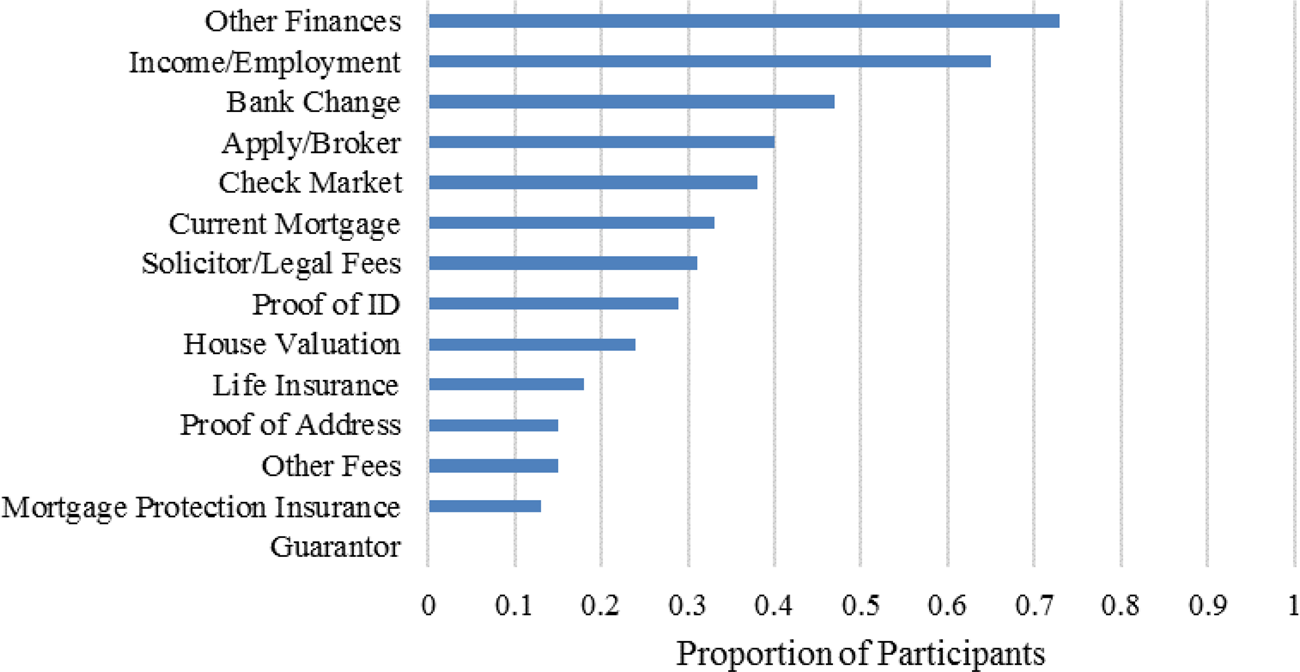
In addition to the impact on willingness to switch, the specific items listed by participants when reflecting on the switching process can give some insight into the extent to which mortgage-holders understand the process. Two members of the research team (ST and MB) coded the items into categories using a framework developed from the advice read by the consumers (with an additional item for life insurance). Inter-rater agreement was high (mean κ = 0.80) and disagreements were resolved through discussion and consensus. As is shown in Figure 6, most participants were aware that in order to switch they would need to provide financial information, such as bank statements, proof of credit or savings history as well as proof of income or employment. However, few participants listed additional aspects of the switching process. In particular, only around a third of this sample of mortgage-holders mentioned any sort of legal aspect to the switching process and only around a quarter thought about the revaluation of their property. In fact, the requirements to engage a solicitor and to have the property revalued typically constitute the largest direct transaction costs when switching a mortgage in Ireland.
Hassle items reported by participants in the writing task. See the Supplementary Online Appendix for a full description of items.

Competence
We estimated the effect of competence through ‘perceived competence’ (see above) and the number of correct responses to MCQs, which we refer to as ‘objective competence’. Perceived competence did not change significantly from before participants rated any offers (M = 4.89, SD = 1.50) to after they rated the first two blocks (M = 5.01, SD = 1.36; Wilcoxon matched pairs, z = –1.05, p = 0.294). Importantly, participants did report feeling more confident in their ability to judge mortgage offers after reading the consumer advice (M = 5.55, SD = 1.22; z = –5.69, p < 0.001).
Turning to objective competence, the mean number of correct responses to the 10 MCQs was 6.94 (Mdn = 7, SD = 1.59). The percentages of incorrect responses to each of the questions are presented in Table 3, along with a note on any patterns within the incorrect responses chosen by participants. Participants performed especially poorly on the questions that probed their understanding of the relationship between APR and monthly interest rates and the effects of only repaying the interest on a mortgage, with correct response rates of 15% and 25%, respectively. A further three questions (about the relationship between the term and the total cost, APR compounding and how cashback offers are calculated) had correct response rates of less than 70%. Recall that these figures reflect comprehension after reading the mandated advice.
Multiple-choice questions and responses.

APR = annual percentage rate.
There was a modest – and weaker than might be expected – positive relationship between perceived and objective competence (ρ = 0.44 and 0.51 for before and after reading the advice, respectively). Model 3 adds these competence variables as regressors. Specifying variables for confidence before and after reading the advice to the respective specifications shows that participants who reported feeling more confident in their ability to judge mortgage offers gave significantly higher ratings for willingness to switch. The impact on ratings of objective competence, as measured by the number of correct MCQs, was highly significant both before and after reading the advice. Note that perceived competence was associated with willingness to switch even when objective competence was controlled for in the same model.
Background characteristics
An experiment such as this is not designed to investigate individual differences in detail, but it is nevertheless possible to undertake a coarse but instructive analysis. We collected information on gender, age, income and educational attainment. We found no evidence of significant relationships between ratings for willingness to switch and the first three of these background characteristics. However, before reading the advice, the 44 participants (41%) without a degree-level qualification produced lower mean ratings than those with a degree (5.11, SE = 0.17, versus 5.69, SE = 0.08; Wilcoxon rank-sum z = –2.71, p = 0.007). After reading the advice, this gap narrowed (5.43, SE = 0.14, versus 5.59, SE = 0.12; z = –1.01, p = 0.312). The change in ratings for those participants without a degree was marginally significant (Wilcoxon matched pairs, z = –1.83, p = 0.067) and significantly greater than for those with a degree (M = 0.32, SE = 0.16 versus M = –0.10, SE = 0.13; Wilcoxon rank-sum z = 2.06, p = 0.039). Adding a dummy variable for having a degree to the models in Table 2, however, does not produce statistically significant effects. The higher mean ratings among those without a degree were mostly driven by a small number of participants who gave consistently low ratings for all offers before reading the advice. Adding the variables for background characteristics has no meaningful impact on the estimates for mortgage attributes in Table 2. Interestingly, it also has no substantive effect on the coefficients estimated for the number of items listed when reflecting on the switching process or for the competence measures. Thus, the results appear to apply broadly across social groups.
Discussion
The primary aim of this study was to pre-test specific consumer advice on switching mortgages that forms an important element of a change in regulatory policy. Broadly speaking, the findings suggest that the advice is effective. Before reading it, participants demonstrated diminishing sensitivity to gains in APR above 0.5 percentage points and were drawn towards mortgages with high-cashback offers. After reading the advice, they became more sensitive to larger gains in APR, began to consider the length of the repayment term and were less tempted by cashback. In general, therefore, a fair summary of these results might be that after reading the official advice, mortgage-holders placed greater weight on factors that would lead to larger long-term savings.
A second motivation was diagnostic and sought to uncover the features of mortgages that potential switchers might find attractive. Initially, participants found cashback enticing and failed to place weight on savings across different terms. This finding adds to existing evidence that consumers in this market struggle to balance immediate payments or rewards expressed as cash sums against benefits that accumulate over time and have a more complex and non-linear relationship with interest rates (e.g., Agarwal et al., Reference Agarwal, Amromin, Chomsisengphet, Landvoigt, Piskorski, Seru and Yao2015; Gathergood & Weber, Reference Gathergood and Weber2017).
We also set out to investigate perceptions of the switching process and how they might influence the attractiveness of switching. Before reading the advice, participants’ willingness to switch to offers that would save money depended on how many tasks or stipulations they could list and was lower than they would recommend to a friend seeking only a good deal. Those who listed few items were less inclined to switch than those who listed more. We suspect that the original effect was driven by poor understanding of the switching process and the associated uncertainty this is likely to induce in consumers, but this interpretation should be treated with some caution. We originally sought to estimate the perception of hassle by priming some participants with the hassle of switching through a writing task, but differences in their knowledge about the switching process led to difficulty with this manipulation. This task instead provided a measure of knowledge about the process that can only indicate the association between this knowledge and willingness to switch. As such, there may be other extraneous variables at play.
That said, these effects have potential theoretical relevance. Our result is the opposite of what one would expect based on a model of consumer behaviour in which consumers rationally weigh up the net present value of switching against perceived transaction costs. Rather, our findings are in line with the competence hypothesis, according to which people are more willing to bet on their own judgement if they perceive themselves as more competent in the relevant domain (Heath & Tversky, Reference Heath and Tversky1991). Furthermore, after participants read the consumer advice, these uncertainty effects did not persist, while self-assessed confidence increased and participants who felt more competent in their ability to judge offers were more willing to switch. Thus, in addition to helping consumers to identify mortgage features linked to long-term savings, the results suggest that consumer advice can increase willingness to engage with the switching process by improving consumers’ understanding of the process and their confidence that they are able to make good decisions. This interpretation would, however, benefit from future research investigating the causal link between certainty in the process and willingness to switch.
Although we interpret the effects of advice as largely positive, performance on some of the MCQs and difficulties with listing the transaction costs of switching highlight potentially serious misunderstandings among consumers in this market. Despite all participants being incentivized to answer correctly and having previously purchased a mortgage, 1 in 3 did not realize that increasing monthly repayments would result in the mortgage being repaid sooner, and 1 in 10 did not know that if a borrower in arrears were to post their house keys to the lender it would not diminish their debt liability. Moreover, when asked to list what they would need to do in order to switch, most mortgage-holders in the experiment did not list the two largest direct transaction costs: legal fees and revaluation. These misunderstandings among consumers who have purchased such a large credit product could lead to unnecessarily higher levels of debt and have potentially substantial legal implications.
Our results can also be considered in the context of the ongoing debate about the appropriate use of behaviourally informed policy. We show here how choices are altered after consumers read advice, but it is harder to demonstrate that decisions are not just altered but improved. Generating persuasive evidence of true preferences in the face of inconsistent preferences is not straightforward (Beshears et al., Reference Beshears, Choi, Laibson and Madrian2008). To some extent, an argument could be made for the imposition of a normative model according to which placing greater weight on long-term savings due to switching is good for the consumer. The magnitude of savings involved, which run to many thousands of euros on a typical switcher's mortgage, implies that in the absence of helpful advice these sums may be routinely and unwittingly foregone. Yet we cannot be sure of this. The additional finding of a positive link between objectively measured understanding and stated willingness to switch is perhaps instructive. The link persists even after background characteristics, including educational attainment and income, are controlled for. This finding is arguably important for policy-makers seeking to encourage switching. Comfort can be had from the knowledge that participants who demonstrated objectively better understanding of mortgages and the switching process also stated a stronger inclination to switch.
Where regulatory policy mandates providers to direct consumers to obtain specific advice, as happened in Ireland with the addendum to the Consumer Protection Code (2012), it is often possible to test empirically whether that advice can alter perceptions in such a way as to induce beneficial decision-making. By designing our materials in collaboration with the national consumer protection regulator and basing stimuli (APR, outstanding mortgage, cashback) on the market, we believe that the experiment provides insight into the mechanisms that underlie real-world decisions. Moreover, although we tested the advice among mortgage consumers in just one country and some features may be representative of specific national markets (e.g., cashback), key elements of the experiment are likely to have wider implications. For example, the general issue of consumer focus on the short term is a more universal problem. The findings imply the potential to shift this focus to long-term savings through the use of a relatively soft intervention (in this case, simply directing consumers to impartial advice) with minimal regulatory burden. This implication might be reinforced by testing whether such advice produces a greater focus on long-term financial outcomes in other countries too, despite differences between markets. The findings also demonstrate the benefits of collaboration between behavioural scientists and policy-makers to design experiments to test official advice empirically. Iterative testing could lead to further improvements in effectiveness.
Of course, there are caveats associated with making inferences from hypothetical, lab-based decisions. We did not examine – nor was it our aim to examine – every factor that might influence an individual's decision to switch. For example, we eliminated references to provider names, meaning that we did not capture potentially important effects of consumer–bank relations. Suspicions of lender motives and trust in the mortgage provider can influence decisions to switch (e.g., Johnson et al., Reference Johnson, Meier and Toubia2016). Moreover, our focus was on one specific point in the refinancing process: the evaluation of potential alternative mortgages. This assumes an initial level of consumer engagement, which makes sense given that the relevant regulation that provided the context for this study directs potential switchers to a website. Tests of other aspects of the process would be fruitful, such as tests of interventions to motivate consumers to read the advice or tests of potential barriers to switching once an alternative mortgage has been chosen. Nonetheless, while a study such as this necessarily simplifies and approximates real-world decisions, it constitutes an experimental test of the proposed policy intervention and provides broader insights into this large financial decision. Had the official advice failed to have a positive impact on perceptions and decisions, it would have cast doubt on the merits of the regulation. That it did so is instructive for policy and demonstrates how laboratory studies can be used to support behaviourally informed policy.
Acknowledgements
For helpful discussions, we thank Cameron Belton, Laura Gormley, Hannah Julienne, Ciarán Lavin, Féidhlim McGowan, Deirdre Robertson, the staff at the Competition and Consumer Protection Commission and attendees at the 11th Annual Irish Economic and Psychology Conference and an Economic and Social Research Institute Seminar. We are also thankful to Conor O'Toole, Christina Kinghan and Kenneth Devine for sharing with us details of their research on mortgage switching.
Funding
This work was undertaken as part of PRICE Lab, a research programme funded by the Competition and Consumer Protection Commission, the Commission for the Regulation of Utilities and the Commission for Communications Regulation. The Competition and Consumer Protection Commission provided helpful input into the design stage of the experiment only.