Introduction
The study to be described was carried out for the Mental Health Research Network (MHRN), which is part of the National Institute of Health Research (NIHR; Department of Health). An important remit of all the research networks in England is patient and public involvement (PPI) in research. The ‘public’ element in PPI aims to promote the public's understanding of, and support for, research. Health stories in the media both shape public understandings of mental disorders, and are influenced by them. We thus sought to understand how mental health research is reported in the UK media to see how the research community might best work with or influence them. We chose the British Broadcasting Corporation (BBC) website, which covers radio and television broadcasts in a convenient format for study. Subsequently the analysis was extended to New Scientist, a weekly magazine about science intended for a general readership.
We were unable to discover any previous studies of how research on mental disorders had been covered in the mass media. A few articles discuss treatment options or mental health policy but research as such is barely considered (Stout et al. Reference Stout, Villegas and Jennings2004; Hall & Seery, Reference Hall and Seery2006).
The mass media, and the Internet, are now important sources of health information for many groups, including politicians and their advisers, healthcare professionals, researchers (Phillips et al. Reference Phillips, Kanter, Bednarczyk and Tastad1991) and the general public (Nicholas et al. Reference Nicholas, Huntington, Jamali and Williams2007). Consequently, policy decisions, individual behaviour patterns and the demand for new (and expensive) treatments for particular people may be significantly influenced by the way new research is presented in the media (Passalacqua et al. Reference Passalacqua, Caminiti, Salvagni, Barni, Beretta and Carlini2004; Francis et al. Reference Francis, Pirkis, Blood, Dunt, Burgess and Morely2005; Wilson et al. Reference Wilson, Bonevski, Jones and Henry2009). Better information in the media may, however, help to counteract negative impressions of mental illness (Stip et al. Reference Stip, Caron and Mancini-Marie2006; Stuart, Reference Stuart2006).
Method
BBC health stories are recorded permanently in a web-based searchable archive. The search can be limited by keyword, by geography or section (e.g. business, education, health – the last was chosen here), by date range (we chose 10 calendar years, from 1 January 1999 to 31 December 2008).
The stories were sought with each of a list of 60 keywords relevant to mental disorders, such as Alzheimer's disease, bipolar disorder, chronic fatigue, depression, electroconvulsive therapy, false memory, gambling, hysteria, and the particulars of each story were downloaded to a spreadsheet. These were the heading (with a hyperlink to the story), a ‘synopsis’ (the first paragraph of the story) and the date. Stories were classified for relevance, i.e. that they reported recent research, as suggested by phrases such as ‘research suggests’ or ‘scientists find’ in the synopsis. The individual stories were then read, and further information recorded on the spreadsheet, including the subject matter (a five-character code, such as ADDIC=addiction, BEHAV=behavioural problems, EATIN=eating disorders) and the story type (also a code, such as DIAGN=diagnosis, GENET=genetics, FUNCT=brain function, PHARM=pharmacology and drug treatment). The BBC stories nearly always recorded the name of the leading researcher, his/her institution and the journal in which the research appeared; these data were recorded, together with the names and affiliations of ‘commentators’ (that is, people who were asked by the journalists briefly to assess the significance of the research and to put it into context). Full bibliographic details of the cited papers were obtained from the Web of Science. The methodology has been described in detail elsewhere (Lewison et al. Reference Lewison, Tootell, Roe and Sullivan2008).
Subsequently, an analysis was carried out of news items and feature articles in the magazine New Scientist over the 21-month period of August 2008 to April 2010. The methodology was somewhat more complex (Lewison & Turnbull, Reference Lewison and Turnbull2010), as the stories had to be scanned individually and many of the references were to digital object identifier (DOI) codes, which uniquely identify documents and can be used to search for them on the Internet, but it generated a similar spreadsheet, with details of the cited papers and commentators, if any.
Comparisons were made between the subject areas of the stories retained for analysis, i.e. the mental disorder(s) that were the subject of the research, and the burden of disease from these disorders in the UK. The latter data were obtained as counts of disability-adjusted life years (DALYs) for 2004 from the World Health Organization (WHO) website (WHO, 2010). Data are given there for 11 specific disorders, listed in Table 1. Comparisons were also made between the characteristics of the papers cited by the BBC and by New Scientist and the totality of papers on mental disorders research as recorded in the Web of Science. These papers (articles and reviews only) were selected by means of a ‘filter’ based on specialist journals and title words (originally developed by G.L. in consultation with Louise Howard and Graham Thornicroft of the Institute of Psychiatry, and subsequently extended with G.S.). It is estimated to have both a precision and recall above 0.9. The characteristics included the national location of the authors, the journals used and the sources of funding. The latter were determined from the formal acknowledgements and also from the addresses, for those papers written by authors in national laboratories, those supported by collecting charities, and commercial companies (Dawson et al. Reference Dawson, Lucocq, Cottrell and Lewison1998).
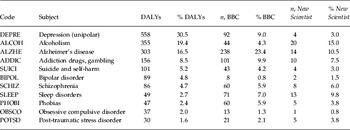
Eleven mental disorders, with their UK disease burden in 2004 (thousand DALYs), stories in the BBC archive and stories in New Scientist Footnote a

DALYs, Disability-adjusted life years; BBC, British Broadcasting Corporation.
a All percentages are of total mental disorders and stories.
Where relevant, comparisons were made with the study of cancer research stories on the BBC website which used the same methods (Lewison et al. Reference Lewison, Tootell, Roe and Sullivan2008).
Results
Numbers of stories
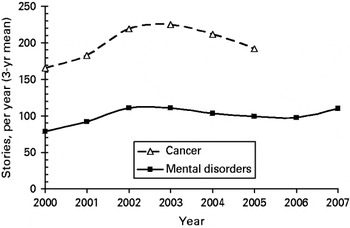
During the 10 years, 1999–2008, the BBC archive contained 1015 stories on mental disorders research (102 per year, with a modest peak in 2002–2003, see Fig. 1), and in the 21 months from August 2008 to April 2010, New Scientist had 133 such stories (76 per year). During the same period there were a further 302 BBC stories reporting on neuroscience research describing various aspects of brain function but without reference to mental health. The BBC coverage of mental health was about half of its coverage of cancer research (see Fig. 1) (199 per year; Lewison et al. Reference Lewison, Tootell, Roe and Sullivan2008), but New Scientist coverage was almost 2.5 times the number of stories on cancer research (31 per year). Mental disorders actually account for 60% more DALYs in the UK than all cancers (WHO, 2010), so the BBC coverage is unduly low on this criterion.
Numbers of British Broadcasting Corporation (BBC) stories per year on mental disorders research and cancer research, 1999–2007. Values are 3-year running means.

UK mental disorders research output has averaged 2700 papers per year in the Web of Science during the decade 1999–2008, whereas cancer research output has averaged 3500 papers, so there is perhaps some justification for the BBC's coverage of mental disorders research being less than that for cancer research, but the former has been growing faster than the latter and the difference in output was only 15% in 2008.
Story content
What subjects or disorders do the BBC and New Scientist report most? The main ones are listed in Table 1, with data also on the DALYs attributable to each, expressed as a percentage of the totalFootnote 1 Footnote †. Although depression accounts for by far the biggest burden within mental disorders, it receives relatively much less attention from the BBC and even less from New Scientist. Alcoholism also gets rather little attention from the BBC but much more from New Scientist. Alzheimer's disease, by contrast, is disproportionately well covered by the BBC, though less so by New Scientist. Sleep is also disproportionately covered, but many of the articles deal with the role of sleep and the consequences for mental health of poor-quality sleep rather than specific sleep disorders.
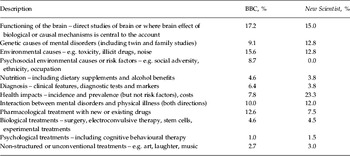
Next we analysed the types of story, dividing them into twelve categories (Table 2). There was an emphasis on biological research – brain function, genetics, physical environmental causes (especially drugs and nutrition), pharmacological and biological treatments, and interactions between physical and mental disorders – accounting for 75% of the BBC stories. New Scientist focused more on health impacts (23%), but both sources rarely reported research on psychological interventions.
Types of stories reporting mental disorders research on the BBC (1999–2008, n=1015) and in New Scientist (2008–2010, n=133)

BBC, British Broadcasting Corporation.
Commentators
Many of the stories, both BBC and in New Scientist, quoted commentators whose remarks were intended to put the cited research into context. This is a notable feature of media stories about research. Of the 1015 BBC stories, 77% had one or more commentators, with 973 named individuals. The six most frequently quoted were all from UK medical charities – three from the Alzheimer's Society (133 mentions), two from the Alzheimer's Research Trust (80 mentions) and one from SANE, the mental health charity (28 mentions). The dominance of the two Alzheimer's charities was perhaps not surprising in view of the large number of BBC stories on this subject. Many fewer of the New Scientist stories had commentators (39 out of 133), but 72 of the stories were anonymous news items which seldom do (Lewison & Turnbull, Reference Lewison and Turnbull2010).
Research papers cited
The research papers cited by the BBC stories and those in New Scientist can be compared with the corpus of mental disorders research worldwide and in the UK in order to see if the selection by the journalists is representative.
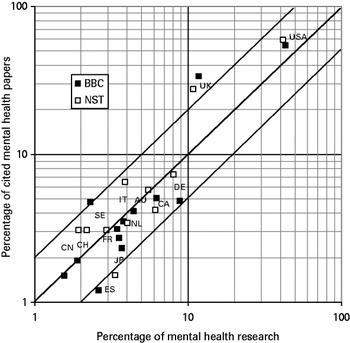
Fig. 2 shows a comparison between the outputs of mental disorders research in 1999–2008 from 13 leading countries (as a percentage of the world output on an integer count basis, whereby a paper from two countries is credited as unity to each) with the countries’ presence among the 996 papers cited by the BBC for which addresses could be found or were given in the story. Also in Fig. 2 are the 262 papers with evident addresses cited in the New Scientist stories, compared with mental disorders research outputs in 2008–2009. UK papers are over-cited relative to their presence in mental disorders research by a factor of about 2.7 in both media. The geographical pattern for the BBC parallels that found for cancer research (Lewison et al. Reference Lewison, Tootell, Roe and Sullivan2008), suggesting that there may be a systematic neglect of some countries' research and over-reporting of others'.
Percentage presence (integer counts) of 13 countries among British Broadcasting Corporation (BBC, ▪) and New Scientist (□)-cited papers in mental disorder research stories plotted against the countries' presence in mental disorders research in the Web of Science (articles and reviews; 1999–2008 for BBC, 2008–2009 for New Scientist). Diagonal lines show where percentages differ by a factor of 2. AU, Australia; CA, Canada; CH, Switzerland; CN, China; DE, Germany; ES, Spain; FR, France; IT, Italy; JP, Japan; NL, The Netherlands; SE, Sweden.

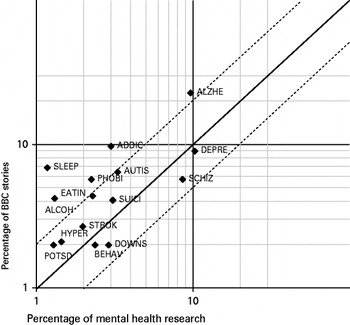
We also compared the subjects of the BBC stories with the amount of research within the UK's total mental disorders research portfolio published for the 10 years 1999–2008. The latter analysis involved the creation of 15 subject filters based on title words and journal names, which were selected by G.S. from the data on the spreadsheet so as to cover the relevant papers. The results are shown in Fig. 3.
Log–log scatter plot of 15 British Broadcasting Corporation (BBC) story subjects compared with their presence in UK mental disorders research in 1999–2008. Dashed diagonal lines show where percentages differ by a factor of 2. For codes, see Table 1, also BEHAV=behaviour disorders; DOWNS=Down's syndrome; EATIN=eating disorders; HYPER=hyperactivity; STROK=strokes.

Here the correlation is somewhat better (r 2=0.44) than appears from Table 1 (r 2=0.21), where the BBC stories were compared with disease burden, reflecting the lack of correspondence between DALYs and overall UK research output. For example, the amounts of research on Alzheimer's disease, depression and schizophrenia are nearly equal, but the burden from depression is over six times that from schizophrenia. There is more than twice as much research on the addictions as on alcoholism, but the disease burden is the reverse.
Journals in which cited papers were published
Next, we examined the journals in which the cited papers were published. No journal accounted for more than 6.6% (BMJ) of stories and only 12 for 2% or more. Altogether, the BBC cited 254 different journals and New Scientist, 126. Papers from specialist psychiatric journals were infrequently cited.
Funding of the cited research papers
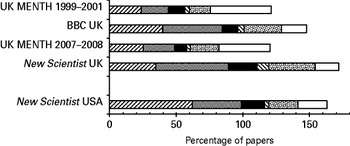
The final analysis concerned the funding of the cited research (Fig. 4). Data were obtained for 277 of the UK papers cited by the BBC, for 46 of the UK ones cited by New Scientist, and for 87 of the US ones. For comparison purposes, funding data were available from the Research Outputs Database (Webster, Reference Webster2005) for UK mental disorders research papers from 1999 to 2001 (n=4297) and for 195 such papers from 2007 to 2008, examined for the project.
Funding of UK papers cited by British Broadcasting Corporation (BBC) stories on mental disorders research (MENTH), 1999–2008, of UK and US papers cited by New Scientist in 2008–2010, and of UK mental disorders research papers from 1999–2001 and 2007–2008.
 , National government;
 , national private-non-profit; ▪, industry;
 , international;
 , other (foreign government and private-non-profit); □, none. Percentages sum to more than 100% because of multiple funding of many papers.

UK papers cited by the BBC and by New Scientist are more frequently funded by government and the private-non-profit (PNP) sectors than the mean for UK mental disorders research papers. While the governmental and PNP sectors are comparable in size in the UK, in the USA the former is much larger because of the dominant role of the National Institutes of Health (NIH) and its individual institutes.
Within the UK, the leading funders whose papers were cited in the two media were the Medical Research Council (28%), the Wellcome Trust (20%), various charities including two involved in Alzheimer's disease research (17%) and the Department of Health (7%) – now the NIHR, the research arm of the National Health Service (NHS). But in the USA, the NIH and its component institutes dominated the funding of mental disorders research papers cited by the two British media. The leading industrial company acknowledged on the cited papers was GlaxoSmithKline plc, which supported just 2% of them; biotechnology companies were acknowledged on 4% of cited papers.
Discussion
Research occurs in a social context. Health stories in the media may both shape public views of mental disorders and are influenced by them. In relation to the reporting of research in this area, the media may influence the public's views of mental disorders and what research is meaningful or appropriate. The media may influence the health research agenda including the demand for treatments and the shape of healthcare systems (Iyengar, Reference Iyengar, Iyengar and Reeves1997). The direction of research, what is researched and how it should be researched may be affected, for instance, by public influence on funding decisions by government agencies or charities. There is even evidence that media research reports may affect citations to research papers (Phillips et al. Reference Phillips, Kanter, Bednarczyk and Tastad1991; Lewison et al. Reference Lewison, Tootell, Roe and Sullivan2008).
Given that views of mental illness are highly contested and that they are frequently negative and stigmatizing, it is important to examine how research, an important underpinning for theories about mental disorders, is reported in the media. The tone of BBC coverage of research was either neutral or sympathetic to patients. But comparison with stories about cancer suggests that the popular demand is somewhat biased against mental disorders research. This becomes particularly evident when reportage is set against disease ‘burden’.
One of the notable divergences between disease burden and reportage in both media was depression, which attracts little coverage. However, we learned that a small sample of three BBC website stories covering research on depression gained ten times as many hits (up to 480 000) in the first 48 h as did a matched sample of three sites covering research on Alzheimer's disease (up to 53 000). This suggests that people suffering from depression may be interested to learn about research that might alleviate their condition. They are likely to be younger and better able to use the Internet than those suffering from Alzheimer's, or even than the latters' carers. The NHS Direct Online pages on depression are second only to anthrax in terms of viewing, and the latter must be for simple curiosity as anthrax is hardly a pressing public health problem (Nicholas et al. Reference Nicholas, Huntington, Jamali and Williams2007). Another divergence is the relatively large amount of coverage of research on addiction to proscribed drugs, particularly compared with the coverage of alcohol-related research.
Around 75% of the BBC stories concerned biological aspects of mental disorder – brain function, genetics, physical environment, nutrition, and pharmacological and other biological treatments. The health impacts of mental disorder accounted for around 8% and ‘talking treatments’ for only 1% of the stories. Mental disorder is represented as being essentially neurobiological in origin. Whilst we do not have data comparing these figures with the corpus of mental health research papers, it is unlikely that talking treatments, in particular, would be so poorly represented. A large number of stories reported apparent ‘breakthroughs’ in understanding or treatment, or how popular beliefs about mental illness were undermined by research.
An important finding from this study concerns the role of ‘commentators’. Almost every BBC story was accompanied by a brief commentary. We hypothesize that the ready availability of persons to act as commentators, such as those from the Alzheimer's disease charities, may contribute to the over-reporting of dementia stories in relation to disease burden. If this is so, then it becomes important for organizations that seek to engage the public in mental health research – such as the MHRN, foundations, notably the Wellcome Trust, collecting charities and state funding bodies such as the Medical Research Council – to examine ways in which commentators can be made more readily available across the whole spectrum of mental health research. Related to this is the finding that while the funding of the research reported by the BBC and New Scientist was disproportionately from governmental and PNP bodies, this was not obvious from the stories themselves.
Finally, despite some of the reservations noted above, the quality and nature of both the BBC and New Scientist stories encourage us in believing in their value for the public understanding of research in mental health. The MHRN's public engagement strategy is founded on: the idea that the public needs to know that research has led to important scientific knowledge about mental illness which in turn has led to effective treatments; that such knowledge about research helps to dispel commonly held, but mistaken, beliefs about mental illness; and that an awareness of the value of research will improve the willingness of people with a mental illness, their carers and others to support and to participate in research, whether as patient participants or as ‘controls’.
Studies of media reporting of research, such as this one, can provide ideas as to how the research community, together with its funders and other supporters, can enhance the range and quality of media coverage.
Acknowledgements
The study was funded by the NIHR MHRN in which G.S. is an associate director with responsibility for PPI.
Declaration of Interest
None.