





Australia is experiencing a current juxtaposition between large amounts of food waste(1) and increasing food insecurity(2). Australia yields enough food for 100 million people/year(Reference Nelson, Lim-Camacho and Robinson3) yet has almost 3·5 million households experiencing food insecurity(2) and generates 7·6 million tonnes of food waste annually(1). Food waste in landfill decomposes anaerobically, producing greenhouse gas emissions, measured at 17·5 million tonnes/year in Australia and representing 3 % of national emissions(1). The Government’s recent National Food Security Strategy Discussion Paper(4) addressing this issue requested comments from the community for consideration, and different national priority groups provided contrasting recommendations(4). End Food Waste Australia (research organisation) recommended a tax deduction/offset incentivisation scheme for businesses donating food to charity to reduce landfill waste and increase donations(5). However, The Australian Food Network (social enterprise) recommended ending food relief in its current form over the next 10 years to tackle the root causes of food insecurity (i.e. housing costs, welfare payments)(6). Simultaneously reducing food waste and improving food security will be difficult, but there are interim opportunities to support individuals and families experiencing adversity.
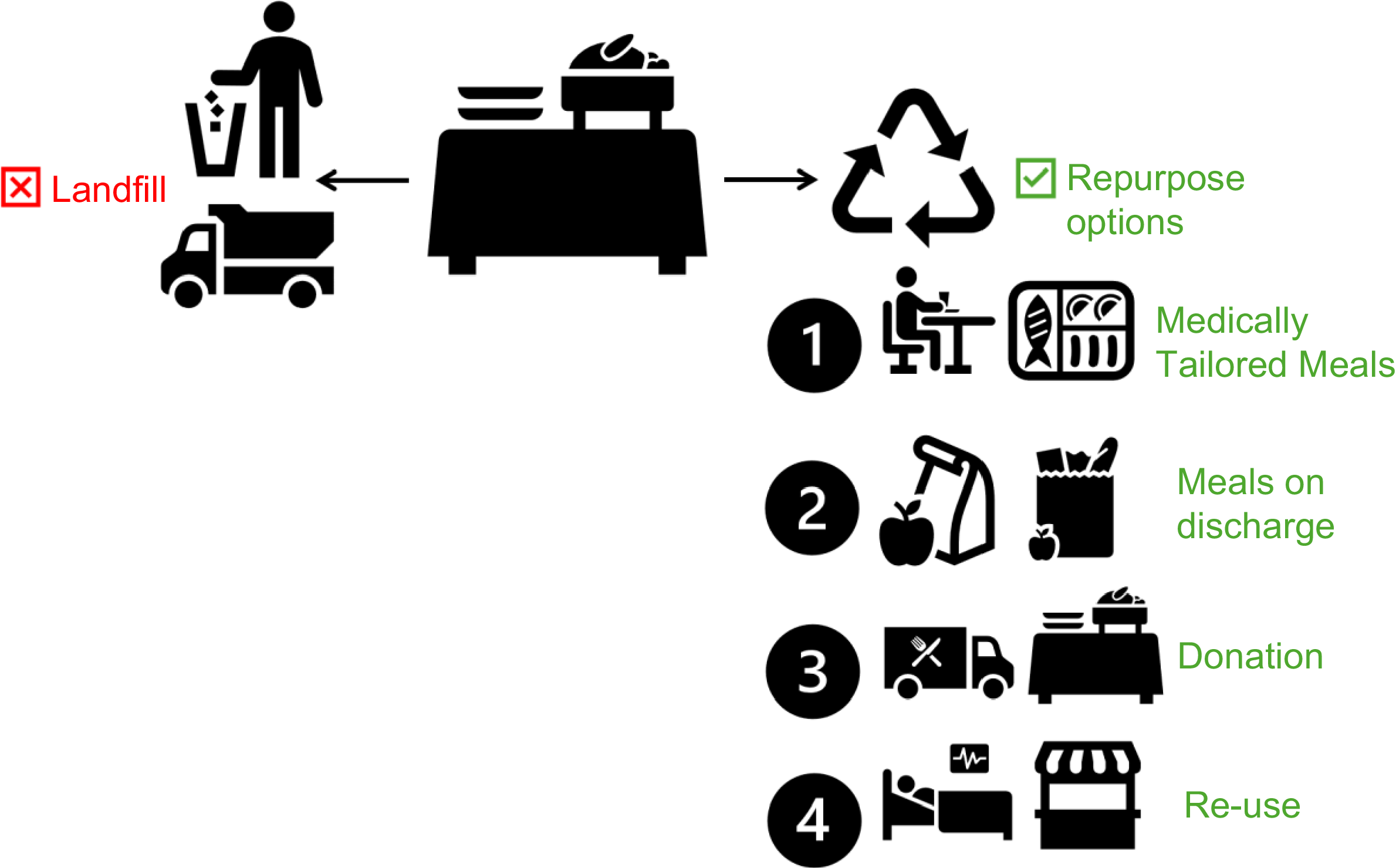
Hospitals produce surplus cooked food due to inaccurate forecasting and intentional overproduction for ‘just in case’ meals to cater for a fluctuating patient census(Reference Sansome, Willmott and Baker7). This food is not served to patients and can account for 88 % of kitchen food waste(Reference Ni, Willmott and McGrath8). Additionally, patients can return up to 1768 items/d of untouched perishable food and unopened non-perishable packaged food to the foodservice(Reference Collins and Porter9). In most Australian hospitals, this surplus food is sent to landfill under current outdated infection control practice(Reference Lewandowski, Barker and Howard10). The End Food Waste Scale prioritises food reuse before diverting food waste from landfill via donation(11). Of course, patient plate waste cannot be reused for food safety concerns. However, surplus unserved cooked food and untouched/unopened perishable and non-perishable food are entirely safe, healthy, edible and suitable for reuse. This commentary explores the potential opportunities for this surplus hospital ‘food waste’ to be used to fight food insecurity (Figure 1), where surplus food can be filtered through one or more strategies to maximise waste reduction potential.
Opportunities for surplus food reuse in hospital foodservices that may support food insecurity in the community discussed in this commentary.

Figure 1. Long description
A picture of left over prepared but not served food is shown with one option as landfill which is in red text and a cross to indicate that this is not the desired option. The other options are in green and labelled as repurpose options and include medically tailored meals for service to outpatients who can eat them in their on home, meals on discharge to give to patients to support food security, donation to charity and re-use inside the hospital for inpatients
The following commentary and four recommendations for the use of surplus hospital food waste are based on academic evidence and the author’s practical experiences, observations and discussions with industry partners.
Medically tailored meals
To repurpose surplus food, hospitals could adopt ‘food is medicine’ programmes(Reference Downer, Berkowitz and Harlan12). Interventions titled ‘Medically Tailored Meals’, ‘Medically Tailored Groceries’ or ‘Produce Prescriptions’ provide pre-prepared meals, grocery items and vouchers to patients who are, or at high risk of, experiencing non-communicable disease and food insecurity(Reference Downer, Berkowitz and Harlan12). An Australian study demonstrated that weekly produce prescriptions of ingredients to make ten meals for 12 weeks increased diet quality, reduced blood lipids and resulted in weight loss for individuals with Type 2 diabetes experiencing food insecurity in a hospital setting(Reference Wu, Trieu and Coyle13). This identifies a clear opportunity for surplus hospital ‘food waste’ to be reused and support patients experiencing food insecurity. Providing hospital-prepared meals could reduce food waste(Reference Cook14), while improving health outcomes(Reference Wu, Trieu and Coyle13), decreasing immediate charity attendance(Reference Berkowitz, Shahid and Terranova15) and providing temporary food relief.
Provision of meals upon discharge
Hospitals are anchor institutions, meaning they are geographically fixed, have a stable public presence and are responsible for improving community equity. For eligible hospital foodservices, they could transform tray-line preparation waste and unopened packaged items into meals for discharging patients screened on admission as food-insecure(Reference Gundersen, Engelhard and Crumbaugh16). Dietitians could provide nutrition education(Reference Oxford17) at this time to improve food literacy(Reference Butcher, Batt and Royce18). This strategy could be reserved for food-insecure patients who do not require a specific medically tailored meal regime to manage a chronic disease diagnosis but support food security for general health, similar to programmes such as Meals on Wheels(Reference Charlton, Tjong and North19).
Food donation
For hospitals without meal production facilities, surplus food donation remains viable and is used in Australia(Reference Cook14). Unfortunately, individual hospitals’ infection control departments differ in their opinions on what is donatable or if donation is viable at all. Further, previous research identified that donations to an Australian food relief charity consisted mostly of poor-quality food items(Reference Mossenson, Giglia and Pulker20). The authors categorised 1216 donated products according to the Australian Dietary Guidelines, identifying 54 % as discretionary(Reference Mossenson, Giglia and Pulker20). Donation of healthier food is warranted, and policy(Reference Mossenson, Giglia and Pulker21) could prevent charities from becoming surplus poor-quality ‘food waste’ dumping grounds and relieve their already resource-constrained environments from having to prepare these donations into meals. Partnering with hospitals through policy agreements on eligible donations could improve the nutritional quality of donations, further supporting nutrition-focused food relief. Recent work by Law et al. (2025) explored the nutritional quality of ready meals produced by an Australian food relief charity from donated items(Reference Law, Trieu and James22). The authors recommended standardising meal recipes prepared by food charities and improving the nutritional quality of meals aligned with dietary guidelines. This practice change should be supported as standardised recipes can reduce food waste and individuals who consume meals of higher nutrient quality may experience better diet-related health outcomes(Reference Lindberg, McNaughton and Abbott23).
Food reuse
On-site hospital reuse of surplus items rather than donation is an emerging practice and may see further uptake, ultimately reducing donations(Reference Lewandowski, Barker and Howard10). For example, there have been successful examples reusing untouched/unopened oral nutrition supplements previously served to other patients(24). This practice could be extended to additional untouched/unopened non-perishable foods to further reduce food waste. Additionally, replicating this practice for leftover prepared hot main meals is an option, where food could be either transferred to onsite staff and visitor cafeterias at a discount to generate financial returns or simply provided to foodservice staff as meals(Reference Ofei, Holst and Rasmussen25). These options may even support staff in need to combat the current cost-of-living crisis(6), while reducing food waste. Although these last options may not directly support external hospital community members experiencing food insecurity, it may eventually be a preferable option for hospitals to keep purchased food resources ‘in-house’.
Potential drawbacks
Unavoidable limitations come with any new practice change that challenges the status quo. For the hospital food systems and the Food Relief Charity sector, there are logistical realities to consider. For example, food safety protocols must be followed to ensure the safe storage and transport of meals. This may require capital expenditure for blast-chilling equipment at the hospital; freezer capacity to receive, store and deliver these meals at the food charity;(26) and labour to operate these changes. Hospital staff may require training on a decision framework (i.e. Figure 1) where timely collection and transport of eligible food for repurposing is required at multiple time points as successfully executed by Queensland Children’s Hospital who captured and diverted 92 % of ward-level food waste(Reference McBrien27). Providentially, hospital plating lines hold temperature-controlled foods safely at >60°C and <5°C during their serving periods, aligning with food safety standards and allowing immediate opportunity post-service for action on some of the waste items discussed(28). A potential drawback to uptake is the common misperception of unlawful practice as some internal hospital foodservice guidelines may excessively override food safety standards to avoid risk(Reference Ni, Willmott and McGrath8). However, no Federal, State or Territory document states that hospital food cannot be donated, and there is no published case of a hospital-acquired infection or food poisoning traced to pathogens on the outside of a food container(29). Hospital foodservice production and distribution model designs and geographical locations also determine what strategies are feasible. Lastly, this group of solutions doesn’t invariably prevent hospital food from potentially being wasted; however, it provides another opportunity for this food to be consumed.
Contingency planning
Extreme reform is required to develop a fair, sustainable and climate-resilient national food system that legislates the human right to food(6). Tackling root causes of food insecurity while empowering user choice, autonomy, dignity and reciprocity is imperative(6). However, hospitals are still disposing of excessive amounts of edible food to landfill. Therefore, the proposed food reuse approaches could serve as a transition programme until the National Food Security Strategy is implemented. If the food relief sector were to subside, reused food could serve as a temporary support mechanism for food-insecure hospital patients. Further, if hospital overproduction of food were solved, but the designed reuse programme continued to face demand, hospitals could shift a dedicated percentage of production to medically tailored meals or provide meals at discharge to continue supporting these patients.
Call to action
Hospitals can play a key role in reducing food waste and supporting food-insecure patients. This commentary should encourage hospitals to drive change in food reuse through food is medicine approaches, the provision of meals to patients upon discharge, or to consider donation and reuse. Hospitals are challenged to urgently reconsider their infection control policies and modernise practice to provide currently wasted surplus edible food a second chance at consumption by those who need it most.
Acknowledgements
None.
Financial support
This research received no specific grant from any funding agency, commercial or not-for-profit sectors.
Competing interests
None.
Authorship
NC was responsible as the sole author on this paper for each of the following CrediT components: Conceptualisation, Data curation, Formal analysis, Funding acquisition, Investigation, Methodology, Project administration, Resources, Software, Supervision, Validation, Visualisation, Writing – original draft, Writing – review & editing.

 Open access

