




No CrossRef data available.
Chasing concepts during design: A photo shoot from the field of architecture
Published online by Cambridge University Press: 02 November 2005
Abstract
This paper examines the role of design concepts in a modus operandi as opposed to a modus operatum, which is how their generation, as it unfolds over time, is perceived by someone involved in designing instead of with the hindsight of being finished. To this end, the interactive activation and competition model, commonly used to model the retrieval of information from stored knowledge of individual exemplars, is applied in the context of architectural design. Parsing the data of an architect's think-aloud protocol through this model at successive points in the design process results in a photo shoot of a design concept “under construction.” This allows for the start of appreciating and accounting for the highly elusive character of concepts during design.
Information
- Type
- Research Article
- Information
- Copyright
- © 2005 Cambridge University Press
1. INTRODUCTION
“Concepts are the glue that holds our mental world together.” opens Gregory Murphy's (2002) Big Book of Concepts. He continues, “Concepts are a mental glue, in that they tie our past experiences to our present interactions with the world, and because the concepts themselves are connected to our larger knowledge structures.” The concept addressed in this paper (the concept of concept in architectural design) tries to do exactly that: to tie past experiences to present interactions with the world.
Past experiences refers to the time the first author studied architecture. In her memories, a student's design project could trigger basically two types of critique from a design teacher: either it did not have a concept, or the concept was acceptable but it had not been worked out consistently. Yet, what a concept was, let alone where or how you could find one, was far from clear. What was clear, however, is that this elusive concept of concept played a key role in making good architecture. Glossy architecture magazines were full of articles praising (or criticizing) the sophisticated (or cheap) concepts of design projects by world-famous architects. Moreover, later on in the curriculum, the course on design methodology advocated that the conceptual stage of the design process is the most influential. Commitments made here have the largest effects on the resulting building and are the hardest to undo later. Thus, if one wants to improve design, then conceptual design is certainly an area with the potential for a high payoff.
Present interactions then refers to a pilot study recently set up to test a prototype of a design tool. (Not surprisingly, the tool at stake intends to support architects during the early, conceptual stages of the design process.) In this study, a professional architect was asked to use the tool while working on a concrete design assignment. When analyzing the resulting protocol, it struck us that the architect spontaneously and candidly talks about a “concept” at various points in the design session. Utterances like “already the start of a concept” and “we are probably abandoning the intention of a toolbox, our concept” strongly suggest that this architect was effectively working on a concept.
A first attempt to tie these past experiences and present interactions together is reported in Heylighen and Martin (2004). Based on a “conceptual” analysis of the protocol and inspired by the connectionist model of interactive activation and competition (IAC; McClelland & Rumelhart 1985, 1988), the paper proposed a tentative scheme of the emergence and development of concepts, which tries to take into account and explain their highly elusive character. In the first application of this scheme to the design protocol, however, the concept at stake was presented and analyzed at one specific point in the design process only. In an attempt to do justice to the elusive and changing nature of concepts during design, the present paper applies the scheme at several successive points in the protocol. The result is a kind of photo shoot of the design concept “under construction,” which allows us to start appreciating and accounting for how concepts come and (may) go during design. It is the authors' hope that, eventually, a more articulate appreciation of this process will help improve the teaching and learning in the design studio.
In the sections that follow, the basic concepts of concept in architectural design (Section 2) and of the IAC model (Section 3) are presented. Based on this foundation, the generation and development of the concept in the protocol are examined (Section 4), and plans are advanced for studying the process of concept generation more effectively (Section 5).
2. THE ELUSIVE CONCEPT OF CONCEPT IN ARCHITECTURAL DESIGN
Presenting the basic concepts of concept in architectural design raises a host of difficulties, starting with the meaning of the word concept itself. To give a precise definition of concept is as difficult as coming up with a definition of knowledge, which is inseparably linked to the notion of concept in psychology. The term concept, as used by Murphy (2002), stands for “the glue that holds our mental world together”. At first sight, this does not bring us much further, because, although the principles involving concept formation and use are thought to be to some degree generalizable across different domains, the psychology of concepts cannot by itself provide a full explanation of the concepts of all domains in which people are interested. By consequence, Murphy's book does “not explore the psychology of concepts of persons, musical forms, numbers, physical motions, and political systems,” and we may as well add design. The details of each of these, Murphy contends, must be discovered by each of the specific disciplines that study them.
Within the discipline of architecture and, more generally, design, several architects, design researchers, and critics have given expression to this notion of concept, without necessarily making explicit mention of the term. Bryan Lawson openly uses the term concept to convey the notion of “a very few major dominating ideas which structure the scheme and around which other relatively minor considerations are organized” (Lawson, 1994). As less explicit variations on this theme we can cite the terms primary generator (Darke, 1978), organising principle (Rowe, 1987), and “the glue that holds a solution together” (Kolodner, 1993), a formulation that comes close to the definition of concept adopted in psychology. Quist, the design tutor in the desk critique made famous by Donald Schön, speaks about “the major thing” (Schön, 1983). Still others use the term parti (Leupen et al., 1997) or image (Alexander, 1979).
In general, Howard Becker points out, concepts are seldom neutral, but rather are terms of praise or blame. “Culture,” for instance, is almost always a good thing, while “bureaucrat” is almost always bad. “So we care, beyond technical theoretical considerations, whether we can say that a group has culture or not” (Becker, 1998). The concept of concept in architectural design is no exception to this rule. Indeed, most authors do care whether they can say that a design project has a concept (or whatever other label they use for it). Interestingly, however, they do not always agree on whether it is positive or negative. According to Lawson, for instance, the fact of having a very few dominating ideas is a characteristic of “good designs” (1994). By contrast, Christopher Alexander (1979) completely dismisses the use of an image as it would interfere with his design patterns:
Architects sometime say that in order to design a building, you must have “an image” to start with, so as to give coherence and order to the whole. But you can never create natural a thing in this state of mind. If you have an idea—and try to add patterns to it, the idea controls, distorts, makes artificial, the work which the patterns themselves are trying to do in your mind. Instead you must start with nothing in your mind.
Apart from this Babel-like jargon and value conflict, a critical exploration of the role of concept in architectural design also raises difficulties of perspective. For although concepts in architecture, as mentioned above, have been written about by many authors before, the majority of these writings analyzes and criticizes concepts as end products of the design process. According to Schön (1963), this tendency comes in large part from our inclination, with things and thoughts alike, to take an after the fact view: we tend to understand the business of forming new concepts in a vocabulary that is appropriate only to their justification after the fact. By contrast, we would like to understand concepts from the point of view of the design process itself. In other words, we want to look at them in a modus operandi as opposed to a modus operatum (Bourdieu, 1977), which is how their generation, as it unfolds over time, is perceived by an architect working on a design, instead of how it looks with the hindsight of being finished.
3. THE IAC MODEL IN A NUTSHELL
In the domain of psychology, some cognitive processes like perception, learning, and memory are explained by connectionism or parallel distributed processing. Somewhere in between the cognitive theories about information processing and the neural activities sustaining it, the essence of connectionism is to model cognitive systems as networks of nodes connected by (typically weighted and directed) associations or links. This static representation is complemented by dynamic rules that govern the short-term interaction between the nodes, and its long-term effect on the links. This connectionist perspective is inspired by the organization of the brain, where neurons play the role of nodes, synapses the role of links, and interaction occurs by the transmission of electrical activation from neuron to neuron, with a strength proportional to the “conductivity” of the connecting synapse. Although this is of course a gross simplification of the actual processes in the brain, research on artificial neural networks has shown that this approach allows to successfully model most fundamental cognitive processes (McLeod et al., 1998).
McClelland and Rumelhart (1985, 1988) have begun to explore this parallel distributed processing approach with IAC mechanisms to model visual word recognition and the retrieval of general and specific information from stored knowledge of individual exemplars. The IAC network is a set of processing units playing a competitive game. The units are organized in pools that receive excitatory activation through connections (Fig. 1). Each unit activates and is activated by other units. We speak about interactive processing precisely because of these bidirectional connections. To maintain a competition between units, however, inhibitory activation runs between units from the same pool. Thus, the pool's strongest unit or units quickly lead the competition and drive down the activation of others. The winner is the most activated unit that models the recognition in a person's consciousness. Changes in a unit's activation depend on a function that takes account of the current activation of the unit as well as the net input from other units and from the outside world. Units influence one another through the weight of the connections between them. Those weights are positive or negative, depending on whether the connection is excitatory or inhibitory. Among the pools, there are “hidden units” that do not receive activation from outside the network. All the others units are called “visible units” because the external world is able to act directly on them through net input activation.

The interactive activation and competition model. Connections between units are (· · ·) inhibitory or (—) excitatory. The activation level of a unit (represented by gray color intensity) depends on current and received activation.
4. CONCEPT GENERATION IN ACTION
In earlier work, the IAC model was used as a springboard to advance a scheme of concept generation and development in architectural design (Heylighen & Martin, 2004). This section embroiders upon this preceding work to provide a more articulate perspective on how design concepts come into being. Its main purpose is to highlight how the scheme proposed accounts for the elusive and changing nature of concepts during design. A description of the scheme is given below, prior to applying the scheme to four successive moments in the design protocol mentioned above.
4.1. Toward a scheme of concept generation and development
We mentioned that the IAC model was originally meant to model the retrieval of general and specific information from stored knowledge of individual exemplars. In a more “imagery” oriented way, we choose to transpose this model to the context of architectural design, thereby exploiting the neuronal activation mechanism of human memory (Churchland & Sejnowski, 1992; Lemaire, 1999). During the design process, architects refer to places they know (Downing, 2003) or make analogies with other elements in their memory (Leclercq & Heylighen, 2002). They try to find something (a concept) to give meaning to their design, or they may search to represent by building the feeling they want to share with the people, like artists with their audience.
The common point between these two cognitive phenomena is a memory system addressed by its content. Designers do not need all properties of the concept to find it. Incomplete information about its characteristics is sufficient for designers to be guided in their decisions by an “elusive concept,” which represents this highly personal sensation architects feel about their work.
The connectionist scheme of concept generation and development represents the concept as an active unit, linked to other units by excitatory or inhibitory connections (Fig. 2). This very simplified scheme comprises two sets of units: on the one hand, concept units, the internal representations of the design, and on the other hand, accessible feature units, the mental images of shapes, structures, materials, and their connections. All these aspects of the design are bound through the vehicle of a concept. Thus, although each feature unit belongs to one domain, a concept unit is based on several different domains (Gärdenfors, 2004). This “parti” and its relations with the various mental images are highly personal and characteristic of each individual designer. Indeed, the connections between the units arise from the designer's personal experience and memories. The knowledge of the designer is closely bricked in the weights of these connections.
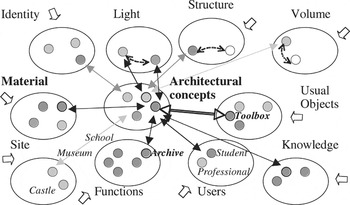
The connectionist scheme of concept emergence illustrated with elements of the think-aloud protocol analyzed in this paper (keywords on line 47: multifunctional; 214: volume; 226: identity; 244: material; 263: structure; 508: light; 636: knowledge; 638: toolbox; 644: concept).
The excitatory connections act upon units among different pools, as the designer establishes relations between various elements. The inhibitory connections, on the other hand, affect units within the same pool and represent opposite knowledge. For instance, when a designer wants a “massive” structure, this immediately implies that the structure is not “light”; or when a volume is “closed,”it is most probably not “open.” Unlike the originally instance modeling of McClelland and Rumelhart (1985, 1988), however, we do not restrict all inhibitory connections to units within the same pool. An architectural construction is a complex object composed of sometimes contrasting and even contradicting aspects. The emergence of the architectural concept is precisely what allows rounding up all these aspects in a single, coherent whole.
The activation of a unit depends on the number and intensity of the activations received from the other units to which it is connected. When a concept unit is sufficiently activated, an idea of an overall principle emerges in the designer's consciousness. Its sufficient activation will interfere in the choice of other qualities of the design. The feature units for their part are, in turn, activated by the dominant concept unit and those close to it. In view of this, the design process can be described as a sort of competition between concept units that interlards the design process, whereby the concept unit and its connections can be thought of as an internal representation of the architectural response or building solution. This internal representation is necessarily multimodal (Chandrasekaran, 1999) and maintains many strong relations with other feature units.
Figure 2 represents the pools of units by “clouds” to reflect the ill-defined limits of a set. The representation of the knowledge and its categorization remain an upstream problem. The aim of this work is to focus only on mechanisms of concept development and processing. Yet, to explain these mechanisms, we need a simplified representation of the concepts manipulated by the designer. The representation of the design problem is not the real environment. It is just the problem as the designer represents it. As will be shown in the following section, keyword analysis of a think-aloud protocol allows the identification of (at least some of) the activated feature units and their pool. Applying the IAC model to the results of this analysis in turn allows us to start monitoring the architectural concept's emergence.
4.2 A photo shoot of a concept under construction
This section applies the proposed scheme to the think-aloud protocol of an architect designing a school building. Originally, we have mentioned, this protocol was generated as part of a pilot study to test a prototype design tool, c.q., an on-line case library for architects (Heylighen & Neuckermans, 2001). To this end, a professional architect was invited to use the prototype during a 2-h design session. He was asked for a proposal to reorganize and extend an architecture school, located in a 16th century castle. The task was to reorganize and optimize the west wing of the castle (design studios, lecture rooms, secretariat, photocopy room) and extend it with a reception hall, material museum, and exhibition room. Small-scale plans of all floors and pictures of the building were provided.
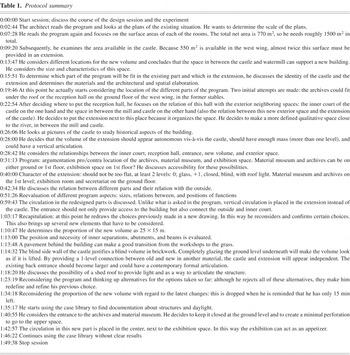
Apart from having access to the case library, the architect could go about the design task as he preferred. The design session was limited to 2 h, and the subject was asked to think aloud as he was designing. To help him become accustomed to thinking aloud, the session was preceded by a short training exercise. Moreover, once the design session had started, the architect was encouraged to think aloud if intervals of silence lasted more than 30 s. During this session, all actions of the architect were audio- and videotaped. Afterward, the drawings and notes were collected and numbered chronologically, and the tapes were transcribed. A summary of this transcription is provided in Table 1.
Protocol summary
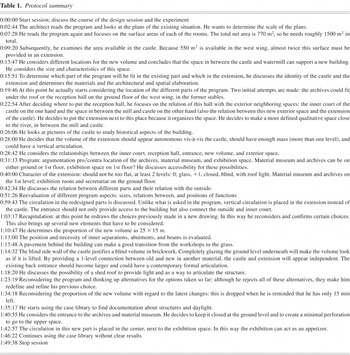
At first sight, one would expect the situation of an architect testing a prototype tool to differ considerably from the situation of an architect designing. However, when having a closer look at the summary of the protocol transcription, the tool does not seem to have thoroughly affected the architect's design process, or at least the part of the process that interests us here. During the first 1.5 h of the design session, the architect concentrates on understanding the design task and developing a proposal. It is only at the end of the session, when he has more or less an idea of what he wants to do, that he consults the case library to look for relevant structures to realize his idea.1
Note that this does not apply to all protocols generated within the context of this study. Protocol analysis revealed some interesting differences between novice and expert designers. Although novices tend to scan the case library for inspiration on interesting ideas, experts (such as the subject studied here) rather try to project their own ideas onto the projects available in the library. In a comparative analysis, the novice under consideration did not consult the case library not because he was looking for anything in particular, but to get inspired by other projects. By contrast, the expert studied here explicitly looked for concepts related to his design ideas. His search was more structured in that he tried to match his own ideas with those in the project collection.
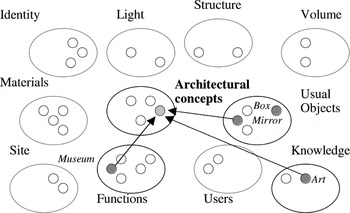
If we applied the proposed scheme of concept generation to the very beginning of the protocol, that is, before the architect has started designing, the first snapshot would possibly look like Figure 3. The strength of the connections between units (shown in the figure by the thickness of the arrows) is determined by the designer's memories and experiences, and thus likely to be unique to this particular subject. Suppose, for instance, that our subject recently visited Myrto and Vitart's Musée des Beaux Arts in Lille (France). In this case, one may expect a strong connection between the function of a museum and the concept of a mirror. This first snapshot, however, is necessarily completely hypothetical, because at this point in the protocol we have no access to the designer's memories or mind (or perhaps more correctly, even less so than during the protocol).
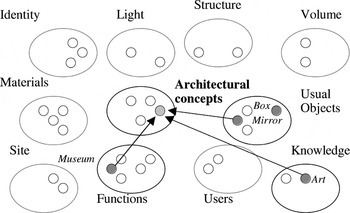
A hypothetical snapshot before design starts. A recent visit to Myrto and Vitart's Musée des Beaux Arts in Lille (France) is likely to introduce activations of the art unit, the function of a museum, and the concept of a mirror.
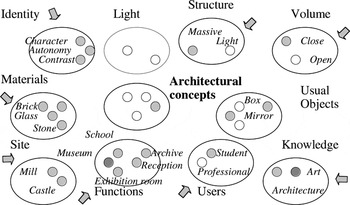
Once the actual protocol has started, we can call in keyword analysis to identify activated feature units. A first phase covers the time of comprehending the design task, when the designer reads the program and examines the plans (keywords on line 37: castle, architecture department; 42: stone; 45: reception, student; 49: exhibition room; 50: material museum, archive; 62: mill). Subsequently, he enters a second phase of problem representation, in which he focuses on dimensions and spaces available (keyword on line 129: open). After approximately 15 min, the designer switches attention to the identity of the castle (keywords on line 233: autonomy; 234: contrast; 237: brick; 246: glass; 268: character; 434: massive). As illustrated in the second snapshot (see Fig. 4), all these activities activate multiple feature units, ranging from functions (e.g., museum) over users (e.g., students) to materials (e.g., brick).
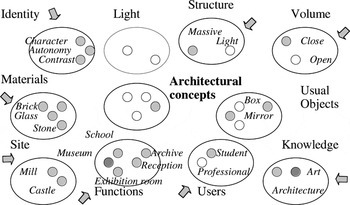
External activation.
At this point, the concept or concepts still appear in a fog. Indeed, the activation of the feature units propagates in the network and transfers by multiple connections to the architectural concept units, each representing a concept defined by a particular combination of features. The architect's task is now to integrate new functions and new spaces in the castle, yet the choices available are downright vast. He must decide on materials, forms, and spaces; but what should he hook these decisions onto? Where should he start?
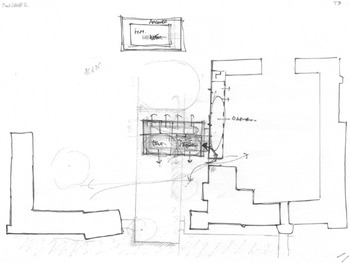
Because the architect has little experience with redesigning historical buildings such as the castle, he cannot readily recycle options or decisions taken in similar projects before. Consequently, deductive reasoning is necessarily limited: the designer is unable to build on generalizations made up beforehand to infer the particular case at stake, but how can he proceed? Starting from the elements available, he tries to find common points and, in doing so, to make inductive inferences. Out of these regularities, the architectural concept emerges in a timid way. Because the surface area available in the castle cannot accommodate all spaces listed in the program, the architect decides to extend the west wing with a new volume between the castle and the neighboring mill (see Fig. 5).

The new volume between the castle (right) and the mill (left).
He starts designing the new volume on line 225, and on line 638 (i.e., about 10 min later) he suddenly talks about a “toolbox.”
634 what do we get then? so we have above materials museum and archive space
635 that looks like that as well
636 that it a … a eh storing of knowledge
637 of knowledge
638 and the toolbox for the students and architects
639 and the toolbox is in …
640 that is the toolbox
641 and the toolbox are both materials
642 as well as knowledge
643 storing of materials and knowledge as the toolbox
644 a … already the start of a concept
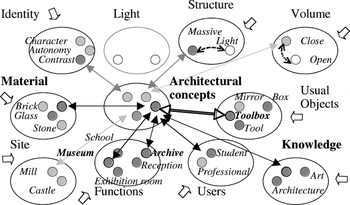
In some sense, he explains, the materials exhibited in the material museum and the design knowledge embodied by the archived student projects can be considered as essential tools for architecture students. If we took a snapshot at this point, we would see that the connections between the active feature units (such as museum, archive, knowledge) have triggered the activation of the toolbox concept unit (see Fig. 6). The term toolbox is a verbal concept that allows the designer to share his architectural concept, but the conceptual world exceeds the linguistic world. The feature unit toolbox is a stamp of a mental picture.

Activation transfer and propagation. The connections between the active feature units (such as museum, archive, knowledge, material) trigger the activation of the toolbox concept unit.
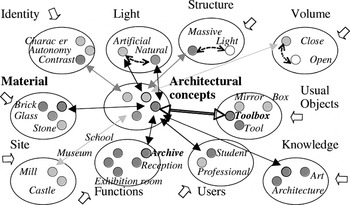
Henceforth, a word, an image, thus gathers under a single label of the totality of the design. As the idea of a toolbox is further developed, the activation is propagated to various feature units. Each new element to be integrated by the design must have the characteristics of the whole to reinforce the parti. In this manner, the concept is gradually consolidated and sharpened with each new choice made. Reinforcing features include the functions (archive and material museum), shape (robust and closed), and material (brick), while at some point in the design process, the choice of (roof) light is clearly destabilizing. Indeed, at the moment of the fourth snapshot (Fig. 7), the designer considers giving up the idea of a toolbox all together, because the two tools within the box (archive and materials museum) have contradictory daylight requirements. Therefore, he considers locating the material museum on the first floor, lit by roof light, and storing the archive away on the ground level, safely protected from the damaging daylight. Eventually, however, he decides to cover only half of the first floor with roof light, which allows him to hang on to the idea of a toolbox.
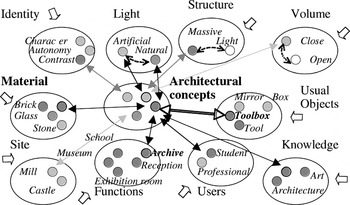
Considering the use of roof light destabilizes the toolbox concept.
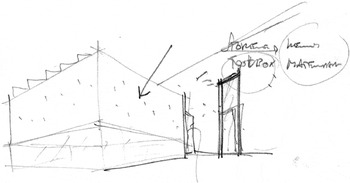
In this process of concept generation and development, a key role is played by the designer's sketches. Throughout the design session, the designer sketches and makes several external representations that validate or invalidate the toolbox concept. The sketches provide new perceptual cues and support not only verification but also extraction of characteristics (Chandrasekaran, 1999). Gabriela Goldschmidt (1999) speaks in this respect of the backtalk of self-generated sketches. In the protocol studied, the designer's sketches supply new stimuli for the feature units in the model. It is an iterative process that gradually increases the activation of the concept unit, which in turn, is transferred by all its connections to other units. The process stops when the design is finished, because no new fundamental information can modify the architectural concept. The internal representation is completed, the activation of the concept unit reaches a maximum, and the transfer of activation is stabilized. The result is a robust, blind, brick box lifted on top of a glazed volume (Fig. 8).
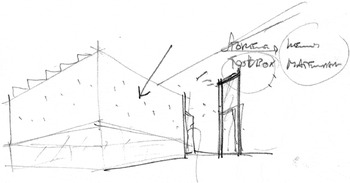
The blind, brick, robust toolbox lifted on top of a glazed volume.
5. DISCUSSION AND FUTURE WORK
Design concepts in architecture typically feature in post hoc explanations or reviews of finished design projects. By contrast, this paper has tried to chase a concept during the design process, and shed more light on when, how, and why it pops up in the designer's mind.
The very difficulty of answering these questions lies in the inaccessibility of the designer's thoughts and operations. Only his features, gestures, and words testify to his inner activity. The words he uses try to share with us his conscious reasoning, but what about the unconscious operations to which the designers himself does not have access? Indeed, the designer's consciousness only has access to a negligible part of these processes (Damasio, 2000). Thus, the concept and its development within the designer's mind are his sole property.2
In fact, questions can even be raised about our access to the reasoning the designer is conscious of: to what extent do his speech acts really attest to the conscious process in his mind? Although the arguments for accepting reports of think-aloud exercises as a reflection of cognitive activity are well documented and substantiated (Ericsson & Simon, 1984), the technique shows serious disadvantages when applied to design. Because the visual, nonverbal thinking is fundamental to how designers know and work (Cross, 1982), the verbalization may produce side effects that change the subjects' behavior and cognitive performance (Cross et al., 1996). Research in the field of product design, for instance, has illustrated that protocol analysis, and the constraint it brings, both theoretically and methodologically, interferes with designing (Lloyd et al., 1996). Until we have a more coherent picture of this interference, however, we can do little more than be very explicit on how our experiment was set up (Cross et al., 1996). Perhaps worth mentioning here is that, in everyday life, our subject is used to designing in team with his design partner and thus to talking while designing. According to Goldschmidt (1996), thinking aloud and conversing with others indeed can be seen as similar reflections of the cognitive processes involved in design thinking.
The connectionist scheme proposed in this paper seems to provide a useful framework to inventory those parts of the conceptual puzzle we do have access to and to map the relationships between them. In the protocol studied, the hidden concept unit is only accessible for us by its name, that is, toolbox. What we do have access to, however, are the various feature units, which activate (e.g., the need for an archive and materials museum), reinforce (e.g., the robust shape or use of brick), or destabilize (e.g., the roof light) the toolbox concept. Together, these features and their relationships form a picture, however vague, of when and how the toolbox concept comes into being.
A question that largely remains unanswered is why the concept of a toolbox rather than another one pops up. Keeping Schön's (1963) warning in mind, it is, of course, no answer to say that “toolbox” comes to mind in connection with the new volume because the new volume, to accommodate the materials museum and archive, is like a toolbox. We can see after the fact that it is like a toolbox and like other things as well. The question is why, of the many things it could come to be conceived as, this one comes to mind and is singled out. According to Schön (1963), part of the answer to this question has to do with what is available in our culture. The various concentric and overlapping cultures we belong to provide the materials from which our concepts are made. The technology, our social system, and our theories of the world, are our “given,” our conceptual resources. The architect in the protocol studied participates, among others, in the cultures of humanity, the western world, Belgium, and the particular architecture office in which he works. When looking at the repertoire of his office, many of the buildings turn out have an explicit boxlike appearance. Moreover, in the period the experiment was conducted, the office had just completed a fire station. It is interesting that this building not only looks like a box but also, according to the architects' description, it was deliberately conceived as a box, albeit a Pandora's box instead of a toolbox. Through this frequent and recent use both as formal articulation and as concept, the notion of “box” is likely to have been “bricked in” in the weights of the connections between multiple units before the design session started, and probably even more so afterwards. In this sense, the fire station example strongly suggests that the concept of concept indeed provides almost literally the glue that ties the designer's past experiences to present interactions with the world.
What the scheme does provide, however, is a plausible answer to the question why the concept is so elusive in the course of the design process. While designing, the architect does not yet possess all ingredients of the project. He has to integrate the elements of the program, some of which may turn out to be in complete contradiction with the initial “parti,” thus requiring a reformulation and sometimes even abandonment of the initial concept. Upon completion of a design project, however, all elements, including some uncontrolled, are fixed. Once the design is finished, the inductive inference of the concept from the overall strategy over the characteristics is much easier, because the architect highlights only those elements that enabled him to develop the final concept. The story developed around the concept is thus much more garnished at the end of the design process because, at this point, all parts of the puzzle have fallen into place.
Our ability to refine and extend the scheme proposed is a necessary condition for advancing meaningful implications for design education. A greater awareness and understanding on the part of design teachers of their own processes of concept generation is likely to benefit the teaching methods in the design studio for all students. We understand that the process of learning design is inevitably fraught with struggles, and students need to go a long way to get familiar with the design-oriented ways of thinking. However, through a less tacit studio pedagogy, based on a more articulate understanding of concept generation, they might learn design in a more confident and productive way. By the same token, the scheme might facilitate communication across students and teachers who are embracing different paradigms, by offering them a common language. Of course, it would not teach students how to develop design concepts. It would not take the place of practice, or of the drive to become a designer. However, it might confirm them in certain directions they have already tentatively explored, or make them more attentive to certain things in themselves they would otherwise brush aside as irrelevant. It might make more understandable and therefore more acceptable to them the sort of process they find themselves going through.
Before we can even start thinking of this common language, however, the arena for additional research contributions to the topic addressed in this paper is virtually limitless, because research attention to how design concepts come into being has been relatively minimal.
There is a need for a better understanding of what architects mean when they talk about a design concept. When we began our research, we found that the current idea of a concept in architectural design is ill defined, arbitrary, and not based on real knowledge of the process of design or the perspective of designers. We therefore saw (and still see) our research problem as not merely to understand how architects generate and use concepts, or how concepts come into being, but also to sharpen the definition of what a concept in architectural design is.
In general, one way of defining a concept is to collect examples of things we recognize as embodying what the concept refers to and then look for what the inevitably messy and historically contingent ideas of people have in common (Becker, 1998). The connectionist scheme of concept generation and development proposed in this paper does exactly that: it tries to synthesize what our past experiences related to design concepts in architecture have in common with the design process of a professional architect. Because the path of only one architect has been studied, it is obvious that the scheme is still in embryo. Future research therefore will confront the preliminary scheme with additional empirical examples to find more aspects of concepts in architectural design worth studying and incorporating into our analysis. Indeed, some aspects of this protocol clearly differ from other protocols generated in the same pilot study, not to mention protocols generated under completely different conditions or real-world design processes. Recently, we have recorded and transcribed four additional design protocols involving a highly heterogeneous group of subjects, which will be used to further validate and refine the scheme proposed.
Besides sharpening the definition of design concepts, and trying to validate the scheme proposed, other research questions to be explored include (but are not limited to) the following:
- How do long-term memory and short-term memory interact in the cognitive processes we are trying to understand? And how can the scheme of concept generation be further developed to accommodate this interplay?
- Can the scheme, by extension, also account for those cases where the integrating role, here ascribed to the concept, is played by other elements, such as a proportional system (Le Corbusier's Modulor, for instance) or a specific building type? In these cases, the links between the active units could be thought of as belonging to the same family, such that the decisions cohere without being “projected” explicitly onto a specific concept.
- How much do the notion of concept and the process of concept generation vary across different design disciplines? What can we learn from these variations and to what extent can the proposed scheme account for them?
Awaiting the outcome of these research tracks, we put our preliminary scheme of concept generation and development on the table, so to say, such that other may learn from it, criticize it, and above all, continue their own research from which, hopefully, new insights in the role of concepts during design will emerge.
ACKNOWLEDGMENTS
The first author is a postdoctoral fellow of the Fund for Scientific Research, Flanders, the support of which is gratefully acknowledged. The second author is supported by the research program WIST-IC&C (contract 03/1/5438) of the Belgian Wallonia Region. The authors thank Jonas Lindekens, Sam Michiels, and Han Vandevyvere for their invaluable comments on earlier versions of this text.
References
REFERENCES
Alexander, C.
(1979).
The Timeless Way of Building.
New York:
Oxford University Press.
Becker, H.S.
(1998).
Tricks of the Trade—How to Think about Your Research While
You're Doing it.
Chicago:
University of Chicago Press.CrossRef
Bourdieu, P.
(1977).
Outline of a Theory of Practice.
Cambridge:
Cambridge University Press.CrossRef
Chandrasekaran, B.
(1999).
Multimodal perceptual representations and problem solving.
In
Visual and Spatial Reasoning in Design
(Gero, J.S. &
Tversky, B., Eds.), pp.
3–14.
Sydney, Australia:
University of Sydney, Key Centre of Design Computing and
Cognition.
Churchland, P.S. &
Sejnowski, T.J.
(1992).
The Computational Brain.
Cambridge, MA:
MIT Press.
Cross, N.,
Christiaans, H., &
Dorst, K.
(1996).
Introduction: The Delft Protocols Workshop. In
Analysing Design Activity
(Cross, N.,
Christiaans, H. &
Dorst, K., Eds.), pp.
1–16.
Chichester:
Wiley.CrossRef
Damasio, A.R.
(2000).
The Feeling of What Happens: Body, Emotion and the Making of
Consciousness.
London:
Vintage.
Darke, J.
(1978).
The primary generator and the design process. In
New Directions in Environmental Design Research
(Rogers, W.E. &
Ittelson, W.H., Eds.), pp.
325–337.
Washington, DC:
EDRA.
Downing, F.
(2003).
Transcending memories: remembrance and the design of place.
Design Studies
24(3),
213–235.CrossRefGoogle Scholar
Ericsson, K.A. &
Simon, H.A.
(1984).
Protocol Analysis: Verbal Reposts as Data.
Cambridge, MA:
MIT Press.
Gärdenfors, P.
(2004).
Conceptual Spaces: The Geometry of Thought. pp.
102–126.
Cambridge, MA:
MIT Press.
Goldschmidt, G.
(1996).
The designer as a team of one. In
Analysing Design Activity
(Cross, N.,
Christiaans, H. &
Dorst, K., Eds.), pp.
65–91.
Chichester:
Wiley.
Goldschmidt, G.
(1999).
The backtalk of self-generated sketches. In
Visual and Spatial Reasoning in Design
(Gero, J.S. &
Tversky, B., Eds.), pp.
163–184.
Sydney:
University of Sydney, Key Centre of Design Computing and
Cognition.
Heylighen, A. &
Martin, G.
(2004).
That elusive concept of concept in architecture. In
Design Computing and Cognition '04
(Gero, J.S., Ed.), pp.
57–76.
Dordrecht:
Kluwer Academic.CrossRef
Heylighen, A. &
Neuckermans, H.
(2001).
Destination: practice. Towards a maintenance contract for the
architect's degree. In
Reinventing the Discourse
(Jabi, W., Ed.), pp.
90–99.
Buffalo, NY:
ACADIA.
Kolodner, J.L.
(1993).
Case-Based Reasoning.
San Mateo, CA:
Morgan Kaufmann.
Lawson, B.
(1994).
Design in Mind.
London:
Butterworth Architecture.
Leclercq, P. &
Heylighen, A.
(2002).
5,8 analogies per hour. In
Artificial Intelligence in Design '02
(Gero, J.S., Ed.), pp.
285–303.
Dordrecht:
Kluwer Academic.
Lemaire, P.
(1999).
Psychologie Cognitive.
Paris:
De Boeck Université.
Leupen, B.,
Grafe, C.,
Körnig, N.,
Lampe, M., &
De Zeeuw, P.
(1997).
Design and Analysis.
New York:
Van Nostrand Reinhold.
Lloyd, P.,
Lawson, B., &
Scott, P.
(1996).
Can concurrent verbalisation reveal design cognition? In
Analysing Design Activity
(Cross, N.,
Christiaans, H. &
Dorst, K., Eds.), pp.
437–463.
Chichester:
Wiley.
McClelland, J.L. &
Rumelhart, D.E.
(1985).
Distributed memory and the representation of general and specific
information.
Journal of Experimental Psychology: General
114,
159–188.CrossRefGoogle Scholar
McClelland, J.L. &
Rumelhart, D.E.
(1988).
Explorations in Parallel Distributed Processing, pp.
11–47.
Cambridge, MA:
MIT Press.
McLeod, P.,
Plunkett, K., &
Rolls, E.T.
(1998).
Introduction to Connectionist Modeling of Cognitive
Processes.
Oxford:
Oxford University Press.
Murphy, G.L.
(2002).
The Big Book of Concepts.
Cambridge, MA:
MIT Press.
Rowe, P.G.
(1987).
Design Thinking.
Cambridge, MA:
MIT Press.
Schön, D.A.
(1963).
Displacement of Concepts.
London:
Tavistock Publications.
Schön, D.A.
(1983).
The Reflective Practitioner—How Professionals Think in
Action.
New York:
Basic Books.
Suwa, M. &
Tversky, B.
(1997).
What do architects and students perceive in their design sketches? A
protocol analysis.
Design Studies
18(4),
385–403.CrossRefGoogle Scholar
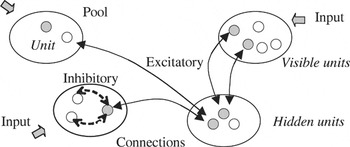
The interactive activation and competition model. Connections between units are (· · ·) inhibitory or (—) excitatory. The activation level of a unit (represented by gray color intensity) depends on current and received activation.
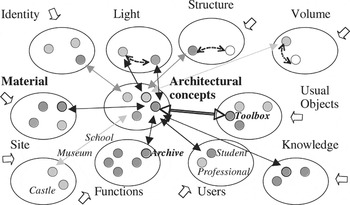
The connectionist scheme of concept emergence illustrated with elements of the think-aloud protocol analyzed in this paper (keywords on line 47: multifunctional; 214: volume; 226: identity; 244: material; 263: structure; 508: light; 636: knowledge; 638: toolbox; 644: concept).
Protocol summary
A hypothetical snapshot before design starts. A recent visit to Myrto and Vitart's Musée des Beaux Arts in Lille (France) is likely to introduce activations of the art unit, the function of a museum, and the concept of a mirror.
External activation.
The new volume between the castle (right) and the mill (left).
Activation transfer and propagation. The connections between the active feature units (such as museum, archive, knowledge, material) trigger the activation of the toolbox concept unit.
Considering the use of roof light destabilizes the toolbox concept.
The blind, brick, robust toolbox lifted on top of a glazed volume.
 You have
Access
- 2
- Cited by