INTRODUCTION
The Trail Making Test (TMT) is one of the most widely used instruments in neuropsychological assessment as an indicator of speed of cognitive processing and executive functioning (AITB, 1944; Lezak, Reference Lezak and Lezak1995; Mitrushina et al., Reference Mitrushina, Boone, Razani and D’Elia2005; Reitan, Reference Reitan1992; Strauss et al., Reference Strauss, Sherman and Spreen2006). The test consists of two parts (A and B). The direct score of each part is represented by the time of completion of the tasks. In addition to direct scores, the B-A difference score, the B:A ratio, and the B-A/A proportional score have been used for clinical proposals as the purest indicators of certain cognitive operations or specific markers of brain damage (but see Periáñez et al., Reference Periáñez, Ríos-Lago, Rodríguez-Sánchez, Adrover-Roig, Sánchez-Cubillo, Crespo-Facorro, Quemada and Barceló2007, for a review).
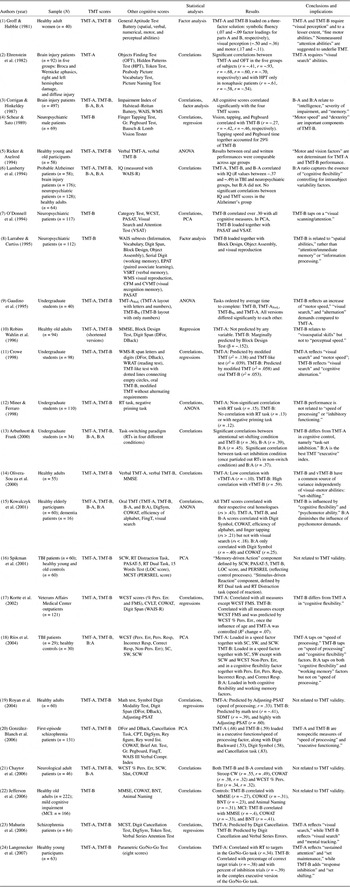
While most studies agree that TMT has a complex and multifactorial structure comprising several cognitive mechanisms, there is a lack of consensus about their exact nature and about their relative contributions to task performance. Table 1 presents an overview of 24 studies that have tried to clarify the processes underlying TMT scores. Visual search, perceptual/motor speed, speed of processing, working memory, and general intelligence are among the most frequently cited constructs thought to contribute to TMT performance. Beyond structural factors such as length of trails or perceptual complexity, the TMT-B has been proposed to involve additional “executive function” demands (Lezak, Reference Lezak and Lezak1995; Mitrushina et al., Reference Mitrushina, Boone, Razani and D’Elia2005; Strauss et al., Reference Strauss, Sherman and Spreen2006). Cognitive alternation/flexibility, inhibition/interference control, working memory, mental tracking, and attentional set-shifting are some of the most frequently reported constructs accounting for the increased times in TMT-B performance (Table 1). However, both the lack of consensus regarding the terminology used to refer to cognitive constructs and the discrepancies regarding the involvement of some of these abilities in TMT make it difficult to clarify what does the TMT ultimately measure. In order to disentangle these confounding factors, it is useful to review which basic processes have been associated with TMT performance and how have they been operationalized.
Overview of studies with relevance to TMT construct validity

Note
Direct (TMT-A and TMT-B) and derived TMT scores (B-A and B:A), WAIS-R (Wechsler Adult Intelligence Test-Revised), WMS-R (Wechsler Memory Scale-Revised), DigSym (WAIS-III Digit Symbol), FingT (finger tapping), DFor (WAIS-III Digit Forward), DBack (WAIS-III Digit Backward), SC (Stroop Color), SW (Stroop Word), SCW (Stroop Color-Word), SInt (Stroop Interference score), SwitchC (Switch Cost in WCST-like task = RT switch − RT repeat), BNT (Boston Naming Test), MMSE (Mini Mental State Examination), MCST (Modified Card Sorting Test), COWAT (Controlled Word Association Test), CVLT (California Verbal Learning Test), PASAT (Paced Auditory Serial Addition Test), CPT (Continuous Performance Test), SDMT (Symbol Digit Modality Test), PCA (principal components analysis), and ANOVA (analysis of variance).
Working memory has been related to both parts A and B in several studies (Crowe, Reference Crowe1998; Larrabee & Curtiss, Reference Larrabee and Curtiss1995; Mahurin et al., Reference Mahurin, Velligan, Hazleton, Mark Davis, Eckert and Miller2006). For instance, Kortte et al. (Reference Kortte, Horner and Windham2002) found that neither TMT-A nor TMT-B part was related to maintaining information in working memory as measured by Failures to Maintain Set on the Wisconsin Card Sorting Test (WCST). On the contrary, only the ability to alternate between different memory sets (manipulation) measured by means of Percent Perseverative Errors of the WCST significantly predicted TMT-B performance. Accordingly, the key factor mediating TMT and working memory seems not to rely merely on storage but on central executive components of memory (Baddeley, Reference Baddeley1986). The consistent finding across studies of a significant correlation between TMT-B and WCST perseverative indices supports the idea that cognitive flexibility, also referred to as “attentional set-shifting” or “task-set switching,” could capture key executive abilities underlying part B performance (Chaytor et al., Reference Chaytor, Schmitter-Edgecombe and Burr2006; Kortte et al., Reference Kortte, Horner and Windham2002; Lamberty et al., Reference Lamberty, Putnam, Chatel, Bieliauskas and Adams1994; Langenecker et al., Reference Langenecker, Zubieta, Young, Akil and Nielson2007; O’Donnell et al., Reference O’Donnell, Macgregor, Dabrowski, Oestreicher and Romero1994; Ríos et al., Reference Ríos, Periáñez and Muñoz-Céspedes2004; Spikman et al., Reference Spikman, Kiers, Deelman and van Zomeren2001). For instance, Arbuthnott and Frank (Reference Arbuthnott and Frank2000) directly addressed the relationship between TMT scores and a supposedly pure measure of cognitive flexibility, that is, the behavioral switch-cost as measured in task-switching paradigms (see a recent review in Monsell, Reference Monsell, Duncan, Phillips and McLeod2005). Their analysis of reaction time (RT) costs revealed a specific association between B:A and the ability to inhibit versus alternate between task-sets. However, the absence of any other cognitive measures besides their task-switching paradigm made it difficult to disentangle the specific contribution of switching ability beside alternative cognitive abilities previously related to TMT. To our knowledge, no other reports have attempted to examine the relationship between TMT and behavioral switch-costs. In accordance to Arbuthnott and Frank (Reference Arbuthnott and Frank2000), a relationship between TMT-B and inhibitory abilities has been supported on the basis of significant correlations between TMT and the Stroop Interference condition (Chaytor et al., Reference Chaytor, Schmitter-Edgecombe and Burr2006; Spikman et al., Reference Spikman, Kiers, Deelman and van Zomeren2001). However, the use of more specific measures of inhibitory abilities such as Go/No-Go tasks (Langenecker et al., Reference Langenecker, Zubieta, Young, Akil and Nielson2007) or negative priming tasks (Miner & Ferraro, Reference Miner and Ferraro1998) has provided contradictory evidence about the role of inhibition in TMT scores with both positive and negative results, respectively. Last, the general assumption that both TMT-A and TMT-B involve visuomotor factors has been questioned based on results from an oral version of the TMT (Kowalczyk et al., Reference Kowalczyk, McDonald, Cranney and McMahon2001; Olivera-Souza et al., Reference Olivera-Souza, Moll, Passman, Cunha, Paes, Adriano, Ignacio and Marrocos2000; Ricker & Axelrod, Reference Ricker and Axelrod1994). Indeed, the high compatibility demonstrated between oral and written TMT versions puts into question the role of these factors given that the oral TMT eliminates visual and motor demands. Moreover, the lack of correlation between TMT scores and an RT task further questioned the relationship between TMT and motor speed factors (Miner & Ferraro, Reference Miner and Ferraro1998).
Across studies, at least three different sources of variability may be held responsible for the inconsistencies described above. First, most TMT validation studies have considered between two and four cognitive measures only. Just 9 of the 24 studies reviewed in Table 1 included neuropsychological batteries containing five or more variables. Given the wide range of cognitive abilities related to TMT performance (i.e., perceptual, motor, attentional, memory, or inhibition abilities), validation studies that consider only a small number of variables may produce a biased interpretation of the mechanisms underlying TMT performance. A second potential source of variability and discrepancy between studies is related to sample composition. Thus, samples from 10 of the reviewed studies were exclusively constituted by healthy participants and only 2 of them included old adults. Of the 14 remaining studies, 5 included neuropsychiatric patients, 3 included neurological patients, and the 6 remaining studies included a mixture of healthy and neurological or psychiatric samples. On the one hand, the use of clinical groups has been shown to hide particular dangers. It has been reported that using clinical groups for TMT validation purposes, even those with mild neurological impairment, may bias the findings as patients may be using compensatory strategies to complete the test (Jefferson et al., Reference Jefferson, Wong, Bolen, Ozonoff, Green and Stern2006; Spikman et al., Reference Spikman, Kiers, Deelman and van Zomeren2001). In fact, the pattern of correlations and factorial loadings between TMT and other cognitive measures has shown changes between different clinical samples even within studies (Lamberty et al., Reference Lamberty, Putnam, Chatel, Bieliauskas and Adams1994). Thus, the use of clinical groups may be biasing validation results by overstating compensatory cognitive factors and understating impaired abilities. On the other hand, the extended use of young and middle-age healthy samples may limit the potential generalization of validity results to different samples outside this age range where TMT has proved to be a sensitive indicator of cognitive disabilities (Periáñez et al., Reference Periáñez, Ríos-Lago, Rodríguez-Sánchez, Adrover-Roig, Sánchez-Cubillo, Crespo-Facorro, Quemada and Barceló2007). Third, the use of different statistical methodologies between studies may also contribute to apparent differences in the results. As reviewed in Table 1, correlation coefficients were calculated in 16 studies: 7 used factor analysis, 5 used regression analysis, and 4 used analyses of variance. However, only eight of all studies included more than one statistical method, thus limiting the comparisons among studies.
The present study aims to examine the cognitive processes underlying TMT performance while sorting out some limitations from prior investigations. The specific objective was to clarify the relative contribution from working memory, inhibition/interference control, task-switching ability, and visuomotor speed to both direct and derived TMT scores (Table 1). To our knowledge, no previous work has comprehensively explored the joint and individual contributions of all these factors to both direct and derived TMT indices. We assessed a sample of healthy old adults, thus maximizing the potential generalization of results to adult populations and reducing the risks derived from using clinical samples for validation purposes, as detailed above.
MATERIALS AND METHODS
Participants
A sample of 41 Spanish Caucasian healthy old adults (mean ± SD age = 59.4 ± 6.9 years; range = 49–78 years; mean ± SD years of education = 11.4 ±3.6; 12 males) took part in this study. Participants were recruited as volunteers from special university courses for retired and elderly people, university staff, and health care centers. A self-reported history of medical and psychiatric problems was obtained from each participant. History of neurological disease, psychiatric illness, head injury, stroke, substance abuse (excluding nicotine), learning disabilities, and any other difficulty that may interfere with testing were the exclusion criteria. All participants had normal or corrected-to-normal vision. Subjects exhibited no signs of cognitive impairment and scored higher than 26 in the Mini Mental State Examination (Folstein et al., Reference Folstein, Folstein and McHugh1975) (mean ± SD = 29.2 ±1.1; range = 26–30). In addition, subjects scored within normal ranges in the standardized neuropsychological tests used, according to Spanish published norms: TMT (Periáñez et al., Reference Periáñez, Ríos-Lago, Rodríguez-Sánchez, Adrover-Roig, Sánchez-Cubillo, Crespo-Facorro, Quemada and Barceló2007), Wechsler Adult Intelligence Scale (Third Version) (WAIS-III) subtests (Wechsler, Reference Wechsler1999), and Stroop Test (Golden, Reference Golden1994).
Instruments and Procedure
Neuropsychological examination was conducted by experienced psychologists in two different sessions: (1) an initial interview and a standardized neuropsychological testing and (2) a computerized testing using a task-switching paradigm. This study was completed in compliance with institutional research standards for human research and in accordance with the Declaration of Helsinki.
Trail Making Test
Participants were administered parts A and B of the TMT according to the guidelines presented by Strauss et al. (Reference Strauss, Sherman and Spreen2006). Total time in seconds for parts A and B was recorded, representing the TMT-A and TMT-B direct scores. Three derived scores were also calculated: difference score (B-A), ratio score (B:A), and Log B:A. The logarithmic transformation of B:A score aimed to reduce the potential impact of dispersion in scores and may be useful to generalize results across healthy and clinical groups. The proportional score (B-A/A) was not considered for analyses due to its linear dependency with B:A, as indicated elsewhere (Periáñez et al., Reference Periáñez, Ríos-Lago, Rodríguez-Sánchez, Adrover-Roig, Sánchez-Cubillo, Crespo-Facorro, Quemada and Barceló2007).
Digit Symbol subtest (WAIS-III)
Speed of perceptual processing and visual search were assessed using the Digit Symbol subtest from the Spanish adaptation of the WAIS-III (Wechsler, Reference Wechsler1999). The number of symbols correctly encoded in 2 min was considered as the dependent variable for analyses.
Finger Tapping Test
The Finger Tapping Test is thought to measure self-directed manual motor speed. According to the guidelines presented by Strauss et al. (Reference Strauss, Sherman and Spreen2006), subjects were instructed to tap as rapidly as possible using the index finger. The number of taps done in five trials of 10-s duration was recorded for each hand. The average number of taps was the dependent variable for analyses.
Digits Forward and Backward subtests (WAIS-III)
These subtests from the Spanish adaptation of the WAIS-III (Wechsler, Reference Wechsler1999) were used in order to assess working memory and mental tracking processes. Both direct scores were recorded separately and included in the analyses as the dependent variables for analyses.
Stroop Test
The Spanish adaptation of the Stroop Test (Golden, Reference Golden1994) was used to assess the ability to maintain a goal in mind and to inhibit a habitual response in favor of a less familiar one (inhibitory/interference control). The number of correct responses in 45 s in the Color-Word condition was recorded as the dependent variable. Errors were indicated by the examiner, and participants were asked to correct them before continuing.
Task-switching paradigm
Task-switching ability was measured by means of a modified version of a classical test of executive function, the WCST (Barceló et al., Reference Barceló, Muñoz-Céspedes, Pozo and Rubia2000, Reference Barceló, Periáñez and Knight2002; Periáñez et al., Reference Periáñez, Maestú, Barceló, Fernández, Amo and Ortiz2004). This WCST modification has generated reliable switch-cost effects (Barceló et al., Reference Barceló, Muñoz-Céspedes, Pozo and Rubia2000, Reference Barceló, Periáñez and Knight2002, Reference Barceló, Escera, Corral and Periáñez2006; Periáñez et al., Reference Periáñez, Maestú, Barceló, Fernández, Amo and Ortiz2004). The behavioral switch-cost in RTs is thought to reflect the time consumed by an executive control mechanism necessary to switch from one task to another (Monsell, Reference Monsell, Duncan, Phillips and McLeod2005). In addition, WCST behavioral switch-cost met some criteria established to distinguish between top-down control and task execution processes during task-switching (Meiran, Reference Meiran1996; Monsell, Reference Monsell, Duncan, Phillips and McLeod2005): RT switch-cost (1) was specific of task-switch trials (Barceló et al., Reference Barceló, Periáñez and Knight2002, Reference Barceló, Escera, Corral and Periáñez2006), (2) did not diminish over successive task blocks (could not be automatized with practice; Barceló et al., Reference Barceló, Periáñez and Knight2002), and (3) was reduced by increasing preparation intervals between switch cues and target events (consistent with the notion that executive control may occur in advance of task performance; Periáñez & Barceló, Reference Periáñez and Barceló2009). At the neuroanatomical level, WCST behavioral switch-costs have revealed association with a frontoparietal network (Barceló et al., Reference Barceló, Periáñez and Knight2002, Reference Barceló, Escera, Corral and Periáñez2006; Periáñez et al., Reference Periáñez, Maestú, Barceló, Fernández, Amo and Ortiz2004). Consistent with current neuroanatomical models of cognitive control (Koechlin & Summerfield, Reference Koechlin and Summerfield2007; Miller & Cohen, Reference Miller and Cohen2001), this network involved the sequential activation of the inferior frontal gyrus, anterior cingulate cortex, and supramarginal gyrus (Periáñez et al., Reference Periáñez, Maestú, Barceló, Fernández, Amo and Ortiz2004). Taken together, both behavioral and neuroimaging data are consistent with the existing task-switching literature and support that WCST switch-costs reflect executive control rather than task-specific processes.
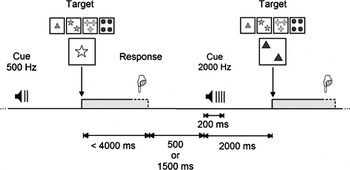
The task was run using a PC with a 14-inch monitor, which was controlled by Presentation software (http://www.neurobs.com). Subjects were instructed to switch between color and shape sorting rules on the basis of a trial-by-trial task-cueing procedure. Sorting rules were cued 2000 ms prior to the target display by means of two different tones (500 or 2000 Hz at 65 dB; Figure 1). The target display remained on screen until the participant selected a response by means of a four-button panel (using the index and middle fingers of each hand) in an array corresponding to the layout of the four key cards. After each response, a feedback text appeared on the computer screen during 200 ms indicating “right,” “wrong,” “too fast,” or “too slow” performance (response time limit of 3 s). Following prior guideline reports, the overall probability of shift and repeat trials was set to 25 and 75%, respectively, in order to minimize task-set reconfiguration processes prior to switch trials (Monsell, Reference Monsell, Duncan, Phillips and McLeod2005). The task-switching experimental session lasted around 30 min including a 10-min training period. RTs were measured in both switch and repeat trials. A switch-cost score was calculated for each participant according to standard procedures (Monsell, Reference Monsell, Duncan, Phillips and McLeod2005) by subtracting mean RTs in correct repeat trials from mean RTs in correct switch trials (RT switch-cost = RT switch − RT repeat). Subjects performed the task in two blocks with 216 target cards per block.
Task-switching protocol. The sequence of events during task-switching performance started with a tonal cue instructing subjects to switch or to repeat the classification rule used in the immediately preceding trial (i.e., color or shape classifications). The switch/repeat meaning of the two tones (500 and 2000 Hz, 65dB) was counterbalanced between subjects. After each tonal cue, a choice card appears centered on the screen together with the four key cards on top and remained on display until a response was given. Responses were immediately followed by “correct,” “incorrect,” “too fast,” and “too slow” feedback text written on the screen (200-ms duration).

Data Analyses
Shapiro–Wilk’s test was used to assess normality in the distribution of the variables as a prerequisite for regression analyses (Table 2). Repeated measures Student’s t test comparing mean RTs during task-switch versus task-repeat trials from the task-switching paradigm helped to decide whether there was a significant switch-cost. Given the relatively small sample size, which may represent a limit for analyses based in correlational methodologies, a set of exploratory correlation analyses helped to reduce the initial set of selected variables and to decide which of them should be included in regression models of TMT scores. The predictive value of variables that correlated significantly with TMT scores was explored using simple and multiple linear regression analyses, thus clarifying their independent and unique contributions to predict each TMT score. Last, the same multiple linear regression analyses were performed using age as a covariate in order to remove its influence from the analyses and explore the potential generalization of results to samples out of this age range. Our interpretation of results relied on these regression models, where the number of variables analyzed never exceeded the recommended ratio of 10 subjects per variable (Tabachnick & Fidell, Reference Tabachnick and Fidell2007). A priori (planned) contrasts were used in all statistical comparisons with an uncorrected significance level of p < .05 given that our variable selection derived from an extended review of studies already demonstrating relationship between scores. SPSS v.14.0 statistical software package was used to perform analyses.
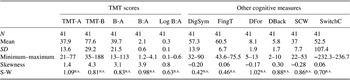
Descriptive statistics and S-W tests of normality

Note
Direct (TMT-A and TMT-B) and derived TMT scores (B-A, B:A, and Log B:A), DigSym (WAIS-III Digit Symbol), FingT (finger tapping), DFor (WAIS-III Digit Forward), DBack (WAIS-III Digit Backward), SCW (Stroop Color-Word), SwitchC (RT Switch Cost in WCST-like task = RT switch − RT repeat), S-W (Shapiro–Wilk test of normality), and n.s. (nonsignificant differences, two-tailed).
RESULTS
Descriptive statistics of all scores, including TMT direct and derived scores, are shown in Table 2. All variables were normally distributed.
Task-Switching Paradigm
Accuracy was high, with an average percentage of correct trials of 90.4% (SD = 0.98). Repeated measures Student’s t test revealed a significant switch-cost effect of 52 ms (switch vs. repeat trials; t 40 = 3.1; p < .003).
Exploratory Correlation Analyses
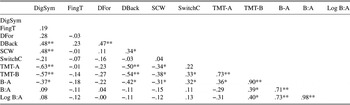
Intercorrelation Pearson coefficients between TMT scores and other cognitive measures are shown in Table 3. The analyses of correlations between direct and derived scores revealed that only B-A was modestly related to TMT-A. In contrast, all derived scores correlated significantly with TMT-B (Table 3). TMT-A scores correlated with Digit Symbol, Digit Backward, and Stroop Color-Word scores. TMT-B scores correlated with Digit Symbol, Digit Backward, Switch-cost, and Stroop Color-Word scores. While the B-A derived score correlated with Digit Symbol, Digit Backward, Switch-cost, and Stroop Color-Word, both B:A and Log B:A did not show significant correlations with any other cognitive measure.
Correlation matrix

Note
Direct (TMT-A and TMT-B) and derived TMT scores (B-A, B:A, and Log B:A), DigSym (WAIS-III Digit Symbol), FingT (finger tapping), DFor (WAIS-III Digit Forward), DBack (WAIS-III Digit Backward), SCW (Stroop Color-Word), and SwitchC (RT Switch Cost in WCST-like task = RT switch − RT repeat).
* p < .05 (two-tailed).
** p < .01.
Regression Analyses
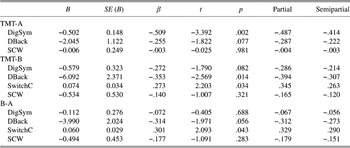
Digit Symbol, Digit Backward, and Stroop Color-Word accounted for 40, 24.8, and 11.3% of the variance of TMT-A when considered independently of each other, as revealed by simple linear regression models. The multiple regression model including the same variables was significant (R 2 = .45, p < .0001) and revealed that only Digit Symbol had a significant unique contribution of 17.14% to the prediction of TMT-A (Table 4, top panel). The same multiple regression model using age as a covariate replicated the pattern of results (R 2 = .35, p < .001) with Digit Symbol as the unique variable significantly contributing to the prediction of TMT-A (11.22%, p < .02).
Results of multiple regression analysis on TMT-A, TMT-B, and B-A scores

Note
Direct and derived TMT scores (TMT-A, TMT-B, and B-A), DigSym (WAIS-III Digit Symbol), DBack (WAIS-III Digit Backward), SwitchC (RT Switch Cost in WCST-like task = RT switch − RT repeat), and SCW (Stroop Color-Word).
Digit Symbol, Digit Backward, Switch-costs, and Stroop Color-Word accounted for 32.3, 28.9, 11.2, and 14.6% of the variance of TMT-B when considered independently of each other. The multiple regression model including the same variables was significant (R 2 = .48, p < .0001) and revealed that both Digit Backward and Switch-costs had significant unique contributions of 9.4 and 6.9%, respectively, to the prediction of TMT-B (Table 4, middle panel). The same multiple regression model using age as a covariate (R 2 = .39, p < .001) replicated the pattern of results with Digit Backward and Switch-costs having unique contributions of 9.9 and 5.2% to the prediction of TMT-B. However, the contribution of Switch-costs to this model was just marginal (p < .03 and p = .09 for Digit Backward and Switch-costs, respectively).
Digit Symbol, Digit Backward, Switch-costs, and Stroop Color-Word accounted for 13.9, 17.4, 10.1, and 9.4% of the variance of B-A, respectively, when considered independently of each other. The multiple regression model including the same variables was significant (R 2 = .3, p < .001) and revealed that only Switch-costs had a significant unique contribution of 8.41% to the prediction of B-A difference score (Table 4, lower panel). The same multiple regression model using age as a covariate (R 2 = .26, p < .02) replicated the pattern of results with Switch-costs being the best predictor of B-A (7.5%, p = .06), which was closely followed by Digit Backward (7.3%, p = .07).
DISCUSSION
The aim of this study was to clarify which cognitive mechanisms underlie TMT direct and derived scores. A sample of 41 healthy individuals was assessed by means of a battery of neuropsychological measures that, according to a comprehensive review of the literature, had previously demonstrated a relationship with TMT performance.
A series of exploratory Pearson product-moment correlations confirmed the relationship between TMT-A and TMT-B direct scores (r = .73), supporting the general assumption of common cognitive factors modulating both scores. As shown in Table 3, results also confirmed our a priori assumption about a relationship between TMT scores and most cognitive scores selected for the analyses. The cognitive measures that were significantly correlated with TMT scores were entered in a series of regression models to assess their joint and unique contributions as predictors of TMT scores (TMT-A, TMT-B, and B-A).
Multiple regression analysis performed on TMT-A explained 45% of the variance and suggested that this score was primarily affected by speed of visual search (as measured by WAIS-III Digit Symbol score). These results agree with several previous studies, suggesting that visual search and perceptual speed are better candidates to account for a substantial amount of variance in TMT-A (Table 1) as compared to motor speed factors (e.g., Ricker & Axelrod, Reference Ricker and Axelrod1994). This result contradicts a previous work using a Finger Tapping Task in a neuropsychiatric sample (Schear & Sato, Reference Schear and Sato1989). Nevertheless, the well-known presence of motor deficits in these patients may introduce a confound factor, overestimating the role of motor factors (Rodríguez-Sánchez et al., Reference Rodríguez-Sánchez, Pérez-Iglesias, González-Blanch, Pelayo-Terán, Mata, Martínez, Sánchez-Cubillo, Vázquez-Barquero and Crespo-Facorro2008). Digit Backward and Stroop Color-Word accounted individually for 24.3 and 11.3% of TMT-A, as reflected by simple regression analysis. However, their relevance in the prediction of part A disappeared when all predictor variables were jointly considered in a multiple regression analysis. The current finding clarifies a previous misunderstanding and suggests that the relationship between TMT-A and both Stroop and Digit Backward scores vanishes after controlling for visual search and perceptual speed factors, as suggested elsewhere (Rapport et al., Reference Rapport, Denney, DuPaul and Gardner1994; Ríos et al., Reference Ríos, Periáñez and Muñoz-Céspedes2004).
Multiple regression analysis performed on TMT-B accounted for 48% of the variance, with Digit Backward and Switch-cost as the main contributing factors. The ability to manipulate information in working memory (as measured by WAIS-III Digit Backward score) explained the greater portion of TMT-B variance compared to the other variables, even when speed of visual search factors were controlled for (as measured by Digit Symbol). This finding is in accordance with Crowe (1998), who suggested that working memory could explain more variance of TMT-B than alternation factors (i.e., task-switching). Furthermore, our results also confirm the broad assumption that task-switching ability is one critical cognitive mechanism differentiating TMT-A and TMT-B (Arbuthnott & Frank, Reference Arbuthnott and Frank2000; Ríos et al., Reference Ríos, Periáñez and Muñoz-Céspedes2004). Taken together, these findings may help conciliating apparent discrepancies regarding the role of working memory versus task-switching in TMT performance. Indeed, the effective implementation of executive control mechanisms, for example, switching between two tasks, may necessarily rely on the activation of short-term representations in working memory (Baddeley, Reference Baddeley1986; Norman & Shallice, Reference Norman, Shallice, Davidson, Schwartz and Shapiro1986). Last, and as found in TMT-A analyses, the individual contribution of Stroop Color-Word (14.6%) to the prediction of TMT-B in the simple regression analysis disappeared in the multiple regression analysis. Again, this result can be interpreted as produced by shared perceptual speed factors (Ríos et al., Reference Ríos, Periáñez and Muñoz-Céspedes2004). Therefore, task-switching seems to be more appropriate than the inhibition/interference control (measured by Stroop Color-Word) as the candidate mechanism that differentiates performance of TMT-B versus TMT-A (see Miner & Ferraro, Reference Miner and Ferraro1998, for analogous evidences).
Multiple regression analysis performed on B-A difference scores accounted for 30% of the variance, with Switch-cost as the main contributing variable. This was followed by working memory that, however, did not reach statistical significance (Table 4). According to the assumption that behavioral switch-costs represent a relatively pure indicator of cognitive control and executive functioning (Monsell, Reference Monsell, Duncan, Phillips and McLeod2005), our results suggest that B-A was the best TMT index of executive functioning. This finding partially contradicts preceding TMT validation studies, where task-switching ability was best related to B:A and not to B-A score (Arbuthnott & Frank, Reference Arbuthnott and Frank2000). However, key differences between the task-switching paradigm used by Arbuthnott and Frank (Reference Arbuthnott and Frank2000) and the one used in this study may account for this discrepancy.Footnote a First, the use of three task-sets in Arbuthnott and Frank’s (Reference Arbuthnott and Frank2000) experiment, as compared with the two task-sets used here has shown to increase behavioral Switch-costs due to increasing working memory demands and minimizing task-switching abilities (Barceló et al., Reference Barceló, Escera, Corral and Periáñez2006; Langenecker et al., Reference Langenecker, Zubieta, Young, Akil and Nielson2007; Mitrushina et al., Reference Mitrushina, Boone, Razani and D’Elia2005). Second, increasing the overall probability of task-switch trials to 60% of the trials, like in Arbuthnott and Frank’s (Reference Arbuthnott and Frank2000) study, has demonstrated to almost suppress behavioral switch-costs (Monsell & Mizon, Reference Monsell and Mizon2006). Thus, when the expectation of a task switch is high within a task, subjects may begin to prepare for switching in advance of task-switch trials, that is, during task-repeat trials, which would result in a subestimation of task-switching ability. In sum, the use of an experimental paradigm with a low memory load (two task-sets) and a low portion of task-switch trials (25%), like the one used here, may provide a more reliable indicator of task-switching ability while minimizing working memory demands and avoiding subjects to strategically/probabilistically prepare for task-switching in anticipation of a task-switch trial.
As noted earlier, none of the additional cognitive scores considered correlated with B:A or with Log B:A. This lack of correlation is consistent with previous studies (Corrigan & Hinkeldey, Reference Corrigan and Hinkeldey1987). Alternatively, the B:A score could be indexing cognitive factors different than those considered in the present work. Further investigation including sustained attention (Ríos et al., Reference Ríos, Periáñez and Muñoz-Céspedes2004) and verbal abilities (Kortte et al., Reference Kortte, Horner and Windham2002) should clarify whether these cognitive factors may alternatively account for B:A score.
In conclusion, our results are clear, suggesting that TMT-A requires mainly visuoperceptual abilities, TMT-B primarily reflects working memory and secondarily task-switching ability, while B-A minimizes visuoperceptual and working memory demands, providing a relatively pure indicator of executive control abilities. The present results on TMT validity will help the clinician to interpret altered patient scores in terms of a failure of the cognitive mechanisms detailed here. However, caution must be taken when trying to generalize the present results to clinical populations since patients may be using compensatory strategies to complete the test (Jefferson et al., Reference Jefferson, Wong, Bolen, Ozonoff, Green and Stern2006; Spikman et al., Reference Spikman, Kiers, Deelman and van Zomeren2001). Regression results were overall replicated when the influence of age was removed from multiple regression models by covariance analysis, providing preliminary evidence about the likely generalizability of results to younger samples. However, future works using larger samples in a wide age range should further support these findings.
ACKNOWLEDGMENTS
An earlier version of this work was presented to the Joint Mid-Year Meeting of the International Neuropsychological Society (2007). We thank the helpful comments of two anonymous reviewers and the Editor on an earlier version of this work. Funded by grants from the Spanish Ministerio de Educación y Ciencia (SEJ2007-61728) and from the DG d’R+D+I of the Govern Balear (PCTIB-2005GC2-08).