

The synagogue ‒ the Jewish communal building of the late Second Temple period ‒ developed after the destruction of Jerusalem, and especially from the 3rd c. CE onward, into an autonomous religious and community center for the Jews in ancient Palestine and the Diaspora. The key feature in the synagogue structure that remained consistent throughout Late Antiquity was the roofed and illuminated space designed to house the members of a congregation who actively participated in the ritual and sat on benches built against the walls of the structure, on portable wooden benches, or on carpets covering the floor of the main hall. The liturgical furniture introduced into the building ‒ the bema, chancel screen, Torah ark, and eternal light ‒ were meant to facilitate the congregation's ritual needs that developed and expanded over time. These elements were discovered at various sites and have been discussed by several scholars, but in 2009 a low stone table decorated in low relief ‒ a unique find then unknown in any other ancient synagogue excavated in our region or elsewhere ‒ was uncovered in a 1st-c. CE synagogue at Magdala. The present article focuses on the Magdala stone, its use in this late Second Temple synagogue, and its manifestation in other synagogues of the first centuries of the Common Era.
The synagogue at Magdala: the archaeological finds
The 1st-c. CE synagogue at Magdala, situated on the western shore of the Sea of Galilee, was constructed on an east–west axis at the northern end of the site.Footnote 1 At least three stages of the building have been identified. The earliest remains, Stage 1, are dated to the mid-1st c. BCE, when the building in all probability did not function as a synagogue. Two other stages distinguished in the same building were identified as a synagogue. Stage 2 was constructed in the early 1st c. CE; based on a coin from 43 CE found in the bedding of the mosaic in the eastern aisle, the synagogue was probably renovated sometime in the mid-1st c. CE (Stage 3). The building's layout was fairly uniform in both stages, except for some changes introduced over time, before it was fully abandoned in the course of the First Revolt against Rome (66–70 CE). It includes a narthex, a rectangular main hall to its east, and a space divided into two small rooms adjacent to the building's southwestern corner. The original entrance to the synagogue was not detected but was presumably located on the building's western side.
A rectangular stone in secondary use was set in the middle of the narthex and may have served as table. Moreover, a single row of stone benches was arranged along the walls of the narthex. The main hall had a continuous aisle and stone benches on all four sides, as well as six columns supporting the building's roof. Its walls and columns were decorated with colored fresco panels, and at least its eastern aisle was paved with a geometric mosaic of a rosette inside a square. One of the rooms in the southwestern corner of the building was paved with a mosaic, while its walls were decorated with frescoes. The excavators maintain that its unique decor suggests that the Torah scrolls were kept in this room.
A rectangular stone base resembling a low table on four short legs (ca. 67 × 55 × 40 cm, including the 7-cm-high legs) was found on the floor in the central area of the main hall, at some distance from its southeastern corner (Fig. 1a–c). Its location in the main hall, and the fact that it was covered with debris, clearly indicate that it was used during the later phase of the synagogue, before it was abandoned on the eve of the Great Revolt against Rome. One cannot determine whether it was already used in the building's first stage, in the early 1st c. CE, which may have served as the terminus post quem for the use of the stone table, but, based on the data published so far, this option can be neither confirmed nor rejected. It is also not clear if the table was discovered in its original location or if it had been repositioned here sometime in the 1st c. CE, perhaps during the renovations made in the mid-1st c. CE.Footnote 2
The Magdala stone (1). (a) general view; (b) short side with the menorah resting on a rectangular pedestal flanked on either side by an amphora, and tabletop with a large rosette and other elements around it; (c) long side with a (double?) arcade and a circular object resembling a (Herodian?) oil lamp under one of the arches. (Photo by Yael Yolovitch; courtesy Israel Antiquities Authority.)
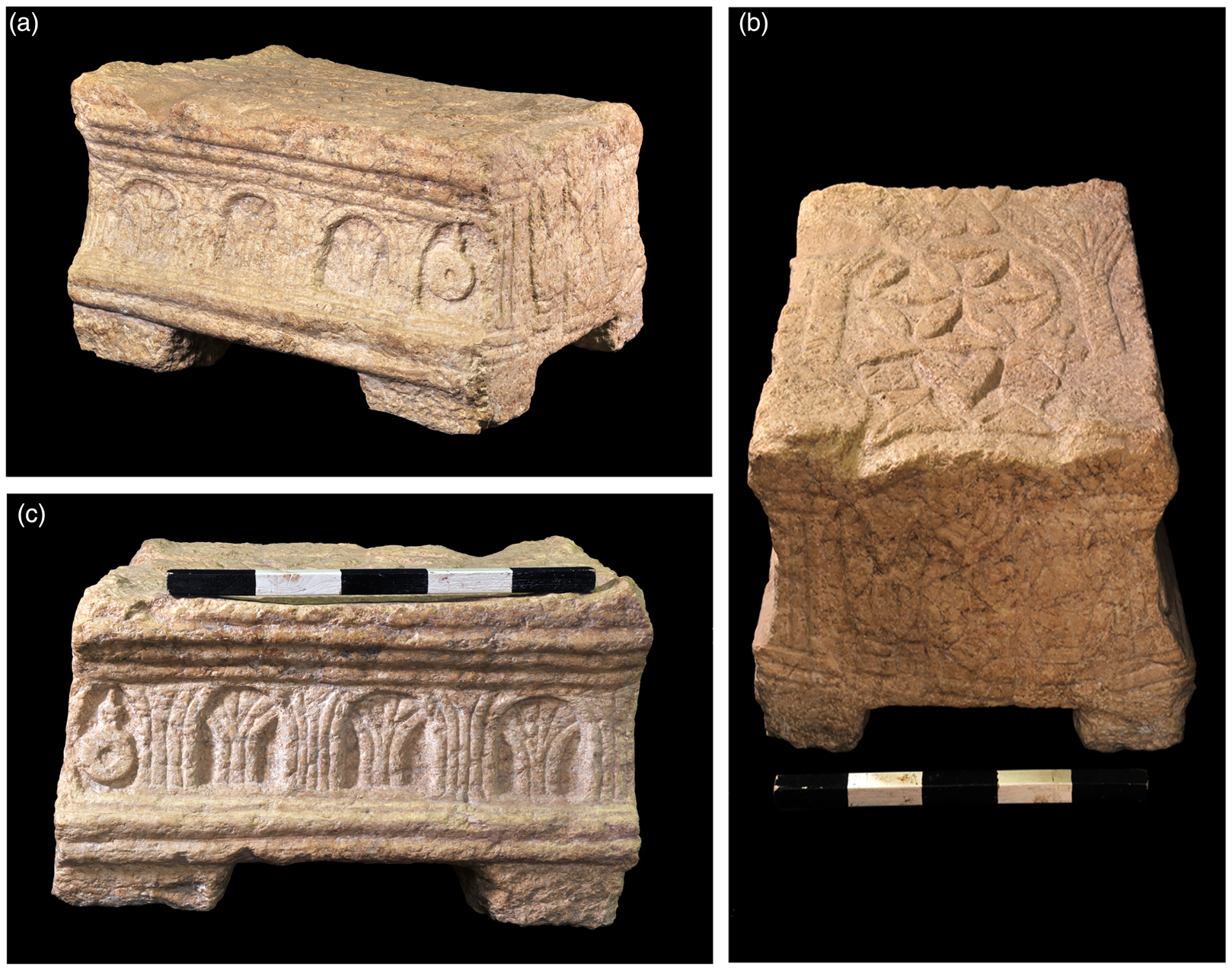
The top and four sides of this Magdala stone are adorned with architectural and artistic elements in low relief, some of which seem to be associated with the Jerusalem Temple.Footnote 3 One of the short sides bears an arch supported by two vertically grooved columns and beneath it a seven-branched menorah resting on a rectangular pedestal flanked by an amphora on either side (Fig. 1b). The other short side features three vertically grooved columns supporting two arches. A rectangular object with four inward-curved sides appears above each of the two outermost columns, and in the middle, above the central column, is a long plaque, the purpose of which is unclear. Two sets of three semicircular elements arranged in the shape of the letter U appear between the columns and close to their bases, and a single rosette is depicted directly beneath each arch. The two long sides of the table are decorated with a (double?) arcade, and under one of the arches, on both long sides of the stone, is a circular object resembling a (Herodian?) oil lamp (Figs. 1a and 1c). A large rosette with six petals inside a circle composed of similar petals graces the center of the tabletop (Fig. 1b). Two tall objects that look like stylized palm trees are depicted on either side of the rosette, parallel to the long side of the tabletop. Moreover, six heart-shaped objects, possibly stylized ivy leaves, and four rectangles decorated with either squares or rhombi fill the area above and below the central rosette, close to the short sides of the tabletop. Two goblet-shaped vessels with long handles appear at one end of the tabletop, close to the short side depicting the menorah and two amphorae. The four corners of the stone's upper surface have round elements, the meaning and function of which will be discussed below.
The Magdala stone: current state of research
Several attempts were made to explain these reliefs but, unfortunately, they have been overinterpreted and lack a methodological awareness of the anachronistic use of later artistic expressions for earlier phenomena.Footnote 4 This becomes evident in light of several rabbinic sources and in 4th- and 5th-c. artistic expressions used to explain 1st-c. depictions, yet without considering the format, style, and development of Jewish art from the Early Roman through Byzantine eras.Footnote 5 I do not intend to discuss the decorative program of the stone or the meanings of certain features; instead I will proffer some guiding principles that may help clarify the motifs and unravel the intricate relationship between them.
Some have argued that the stone's assorted depictions were carefully selected and grouped together into one iconographic and well-structured layout that seeks to illustrate Temple-related objects and underscore this local community's spiritual affiliation to the holy site in Jerusalem.Footnote 6 This holistic reading raises quite a few difficulties, not only because it is doubtful whether the local community would have been able to associate the meaning of the stone's motifs with the Temple or whether they would have been familiar enough with the range of late Second Temple-period literary works to be able to decipher the underlying meaning in the visual medium, but primarily because intricate artistic compositions are not characteristic of Jewish art from the late Second Temple period. The lack of evidence is not necessarily evidence of absence; on the contrary, it is possible that the Magdala stone may suggest that Jews did indeed create more sophisticated compositions in the late Second Temple period and that, with the help of various symbols, expressed spiritual ideas that inculcate identity, affinity, and a longing for the Jerusalem Temple. This might be true, though one ought to resolve the doubts raised above.
Nevertheless, it might be simpler and more appropriate to explain the range of motifs adorning the stone. Features such as the menorah and two amphorae clearly exhibit an association with the Jerusalem Temple and its cult. If not interpreted as such, the images such as the rosette, palm trees, and ivy leaves would simply reflect common artistic expressions in Judaea, and especially Jerusalem, in the Second Temple period.Footnote 7 Jewish art in the late Second Temple period is characterized by a preference for neutral motifs ‒ geometric, floral, architectural, and even objects in daily use ‒ over figurative images and cultic symbols common in Greco-Roman art in the region and beyond. These find expression in mosaics, architectural façades, burial coffins, ossuaries, coins, and small objects. Whether one or several such depictions are displayed, the choice to avoid the use of pagan motifs in favor of non-figurative images may have been intentional in order to differentiate the Jews from their surrounding society and to give expression to their self-identity, which was shared by the inhabitants of both the Galilee and Judaea.Footnote 8
Although identifying the artistic elements adorning the stone is important, my prime interest here concerns the functionality and role of this prominent piece of furniture inside the synagogue's main hall in reconstructing the liturgy in this Second Temple-period synagogue and in others constructed in the 3rd and 4th c. CE. Several options have been raised thus far, but none of them provides a satisfactory explanation that factors in the nature of the activities conducted in the synagogue at this time. Mordechai Aviam opines that the round elements in the four corners of the stone's upper surface “are the remains of four stone legs or four stone bases for wooden legs, on which a table (stone or wood) was placed and it is the table on which the Torah was read.”Footnote 9 Donald Binder offers four options but does not reach a decisive conclusion: it may have been a table for reading the Scriptures (following Aviam), a base for a lampstand, a seat for the archisynagōgos (head of the synagogue), or a base for an offering vessel.Footnote 10 Steven Fine states that he is “not yet ready to interpret the ashlar as a reader's table,” maintaining that the purpose of this stone is “still a mystery.”Footnote 11 More recently, it has been suggested that the tevah (chest or ark) containing the Torah scrolls was set upon the stone table when brought into the main hall.Footnote 12
The round elements mentioned by Aviam are flat, unequal in size, and relatively smooth except for the outer margins, and there is no evidence that the conjectured “stone legs” were sawn off at a certain stage. Rather, they seem to be sections of the relief left in the four corners of the stone that were molded into a round shape but not refined (Fig. 1b). It is equally difficult to assume that the round elements served as “bases for wooden legs” that stabilized the table on which the Torah was read; and the combination of wood and stone would be rather imperfect, unstable, and odd. It seems that the suggested reconstruction was influenced by the modern-day custom of placing the Torah scroll on a table with a sloped top, a lectern of sorts, for the Torah reading.
The Magdala stone table and its use in the late Second Temple-period synagogues
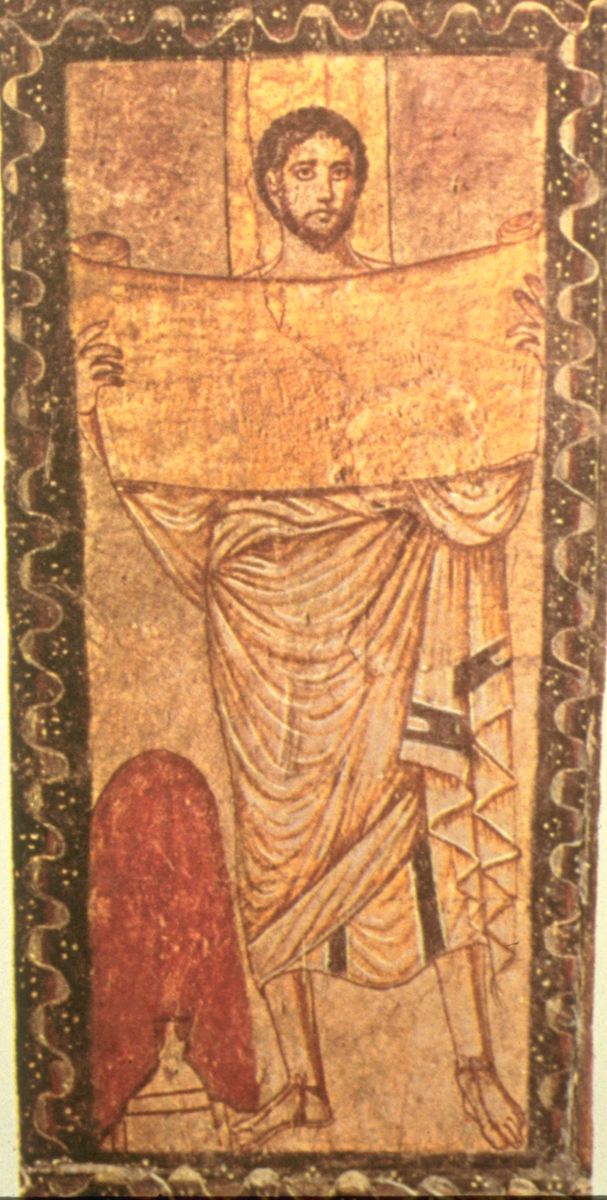
What, then, was the purpose of the Magdala stone and how was it used during ceremonies conducted in the synagogue? Its modest shape and calculated dimensions seem to indicate its use as a table on which Torah scrolls were placed. However, this is neither the “reading Torah table”, to use Aviam's wording (“Torah-reading table” would be preferable), nor one of Binder's abovementioned suggestions.Footnote 13 Rather, I argue that it was a low stand on which the scroll was placed before the Torah-reading ceremony, during the breaks between the readers, and after the completion of the ceremony. Just as Ezra the scribe held the Torah in his hands, opened it, and lifted it for all to see (as described in Neh. 8:4–8) ‒ a detail vividly and prominently depicted in one panel of the fresco in the 3rd-c. CE Dura Europos synagogue (Fig. 2)Footnote 14 ‒ in the Second Temple period, a congregant stood and held the scroll in his hands while reading the Scriptures to those present in the synagogue. King Agrippa stood on the wooden platform in the Temple court: “(he) stood and received (the scroll) and read (it) standing, and the Sages praised him” (M Sotah 7:8). Similarly, upon the completion of the sacrifices in the Temple on the Day of Atonement (Yom Kippur), the Torah scroll was handed to the high priest who “stands and receives it, and reads standing” (M Yoma 7:1). After completing the reading, the same mishnah states that “he rolls up the scroll, holds it close to his bosom, and says….” A more detailed description of the ceremonies held in the synagogue appears in Luke 4:16–22, wherein Jesus came on the Sabbath to the synagogue in his hometown of Nazareth: “And when he stood up to read, the scroll of the prophet Isaiah was handed to him. He unrolled the scroll and found the place where it was written…” Upon completing the readings for that Sabbath, Jesus “rolled up the scroll, returned it to the attendant, and sat down” to deliver his sermon. The reference in JT Sukkah 5.1.55b also indicates that a Torah reader in the synagogue in Alexandria stood on the wooden bema to read the Torah.Footnote 15
Fresco panel in the 3rd-c. CE Dura Europos synagogue: Ezra the scribe holding a scroll. (Courtesy Center for Jewish Art, the Hebrew University of Jerusalem.)
Considering the architectural layout of the late Second Temple-period synagogues and the sources that describe the public reading of the Scriptures, the purpose of the Magdala stone becomes evident. The reading of the Scriptures in pre-70 CE synagogues was limited to the Sabbath and holidays, and only then were the scrolls that were kept in one of the side rooms of the building brought into the hall for the Torah-reading ceremony.Footnote 16 Members of the community sat in these synagogues on stepped benches constructed along the four walls and facing the center of the hall. At Magdala, it seems that the congregants faced the decorated stone on which the Torah scroll, which seems to have been customarily kept in a side room, was brought into the communal hall at the appointed time of the Torah-reading ceremony.Footnote 17 An examination of the Magdala stone indicates clearly that the upper surface is slightly concave so that the raised margins on its short sides could support the scroll and prevent it from falling off the table (Fig. 1c). When it came time for the Torah reading, a congregant stood, walked to the table, raised the scroll, and read the Scriptures while standing (Fig. 3). At the end of the reading, according to Luke 4:20, Jesus rolled up the scroll and returned it to the attendant, but in the Magdala synagogue, the reader of the Scriptures presumably placed the scroll back on the table, possibly covering it with a cloth, and then returned to his seat to listen to the sermon.Footnote 18
Artistic reconstruction of the Magdala synagogue with its stone table, demonstrating its use in the synagogue during the Torah-reading ceremony. (Drawing by Keren Nebenhaus.)

Scrolls were not found at Magdala, but my suggestion corroborates an analysis of the finds from Qumran, which demonstrate that, before the destruction of the Temple, each scroll in most cases contained a single book of the Bible and that from 50 BCE onwards a scroll measured from 25 to 46.5 cm high.Footnote 19 Assuming that the scrolls used in 1st-c. Magdala were similar in size, their height would fit the dimensions of the table perfectly (67 × 57 cm).
The synagogue building at Magdala is not oriented toward Jerusalem, nor was the table inside the hall. Thus, the menorah facing southward is not indicative of anything, especially since it is not clear whether the table was discovered in its original position or whether it had been repositioned in Antiquity.Footnote 20 It is my understanding that whoever read the Scriptures stood behind the long side of the table and, in keeping with its current location in the hall, faced westward so that most of those present could see him. The table served as a focal point for the congregants; as long as it stood in the central space of the synagogue, it could be positioned anywhere and at any angle, suggesting that it had no preferable direction or other purpose inside the hall.
A stone table such as the one found at Magdala has not yet been discovered in any other synagogues dating to the Second Temple period, but it is hoped that similar furnishings will be found at other 1st-c. CE sites in the future. There is no mention of such a piece of furniture, let alone its actual use, in any sources from the late Second Temple period, and therefore we lack definitive proof that irrefutably supports the proposed explanation. And yet, the interpretation for the use of the stone table in the Magdala synagogue presented above is supported, if only indirectly, by an analysis of the evidence pertaining to the late Second Temple period ‒ literary sources relating to Torah reading, the size and shape of the scrolls, and an architectural analysis of the synagogue layout in which it was discovered.
If the interpretation presented here is correct, the Magdala stone may provide another important dimension that not only relates to the actual Torah-reading ceremony in the synagogue of 1st-c. Palestine, but also marks the early crystallization of synagogue liturgy in the Second Temple period, followed by major changes in subsequent centuries. The reading of Scriptures was one of the main activities conducted in the synagogue up to the Bar-Kokhba revolt, suggesting that similar furniture, made of stone or wood, was most probably used for the same purpose elsewhere. In the following period, the reading of Scriptures was supplemented by prayer, which eventually became the central component of synagogue liturgy ‒ a change that also affected the building's architectural layout and liturgical furniture.Footnote 21
Shaping the synagogue's liturgical space in the first centuries of the Common Era
Unlike the 1st-c. synagogues that were dissimilarly oriented, the first noticeable change introduced into the synagogue building concerned its direction, now designed to meet the new liturgical needs that transpired sometime between the mid-2nd and mid-3rd c. CE. The orientation of prayer toward Jerusalem, derived from the tannaitic law stipulated in Sifre–Deuteronomy 29, apparently influenced the design of many synagogues built in the 3rd c. CE and onwards in ancient Palestine and the Diaspora; exceptions to this rule are well documented in both cities and villages throughout the region.Footnote 22 To date, not a single synagogue constructed between 150 and 250 CE has been found in the region. However, the buildings erected in the second half of the 3rd c. CE ‒ at Ḥammat Tiberias (Stratum IIb), ‘En Gedi, and Khirbet Wadi Ḥamam ‒ are oriented toward Jerusalem but have no ritual focus.Footnote 23 Judging by the description in several rabbinic sources, mainly tannaitic, it seems that the tevah containing the Torah scrolls was brought into the main hall of these buildings for the Torah-reading ceremony and was subsequently returned to its place upon its completion.Footnote 24 When the tevah was brought into the main hall, it was set (on the floor) as stipulated in T Megillah 3:21: “it [the tevah] faces the people and its back is to the holy,” thus indicating its orientation toward Jerusalem.Footnote 25 A similar reality underlies one Palestinian tradition embedded in BT Sotah 39b: “R. Tanḥum said in the name of R. Joshua b. Levi: The congregation is not permitted to leave (the synagogue) until the Torah scroll is removed (from the hall) and deposited in its place.”Footnote 26
This practice seems to comply with the custom in Second Temple-period synagogues. However ‒ in contrast to the earlier period ‒ the scrolls were now placed in a portable tevah and, when needed, brought into the prayer hall, which was now oriented toward Jerusalem. Side rooms were found in quite a few Late Antique synagogues in the Galilee and beyond. These may have been used for various purposes, some of which are even specified in rabbinic sources; nevertheless, the archaeological finds are insufficient to determine their precise purpose.Footnote 27 But the side rooms in the first stage of the synagogues at Ḥorvat Shema, Ḥammat Tiberias, Khirbet Wadi Ḥamam, and Kefar Kana, for example, which have no bema or a permanent Torah ark inside the main hall, may have been used for storing the portable tevah containing the Torah scrolls when not needed in the main hall.Footnote 28 Once the tevah was brought into the prayer hall, it was placed on the floor and not on a stone table. The tevah and stone table are two distinct pieces of liturgical furniture, each with its own function and purpose. They both have four legs, a detail that may suggest that they stood on the floor. Judging by depictions of the tevah from Bet She‘arim and mosaics of some of the ancient synagogues, it becomes clear that it stood on the floor.
Only later, in the 4th c. CE, with the introduction of a built bema into the synagogue, did the Torah ark ultimately become a permanent fixture in the prayer hall, serving as a ritual focus and indicating conclusively that the direction of prayer was toward Jerusalem.Footnote 29 Synagogues constructed in the 3rd c. CE at Ḥammat Tiberias, ‘En Gedi, and Khirbet Wadi Ḥamam, mentioned earlier, had an elevated bema added later, while those buildings constructed from the 4th c. CE on, such as those at Ma‘oz Ḥayyim, Susiya, and Sepphoris, had a permanent bema in the hall from the outset. Several decorative architectural elements, a few broken pieces of liturgical furniture, and some other objects from these latter sites suggest that a permanent Torah ark was constructed on the bema in some synagogues from the 4th c. CE onwards. In others, the portable tevah that was previously brought into the hall for the Torah-reading ceremony was now a permanent fixture on the bema.
But where were the scrolls placed during the Torah reading and how was the ceremony conducted in the 3rd- and 4th-c. CE synagogues that had a portable tevah or a permanent ark in the prayer hall from the outset or in a second stage? Some scholars maintain that several decorative elements in the middle of a few synagogue floors, or a change in the direction of a few stone pavers, allude to the existence of a wooden table or bema built in the middle of the hall, but this option remains unproven.Footnote 30 Nevertheless, the question under discussion concerns a matter associated with the Magdala stone. Assuming that tables similar to the Magdala stone were in use concurrently in several other late Second Temple-period synagogues, it should be clarified whether and why such furniture disappeared by the end of the 1st c. CE or after the Bar-Kokhba revolt at the latest, or whether they continued to be used during the Torah-reading ceremony in the Late Antique synagogue as well. This question becomes even more relevant in light of the fact that the same ceremony took place in the Late Roman and Byzantine synagogues as well, even if priority was now given to prayer.
Evidence of other stone tables: review of the archaeological finds
New finds uncovered more recently, together with the re-examination of some earlier discoveries, allow one to reconstruct ‒ given the limitations of the existing finds ‒ how the Torah-reading ceremony might have taken place in the Late Roman and Byzantine synagogue. One stone table, fully preserved but of questionable identification, was discovered at Ḥorvat Kur, while another four fragments of a similar nature were found elsewhere ‒ two in the Galilee and two in the Golan. Theoretically, it could be argued that the typology of these finds resembles the Magdala stone and therefore should be dated to the 1st c. CE and attributed to late Second Temple-period synagogues, but it is doubtful if this hypothesis is true everywhere. Below I will present the evidence, and then, based on an analysis of the archaeological finds, argue that these tables, and others like them, in stone or wood, were still in use in the synagogues constructed in the first centuries of the Common Era.
Ḥorvat Kur
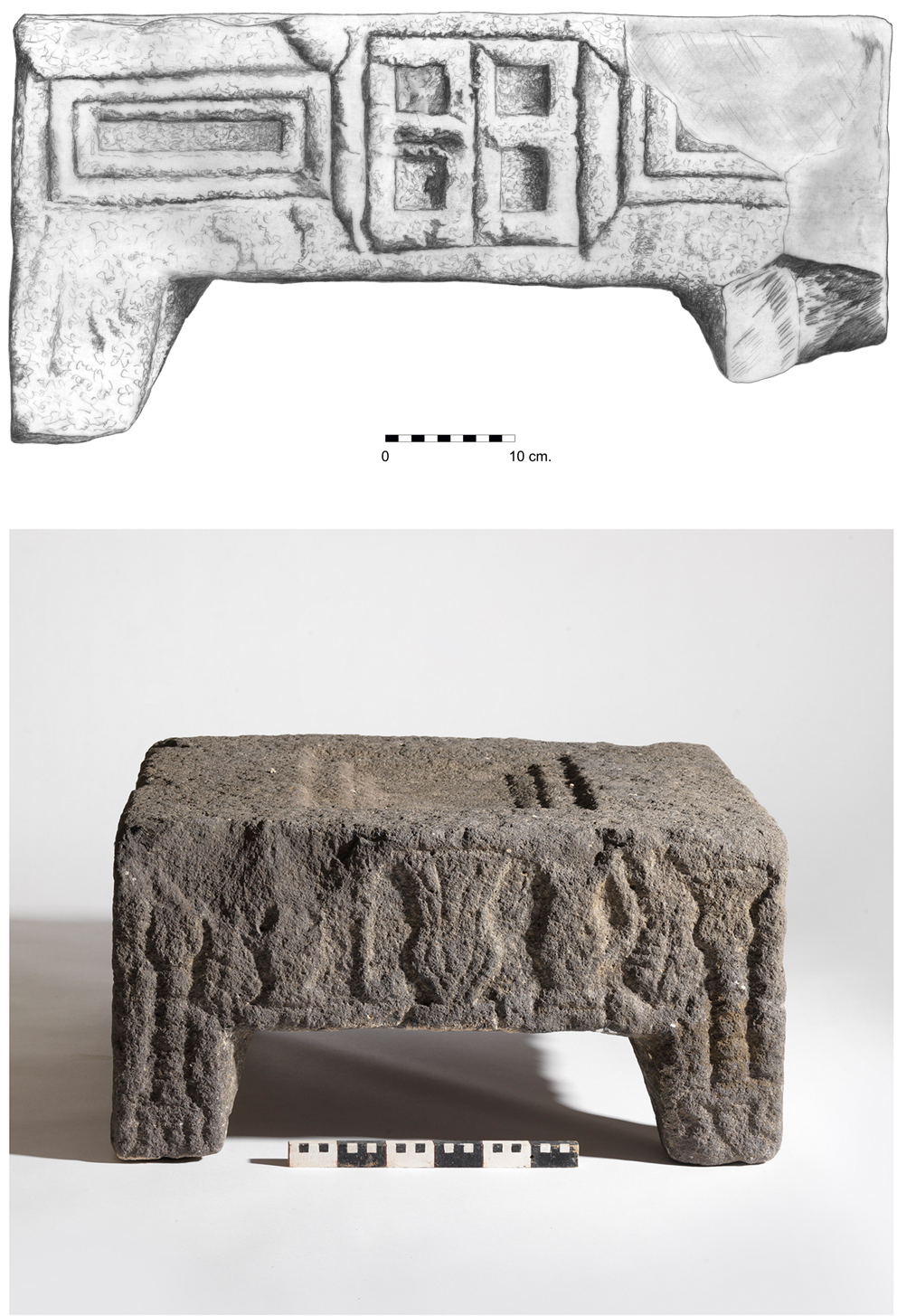
A square basalt table (70 × 68 × 35 cm, including 14 cm-high legs) resembling the one at Magdala in size and shape was found in the 600 CE synagogue at Ḥorvat Kur, incorporated in secondary use into a bench set between the columns of the eastern aisle (Fig. 4a–b).Footnote 31 The table is decorated on four sides and on top in low relief. Two opposite sides are decorated with geometric motifs (rectangles and circles). A double door flanked on each side by three concentric rectangles appears in the center of a third side; the fourth side, opposite the one with the double door, portrays an array of objects ‒ several jugs, one or two candelabra, a kantharos, a ladle, and a few unidentified containers. The tabletop is decorated with a rectangular stepped depression measuring 30 × 45 cm and ca. 2.5–3 cm deep. Jürgen Zangenberg, excavator of the synagogue, rejects the possibility that the stone table served the same purpose as the one in Magdala, arguing that this low decorated table, a kind of pedestal, initially functioned as an “offering” or dining table, either in a private house or in the synagogue.Footnote 32 Although it is unclear when and from where the stone table was brought into the synagogue at Ḥorvat Kur, the excavator suggests that it was moved into the prayer hall from an adjacent room, a garden triclinium, or a dining hall in a house near the synagogue.
Ḥorvat Kur, basalt stone table. (a) double door flanked on each side by three concentric rectangles in the center of one side of the table; (b) opposite side, with several jugs, one or two candelabra, a kantharos, a ladle, and several unidentified containers. (Drawing by Francesco Pilastri; photo courtesy of Jürgen Zangenberg, Faculty of Archaeology, Leiden University.)
Mordechai Aviam rejects Zangenberg's proposed identification, maintaining that, like the Magdala stone, this one served as the base of an elevated Torah-reading table. Furthermore, he argues that, in contrast to the reconstruction at Magdala, the rectangular depression on the tabletop here suggests that it was a monopodium (single-legged) table.Footnote 33 Here, too, Aviam's proposed reconstruction makes no sense. Monopode tables generally have an elegant leg for support, but their stability does not require such a massive pedestal.Footnote 34 Moreover, the rectangular depression is sloped and not deep enough to hold or stabilize the single leg, and therefore could not prevent the Torah-reading table from toppling over. Needless to say, the basalt tabletop at Ḥorvat Kur shows no indication that a leg was affixed to it, not even with nails.Footnote 35
The reliefs decorating the stone table from Ḥorvat Kur do not resemble those embellishing the Magdala stone. Parallels for each of the objects portrayed on it can be found in Roman and Late Antique art; when grouped together they might even signify the Greco-Roman banquet setting. It is quite possible, however, that the artist, patrons, and even the entire community perceived these objects as representing some of the trappings in the destroyed Temple. The scope of this article does not allow for a discussion of each of the objects portrayed on the stone or their comparison to Temple implements; however, it should be kept in mind that their depiction in ancient Jewish art does not necessarily correspond with the literary evidence. The artist or his iconographical sources used familiar objects known in their immediate surroundings and may even have added a number of identifying details that facilitated an understanding of the depiction, thereby creating a meaningful tie with the original object used in the Temple.
Suffice it to say that, in this context, the round Shewbread Table adorned with round loaves of bread appearing several times in ancient synagogue art, the two censers containing frankincense above the table in Sepphoris, the chalices and bowls on the table at el-Khirbē, and the containers appearing in the panel portraying the daily sacrifice in Sepphoris were all objects in daily use in Late Antiquity.Footnote 36 If one were to follow the same pattern, the proposed identification of the objects portraying the Temple implements appearing on one side of the table at Ḥorvat Kur is reinforced by the depiction of the double door appearing on the other side. This door is schematically depicted and is a well-known motif in ancient Jewish art, in both mosaic and relief, that alludes to the façade of the destroyed Temple. The depictions appearing on the parallel sides of the table complement each other and together may portray the affinity between synagogue liturgy and the destroyed Jerusalem Temple; they may even symbolize the community's messianic longing for the rebuilding of the Temple and its cult. In contrast, the geometric motifs added to the table are merely decorative.
As noted, the stone table from Ḥorvat Kur resembles the Magdala stone in size and shape, and the reliefs decorating two of its sides may express an association with and longing for the destroyed Temple. I would argue, therefore, that this table belongs to the synagogue and was meant to serve the same purpose as the Magdala stone (and others, to be discussed below). Although the stone table was found in secondary use, it seems to have been used during the Torah-reading ceremony in one of the earlier phases of the synagogue that was constructed in the mid-4th c. CE.Footnote 37
Khirbet Wadi Ḥamam
One architectural fragment (15 × 17 × 11 cm) carved in limestone was found in conjunction with the synagogue and should be identified as a piece that broke off such a table (Fig. 5). A rectangular leg measuring 10 × 8 × 7 cm appears at its lower end, and above it a semicircular molding (torus) with a narrow fillet above it.Footnote 38 The low rectangular leg with the moldings above it resembles the same segment in the Magdala stone and reinforce the proposed identification of the Khirbet Wadi Ḥamam stone. This fragment, found together with other architectural elements in the debris covering the alley that ran from east to west, south of the synagogue, belongs to the synagogue constructed in the 3rd c. CE that was heavily damaged toward the end of that century (Stratum 2 = Synagogue 1).Footnote 39 Although Uzi Leibner and Benjamin Arubas suggest that a public building, in all probability an early 1st-c. CE synagogue, may have stood on this same spot, the southern alley was constructed only in Stratum 2, together with Synagogue 1, in the early 3rd c. CE. Therefore, any finds discovered above it are contemporaneous, or – as seems more likely – postdate it.Footnote 40 In light of the above, it is clear that the Khirbet Wadi Ḥamam table was used in Synagogue 1 constructed in the 3rd c. CE, and by no means can be attributable to the public building that Leibner and Arubas have unconvincingly identified as a 1st-c. CE synagogue.Footnote 41
Khirbet Wadi Ḥamam, fragment of a stone table. (Photo by Gabi Laron; drawing by Marcos Edelcopp; courtesy of Uzi Leibner, the Hebrew University of Jerusalem.)

Magdala/Taricheae (2)
A rectangular basalt block (62.5 × 49 × 35 cm) with a symmetrically decorated upper surface was found at the site, though it is not clear exactly where at the site it was uncovered and what the nature of its archaeological context was (Fig. 6a–b).Footnote 42 Vertical grooves were cut on four sides of the stone; those on the long sides are wider than those on the short sides. The stone's upper surface is flat and the stone itself is roughly rounded in section; it seems that the block was redesigned in its second stage, when its five sides, except the upper surface, were slightly chiseled and the vertical bands, the function of which is not clear, were added. Traces of unidentified worn incisions are visible on one of the stone's short sides (Fig. 6b), but other than that, only the upper surface is decorated; these decorations were executed in low relief and arranged in two rows separated by a narrow band. Two beakers with a low foot and two short vertical bands on either of their outer sides are portrayed in one row; above them, two rosettes are separated by a motif resembling a blocked entrance with a double door.Footnote 43 Since the stone was redesigned at a later stage, it is difficult to determine what it originally looked like and for what it was used. Judging by the stone's dimensions and their similarity to those of the stone table from Ḥorvat Kur, and in light of the motifs adorning it that have parallels in Jewish art, it seems that this stone block served first and foremost as a table in one of the synagogues that stood in Magdala ‒ either in the late Second Temple period or in the first centuries of the Common Era.Footnote 44
The Magdala stone (2). (a) upper surface with decorations arranged in two rows; (b) short side with unidentified worn incisions. (Courtesy of Jürgen Zangenberg, Anna Lena, and Carmelo Pappalardo; photo by M. Forgia.)
Ḥorvat Kanaf
Remains of a building dating to the 3rd and 4th c. CE were found in the soundings that Oren Zingboym conducted in the Byzantine synagogue at the site. Among the finds was a rectangular stone table in secondary use, measuring 78 × 66 × 42 cm (Fig. 7).Footnote 45 The tabletop is decorated with a rectangular depression bordered by a convex profile and a fine rectangular band in low relief inside it. The four sides of the table are decorated with a convex strip running roughly through the center of each side.
Ḥorvat Kanaf, stone table associated with the early phase of the 3rd- and 4th-c. CE synagogue. (Courtesy of Oren Zingboym, the Israel Antiquities Authority.)

Deir ‘Aziz
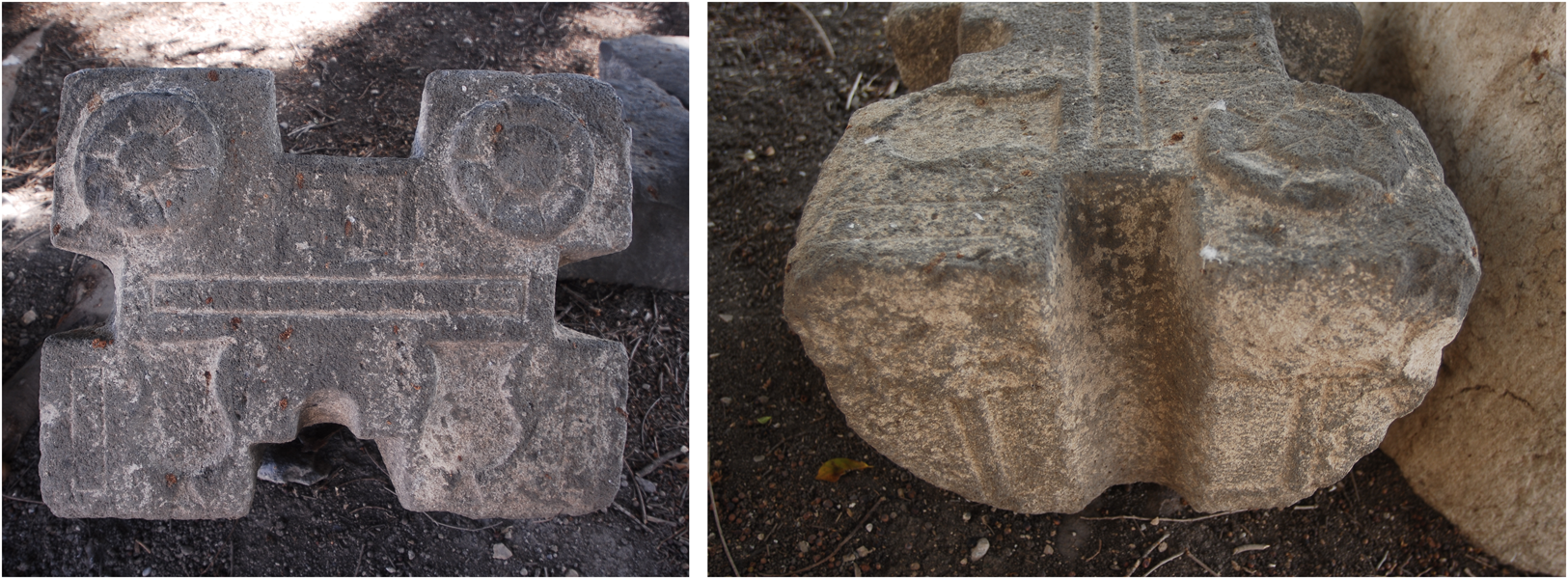
One basalt architectural element incorporated in the upper row of benches, close to the northwestern corner of the synagogue's interior, was identified by the excavators as a fragment of a stone table (Fig. 8).Footnote 46 In fact, this was only the upper part of the stone, which was cut and shaped to roughly conform with the size and height of the other benches in that row (even though it is slightly lower). The stone is 68 cm wide, visibly 57 cm deep, and has a preserved height of ca. 32 cm. Traces of two legs that were cut off when the stone was incorporated into the bench are visible at the bottom of its front side. Since the only visible side is broken and has signs of chipping, it is difficult to identify the original decorative elements. The surface of the tabletop has a depressed 9-cm frame that emphasizes its margins and center, and is reminiscent of the stone table from Ḥorvat Kanaf, alluding to a certain affinity between the two in terms of design, execution, and actual use in the local synagogues.
Deir ‘Aziz, fragment of a stone table that was discovered incorporated into the upper row of benches, close to the northwestern corner of the synagogue's interior. (Courtesy of Oren Zingboym, the Israel Antiquities Authority.)
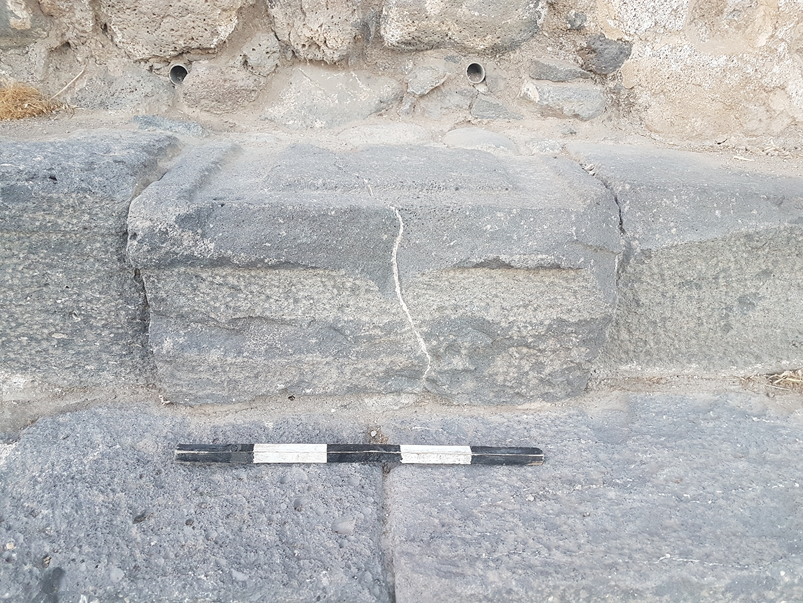
The synagogue was constructed toward the end of the 4th c. CE, renovated in the 6th c. CE, and restored in the Early Islamic period. Two entrances were added in its western wall in the second stage, a modification that required some repair of the benches close to the same northwestern corner of the building.Footnote 47 It seems, therefore, that the stone table belonged to the 4th-c. CE synagogue; after it went out of use the legs were cut off and its upper section was incorporated into the highest bench in the renovated 6th-c. CE synagogue.
Stone tables and the Torah-reading ceremony in the synagogues of Late Antiquity
The stone tables from the synagogues in the Galilee and the Golan are constructed of limestone or basalt, their dimensions are quite uniform (see Table 1), and they generally have a consistent format ‒ although, judging by the finds, their decorations indicate some diversity. These tables are generally rectangular, not very large, and have low legs. They are decorated in low relief and at times bear geometric and floral motifs or an array of objects, some of which may be associated with the Temple cult. Above all, they resemble the Magdala stone in size, shape, and detail, and may indicate that these and others like them, made of wood or stone, existed in other Late Antique synagogues and were used for the same purpose.
Measurements of the stone tables from six Galilean and Golan sites

Alongside the archaeological finds, the literary sources indicate that the Torah reading in the synagogues of the first centuries of the Common Era was conducted standing, as was common in the late Second Temple period as well. It is stated in T Megillah 3:12: “A synagogue that has only one person who can read stands and reads [in the Torah] and sits down, stands and reads and sits down, stands and reads and sits down, even seven times.”Footnote 48 Elsewhere (T Megillah 3:21) it is written that “the ḥazzan of the synagogue who rises to read, one stands [next to him] and the ḥazzan recites each verse beforehand until he has read [the required verses].”Footnote 49 Unlike the Torah reading that requires standing, whoever reads the Book of Esther “may stand or sit” (M Megillah 4:1).Footnote 50
According to Rabbi Abbahu (BT Megillah 21a), the requirement to stand when reading the Torah is anchored in a biblical verse, but the discussion in JT Megillah 4.1.74d further elucidates the matter: “He who stands to read in the Torah, why does he stand? Because of its honor or the honor of the public?” Knowing that the Torah reader must stand while reciting the verses is at the core of the Talmudic discussion, but it is asked whether this ruling derives from respect for the Torah or from one's honor of the public that attends the ceremony in the synagogue. The Talmud reaches the conclusion that it is due to the respect for the Torah itself and maintains that the ruling should be adhered to only when the community listens to the reading, but not when one reads to oneself. The Talmud (JT Megillah 4.1.74d) then relates the anecdote of the 3rd-c. sage Rabbi Samuel bar Isaac who entered a synagogue in which it is implied that the translator (meturgeman), like the Torah reader, should have been standing during the ceremony out of respect for the Torah. Elsewhere it states, in the name of Rabbi Yoḥanan, that “If one became paralyzed while reading the Torah, the one who stands in for him should pick up from where the first one began” (JT Megillah 4.4.75b).
The image in the Dura Europos synagogue of Ezra the scribe holding the Torah scroll in his raised hands illustrates how the scrolls were held in Antiquity and suggests, even indirectly, how the Torah reading was performed (Fig. 2). This depiction is influenced by the well-known model in Roman and Late Antique art of a philosopher, poet, pupil, or even a slave standing before his master or, alternatively, of Jesus, the apostles, or the martyrs holding a scroll in their hands.Footnote 51 In some cases the figure holds a rolled scroll; in others, more relevant to our case, he holds an open scroll in both hands and seems to be reading it. Some of these figures are portrayed standing, in a manner reminiscent of the Torah reading in the synagogue. In Roman art, the portrayal of standing figures who converse or read expresses wisdom, authority, and influence, whereas the Christians, who were inspired by the Classical heritage, cast additional meanings into their images, such as the truth of the gospel, adherence, and faith, which conformed with their spiritual world.Footnote 52
As mentioned above, the finds from Qumran suggest that prior to the destruction of the Second Temple each scroll usually contained a single book of the Bible. The first evidence for the use of scrolls containing all five books (the Pentateuch) appears in extraneous tannaitic traditions (baraitot) embedded in the Jerusalem and Babylonian Talmuds. However, it seems, as asserted by Menahem Haran, that, even after the introduction of the complete Pentateuch, years after the destruction of the Temple, the Torah was still read in synagogues from individual scrolls ‒ Ḥumashim in rabbinic terminology ‒ throughout the Talmudic era.Footnote 53 Among the main reasons for preferring the single-book scroll were that it was unwieldy to use the complete Pentateuch during the relatively brief Torah-reading ceremony and that the full scroll was difficult to lift while reading. This also became evident from the remains of the charred rolled scroll uncovered in the debris of the Torah ark from the ‘En Gedi synagogue, which was destroyed in a fire around 600 CE. The scroll's reconstructed height would be about 18–19 cm and the beginning of the scroll contained the two first chapters of Leviticus, which represent the beginning of the scroll. The fact that the ‘En Gedi scroll opens with Leviticus, suggests that the community did not possess a complete Pentateuchal scroll.Footnote 54 Although this scroll may have been somewhat diminished by the fire, its modest size clearly indicates that it could be held with two hands while reading the Torah.
Since the reading of the Torah in Late Antique Palestine followed a three-year cycle, the number of verses read from week to week was not large.Footnote 55 The pericope (reading selection, parashah) was divided into several portions and the number of people to be called to the Torah was fixed to accommodate the calendrical framework of the reading, on weekdays, the Sabbath, and Jewish holidays. Every person called to the Torah read his portion by himself; if he could not do so, the ḥazzan read it in his stead. Although we do not know the scope of the reading in the Second Temple-period synagogues or the number of people who were called to the Torah, it seems that the performance itself in the Late Antique synagogues followed the pattern that prevailed in the pre-70 synagogues, i.e., the reader was called to the Torah and, while standing, raised the scroll in his hands and read his portion to the congregation gathered in the main hall.Footnote 56
In preparation for the Torah reading in these synagogues, the scroll was taken out of the portable tevah or permanent ark and placed on a stone or wooden table, similar in shape to those mentioned above. These were not Torah-reading tables, but low stands upon which the scroll was placed before the actual Torah reading, during the breaks between the readers, and after the completion of the ceremony. The Torah reader rose from his seat, walked to the stone table and stood beside it, raised the scroll with both hands, recited the blessing for reading the Torah, and read the allotted portion while still standing (Fig. 3). After completing his reading and reciting the closing blessing, he placed the scroll back on the table, returned to his seat, and the next reader followed suit. Upon the completion of the entire prescribed Torah reading, the scroll was returned to the portable tevah and subsequently taken to a side room for safekeeping, or returned to the permanent Torah ark that stood in the main hall, as at Ḥorvat Kur.
This custom may find expression in JT Yoma 7.1.44b, where the story is told of Rabbi Yose, a 4th-c. CE Palestinian sage, who instructed Bar ‘Ulla the ḥazzan of the Babylonian synagogue in Sepphoris: “If there is one Torah, scroll it behind the parokhet [curtain]; if there are two, take one away and bring the other.”Footnote 57 Rabbi Yose's instructions bespeak a situation that required reading two different portions on the same day; he tells Bar ‘Ulla that, if there is only one Torah scroll, it should not be scrolled in public but behind the parokhet; if there are two scrolls available, then one should be taken away and the other brought.Footnote 58 His instructions vis-à-vis two Torah scrolls contain interesting details important to the present discussion, but he does not specify to where the first scroll is to be taken or from where the other is to be brought. One may assume that the first scroll was returned to the ark, at which time the second one was taken out of it, but Rabbi Yose does not mention such furniture at all. In light of the archaeological finds, it seems more likely that these actions were referring to a table in the Babylonian synagogue in Sepphoris, on which they placed the two scrolls that were taken out of the ark prior to the Torah reading. When the reading in the first scroll was completed it was returned to the table; only then did the reader take the second scroll and continue the reading of the other portion.
In the course of a discussion concerning religious accessories, the 4th-c. CE Babylonian sage Rava refers to the kurseyā ‒ a chair, throne, or pedestal covered at times with a prisa, a piece of cloth upon which the Torah scroll was regularly placed (BT Megillah 26b).Footnote 59 These elements ‒ which according to Rava were often used in the synagogue, acquired a degree of holiness, and could not be sold for other purposes ‒ further support our assumption that various kinds of low pedestals, sometimes covered with a cloth and on which the Torah scroll was placed, were customary furniture in the synagogue context. Rava's inferences and the ensuing discussion, which have no parallels in ancient Palestinian sources, reflect the reality in ancient Palestinian synagogues, where the Torah scroll was placed at different times during the reading ceremony on a special piece of furniture, a kind of pedestal, that was sometimes covered with a piece of cloth. Even if Rava's discussion stemmed from his acquaintance with Babylonian synagogues, one could still argue that the ceremony as well as the liturgical furniture used by the Jewish communities in both ancient Palestine and the Diaspora was essentially the same.Footnote 60 If this notion is correct, then Rava's testimony sheds further light on the nature of the Torah-reading ceremony in the ancient Palestinian synagogues.
Until what date were the stone (or wooden) tables in ancient Palestinian synagogues used for placing the scroll before the Torah-reading ceremony, during the breaks between the readers, and after the completion of the ceremony? The answer is not entirely clear, mainly because the archaeological finds presented above indicate a wide range of dates, from the 3rd to the 5th c. CE. For example, the stone table at Khirbet Wadi Ḥamam was used only in the Stratum 2 synagogue, which was heavily damaged toward the end of the 3rd c. In contrast, the stone tables at Deir ‘Aziz and Ḥorvat Kur may have been in use up to the 6th c. CE. It is probable that such stone tables ceased to be used largely because of the scope of the use of the Torah scroll (which contained the entire Pentateuch) by the ancient communities in Palestine. Compared to the single-book scroll ‒ the Ḥumash ‒ that could be held up in one's hands while reading, the Torah scroll containing all the books of the Pentateuch would have been too heavy and unwieldy to be held with open hands through the reading and would therefore have required a solution that would make the low table superfluous.
With the increased use of large scrolls in the course of the Byzantine period, the nature of the Torah-reading ceremony inevitably would have changed also. Instead of holding the heavy scroll in one's hands, it was now placed on a raised pedestal or lectern, i.e., a wooden or stone ambo resembling the one added to the main hall in the synagogue at Bet Alpha.Footnote 61 The Torah reader stood beside this new piece of furniture ‒ a Torah-reading table ‒ upon which the Pentateuchal scroll rested and from which he read.Footnote 62 The transition from a low table to an elevated lectern, and from a single-book scroll that could be held open in two raised hands to a Pentateuchal scroll that was placed on a Torah-reading table, did not occur overnight; it was an evolving process that grew over time and seems to have been dependent on the way in which the various congregations adopted the custom of binding the five Pentateuchal books into one Torah scroll.
Conclusion
The discovery of the Magdala stone offers an opportunity to examine, for the first time, the liturgical furniture used in the Torah-reading ceremony in the synagogues of the late Second Temple period. Over time, additional stone tables have been identified in several synagogues in the Galilee and the Golan, some of which have been only partially preserved. We seek to define the function of these tables in synagogues that were used continuously from the late Second Temple period and in the first centuries of the Common Era. Throughout this period, the Torah reader stood, reading the open scroll while holding it in his hands. These ashlar stones were not intended to be used as a Torah-reading table or as base for a portable tevah brought into the synagogue hall for the Torah reading, but were used as a low stand, at times covered with a piece of cloth, upon which the scroll was placed before the ceremony, during the breaks between the readers, and after its completion. With the transition from a single-book scroll (Ḥumash) to a Torah scroll that contained the entire Pentateuch, the low table was replaced with an elevated pedestal or ambo made of wood or stone, which has since become the Torah lectern in the synagogues of ancient Palestine and the Diaspora.
This interpretation is founded on analyses of the archaeological finds and literary sources concerning the reading of the Torah in the late Second Temple period and the first centuries of the Common Era. It is hoped that future finds, especially those dating to the late Second Temple period, will shed further light on the liturgical furniture used for the Torah reading in the ancient synagogue.



