

Introduction
Experts can simultaneously operate under a political mandate and still claim to be independent. This balancing act is a necessary condition for the authoritative symbiosis between political institutions and ‘independent’ expertise. Common partners in this symbiosis are international organisations (IOs) on one side and what I term here the entrepreneurial expert economy on the other: this economy constructs the claim to knowledge authority around the publicly celebrated experience, excellence, and independence of individual experts. Through a public dramaturgy of expert panels and reports, IOs mobilise entrepreneurial experts’ established claim to objective knowledge to inform and legitimise their own policies.Footnote 1 In turn, experts gain publicity, resources, and experience. For the symbiosis to function, however, experts have to reconcile two demands: they must claim knowledge authority based on their independence while placing this independence in the service of an IO. How do they achieve this?
A situation in which an individual has to respond to conflicting social expectations is characterised by sociological ambivalence.Footnote 2 In this case, sociological ambivalence is provoked by the simultaneous expectations of being independent while fulfilling a political mandate. I will show that Erving Goffman's view on social order and his concept of role distance help us understand the situation and behaviour of entrepreneurial experts mandated by IOs. Role distance refers to an actor's signalling of ‘some measure of disaffection from, and resistance against, the role’ that he or she is currently performing.Footnote 3 This balancing act can allow individuals to perform roles more or less diligently even where they do not embrace those roles.
I use the two concepts of sociological ambivalence and role distance to analyse the situation and work of entrepreneurial experts on the Panels of Experts (PoEs), which are mandated by the United Nations Security Council to conduct monitoring in the context of sanctions. In the case study, I show that entrepreneurial experts on UN PoEs experience sociological ambivalence and analyse their role distance performances. The results suggest two implications for the macro-level: first, the repeated micro-situational bridging of sociological ambivalence prevents systemic contradictions from becoming obstructive and should thus protect the macro-level symbiosis between the entrepreneurial expert economy and IOs. Second, experts perform role distance through practices of knowledge production, such that role distance leaves traces in political knowledge.
The notion of sociological ambivalence contrasts with the typical images of experts, expertise, and organisations. Experts are seen as an influential caste characterised by its common skillset and abstract knowledge;Footnote 4 this caste, furthermore, often overlaps with political elite networks.Footnote 5 The related research stream on professions has solidified this image of technocratic communities that are bound together by shared procedures and restrict access for outsiders.Footnote 6 This image – although largely justified – leaves too little space for the ambiguities and ambivalences that are a feature of all social life. It seems ironic, then, that the concept of sociological ambivalence is rooted in early studies on professions (as will become clear later in this text). Jacqueline Best resolves this irony: ‘the concept of ambiguity is implicit in much social theory’, but ‘over time, as theories become established, much of their openness to tension and ambiguity tends to be closed off’.Footnote 7
Although scholars have shown that experts can combine multiple roles, they did not analyse how such a combination can lead to tensions between those roles. Instead, they focus on instances where experts appear as calculated and assertive ‘identity managers’ who switch between different roles to further their careers.Footnote 8 Leonard Seabrooke, for instance, describes how transnational experts switch between different profiles as they seek to gather recognition in different sectors (such as IOs, national governments, and so on).Footnote 9 This ‘identity switching’ works precisely not in ambivalent contexts, but in contexts where different audiences with different expectations are separated. In ambivalent settings, where experts have to account for conflicting expectations simultaneously, they would not get away with flipping roles.
Studies on expertise address a different kind of ambiguity, if they do so at all. This literature refers to strategic ambiguities in the content of expertise more than ambiguities in the production context. Strategic ambiguities are found in reports, legal or diplomatic texts, policy guidelines, and so on.Footnote 10 Studies on ambiguities in expertise thus focus on foregrounded knowledge, that is, that which is proclaimed by experts as their expertise. Ambiguities are rarely studied in background knowledge, that is, in the self-understandings, social norms, and taken-for-granted knowledge that experts internalise and that guide their work. Finally, the dominant understanding of organisations and how they function internally is strongly influenced by Max Weber's conception of bureaucracies and their rationalist culture.Footnote 11 However, (arguing, again, with Best), bureaucracies work as ‘ambiguity-reducing machines’ in some aspects and at the same time create new ambiguities in other aspects.Footnote 12 The chaotic nature of organisations has indeed been described by James March and Johan Olsen but without providing a framework for the individual experience of, and response to such chaos.Footnote 13
I do not propose a radical overhaul of any of these conceptions. Instead, I seek to revive the notion of ambiguity that has receded over time. My findings and the social theory that I invoke remind us that ambiguities and ambivalences persist: that even strong social groups can be exposed to ambivalent conditions; that the normative order that binds a community also produces conflicting norms; and that organisation – both in the sense of IOs and of social order as such – may settle some ambiguities but create others.
This theory is based on Goffman's study of social interaction. Goffman did not focus on knowledge practices, but they can be integrated in his framework if they are understood as social interactions. Indeed, this is how we should understand them, according to a range of studies that have shown how the production of knowledge is not a divine exercise but follows quite ordinary patterns of social interaction.Footnote 14 While many of these approaches focus on human/object interaction, Goffman focuses on the individual in its social context and thus on interaction between humans. Importantly, Goffman grounds the analysis of social interaction in a theory of the self and of social roles.
In this view, an expert's statement on, say, Chinese foreign policy is likewise an interaction with its peers and audience at a more trivial level of self-performance. The ‘scientific’ rationalities held by an epistemic culture (how to build arguments, how to handle data, etc.) are likewise interaction rituals within that culture (just like dress codes, manners, and other everyday interaction rituals). Methods and scientific routines thus serve a twofold purpose: they are a community's engagement with the contents of a knowledge complex; at the same time, they constitute a specific dimension of interaction rituals through which to perform the self within that community. This framing makes it possible to analyse experts’ responses to sociological ambivalence.
IR scholars have made little use of Goffman's thinking thus far. Exceptions include Rebecca Adler-Nissen's integration of Goffman's stigma concept into a constructivist framework,Footnote 15 which analyses, however, state behaviour rather than individual behaviour. In further studies, both Adler-Nissen and Vincent Pouliot enriched Bourdieusian frameworks with certain Goffmanian concepts on social interaction.Footnote 16 This theoretical integration renders the studies more sensitive to contradictory social expectations in the field of diplomacy.Footnote 17 Overall, however, both of these studies focus on the ordering and self-reproducing effects of interaction patterns; these effects are, indeed, fundamental pillars of both Bourdieu's and Goffman's frameworks. A distinct aspect of Goffman's sociology, however, is how these same effects of social ordering are also seen to produce contradictions and how individuals deal with those contradictions. This aspect of Goffman's sociology is what informs my study.
In the following, I first explain Goffman's specific view on social roles and role performances. Building on that, I explain sociological ambivalence and role distance. I then turn to the case study. I begin by describing the symbiosis of the entrepreneurial expert economy and IOs at a systemic level to then study how entrepreneurial experts who work for the Security Council face sociological ambivalence and how they respond to it through role distance in knowledge production.
Sociological ambivalence and role distance
A microscopic view of social order and its ambiguities
In this section, I want to convey a particular view of social order, organisation, and individual behaviour. This view acknowledges the structuring of social interaction through social roles (and familiar concepts such as practices, rituals, and routines). However, this view also considers the many variations, reinterpretations, and even subversions of these roles during their actual performance. These deviations are necessary to maintain social structure and keep social interactions running.
The necessity for reinterpretations and subversions arises because the social structure is, in this view, not a smooth machinery that imbues its individuals with necessarily functional patterns of behaviour. Instead, structure means an evolving web of norms and meanings that can combine ambiguously and that can even conflict with one another during specific situations of social interaction: in such situations, mechanically reproducing roles according to ‘scripts’ would cause interactions to fail. This perspective takes the ambiguities and the acts of glossing over them just as seriously as the typical script of a role. It deviates from the many approaches that focus exclusively on the average pattern of a role (or a practice) and that treat situational variations as insignificant.
This view is based on Goffman and some of his peers from the Chicago School of sociology. Goffman formulated a microscopic perspective on individuals, ‘[b]ut he observed, and analysed, the conduct of individuals as an attribute of social order.’Footnote 18 Goffman defined this social order as ‘the consequence of any set of moral norms that regulates the way in which persons pursue objectives’.Footnote 19 In other words, there is a web of social expectations that is perceived by individuals and influences their actions – and the social order is the product of the sum of those actions. Of course, the web of social expectations is itself a feature of the social order and is reproduced through the sum of actions, such that we arrive at a circular understanding of structure and individual actions. This circular conception is, however, less deterministic than with other sociologists such as Pierre Bourdieu.
Performing social roles: A triadic conception
Central to Goffman's theoretical framework is the concept of the social role. Goffman gives a brief but insightful description of a role as ‘the typical response of individuals in a particular position’.Footnote 20 Equating role with ‘response’ means defining it as part of an interaction. The ‘typical’ response is what one has learned to expect from someone in a particular position. ‘Position’, finally, can refer to the position of an ambassador as much as the position of a parent; it can also refer to momentary positions, such as that of a birthday party guest or a customer.Footnote 21 In sum, roles structure interaction by creating shared expectations about appropriate responses in particular situations.
In turn, it is through the approximation of these expectations through actual performances that roles come into being. These are, indeed, only approximations, as role performance is not simply the exact repetition of routines:
between typical response and actual response we can usually expect some difference, if only because the position of an individual … will depend somewhat on the varying fact of how he [or she] perceives and defines his [or her] situation.Footnote 22
This variability in the individual assessment of the situation introduces an important degree of flexibility. The individual assessment of the situation is socially preconditioned (that is, the individual has learned how to assess and respond to situations); however, the assessment remains subject to individual perception, interpretation, and uncertainties and is complicated by the infinite multitude of possible situations. Role performance is thus sustained by routines that are shared and recognised across society (that is, at the macro-level) but distorted, reinterpreted, and played with at the micro-level; hence, the notion of ‘soft’ or ‘non-mechanistic’ determinism that Chicago School sociologists have adopted.Footnote 23
We can therefore picture a triad: the abstract notion of a role, the role performance as situational engagement with that abstract notion, and the individual who processes the situation to translate notion into performance. The theoretical feature of the triad is critical: it is in this uncertain space between role expectation, individual uncertainty, and resulting role performance where the theory develops its non-mechanistic dynamism; it is also in this space where identities are claimed through the exact way roles are combined and performed.
Performance thus has a profound purpose: performance is an attempt of individuals to negotiate identity through social interaction. This performance is structured through roles. However, which roles one performs and how exactly one performs them must be understood and accepted by one's interactants:
Mere efficient enactment is not enough to provide the identity; activities must be built up socially and made something of.Footnote 24
As a result, performance is subject to potential failures:
[T]he individual is always in jeopardy in some degree because of adventitious linking of events, the vulnerability of his [or her] body, and the need in social situations to maintain the properties.Footnote 25
This jeopardy introduces an existential urgency into the triadic interaction theory: it drives individuals to constantly assess the situation and to be aware of themselves and their own performance within that situation. This is one reason why the Goffmanian self – in the words of Adler-Nissen – can be understood as ‘inherently incomplete and fragile’.Footnote 26
Sociological ambivalence
To complicate matters, persons hold not one but several roles: professional roles, gender roles, family roles, and many others.Footnote 27 These roles – even when held by one and the same person – may have conflicting expectations attached to them. This situation becomes particularly problematic when a person faces these conflicting expectations simultaneously, in which case he or she experiences sociological ambivalence.Footnote 28 Sociological ambivalence means that the incoherence of social order becomes palpable and problematic to individuals within a given situation.
This notion that individuals can find themselves in a web of contradicting expectations – and that social structure can thus create ambiguities and contradictions – has also been elaborated by Goffman's influences and peers. Everett Hughes, who strongly influenced Goffman at the University of Chicago,Footnote 29 studied the ‘status-collision’ experienced by African-American physicians in the US in the 1940s. The social status of these physicians was torn between high professional status and racial discrimination. Their white and racist interactants could only resort to either racist or deferential rituals and found neither one entirely fitting, leaving them unsure about how to handle such interactions.Footnote 30 Hughes, then, refers to Chicago School sociologist Robert E. Park and his study of the marginal man: a person of mixed ethnic origin who, in a society that linked status to race, was locked between different status groups.Footnote 31 Park, in turn, builds on the German sociologist Georg Simmel and his stranger: an ‘organic element of the community’ that has been ‘inorganically attached’, simultaneously distant and close to the rest of the community.Footnote 32
Goffman's contemporaries, Robert Merton and Elinor Barber, distinguished among five types of sociological ambivalence, two of which are relevant here: one refers to a conflict between multiple roles held by the same person – the main focus of the present text. The other type refers to ambivalence inscribed into one and the same role, such as, in the authors’ example, the expectation for physicians to show ‘both a degree of affective detachment from the patient and a degree of compassionate concern with him [or her]’.Footnote 33 However, it seems evident that this second type of ambiguity, which is experienced by all physicians merely by virtue of being physicians, is less challenging and less profound than, for instance, the ambiguity experienced by African-American physicians in the 1940s by virtue of having a high professional status and belonging to a minority group that is subject to discrimination. Roles with inherent ambiguity may be more challenging to perform than unambiguous roles, but matters should become more complicated when an individual combines several roles that contradict each other.
What kind of audience creates contradictory expectations? Rose Laub Coser held that sociological ambivalence arises only when a performer faces two distinct audiences without ‘insulation from observability’,Footnote 34 that is, the performer cannot perform one role to one audience (for example, parents) and another role to another audience (for example, school friends) but has to address both audiences – with their conflicting expectations – simultaneously. This scenario constitutes a situation of clear sociological ambivalence and matches the scenario we will encounter in the case study. However, Goffman's observations rarely fit such systematic blueprints. For instance, an audience need not be divisible into two different groups in order to hold irreconcilable expectations towards a performer (as is the case in Hughes's study of Afro-American physicians). Furthermore, an ambivalent performer is also an ambivalent observer (since performing and observing are the two elements of interacting). This one person can thus be enough to create sociological ambivalence for others, too: they may know by which person they are being observed but not by which role.
Role distance as a remedy for sociological ambivalence
Goffman studied a response mechanism to sociological ambivalence: role distance. Role distance means that an individual performs a role more or less diligently but at the same time signals that she denies ‘the virtual self that is implied in the role’.Footnote 35 Goffman explains:
the term role distance is not meant to refer to all behavior that does not directly contribute to the task core of a given role but only to those behaviors that are seen by someone present.Footnote 36
Role distance is thus about signalling. The definition continues to explain what is to be signaled: thus, role distance refers to behaviour that is seen by someone present
as relevant to assessing the actor's attachment to his particular role and relevant in such a way as to suggest that the actor possibly has some measure of disaffection from, and resistance against, the role.Footnote 37
‘Some measure of disaffection’ – that is not the same as rejecting a role:
for the special facts about self that can be conveyed by holding a role off a little are precisely the ones that cannot be conveyed by throwing the role over.Footnote 38
Role distance thus conveys a special image of the ‘self’: a claim to a certain identity. As an example, take Goffman's observation of a medical surgery team. Start with the intern. Outside the surgery room, this young medical student may feel proud to be a future medical professional, but, as the surgery is performed, he finds himself at the very bottom of the hierarchy – and that troubles him. The intern does not reject his role but signals, through regular mockery, that he aspires to an identity other than the one implied by the role he is currently performing. He executes the role less than perfectly but still cooperates enough not to disrupt the overall activity of the surgery. Role distance thus helps him to more or less perform a role with which he feels somewhat at odds.
Role distance is also performed at the top of the hierarchy, in this case, by the chief surgeon. Trying to ‘make sure that those at his table feel good about what is happening’, he slightly undermines his own privileged position through, for instance, self-ironic joking, thus loosening up the stark hierarchy inscribed into the roles involved in the surgery. All these small deviations are meant to avoid the conflicts that could arise through a strict interpretation of the roles, thus contributing to the effective execution of the surgery.Footnote 39 Such behaviour preserves a sufficient space of action despite the friction between the organisation of roles during surgery and broader social roles. These frictions are not resolved but merely covered up during the given situation.
Role distance as an expected response
Role distance occurs not in an unregulated space but rather in an ambiguously regulated space and thus still responds to social norms. It is about balancing one socially preconceived role with another; it is not about rejecting the socially preconceived role in favor of some authentic psychological self that could blossom if only there were no social constraints to our identities (there is no non-sociological identity):
when the individual withdraws from a situated self he [or she] does not draw into some psychological world that he [or she] creates himself but rather acts in the name of some other socially created identity. The liberty he [or she] takes in regard to a situated self is taken because of other, equally social, constraints.Footnote 40
This leads to a further question: is role distance a break with social expectations? To answer this question, Coser applies what she terms the ‘social sanction test’, asking whether someone who sticks closely to a role's transcript, regardless of sociological ambivalence, gets away with it. The answer is no. A person who ignores sociological ambivalence and performs her set of roles stubbornly according to script is likely to be rebuked by her interactants.Footnote 41 There is an expectation that individuals will balance conflicting expectations. However, since role distance is less ritualised than regular role performance, finding the right way and the appropriate dose of role distance is among the more difficult challenges of social interaction.
Case and methods
In the following analysis, I first give a brief overview of the systematic production of sociological ambivalence through the synergy of IOs and the entrepreneurial expert economy. Then, I move to the case study: an analysis of sociological ambivalence and role distance in the context of UN sanctions monitoring. I first show how entrepreneurial experts who are mandated to monitor UN sanctions face sociological ambivalence. In the subsequent section, I analyse interviews with these entrepreneurial experts, studying how they address sociological ambivalence through role distance in knowledge production.
The study draws on semi-structured interviews that I conducted in the context of a larger study on the monitoring of UN sanctions. My interviews focused mainly on the work procedures around knowledge production; they were not conducted as part of a study on sociological ambivalence and role distance. However, the peculiar back-and-forth of the experts during the interviews struck me and led me to look for explanations in social theory and, ultimately, to produce the present study. I asked experts about their work routines, investigation practices, and interactions with other individuals, but not about subversive acts: all signalling of role distance was brought up by the interviewees themselves during their descriptions of workflows and specific events and episodes. In some of the earlier interviews, however, I asked experts of the entrepreneurial type whether working for the Security Council created potential conflicts for them. However, such head-on questions yielded little insight, as they only provoked interviewees to become defensive.
Are interviews an appropriate method given the theoretical framework? Goffman observed role distance in the subtleties of social interaction and in verbal and non-verbal expressions. In the study of global governance, however, these methods are rarely feasible, which makes interviews the method of choice. This method has, despite its shortcomings, led to satisfying results in the study of global governance practices.Footnote 42 Importantly, recovering past actions through interviews leads us to discover actions of a different scale than those in Goffman's studies: not subtleties in everyday interaction but actions that interviewees themselves remember as particularly notable.
The interviews provided insights into sociological ambivalence and role distance in two dimensions. The first dimension is an account (and interpretation) of what had happened at some other time and place before the interview – an account of earlier role performance, including role distance. The second dimension is role distance performed ‘live’ to me, the interviewer: telling me about some earlier performance of role distance is also a live performance of role distance during the interview (regardless of whether the earlier performance ever happened as told). The obviousness of role distance in the second dimension corroborates assumptions about the difficulty of the role constellation of entrepreneurial experts with a political mandate. However, I will not delve much into insights on this second dimension because the primary interest remains on the role distance that experts perform during their work, that is, on the first dimension.
How, then, do we recognise role distance in interviews? This is not difficult because role distance is performed in order to be perceived. This effect may be even stronger in interviews because interviewees – as noted above – tend to talk about particularly notable events and actions.
How should we interpret and describe role distance? Next to a narrative description, I produce a tabular analysis of each instance of role distance using the concepts defined earlier: the triad of the typical role, the actually performed role, and the claim to a self that the individual makes through this performance. Given the sociological ambivalence, I specify each time the colliding social expectations concerning the roles of the independent expert and of the mandated expert. I, furthermore, identify the audiences and consider how the act of role distance should leave a trace in discourse. To emphasise the message that role distance sends about its performer, I name each observation of role distance along a particular theme of independence that it evokes; this also facilitates later references in the text.
Although I focus on entrepreneurial experts, the study set-up is comparative. I interviewed nine entrepreneurial experts and eight non-entrepreneurial experts who had served on PoEs (according to my estimates, a total of 200 to 250 PoE members served on African PoEs between 2000 and 2018). However, once I move on to analyse role distance, I focus on those experts who actually showed role distance, that is, entrepreneurial experts. Interviews took place between October 2014 and July 2018. I made further observations at two events that took place in Geneva under the ‘Chatham House Rule’, with former PoE members as participants (one of the quotes in the following section stems from such an event).
While there were both male and female experts among my interviewees, I will generally use the female form in my descriptions; this approach keeps sentences the short and helps to guarantee the anonymity of the interviewees.
The bigger picture: Systematic production of sociological ambivalence through the synergy of IOs and the entrepreneurial expert economy
Entrepreneurial expert economy
The conflicting role combination of the independent expert and the mandated expert is systematically produced by the convergence of two phenomena in global governance. The first phenomenon is what I call the entrepreneurial expert economy. Entrepreneurial experts perform their role with deliberate publicity, claiming expertise in their own name and on the basis of their individual experience rather than integrating themselves into the collective voice of any institution. These experts always (also) remain private entrepreneurs on their own, as each one promotes and markets her own unique expertise in public (hence the label ‘entrepreneurial’). Constant self-marketing is necessary in an economy that offers few long-term work contracts and little budgetary security, particularly for younger experts.
We find an entire economy structured around entrepreneurial experts: it runs through think tanks and research institutions, but the claim to expertise (that is, to knowledge authority) is rooted in the individual and the individual's experience and ‘independence’. Knowledge outputs are attributed to individual experts, such that experts leave behind a trail of publications that they then display as part of their expertise. This phenomenon matters in the later analysis of sociological ambivalence, because it means that entrepreneurial experts expose themselves to public observation.Footnote 43
Not all experts are as exposed as entrepreneurial experts. Bureaucracies and activist organisations such as Amnesty International mostly root their claim to expertise in the institution's collective expertise and its procedures. Either their reports are not attributed to individual authors, or these attributions remain hidden in the details without invoking the author's individual experience. We are accustomed to these institutions speaking with a collective voice, for instance, through news articles such as ‘Global death sentences are at record high, says Amnesty International’.Footnote 44 Here, the claim to knowledge authority rests not with the individual expert but the institution: its name, the trust it has accumulated over time, and its institutionalised knowledge production procedures.
Independence and knowledge authority
All claims to knowledge authority – from science to religion – refer to higher values. In the knowledge production systems addressed here, ‘independence’ recurs as a central value. Sociologically speaking, however, ‘independence’ exists at best as a limited degree of apparent freedom within a restrictive framework of unquestioned practices and discourses. Nonetheless, epistemic cultures effectively perpetuate the ideal of being ‘independent’ as a rhetorical symbol and normative value.
In 1929, Julien Benda defined the intellectual as ‘the guardian and possessor of independent judgment owing loyalty to truth alone’.Footnote 45 Later, Edward Said noted ‘the general liberal consensus that ‘true’ knowledge is fundamentally non-political (and conversely, that overtly political knowledge is not ‘true’ knowledge)’.Footnote 46 ‘Non-political’ is plastic: even partisan and activist institutions call themselves independent in some sense. The Central Intelligence Agency, for instance, calls itself ‘independent’ because it is not formally directed by the executive branch of the government.Footnote 47 It has also been described how independence constitutes an ‘organisational myth’ at the International Crisis Group.Footnote 48 Independence, however sociologically unreal it may be, is culturally real: successful claims to knowledge authority usually include successful claims to independence. In this study, independence is thus treated as a cultural concept.
Similar to experience, independence can be claimed at the institutional level or the individual level. A bureaucrat is not supposed to act independently of the agency in which she works, even if that agency claims independence at the institutional level (as the CIA did in the example above). In turn, most bureaucrats do not sign their names to the work of the bureaucracy, which protects them from being observed individually. This situation is different for entrepreneurial experts. In the entrepreneurial expert economy, the claim to independence and knowledge authority are rooted at the individual level; likewise, it is the individual expert who is exposed to observation.
IOs mobilising independent expertise
The second, well-documented phenomenon is the mobilisation of ‘independent’ knowledge by IOs through the incorporation of external experts, including entrepreneurial experts.Footnote 49 We can see this incorporation of external experts into IO processes in the broad range of expert panels operating in global governance.Footnote 50
These uses of expertise bolster IOs’ specific type of authority: an authority that rests to a considerable extent on knowledge and that is enacted by shaping the way specific domains of life are understood, problematised, and subjected to the technocratic guidance of IOs.Footnote 51 Annabelle Littoz-Monnet thus speaks of the
multifold ways in which expert knowledge can be mobilized in policy-making processes, as ‘ammunition’ for substantiating organizational preferences, tool of legitimation, or mechanism of symbolic authority.Footnote 52
Scholars have analysed this mobilisation of expertise for various IOs, notably for economic IOs.Footnote 53 The Security Council, however, has received little attention when it comes to knowledge-based authority, as it is understood to represent ‘classical’ power politics and tedious diplomacy. However, the PoEs that I will analyse here are a case in point that the Security Council also integrates and bolsters its procedures with visible platforms of external and independent experts.
Although such platforms often operate under the label of an ‘independent’ expert panel, they are tied to a mandate and staged within settings that impose specific political and social constraints on experts. The potentially conflicting role constellation, particularly for entrepreneurial experts on those panels, is that of an expert who is at the same time mandated and independent.
Analysis 1: Sociological ambivalence – entrepreneurial experts on UN Panels of Experts
In the following, I apply the concepts of sociological ambivalence and role distance to a case study of the Panels of Experts (PoEs) that are mandated by the UN Security Council to conduct monitoring in the context of targeted sanctions. Targeted sanctions typically comprise arms embargoes, individual financial sanctions, and travel bans.Footnote 54 Most sanctions have been applied in the context of political violence in Africa since 2000 (Central African Republic, Côte d'Ivoire, Democratic Republic of the Congo, Liberia, Libya, Mali, Sierra Leone, Somalia and Eritrea, South Sudan, and Sudan); there are also sanctions regimes targeting the Democratic People's Republic of Korea (DPRK), Iran (until 2016), and Al-Qaida, ISIL, and the Taliban. All entrepreneurial experts who I interviewed were working on sanctions in Africa. In contrast, experts for the politically highly sensitive PoEs on Iran, DPRK, and the terrorist groups are mainly recruited from national bureaucracies, with each of the five permanent Security Council member states having an expert from their own ranks on the PoE. Of the non-entrepreneurial experts among my interviewees, four had a background in state agencies and worked on either Iran, the DPRK, or terrorism; the remaining four worked on the African PoEs. The experts on the PoEs are hired as external consultants for the duration of the mandate (usually one year, with possible renewal up to a maximum of five years).
Many of the experts on the PoEs operating in Africa are entrepreneurial experts and are confronted with contradictory expectations emanating from their temporary role as PoE members in combination with their lasting professional role as independent experts outside the panel. Given the publicity of their work, the two role performances are simultaneously observable – not on the level of everyday performances but on the level of the outputs and investigation activities in which they engage with outside actors, including their own professional networks.
First, let us consider the expectations linked to the role of the PoE member. The role of the PoE member is formally created and recreated through Security Council mandates. PoE members are mandated and paid to write reports on various matters pertaining to specific sanctions regimes, which includes politically sensitive issues. These reports are to be submitted at each end of a mandating period and are then, at least in most cases published. The reports offer elementary directives regarding which issue domains should be investigated. These directives remain broad, requiring experts to determine a focus, and typically consist of the following points:
• Monitoring the implementation and violation of sanctions;
• Monitoring the implementation and violation of related secondary measures (such as transport regulations imposed or urged by the Security Council in the context of the sanctions);
• Recommending ways to improve implementation;
• (In some cases:) investigating violations of fundamental norms (such as human rights); and
• (In some cases:) assisting the Sanctions Committee in the designation of individuals for sanctions.
The mandates thus formulate rough guidelines regarding the direction and focus of investigations. PoEs are generally not mandated to assess the impact, purpose, or legitimacy of sanctions. The mandates do not equip PoE members with specific powers. The following is a typical experience that emerged in my interviews: if an expert wishes to obtain information on, for example, certain money transactions, there is no formal procedure that she can invoke. The expert would probably first contact the respective country's mission to the UN and hope for the mission's support in reaching further persons, but she will usually depend on people's goodwill.
Expectations emanate not only from the mandate but also from the political stage on which experts operate. State representatives exert informal pressure on PoE members by, for example, asking the experts to investigate specific issues, attacking reports on methodological or political grounds, or finding that reports have violated diplomatic courtesy.Footnote 55 Many interviewees also stressed the importance of taking into account the political sensitivities within and around the Security Council.
Sociological ambivalence arises when we add to the picture the expectations emanating from the PoE members’ professional environment. Experts work on PoEs for a period of one to five years, which means that they often return to their prior sectors after this work is finished. Their professional networks in those sectors thus continue to constitute important audiences for the experts during their temporary and fairly high-profile work on PoEs.
The entrepreneurial experts among my interviewees had all published in their own names before and after their appointment as PoE members; thus, they had promoted their individualised claims to expertise in public. Their careers were chiefly with think tanks but also included temporary research and consultancy engagements with international bureaucracies or NGOs (therefore, not every single career step necessarily happened within the entrepreneurial expert economy). The latter experiences were commonly with human rights NGOs or the humanitarian branch of the UN (UNICEF, UNHCR, and UNDP). Of the nine entrepreneurial experts among my interviewees, four hold a PhD; most have studied social sciences.
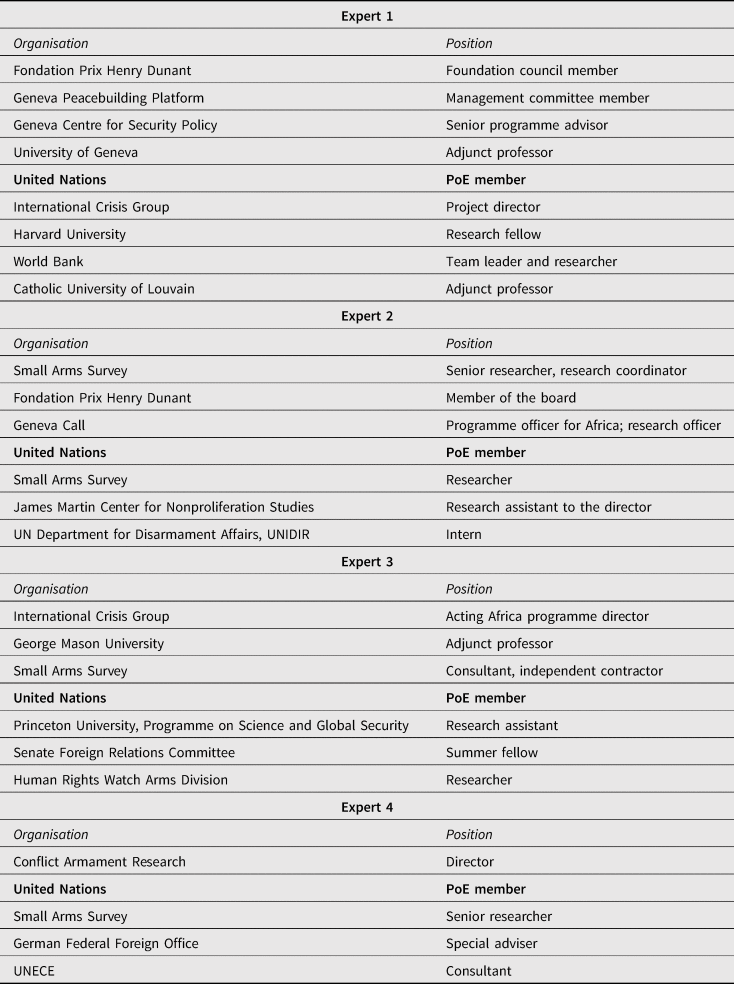
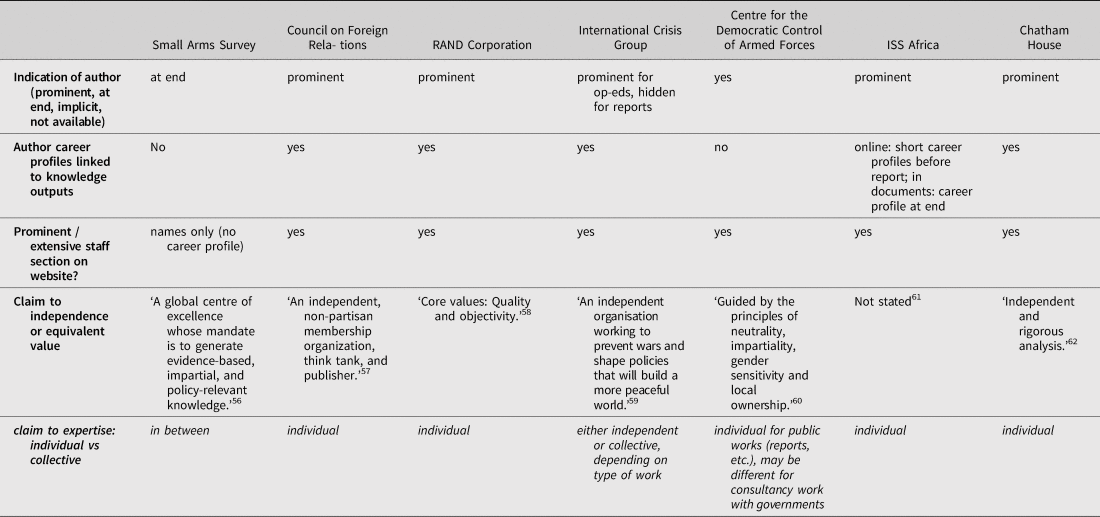
Table 1 provides an example of the career paths of entrepreneurial experts who served on PoEs (these career paths are extracted from public sources and the respective persons do not necessarily correspond to my interviewees). By examining the types of institutions in which these experts work, we see that many of them root their claim to knowledge authority in individual expertise (see Table 2): an expert always performs under her own name, not hidden behind an institution's collective voice, as knowledge outputs (reports, etc.) are clearly attributed to individual authors. On the websites of many of these institutions, the experts’ career profiles are only a click away from the knowledge outputs; the outstanding experience illustrated in these career profiles strengthens the claim to knowledge authority. Although knowledge production is still organised around institutions, the claim to expertise is rooted in individual experts and their individually embodied experience. Consequently, these entrepreneurial experts tend to have visible publication profiles.
Exemplary career profiles of entrepreneurial experts who worked on PoEs.

Note: Profiles do not necessarily match with my interviewees.
Source: Public profiles available at: www.linkedin.com.
Institutions building on an individualised claim to expertise.

When these experts join PoEs, they perform their permanent roles in the entrepreneurial expert economy and their temporary roles on PoEs in ways that make the two performances simultaneously observable. Others – such as the experts’ professional networks – may not observe the experts’ work in detail but are able to follow the experts’ outputs and major activities: the experts’ professional networks contain other experts and constitute particularly important audiences. We should thus assume that working on a PoE poses a particular challenge to the image of independence upon which the entrepreneurial expert economy rests. I am not referring to stark normative categories such as ‘conflicts of interests’ but to tensions in the construction of a self through the performance of roles.
Do only entrepreneurial experts on PoEs experience sociological ambivalence? Let us recall that scholars have noted a further type of ambivalence: the ambivalence inscribed into one and the same role. In the theory section, I explained, however, that this ambivalence should be less challenging than the one between two roles. For PoE members, there is always a tension between working for someone while having to put one's own name on the results. This ambivalence affects all PoE members. However, we should expect entrepreneurial experts to experience this tension more acutely, as they perform their permanent role in the entrepreneurial expert economy and their temporary role on PoEs in ways that make the two performances simultaneously observable.
Analysis 2: Role distance on UN PoEs – ‘We were cowboys’
Overview of results
Let me begin with an overview of the results: eight of the nine interviewed entrepreneurial experts performed role distance regarding the role of the PoE member. Six experts did so strongly; two did so to a smaller degree, of whom one was not a cooperative interviewee and the other was new to the position at the time of the interview. One followed a purely technical approach in her research (based on engineering and physics) and seemed not to experience any conflicting expectations.
One of the non-entrepreneurial experts with a background in national law enforcement showed some role distance. Another non-entrepreneurial expert with a background in private industry did not give any hints regarding role distance performance during her work on the PoEs but expressed a profound critique of the PoEs. However, she said she would not express this critique publicly to avoid putting the renewal of her mandate at risk; thus, this expert distanced herself from her role only during the interview with me. The other six non-entrepreneurial experts did not give any indication of role distance or show any other signs of a problematic relationship with their role as mandated experts. This overview supports the above-described assumption that entrepreneurial experts experience sociological ambivalence most strongly and hence perform role distance.
Three aspects recurred in the interviewees’ descriptions of work practices: first, the relation to the mandate and the mandating authority; second, the relation to the broader professional network; and third, the space for ‘independent’ agency. These elements were intertwined and culminated in descriptions of role distance performances: these performances develop particular meanings through their partially antagonistic relation to the practices expected of UN-mandated investigators. None of these performances or statements, however, imply a rejection of the role of the mandated expert.
The analysis supports two conclusions that link the micro-situational processes to macro-phenomena (without specifying how systematic or strong these links are). First, the described role distance performances help the actors perform a new, temporary role that conflicts with their existing roles by signalling some distance from the new role. This first finding suggests that role distance facilitates the role combination of the independent and hired expert and thus the symbiosis of IOs and the entrepreneurial expert economy.
Second, my interviews suggest that experts perform role distance in the production of political knowledge. Role distance thus influences the content, form, and distribution of political knowledge. This second finding underlines the social nature of knowledge production: to experts, the (re)production of international political knowledge is also an engagement with their own immediate social context, which is why role distance interlaces with knowledge production practices.
Role distance in interpreting the mandate
Interviewees addressed their mandates repeatedly but ambiguously: the mandates give only broad directions, but PoE members used their mandates to communicate their relation to their role. The pattern was to affirm the role in principle but to distance oneself from it on important points. Thus, PoE members expressed respect for the mandate:
You're careful to stick to the mandate of your report because you don't have the right to do something else. The UN asks you to do something specific: that's your mandate.
The mandate also serves a protective function. For instance, when I asked one interviewee, rather straightforwardly, ‘Why does your report not contain any analysis of the political context?’, the answer was, ‘Political context was not our mandate.’ With such comments, experts seemed to adhere to the guidelines given to them and to embrace their role as PoE members.
However, the same PoE members who, at one point, embraced their role as Security Council-hired professionals, evoked the opposite impression at other points. Throughout the interviews, experts emphasised that they deliberately stretched or overstepped the mandate:
We were not mandated to include recommendations about whom to sanction, but this guy just had to be sanctioned, and I made that clear in the report.
The same expert who purported to be careful to stick to the mandate later showed a different view of the mandate. When explaining the reasons behind a strong focus on victims in their investigation, she said, ‘For me, it wasn't a mandate; it was something that had to be done.’ In this context, entrepreneurial experts expressed acknowledgment of other entrepreneurial experts on PoEs regarding the fact that they ‘do it the same way’. In contrast, they repeatedly accused their bureaucratic panel colleagues and those with a military background of lacking independent initiative. According to these narratives, entrepreneurial experts visited dangerous areas – even without permission from the UN – while those experts with backgrounds in state services relied chiefly on information provided by agencies. As one entrepreneurial expert put it, ‘we were the cowboys’.
These comments that belittle the mandate may appear to contradict those above that embrace it, but, together, they achieve a careful balance: a balance between the diligent fulfillment of the mandate with supposedly independent individual initiative.
Role distance in knowledge production
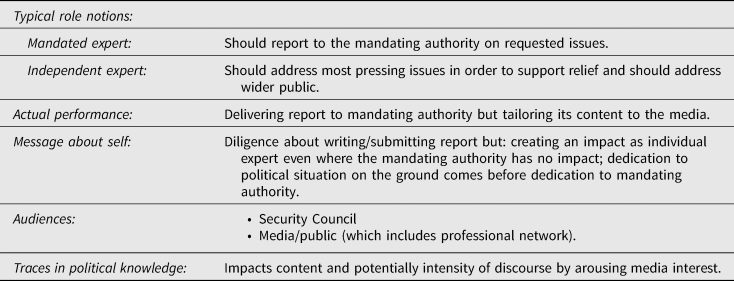
As a first example of the performance of role distance through knowledge production, experts can bypass the mandating authority (Table 3) and formal main recipient of the report. For instance, they can write the report with the media rather than the Security Council in mind. This is what the following PoE member said she did, explaining that ‘influence comes not through the Council but through public opinion’.
There is a slapdash approach [in PoEs]: Let's just investigate anything that has to do with sanctions violations. This is ridiculous; there is way too much of this; you will never get enough, and it has no impact. The impact comes through public opinion. I think the key dynamic [of the conflict in the DRC] is Rwanda's involvement. With this, I can go to the newspapers. No newspaper picks up ‘there are 40 armed groups that violate embargoes’.
Pointing at Rwanda's role as a driver of conflict in the DRC places an expert in a difficult situation, as Rwanda and other states are likely to accuse the expert of overstepping her mandate.Footnote 63 This expert, however, did precisely that instead of continuing analysis the way her colleagues did. By doing so, she signalled simultaneously that she was standing up against political pressures and that she was acting on the basis of a higher motivation to improve conditions in the DRC. This narrative also shows how role expectations intertwine with broader political dynamics and histories and that the expectations towards mandated experts are indeed tied to larger political interests.
Bypassing the mandating authority.

The same expert, however, provided a much more positive assessment of PoEs shortly after:
[PoEs] are an important tool because they are created for conflict situations where information is at a premium since actors try to hide their involvement. It is important to look at the different actors: armed actors, business people, arms dealers. Few others look at this. PoEs can really be game changers.
It is this immediate and visible balancing of affirmation and subversion where role distance becomes perceptible.
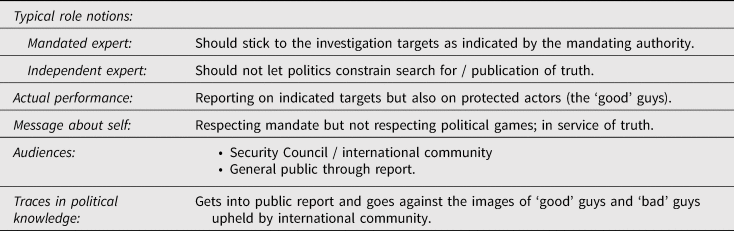
A further way of performing role distance is speaking unwanted truths (Table 4):
So we need to balance what people [in the Committee] want to hear with what we have to say. At times the international community wants good guys and bad guys clearly distinguished so that they have someone to talk to … So they don't want us to report on the bad things that the ‘good’ guys have done. But we kept reporting on all of them.
Speaking unwanted truths.

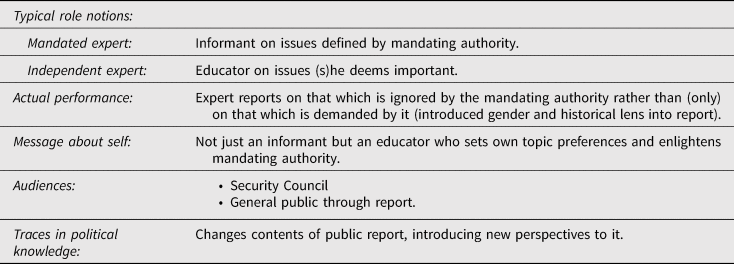
A milder way of performing role distance in knowledge production is to educate when one is only supposed to inform (Table 5). Through this kind of role distance, an expert exceeds the role of a mandated investigator, elevating herself to the guiding role of a teacher. As one expert said, ‘I pursue investigations to become an educational piece for the committee.’ In this vein, the expert described how she sought to include a new social and historical focus into the report to direct attention to a neglected issue. The expert then demonstrated a positive relation to the role of the mandated expert and again reduced the role's purpose to ‘supporting’ the mandating authority; thus, the expert described a strong report as one that
support[s] the chair, other UN representatives, Special Representatives of the Secretary-General, the Secretary-General, and components from member states and neighboring states to discuss the issue in a better way.
Educating instead of informing.

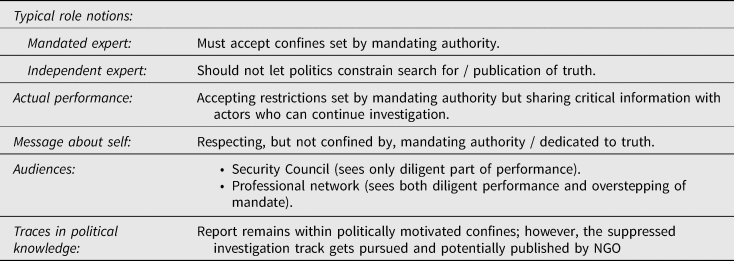
A famous practice of subversion in the workplace is leaking (Table 6). In the event described to me, however, leaking did not constitute sabotage but rather carefully balanced role distance. Leaking facilitated basic adherence to guidelines without entirely sacrificing independence. In this case, leaking made it easier for the expert to respond to the demands of the UN; at the same time, it allowed her to demonstrate to persons in her professional network that those demands did not confine her:
There was a case of brutal human rights violations by [conflict party 1]. Making this public would have made [conflict party 2] look good [note: but, as the interviewee told me, important member states on the Security Council wanted the report to work out the misdeeds of conflict party 2]. So everything was set up … to go there and investigate. But the UN did not let us go … So we leaked it to [a human rights NGO].
Leaking.

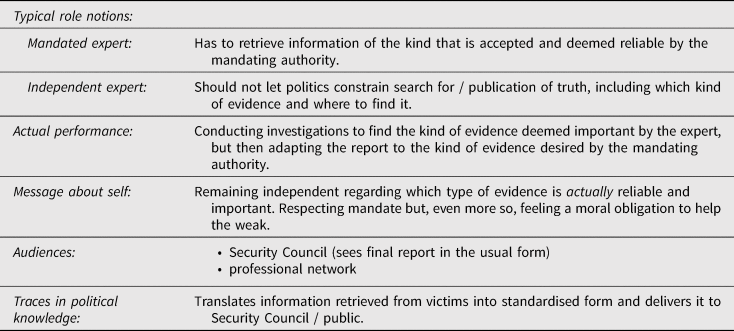
Next, lending a voice to the silenced (Table 7): in this case, the expert had executed a kind of investigation that was in line with her usual research as an entrepreneurial expert outside the PoE, which involved talking to victimised and neglected groups of people. This procedure was not foreseen by her mandate, and the type of evidence – victim testimonies – is vulnerable to attacks by state representatives who disagree with the report's findings.Footnote 64 For the written report, the expert then replaced the original sources with sources deemed more objective and robust, such as documents generated by UN agencies during field missions.Footnote 65 While the final documentation conforms with common PoE practice, the actual investigation led the expert to discover themes that were more important to her. Other experts also emphasised that they had sought closer interaction with persons who fell victim to violence even where this was not covered by the mandate. According to interviewees, the UN secretariat has at times disagreed with this kind of procedure when it exposed investigators to high risks due to the involved travels to remote conflict regions. This is precisely where experts can perform themselves as risk-takers in the name of truth, restrained neither by the mandate nor by safety guidelines (as in the ‘cowboy’ quote above). Role distance is about signalling, however, so it must be added that such actions are indeed visible: experts usually rely on their professional networks when conducting their investigations (as I was told by many interviewees), such that we can assume such investigations to always be visible to some people in their professional networks.
Lending a voice to the silenced.

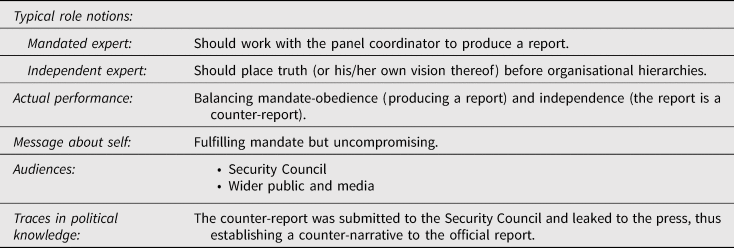
The last example is an often retold, although exceptional, episode: in this episode, several members of a panel disagreed with the panel coordinator'sFootnote 66 direction for the report. The discontented experts split off and produced a counter-report that was leaked to the media (Table 8). This pushed and maybe overstepped the boundaries of acceptable role performance and was seen critically by some of the other entrepreneurial experts; one of them mockingly referred to the producers of the counter-report as ‘the three musketeers’. Remarkably, however, even this action was not a full renunciation of the role because it still delivered an output similar to what was asked for.
Counter-report.

The experts show different degrees of distance to the role of the mandated investigator. In many cases, role distance includes a degree of detachment from the mandating authority and its means of intervention, that is, from the Security Council and sanctions. This detachment is particularly evident in the example of bypassing the mandating authority: this action conveys that the sanctions do not work but media pressure does. One expert preceded a story of role distance with this critique of the Security Council:
The Sanctions Committee is a political committee, as a subcommittee of the Security Council. It makes political decisions. These decisions are informed by a desire to seem to be doing something and not enough will.
However, role distance can also show approval of the Security Council and its tool of intervention, that is, sanctions. This approval emerged in the earlier quote from another expert: this other expert's ‘story of independence’ was that she had recommended, sanctioning a specific individual despite not having been mandated to make such recommendations. In this example, the expert signals distance to the role of the mandated investigator but still embraces the tool of sanctions. It is noteworthy that this example stems from the only non-entrepreneurial expert who showed some degree of role distance. The contrast between these two examples of role distance indicates that role distance can lead in different directions. What both performances of role distance have in common, however, is that they restore leeway for independent action.
Different messages are communicated to different audiences, crossing the border between the UN and the outside professional network. For instance, leaking (in the instance described by my interviewee) was an immediate engagement with the broader professional network outside PoEs, and it may not have been visible to most others. Lending a voice to the silenced (again, as performed by the interviewee) followed investigative threads elaborated in and by the outside network. Speaking unwanted truths and invoking public pressure were more easily visible. The way experts emphasised stories of role distance in their narratives during interviews and at academic events further suggests that, in one way or another, they ensure that the right people either see the performance or hear the post-factum narrative.
There is a further distinction to be made based on the interviews: role distance can take the form of strategically adjusting knowledge outputs, but the strategic adjustment of knowledge outputs can also be found in regular role performance. For instance, one non-entrepreneurial expert explained why she commended, in a report, two rivalling countries for their improved collaboration with one another. Her actual finding, however, was that collaboration had not meaningfully improved at all: the expert chose this formulation as a diplomatic way of encouraging a collaboration that had not yet existed. This move deliberately introduced a discrepancy between the communicated knowledge and the ‘true’ state of affairs (as perceived by the expert), but that does not make it role distance. This action did not run against expectations but embraced them in an attempt to ensure diplomatic restraint. Notably, unlike in the instances of role distance described above, this expert did not raise this episode on her own but did so only when I asked her, out of curiosity, about the nature of this supposedly improved collaboration mentioned in her report.
Conclusion
I have analysed role distance as an interaction strategy that enables experts to perform a temporary role as a mandated investigator without betraying their permanent role as an ‘independent’ expert in the entrepreneurial expert economy. Role distance is not sabotage. Instead, in the face of conflicting expectations, role distance allows individuals to mostly do what they are supposed to do in a particular role by also doing certain things that they are not supposed to do. Role distance, therefore, facilitates the performance of the role to which it creates a distance.
Because role distance helps experts to combine the role of the independent expert with that of an IO-mandated investigator, it also facilitates, at the systemic level, symbiosis between the entrepreneurial expert economy and international bureaucracies. In the observed case, role distance, therefore, stabilises rather than challenges the larger status quo: it maintains the perception of ‘independence’ even when this ‘independence’ is recruited by a governing apparatus to substantiate political intervention practices with knowledge authority.
The analysis has also shown that experts perform role distance through the way they produce knowledge, reminding us that knowledge practice is a form of social interaction. Scientific methods and routines of expertise thus have a dual purpose: they are the expert community's engagement with the contents of a knowledge complex; at the same time, they constitute a specific dimension of interaction rituals through which to perform the self within that community.
Drawing on the work of Goffman leads us to foreground the individual in interaction. It lets us distinguish between role in the abstract and its actual performance by an individual; it furthermore remains sensitive to the problematic relationship that the individual may have with a role that she performs. This perspective supports an empirical study of the intertwinement of structural and individual dynamics.
Goffman's sociology challenges IR scholars with a demand for detailed ethnographic data, but interviews are a way to remedy the lack of observational data. One of the benefits of Goffman's sociology for IR scholars is its way of acknowledging structural ambiguities and individual responses: if Goffman found that such ambiguities shape life and institutions in Northern America, they should abound in the intricate, transnational phenomena that we summarise under the term ‘global governance’.
Acknowledgments
I am particularly grateful to Thomas Biersteker, Grégoire Mallard, and Vincent Pouliot for their support. Various versions of this article further benefited from the insightful feedback of Annabelle Littoz-Monnet, Rebecca Adler-Nissen, Doris Bühler-Niederberger, Falk Daviter, Alejandro Esguerra, Lou Pingeot, and Kylie Thomas. Once more, my interviewees (whom I keep anonymous) deserve particular gratitude for their generous cooperation.
Aurel Niederberger is a postdoctoral researcher at the Graduate Institute of International and Development Studies Geneva. Prior to that position, he was a postdoctoral fellow and course instructor at McGill University. He holds a PhD from the Graduate Institute Geneva. His current research investigates knowledge production in international organisations, global expert networks, and the integration of epistemic and diplomatic practices.