Anatomic repair of isolated balanced atrioventricular septal defect or transposition of the great arteries are common procedures, and both have well-established, excellent long-term results.Reference Buratto, McCrossan and Galati1–Reference Devlin, Backer, Eltayeb, Mongé, Hauck and Costello7 Conversely, the association of atrioventricular septal defect and transposition of the great arteries is very rare.Reference Bharati, Kirklin, McAllister and Lev8,Reference Shaher9 There have only been a few cases of surgery for concomitant atrioventricular septal defect and transposition of the great arteries reported in the literature.Reference Kikuchi, Sato and Yokozawa10–Reference Bautista-Hernandez, Marx and del Nido14 Although biventricular repair in these patients has been described,Reference Kikuchi, Sato and Yokozawa10–Reference Bautista-Hernandez, Marx and del Nido14 given the complex anatomy and frequent association with other abnormalities, it is often unfeasible. Despite this, the outcomes of single-ventricle palliation in patients with atrioventricular septal defect and transposition of the great arteries have not been previously described in detail. We reviewed our experience with single-ventricle palliation in patients with atrioventricular septal defect and transposition of the great arteries.
Materials and methods
Patients
All patients with a diagnosis of atrioventricular septal defect and transposition of the great arteries who underwent surgery at the Royal Children’s Hospital, Melbourne, between 1971 and 2016 were included in the study. Ethics approval was granted by the RCH Human Research Ethics Committee (HREC 32047E). The data were collected by retrospective review of medical records. Follow-up data were obtained by correspondence with the patients’ general practitioners and cardiologists.
Early death was defined as death occurring within 30 days of surgery or prior to discharge from hospital. The degree of atrioventricular valve regurgitation was graded by echocardiography on an ordinal scale (0 = none, 1 = trivial, 2 = mild, 3 = moderate, 4 = severe). Significant atrioventricular valve regurgitation was considered to be present when atrioventricular valve regurgitation was moderate or greater. Unbalanced atrioventricular septal defect was defined as a complete atrioventricular septal defect, which in the opinion of the treating team was not suitable for biventricular repair (i.e., the ventricles could not be septated). The reasons for this were either hypoplastic ventricle or a straddling/overriding atrioventricular valve.
Statistical methods
All data were analyzed using STATA version 13 (Stata Corp., College Station, TX, USA). All continuous data are expressed as mean ± standard deviation unless otherwise specified. Continuous data were compared between groups using the Mann–Whitney U test. Discrete variables were compared between groups using the χ2 test, unless group size was less than 10, in which case the Fisher exact test was used. Given the long time period over which surgeries were performed, we divided the cohort into two eras: those who had their first procedure prior to 2000 and those who had their first surgery from the year 2000 on. Time-dependent end-points, specifically survival and freedom from atrioventricular valve operation, were analyzed using the Kaplan–Meier method. When analyzing the entire cohort, time is measured from the first palliative procedure, while for survival following Fontan completion, time commences at Fontan operation. Differences between groups were compared using the log-rank test. Progression to Fontan and post-Fontan survival were both analyzed using a competing risk framework. The threshold for statistical significance was p < 0.05.
Results
Patients
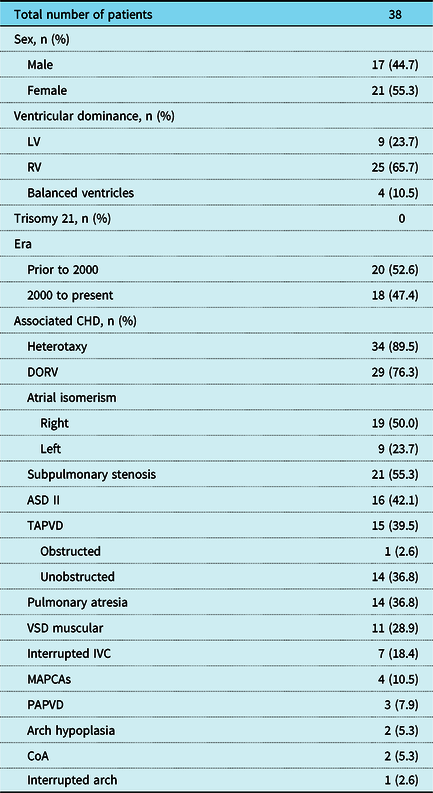
A total of 38 patients with a diagnosis of atrioventricular septal defect and transposition of the great arteries underwent surgery at the study institution. Demographic data are summarized in Table 1. The majority of patients had unbalanced atrioventricular septal defect (36/38, 94.7%), with 89.5% (34/38) having a hypoplastic ventricle, while 7.9% (2/38) had a straddling atrioventricular valve with normally developed ventricles. Only 7.9% (2/38) had balanced atrioventricular septal defect, and both of these patients had pulmonary atresia.
Demographic data

ASD II = secundum ASD; CHD = congenital heart disease; CoA = coarctation; DORV = double outlet right ventricle; IVC = inferior vena cava; LV = left ventricle; MAPCAs = major aortopulmonary collateral arteries; PAPVD = partial anomalous pulmonary venous drainage; RV = right ventricle; TAPVD = total anomalous pulmonary venous drainage; VSD = ventricular septal defect.
Surgical procedures
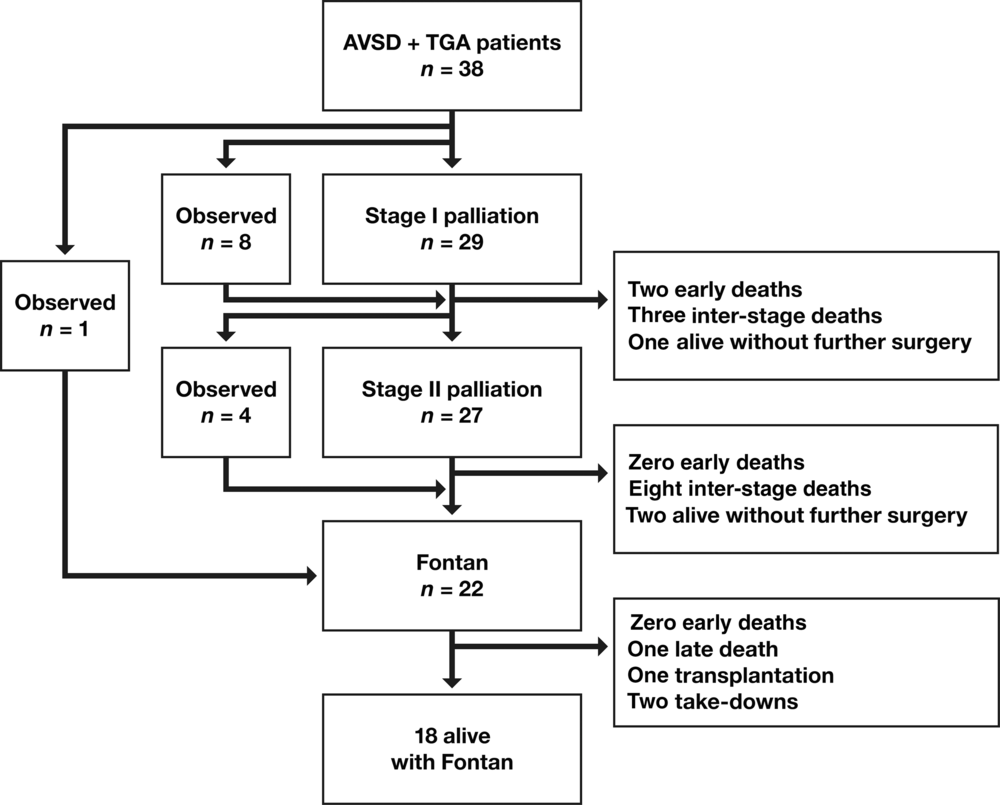
All patients underwent single-ventricle palliation, as summarized in Figure 1. There were no children with transposition of the great arteries and atrioventricular septal defect who underwent biventricular repair.
Outcomes of each stage of palliation.

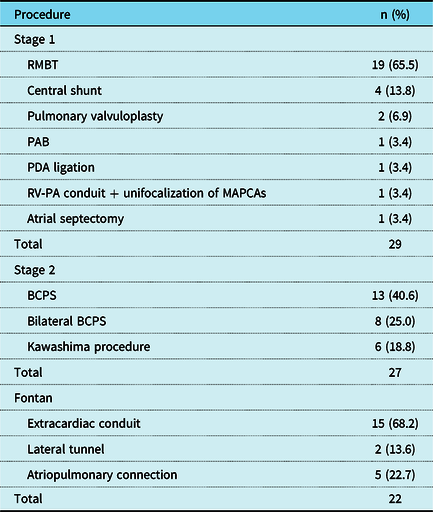
Of the 38 children, 76.3% (29/38) underwent a stage I palliative procedure, as summarized in Table 2. The mean age at time of stage I was 130 ± 296 days (median: 13.9 days, Interquartile range (IQR): 4–78 days). Patients were significantly younger at the time of stage I palliation in the most recent era (20.4 ± 10.8 versus 248.9 ± 107.3 days, p = 0.04). Early mortality following stage I was 6.7% (2/29). One patient had a diagnosis of atrioventricular septal defect, transposition of the great arteries, pulmonary atresia, and total anomalous pulmonary venous drainage (TAPVD), and underwent right modified Blalock–Taussig shunt at 2 days of age. The child subsequently required shunt revision due to stenosis and the early postoperative course was complicated by a pulmonary hypertensive crisis and cardiac arrest with unsuccessful resuscitation. The other early death was a 10-day-old child with atrioventricular septal defect, transposition of the great arteries, and pulmonary atresia with absent central pulmonary arteries and major aortopulmonary collaterals. This child underwent unifocalization and placement of a right ventricle to pulmonary artery conduit, complicated by postoperative poor oxygen saturation, high lactate levels and inability to wean bypass. Despite initial improvement after revision of the conduit, the lactate level remained elevated and oxygen saturations were poor, the patient had a cardiac arrest within 2 hours of return to the intensive care unit and attempts at resuscitation were unsuccessful. Among children who survived stage I palliation, a further 11.1% (3/27) of children died without progressing to stage II palliation.
Type of procedure by stage of palliation

BCPS = bidirectional cavopulmonary connection; MAPCAs = major aortopulmonary collaterals; PAB = pulmonary artery band; PDA = patent ductus arteriosus; RMBT = right modified Blalok-Taussig shunt; RV-PA = right ventricle-pulmonary artery.
Stage II palliation was performed on 71.1% (27/38) of children, as summarized in Table 2. The mean age at the time of stage II palliation was 1.6 ± 2.2 years (median: 1.0 years days, IQR: 0.5–1.7 years). The inter-stage time (0.8 ± 0.2 versus 2.2 ± 0.9 years, p = 0.11) and age at stage II (0.8 ± 0.1 versus 2.4 ± 0.8, p = 0.07) were both lower in the most recent era but did not reach statistical significance. There were no early deaths; however, 29.6% (8/27) of children died without progressing to Fontan completion.
Fontan completion was performed in 57.9% (22/38) of children, as summarized in Table 2. The mean age at time of Fontan was 7.8 ± 7.0 years (median: 6.0 years, IQR: 4.4–8.2 years). Age at time of Fontan was lower in the most recent era but this did not reach statistical significance (6.0 ± 0.6 versus 9.0 ± 2.5, p = 0.32). The mean time between stage II palliation and Fontan completion was 5.1 years (median: 5.0 years, IQR: 3.6–5.6 years). There were no early deaths following Fontan completion. There has been one late death (4.5%, 1/22), which occurred 24 years after Fontan completion. Furthermore, there was one orthotopic heart transplantation (4.5%, 1/22) and two Fontan take-downs (9.1%, 2/22).
Long-term outcomes
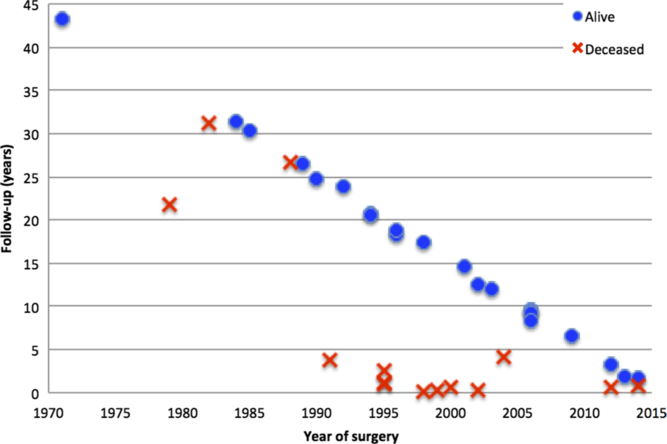
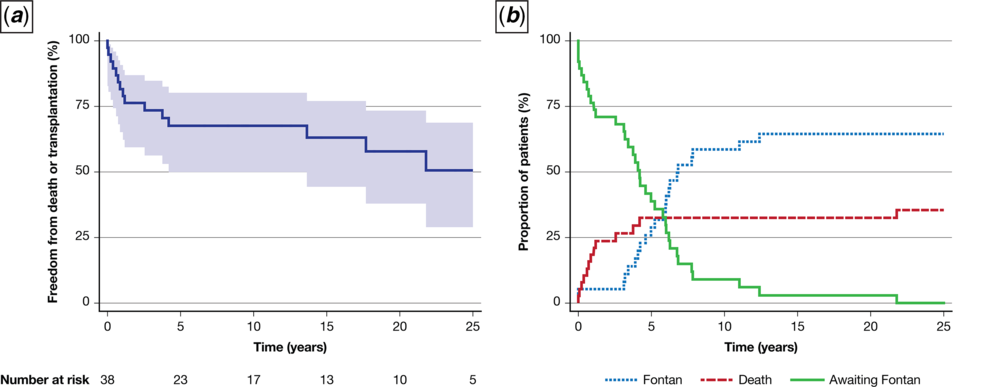
The mean follow-up was 12.4 years (median: 14.6 years, range 2–43.3 years; Fig 2). Kaplan–Meier survival curves for the whole cohort are shown in Figure 3a. Survival was 67.6% (95% CI: 50.0–80.2%) at 10 years and 57.8% (95% CI: 38.0–73.4%) at 20 years. Survival at 10 years was 70.0 % (95% CI: 45.0–85.3%) in patients operated prior to 2000, compared with 68.8% (95% CI: 40.0–85.9%) in those operated on in the year 2000 or later (p = 0.93). A diagnosis of TAPVD was not associated with poorer survival (p = 0.40).
Completeness of follow-up plot.

Kaplan–Meier freedom from death or transplantation (a) and competing risk model for progression to Fontan completion (b). Time is measured from the first palliative procedure. At 10 years, 58.6% (95% CI: 40.8–72.7%) had progressed to Fontan, while was 32.5% (95% CI: 18.2–47.6%).

The competing risk model for progressing to Fontan completion is shown in Figure 3b. At 5 years, 28.8% (95% CI: 15.0–44.1%) had progressed to Fontan, while 32.5% (95% CI: 18.2–47.6%) had died. At 10 years, 58.6% (95% CI: 40.8–72.7%) had progressed to Fontan, while mortality remained 32.5% (95% CI: 18.2–47.6%).
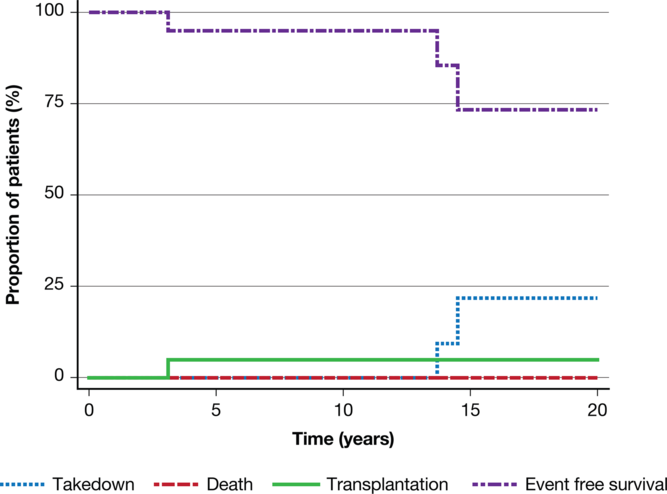
Survival following Fontan completion was 100% at 10- and 20-year follow-up. A competing risk model for survival following Fontan completion is shown in Figure 4. At 20 years, event-free survival was 73.3% (95% CI: 34.8–91.3%), while 5.0% (95% CI: 0.4–20.5%) had undergone cardiac transplantation and 21.7% (95% CI: 3.2–50.8%) had undergone takedown of the Fontan circulation.
Competing risk model for event-free survival following Fontan completion. At 20 years, event free survival was 73.3% (95% CI: 34.8–91.3%), while 5.0% (95% CI: 0.4–20.5%) had undergone cardiac transplantation and 21.7% (95% CI: 3.2–50.8%) had undergone takedown of the Fontan circulation.

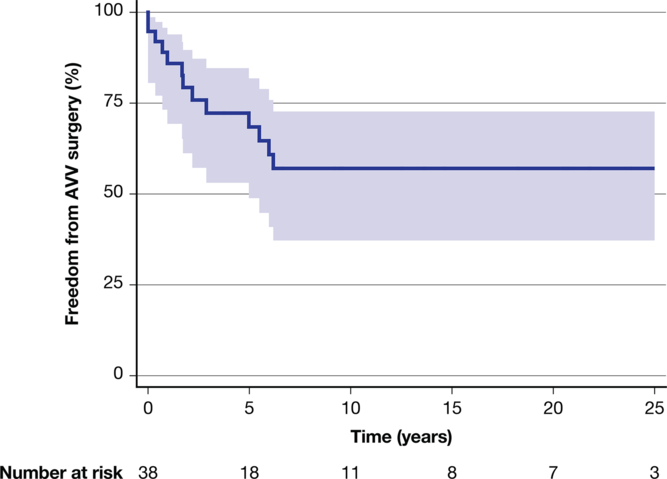
Kaplan–Meier freedom from atrioventricular valve reoperation is shown in Figure 5. Freedom from atrioventricular valve surgery was 57.0% (95% CI: 37.2–72.7%) at 10 and 20 years of follow-up. Surgery on the atrioventricular valve was performed in 34.2% (13/38) patients, of whom 84.6% (11/13) were repaired and 15.4% (2/13) were replaced. The commonest repair technique was edge-to-edge repair in 69.2% (9/13), with the addition of chordal repair in 44.4% (4/9), expanded polytetrafluoroethylene (Gore-Tex Inc., Flagstaff, Ariz) bridge re-inforcement in 22.2% (2/9) and annuloplasty in 22.2% (2/9). Isolated annuloplasty was performed in 15.4% (2/13). A second atrioventricular valve operation was required in five patients (13.2%, 5/38), with 60.0% (3/5) re-repaired, 20.0% (1/5) replaced after prior repair, and 20.0% (1/5) replaced after prior replacement. Two patients (5.3%, 2/38) required a third atrioventricular valve operation: one was repaired and one was replaced.
Freedom from atrioventricular valve reoperation.

Discussion
Atrioventricular septal defect and transposition of the great arteries are both relatively common congenital cardiac malformations, with established techniques for achieving anatomical repair with good outcomes.Reference Buratto, McCrossan and Galati1–Reference Devlin, Backer, Eltayeb, Mongé, Hauck and Costello7 The association of the two conditions is very uncommon. In a large series of 507 cadaveric hearts with atrioventricular septal defect, only 3.4% (17/507) had transposition of the great arteries.Reference Bharati, Kirklin, McAllister and Lev8 Similarly, in a series of 400 hearts with transposition of the great arteries, only 0.3% (1/400) had a diagnosis of atrioventricular septal defect.Reference Shaher9
Given how uncommon this association is, it is not surprising that there has been very little data published on this group of patients. There have been a small number of case reports,Reference Kikuchi, Sato and Yokozawa10–Reference Bautista-Hernandez, Marx and del Nido14 each describing complete repair of atrioventricular septal defect and transposition of the great arteries in patients with balanced ventricles. We reviewed all cases of atrioventricular septal defect and transposition of the great arteries in our institution over a period of 45 years, with the aim of better understanding the associated anomalies, the strategy of repair adopted and the outcomes over this long period. Interestingly, the patients in our study differ quite markedly from the rare cases of biventricular repair reported in the literature, as they all had unbalanced ventricles, straddling atrioventricular valve or pulmonary atresia, precluding the possibility of a biventricular repair. Furthermore, these patients frequently had additional severe congenital heart defects, with the majority of patients having heterotaxy syndromes, further adding to the difficulty of achieving biventricular repair. As such, all patients with the association of transposition of the great arteries and atrioventricular septal defect underwent single-ventricle palliation in our experience. It appears to be exceedingly rare to encounter patients with atrioventricular septal defect and transposition of the great arteries with balanced anatomy who are suitable for biventricular repair.
Our experience shows that the overall survival of patients with atrioventricular septal defect and transposition of the great arteries is approximately 50% at 25 years, with substantial mortality by 5 years after first palliation and a steady decline in survival thereafter. This is substantially less than survival observed after transposition of the great arteries or balanced atrioventricular septal defect repair performed in isolation; however, it is quite similar to results observed for single-ventricle palliation of atrioventricular septal defect.Reference Xie, Brizard and d’Udekem3,Reference Buratto, Ye and King15–Reference Owens, Gomez-Fifer, Gelehrter and Owens17 It was interesting to note that overall survival has not increased in the most recent era; however, procedures are performed on younger patients, especially the first-stage palliation. This may have introduced survivorship bias, whereby only patients with better physiology survived to their first procedure in the earlier era.
By 10 years, approximately 60% of children had progressed to Fontan completion, 30% had died and the remainder had not undergone Fontan. In the 60% of patients who achieved Fontan completion, the outcomes were quite promising, with 75% of patients free from death, Fontan takedown and transplantation at 20 years, no early deaths and only a single late death.
Failure of the atrioventricular valve has been shown to be a major contributor to death and comorbidity in patients with atrioventricular septal defect.Reference Buratto, Ye and Bullock18–Reference King, Gentles and Winlaw20 In our series over 40% of patients had required atrioventricular valve surgery by 10 years, with most of these patients requiring surgery in the first 5 years. This is a much higher rate of reoperation that would be expected for balanced atrioventricular septal defect, but is quite similar to what has been previously reported for patients undergoing single-ventricle palliation for unbalanced atrioventricular septal defect.Reference Buratto, Ye and King15 Despite the complex anatomy, most of these valves were repaired using the edge-to-edge technique. Similarly to what we have demonstrated for unbalanced atrioventricular septal defect, there is a high proportion of patients requiring a second and third atrioventricular valve operation.
Limitations
This study is limited by its retrospective nature and small sample size. Nevertheless, this is the only series of patients with atrioventricular septal defect and transposition of the great arteries described so far.
Conclusions
The association of atrioventricular septal defect and transposition of the great arteries is very rare, and most of these children have unbalanced ventricles, heterotaxy, and other complex anatomy, which precludes biventricular repair. Single-ventricle palliation resulted in a 25-year survival of 50%. In the 60% of children who achieve Fontan completion, long-term outcomes were promising. Overall, outcomes in these children are similar to those achieved with unbalanced atrioventricular septal defect.
Acknowledgements
None.
Financial Support
This project was supported by the Victoria Government’s Operational Infrastructure Support Program. Dr Buratto is a recipient of a Reg Worcester Scholarship from the Royal Australasian College of Surgeons and a Postgraduate Scholarship from the National Health and Medical Research Council (NHMRC) (1134340). Dr Fricke is a recipient of a Postgraduate Scholarship from the NHMRC (113420). Dr d’Udekem is a NHMRC Clinician Practitioner Fellow (1082186).
Conflicts of Interest
Yves d’Udekem is a consultant for Actelion and MSD. Christian Brizard serves on the advisory board of Admedus. No other disclosures.