When women are elected to a male-dominated legislature, how do their decisions and behavior affect politics and policy making within the institution? In the U.S. Congress, scholars have found that congresswomen devote greater effort to affect policies related to women's interests. When policies directly concern a set of women's issues (e.g., Dolan Reference Dolan1997; Swers Reference Swers1998), female representatives tend to vote similarly. During floor debates, women exhibit a higher rate of participation than their male counterparts on women's issues (e.g., Walsh Reference Walsh and Rosenthal2002) and speak with a distinctive voice on such issues (e.g., Pearson and Dancey Reference Pearson and Dancey2011). Finally, women introduce more legislation related to women's issues than men (e.g., Swers Reference Swers2002). Accordingly, scholars link descriptive representation (the way a representative looks) with substantive representation (the way a representative acts), finding that the latter enhances the former (see Mansbridge Reference Mansbridge1999).Footnote 1
Far from “merely” enhancing the substantive representation of women's interests in Congress, however, research also demonstrates that female representatives outperform their male colleagues when it comes to job performance, regardless of the specific policy area. Congresswomen in the minority party, for example, are more effective legislators than minority party congressmen (Volden and Wiseman Reference Volden and Wiseman2014, chap. 4; Volden, Wiseman, and Wittmer Reference Volden, Wiseman and Wittmer2013), with effectiveness defined as the “‘proven ability’ to advance a member's agenda items through the legislative process and into law” (Volden and Wisemen Reference Volden and Wiseman2014, 18). This finding suggests that women enhance Congress as an institution beyond fostering its responsiveness to women's interests. Volden, Wiseman, and Wittmer (Reference Volden, Wiseman and Wittmer2013) attribute this finding to the tendency of female lawmakers to adopt “consensus-building” approaches to lawmaking (Rosenthal Reference Rosenthal1998). In employing “more consensus-oriented and collaborative” orientations when trying to enact legislation, congresswomen may “facilitate the movement of their agenda items through the law-making process” (Volden, Wiseman, and Wittmer Reference Volden, Wiseman and Wittmer2013, 327). In addition, scholars have observed that congresswomen work harder than congressmen due to a sense that they are more electorally vulnerable (see Lawless and Pearson Reference Lawless and Pearson2008; Lazarus and Steiegerwalt Reference Lazarus and Steigerwalt2018; Milyo and Schosberg Reference Milyo and Schosberg2000; among others).
In evaluating whether women are more effective, though, scholars have not yet measured consensus-building behavior. Nor have scholars assessed whether consensus-building behavior helps lawmakers move sponsored bills through the lawmaking process (i.e., be effective). Lawmakers can win enactment of legislation in the absence of consensus-building through, for example, sheer partisan force, as the Republicans enacted tax reform in the 115th Congress (2017–18) and the Democrats enacted the Affordable Care Act in the 111th Congress (2009–10). Volden and Wiseman (Reference Volden and Wiseman2014, chap. 3) note that studying legislative effectiveness provides insight into the role of the majority party in enacting legislation. Many members are effective largely because of their place in the majority party—as committee chairs and party leaders. Therefore, the view that congresswomen (especially in the minority party) enjoy enhanced effectiveness as a result of coalition building would benefit from a stronger foundation if one observed that minority party congresswomen engaged in activities that are tied both to legislative effectiveness and consensus-building activities.
Toward this end, we examine legislative entrepreneurship by members of Congress. Whereas legislative effectiveness measures progress through the lawmaking process, legislative entrepreneurship measures how members of Congress reach out to their colleagues to build coalition and consensus behind legislative solutions to lawmaking problems (Wawro Reference Wawro2000). It is easy to imagine situations in which members may be effective, able to shepherd their legislation through Congress, while at the same time not being terribly collaborative. It is also possible to imagine the reverse: members work together, but they are not successful in ushering their bills through the legislative process. If, as the previous literature suggests, congresswomen—or at least minority party congresswomen—are more effective than their male colleagues because of a greater commitment to consensus building, then we should also observe them engaging in practices that build consensus to a greater degree than congressmen. To accomplish this, we examine legislative entrepreneurship in Congress from 1973 to 2008 and explore the relationship between gender and entrepreneurship. Our results suggest that the election of women to Congress should increase the pool of hard work available to create original and effective solutions to policy and policy problems, and thus improve Congress as a democratic policy-making institution.
LEGISLATIVE ENTREPRENEURSHIP, CONSENSUS BUILDING, AND THE GENDER OF LAWMAKERS
Legislative entrepreneurship, as defined by Wawro (Reference Wawro2000, 4), involves “a set of activities that a legislator engages in, to form coalitions to pass legislation.” In pursuing entrepreneurship, members “invest time and effort to become aware of existing opportunities for enacting legislation that others have failed to notice and gather information about how to produce various legislative inputs to exploit these opportunities,” producing “legislative packages” that can win enactment into law (4). This work provides a collective good for Congress as an institution. Wawro found that members of Congress who provided these benefits were rewarded with a greater likelihood of obtaining committee, subcommittee, and party leadership positions (chap. 5).
Entrepreneurship, then, entails the creation of new, and sometimes innovative, policies to address problems and the embodiment of these policies in legislation. Notably, entrepreneurship may involve policies that are not meant to facilitate purely partisan goals or to pursue the interest of a narrow set of stakeholders. There is no guarantee that novel and inventive proposals will fit squarely within a single party's or group's agenda. Of course, entrepreneurial legislation does not preclude the pursuit of narrow goals, nor is it necessarily bipartisan or even nonpartisan. Rather, we note that it is reasonable to expect that most entrepreneurial activity will yield legislative proposals that do not cleave neatly along partisan lines or respond to the narrow priorities of stakeholder groups.
Entrepreneurship is also clearly time-consuming on the part of members. When trying to build a legislative portfolio, it is expeditious for members to propose bills that embody existing ideas. Acquiring and understanding the (sometimes complex) information necessary to develop original legislative proposals, though, is a grind. With all the work members must do, and with the scarcity of time they have to do it in, it is easy to allow the bills one has sponsored to be gatekept by committees. On the other hand, it is laborious work to build a coalition on behalf of one's sponsored legislation.
Given that entrepreneurship involves engaging problems from different perspectives, scholarship on female lawmakers suggests strongly that congresswomen will, on average, engage in more entrepreneurial legislative activity than congressmen. The basis for this hypothesis is twofold. First, when women serve as legislators, their orientation toward leadership is more likely to be “integrative” (what Volden and Wiseman [2014] refer to as “consensus building”) than is the case for men. Rosenthal (Reference Rosenthal1998, 19) both defines integrative leadership and describes why women adopt it as a style more frequently than men. This style is “other directed” and focuses on facilitating cooperation and the “discovery of shared goals,” to arrive at “shared problem solving and collaborative win-win strategies.” Female legislators are more likely to adopt this style because of “cultural norms and specialization. The hypothesis also emerges from the gendered nature of work roles. In addition, other research from the fields of management and education suggests the association between integrative styles and women leaders” (26).
An integrative approach to legislating amounts to a style of legislating that is commensurate with entrepreneurship. This style involves facilitating compromises to make a larger portion of stakeholders, and participants, better off. For example, a set of stakeholders may oppose government action to address a problem given the current legislative proposals being offered. In authoring complex legislation, or in writing legislation that combines many issues, and in investing time to learn about policy in order to do these things, a member can develop new legislation that leads these stakeholders to remove their opposition. When this occurs, entrepreneurship produces solutions stakeholders can accept whereas in the past, they could not. Members of Congress who draw support from these stakeholders, then, may begin to cosponsor the entrepreneurial proposals. In this way, an integrative style—manifesting as entrepreneurial activity—provides a collective benefit to Congress generally by creating a solution to a problem that could not be previously solved.
A second basis for expecting congresswomen to focus on entrepreneurship to a greater extent than congressmen involves the hard work necessary to perform entrepreneurial activities, as noted earlier. Research on women serving in the U.S. Congress suggests they simply work harder (see Carroll Reference Carroll2002; Lawless and Fox Reference Lawless and Fox2005; Reingold Reference Reingold1996). Lazarus and Steigerwalt (Reference Lazarus and Steigerwalt2018) argue that congresswomen, more so than congressmen, perceive that they are vulnerable to defeat when standing for reelection. One reason for this disparity is that their experiences as women have led them to believe that “they are inherently more vulnerable to attack” (Lazarus and Steigerwalt Reference Lazarus and Steigerwalt2018, 14). However, perception is also reality. In fact, congresswomen face more, and better-quality, challengers and receive less favorable media coverage than congressmen when running for reelection (chap. 2). These circumstances lead to a sense of “gendered vulnerability” among congresswomen, leading them to work harder than their male colleagues in order to win reelection. In working harder, women are more likely to perform the tasks that comprise entrepreneurship.
Research also stresses that the obstacles women face in winning election, and reelection, to Congress should lead women to engage in higher levels of entrepreneurship. Anzia and Berry (Reference Anzia and Berry2011) articulate these challenges in their theory of sex-based selection, acknowledging that a sizeable proportion of voters are biased against female candidates (see Fox and Smith Reference Fox and Smith1998; Newport and Carroll Reference Newport and Carroll2007). Anticipating this discrimination, only the most qualified women run. On average, then, congresswomen are more qualified than congressmen. Accordingly, congresswomen outperform their male colleagues who do not face this bias (Anzia and Berry Reference Anzia and Berry2011, 481).
Volden, Wiseman, and Wittmer (Reference Volden, Wiseman and Wittmer2013) and Volden and Wiseman (Reference Volden and Wiseman2014, 92) draw on both explanations—that congresswomen tend to employ leadership styles that are integrative, which they label “consensus building,” and that congresswomen may be more qualified—to explain the basis for the hypothesis that congresswomen will be more effective lawmakers than congressmen. Thus, our expectations with respect to entrepreneurship mirror theirs with respect to effectiveness. These scholars find support for this prediction in models of members’ success in moving the legislation they sponsor through the lawmaking process in the U.S. House of Representatives. Congresswomen are more effective than congressmen when effectiveness is modeled as a function of gender. In addition, as discussed in more detail later, the authors observe that the influence of gender on effectiveness is conditional on party status. Women in the minority party are more likely to be effective relative to congressmen in the minority party; however, majority party congresswomen are not more effective than their male majority party colleagues. We return to this finding later.
In developing complex legislation that combines issues in novel ways and attracting the support of rank-and-file colleagues as well as leaders within Congress—that is, engaging in legislative entrepreneurship—members of Congress perform the behind-the-scenes work necessary to enact legislation. Moreover, the characteristics of entrepreneurial legislation, such as combining a large number of issues in single bills to accommodate diverse stakeholders, are consistent with the integrative (i.e., consensus-building) approach to lawmaking. In addition, if congresswomen are more qualified (Anzia and Berry Reference Anzia and Berry2011) and harder working (Lazarus and Steigerwalt Reference Lazarus and Steigerwalt2018), they will, on average, devote more effort to coalition building and gaining policy knowledge, two aspects of entrepreneurship. In summary, if congresswomen must be more qualified than their male counterparts just to be elected (Anzia and Berry Reference Anzia and Berry2011; Pearson and McGhee Reference Pearson and McGhee2013), work harder to win reelection (Lazarus and Steigerwalt Reference Lazarus and Steigerwalt2018), and, once elected, approach their duties with an emphasis on consensus building (see Duerst-Lahti Reference Duerst-Lahti and Rosenthal2002; Rosenthal Reference Rosenthal1998; Volden and Wiseman, Reference Volden and Wiseman2014, chap. 4; Volden, Wiseman, and Wittmer Reference Volden, Wiseman and Wittmer2013), we should observe that congresswomen produce more entrepreneurial legislation than congressmen.
However, it is possible that the effect of gender is not consistent across all members. The foregoing discussion relies on the observation that lawmakers possess different approaches to lawmaking—and that since women tend to be more integrative and hardworking, congresswomen will tend to be more entrepreneurial. Yet it is also the case that members possess different incentives to pursue entrepreneurship regardless of their style. In particular, some members are better positioned to be successful in moving their legislative proposals through the lawmaking process and into law. In particular, party status plays a crucial role in the business of Congress (e.g., Cox and McCubbins Reference Cox and McCubbins2005, Reference Cox and McCubbins2007), and members of the majority party are in a more advantageous position to accomplish their goals than minority party members. Members of the majority—both men and women—are more likely to attract sufficient support for the enactment of their bills by virtue of their party's majority status. Majority party members are more likely to receive hearings from committees (Cox and Terry Reference Cox and Terry2008) and enjoy higher levels of effectiveness than minority party members (Volden and Wiseman Reference Volden and Wiseman2014, chap. 3). Majority party members can sponsor bills consistent with their party's political and policy agenda and, by virtue of being in the majority, enjoy a ready-made coalition that is favorably disposed toward their bills. In summary, since majority party members are more likely to achieve legislative success, we expect that they will be more likely to engage in the entrepreneurial practices that facilitate this success than minority party members.
How will the incentives members have to pursue entrepreneurship that are a function of party status interact with members’ underlying styles? Minority party members are disadvantaged when it comes to their legislative proposals moving through the lawmaking process (Volden and Wiseman Reference Volden and Wiseman2014, chap. 3). Therefore, minority party lawmakers who employ integrative legislative styles (Rosenthal Reference Rosenthal1998)—regardless of gender—have an incentive to lean on consensus-building practices reflected in entrepreneurship. This is how they will achieve success as lawmakers. Since we have reason to think more congresswomen rely on integrative legislative styles more often than congressmen (Rosenthal Reference Rosenthal1998), we expect that minority party congresswomen will engage in greater entrepreneurship than their male colleagues.
The difference in entrepreneurship between majority party congresswomen and congresswomen may be muted, however. Majority party congresswomen may be more committed to integrative tactics reflected in entrepreneurial activity than majority party congressmen, for reasons discussed by Rosenthal (Reference Rosenthal1998). But the prospect of achieving legislative success (Volden and Wiseman Reference Volden and Wiseman2014, chap. 3) will nevertheless give all majority party members an incentive to put in the work necessary to enact bills into law. This will lead to all majority party members—integrative or not—to pursue tactics leading them to attract support for their legislative proposals. These dynamics may mute the difference between integrative—and nonintegrative—majority party members. And since congresswomen tend to be more integrative than congressmen, it may mute the difference between congressmen and congresswomen in the majority party.
Our expectations extend the work of Volden, Wiseman, and Wittmer (Reference Volden, Wiseman and Wittmer2013) and Volden and Wiseman (Reference Volden and Wiseman2014, chap. 4), who expect that congresswomen—especially those in the minority party—will be more effective lawmakers. We argue that these are distinct concepts, and that a member's level of effectiveness, or their ability to move legislation through the legislative process, is rooted in entrepreneurial behaviors. If women are indeed more entrepreneurial than their male colleagues, this would explain their tendency toward greater levels of effectiveness and suggest that the election of more women to the legislative branch should make for a more effective government overall.
DATA AND METHODS
What are entrepreneurial behaviors? We rely on Wawro's (Reference Wawro2000) measure of legislative entrepreneurship, updating his data through the 110th Congress. Recall that Wawro (Reference Wawro2000, 4) defines legislative entrepreneurship as “a set of activities that a legislator engages in, which involves working to form coalitions of other members for the purpose of passing legislation by combining various legislative inputs and issues in order to affect legislative outcomes.” Wawro's legislative entrepreneurship score is a scaled measure comprised of five indicators of legislative collaboration, coalition building, and expertise in Congress, including cosponsorship, issue grouping, bill drafting, and policy knowledge. As Wawro's original data collection ends with the 103rd Congress (1993–94), we extend his data through the 110th Congress (2007–08) using a Python web scraper of Congress.gov and the previous legislative information system, Thomas.Footnote 2, Footnote 3 Additional data were collected using ProPublica's Congress API. We discuss each of the five component measures in turn.
The first individual measure used in the scaled entrepreneurship score is bill cosponsorship. Cosponsorship represents a member's coalition-building skills (e.g., Harbridge Reference Harbridge2015), with “the number of cosponsors a member can get to sign onto a bill being indicative of the member's ability to convince others the bill is worthy of their support” (Wawro Reference Wawro2000, 30). For this measure, we count the number of cosponsors across the bills introduced by each member from the 94th to the 110th Congress. Next, we follow Wawro's (Reference Wawro2000) calculations and sum the number of cosponsors from congressional leadership attached to member's sponsored bills as a second indicator of entrepreneurship. The number of leader cosponsors acts as a measure of superior coalition-building skills: it is one thing to obtain cosponsors, but it signals real success when one convinces a congressional leader to endorse one's bill.Footnote 4 These measures are then used to create a mean cosponsorship score and mean leader cosponsorship score for each measure in each Congress (see Wawro Reference Wawro2000, 35, for a discussion of correlation between alternative measurement strategies).
The third indicator is a measure of the number of issues or subjects addressed in each bill. The larger the number of issues addressed by a bill, the greater the probability it will attract broad support (Wawro Reference Wawro2000, 33). This measure is calculated by counting the number of index terms in the list for each bill introduced by each member per Congress. This measure is used to create an average number of subjects score for each member's bills in each Congress.
The fourth component measure of legislative entrepreneurship is the number of titles in a given bill. This indicator acts as a proxy for legislative complexity, as bills with multiple titles are more likely to address a range of issues and can therefore attract broad congressional support from a larger number of members (Wawro Reference Wawro2000). Additionally, bills with multiple titles are likely to be very complex pieces of legislation and can only be drafted and pushed through by members with both extensive knowledge and well-developed parliamentary skills (Wawro Reference Wawro2000, 33). This measure is used to create a mean number of titles per each member's bills in each Congress.
Finally, to account for the knowledge of policy held by each member in each Congress, we follow Wawro's (Reference Wawro2000) calculations and count the number of times members testify before congressional committees in a given Congress, excluding testimony before appropriations committees.Footnote 5 This indicator accounts for both policy expertise and political skill, as entrepreneurial members may testify to advance their legislation or increase awareness of their preferred policies. The testimonies are then summed and divided by the total number of hearings held during the Congress to create the policy knowledge measure.Footnote 6 These five measures represent different qualities present in entrepreneurial legislators.
Wawro (Reference Wawro2000, 36) acknowledges that these measures are all proxy measures of the same behavior and suggests computing a single measure by combining the separate measures into a scaled score. The score is calculated per member per Congress and measured in terms of the same units as the general cosponsorship measure. For each member i, we follow Wawro (Reference Wawro2000) and divide each of the five measures by its standard error in Congress t and then multiply by the standard error of the general cosponsorship measure. These scaled measures are then added together to obtain the entrepreneurship score for each member.Footnote 7 Table 1 contains descriptive statistics of the scaled entrepreneurship score, reporting data from the 94th–103rd Congresses from Wawro (Reference Wawro2000) and the additional data that we collected from the 104th–110th Congresses. Consistent with the move to allow unlimited cosponsorship of bills that occurred in the 96th Congress, the entrepreneurship scores of members have increased over time.
Summary of legislative entrepreneurship measure by Congress

To illustrate how the entrepreneurship score varies across gender and time, Figure 1 presents a time-series plot of the mean scaled entrepreneurship score by party and gender. The vertical line on the chart designates when Republicans won majority control of the House in the 104th Congress in 1995. This transition ended a 40-year period during which Democrats enjoyed majority control of the House and observers of Congress wondered about a “permanent” Republican minority. The transition is important because it provides an opportunity to examine shifts in entrepreneurial behavior among Democrats and Republican and congressmen and congresswomen as they transition between serving as majority and minority party members.
Time-series plot of the mean of the scaled entrepreneurship score.

As the figure demonstrates, congresswomen in both parties tend to be more entrepreneurial than their male colleagues for most of the period. Also of interest is that women in the minority party are typically more entrepreneurial than their male colleagues. Democratic congresswomen have higher mean entrepreneurship scores than Democratic congressmen prior to the 104th Congress, when Democrats controlled the majority. However, when Democrats became the minority party, the distance between the series denoting Democratic congressmen and congresswomen is noticeably larger in most Congresses. It is also the case that Republican congresswomen's scores were higher than GOP congressmen when they were in the minority prior to the 104th Congress. However, this trend ceased once the Republicans assumed majority control in 1995. This offers tentative support for the idea that minority party congresswomen—both Democrats and Republicans—engage in more entrepreneurial behavior than their male colleagues.
To explore how gender affects legislative entrepreneurship, we include a variety of individual and institutional covariates as independent variables. Our main independent variable of interest, whether the member is a congresswoman, is coded 1 if the member identifies as female and 0 if the member identifies as male. This variable will be positively and significantly associated with the dependent variable (entrepreneurship) if congresswomen are more entrepreneurial than congressmen.
We also include a variable to account for majority party membership. This variable equals 1 for majority party members and 0 otherwise. We also create variables denoting members as majority party congresswomen (1 if so, 0 otherwise) and minority party congresswomen (1 if so, 0 otherwise). Second, we account for the percentage of women in each Congress to control for the possibility that the presence of women more generally elevates the policy-making capacity of all members and therefore increases legislative entrepreneurship scores.
Beyond our key independent variables, we account for whether members served as committee chairs or subcommittee chairs by employing dummy variables (1 if members enjoyed these positions, 0 otherwise). We account for a member's partisanship, coded 1 if the member is a Democrat and 0 if not. We also include a measure of absolute distance from the floor median, measured as the distance of the member's DW-Nominate score from the floor's median DW-Nominate score. As more senior members are more likely to have well-developed parliamentary skills required of entrepreneurial behavior, we control for member seniority with the number of terms served. Additionally, we account for electoral vulnerability with a measure of vote percent in the previous election. Finally, we account for whether members enjoyed assignments on power committees (Rules, Appropriations, or Ways and Means) or were assigned to the House Budget Committee. Members with these assignments were coded as 1, and 0 otherwise. Summary statistics for all variables are reported in Appendix 1 in the supplementary material online.
LEGISLATIVE ENTREPRENEURSHIP 1974–2008
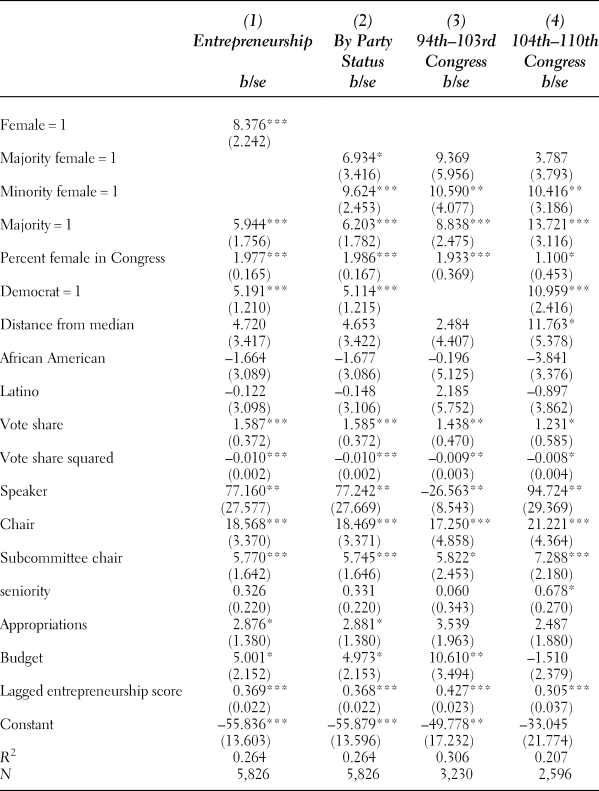
Table 2 presents the results of four ordinary least squares (OLS) models exploring the effects of the covariates of interest on legislative entrepreneurship. The first column presents the estimates of Model 1, in which entrepreneurship is a function of individual and Congress-level variables, including gender, membership in the majority party, distance from the floor median, and legislative roles. Consistent with our expectations, Model 1 in Table 2 suggests that female members of Congress are more entrepreneurial than their male colleagues, with female legislators seeing about an 8-point jump, on average, in entrepreneurship score compared with male legislators.
Determinants of legislative entrepreneurship

* p < .05; ** p < .01; *** p < .001.
Note: Models include dummy variables for each Congress.
Additionally, Model 1 suggests that members of Congress with greater structural advantages, such as the Speaker, committee and subcommittee chairs, and those serving on a budget committee, are all more entrepreneurial legislators. Members who are better positioned institutionally to exert leverage on the lawmaking process do more work to “coordinate the actions and resources of other individuals so that they can realize gains that would not be possible without such coordination” (Wawro Reference Wawro2000, 4). This finding is also consistent with Hall's (Reference Hall1996) conclusion that committee leaders participate more in committee deliberation because the resources afforded by their positions subsidize their ability to participate.
While Model 1 suggests that women are more entrepreneurial than men, even when controlling for other factors, it does not account for the theorized conditional relationship between gender and institutional position. The second column in Table 2 presents the results of Model 2, which extends Model 1 to control for whether the female member of Congress is in the majority or minority party. Consistent with expectations, and with the findings on the association between legislative effectiveness and gender (Volden, Wiseman, and Wittmer Reference Volden, Wiseman and Wittmer2013), Model 2 suggests that while women are still more entrepreneurial than men, there is no significant difference in the effect of party status on the role of gender in entrepreneurship. When the reference category is all men, women in the majority party and women in the minority party are both more entrepreneurial than men.
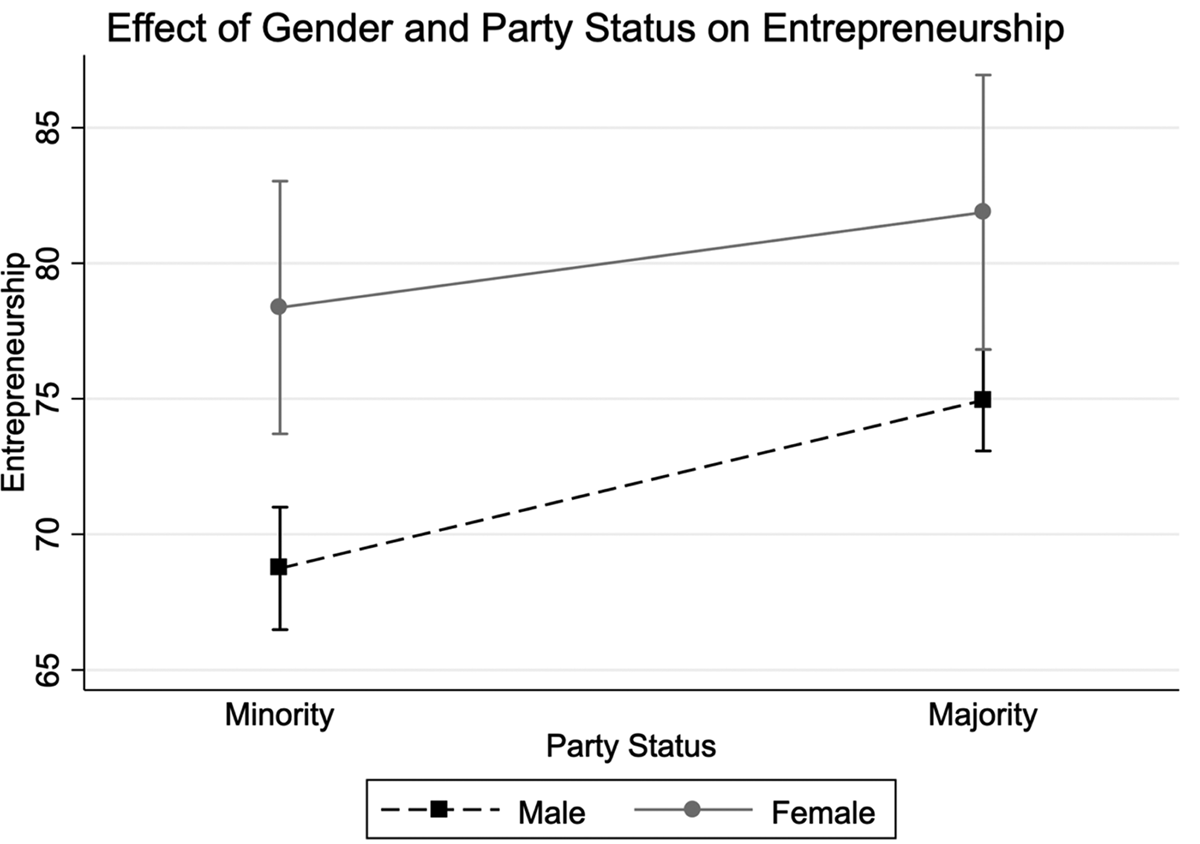
However, when the reference category is men in each party position—majority and minority—it is evident that the results are driven by minority party women. We demonstrate this by estimating a model of entrepreneurship with an interaction between membership in the majority party and gender (presented in Table A2 in Appendix 2). Findings from this model demonstrate that majority party women appear more entrepreneurial than majority party men—but the difference is not significant at conventional levels. However, minority party women are significantly more entrepreneurial than minority party men. Figure 2 provides an illustration of this relationship and indicates that in an interactive model, majority and minority party women engage in greater entrepreneurship than congressmen as a general class. Yet congresswomen of the majority party, while engaging in more entrepreneurship than majority party congressmen, do not do so at a rate that allows for rejection at conventional standards of statistical significance (p < .05).
Effect of gender and party status on entrepreneurship. Figure stems from the interactive model not included in the main document. Full model results are presented in Table A2 in Appendix 2.

Moving forward in this article, the findings that we present are from models in which we include dummy variables for majority party congresswomen (1 if this status holds, 0 otherwise) and minority party congresswomen (1 if this status holds; 0 otherwise). Following Volden and Wiseman (Reference Volden and Wiseman2014) and Volden, Wiseman, and Wittmer (Reference Volden, Wiseman and Wittmer2013), the reference category in these models is all congressmen (Democratic and Republican congressmen together). In all models, we continue to control for membership in the majority party (1 if members are majority party members, 0 otherwise).
Interestingly, across Models 1 and 2 in Table 2, the percentage of women serving in each Congress is positive and significantly related to entrepreneurship scores, suggesting that just changing the composition of the legislature brings the overall entrepreneurship score up. This adds support to the argument that women improve how well Congress functions because of their consensus-building style—essentially elevating the work of everyone around them.
Given the large changes that occurred in the House during and after the 104th Congress, Models 3 and 4 in Table 2 replicate the analysis of Model 2 but break the data into two distinct time periods. The first period encompasses the 94th–103rd Congresses, which observed uniformly Democratic control of the House. The second period includes the 104th–110th Congresses, which saw mostly Republican control (104th–109th Congresses) before a return to Democratic control in the 110th Congress. The latter period also was marked by higher polarization between the parties than the earlier one spanning the mid-1970s through the early 1990s (e.g., Barber and McCarty Reference Barber, McCarty, Mansbridge and Martin2015).
Observation of the results reveals that when we separate the results by time period, the overall relationship between women and entrepreneurship is driven primarily by minority party women. Women in the minority party are more entrepreneurial than congressmen, while majority party women are not significantly more entrepreneurial than congressmen. These results are illustrated in Figure 3, which presents the coefficients and 95% confidence intervals for majority and minority party women across the three time periods modeled in Table 2. Figure 3 shows that in both the early and later time periods, the effect of being female and a member of the minority party results in a significant increase in entrepreneurial behavior. Because of the Democratic dominance in the U.S. House during the earlier period, the minority party female measure between the 94th and 103rd Congresses is a measure of Republican women. However, in the later period, the measure is both Democratic and Republican women, as the majority party in the House changed in the 104th Congress and again in the 110th. These results suggest that, regardless of partisanship, minority party women are significantly more entrepreneurial than male members of Congress.
Party status, gender, and changes in legislative entrepreneurship.

In total, these findings support the hypothesis that congresswomen engage in greater entrepreneurship than congressmen. When modeled additively with gender as a dummy variable (1 = female members), congresswomen demonstrate greater levels of entrepreneurship (Model 1 in Table 2). When we include two dummy variables for congresswomen—one for majority party and one for minority party (reference category is men, consistent with Volden, Wisemen, and Wittmer [2013] and Volden and Wiseman [2014, chap. 4]), both majority and minority party congresswomen show significantly greater levels of entrepreneurship (Model 2 in Table 2). However, this finding that majority party women engage in greater oversight than congressmen, while still positive, is not significant when the periods are disaggregated (Models 3 and 4 in Table 2). These results comport nicely with the work on effectiveness of Volden, Wiseman, and Wittmer (Reference Volden, Wiseman and Wittmer2013) and Volden and Wiseman (Reference Volden and Wiseman2014), who similarly find that in the later period, the coefficient on majority party female drops in statistical and substantive significance. In the models presented here, the coefficient drops from roughly 9.4 to 3.8 from Model 3 to Model 4.Footnote 8
The period models also find that legislative entrepreneurship is positively and significantly associated with the percentage of women in the chamber.Footnote 9 The period models illustrate two differences in the control variables. First, a member's distance from the chamber median is not significant in any specifications except for the later period, suggesting that between the 104th and 110th Congresses, members who were further from the chamber median were more entrepreneurial than was the case during in previous years. This result may be a function of the increased legislative polarization and the fact that members who are ideologically distinct need to work harder to build coalitions and foster collaboration than their colleagues who are closer to the median. Similarly, we also see the Speaker become more entrepreneurial in this era than in years past—a finding that holds for members with more seniority. While the effect is slightly curvilinear, members who have served for greater lengths of time see a significant increase in entrepreneurship scores during this period, suggesting they are better equipped to form the necessary relationships under polarization than junior colleagues. The same effect holds when considering electoral security, with members receiving higher vote shares in the previous election observing a slight attenuation of entrepreneurship.Footnote 10
WHAT DRIVES ENTREPRENEURIAL BEHAVIOR? MODELING AVERAGE ENTREPRENEURSHIP MEASURES
The results presented here demonstrate a relationship between gender, party, and entrepreneurial behavior between the 94th and 110th Congresses. Specifically, women, particularly those in the minority party, are more entrepreneurial than congressmen. These results suggest that electing more women to Congress could produce a more entrepreneurial legislative body with greater focus on building coalitions and collaboration. However, what if these results are driven by particular legislative behaviors, rather than an overall approach to entrepreneurship?
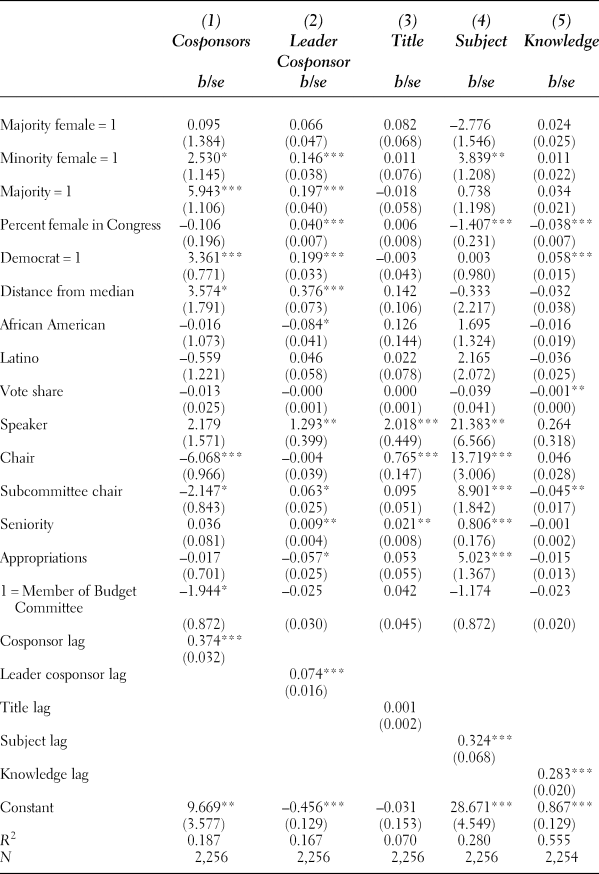
To account for this possibility, we treat each of the component averages (cosponsorship, leader cosponsorship, titles, index terms, and specialization) as a unique dependent variable. Individually, these measures are all highly correlated with each other, but treating them as individual measures can shed light on the nuances of entrepreneurial behavior and offer further understanding of the ways in which women form necessary connections, collaborations, and ideas to provide the collective good of entrepreneurship for Congress as an institution. If congresswomen approach their duties with a greater emphasis on consensus because it is harder for them to be elected, and to win reelection, than men, congresswomen should evince higher levels of those entrepreneurship behaviors that measure consensus building. Table 3 presents the results of five OLS models exploring the effect of the covariates of interest on each average component of legislative entrepreneurship during the 104th–110th Congresses.Footnote 11, Footnote 12
Effect of covariates on legislative entrepreneurship score

* p < .05; ** p < .01; *** p < .001.
Notes: Models include dummy variables for each Congress. Political knowledge measure is multiplied by 100 to create a percentage of testimony measure for increased readability.
Table 3 shows a positive and significant association between minority party women and the average number of cosponsors (Model 1), average number of leader cosponsors (Model 2), and average number of subjects (Model 4).Footnote 13 These results suggest that women in the minority party do more to attract cosponsors (both rank and file and leadership) than congressmen. This finding does not extend to majority party congresswomen. Although the association is not conclusive about why minority party women obtain more cosponsors and leadership cosponsors than congressmen, it is suggestive. We feel secure in the view that their status in the minority party means that lawmakers are not flocking to cosponsor minority party congresswomen's bills out of a desire to hitch their wagons to legislation that is especially likely to be enacted into law. Minority party congresswomen—and not congressmen—are doing something to attract a greater number of cosponsors and more broad legislation, even when controlling for party membership. This is consistent with the view that female lawmakers’ coalition-building style secures support.
We observe additional support for this view with the positive and significant coefficient for the minority party congresswomen dummy variable in Model 4 in which the dependent variable is the number of subject terms. Subject terms act as a proxy for the scope or breadth of provisions in a bill, with broader bills having a greater number of subject terms than more narrowly focused legislation. This finding suggests that minority party congresswomen are writing bills combining multiple issues in order to attract support from lawmakers. In fact, the results suggest majority party women have an average of about four fewer index terms attached to their bills than congressmen. Minority party women, however, have an average of almost six more index terms than congressmen. Figure 4 presents the predicted average title associated with majority and minority party women and majority and minority party men.
Average title by gender and party status.

In summary, from 1995 to 2008, minority party congresswomen do not evince greater activity on all of the individual behaviors that comprise the entrepreneurship measure. Rather, they obtain a higher number of cosponsors from rank-and-file members and from leaders. In addition, they sponsor legislation with a larger number of subjects. That more than just cosponsorship drives the findings, though, suggests that entrepreneurship is more than the sum of its component parts.
It is clear women in the minority party write significantly broader legislation. This finding is consistent with the view that congresswomen tend to adopt a coalition-building style of leadership: by combining multiple issues into one bill, minority party congresswomen (to a greater extent) try to make the tent bigger to attract support for their legislative initiatives. However, when lawmakers are in the majority party, it is majority status that trumps all when it comes to securing support for sponsored bills, and we observe no significant difference between men and women in the majority party. Women in the minority party, though, tend to outperform their male colleagues with respect to these indicators that comprise the scaled entrepreneurship scores.Footnote 14
We do not observe any gender differences in the complexity of legislation (measured as bill titles—Model 3) or in policy knowledge (Model 5). For these aspects of entrepreneurship, the driving factors seem to be members with greater power (Speakers or committee chairs) or seniority. Democrats are also more likely to have higher policy knowledge scores based on their testimony before non-appropriations committees.
It is worth noting that while women in the minority party do not have significantly higher averages across all entrepreneurship components, they do have significantly greater averages for the measures that depend on their coalition-building skills. First, the number of cosponsors a member attracts for a bill is indicative of her ability to convince her colleagues the bill is worthy of support. Second, with respect to leader cosponsors, leaders should be more selective in making cosponsorship decisions than the general membership. Having the support of congressional leadership greatly increases the odds of a bill advancing through the legislative process, and therefore leaders only attach themselves to bills which have a realistic chance of passing and to which they can devote their resources. Therefore, a higher number of leader cosponsors should be indicative of superior coalition-building skills. Third, members may seek to broaden their coalitions by combining the number of issues addressed by a piece of legislation. These bills with a greater number of subjects, or more dimensionality (see Wawro Reference Wawro2000), are designed to appeal to a broad coalition of supporters, compared to bills that focus on only one subject and appeal to only a subset of interested members.
Taken together, female legislators, particularly those in the minority party, see a significant increase in the average number of cosponsors, leader cosponsors, and bill subjects, suggesting that these members are engaging in activities behind the scenes that emphasize collaboration and coalition formation at a greater level than their male colleagues. The other measures, including the average number of titles in each bill and measures of policy knowledge, are less reliant on coalition formation. While bills with multiple titles typically cover a range of subjects and issues, they are also usually omnibus bills, often originating with senior members or leadership. The results presented in Table 3 speak to this idea, as the only covariate associated with a significant increase in the number of titles in a bill is when a member is serving as the Speaker of the House. The policy knowledge measure accounts for a member's engagement with a particular topic—it is a measure of policy specialization, an important factor in developing policy, but a testimony before a House committee is more focused on one's expertise rather than coalition building or collaboration.Footnote 15, Footnote 16
In aiming to answer the questions posed at the outset—whether the election of women to Congress improves how it functions as a legislative body, or, more specifically, whether female legislators more entrepreneurial than their male colleagues—the answer is clear. Female legislators, particularly those in the minority party, are better able to offer legislation that appeals to a diverse group of stakeholders and secure greater support for the bills that they sponsor. That minority party congresswomen are able to secure a higher volume of cosponsors than their male colleagues suggests that coalition-building skills are what makes the difference. It certainly is not institutional privilege that allows any member of the minority party to secure cosponsors.
Additionally, cosponsorship alone does not drive women's entrepreneurial behavior. Rather, women, particularly when institutionally disadvantaged, focus their efforts on how to best build coalitions that appeal to diverse stakeholders. This includes the breadth of issues that congresswomen address in bills that they sponsor. These results suggest the collaborative nature of women has the potential to improve how Congress functions as a collaborative legislative body.
This work demonstrates that women, particularly those in the minority party, are more entrepreneurial, and it suggests one explanation for the previous findings indicating that women are more effective legislators stems from the effort they put into consensus-building work. While some members may be able to push their legislation through because of their majority party status or leadership position, other members must rely on their legislative skills and behind-the-scenes work to do so. Thus, a member's tendency toward entrepreneurial behavior should be a key component of their effectiveness.
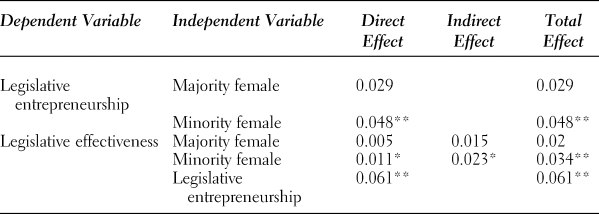
As a robustness check, we examine whether women continue to be more entrepreneurial and effective when we model the behaviors simultaneously. We use a mediation analysis to demonstrate the way gender influences effectiveness sequentially through entrepreneurial behavior. This approach allows us to model the internal processes of behind-the-scenes behavior, and how these processes mediate the relationship between gender and legislative effectiveness. Figure 5 presents a graphical depiction of the model for clarification.
Mediation model linking gender and effectiveness. Model includes controls for the variables used in Table 2 for entrepreneurship and in Table 1 of Volden, Wiseman, and Wittmer (Reference Volden, Wiseman and Wittmer2013) for effectiveness.

Table 4 presents the standardized effects of gender and entrepreneurship on legislative effectiveness. The full models appear in Appendix 3 to conserve space and include controls for the independent variables used in Table 2 in modeling entrepreneurship and Table 1 of Volden, Wiseman, and Wittmer's (Reference Volden, Wiseman and Wittmer2013) work on legislative effectiveness. This model presents two key findings. First, entrepreneurship has a significant effect on a member's legislative effectiveness, such that members with greater entrepreneurship are more effective. Second, we find that even when controlling for traditional covariates discussed earlier, the variable measuring whether members are minority party congresswomen continues to have a significant indirect effect on legislative effectiveness, that is mediated by a member's entrepreneurial behavior. Put differently, for women, membership in the minority party has a significant direct effect on entrepreneurship, as well as statistically significant direct and indirect effects on effectiveness. The total effect of the measure for minority party women mediated through entrepreneurship is 67%, which confirms that women in the minority party have a higher level entrepreneurship, a critical component of their effectiveness relative to men. The same is not true for women in the majority party, who are not significantly more entrepreneurial or effective relative to their male colleagues. These results suggest understanding entrepreneurship is key to understanding legislative effectiveness, and our analysis demonstrates that women are more entrepreneurial and therefore provides a more nuanced understanding of how women, particularly minority party women, are more effective.Footnote 17
Explaining effectiveness with entrepreneurship

* p < .05; ** p < .01; *** p < .001.
Notes: Model includes controls for the variables used in Table 2 for entrepreneurship and in Table 1 of Volden, Wiseman, and Wittmer (Reference Volden, Wiseman and Wittmer2013) for effectiveness. Coefficients are standardized.
DISCUSSION
These findings speak to an aspect of legislative behavior that has not yet been examined with respect to lawmaker gender, while reinforcing existing findings about the importance of gender diversity in the U.S. Congress. In addition, the findings highlight questions about the basis for different behaviors between male and female representatives. Lazarus and Steigerwalt (Reference Lazarus and Steigerwalt2018, chap. 5) demonstrate that congresswomen sponsor and cosponsor more bills than congressmen, a finding consistent with their theory that congresswomen work harder than male representatives because of “gendered vulnerability.” Our findings reinforce this perspective. However, our findings also stress that the hard entrepreneurial work of congresswomen may facilitate effective lawmaking. Congresswomen—at least those in the minority party—not only work harder, they work on behalf of the institution to address problems in a novel ways, providing a collective good for Congress.
Our findings also have something to add to the conversation about participation by, and the influence of, women in group decision-making settings (Karpowitz and Mendelberg Reference Karpowitz and Mendelberg2014). Findings from this experimental research stress that rules for decision-making interact with how well women are represented in a group, where representation refers to there being few or many women in a group relative to a group's size. Most relevant to the findings presented earlier, under majoritarian decision-making, women participate more and achieve outcomes more consistent with their interests when women are better represented in groups (Karpowitz, Mendelberg, and Shaker Reference Karpowitz, Mendelberg and Shaker2012). Similarly, when women discuss concerns such as children and family at higher rates, group decisions are more likely to prioritize these concerns by endorsing higher minimum incomes in society—but only in groups with relatively high numbers of women. This finding does not hold for unanimous decision-making settings (Mendelberg, Karpowitz, and Goedert Reference Mendelberg, Karpowitz and Goedert2014).
Although this research is experimental, it has implications for understanding deliberation and decision-making outside the laboratory, including in the U.S. Congress. Since Congress is a majoritarian institution (notwithstanding the presence of the Senate filibuster), it suggests that congresswomen will participate more, and obtain outcomes desirable to their concerns, as the volume of women who serve in the House and Senate increase. This is consistent with the “critical mass” hypothesis that, as the percentage of female lawmakers increases in a legislature, women will be more influential within it (e.g., Thomas Reference Thomas1991).Footnote 18
Kantak and Krause (Reference Kantak and Krause2012), though, observe that as women make up a larger share of their party caucuses, they are increasingly marginalized. This finding is not inconsistent with the experimental findings discussed earlier. This is because Karpowitz, Mendelberg, and Shaker (Reference Karpowitz, Mendelberg and Shaker2012) and Mendelberg, Karpowitz, and Goedert (Reference Mendelberg, Karpowitz and Goedert2014) do not observe increased participation and influence by women within majoritarian group settings until women make up a majority, or near majority, within their groups. At no time in the period examined by Kantak and Krause (Reference Kantak and Krause2012) does the percentage of women in the Democratic or Republican caucus in the House or Senate approach such a level. During the 116th Congress (2019–20), which had a greater share of women serving in the institution than at any point in its history, women made up 25% of the Senate and slightly less than that percentage in the House. This suggests to us that until there are at as many congresswomen as there are congressmen, congresswomen may have to continue to influence and improve the U.S. Congress by pursuing more integrative styles and engaging in more hard work than their male colleagues.
Our analysis, though, suggests that congresswomen are capable of influencing outcomes even when in a disadvantageous position relative to majority rule. The findings in Table 4 speak to this point in particular. Compared with all congressmen, minority party women are more effective. The basis for this effectiveness is direct and indirect. There is a direct link between minority party women and enhanced effectiveness. But there is also an indirect link in that minority party women are more entrepreneurial, leading to enhanced effectiveness. We view our findings, as well as those of Volden and Wiseman (Reference Volden and Wiseman2014) and Volden, Wiseman, and Wittmer (Reference Volden, Wiseman and Wittmer2013), as informing the larger conversation about the role, and influence, of women in deliberation and decision-making within democratic politics.Footnote 19 Scholars may wish to investigate whether the hard work (Lazarus and Steigerwalt Reference Lazarus and Steigerwalt2018) and integrative perspective (Rosenthal Reference Rosenthal1998) that female lawmakers disproportionately bring to Congress is present in other settings—and whether this trait enhances their willingness to participate and their power in influencing group decisions.
That congresswomen, especially those in the minority party, are more entrepreneurial makes sense in light of research on legislative effectiveness (Volden and Wiseman Reference Volden and Wiseman2014; Volden, Wiseman, and Wittmer Reference Volden, Wiseman and Wittmer2013). Congresswomen are more effective in moving legislation they sponsor through the lawmaking process than their male colleagues. This relationship is also conditional, as noted earlier, with female lawmakers from the minority party being more effective than male representatives in the minority. The fact that we observe similar findings for entrepreneurship, observe greater entrepreneurship for women when modeling entrepreneurship as a function of gender additively, and observe greater entrepreneurship for women in the minority (but not majority) party when the relationship is modeled conditionally by majority party status buttresses this prior research on effectiveness. (Again, note that majority party congresswomen evinced greater entrepreneurship than majority party congressmen at levels that were nearly significant at conventional levels, p < .05.) This is the case because entrepreneurship and effectiveness, though distinct concepts, are related. Hard work behind the scenes to develop legislation should be linked to the ability to move legislation through the lawmaking process. That levels of both phenomena are associated with female representatives should increase confidence that each phenomenon (effectiveness and entrepreneurship) is boosted—especially among minority party members—by the presence of congresswomen.
That the relationship between entrepreneurship and gender in the minority party is stronger than in the majority party may not be surprising given the importance of parties in shaping politics in the U.S. House during the period of our study. This period is characterized by conditional party government (Rohde Reference Rohde1991; Aldrich and Rohde Reference Aldrich and Rohde2000) such that increasingly ideological homogeneity within the majority party—and increasing disagreement between the majority and minority party—motivates majority party members to vest power in majority party leadership. Leaders, then, exercise this power to ensure that legislative outcomes favor majority party positions. Under these circumstances, majority party members may not need to rely on consensus-building, or the behaviors manifested in entrepreneurship, if they can push their legislation through the brute force of being in the majority. Minority party members, however, need to rely on entrepreneurial activities all the more to generate support for their legislative proposals. Although it is outside the scope of this manuscript, this observation suggests that, in periods characterized less by partisan polarization, both congressmen and congresswomen may have incentive to engage in entrepreneurial activities.
Finally, our research suggests that the relationship between the gender of lawmakers and the degree to which they pursue the collective good of legislative entrepreneurship is due to coalition-building characteristics that female lawmakers tend to adopt. In particular, we observe that congresswomen in the minority party do more to include a greater number of issues in the bills that they sponsor than congressmen (Table 3). This suggests that congresswomen are reaching out to their colleagues to attempt to build coalitions behind legislation that they sponsor—to a greater extent than congressmen.
SUPPLEMENTARY MATERIAL
To view supplementary material for this article, please visit https://doi.org/10.1017/S1743923X21000015