Introduction
Foetal growth restriction has been reported as a problem in ruminant production due to the limitations it causes in postnatal productivity (Du et al., Reference Du, Tong, Zhao, Underwood, Zhu, Ford and Nathanielsz2010a). Prenatal development has long-term effects on the growth and physiological functions of animals and foetal programming has been shown to influence new-borns' survival and their subsequent productivity and meat quality (Rehfeldt et al., Reference Rehfeldt, Te Pas, Wimmers, Brameld, Nissen, Berri, Valente, Power, Picard, Stickland and Oksbjerg2011).
At the beginning of gestation, protein restriction changes placental development, which may reduce foetal weight (Perry et al., Reference Perry, Norman, Owen, Daniel and Phillips1999). Cow malnutrition during the first two trimesters of gestation reduces the number of muscle fibres, while in the third trimester it results in low calf birth and postnatal body weights (Greenwood et al., Reference Greenwood, Hunt, Hermanson and Bell2000).
It was demonstrated that bovine foetuses that experience nutritional restriction at some stage of gestation show compensatory gain, larger muscle fibre diameter and greater adiposity (Gonzalez et al., Reference Gonzalez, Camacho, Ebarb, Swanson, Vonnahme, Stelzleni and Johnson2013; Gutiérrez et al., Reference Gutiérrez, Espasandín, Machado, Bielli, Genovese and Carriquiry2014). On the other hand, nutrient intake by pregnant cows above their requirements can also be detrimental to foetal development (Du et al., Reference Du, Tong, Zhao, Underwood, Zhu, Ford and Nathanielsz2010a). The main effects of cow over-nutrition on the foetus are metabolic disorders, such as insulin resistance (Radunz et al., Reference Radunz, Fluharty, Relling, Felix, Shoup, Zerby and Loerch2012), over-expression of genes responsible for the formation of adipocytes in the foetus and down-regulation of myogenesis (Tong et al., Reference Tong, Yan, Zhu, Ford, Nathanielsz and Du2009), resulting in reduced calf birth weight (CBW). Therefore, conflicting results on the influence of cow nutrition on foetal development have been reported.
The efficiency of cow–calf herds is measured by the number and weight of calves produced (Dickerson, Reference Dickerson1970). Then, cow nutrition is an important strategy to improve efficiency in production systems. Considering the variability in results previously reported on foetal programming in beef cattle, the aim of the current study was to evaluate data published in the literature on effects of dietary energy and crude protein (CP) fed to pregnant cows on foetal weight and CBW.
Method and materials
Research question and protocol
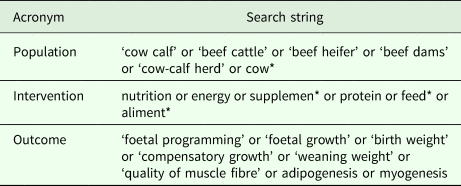
The current study aims to identify the effects of different dietary total digestible nutrients (TDN) and CP levels fed to pregnant beef cows on foetal weight at two gestation stages and birth weight. The literature search strategy was defined based on the main concepts in terms of PICO: population, intervention, comparator and outcome (Table 1). The population studied was pregnant cows and heifers. The interventions of interest were dietary energy and protein levels fed to pregnant cows and heifers. Similar groups of animals subjected to the same treatment with or without intervention were considered as comparative groups. The outcomes of interest were foetal weight at 4 (FW4) and 8 months (FW8) of gestation and CBW.
Search terms for population, intervention and outcome used in the systematic review on the nutrition of the pregnant cow and its effects on foetal development

To be considered relevant, the studies had to include at least one of the outcomes of interest. Therefore, studies on animal development related to female reproductive function were not included. A search protocol was developed and each screening tool was adapted from forms applied in earlier studies (Mederos et al., Reference Mederos, Waddell, Sánchez, Kelton, Peregrine, Menzies, VanLeeuwen and Rajic2012; Canozzi et al., Reference Canozzi, Mederos, Manteca, Turner, McManus, Zago and Barcellos2017). The protocol was tested before being implemented.
Search methods for the identification of studies
A list of search terms and final algorithms was summarized by population, intervention and outcome components: (‘cow calf’ or ‘beef cattle’ or ‘beef heifer’ or ‘beef dams’ or ‘cow calf herd’ or cow*) AND (nutrition or energy or supplemen* or protein or feed* or aliment*) AND (‘foetal programming’ or ‘foetal growth’ or ‘birth weight’ or ‘compensatory growth’ or ‘weaning weight’ or ‘quality of muscle fibre’ or adipogenesis or myogenesis). This search strategy also retrieved relevant publications on carcase evaluation. However, the word ‘carcass’ was not included in order to avoid non-relevant citations.
The search was carried out in May 2015 and updated in October 2016 using two electronic databases, Scopus (Elsevier, 1960–2016) and Web of Science (Clarivate Analytics, 1945–2016). The search was validated by manually searching the reference lists of two literature reviews on foetal programming in ruminants (Du et al., Reference Du, Huang, Das, Yang, Duarte, Dodson and Zhu2013; Funston and Summers, Reference Funston and Summers2013). All references were exported into software EndNote Web® (Thomson Reuters, New York, USA) for organization and removal of duplicate references.
Study selection criteria and relevance screening
Four reviewers were trained for the relevance screening steps using 30 abstracts. Potentially relevant studies were identified at this stage. The abstracts were assessed independently by two reviewers by reading the title, abstract text and keywords. No language or year of publication restrictions were applied.
When the response of all reviewers was ‘no’ to one or more questions, the reference was deleted. Any conflicts were solved by agreement; if no agreement was reached, another reviewer was consulted. Randomized and non-randomized studies were included. Microsoft Excel® software was used during all relevant screening stages.
Methodological assessment and data extraction process
The data extraction form was developed based on previous models. Manuscripts reporting more than one trial were duplicated and the data extracted as separate studies to obtain as much detail as possible. Information extracted from each study was divided into general information (study population, intervention, parameters evaluated and outcome data) and manuscript-related information (authors, publication year and original language).
Considerations for data collection and manipulation
For each outcome, a database including the mean, the standard error of the mean or other available dispersion measure, the probability value and the number of animals evaluated in each group (control and treatment) was built.
In order to compare dietary nutrient supply, the levels (kg) of TDN and CP fed to the cows were separately calculated as a percentage (%) of their requirements published in the NRC (1996). When the studies did not report TDN and CP dietary levels, these were calculated based on the amount of each ingredient that composed the diets, multiplied by their TDN and CP content (%) (NRC, 1996). For each comparison, differences in both TDN and CP levels between the treatment and control groups were calculated. The data were organized so that the control group always received nutrient supply equal to the demands and the treatment group levels above or below.
When studies reported the probability value, the standard deviation was estimated using the t-statistic, assuming that the data presented a normal distribution, according to the following equation (Ceballos et al., Reference Ceballos, Sánchez, Stryhn, Montgomery, Barkema and Wichtel2009; Mederos et al., Reference Mederos, Waddell, Sánchez, Kelton, Peregrine, Menzies, VanLeeuwen and Rajic2012):
 $$S_{\rm p} = \displaystyle{{(x_2-x_1)} \over {t(\alpha {\rm d}fE)\sqrt {(1/n_2) + (1/n_1)}}} $$
where x 2 − x 1 represents the difference between the means, t(αdfΕ) is the percentile of the reference distribution and n is the sample size of each group.
Quality assessment
The Cochrane Collaboration Risk Bias Tool (Higgins and Green, Reference Higgins and Green2011) assessed the risk of publication bias in individual studies included in this meta-analysis (MA). However, interpretation of the risk of bias due to blind use of the outcome assessors was considered low for all studies, as the outcomes evaluated were measured using a scale or other objective measurement equipment.
Meta-analysis
Studies included in this MA reported sufficient quantitative data to estimate the mean difference (MD) between the control and the treatment groups and 95% confidence interval (95% CI). Foetal weight values referred to the gestation period when foetuses were weighed in each study, 4 and 8 months of gestation, and the included birth weight values were obtained when calves were weighed up to 24 h after calving.
Because the studies had different experimental designs, between-study heterogeneity was assumed and estimated using the DerSimonian and Laird method (DerSimonian and Laird, Reference DerSimonian and Laird1986). All statistical analyses were performed using software Stata V 14.0 (StataCorp., Texas, USA).
Each outcome was evaluated separately as a group, and a pooled effect on MD and 95% CI (forest plot) was generated. Cochran's Q test (χ2 test of heterogeneity) and I 2 (percentage of total variation across studies due to heterogeneity rather than chance) were calculated based on dietary TDN and CP levels and on the outcome of interest. The magnitude of I 2 was interpreted in the order of 25, 50, and 75%, and considered as low, moderate or high heterogeneity, respectively (Higgins et al., Reference Higgins, Thompson, Deeks and Altman2003).
Publication bias
Publication bias was evaluated graphically (funnel plot) and statistically (Begg's correlation and Egger's linear regression tests) for each outcome of interest. If there was any trend in publication bias (P < 0.10), the ‘trim and fill’ method was applied to estimate the extent of bias (Duval and Tweedie, Reference Duval and Tweedie2000). This method indicates the number of studies that should be included in the analysis to achieve symmetry in the weight distribution graph.
Meta-regression
Univariate MA was performed to explore the sources of data heterogeneity, applying the method-of-moments approach (Borenstein et al., Reference Borenstein, Hedges, Higgins and Rothstein2009). The following variables were explored: randomization (yes or no); cluster control (not applicable, systematic, convenience or deliberate, randomized, not reported); confounders identified and controlled (no, yes or not applicable); year of publication; continent (North America, South America, Central America, Asia, Oceania, Europe or Africa); dam and sire groups (Bos indicus, Bos taurus (British breeds) purebreds, B. indicus × B. taurus (British breeds) crossbreds, B. indicus × B. taurus (Continental breeds) crossbreds, B. taurus (British × Continental) crossbreds, B. indicus × B. taurus (British and continental) crossbreds); evaluation period (days), sample size; parity (primiparous or multiparous); gestation period (first (1TRI), second (2TRI) or third (3TRI) trimester); production system (grazing or feedlot) and body condition score (1–9 scale according to Pruitt and Momont (Reference Pruitt and Momont1987)) (Appendix A).
Cumulative MA and sensitivity analysis
Cumulative MA are often performed to update the overall treatment effect each time a new study is published. It allows identification of the time when the treatment effect was significant relative to the control. Sensitivity analyses were conducted to verify whether determined studies influenced the measure of effect (MD), by manually removing one study at a time and evaluating whether the MD varied ±30% before including the next study (Egger et al., Reference Egger, Smith and Altman2001; Borenstein et al., Reference Borenstein, Hedges, Higgins and Rothstein2009).
Results
Study selection
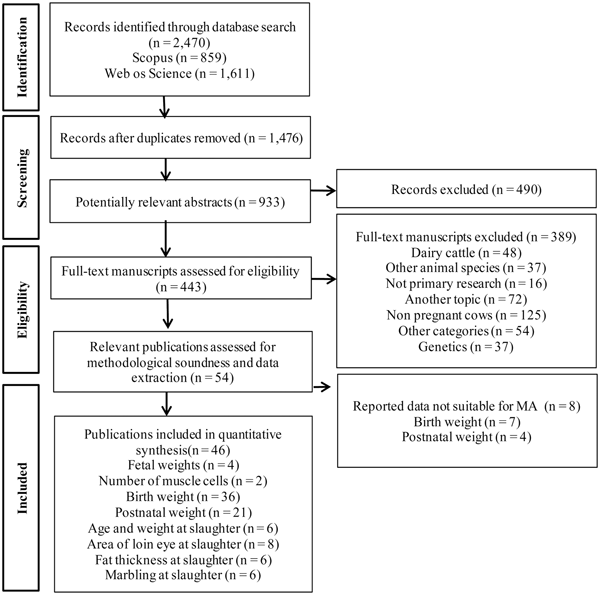
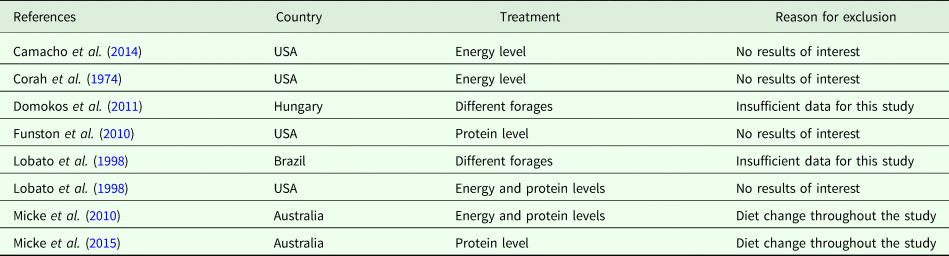
The search identified 2470 citations, from which 443 full-texts were assessed for eligibility for reading in their entirety and 389 were excluded after methodological validation and data extraction (Appendix B). Out of the remaining manuscripts, eight did not report sufficient data to perform the quantitative analysis (Appendix C) and, finally, 39 manuscripts on foetal weight and CBW were included in this SR-MA. In the current study, the FW4 was evaluated in four studies; the FW8 in four studies; and the CBW in 48 studies. Relative to dietary nutrient levels fed to pregnant cows, 34 studies evaluated energy levels; 12, protein level and seven, both energy and protein levels. In total, 170 foetuses and 9053 calves were included. The body weight of 146 foetuses and 3998 calves were evaluated as a function of dietary energy levels, and 46 foetuses and 1399 calves as a function of dietary protein level.
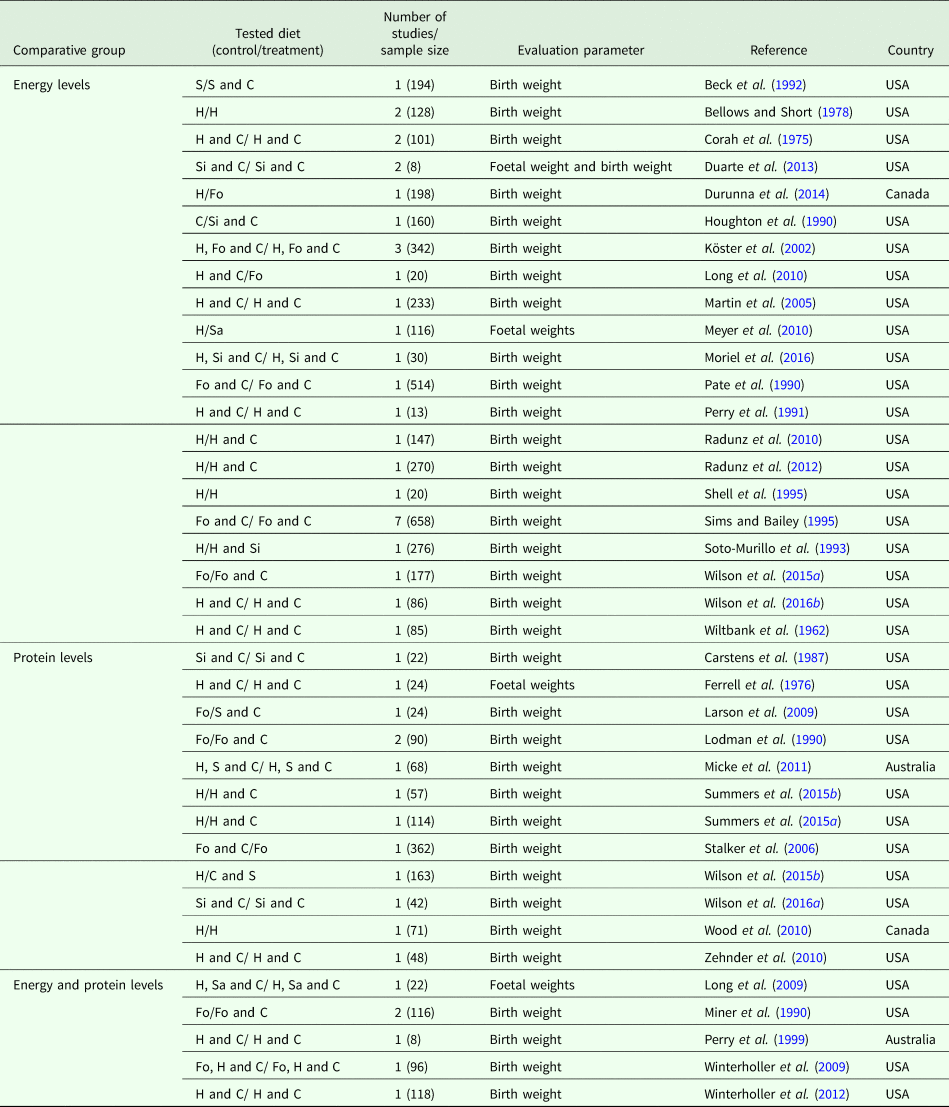
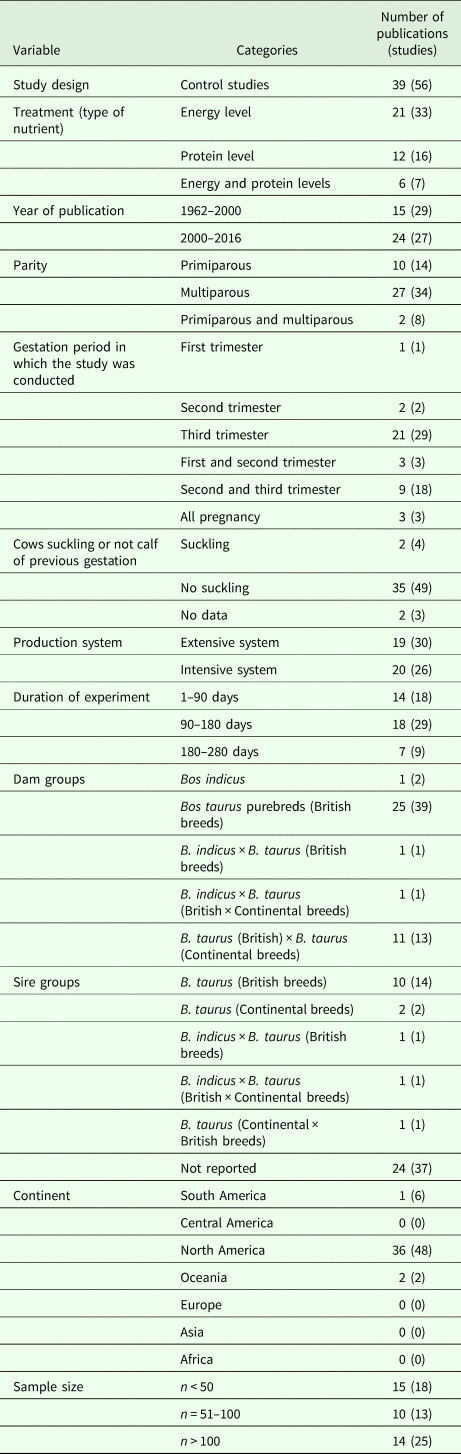
The 39 publications included in this SR-MA comprised 56 studies and 135 trials. The main characteristics of studies included in this MA are presented in Tables 2 and 3.
Descriptive summary of each relevant study included in this MA and meta-regression (39)

Sa, straw with added ammonia; C, concentrate; H, hay; Si, silage; Fo, forage; S, straw.
Descriptive characteristics of 39 publications reporting 56 studies included in the MA on the nutrition of the pregnant cow and its effects on foetal development

Risk of bias
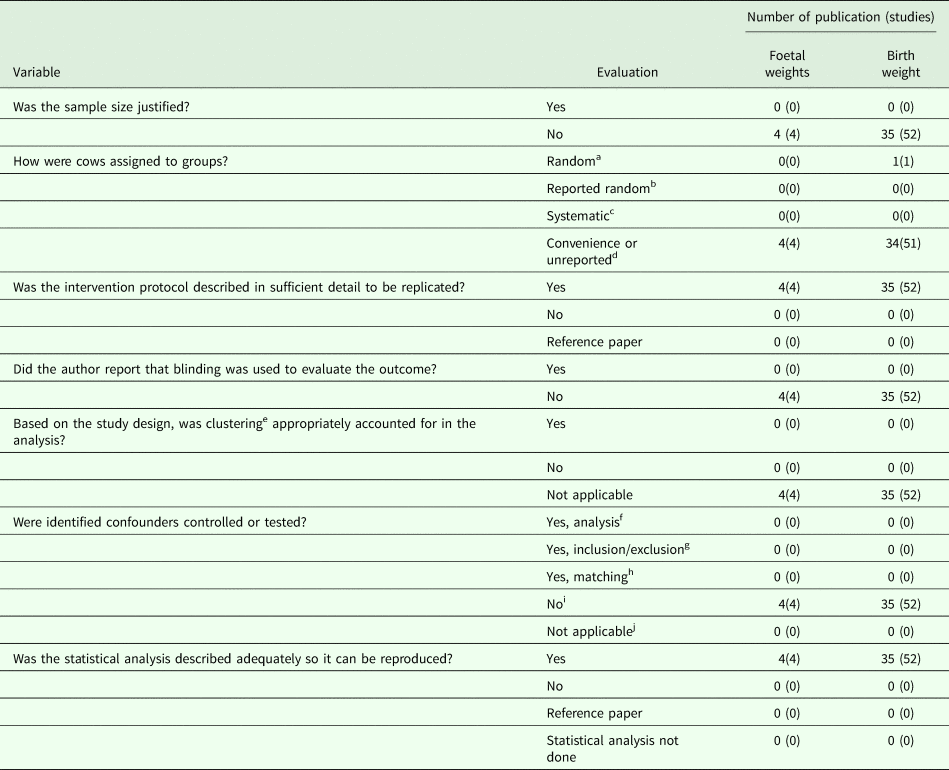
Few studies allowed a detailed analysis of the risk of bias. The risk of bias due to blinding was assumed to be ‘low’ because the outcome parameter was body weight, which is an objective measure with low probability of error (Table 4 and Appendix A).
Methodological quality assessment of risk of bias (classified as low, not clear and high) of the 56 studies included in the MA on foetal weight and CBW

Meta-analysis
In the MA included studies, the FW4 and FW8 were assessed in the same four publications (Table 2), out of which only Duarte et al. (Reference Duarte, Gionbelli, Paulino, Serão, Martins, Tótaro, Neves, Valadares Filho, Dodson, Zhu and Du2013) also reported CBW results.
Foetal weight
Only foetuses weighed at 4 (n = 4 studies, 6 trials) and at 8 months (n = 4 studies, 4 trials) of gestation were included in the current MA. The stratified analysis revealed high heterogeneity between studies both at 4 (I 2 = 94.4%) and at 8 months (I 2 = 91.08%) of pregnancy.
Mean foetal weight at 4 months of pregnancy was 1.13 kg and no significant influence of the treatments on this outcome was detected.
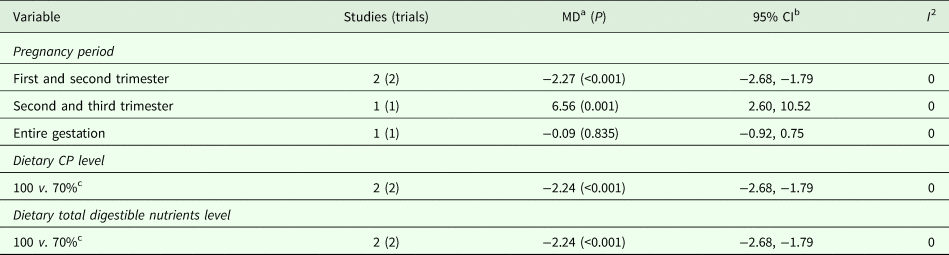
Mean foetal weight at 8 months of pregnancy was 27.93 kg. A significant reduction in FW8 (−2.23 kg) was determined when the cows were fed CP and TDN levels corresponding to 100% of the NRC (1996) (95% CI = −2.68, −1.79, P < 0.001, n = 2 studies, I 2 = 0%) compared with 70% (Table 5) both in 1TRI and 2TRI.
Foetal weight at 8 months of gestation according to dietary CP and total digestible nutrients levels fed to pregnant cows during different gestation periods

a Expressed in kg.
b 95% confidence interval.
c Control v. treatment group.
Calf birth weight
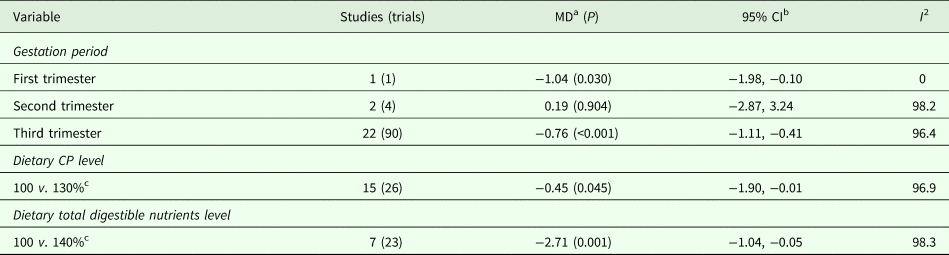
Overall average CBW was 37.11 kg. The analysis showed high heterogeneity across the 48 studies (n = 125 trials) evaluating CBW (I 2 = 96.9%). In the studies in which cows were fed 130% of their CP requirements (NRC, 1996), CBW was reduced by 0.45 kg (95% CI = −0.90, −0.01, P = 0.045, n = 15 trials, I 2 = 96.9%). Where cows were fed 140% of their TDN requirements (NRC, 1996), CBW was reduced by 2.71 kg (95% CI = −1.04, −0.05, P = 0.001, n = 7 trials, I 2 = 98.3%) relative to the other dietary TDN levels.
Publication bias
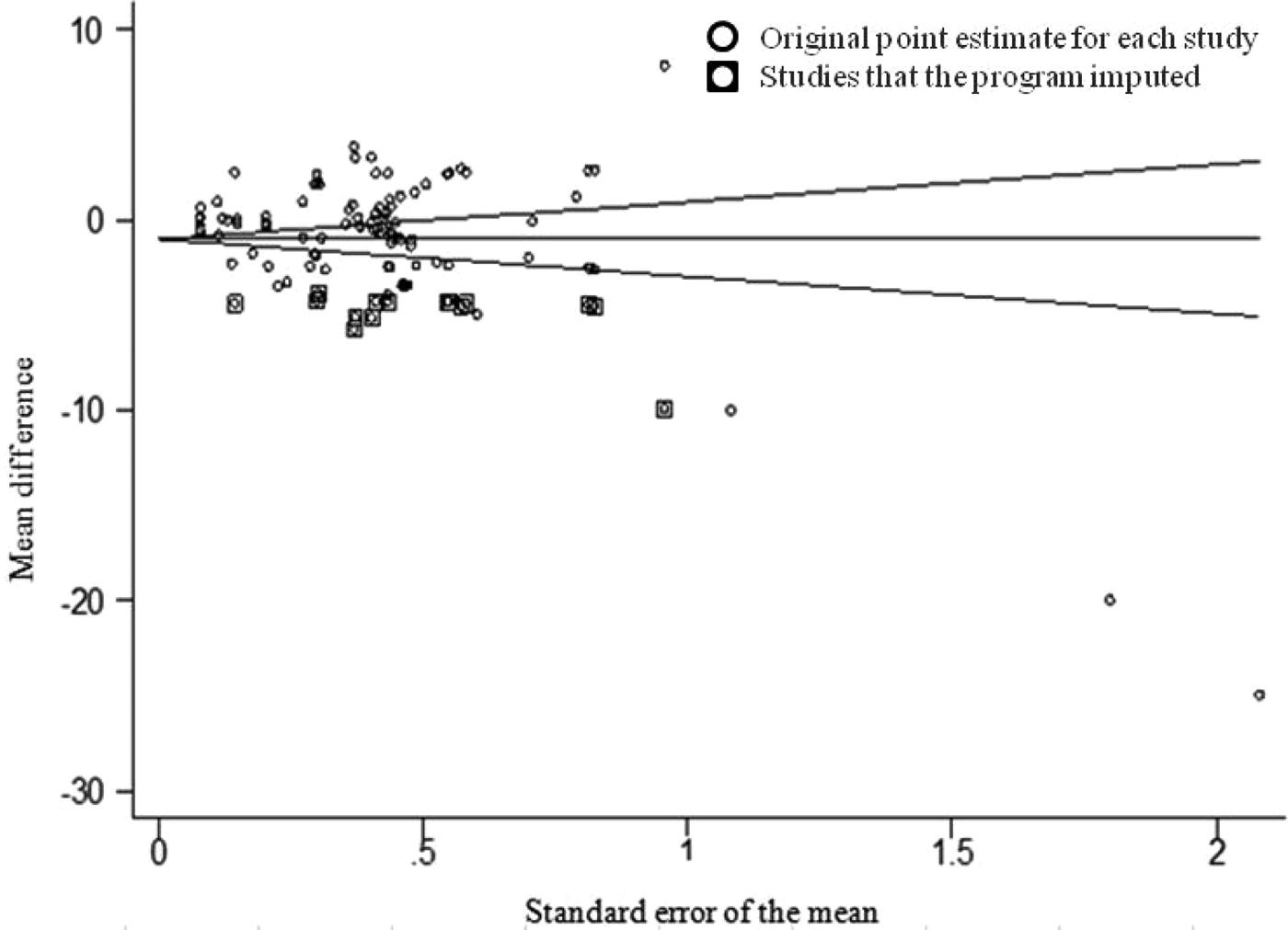
The studies included in the current MA are highly heterogeneous and, therefore, the results should be interpreted with caution. There was no evidence of publication bias in the studies evaluating FW4 and FW8, as determined by the symmetrical results of the funnel plot and the lack of significance in the Egger's and Begg's statistical tests. However, Begg's test detected a publication bias (P = 0.058) for CBW, and the ‘trim and fill’ test indicated 17 additional tests would be required to remove this possible bias (Fig. 1).
Funnel plot obtained using Duval and Tweedie's ‘trim-and-fill’ linear random effect model measuring standard MD in CBW.

Meta-regression analysis
Meta-regression analysis is not indicated when the number of studies evaluated is lower than ten (Borenstein et al., Reference Borenstein, Hedges, Higgins and Rothstein2009). Therefore, it was not performed for FW4 (n = 4 studies and 6 trials) or FW8 (n = 4 studies and 4 trials) data.
The 48 studies (n = 125 trials) reporting CBW outcomes were subjected to meta-regression analysis. The results showed that 96.88% of the variation across studies was due to chance. It was determined that 1 year of increase in publication year reduced the MD by 0.07 kg (P = 0.003).
Cumulative MA and sensitivity analysis
Cumulative MA did not detect any significant chronological trends for FW4 and FW8. However, CBW presented a slow and clear chronological shift. Until 1993, outcomes tended to favour the treatment group, whereas from 1993, the control group presented better results.
The sensitivity analysis of FW4 data showed that removing three studies (Ferrell et al., Reference Ferrell, Garrett and Hinman1976; Meyer et al., Reference Meyer, Reed, Vonnahme, Soto-Navarro, Reynolds, Ford, Hess and Caton2010; Duarte et al., Reference Duarte, Gionbelli, Paulino, Serão, Martins, Tótaro, Neves, Valadares Filho, Dodson, Zhu and Du2013), one at a time, increased MD from 0.84 kg to 1.64, 1.95 and 2.35 kg, respectively. As for FW8, the removal of three studies (Ferrell et al., Reference Ferrell, Garrett and Hinman1976; Long et al., Reference Long, Vonnahme, Hess, Nathanielsz and Ford2009; Meyer et al., Reference Meyer, Reed, Vonnahme, Soto-Navarro, Reynolds, Ford, Hess and Caton2010), again one at a time, increased MD from −0.47 kg to −0.22, 0.37 and 0.67 kg, respectively. The sensitivity analysis for CBW showed that removing the study of Zehnder et al. (Reference Zehnder, Maddock, DiCostanzo, Miller, Hall and Lamb2010) decreased MD from −0.48 to −0.21 kg.
Discussion
A large number of studies on foetal programming in beef cattle have been published and the majority included in the current study were conducted in North America. The outcomes evaluated are conflicting and inconclusive, possibly due to differences in diets, breeds and pregnancy periods evaluated. For instance, Beck et al. (Reference Beck, Simms, Cochran, Brandt, Vanzant and Kuhl1992) found similar CBW, regardless of whether cows consumed 104 or 114% CP in 2TRI and 3TRI. Perry et al. (Reference Perry, Corah, Cochran, Beal, Stevenson, Minton, Simms and Brethour1991) found cows that consumed 70% of their energy requirements (NRC, 1984) produced heavier calves at birth than those that consumed 150% of their energy requirements. On the other hand, cows fed a diet with nutrient levels 24.5% above their requirements (1.40 kg/day of CP and 19.70 Mcal/day of ME) during 2TRI produced 8.3% heavier calves at birth compared with those of cows fed a diet with low nutrient levels (0.38 kg/day CP and 15 Mcal/day ME) (Micke et al., Reference Micke, Sullivan, McMillen, Gentili and Perry2011).
Although foetal programming is a recent research topic, the literature search included studies published since 1976, when this term was not yet used. The effect of pregnant cow nutrition on progeny performance had already attracted researcher interest (Reid et al., Reference Reid, Ward and Salsbury1948; Wiltbank et al., Reference Wiltbank, Bond, Warwick, Davis, Cook, Reynolds and Hasen1965; Corah et al., Reference Corah, Quealy, Dunn and Kaltenbach1974; Ferrell et al., Reference Ferrell, Garrett and Hinman1976). Due to the need for intensification of animal production (Barcellos et al., Reference Barcellos, Queiroz Filho, Ceolin, Gianezini, McManus, Malafaia and Oaigen2011) and the demand for high-quality beef (Du et al., Reference Du, Wang, Fu, Yang and Zhu2015), foetal programming has been increasingly studied.
Meta-analysis
Foetal growth rate and subsequent birth weight are the main determinants of postnatal survival and growth (Reynolds and Redmer, Reference Reynolds and Redmer1995). In the current study, the effect of the cow's diet on foetal weight was only significant when applied in 1TRI and 2TRI and had an effect at 8 months of gestation. The daily body energy deposition of 4-month-old foetuses is 31 kcal, or only 4.8% of the 644 kcal daily deposited at 8 months of gestation (Ferrell et al., Reference Ferrell, Garrett and Hinman1976). This requirement for foetal body growth is low relative to the subsequent periods and to the total requirement of the cow, indicating that diets evaluated at 4 months of gestation were not able to change foetal growth during this period. This is also because in early pregnancy the embryonic development is a maternal priority (Valadares Filho et al., Reference Valadares Filho, Marcondes, Chizzotti and Paulino2010), regulated by an endocrine balance that directs nutrients to the maternal–foetal circulation (Bauman and Currie, Reference Bauman and Currie1980).
A similar result was found by Camacho et al. (Reference Camacho, Lemley, Dorsam, Swanson and Vonnahme2018), who offered 100 or 60% of the NRC recommendations for pregnant cows from 30 to 85, 140 or 254 days of gestation and did not observe reduction in foetal weight in any of treatments. Those authors suggested that cows develop mechanisms of placental adaptation on sub-optimal feeding conditions. For example, the cows are more efficient in delivering nutrients to the foetus under restricted nutritional conditions if there are increases in placental size, placentome weight and number, umbilical blood flow and the placental ability to produce and secrete sex steroids or hepatic clearance of progesterone oestradiol-17β.
Although in the current study nutritional restriction in the first months of gestation did not seem to change the weight of foetuses at 4 months, it is known that it exerts an influence on placental formation and development, producing alterations in foetus development in later periods of gestation (Long et al., Reference Long, Vonnahme, Hess, Nathanielsz and Ford2009). In the current study, higher FW8 was obtained in cows fed 70% CP levels (NRC, 1996) during 1TRI and 2TRI, the period when restriction was applied, compared with 100% CP levels. During 1TRI and 2TRI, placental growth in terms of mass and cell proliferation is maximal, and the size and function of the placenta until the end of gestation depends on its early development (Erhardt and Bell, Reference Erhardt and Bell1995), which Perry et al. (Reference Perry, Norman, Owen, Daniel and Phillips1999) found to improve under conditions of low CP intake. These benefits are generated through improved microvilli development and increases in cotyledon weight and trophectodermal volume, stimulating placental growth and function in cows, and promoting foetal growth (Perry et al., Reference Perry, Norman, Owen, Daniel and Phillips1999). Moreover, it is believed that placental growth of cows subjected to nutritional restriction at the beginning of gestation may be compensated by increasing the number of caruncles to provide the nutrients required for foetal development (Bassett, Reference Bassett1991; Clarke et al., Reference Clarke, Heasman, Juniper and Symonds1998). Therefore, the lower FW8 observed when cows were fed 100% CP may be attributed to a reduction in placental development, in relation to the restricted level, as the placenta supplies nutrients to the foetus (Hyttel et al., Reference Hyttel, Sinowatz and Vejlsted2012) and the development is directly influenced by foetal weight (Kelly, Reference Kelly1992).
In the current MA, when the TDN level matched cows' requirements (NRC, 1996) during 1TRI and 2TRI, FW8 was lower than those of animals fed 70% of their requirements. Gonzalez et al. (Reference Gonzalez, Camacho, Ebarb, Swanson, Vonnahme, Stelzleni and Johnson2013) reported that when the energy intake of beef cows was restricted to 60%, the size of the primary muscle fibres of their foetuses at 85 days of gestation increased, as a result of higher activity of the protein that acts as muscle growth factor in the foetus (insulin-like growth factor 2 or IGF-2), compared with non-restricted cows. Several authors also observed that myocyte size and number influence calf body weight by increasing muscle hypertrophic efficiency, consequently increasing offspring body weight (Du et al., Reference Du, Tong, Zhao, Underwood, Zhu, Ford and Nathanielsz2010a; Rehfeldt et al., Reference Rehfeldt, Te Pas, Wimmers, Brameld, Nissen, Berri, Valente, Power, Picard, Stickland and Oksbjerg2011; Radunz et al., Reference Radunz, Fluharty, Relling, Felix, Shoup, Zerby and Loerch2012; Gonzalez et al., Reference Gonzalez, Camacho, Ebarb, Swanson, Vonnahme, Stelzleni and Johnson2013).
Although some studies (Spitzer et al., Reference Spitzer, Morrison, Wettemann and Faulkner1995; Stalker et al., Reference Stalker, Adams, Klopfenstein, Feuz and Funston2006) show that maternal overnutrition during 2TRI and 3TRI promotes foetal development and increases birth weight, detrimental effects on postnatal offspring growth was reported (Caton and Hess, Reference Caton, Hess, Hess, DelCurto, Bowman and Waterman2010). The results of the current MA indicated a negative relationship between cow CP intake during the 3TRI of gestation and CBW, i.e. when cows were fed CP levels more than their requirement, CBW was reduced (Table 6). These effects were more evident in 3TRI, as 75% of foetal growth occurs during this phase (Robinson, Reference Robinson1977).
CBW according to dietary CP and total digestible nutrients levels fed to pregnant cows during different gestation periods

a Expressed in kg.
b 95% confidence interval.
c Control v. treatment group.
Although high CP intake by pregnant cows should increase foetal and calf weights, given the higher availability of amino acids for foetal growth (Long et al., Reference Long, Prado-Cooper, Krehbiel and Wettemann2010), it may compromise body development. A possible explanation is that foetuses from overfed dams may have low insulin sensitivity, which reduces glucose utilization by the cells and impairs body development (Radunz et al., Reference Radunz, Fluharty, Relling, Felix, Shoup, Zerby and Loerch2012; Wilson et al., Reference Wilson, Long, Faulkner and Shike2016a). In addition, pregnant cows fed high CP may present lower blood levels of IGF-I (Sullivan et al., Reference Sullivan, Micke, Perkins, Martin, Wallace, Gatford, Owens and Perry2009), the hormone responsible for nutrient partition between the dam and the foetus. For Herring et al. (Reference Herring, Bazer, Johnson and G2018), protein in ovine gestation caused delayed foetal growth beyond embryonic death. According to those authors, when the amino acids methionine and cysteine are degraded, sulphuric acid and homocysteine are produced, which reduces the blood pH of the pregnant sheep and increases oxidative stress in the cells of the foetus, causing the foetuses to have low body weight or to die.
The current MA also determined lower CBW in cows fed higher levels of TDN than their requirements compared with cows fed adequate TDN levels during gestation. Excess energy consumption by ruminants can lead to reduced energy efficiency (Webster, Reference Webster1981) and increased body tissue degradation (Jones et al., Reference Jones, Starkey, Calkins and Crouse1990). For Jones et al. (Reference Jones, Starkey, Calkins and Crouse1990), the excretion of 3-methyl-histidine was higher in animals fed ad libitum than in those who had energy restricted diets. It is important to note that 3-methyl-histidine is indicative of muscle protein degradation. Following this line of reasoning, in the current work, excess energy consumption may have impaired foetal muscle deposition.
Although few reports in the literature address the influence of dam TDN intake on foetal development in cattle, many studies with other livestock species have been published. In pregnant ewes fed energy levels above their requirements, adipogenic gene expression was up-regulated, whereas myogenic genes were down-regulated, suggesting a direct negative effect of high energy intake on lamb birth weight (Tong et al., Reference Tong, Yan, Zhu, Ford, Nathanielsz and Du2009). Similarly, other authors observed lower lamb birth weight in pregnant ewes fed 140% compared with 100% of their energy requirements, from day 40 of gestation until lambing, possibly as a result of 30–40% lower placental growth (Da Silva et al., Reference Da Silva, Aitken, Rhind, Racey and Wallace2001; Wallace et al., Reference Wallace, Luther, Milne, Aitken, Redmer, Reynolds and Hay2006; Swanson and Bewtra, Reference Swanson and Bewtra2008). In pigs, increasing protein and energy levels (43%) of a standard gestation diet (2.55 Mcal DE/kg and 12% CP), during the first 50 days of gestation, reduced piglet birth weight (Bee, Reference Bee2004). According to Han et al. (Reference Han, Bosi, Hyun, Kim, Sohn and Kim2000), feeding sows with dietary nutrients 40% above their requirements throughout gestation impairs piglet survival and postnatal growth.
In humans (Du et al., Reference Du, Yan, Tong, Zhao and Zhu2010b) and in cattle (Moisá et al., Reference Moisá, Shike, Shoup, Rodriguez-Zas and Loor2015), the negative impacts of maternal over-nutrition on the progeny may be due to low-grade inflammation, causing epigenetic changes in mesenchymal stem cells (MSC), limiting myogenesis and promoting adipogenesis. The shift of MSC function from myogenesis to adipogenesis and fibrogenesis increases intramuscular fat and connective tissue, and reduces the number and/or diameter of muscle fibres, with negative and long-lasting effects on the muscle tissue (Du et al., Reference Du, Yan, Tong, Zhao and Zhu2010b). The reduction in birth weight is because skeletal muscle accounts for 40–50% of the body mass and contains more water than other body constituents, such as adipose tissue.
In the current MA, restricting both TDN and CP levels in the diets fed to pregnant cows during 3TRI did not affect CBW (Table 6). Carstens et al. (Reference Carstens, Johnson, Holland and Odde1987) observed lower heat production in calves from CP-restricted heifers compared with those of non-restricted heifers, indicating reduced foetal basal metabolism, which shows that the dam saves energy to maintain normal growth of foetus and CBW. In relation to energy, Fiems et al. (Reference Fiems, Van Caelenbergh, Vanacker, De Campeneere and Seynaeve2005) did not observe changes in CBW in heifers fed 70 or 100% of their energy requirements. However, those heifers fed the lowest level of energy showed lower body condition score, which may compromise the calves' body growth.
Meta-regression analysis
The meta-regression analysis showed that until 1993, the CBW of the control group was reduced when the publication date increased by 1 year. This result was also observed in the cumulative MA. This change in CBW values may be explained by the increased selection for low birth weight of beef calves (Garay et al., Reference Garay, Murillo, Pérez, Guerra, Jiménez, Ríos and Coma2014). It should be noted the genotype of the foetus also regulates foetal growth, particularly during the initial and intermediate stages of gestation, before the maternal genotype and the foetal environment become the predominant influences on foetal growth (Ferrell, Reference Ferrell1991). Birth weight is an indicator of calf survival and calving ease; therefore, the genetic selection influences production costs (Garay et al., Reference Garay, Murillo, Pérez, Guerra, Jiménez, Ríos and Coma2014).
Conclusions
In the current MA, the NRC (1996) was used as a reference for energy and protein levels for beef cows, because it presents consolidated and globally-accepted information on the nutritional requirements of beef cattle. However, some of the results obtained showed that the NRC recommendations did not ensure higher CBW. The NRC (1996) provides important information, mentioning factors influencing birth calf weight and presents pregnant cow nutrient requirements according to body weight, breed and pregnancy phase, but does not include foetal programming considerations. Then, the use of foetal programming information may be relevant to improve the efficiency in cow–calf production systems. To our knowledge, this is the first study to compile literature data about the influence of pregnant cow nutrition on foetal development and its results may be used to improve the productivity of cow–calf production systems, particularly when cows are fed low nutritional levels.
In summary, protein restriction during the first and second trimesters of pregnancy was shown to be favourable for foetal weight gain at end of gestation. This could be an interesting management option, since in the first trimester of gestation and half of the second, multiparous cows are suckling the calf of the previous gestation, which may eventually reduce the availability of nutrients to the foetus. In addition, the supply of protein and excess energy to pregnant cows is not recommended because they cause a reduction in birth weight of progeny, a fact that may compromise the survival of the new-born and its development in the first days of life (Reynolds and Redmer, Reference Reynolds and Redmer1995). With nutritional restriction being somewhat positive, the farmer can save on the diets of pregnant cows. For North American calf-fed and yearling-fed integrated beef production systems, Basarab et al. (Reference Basarab, Baron, López-Campos, Aalhus, Haugen-Kozyra and Okine2012) estimated that the cow herd (cows, bulls and replacements) requires approximately 82 and 64%, respectively, of total feed inputs. Thus, attempts to improve efficiency of feed utilization and profitability of beef cattle operations will need to focus on reducing cow herd feed inputs relative to system outputs (Tedeschi et al., Reference Tedeschi, Fonseca, Muir, Poppi, Carstens, Angerer and Fox2017).
Author ORCIDs
D. Zago, 0000-0003-3444-4323.
Financial support
The authors are grateful for the financial support of the Brazilian Council of Scientific and Technological Development (CNPq).
Conflict of interest
None.
Ethical standards
Not applicable.
Appendix A
Summary of the evaluation for the methodological validity of 39 publications reporting 56 studies included in this MA on the nutrition of the pregnant cow and its effects on foetal development

Appendix B
Flow diagram indicating the number of abstracts and publications included and excluded in each level of the systematic review on the pregnant cow nutrition and its effects on foetal development, adapted from Moher et al. (Reference Moher, Liberati, Tetzlaff and Altman2009). All search results are included in the diagram to allow better understanding of the total number of records found.

Appendix C
Relevant publications excluded from the final MA database on the nutrition of the pregnant cow and its effects on foetal development