The sixth to twelfth centuries of the common era were marked by intense religious activity in all parts of India. In the Paramāra kingdom – the main focus of the articles in this special issue – the dominant religious forces were Jainism and the Śaiva traditions of Hinduism. While Buddhism was certainly present in central India, archaeological remains, inscriptions and post-medieval narratives suggest its role was much diminished compared to the early historic period. In substantial contrast, Buddhism remained a vibrant force in eastern India. Bodhgayā, as the site of the Buddha's enlightenment, had emerged as a sacred place by the time of Aśoka in the third century BCE and it evolved subsequently into one of the key centres of the Buddhist world. This importance is attested by existing remains at the site, including the Mahābodhi temple, monastic ruins and innumerable sculptures from medieval times.
From about the fifth century, two religious dispensations, Vaiṣṇavism and Śaivism, appeared in the Bodhgayā region and grew rapidly in both regional and pan-Indian importance. A poignant indicator of these developments was the emergence of Gayā as a key Vaiṣṇava place of pilgrimage just ten kilometers north of Bodhgayā. In addition to the temples to Viṣṇu and Śiva that were built at Gayā, many shrines to these gods also began to be established in the region as a whole. These developments in the geographical milieu of Bodhgayā, and the growth of the Brāhmaṇa dispensation they represented, posed serious competitive challenges to the long-established Buddhist saṅgha. In this paper, I will attempt to analyse how these challenges emerged and how the saṅgha responded. Inter-religious dynamics of this kind stand at the heart of socio-historical developments between the fifth and twelfth centuries. As the subject is not taken up elsewhere in this volume, the model developed here has the potential to explain not only the position of later Buddhism in central India, but something of the interactions between Hinduism and Jainism in that region as well.
Throughout this paper I will speak of the Vaiṣṇava and Śaiva dispensations as ‘orders’. Side-stepping the entanglements of preliminary definitions,Footnote 1 I use the term ‘order’ to embrace not only the individual monks, ascetics and priests who participated in and advanced the traditions to which they belonged – so orders of a kind – but also the social circle of people they garnered as devotees and lay-followers. I also use the term ‘Brāhmaṇa orders’, not in the strict sense that all were members of the Brāhmaṇa caste necessarily, but rather that they constituted themselves as deferential to received tradition and orthodox authority, however each group and sub-group happened to define that tradition and authority.
Framing the Problem: Contestation or Peaceful Coexistence?
While examining the religious history of India, scholars have tended to explain interactions between Buddhist and Brāhmaṇa orders in terms of ‘contestation’ or ‘peaceful coexistence’. There is evidence for both positions. The inter-religious relationships between Buddhists and other orders are recorded in a number of Buddhist accounts, most notably the Chinese pilgrim-monk Xuanzang and the Tibetan scholar-monk Tārānātha. They wrote in the seventh and seventeenth centuries respectively. Both indicate that Vaiṣṇavism and Śaivism posed a serious challenge to Buddhism, especially in the Bodhgayā region. Xuanzang mentions the cutting of the Bodhi tree and the replacement of the Buddha's image by Maheśvara in the main Mahābodhi shrine on the orders of king Saśāṅka in the early seventh century CE.Footnote 2 Similarly, Tārānātha mentions three periods of hostility and refers to repeated debates with Śaivas.Footnote 3 According to his account, eighty-four temples at the centres of Buddhism, including Nālanda, were destroyed by a miraculous fire produced by a tīrthika in the twelfth or thirteenth century.Footnote 4 This tīrthika may be explained as a Buddhist term for the ascetic-followers of non-Buddhist orders, in this case ascetics engaged in a Sūrya sādhanā that caused the fires. Both these accounts show that close competition often led to tension and hostility. Based on this, scholars like G. Omvedt and L. M. Joshi have pointed to competition between religious orders in various parts of India, emphasising particularly the challenges posed by the Brāhmaṇa orders in the post-Gupta period.Footnote 5 Omvedt further argued that the Buddhist saṅgha was replaced by aggressive political force, and by religious repression at the hands of Brāhmaṇa Hindu culture as a whole.Footnote 6 Similarly, Holt has argued for violent persecution and the appropriation or annexation of Buddhism by Vaiṣṇavism.Footnote 7 Read critically, these works tend to see Buddhism or, more exactly, the followers of Buddhism, as static historical figures who participate in events only as unwitting recipients of forces emerging within Hinduism. This negates the development of new thought and practices within the Buddhist saṅgha and the social context in which the saṅgha constituted and re-constituted itself and its circle of lay believers.
In contrast to those explaining inter-religious dynamics as a story of conflict, scholars such as R. C. Mitra and Rama Chatterjee present a picture of religious harmony and peaceful co-existence.Footnote 8 As evidence they cite the charters and inscriptions documenting patronage of Buddhist and Brāhmaṇa orders by the kings of major dynasties in various regions of India. They reinforce their understanding by citing the intermixing of sculptures of Buddhist and Brāhmaṇa gods, seen at numerous shrines in South Asia. This is explained as a result of ‘syncretism’. This syncretism, widely argued in the Indian setting, has just as many failings as the models advocating conflict as the key leitmotif in inter-religious dynamics. Due to its inherent vagueness, syncretism fails to explain the processes that led to the placement of sculptures of different deities within a single monument or complex.Footnote 9 Presenting the placement of the Buddha with Hindu gods or vice-versa as little more than syncretism also avoids the development of an historicised understanding of how this was brought about and what it meant to the religious communities involved. What was the religious ideology that guided such placements? If the Buddhist saṅgha practiced a fixed or bounded ideology, how did the saṅgha explain the installation of Brāhmaṇa gods within their shrines? Ignoring such questions effectively obscures the workings of human agency in the historical process. Moreover, syncretistic models tend to sit in a synchronic framework and therefore fail to explain the factors that prompt new phenomena and encourage the development of various kinds of religious synthesis.
Beyond Contestation and Syncretism
My representation of contestation and syncretism is perhaps overdrawn, but it usefully shows that these models, however nuanced, cannot explain the complex relationship between the Buddhist and Brāhmaṇa orders. Proponents of both approaches tend to treat Buddhism as a fixed entity without giving much attention to its internal diversity or the developments that arose from interactions with other religious dispensations. Xuanzang's description of the concurrent presence of Buddhist and Brāhmaṇa shrines at many cities in India actually proves a substantial period of coexistence. If Buddhists did interact with the Brāhmaṇa orders in significant ways, how actively did they respond? And what were the specific challenges posed by the Brāhmaṇa orders? In my attempt to address questions of this kind I found it necessary to move away from the contestation-syncretism dichotomy and its several variations. Instead, I have drawn on the theoretical framework employed by Richard Davis for the study of Jaina-Hindu interactions in southern India. I have also drawn on Ronald Inden's model of overlapping religious ideologies in medieval Kashmir and how these ideologies were articulated into a coherent tradition.Footnote 10 Developing these ideas and applying them to the Bodhgayā region, I seek to demonstrate in this article that a shared religious milieu was constructed by the Buddhist and Brāhmaṇa orders and their interaction. In addition, I will also explore how divine figures and rituals in the shared religious milieu were often reformulated and re-situated within particular religious settings, especially those of the Buddhists. In exploring these issues, I seek to emphasise active Buddhist reactions and hence question the formulation of the Buddhist saṅgha as a passive institution that failed to respond to rising challenges in medieval South Asia. This picture of a passive Buddhism, often found in the historiography of inter-religious interactions, has emerged as a result of two methodological problems that have informed the study of Buddhism in early medieval India. Both need to be mentioned briefly before continuing.
Firstly, the generally-accepted picture of stagnancy within Buddhism from the sixth century CE is based on a simple reading of the textual sources and pilgrim accounts, taking them at face value without analysing their contexts or cultural position.Footnote 11 For example, many scholars have used Xuanzang's account to present a gloomy picture of Buddhism in the mid-seventh century. Based on his description of the poor condition of Buddhist monasteries, scholars such as Omvedt have emphasised the decline of Buddhism without setting Xuanzang's description against the archaeological record or investigating the context of his account or assessing his testimony against coeval sources.Footnote 12 Indeed quite the contrary approach prevails: Xuanzang's account, almost always taken as an “authentic historical document”, has guided the study of the period and the problem of Buddhism, shaping a framework within which scholars have placed all other available sources including the archaeological and art-historical data. This has resulted in a circular formulation of certain decline. This formulation needs critical re-examination, without, of course, undermining the importance and value of Xuanzang's statements.
Secondly, scholars have emphasised a general picture of decline without considering specific spatial and temporal contexts.Footnote 13 While the Buddhist saṅgha was not in a dominant position across early medieval South Asia – in the Paramāra kingdom most notably for the readers of this volume – it still had a prominent if not a dominant place in certain parts of eastern India. In Magadha, in particular, Buddhism enjoyed a wide social base and significant political patronage. This suggests an interplay between the socio-religious and political institutions of the early medieval period that needs to be explored to study the development of the medieval Buddhist saṅgha.
Informing both positions just outlined is the old idea of decline precipitated by ‘Tantric influences’.Footnote 14 Although the sexual mores of the Edwardians in India have long been discounted, if not reduced to a subject of curiosity, the idea of decline due to Tantric decadence has shown itself to be remarkably resilient. A detailed corrective for this is hardly needed. Esoteric Śaivism burgeoned in many parts of north India from the sixth century and it became, as argued by Alexis Sanderson, the preferred religious discourse of kings from the seventh century.Footnote 15 If decadence and decline are inherent in Tantrism, then how is one to explain the flourishing nature of Śaivism in medieval times? In fact, the archaeological and textual evidence proves just the opposite: Tantrism was a powerful force for mobilising religious energy, resources and patronage. It is not, therefore, an issue that I need to address here. What is relevant are the ways in which Buddhists drew on the repertoire of Śaivism, creating in Vajrāyana a tradition that attempted to absorb and surpass concurrent developments in the Brahmanical orders.
Based on the problems outlined in the historiography just given, this paper focuses specifically on the ‘intertwined histories’ of Buddhism and early Hinduism. By addressing these questions in the context of the Bodhgayā region between the sixth and twelfth centuries, this paper attempts to present a specifically contextualised history of interactions between the Buddhist saṅgha and the Brāhmaṇa orders. Rather than according primacy to any one set of sources, I have taken an integrated approach based on textual, archaeological and sculptural materials. In the next section, Trajectories of Religious Development, I use these materials to trace the emergence and evolution of the Vaiṣṇava and Śaiva orders along with the growth of Buddhism. The discussion of Vaiṣṇava and Śaiva orders incorporates their challenges to Buddhism, as reflected in their reformulation of Buddhist ideas and the implantation of Brāhmaṇa meanings in the Buddhist landscape. After that, in my section Inter-religious Dynamics: Buddhist Responses to the Brāhmaṇa Challenges, I examine Buddhist responses to the Śaiva and Vaiṣṇava orders and outline the strategies employed by the saṅgha to counter and re-appropriate the Brāhmaṇa orders through a theological and doctrinal re-articulation within Buddhism itself. I should stress that my narrative is set in the Bodhgayā region because I think that general trends, however pan-Indian, need to be situated in specific areas, sites and monuments for them to have concrete historical meaning.
Trajectories of Religious Development
The study of material remains at Bodhgayā indicates the emergence of Buddhism at the site in the third century BCE. The sacred landscape of the precinct or bodhimaṇḍa was marked by the Bodhi-seat shrine, the main feature of which was a decorated stone slab uncovered by Alexander Cunningham in the nineteenth century and still visible at the base of the Bodhi tree.Footnote 16 It dates to the Mauryan period. A stūpa, a sandstone railing around the Bodhi tree and some monasteries were in place by the close of the first century BCE. The area was developed further by the construction of a temple-shrine, numerous subsidiary structures and the installation of carved images from the fourth century CE onwards.Footnote 17 The Mahānāman inscription refers to the building of a gandhakuṭī and therefore confirms that the Mahābodhi temple, roughly in its present form, was constructed in the second half of the sixth century CE.Footnote 18 In fact, the precinct began to be termed the Mahābodhi mahāvihāra after the construction of the gandhakuṭī. The development of a complex sacred landscape around the Bodhi tree is attested by the account of Xuanzang who has provided vivid descriptions of the Mahābodhi mahāvihāra and other sacred shrines in the vicinity as well as a large Mahābodhi sanghārāma (monastery).Footnote 19 This expansion is confirmed by a number of inscriptions and donated sculptures from within the temple complex, many of which are from Pāla times.Footnote 20
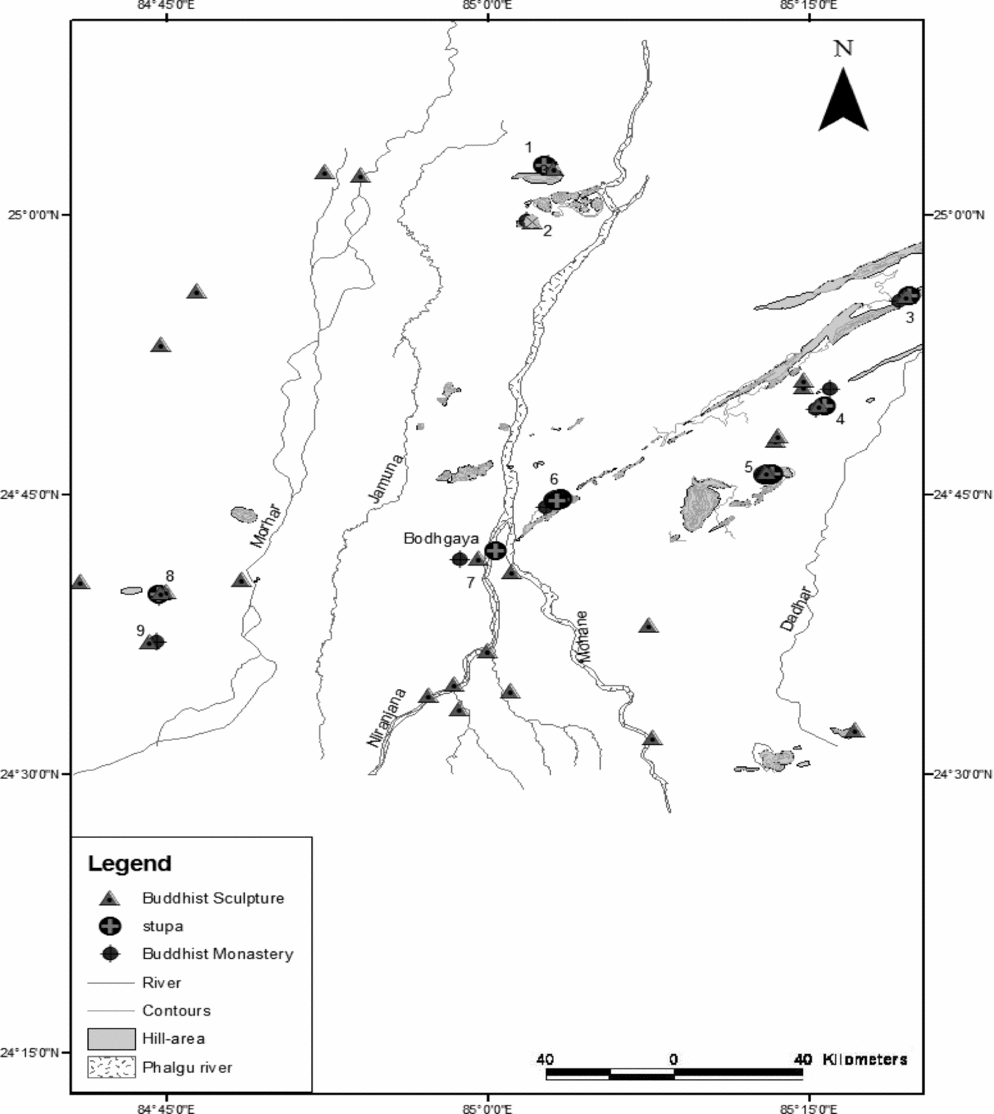
The emergence and development of the saṅgha at Bodhgayā led to the spread of Buddhism into the surrounding territory. This transmission is evinced by a number of early historic monasteries such as Dharawat, Jethian, Kurkihar, Hasrakol and Bakror (Fig. 1).Footnote 21 The subsequent evolution of these sites in the early medieval period is attested by the travel account of Xuanzang who has provided details about Gunāmati vihāra (identified as Dharawat), Yaṣṭivana (identified as Jethian) and the stūpa marking the spot where Sujātā offered the Buddha milk-rice (identified as Bakror stūpa, across the river from Bodhgayā).Footnote 22 In addition, Xuanzang also lists seemingly newer Buddhist monasteries and shrines such as Śilabhadra vihāra (identified as Kauwadol), Kukkuṭapadagiri shrine (identified as Gurupa), Gayāśīrṣa (identified as a hill beside Gayā) and Pragbodhi (identified as Dungeśvarī). Although some of these may be old at their core, the evidence available from surface surveys indicates these places emerged in the early medieval period. In any event, all these sites, including the Mahābodhi mahāvihāra complex, have materials in the form of donated sculptures, miniature stūpas and shrines that document the development and material advancement of monasteries during the time of the Pāla kings. In terms of epigraphic data, the Mahābodhi has eighteen donative inscriptions, Kurkihar has ninety-three and other sites, such as Dharawat, Guneri and Hasrakol, have several inscriptions each. The inscriptional data from these monasteries, most notably Kurkihar, also indicate that donations and visitors came from various regions of India and from other countries, indicating that these places had grown into prominent Buddhist centres with a wide reputation.
Distribution of Buddhist Monastic and Sculptural Sites. 1. Dharawat, 2. Kauwadol, 3. Jethian, 4. Kurkihar, 5. Hasrakol, 6. Dungeshwari, 7. Bodhgayā, 8. Dubba, and 9. Guneri.

The evidence just presented shows there were two key developments from the seventh century: the first was the growth of old Buddhist places (Bodhgayā, Dharawat, Jethian, Kurkihar, Hasrakol, Bakror), the second an emergence of seemingly new sites (Kauwadol, Gurupa, Gayā, Dungeśvarī, see Fig. 1). Simultaneously, more than thirty ‘settlement-shrines’ were established in the Bodhgayā region. I use this term to describe small shrines with single or multiple sculptures that came up within, or near, rural settlements throughout the area. The development of these settlement-shrines meant that the laity could worship the Buddha (and related Buddhist deities) in their neighbourhood rather than going to the larger regional monastic centres or to Bodhgayā. By establishing these shrines within the rural landscape, the saṅgha was able to develop a substantial social following at the local level. Because the shrines required resources, however modest, to be maintained, they show that a ‘grass-roots’ network of patronage was being built and cultivated in the villages round Bodhgayā. In fact, the heavy concentration of ‘settlement-shrines’ in the area demonstrates a substantial lay-following and the development of Buddhist piety away from the main centres. The importance of this cannot be over-emphasised because it directly contradicts the long-held assumption that Buddhism retreated into large monastic institutions in the medieval period.Footnote 23 Moreover, the frequent appearance of the Buddha in the ‘earth-touching pose’ or bhūmisparśamudrā in the settlement-shrines can be read not only as an indication of the popular prevalence of the doctrine of spiritual enlightenment but as a signal that the realised Buddha was calling the earth to witness and so materially support his dispensation in every hamlet and village where such images were placed.Footnote 24
In addition to showing that Buddhism had deep roots in the countryside round Bodhgayā, the sculptural assemblages at the settlement-shrines and larger monastic centres are indicative of the range of religious practices in early medieval times. Images discovered during my surveys, and those already known from earlier publications, include Tārā, Avalokiteśvara, Maitreya, Jāmbhala and Vajrapāṇi. The popularity and veneration of these images suggests the spread of Mahāyāna tenents in the Bodhgayā region and questions the predominance of Sthaviravāda that is asserted generally on the testimony of the Chinese pilgrims.Footnote 25 The sculptural assemblages, if anything, show just the opposite was the case, but anyway hint at a borrowing of religious ideas across Buddhist schools and the lack of rigid theological frameworks when it came to the concrete manifestation of faith and the patronage of images.Footnote 26 The overall picture, therefore, is one of a broad-based, vibrant and multi-facetted Buddhism. This ensured ongoing support for the saṅgha, guaranteeing its revenues and thus its survival from sixth to the twelfth centuries.
Emergence of Vaiṣṇavism
Gayā, located ten kilometers north of Bodhgayā, emerged as a centre of funerary ritual (śrāddha) in the early centuries of the common era. The earliest reference to Gayā as a centre of śrāddha in the textual tradition comes from Vaṣiṣṭha Dharmasūtra, a work now assigned to the first century CE.Footnote 27 The text mentions that “when someone offers food to his ancestors at Gayā, they rejoice, just as farmers rejoice at fields that have received abundant rains; in him, his ancestors are blessed with a true son”.Footnote 28 The Rāmāyaṇa, roughly the same date as the Vaṣiṣṭha, makes a cursory reference to the ritual of śrāddha at Gayā. The relevant verses have been inserted simply to show the importance of the place: neither Rāma nor Bharata go there to perform śrāddha.Footnote 29 The Mahābhārata, in some form coeval with the Rāmāyaṇa but which in the critical edition reflects the state of the text in the circa fourth century CE, also refers to Gayā under the name Gayāśīrṣa.Footnote 30 This is identified as the sacred hill on the southern side of modern Gayā and the epic tells us that it was a place of the footprints of Sāvitṛ.Footnote 31 This suggests that by the fourth century certain rituals were beginning to be practiced in and around Gayā, perhaps sacred recitations connected with the worship of the sun. The ongoing importance of Sūrya is shown by three shrines dedicated to him within Gayā that contain several images, including a massive figure, dateable to the eleventh century, in the temple of Sūrya Nārāyaṇa. The close identity of Sūrya and Viṣṇu, evident enough in the current name of the temple, emerged in the circa fifth century.Footnote 32 The Mahābhārata also refers to Vaṭa as a place where one should perform śrāddha.Footnote 33 This is difficult to identify because the name simply refers to a kind of tree and there is no definitive information about the tree's location.Footnote 34
With the Viṣṇusmṛti more data becomes available. Julius Jolly, the first editor of the text, thought the text was old but subject to reworking in the fourth or fifth century. More recently, Olivelle has placed the Viṣṇusmṛti in the seventh century (or later) and argued that it is a coherent, authored work.Footnote 35 The text, in any event, allows śrāddha to be offered at a wide range of places including Gayāśīrṣa and Vaṭa.Footnote 36 At the end of the chapter dealing with these places of pilgrimage, three verses have been added that extend our understanding of Gayā's importance. The position of these verses shows they were circulating independently and added at the final stages of the Viṣṇusmṛti's formation. They were brought in because they were seen to represent authoritative statements on śrāddha matters. The verses run as follows:Footnote 37
64. There are some stanzas recited by the ancestors which refer to this subject:
65. “May that person be born to our race, who will give us libations of water, taken from streams abounding with water, especially if their floods (coming from the Himālayas) are cool”.
66. “May that excellent man be born to our race, who offers us a śrāddha attentively at Gayāsīrṣa or at Vaṭa”.
67. A man must wish to have many sons, because if only one of them goes to Gayā (and offers a śrāddha to him after his death), or if he performs a horse-sacrifice, or if he sets a dark-coloured bull at liberty, (he will acquire final emancipation through him).
The references given so far show that Gayā was known for śrāddha from as early as the first century and that it became a preeminent place for these rites from the sixth or seventh century. The re-structuring of the śrāddha tradition around Viṣṇu also took place at this time: the verses just cited from the Viṣṇusmṛti are, after all, in a text that is unambiguously allied to the Vaiṣṇava faith. How an ancient ritual, essentially a Vedic rite of life passage, was incorporated into the theistic cult of Viṣṇu was a complex religious process. The most recent work on the subject is by Michael Willis who has explained how the royal consecration and other Vedic sacrifices were incorporated into Viṣṇu's form through a series of homologies.Footnote 38 In essence, the process involved the king assuming two roles simultaneously: that of paramount devotee (paramabhāgavata) and that of Vedic patron (yajamāna). As devotee he gave heart and soul to Viṣṇu in his various forms, while as patron he supported Vedic sacrifices, especially the royal consecration or rājasūya. The link between the two was cemented by assertions in the Bhagavad Gītā and other seminal texts: Viṣṇu was the living embodiment of the sacrifice and actually contained the sacrifice in his body. The evidence provided by Gayā shows that this kind of association was also being made with Vedic rites of passage, bringing the Vaiṣṇava transformation of ritual down from kings and solemn state sacrifices to the level of every man who might seek to better the soul of his deceased father or grandfather.
In archaeological and historical terms, the first appearance of the Vaiṣṇava order in Bihār during the fourth and fifth centuries is reasonably well documented. The earliest stone images of Vāsudeva, Balarāma and Ekanaṃśā from Devangarh (in Nawada) have been dated by Asher to the Gupta period.Footnote 39 In epigraphic terms, the Mandārgiri cave inscription, located about 50 km south of Bhagalpur, mentions a shrine (pādamūla) of Ārya Viṣṇudatta, son of Viṣṇuśarman, and an image Virajoguhāsvāmin (the Narasiṃha in the cave where the inscription was found). It also mentions a sattra or hospice.Footnote 40 Moreover, the direct presence of the Gupta kings, openly Vaiṣṇava in their persuasion, is shown by the seals and inscriptions found at Nālanda and other sites in eastern India.Footnote 41 The seals carry Garuḍa, the eagle-like crest of the Gupta dynasty and the vehicle of Lord Viṣṇu. The later Gupta kings (circa 550–750) also actively patronised the Vaiṣṇava religion as shown, most conspicuously, by the inscription from Apshad, now in the collection of the British Museum.Footnote 42 Vaiṣṇavism continued to grow in the Pāla period (circa 750–1200) thanks to support from Pāla subordinates and ministers.Footnote 43 Indeed the widespread nature of Viṣṇu worship is shown by the ubiquitous presence of Viṣṇu images from eastern India which survive in their hundreds. All these facts contributed, directly and indirectly, to the growth of the Vaiṣṇava order in the Bodhgayā region.
The emergence of Gayā as a Vaiṣṇava centre was a long process. A precise dating of the Vaiṣṇava reformulation of Gayā is a challenging task due to three factors. Firstly, the dense distribution of shrines and houses at Gayā, and their active use today, makes it practically impossible to conduct archaeological excavations. This hinders the dating of the Vaiṣṇava shrines there. Secondly, numerous sculptures from neighbouring regions were brought to the town and added to existing shrines in the last three centuries. It is difficult to establish the provenance of these newly-added sculptures, and, more to the point, use them to date any of the shrines in Gayā where they are located. Thirdly, there are difficulties surrounding the date and nature of the Gayā Māhātmya, a text composed to construct and celebrate the Vaiṣṇava reformulation of the place. To rely on the Gayā Māhātmya as a ‘religious gazetteer’ is problematic because the text exists in several recensions with no clear date for the compilation of any version.Footnote 44 The Gayā Māhātmya was originally an independent text, written, most probably, by Gayāwal Brāhmaṇas – known for performing piṇḍadāna and śrāddha – to promote Gayā as a place of pilgrimage. It was added to the Vāyu, Garuḍa and other Purāṇas at a later period because the text claimed to be ‘part’ of these Purāṇas.Footnote 45
Despite these limitations, I have attempted to explore the Vaiṣṇava reformulation of Gayā based on a study that integrates the Gayā Māhātmya with epigraphic and sculptural sources. I rely on the Vāyu Purāṇa version of the Gayā Māhātmya which is considered a complete text with a distinct Vaiṣṇava character. Furthermore, this version contains many legends, here examined to map the establishment of Vaiṣṇava and other shrines within the town. The analysis of the chronological and historical development of some of these shrines and their sculptures is compared with the Gayā Māhātmya. To resolve the problem of provenance while analysing the sculptures, shrines containing inscriptions, and inscribed sculptures, are my main focus.Footnote 46 This comparative method, not undertaken before, is further combined with a study of relevant sculptures from Bodhgayā to present a wider picture of the development of Vaiṣṇavism in the region.
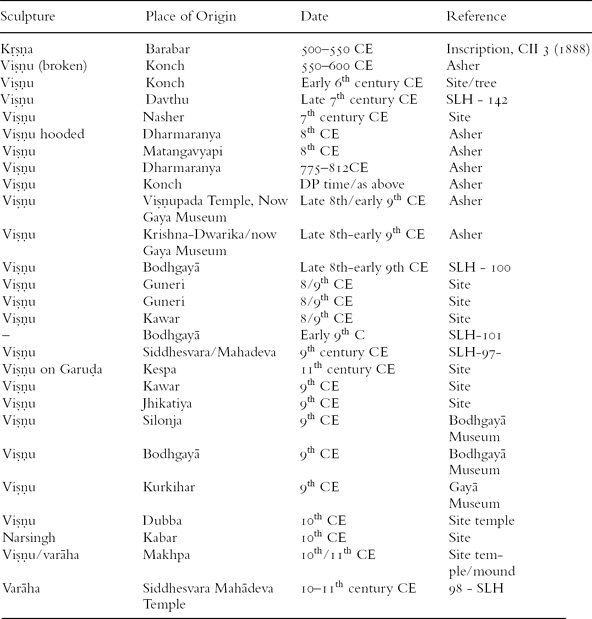
The earliest evidence of Viṣṇu worship in Bodhgayā region comes from the Maukharī inscription of Anantavarman (c. 550–600) at the Lomas Rishi cave at the Barābar hills. This announces the installation of an image of the god Kṛṣṇa.Footnote 47 Though the image has not been found, the inscription proves the existence of a Vaiṣṇava shrine at Barābar in the mid-sixth century CE. Moreover, the earliest image of Viṣṇu reported locally comes from Konch and has been dated to the same period, i.e. the second half of the sixth century.Footnote 48 After this, there are just two sites with Viṣṇu images from the seventh century: Davthu and Nasher. With the eighth century, however, the number of Viṣṇu images increases dramatically at Gayā and in the region as a whole (see Appendix: Table 1).
The great increase of Vaiṣṇava images at Gayā in the 700s suggests that the oldest layers of the Gayā Māhātmya date to this time, albeit barely visible in the subsequent reworking of the text. As we will see, there are clear indications that this later reworking was undertaken in the eleventh century to reflect and validate the Vaiṣṇava reformulation of Gayā that had been achieved by that time. The antiquity of the oldest aspects of the Gayā Māhātmya is indicated by a number of Vaiṣṇava legends which were taken over from pre-existing sacred texts, often the Epics, and reworked with greater detail to establish Gayā's legitimacy.Footnote 49 The redactors also embroidered traditions, in effect creating new legends about holy places and shrines. The sacred geography in the Gayā Māhātmya reflects this development, as I will attempt to show by examining the text in tandem with the sculptural and epigraphic remains.
The Gayā Māhātmya and the Emergence of Vaiṣṇava Gayā
The Gayā Māhātmya defines a precise sacred geography for Gayā: “Let it be declared, for the benefit of all men, that (there is a distance of) two-and-a-half krośa in all directions from Muṇḍaprṣṭha. The Gayākṣetra is five krośa; the Gayāśīrṣa covers one krośa. In their midst are all the tīrtha-s”.Footnote 50 The verse refers to the sacred zone of Gayā by demarcating the centre (Muṇḍapṛṣṭha, the place of Viṣṇupada temple) as well as the outer boundary of Gayākṣetra (sacred Gayā as a whole). This demarcation is followed by a narration of various legends that emphasise the ritual importance of Gayā, the most important being that of the demon called Gayāsura.
An examination of the Gayāsura legend reaffirms that the Gayā Māhātmya was a product of a long process of narrative accumulation conducted over several centuries. The legend, emphasising the predominant role of Viṣṇu, brought a number of stories together such as the killing of Heti by the Viṣṇu, Brahmā's curse on the local Brāhmaṇas, Dharmavratā and Marīci, the śrāddha tradition and, of course, the story of Gayāsura himself. These interlocking stories created an ‘eternal’ sacredness for Gayā, due not just to the presence of Viṣṇu and his forms (Janārdana, Adigadādhara and Rāma), but also other gods and goddesses such as Brahmā, Maheśvara, Sūrya, Lakṣmī, Sītā, Gaurī, Gāyatrī, Sāvitrī and Sarasvatī.Footnote 51 This is justified in the Gayā Māhātmya in varied contexts, one of which I will outline in the following paragraphs.
The gods firstly ask Gayāsura to donate his body on account of his special purity and merit. This is, to all appearances, a thinly veiled reference to the Buddha. The gods perform a sacrifice to the body, but it trembles and Brahmā, himself shaking from fear, says to Dharmarāja (Yama, the god of death):Footnote 52
By my command, bring the dharmaśilā from your house without questioning and quickly fix it on the daitya's head. Yama heard and, with the aim of (making the asura) motionless, he fixed the stone upon (the asura’s) head. Even when the stone was fixed, the asura, along with the stone, moved.
Then he (Brahmā) said to Rudra and the other gods, “Let all the gods, the goddesses, and the sages stand motionless upon the stone”. The gods marked it with their feet. Even then the asura moved.
These verses explain the necessary presence of all the gods at the Muṇḍapṛṣṭha and hence their footprints including that of the Brahmā, Indra, Sūrya and Śiva.Footnote 53 A few other verses justify the performance of śrāddha at the footprints of these other gods and the benefits that accrue from such rituals.Footnote 54 This is illustrated archaeologically by the presence and ritual use of a large grey stone carved with the footprints of the sixteen gods in the Viṣṇupada complex in Gayā. This stone (mentioned also in the Gayā Māhātmya) can be dated to the eleventh or twelfth century based on its carvings and the grey fabric of the stone. These things are indicative of the theistic practices adopted by the Gayāwāl Brāhmaṇas, indicating their attempt to assimilate the gods and goddesses of other orders in an appropriate hierarchy into the Vaiṣṇava-centred system at Gayā.Footnote 55 The supremacy of Viṣṇu is presented in several episodes in the Gayā Māhātmya, including that just given. In the end the gods are unable to stop the body of Gayāsura trembling and this forces Brahmā to appeal directly to Viṣṇu for help:Footnote 56
Hearing this (plea), Viṣṇu gave a statue (mūrti) to Brahmā but even the installation of that statue could not make the body of Gayāsura immobile. Finally Brahmā summoned Viṣṇu again: ‘Viṣṇu came from his lake of milk and stood on the stone with the name Janārdana, and with the name Lotus-Eyed (Kamalanayana)’. Gadādhara himself (stood) on the stone to make (Gayāsura) immobile. He took on five forms on the stone to make him immobile: the Great-grandfather, the Grandfather, the lord of Phalgu, the (Lord) of Kedāra, and Lord of Kanaka. . . . .Footnote 57 And since Hari made the daitya immobile with the first mace (Ādigadā), saying, “he is still”, for this reason he is (called) Ādigadādhara.Footnote 58
These verses demonstrate the supremacy of Viṣṇu who is able to assume any incarnation or form – Ādigadādhara, Janārdana, Kamalanayana, Phalgunātha, Kedāranātha and Kanakanātha – all of which are different from the standard incarnations that appear in medieval sculpture and textual lists. The construction of shrines to these different forms meant that Viṣṇu could be worshipped in these ways in Gayā, thereby adding multiple layers to the sacrality of the location. The description in the Gayā Māhātmya of the various forms of Viṣṇu was probably inspired by the construction of shrines to these forms at Gayā itself.
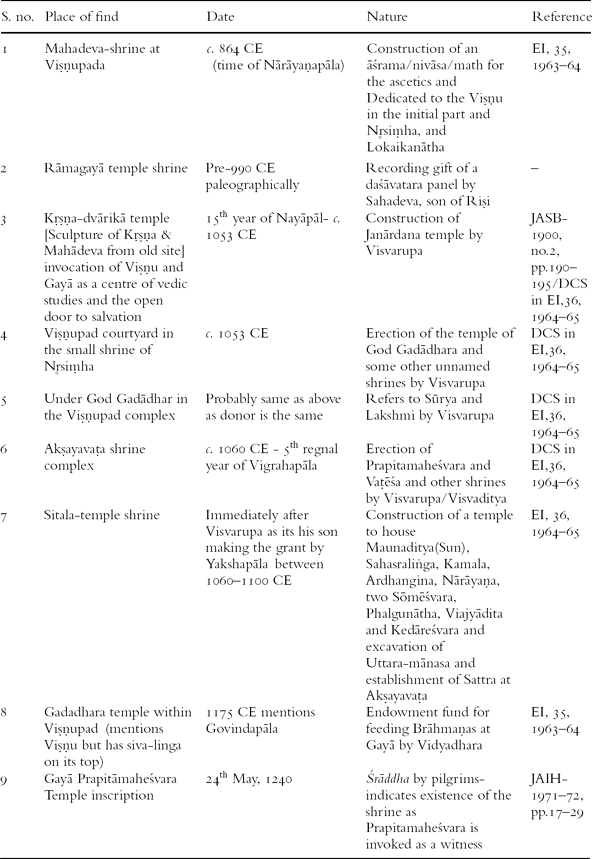
The earliest documented forms of Viṣṇu at Gayā were, however, Lokaikanātha, Murārī and Nṛsiṃha. An inscription, dated to circa 864 CE, mentions these forms and recounts the construction of an ascetic's residence (āśrama, nivāsa and maṭha). Verses one and two of the inscription mention:Footnote 59
. . . that it was Viṣṇu, the sole Lord of the universe who healed the wound of suffering human beings by overpowering Murā the demon and thus became famous as Murārī. It was he who, in his Nṛsiṃha form, pierced the demon with the sharp–tipped nail of his finger.
Based on this inscription, the first Vaiṣṇava shrine at the Muṇḍapṛṣṭha hill – the present Viṣṇupada complex as noted above – can be dated to the ninth century CE. The presence of other forms – Ādigadādhara and Janārdana – is attested only in the mid-eleventh century by two inscriptions reported from the Viṣṇupada complex. Both inscriptions record donations by Viśvarūpa in the fifteenth regnal year of Nayapāla (circa 1053 CE). These document two shrines made for Gadādhara and for Sūrya with Lakṣmī. One further inscription of Viśvarūpa, found at the Kṛṣṇa Dvārka temple at Gayā, mentions the erection of another shrine for the Janārdana. The archaeological record and the emphasis on this form of Viṣṇu in the Gayā Māhātmya thus points to a mid-eleventh century CE for the text. Nevertheless, the worship of Viṣṇu at the Viṣṇupada was probably present by the ninth century, something confirmed by nine sculptures of Viṣṇu (including one of Nṛsiṃha) in the modern complex. All can be dated between the ninth and twelfth centuries CE.
Based on the evidence just given, the early development of the Viṣṇupada complex can be tentatively reconstructed. The Muṇḍapṛṣṭha, to judge from the term, seems to have been a prominent smooth rock.Footnote 60 By the eighth or ninth century images of various deities seem to have been placed around the base of the Muṇḍapṛṣṭha, a fact attested in the Gayā Māhātmya which openly states that “Viṣṇu gave a statue (mūrti) to Brahmā” for installation at the site.Footnote 61 With time, further images and footprints belonging to the Brāhmaṇa orders accumulated, until they reached a ‘critical mass’ and the Hindu deities, with Viṣṇu in the lead, became the dominant focus of religious activity.
Buddhist sources also provide information about Gayā but focus on the Gayāśīrṣa, the prominent hill outside the town as noted before. Early Pāli texts record this as the place where the Buddha preached the celebrated ‘fire sermon’, a fact repeated in biographies of the Buddha.Footnote 62 In the seventh century, Xuanzang refers to the hill as the place where sovereigns come after their anointment to declare their succession with religious ceremonies. He further writes:Footnote 63
On the top of the mountain is a stūpa about hundred feet high, which was built by Aśokarājā. Divine prodigies are exhibited by it, and a sacred effulgence often shines from it. In the old days Tathāgata here delivered the P'ao-yun and other sūtras.
Whether there was a stūpa at the top of the mountain is not something I was able to confirm during my surveys because there are no archaeological traces of any such monument. For its own part, the Gayā Māhātmya repeatedly refers to the hill as an important geographical indicator of Vaiṣṇava Gayā: “Let it be declared, for the benefit of all men, that the Gayākṣetra is five krośa; Gayāśīrṣa is one krośa. In their midst are all tīrthas”.Footnote 64 Besides this, other verses mention Gayāśīrṣa in the context of piṇḍadāna at Brahmāyoni.Footnote 65 Archaeologically speaking, the religious orientation of the hilltop cannot be determined. However, the lack of any Buddhist remains on the hill and the constant emphasis in the Gayā Māhātmya on the Brahmāyoni and Gayāśīrṣa as a place of piṇḍadāna indicates the dominance of Gayāwāl Brāhamaṇas at that location in late medieval times.Footnote 66
Xuanzang mentions three more Buddhist stūpas in the vicinity of Gayāśīrṣa: “To the south-east of Mount Gayā is a stūpa. This is the spot where Kaśyapa (Kia-she-po) was born. To the south of this stūpa are two others. These are the spots where Gayākaśyapa (Kia-ya-kia-she-po) and Nadīkaśyapa (Nai-ti-kia-she-po) sacrificed as fire-worshippers”.Footnote 67 This account of the existence of Buddhist stūpas in Gayā again cannot be proved, due to the lack of archaeological evidence. There are, it is true, many parts of the small votive stūpas of the Pāla period in the various sculptural assemblages at Gayā. But there is no prominent in situ base of a stūpa mound or similar structure. However, it seems unlikely that Xuanzang is incorrect in locating these three stūpas at Gayā. Thus there were probably small monastic establishments, at the very least, to look after and perform the daily rituals at these places. The Gayā Māhātmya, of course, completely ignores the presence of either Buddhism or Buddhist shrines at Gayā. There is a long gap between the visit of Xuanzang in the seventh century and the consolidation of Gayā Māhātmya in the eleventh. During these centuries the Buddhist shrines of Gayā seem to have been gradually displaced, the Gayā Māhātmya presenting the final vision of the religious victors.
That this is the correct historical interpretation is shown by the ways in which the Gayā Māhātmya attempts to assign new Vaiṣṇava meanings to the Bodhi tree at Bodhgayā. Xuanzang encapsulates the Buddhist perception of this site in the early medieval period:
In the middle of the enclosure surrounding the Bodhi tree is the diamond throne (vajrāsana). In the former days, when the Bhadrakalpa was arriving at the period of perfection (vivartta), when the great earth arose, this (throne) also appeared. It is in the middle of the great chiliocosm; it goes down to the limits of the golden wheel (the gold circle), and upwards it is flush with the ground. It is composed of diamond. In circuit it is a hundred paces or so. On this, the thousand Buddhas of the Bhadrakalpa have sat and entered the ‘diamond samadhi’ – hence the name of the diamond throne. It is the place where the Buddhas attain the holy path (the sacred way of Buddhahood). It is also called bodhimaṇḍa.
This description tallies with a number of other textual and pilgrim accounts, including Dharmasvāmīn. All consider the Bodhi tree shrine at Bodhgayā as the centre of the Buddhist world. The Gayā Māhātmya presents a completely different account:
After bowing to dharma and Dharmeśvara, he (the pilgrim) should bow to the Mahābodhi tree (Mahābodhitaru), (with this mantra), “reverence to the tree whose leaves tremble, where Viṣṇu stands eternally, to the truth of awakening (bodhitattvāya), to sacrifice, and to the Aśvattha tree. You are the eleventh of eleven, and also the eighth of eight; you are the Nārāyaṇa of the gods, you are the Pipala, the king of trees. Since Nārāyaṇa stands in you for all time, Aśvattha king of trees, you are perpetually auspicious among trees; you are fortunate; you are the destroyer of bad dreams. I revere Hari, the divine wielder of the conch, discus and mace, in the form of Aśvattha, the Lotus Eyed, having the shape of a branch (śakhārūpadhara).Footnote 68
These verses clearly identify the Bodhi tree as a Vaiṣṇava place, something also found in Purāṇic literature. This was an attempt by Vaiṣṇava followers to appropriate the most important Buddhist site by arguing that the place was significant thanks to the presence of Viṣṇu. The assertions in the Gayā Māhātmya come at the end of the historical process that attempted to claim the Buddha as an incarnation of Viṣṇu, a process already in place by the eighth century to judge from temple sculptures in other parts of India.Footnote 69
How this was worked out locally in the Bodhgayā region is shown by the Vaiṣṇava reformulation of a number of śrāddha shrines in the area. Taking just two examples from my field surveys, I would draw attention to the two Viṣṇu sculptures of the eighth century found at the shrine of Dharmāraṇya, two kilometers east of Bodhgayā. The site is mentioned in the Mahābhārata which describes it as a place where Yudhiṣṭhira performed a sacrifice during his pilgrimage to Bodhgayā.Footnote 70 There is no reference to Viṣṇu. The presence of eighth-century images thus indicates that the location was being reframed as Vaiṣṇava at the time the sculptures were added. Similarly, the Gayā Māhātmya mentions the Mātaṅgavyāpī tank and Mātaṅgeśa (temple) as important Vaiṣṇava centres of śrāddha.Footnote 71 These are located close to the Bakror Buddhist stūpa on the eastern bank of the Nirānjana River, a short distance from Mahābodhi. This suggests a conscious attempt to position new shrines near to the Buddhist shrines around Bodhgayā.
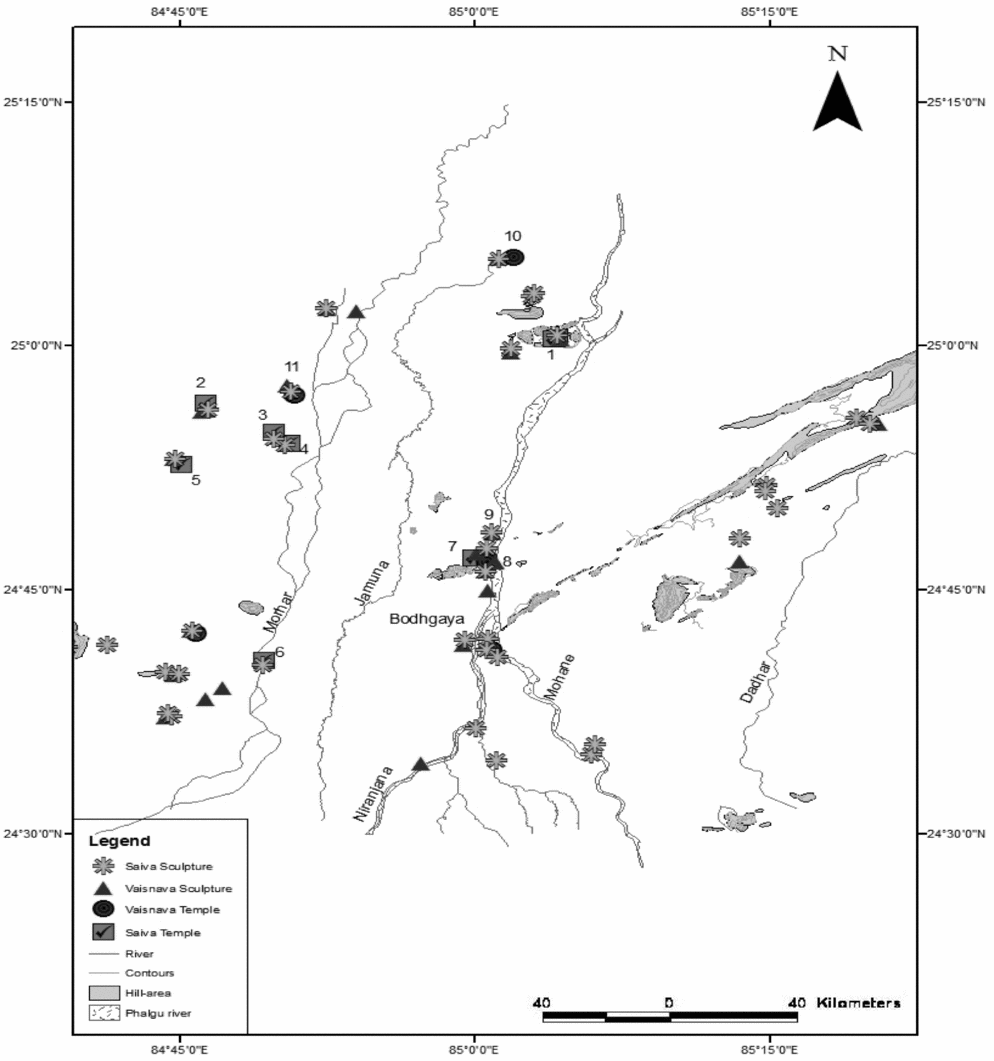
The Gayā Māhātmya also mentions seemingly new shrines such as Maṅgalagaurī, Rāmagayā and Rāmaśilā in Gayā which were not listed either in the Mahābhārata or other literary accounts. All these shrines contain Viṣṇu sculptures (found during my surveys). For example, a Balarāma, datable to the eighth century, was found within the Maṅgalagaurī temple. Another Viṣṇu sculpture, datable also to the eighth century, was found at Rāmagayā, whereas two Viṣṇu daśāvatāra panels were found within the shrine at the foot of Rāmagayā Hill. Two others of the same period, reported from an unknown shrine at Gayā, are kept in the Gayā Museum. The presence of these sculptures at specific shrines in Gayā indicates that the reframing of existing shrines and the construction of new Vaiṣṇava shrines were concurrent processes between the eighth and twelfth centuries. In addition to Gayā, fifteen other Viṣṇu sculptures from the same timeframe were documented at a number of sites in the Bodhgayā region. These sites include Kabar, Barābar, Silonja, Kespa and others (Fig. 2). Most show Viṣṇu in his classic four-armed form but the popularity of the incarnations are shown by individual figures of Varāha and Nṛsiṃha, the ten avatāras (at Konch), and panels with the ten incarnations (at the foot of Rāmagayā hill). The latter can be assigned to about the tenth century based on the epigraphic style of the inscription.Footnote 72
Distribution of Vaiṣṇava-Śaiva Sculpture in the Bodhgayā Region

The detailed synopsis of Vaiṣṇava remains given in the preceding pages can be summarised as follows: under Gupta patronage, the Vaiṣṇava order was introduced into the wider Bodhgayā region in the fourth and fifth centuries, and Vaiṣṇavas enjoyed a significant if somewhat geographically constrained influence in post-Gupta times. With the eighth century the Vaiṣṇava religion burgeoned. Early historical Gayā and its śraddha tradition were reformulated, with the Viṣṇupada shrine serving as the ritual focus. The cult of Sūrya – touched on briefly above – was brought into the dominant Vaiṣṇava framework and, simultaneously, Vaiṣṇavas colonised or attempted to colonise Buddhist sites throughout the region.
The reformulation of Gayā was supported by the Brāhmaṇa chiefs who ruled Gayā in the tenth and eleventh centuries CE (see Appendix: Table 2). These rulers marked the landscape of Gayā by constructing numerous Vaiṣṇava shrines which became permanent indicators of the sacredness of the Vaiṣṇava landscape. However, the Gayā Māhātmya also shows other gods were present, notably Śiva, as evidenced by the shrines of Prapitāmaheśvara and Vaṭeśa erected by Viśvarūpa (otherwise known as Viśvāditya).Footnote 73 This is further corroborated by the presence of a number of sculptures, mostly depicting Umā Maheśvara, from the eighth and the ninth centuries, in the Akṣayavaṭa complex and a ninth-century liṅga within the Prapitāmaha temple. These items lead us to the Śaiva tradition.
Spread of Śaivism
Śaivism is known in the Bodhgayā region from the Gupta period. The earliest information comes from a solitary reference in the Mahāhbhārata about the presence of Rudra or Lord Pinaka in Gayā.Footnote 74 The earliest archaeological evidence, likewise, is from Gupta times and represented by an old temple site, called Baiju-bigha, where a Śiva liṅga, roughly dating to the Gupta period, was unearthed recently. The presence of a shell-inscription, engraved on the same hill, in the vicinity of the temple ruins, gives an indication of the shrine's date.Footnote 75 The appearance of Śaivism at this time may be due to influence from Vārāṇasī which had emerged as a major Śaiva centre. Hans T. Bakker, basing himself on a comprehensive study of archaeological, sculptural and literary sources (notably the Vārāṇasī Māhātmya of the Skanda Purāṇa), has argued for the emergence of Śaivism in Vārāṇasī from the fourth century CE.Footnote 76 He also suggests that the spread of Śaivism from the west to Vārāṇasī and Magadha originated from Pāśupatas who were based in Kānyakubja.Footnote 77 The Skanda Purāṇa also mentions a number of places in Magadha where Lakulīśa, the founder of Pāśupata, roamed about with his pupils. The link between Kānyakubja and Magadha is supported by the presence of Vardhana and Maukhari rulers in both the regions in the sixth and seventh centuries. The inscriptions, seals and charters of both these dynasties suggest their preference for Śaivism which may have contributed to the spread of the order in the region.
The Maukharis first emerged as subordinates of the later Gupta kings.Footnote 78 The earliest documents of their involvement with Śaivism in the Bodhgayā region are two inscriptions at the Nāgārjunī Hill datable to the first half of the sixth century. Both inscriptions record the establishment of Śaiva shrines by the Maukhari king Anantavarman. The first commemorates the installation of an image of Śiva in the form of Bhūtapati or the ‘Lord of Beings’ and his consort.Footnote 79 The second records the installation of an image of the goddess Pārvatī, under the name of Kātyāyanī, at the Gopi cave on the Nāgārjunī Hill and also mentions the donation of a village to the goddess under the name of Bhavānī.Footnote 80 The donation to the goddess indicates direct control of the region by the Maukhari rulers and, simultaneously, the presence of priests of the Śaiva order who would have received and regulated the grant in the performance of their ritual obligations. The institutional establishment of Śaiva groups in the region is therefore demonstrated from the sixth century.
The Śaiva sculptures and epigraphs surveyed as part of my project in the Bodhgayā region suggests a significant increase in the number of Śaiva shrines over time. For example, the Siddheśvara shrine at the top of Surjangiri, the highest hill in the Barābar range, can be dated to about the seventh century on the basis of two inscriptions from the Vāpi cave at the Nāgārjunī Hill which mention Siddheśvara. One of the records mentions a preceptor or ācārya with the name Yogānanda bowing to Siddheśvara.Footnote 81 This confirms the name and existence of the shrine from the circa seventh century, a fact further substantiated by the rock carvings of a liṅga, Gaṇeśa, Umā Maheśvara and Sūrya, all from the same period.Footnote 82 The site also has a number of other sculptures of gods such as a Viṣṇu, Pārvatī, Cāmuṇḍā, Gaṇeśa and Varāha which were added to the shrine between the ninth and eleventh centuries.
Śaiva shrines were also constructed in the village settlements of the region from the seventh century onwards. Prominent Śaiva shrines were documented during my survey work at Konch, Pali, Kabar, Baiju-bigha, Utren and Jethian. Of all these, Konch emerged as a prominent Pāśupata centre with the shrine known as Konchesvar Mahādeva containing a sculpture of Lakulīśa and a single faced liṅga of the circa seventh century. The architectural fragments and pillars found in the Koncheswar Mahādeva confirm its construction at this time. Later, another liṅga and a number of Umā Maheśvara and Vaiṣṇava sculptures were added. Similar affiliations can also be suggested for Pali which also contained an eleventh-century Lakulīśa image (currently in the Gayā Museum). Many large liṅgas and a heavy distribution of Umā Maheśvara sculptures from Jethian, Utren, Pali and Kabar also confirm the existence of important Śaiva shrines at these places during the Pāla period (Fig. 2). The influence of Śaivism is indicated by the construction of a few Śaiva shrines within Gayā proper, notably the Śivamahādeva Phalgiśvara temple inside the Viṣṇupada complex, Prapitāmaheśvara temple and the Vaṭeśa liṅga within Akṣayavaṭa (eleventh century), Pātāleśvara Mahādeva on Rāmaśilā Hill (circa 1014 CE) and the Śaiva temple at Rāmagayā Hill (ninth-tenth centuries).Footnote 83
An especially poignant indicator of Śaiva influence is found in an inscription from the Bodhgayā temple complex itself. This was dedicated by an individual named Keśava in the twenty-sixth regnal year of the Pāla king Dharmapāla (reg. circa 775 to 812).Footnote 84 This inscription is incised on a lintel with representations of Śiva, Sūrya, Lakulīśa and Viṣṇu. The inscription reads:
In the pleasant Campaśāyatana, a four-faced Mahādeva was consecrated by the son of the sculptor Ujjavala, Keśava by name, for the (spiritual) benefit of the chief Mallas dwelling at Mahābodhi.
To summarise, the above discussion of inscriptions, sculptures and archaeological sites suggests the dissemination of Pāśupata Śaivism in the Bodhgayā region after the sixth century, organised by Pāśupata ascetics who established Śaiva monasteries and shrines.Footnote 85 Like Buddhist monks, they also received royal patronage from the Maukharis, Vardhanas and other rulers. These developments led to the construction of numerous Śaiva shrines within a number of long-established settlements.
Inter-religious Dynamics: Buddhist Responses to the Brāhmaṇa Challenges
The above discussion demonstrates the growth of Buddhism along with the emergence and spread of Vaiṣṇavism and Śaivism in the Bodhgayā region between the sixth and twelfth centuries. The concurrent presence of these three competing orders in the same geographical milieu resulted in numerous interactions. Richard Davis has shown how the interchanges, dialogues and productive debates between the Jaina and Hindu orders in early medieval Tamil Nadu resulted in the construction of a shared religious milieu in which the divine figures, literary tropes and ritual forms were often reincorporated, reformulated and resituated for polemical purposes.Footnote 86 Drawing upon this model, I will seek to identify the shared religious milieu produced by the interactions between religious orders in the Bodhgayā region. The shared religious milieu is revealed in the adoption of similar religious practices by different orders, for example the Vaiṣṇava appropriation of the Buddhist practice of feet-worship, apparent in the Viṣṇupada shrine at Gayā. Concurrently, Buddhist practices also drew upon the milieu to articulate their responses by appropriating Vaiṣṇava and Śaiva ideas, practices and gods. By examining these Buddhist appropriations, I will attempt to emphasise the active role of the saṅgha as historical agents in initiating such measures and subsequently reformulating them in accordance with Buddhist doctrine.
Buddhist Response to Śaivism
The strategies devised by the Buddhist establishments in the Bodhgayā region to check the influence of their competitors were multifold. Xuanzang cites two instances of debate between the Brahmanical orders and the Buddhist monks which form the background of the construction of the Guṇamati vihāra (identified as Dharawat) and Śilabhadra vihāra (identified as Kauwadol).Footnote 87 In both the stories, the heretics, probably Śaivas, were defeated in debate by the Buddhist monks at these locations. These victories led to the appreciation of the wisdom and intellect of the Buddhist monks on the part of local kings who then requested that the two monks involved each establish a monastery. The kings also donated villages to support the new monasteries. These stories not only indicate the fierce competition between Hindu ascetics and Buddhist monks but also show the significant stakes involved. A victory in debate ensured the establishment of new monasteries and land grants for sustenance whereas defeat brought ignominy and the withdrawal of royal support. The dearth of Śaiva texts is a serious lacuna, especially local texts from Magadha which might illuminate Śaiva claims, but given the active Buddhist response, it is clear the Śaiva order was a significant force and a source of concern for the Buddhists.
The Buddhist response to the influential presence of Śaivism can also be read from another story in the accounts of Xuanzang and Dharmāsvāmin.Footnote 88 Both mention the story of the construction of the Mahābodhi mahāvihāra by a follower of Maheśvara. According to the accounts, the small Aśokan shrine at Bodhgayā was reconstructed in the Mahābodhi mahāvihāra by two Śaiva Brāhmaṇa brothers who were guided by none other than Maheśvara himself. He instructed them to construct the mahāvihāra to acquire copious merit in a superior religious field.Footnote 89 There is a meta-narrative in this account which, through its emphasis on the superiority of Buddhism, is attempting to create a hierarchy for the generation of merit. It also emphasises the importance of the place of the Bodhi tree in generating merit by donations and constructions at that specific place, described as being more beneficial to the pilgrim than even Mount Kailāśa, the abode of Lord Śiva. The achievement of the Brāhmaṇa's desire to become a government minister (as narrated in the account) signified the importance of merit generation for material gain and worldly ambition in the world of that time. The story shows that the Buddhist saṅgha responded dialectically to their historical environment and constructed a new model for including and attracting the followers of Śiva. This model was necessitated by the fast spread of Śaivism in the region, evidenced, as we have seen, by the wide popularity of Umā Maheśvara sculptures, liṅgas and other Śaiva remains. The construction of the Mahābodhi mahāvihāra – the most important shrine at the paradigmatic Buddhist site – by a Śaiva was meant to create a hierarchy among the existing religious orders. The enduring nature of this vision over many centuries is shown by the legend being repeated by both Xuanzang and Dharmasvāmin who visited Bodhgayā in the seventh and thirteenth centuries respectively.
Another instance of the Buddhist response can be found in the concept of Trailokyavijaya in the sculptural and textual traditions. The story of Trailokyavijaya is found in three texts of Mantrayāna or Vajrayāna: Sarvatathāgatatattvasaṃgraha and the Cakrasaṃvara and Hevajra Tantras.Footnote 90 Of these texts, The Summary of All Tathāgata's Reality was codified in the ninth-tenth century in Bihar.Footnote 91 Chapter Six, entitled Trailokyavijaya, gives the story of the subjugation of Rudra Śiva by Heruka. In a nutshell, the story narrates the emanation of one of the Bodhisattvas, Vajrapāṇi, as Heruka, who becomes angry with Maheśvara and destroys him. Maheśvara accepts his defeat and submits to Heruka. After his submission, Heruka resurrects Śiva and his consort as Umā Maheśvara, gives them a new name, Bhairava-Bhairavī, and admits them into the Buddhist fold as powerful lay-followers. One paragraph from this story merits quotation:Footnote 92
When Maheśvara heard Vajrapāṇi, he again became incensed and violent, displaying his form as Mahāraudra, saying, “I can endure death, but I will not do as you command!” With that Vajrapāṇi uttered the appropriate mantras, and while the world laughed, Maheśvara and his consort, Umā, were both dragged stark-naked and feet-first before Vajrapāṇi, who stepped on Maheśvara with his left foot, while standing on Umā's breast with his right. Then he uttered the mantra . . .. And Maheśvara started beating his own thousand heads with his own thousand arms, while all his minions outside the palace gave a great roar of laughter and said, “Look at our lord being disciplined by this great being!”
This somewhat startling description from an early medieval text is also found in sculptures from the south Bihar region. For example, one depiction of Trailokyavijaya dating to the tenth century has been found at Bodhgayā in the Mahant's compound.Footnote 93
The Trailokyavijaya sculptures have been variously interpreted. Some scholars argue for their value as reflections of sectarian conflict and Buddhist-Śaiva rivalry, while others make a case for their importance in terms of esoteric Buddhism at a metaphysical and soteriological level.Footnote 94 Linrothe, while emphasising the metaphysical importance of the sculptures, has argued that these pieces were not set up for the general public in temples, but were shown only to converts. He further argues that the images were to be understood primarily within the framework of esoteric Buddhism, although he does not discount Hindu-Buddhist rivalry entirely. However, if the purpose of these sculptures was confined to esoteric circles, what need would their have been to actually make Trailokyavijaya images? Sculpture is a prominent memorial to people engaged in visualisation, not a tool for it. Secondly, even if the sculpture was meant for esoteric practices, it still reflects the conceptualisation of Śaiva deities as powerful yet inferior beings who were meant to be trampled and controlled. The textual and sculptural depiction of the trampling of Śaiva and Pārvatī by Heruka demonstrates that the saṅgha was actively exploring its superiority to Śaivism, not only on the level of esoteric religious practice but in the memorialisation of this practice in the sculpture commissioned by lay-followers who are almost always recorded as merit-making donors in surviving inscriptions.
Furthermore, the disputatious nature of the Buddhist conception is shown by the dhāraṇī used by Heruka to subdue Maheśvara. In the dhāraṇī, Trailokyavijaya calls on Śumbha and Niśumbha to advance and seize Maheśvara.Footnote 95 The two asura brothers – Śumbha and Niśumbha – are also part of the story of Cāmuṇḍā or Kālarātri, an emanation of Umā. In that story, the asura brothers are killed by Śiva's consort. In the Buddhist narrative, however, they are called on by Vajrapāṇi to subdue Maheśvara. This reformulation was meant to prove a Buddhist polemical point, namely that Maheśvara was and is less powerful than even these two lowly demons. Buddhist supremacy is therefore asserted. The Trailokyavijaya thus needs to be grasped as signalling an eristical relation and dialectical response of the Buddhist saṅgha to the religious landscape around them. This response is further developed in the second part of the account:
Then Vairocana, taking pity on Maheśvara and the touch of Vajrapāṇi's feet, became the consecration which allowed him to attain the level of Tathāgata. Abandoning his Mahādeva form, Maheśvara passed beyond countless world systems and was reborn into the world known as Bhasmācchanna as the Tathāgata Bhasmeśvaranirghoṣa.
At that point, Vajrapāṇi, commanded all the other gods:Footnote 96
Friends, enter into the great circle of the adamantine assembly of all Tathāgatas and protect that assembly!” And they replied in assent: ‘As you inform us, so we will perform!’ Then all the gods and goddesses - Maheśvara, Umā, and the others - were given new names and positions in the mystic circle.
After his submission, Maheśvara is given a new name (as noted above) and admitted into the Buddhist fold as a powerful protector. Therefore, the tension and conflict – reflected in the trampling figures – remains the first step towards a final inclusion and appropriation within the Buddha fold. Davidson has argued that, at the socio-historical level, we should understand the Maheśvara myth in the Tattvasaṃgraha as a defensive technique of the Buddhists to establish the superiority of their gods over Maheśvara, Brahmā, Viṣṇu.Footnote 97 The dialogical analysis given here suggests, however, that the Buddhist saṅgha employed techniques to actually counter the growing influence of Śaivism in the region. This technique unfolds when Śiva is included within the Buddhist pantheon as a minor deity, evinced, most importantly, in the sculptural assemblages of Buddhist monastic sites. This is fully documented by the inscription of Keśava at Bodhgayā, already noted above. To repeat, this was found on a lintel with representations of Sūrya, Lakulīśa and Viṣṇu in the Mahābodhi complex and reports the installation of a four-faced Mahādeva in the twenty-sixth regnal year of the Pāla king Dharampāla.Footnote 98
Previous studies have failed to analyse the inscription's context or its implications for Buddhist-Śaiva relations. Why did the monastic centre at Bodhgayā allow the installation of a four-faced Mahādeva and a lintel with other Brāhmaṇa gods within the Mahābodhi complex? A contextual reading of the inscription suggests that the Buddhist saṅgha attempted to appropriate Śiva and Śaivism within their own order. This was widely practiced within Buddhist monastic complexes and village-shrines, the installation of statues of Umā Maheśvara within the Buddhist shrines being deliberately undertaken to prove Buddhist superiority and the subordination of Śiva as a lay-follower. This means – thinking of individual historical actors – that specific monks at the monastic centres initiated and regulated the installation of Umā Maheśvara sculptures within their Buddhist shrines as a way of attracting Maheśvaras – ordinary Śaiva devotees – who would have been subsumed into the Buddhist establishments and encouraged to make donations to them. These strategies, therefore, demonstrate the active response of the Buddhist order to the challenges of Śaivism in the region, a pattern also manifested in their interaction with the Vaiṣṇava order.
Buddhist Response to Vaiṣṇavism
The Buddhist reaction to Vaiṣṇavism was very similar to its response to Śaivism. The responses can be examined from the claims made in texts such as Śāntideva's Bodhicaryāvatāra, the Bhūtaḍamara and the Mañjuśrīmūlakalpa as well as the sculptural and epigraphic remains from monastic sites. The above-mentioned texts were composed in the south Bihar region during this period.Footnote 99 They illustrate the tensions that existed and the attempts to appropriate Viṣṇu. Especially interesting is the Bhūtaḍamara in which Vajrapāṇi, at the request of Śiva, instantly slaughters all the other gods (Indra, Brahmā, Viṣṇu, and other deities). Later, he revives them with an enormous fart: a hilarious transformation of the gods that reduces them to an object of farce. Davidson incisively notes that taking such statements as necessarily metaphorical is a questionable position.Footnote 100 There can be little doubt that this is an attempt to humiliate the Brahmanical gods, including Viṣṇu. Indeed, later they are incorporated within the Buddhist cosmology as minor deities.
In a similar context, the account of the Mañjuśrīmūlakalpa is useful as it states that Viṣṇu and Śiva are merely the skilled (upāya) bodies of Mañjuśrī functioning to start people on the path.Footnote 101 This is another attempt to appropriate and include Brāhmaṇa gods within Buddhist cosmology. A further attempt at the appropriation and redefinition of Vaiṣṇava practice can be read in Śāntideva's Bodhicaryāvatāra where the Bodhisattva is described as a sattrapati.Footnote 102 In the Gupta period, the institution of sattra was a ‘charity-house’ attached to Viṣṇu temples.Footnote 103 Although the sattra was initially a Buddhist concept it was taken over by the Vaiṣṇavas and then, in Śāntideva, re-appropriated once again, with the Bodhisattva pictured as the embodiment of perfect compassion and generosity, the implication being that in the ongoing contest over merit, it was the Bodhisattva who had the most worthy sattra.Footnote 104
The appropriation of Viṣṇu within the Buddhist order is also manifested in the installation of the lintel with depictions of Viṣṇu, Lakulīśa, Sūrya in the Mahābodhi shrine, already noted above. Similarly, three Viṣṇu sculptures (dated to the eighth and ninth centuries) found within the Mahābodhi complex also indicate the attempt to accommodate Viṣṇu within the Buddhist shrine and hence pantheon, as with other Brahmanical gods. Similar attempts can also be read in the inscribed sculptural donations at Kurkihar. According to one such record, the Āpaṇaka mahāvihāra at Kurkihar accepted an image of Viṣṇu, donated by a cobbler Tiyāśache of Thisavī in the ninth century.Footnote 105 There are three more instances of such donations of images of non-Buddhist gods to the Buddhist monasteries at Kurkihar: a ninth-century Balarāma, a tenth-century Nāga and tenth-century Umā Maheśvara. Why a Buddhist monastery should accept donations of this kind can be explained through a ‘dialogical analysis’ of the inscriptions and sculptural donations. The materials suggest that these activities were pursued by Buddhist monasteries as a result of their ongoing dialogues, debates and polemical encounters with the Brāhmaṇa orders and that these exchanges inspired action to counter the increasing influence of the Brāhmaṇa orders, the aim being to incorporate them within the Buddhist system.
Redefined Buddhist Order
The Buddhist appropriation and subordination of Vaiṣṇava and Śaiva gods (and associated practices) were long drawn-out and complex. The processes also had to be justified and explained in accord with Buddhist doctrinal and theological positions. In effect this required a re-articulation and led to the development of a ‘redefined Buddhist order’. To explain this redefined Buddhist order as a result of interaction with competing orders, I draw on Ron Inden's ‘scale of forms’ which he has used to explain the formation of the Viṣṇudharmottarapurāṇa.Footnote 106 Inden argues that the ‘complex authors’ of this text redefined Pāñcarātra Vaiṣṇavism and reworked other religious traditions to accommodate them within a new Pāñcarātra framework during the seventh-eighth centuries. By employing the idea of a ‘scale of forms’, Inden elucidates the multiple layers and voices that were redefined and coalesced to formulate the Viṣṇudharmottarapurāṇa.
Studying the overlapping agents within the scale of forms helps clarify the varied discourses (or contents) within the text and tradition. These discourses are connected by various relations, not only opposition but also of distinction, and by differences, not only of kind but of degree. Although these overlapping portions within a text or tradition may be heterogeneous, nevertheless, the agent (as an author or reader), may try to reduce this heterogeneity to a coherence by means of a dialectical process that reworks the materials through discussions, arguments, debates, or by using lies, threats, deceptions and misstatements in case of eristic relations.Footnote 107
The articulation of this coherence in a scale of forms is an ongoing process, dependent on the existing situation and context. This context-specific articulation explains how Viṣṇu, Śiva and other Brāhmaṇa gods were included within a Buddhist hierarchy of gods, so constructing what I have called the ‘redefined Buddhist order’. The process can be understood as having three steps. Firstly, the saṅgha questioned the existence of these Brāhmaṇa gods and the utility of worshipping them. Secondly, it degraded and insulted them by considering them the source of all evil, and often had them killed by a minor Buddhist deity. And thirdly, a Buddhist deity would then revive them, and accord them a respectable albeit subordinate position within the Buddhist pantheon. Individually these strategies potentially were very different or even at cross purposes, but together they reveal quite complex negotiations, resulting in something we describe as ‘hierarchical-inclusion’.
The three different layers of this strategy are also apparent in numerous Buddhist texts, especially the dhāraṇī literature. Here I take the example known popularly as the Sītātapatra, a long dhāraṇī devoted to the fierce form of Tārā.Footnote 108 This text was compiled in the sixth or seventh century in the Magadha region and later travelled to Tibet where it was translated.Footnote 109 There are a number of closely related versions, suggesting the wide use and circulation of this particular text. The dhāraṇī texts were generally meant for the laity as indicated by the instructions that are given at the end. These instructions mention that the dhāraṇī was to be written on cloth or birch-bark and suspended on the body or the neck, or recited to ward off diseases and harm. It could also be hung from gates and over doorways. In the Sītātapatra, Brāhmaṇa gods such as Garuḍa, Skanda, the Mātṛkās, Revatī, Yamarāja and others are represented as the cause of all kinds of fears, diseases, monsoon failures, earthquakes, premature deaths and other ills. This attempt to portray Brāhmaṇa gods as the source of evil reveals the first two strategies and suggests the reasons why people might feel obliged to worship such gods. However, the text also invokes Brahmanical gods such as Rudra, Umā, Mahākāla, Brahmā, Indra, and others after first appealing to the Buddha and Bodhisattvas for help in the alleviation of problems. This, therefore, manifests the third strategy, as these gods are worshipped along with the Buddhist deities for good results. These three strategies reveal the Buddhist reformulation of Brahmanical gods as ‘new Buddhist gods’ as well as showing important redefinitions within their own systems of thought and religious practice. To put the matter a different way, the idea of a ‘scale of forms’ shows how Buddhism and its religious practices evolved with the Buddha at the apex of a newly reconstituted and all-inclusive Buddhist order. Śiva and Viṣṇu, like other Brāhmaṇa gods, are part of this order, though at a lower position in terms of ritual power and ability.
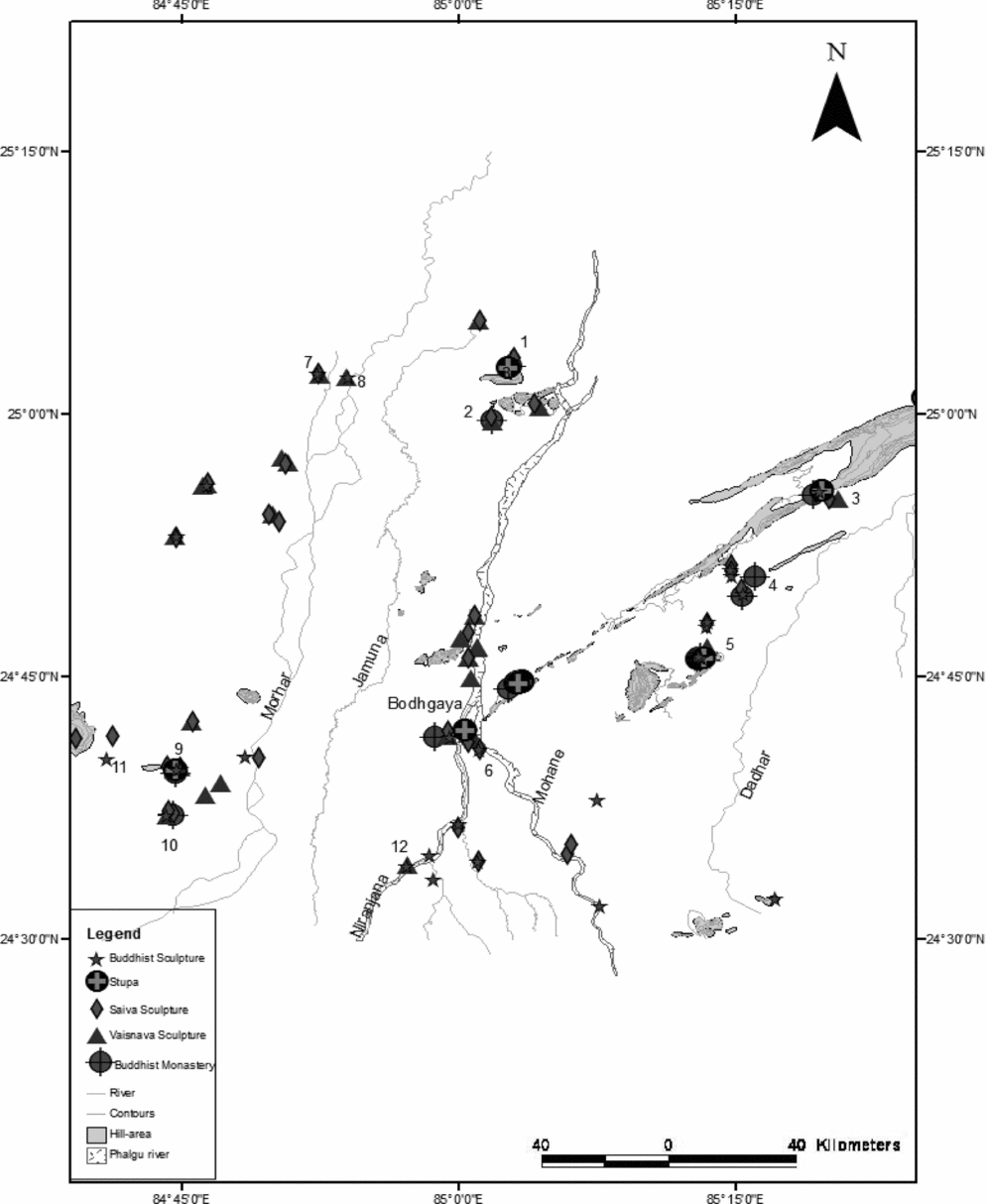
This arrangement is also demonstrated by archaeological materials, i.e. the position of Brāhmaṇa sculptures in relation to the central Buddhist shrines at Buddhist sites. A good example is Kauwadol, an extensive Buddhist monastic site with a large ruined temple and sculpture of the Buddha. Near the main image is a rock formation where a rock-cut Buddha is surrounded on three sides by rock-cut reliefs of Brāhmaṇa deities including Viṣṇu and Umā Maheśvara. Other sites have in subsidiary shrines following the same pattern, such as Kespa, Amethi, Guneri, and Dharawat (Fig. 3). Therefore, the idea of a ‘scale of forms’ provides an useful explanatory framework for the presence of sculptures of Viṣṇu, Umā Maheśvara and other Brāhmaṇa gods at the Buddhist monasteries and shrines at many places in the Bodhgayā region.
Distribution of Buddhist Sites with Śaiva and Vaiṣṇava Sculptures in the Bodhgayā Region

The idea of a ‘scale of forms’ also explains Vaiṣṇava and Śaiva responses to each other. The most prominent Śaiva shrine in the region at Konch included sculptures of Viṣṇu and a daśāvatāra panel within its precinct. Similarly, the Vaiṣṇava response to the growing importance of Śaivism can be read into the establishment of minor Śaiva shrines or the placing of Śaiva sculptures within Vaiṣṇava shrines. This is also emphasised in the accounts of the Gayā Māhātmya, which place Śiva within Gayā's sacred area to include and subsume Śaivism within the Vaiṣṇava order: Śiva is invoked in the Gayāsura legend and, as a result, a foot-print of Śivā is worshipped at Viṣṇupada temple of Gayā. The last verse of the seventh chapter of the Gayā Māhātmya affirms this idea: “Since in the Kali age the people were Maheśvaras, Gadādhara took on the form of a liṅga and became him. I praise the Śrī Prapitāmaha (temple)”.Footnote 110 Another verse mentions that Viṣṇu takes the form of Kedārnāth and Phalgunāth, epithets that were used for Śiva. These two examples show how the liṅga and other popular forms of Śiva were subsumed within the Vaiṣṇava order in a hierarchical ‘scale of forms’. This is doctrinally justified by a number of verses in the Gayā Māhātmya which hint at the supremacy of Viṣṇu by indicating the presence of Śiva in a subordinate position.Footnote 111 In contrast to this, the Gayā Māhātmya maintains relative silence on Buddhism, signifying the eristical nature of the relationship. Neither do we see any Buddhist sculpture in the Vaiṣṇava shrines at Gayā or elsewhere. Indeed, in the three Viṣṇu-daśāvatāra sculptural panels reported from the region, the Buddha is replaced by Balarāma. This silence and exclusion, along with active Buddhist responses, point to the dominance of Buddhism in the region, particularly between the eighth and twelfth centuries.
To conclude, the concurrent presence of the Buddhist, Vaiṣṇava and Śaiva orders in the Bodhgayā region between the sixth and twelfth centuries meant that all these orders attempted to prove their supremacy by fiercely competing with each other in the soteriological, religious and societal domains. The analysis of textual and archaeological remains indicate that the Vaiṣṇava order responded by attempting to include Buddhism, although they were more successful at including Śiva and Śaivism within their order. In contrast, the Buddhist saṅgha responded emphatically through ‘hierarchical-inclusion’, appropriating all the Brāhmaṇa gods within their order. The Buddhist appropriations redefined the Buddhist order as a result. These transformations, indicative of a vibrant and dynamic saṅgha in the Bodhgayā region, question the generalised picture of Buddhist decline brought on by challenges from the Brāhmaṇa orders across South Asia from the sixth century. The active role of the saṅgha in the social and religious domains, documented clearly by the study presented here, has to be reckoned in any examination of the supposed decline of Buddhism, a thesis which is now in urgent need of reevaluation.
Abbreviations

Appendix:
Viṣṇu Sculptures from the Region

Note: Site refers to location of the sculpture at the current site, documented during my archaeological survey of the region in 2005–06.
Abbreviations: SLH = Susan Huntington (see references); Asher = F. M. Asher (see references).
Inscriptions of Gayā