Clostridium difficile infection (CDI) has become the most common healthcare-associated infection in the United States, surpassing even methicillin-resistant Staphylococcus aureus.Reference Miller, Chen, Sexton and Anderson 1 CDI is substantially burdensome; inpatient CDI has been estimated to cost up to $15,000 per episode, with a national annual hospital cost of up to $4.9 billion.Reference Dubberke, Carling and Carrico 2 Further, CDI increases length of stay, increases likelihood of discharge to a long-term care facility, and imparts a mortality of up to 10%.Reference Dubberke, Carling and Carrico 2 Molecular diagnostics may contribute to the nationally increasing incidence of CDI owing to the high sensitivity of polymerase chain reaction (PCR) in detecting the presence of C. difficile.Reference Longtin, Trottier and Brochu 3 This testing modality may lead to overdiagnosis of CDI in patients who have asymptomatic colonization with C. difficile. Polage et alReference Polage, Gyorke and Kennedy 4 demonstrated that only 44.7% of patients with positive results for C. difficile by PCR had detectable C. difficile toxin by a concurrent toxin assay, suggesting that more than 50% of positive PCR tests represent asymptomatic colonization, thus overestimating the true incidence of infection.
Currently, the National Healthcare Safety Network (NHSN) requires that acute care hospitals report laboratory-identified CDI as the sole means of surveillance. NHSN classifies CDI types into 3 categories: healthcare facility-onset CDI (HO-CDI: laboratory identification of C. difficile in a stool specimen collected ≥4 days after admission to the facility), community-associated CDI (laboratory identification of C. difficile in a stool specimen collected in an outpatient location or an inpatient location <4 days after admission to the facility), and community-onset healthcare facility-associated (laboratory identification of C. difficile in a stool specimen collected from a patient who was discharged from the facility ≤4 weeks prior to current date of stool specimen collection). 5 At this time, all positive C. difficile cases are reported to NHSN by acute care facilities. Only the HO-CDI cases are used to determine a facility-specific standardized infection ratio (SIR), which is then compared to a national benchmark.
Herein, we aim to evaluate documented signs and symptoms of patients in whom C. difficile was detected and reported as HO-CDI. By retrospectively analyzing all cases of laboratory-identified HO-CDI at our facility during 1 fiscal year and determining appropriateness of testing on the basis of the clinical situations prompting CDI testing, we hope to provide a basis for proper utilization of C. difficile PCR testing to reduce overdiagnosis.
METHODS
Case Selection and Classification
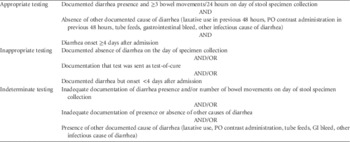
All laboratory-identified HO-CDI cases reported to NHSN from Northwestern Memorial Hospital (Chicago, IL) during a 1-year period were evaluated by retrospective review of the electronic medical record. Testing was performed using C. difficile PCR (BD Max; Becton Dickinson), which detects the toxigenic B gene. Each case was assessed for documented CDI clinical criteria. Although the definition of clinical CDI has not been extensively validated, we applied the Centers for Disease Control and Prevention criteria for clinical CDI: at least 3 episodes of unformed stool within a 24-hour period, in absence of another etiology of diarrhea. 6 We regarded use of laxatives or stool softeners within 48 hours (which has previously been shown to lead to inappropriate C. difficile testingReference Dubberke, Han and Bobo 7 ), oral contrast administration within 48 hours, concomitant tube feeding, gastrointestinal bleeding, and other documented infectious causes of diarrhea (defined as positive stool testing for other pathogenic bacteria, Giardia, cryptosporidium, ova and parasites, or norovirus) as non-CDI etiologies of diarrhea. We established criteria for appropriateness of testing (Table 1) and categorized each case as appropriate, inappropriate, or indeterminate. We then calculated a SIR for our institution after excluding inappropriate tests. SIR is calculated by dividing the number of observed cases (the numerator) by the number of expected cases (the denominator). The number of expected cases was determined for our facility by NHSN using patient-days, total admissions, and testing methodology. Multiple demographic and clinical parameters were compared among the cases, stratified by appropriateness of testing, to evaluate associations with appropriate and inappropriate testing. This study was approved by the Northwestern University Institutional Review Board.
Determinants of Testing Appropriateness for HO-CDI Based on Clinical Scenario

NOTE. GI, gastrointestinal; HO-CDI, healthcare facility-onset Clostridium difficile infection; PO, by mouth.
Statistical Analysis
Dichotomous variables were compared between the appropriateness categories with the χ2 tests using a significance level of .05. For variables with significant differences between the appropriateness categories, they were separately compared using nonparametric Mann-Whitney tests. Continuous variables were compared between the appropriateness categories using analysis of variance. A significance level of .05 was used with Tukey-adjusted post hoc comparison. All analyses were executed with SPSS, version 23 (IBM).
RESULTS
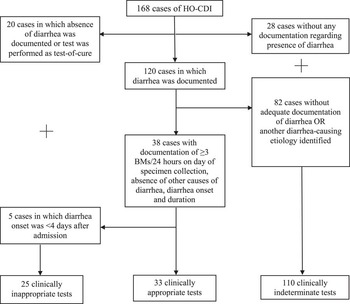
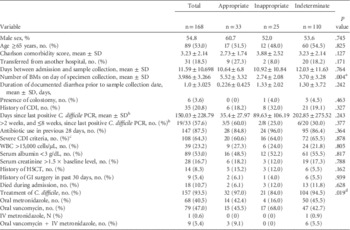
From September 1, 2014, through August 31, 2015, our facility reported 168 cases of HO-CDI to NHSN. Patients were stratified by level of testing appropriateness on the basis of our predefined criteria (Figure 1) and demographic and clinical data were compared among the groups (Table 2). Among all 168 HO-CDI cases, only 33 (19.6%) could be classified as truly appropriate tests on the basis of the predefined criteria. Inappropriate tests accounted for 25 HO-CDI cases (14.8%), and 110 (65.5%) were considered indeterminate largely due to inadequate documentation. We also identified 5 cases classified as HO-CDI in which Centers for Disease Control and Prevention clinical criteria for CDI had been met but the diarrhea onset began less than 4 days after admission, which would be consistent with community-associated CDI rather than HO-CDI; these cases for which testing should have been performed earlier were thus classified as inappropriate tests.
Appropriateness of testing. All testing was performed using Clostridium difficile polymerase chain reaction on samples from adult, hospitalized patients from September 1, 2014, through August 31, 2015. BM, bowel movement; HO-CDI, healthcare facility-onset C. difficile infection.

Demographic and Clinical Data of Patients Associated With HO-CDI Cases, Stratified by Level of Testing Appropriateness

NOTE. BM, bowel movement; CDI, C. difficile infection; GI, gastrointestinal; HO-CDI, healthcare facility-onset CDI; HSCT, hematopoietic stem cell transplantation; IV, intravenous; PCR, polymerase chain reaction; WBC, white blood cells.
a Significant differences observed between appropriate and inappropriate (P=.008), appropriate and indeterminate (P=.015).
b Calculation based on 33 total: 5 appropriate, 8 inappropriate, and 20 indeterminate.
c Defined as presence of at least one of the following: WBC >15,000 cells/µL, serum albumin <3 g/dL, and serum creatinine >1.5× baseline level.
d Significant differences observed between inappropriate and indeterminate (P=.008).
Among all 168 cases, presence of diarrhea was documented in 120 (71.4%); the remainder of cases had no diarrhea or no diarrhea documented. Absence of diarrhea at specimen collection was documented in 18 (10.7%) of the 168 cases (of note, none of these cases had been diagnosed with toxic megacolon). Although our microbiology lab routinely rejects formed stool specimens, individual requests by providers to perform testing on nonliquid specimens may be obliged. Test-of-cure, in which testing was repeated following a prior positive result and after improvement in symptoms, was documented as the reason for test acquisition in 3 (1.8%) of the 168 cases.
Among the demographic and clinical factors compared between the categories of testing appropriateness, the number of bowel movements on the day of specimen collection significantly differed between the appropriate and inappropriate groups and the appropriate and indeterminate groups, with highest number of bowel movements associated with appropriate testing. Most patients received CDI-directed antibiotic therapy regardless of the appropriateness of testing.
The HO-CDI SIR, defined as the number of observed cases (168) divided by the number of expected cases (174.65) during the study period, was 0.962. If cases categorized as inappropriate testing were removed from this calculation (n=25), the SIR would have been 0.819.
DISCUSSION
We found that of all HO-CDI reported cases, only a minority were considered appropriate to test. Further, a substantial number of tests were sent inappropriately; by our estimate, approximately 15% of the HO-CDI cases were the result of inappropriate testing. This inappropriate testing inflated the publicly reported metric and resulted in unnecessary antibiotic use. The prominent incidence of inappropriate testing of asymptomatic patients is consistent with prior studies.Reference Dubberke, Han and Bobo 7 , Reference Peterson, Manson and Paule 8 We also found that appropriate testing was associated with significantly more bowel movements on the day of specimen collection. This may reflect the severity of true CDI; however, it may also reflect collinearity of variables due to the clinical criteria of at least 3 bowel movements over 24 hours that we used to categorize appropriate tests.
Reporting of positive C. difficile cases is a national mandate; acute care hospital HO-CDI SIRs are compared with national benchmarks in an effort to improve quality. As part of the Centers for Medicare and Medicaid Services conditions of participation, HO-CDI will be a component of the hospital-associated condition penalty; financial penalties could be levied if the HO-CDI rate of a given facility rises above the national benchmark beginning in 2017. Subsequently, this penalty will likely motivate facilities to utilize C. difficile PCR more appropriately to reduce the risk of penalization from overreporting or to utilize an alternative methodology for C. difficile testing. Incorporating patients’ clinical symptoms into testing decisions can potentially reduce inappropriate testing and subsequent reporting of false-positive results, providing more accurate estimates of CDI rates. Further, Olans et alReference Olans, Olans and DeMaria 9 recognized that nursing staff can serve an important role in antimicrobial stewardship by communicating with prescribers about changes in stool consistency and frequency, thus sharing the responsibility to test only those with symptomatic CDI.
Given the prominence of symptoms generally present in true CDI, sending a stool specimen for C. difficile PCR either in the absence of clinically significant diarrhea or as a test-of-cure is a clear-cut medical error. In our cohort, 18 tests (11%) were sent in the absence of diarrhea and 3 (2%) were sent as tests-of-cure. Our findings are consistent with those of 2 prior studies that compared the clinical characteristics and performance of CDI diagnostic assays and determined that 36%–39% of patients from whom stool samples were sent for C. difficile testing did not exhibit clinically significant diarrhea.Reference Dubberke, Han and Bobo 7 , Reference Peterson, Manson and Paule 8 Due to the abundance of cases with inadequate documentation, we are likely underestimating inappropriately tested cases in our study. Timing of testing is also important for surveillance of HO-CDI. In our study, we determined that 11 cases (5 of which met Centers for Disease Control and Prevention clinical criteria for CDI) had documented onset of diarrhea less than 4 days after admission. Owing to delays in specimen collection, however, these cases were identified on or after day 4 of admission and reported as HO-CDI. These failures to appropriately utilize the C. difficile PCR likely led to a significant number of inappropriately categorized HO-CDI cases and affected the calculated SIR. The reported SIR of HO-CDI at our institution was 0.962 for the study period, exceeding the national SIR benchmark of 0.833. The SIR that would have been reported by avoiding testing of these inappropriate HO-CDI cases is 0.812 and would likely have been substantially lower if the clinical symptoms of most cases (those that were indeterminate due to inadequate documentation) were better characterized. Had clinicians utilized C. difficile PCR testing more conscientiously in concert with the patients’ clinical symptoms, our facility would likely not have surpassed the national SIR benchmark. Although this improved SIR calculation is only theoretical (cases cannot actually be removed from the SIR calculation once reported to NHSN), it does imply that our institution, and perhaps most institutions nationally, can reduce the number of observed HO-CDI cases (the SIR numerator), and thus the SIR, with more clinically appropriate testing. The depth of the SIR reduction by this initiative, of course, is entrenched in its relationship to the national benchmark. As the national benchmark is progressively lowered, maintaining a favorably low SIR is an ongoing challenge involving multiple interventions.
CDI overdiagnosis presents not only a surveillance challenge but an antibiotic stewardship challenge as well. We found a sizeable number of our HO-CDI cases (93%) received CDI-directed antibiotic therapy regardless of the appropriateness of testing and clinical symptoms. Antibiotic treatment for inappropriate cases (as well as an unknown fraction within the indeterminate category) is unnecessary and possibly detrimental. Although broad-spectrum antibiotic therapy is a well-known risk factor for CDI, oral metronidazole and vancomycin can sufficiently alter the gastrointestinal microbiota and predispose to CDI.Reference Lewis, Buffie and Carter 10 Oral vancomycin, which most of our patients received, has been found to prolong C. difficile colonization,Reference Shim, Johnson, Samore, Bliss and Gerding 11 and C. difficile colonization itself has been found to be an independent risk factor for subsequent CDI in hospitalized patients.Reference Tschudin-Sutter, Carroll and Tamma 12 To counter the unnecessary antibiotic use spurred by positive C. difficile testing in the absence of clinically significant diarrhea observed in our study, our facility developed an alert in the electronic medical record prompted by the placement of a C. difficile PCR order. This alert provides guidance to the ordering healthcare provider in whether or not to proceed with order placement on the basis of the patient’s symptoms.
Two other important observations were noted in our study. The first is that our study captured very few HO-CDI cases representing definitive recurrent CDI (defined as positive C. difficile stool testing >2 weeks but ≤8 weeks after the most recent positive test) 5 ; only 3 (9%) of 33 appropriate cases, 6 (5%) of 110 indeterminate cases, and 2 (8%) of 25 inappropriate cases met criteria for laboratory-identified recurrent CDI. Although recurrences are thought to occur in approximately 30% of patients followed up after their first episode of CDI,Reference Pepin, Routhier, Gagnon and Brazeau 13 a retrospective review of 520 patients with positive CDI testing found 104 of the cases (20%) were recurrences.Reference Shivashankar, Khanna and Kammer 14 These published recurrence rates far exceed our overall observed rate of 7%. Our results may also be due to overdiagnosis of asymptomatic, colonized patients who were less likely to have a prior diagnosis of true CDI. Nevertheless, our results represent a single center study, so potential positive C. difficile PCR lab results outside our facility were not counted and may also be responsible for our low observed recurrence rate. The second interesting observation is that all groups, including the inappropriate testing group, had similar numbers of cases that met criteria for severe CDI. Our observation may be due to the general severity of illness among the hospitalized patients, as all groups had Charlson comorbidity scores that were not statistically different. These severe CDI criteria, as proposed by the Infectious Diseases Society of America and the Society for Healthcare Epidemiology of America, are nonspecific and have not been thoroughly validated,Reference Cohen, Gerding and Johnson 15 thus more specific indicators of severe CDI among hospitalized patients deserve investigation.
Our study has several important limitations. First, the retrospective chart abstraction and the lack of documentation limit the reliability of the assessment of true appropriateness of testing. Additionally, by nature of the retrospective study design, we have likely underestimated the incidence of inappropriate testing; as stated above, prior prospective studies have estimated more than 30% of their participants did not demonstrate clinically significant diarrhea at the time of C. difficile testing.Reference Dubberke, Han and Bobo 7 , Reference Peterson, Manson and Paule 8 Although the nurses routinely record bowel movement frequency in our electronic medical record, stool consistency was often not documented, and any interruption in nursing care (such as patient transfers) or self-report from patients may have resulted in exaggerated, unwitnessed, or undocumented bowel movements. As a result, only those cases in which documentation clearly indicated inappropriate testing for HO-CDI (no diarrhea present, sent as test-of-cure, or diarrhea onset <4 days after admission) were included in recalculating our hypothetical SIR. The lack of a clearly validated definition for clinical CDI is another potentially critical limitation. Any functional clinical definition, however, is likely to exclude rare presentations. Further, although no cases had been diagnosed with toxic megacolon, ileus is a potential cause for absence of diarrhea in patients with true CDI. Although ileus was not clearly documented in any of the inappropriate testing cases, presence of ileus may have resulted in misclassification of testing appropriateness in patients with true CDI. Similarly, the presence of diarrhea-causing agents (such as oral contrast and tube feeding) and CDI are not mutually exclusive. Given the prevalence of use of such agents, true CDI may often occur in their presence. Thus, the appropriateness of such cases of true CDI may have been misclassified. It should be noted, however, that we are not attempting to predict true CDI in each case, but rather the appropriateness of ordering a C. difficile PCR given the case-by-case clinical information. Therefore, any C. difficile testing algorithm focused on clinical decision-making will need to have some flexibility and emphasize the use of the provider’s own clinical judgment and use of speedy empirical therapy for the critically ill. Finally, because we included only laboratory-identified HO-CDI in the study design, we were not able to evaluate those patients with appropriate testing yet negative laboratory results. As such, we are unable to make conclusions about the positive predictive value of our appropriateness algorithm.
HO-CDI is now the most common healthcare-associated infection in the United States, with significant associated mortality, morbidity, and healthcare costs. Inappropriate testing coupled with the sensitivity of molecular testing methodologies results in overdiagnosis of HO-CDI, overtreatment, and overreporting. The validation and utilization of standardized algorithms to assist providers in ordering C. difficile testing, in addition to more thorough documentation of the clinical scenario, may be useful to improve accuracy in CDI surveillance, diagnosis, and treatment. Findings of this study may guide hospitals to design interventions that target the ordering and documenting behavior of providers, thus more accurately reflecting CDI incidence and reducing unnecessary antibiotic use for CDI treatment of asymptomatic patients.
ACKNOWLEDGMENTS
Financial support. None reported.
Potential conflicts of interest. All authors report no conflicts of interest relevant to this article.