INTRODUCTION
Hazard perception can be defined as the ability to anticipate dangerous traffic situations. It is typically measured by calculating response latencies to potentially dangerous traffic situations presented on video or film and, unlike other driving-specific skills, such as vehicle control, has been found to correlate with crash involvement (Horswill & McKenna, Reference Horswill, McKenna, Banbury and Tremblay2004).
One reason why drivers over age 65 have a higher crash risk than younger drivers (Cerelli, 1998) could be changes in hazard perception ability, driven by declines in cognitive, sensory, and motor function. In previous work (Horswill, Marrington, McCullough, Wood, Pachana, et al. Reference Horswill, Marrington, McCullough, Wood, Pachana, McWilliam and Raikos2008), we reported that hazard perception slowed significantly with age (in a sample 65 years and above), which could be accounted for by cognitive, visual, and motor measures. However, a key factor missing from this study was the inclusion of a matched comparison group of younger drivers to determine at what age this decline begins in healthy drivers.
Quimby and Watts (Reference Quimby and Watts1981) found a significant nonlinear trend for hazard perception latencies across an age range of 17 to 72 years, where latencies were fastest between 45 and 54 years and slower at either end of the age distribution. However, there was no attempt to match individuals between age groups, and age-related declines could have been a function of a greater incidence of pathology in the older drivers. Renge et al. (Reference Renge, Ishibashi, Oiri, Ota, Tsunenari, Mukai and Underwood2005) reported that older drivers detected fewer hazards in a freeze-framed image of a traffic scene than middle-aged drivers, though this type of measure is potentially assessing a different aspect of driving ability than latency-based video tasks.
In the present study, we aimed to determine the extent to which mid-aged drivers (35–55 years) differed in their hazard perception response latencies compared with young-old (65–74 years) and old-old drivers (75–84 years). The mid-age group was chosen as a baseline to include those with the fastest hazard response times (Quimby & Watts, Reference Quimby and Watts1981) and the young-old and old-old group cutoffs were based on the widely-used classifications recommended by Suzman and Riley (Reference Suzman and Riley1985). We also investigated cognitive, sensory, and motor factors that might account for any age differences.
METHOD
Participants
We tested 22 drivers aged between 35 and 55 (minimum 10 years driving experience), recruited from a research pool, via advertisements, or by word of mouth. Data from 118 community-dwelling drivers aged 65 plus, who were tested as part of a previously published study (Horswill et al., Reference Horswill, Marrington, McCullough, Wood, Pachana, McWilliam and Raikos2008), were used to create matched young-old and old-old groups.
Between-group matching was performed by inspecting the distribution of gender, highest qualification (as measured using a 7-option ordinal scale from “no qualification” to “higher university degree”), and vocabulary (measured by the Wechsler Abbreviated Scale of Intelligence). Participants in the two older-driver samples were systematically excluded until the distributions of these variables matched across all groups, resulting in 22 mid-aged, 34 young-old, and 23 old-old drivers.
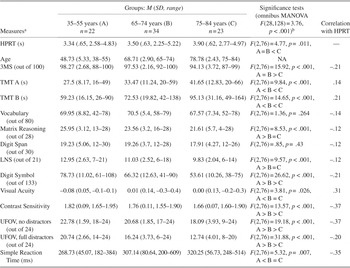
There were no significant differences between the three groups in the distribution of gender (Pearson chi-square = .87, p = .648; 68.4% women overall), highest qualification (Kruskal-Wallis chi-square = .14, p = .933), or vocabulary (see Table 1). All participants rated their overall health to be at least “fair” (on a 5-point scale labeled “excellent,” “very good,” “good,” “fair,”, and “poor”), with 92% rating themselves as “good” or better. There were no significant differences in health rating between the groups, F(2,75) = 1.18, p = .312. The study was granted ethical approval by the University of Queensland.
Group differences and significance tests for all measures

a HPRT = hazard perception response time (Horswill et al., Reference Horswill, Marrington, McCullough, Wood, Pachana, McWilliam and Raikos2008); 3MS = Modified Mini-Mental State Examination (Teng & Chui, Reference Teng and Chui1987); TMT = Trail-Making Test (Spreen & Strauss, Reference Spreen and Strauss1991); Vocabulary and Matrix Reasoning (The Psychological Corporation, 1999); Digit Span, LNS = Letter-number sequencing, and Digit Symbol (Wechsler, Reference Wechsler1997); visual acuity = static visual acuity as measured by the logMAR chart (logarithm of the minimum angle of resolution: NVRI, Melbourne, Australia); contrast sensitivity was measured by the Pelli-Robson chart (Pelli, Robson, & Wilkins, Reference Pelli, Robson and Wilkins1988); UFOV = Useful Field of View test (Wood & Troutbeck, Reference Wood and Troutbeck1995); simple reaction time (Horswill et al., Reference Horswill, Marrington, McCullough, Wood, Pachana, McWilliam and Raikos2008). For TMT, HPRT, visual acuity, and simple reaction time a lower score indicates better performance. For 3MS, vocabulary, matrix reasoning, Digit Span, LNS, Digit Symbol, contrast sensitivity, and UFOV, a higher score indicates better performance.
b Alpha was set at 5% and variables were transformed to maximize normality if required. Statistics are the results of a multivariate analysis of variance (MANOVA, where all variables were entered as dependent variables, with age group as the independent variable, to control for multiple comparisons) with the results of Student-Neuman-Keuls post hoc tests indicated by showing individual group differences [for example, A = B < C indicates group A (35–55) were not significantly different from group B (65–74), but both these groups were significantly different from group C]. Note that there were 5 missing values for UFOV no distracters and 3 missing values for UFOV full distracters, which were replaced using expectation-maximization methods for the MANOVA, but one-way ANOVAs on these variables with the misses excluded yielded nearly identical outcomes (means for these variables are reported without the substituted values).
Procedure
Details of measures and procedures are given in Horswill et al. (Reference Horswill, Marrington, McCullough, Wood, Pachana, McWilliam and Raikos2008). Participants completed a battery of cognitive and vision tests, in addition to a validated video-based hazard perception test, and a simple reaction time test (see Table 1). The measures were chosen to cover aspects of cognitive and visual function that plausibly might affect hazard perception ability (Horswill et al., Reference Horswill, Marrington, McCullough, Wood, Pachana, McWilliam and Raikos2008). The hazard perception test involved participants viewing video of genuine traffic footage filmed from the driver’s perspective. They were told to press a response button whenever they anticipated a potential traffic conflict (traffic conflicts were defined as any situation where the driver would have to take action to avoid a collision with another road user). The test was approximately 20 minutes long and participants received a 2-minute practice. Responding to the hazards had no effect on video playback. Overall response latency was the mean response time across all conflicts.
RESULTS
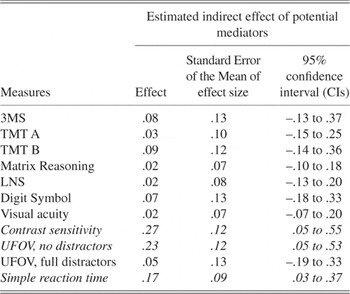
The 35–55 year-olds did not significantly differ in hazard perception latency from the 65–74 year-olds, but the 75–84 year-olds had significantly slower hazard perception latencies than both of the other groups (Table 1). To assess whether this difference could be mediated by other measures in our battery, we created a new independent variable by combining the two younger groups and compared them with the 75–84 year-olds. Using Preacher and Hayes’ (2004) accelerated bootstrap procedure, with 5,000 resamples, we determined whether any of the measures in Table 1 (excluding those with no age group difference) could significantly mediate the age group/hazard perception relationship (Table 2). This method was chosen because it allowed direct testing of mediation relationships while avoiding normality assumptions, and also the requirement for larger sample sizes associated with alternative methods. Note that the difference in sample sizes between the two groups (56 vs. 23) was not a problem for the independent sample analysis, given there was no difference in the variance of the two groups on hazard perception score (Levene’s test for equality of variance: F = .01, p = .916). Significant mediation effects, defined as 95% confidence intervals (CIs) for the indirect effects that did not include zero, were found for contrast sensitivity, UFOV without distractors, and simple reaction time. This indicated that these three variables had the potential to account for age-related differences in hazard perception.
Accelerated bootstrap estimates of possible mediation models, with hazard perception response latency as the dependent variable, 35–55 and 65–74 age groups combined vs. 75–84 age group as the independent variable, and each of the measures in Table 1 for which an age difference was found inserted individually as potentially mediating this relationship. Significant mediators are in italics.

Note
All continuous variables were converted into Z scores and the age group variable was coded 0 (35–74 year-olds) and 1 (75–84 year-olds) to aid interpretation of effect size.
DISCUSSION
We found that healthy 65–74 year-olds were not significantly slower than a matched group of 35–55 year-olds in responding to traffic conflicts. This could indicate that declines in hazard perception previously shown for this age group (Quimby & Watts, Reference Quimby and Watts1981) may be a result of the increased incidence of pathology in older adults, a variable that was controlled for in the present study. Among healthy young-old drivers, it is possible that driving experience may compensate for potential declines in hazard perception that might be expected as a result of more general sensory and neuropsychological declines linked to primary aging. However, we also found that healthy 75–84 year-olds were significantly slower at anticipating hazards than the other groups, and this difference could be accounted for by individual differences in UFOV, contrast sensitivity, and/or simple reaction time. The 560 ms mean slowing in hazard perception response latency between the mid-age and the old-old groups equates to an additional 9.3 meters of travel when driving at 60 kilometers per hour (kph), suggesting that this slowing could map onto differences in crash risk.
ACKNOWLEDGMENTS
This research was funded by the Australian Research Council and Queensland Main Roads (Linkage Grant LP0348431) and a University of Queensland New Staff Grant to MSH. We acknowledge the help of Andrew Hill and Maria Theodoros in collecting and entering the data.