Practical implications
The common duck can be bred either in pure breeding (PB) or in crossbreeding (CB) using the semen of Muscovy drakes to produce the mule duck. Because of the short duration of the fertile period (DFP), particularly in CB, it is necessary to inseminate the females twice a week. Selection for increased DFP might be a solution to reduce the insemination frequency and hence labour costs and animal handling, thus improving animal welfare. Our results demonstrate (in PB) or confirm (in CB) that DFP can be improved by selection due to fairly high heritability values and that gains in one breeding scheme will result in correlated gains in the other one due to high values of the purebred–crossbred genetic correlations.
Introduction
Female birds can store spermatozoa for prolonged periods in specialised sites located in the lower and upper oviduct (Fujii and Tamura, Reference Fujii and Tamura1963; Michel, Reference Michel1987) allowing the fertilisation of several eggs during the days following a single mating or artificial insemination (AI; Zavaleta and Ogasawara, Reference Zavaleta and Ogasawara1987). As a consequence, females may lay fertile eggs for periods of variable length. Each period, which can be defined as ‘duration of fertile period’ (DFP), is itself dependent on a variety of male and female traits. As a consequence, other factors directly associated with the fertile period (e.g. the maximum duration of fertility (MD), as defined by Lake, Reference Lake1975) vary extensively between and within species.
Following chicken and turkey, ducks are the third most important bird species in animal production for human consumption worldwide, and duck meat production has sharply risen over the last decades (Pingel, Reference Pingel2009). Two major species are concerned, the common duck (Anas platyrhynchos) and the Muscovy duck (Cairina moschata), as well as their hybrid, the so-called ‘mule duck’. The mule duck is traditionally important in Taiwan for meat production and its production has dramatically increased in France since the 1990s for the production of foie gras. The mule duck combines the high reproductive rate and the early development of the common duck dam (usually a Pekin duck), and the high proportion of muscle of the Muscovy sire (Ricard, Reference Ricard, de Carville and Marché1988; Pingel, Reference Pingel1990). Mule ducks therefore have great potential for providing duck meat for worldwide food production. AI was the key technology that led to the success of mule duck production, greatly improving the fertility level (Tai and Tai, Reference Tai and Tai2001).
Female common ducks can thus be bred either in pure breeding (PB) or in inter-generic crossbreeding (CB) with Muscovy drakes. Fertility levels observed after CB generally remain lower than those observed after PB. The main difference between the two breeding schemes lies in the persistence of fertility after a single AI rather than in the initial fertility (Brun et al., Reference Brun, Richard, Marie-Etancelin, Rouvier and Larzul2005 and Reference Brun, Mialon-Richard, Sellier, Batellier and Brillard2008). In the INRA44 experimental strain of common duck, half initial fertility, an indicator of persistence, was reached on day 5.5 after AI in CB v. 7.5 in PB, and the MD was evaluated at 6.4 days in CB v. 8.1 days in PB (Sellier et al., Reference Sellier, Brun, Richard, Batellier, Dupuy and Brillard2005; Brun et al., Reference Brun, Richard, Marie-Etancelin, Rouvier and Larzul2005 and Reference Brun, Mialon-Richard, Sellier, Batellier and Brillard2008). In commercial flocks, this shorter duration of fertility in CB justifies the need for frequent AI (e.g. two AIs per week) in order to maintain fertility rates at acceptable levels. Increasing the duration of fertility in commercial flocks of CB would therefore make it possible to reduce AI frequency and, as a consequence, labour costs and animal handling, thus improving animal welfare.
Authors who have studied the possibility of improving the duration of fertility by selection have primarily focused on the female component: Pingel (Reference Pingel1990), Beaumont (Reference Beaumont1992) and Brillard et al. (Reference Brillard, Beaumont and Scheller1998) for the laying hen, and Tai et al. (Reference Tai, Rouvier and Poivey1994), Poivey et al. (Reference Poivey, Cheng, Rouvier, Tai, Wang and Liu2001) and Cheng et al. (Reference Cheng, Rouvier, Poivey, Tai, Tai and Huang2002 and Reference Cheng, Rouvier, Poivey, Liu, Huang, Huang, Liao, Tai, Tai and Poivey2009) for the common duck. In the case of ducks bred by CB, selection can dramatically improve the number of fertile eggs after a single insemination (Cheng et al., Reference Cheng, Rouvier, Poivey, Tai, Tai and Huang2002 and Reference Cheng, Rouvier, Poivey, Liu, Huang, Huang, Liao, Tai, Tai and Poivey2009).
Meanwhile, the expressions of the duration of fertility in PB or CB can be considered, at least a priori, as two different traits due to marked differences between the two breeding schemes. The objective of the present study was to estimate their heritability and the purebred–crossbred genetic correlation as indicators of the extent of their genetic similarity. This would also make it possible to predict the direct and the correlated responses to selection on one of them. Several characteristics of fertility duration have been analysed: the MD, the number of fertile eggs and the number of hatched ducklings following a single insemination, and the fertility rate over days 2 to 12 post insemination. Moreover, the latter trait has been analysed by considering three sub-periods, days 2 to 4, 5 to 8 and 9 to 12 after AI, respectively.
Material and methods
Birds and breeding methods
This study was performed over a 3-year period at the INRA Experimental Farm for Waterfowl in Artiguères (south-western France). It involved three successive generations of INRA44 female ducks. The INRA44 strain is a synthetic strain of common duck initially obtained by crossing Tsaiya and Pekin grandparent stocks. Each year of the experiment, a total of 180 common duck females, 36 common drakes (INRA44) and 36 Muscovy drakes (ST4 Compact, Gourmaud selection) were individually caged and then raised under standard conditions. The 494 females studied were the progeny of a total of 34 sires and 128 dams. The females were divided into two groups each year, with the same sires and dams, and subjected to the two breeding schemes. Females were inseminated during three periods of their reproductive cycle (27 to 35 weeks, 39 to 43 weeks and 49 to 56 weeks of age). Within each period, the first group of females was initially inseminated with semen from the same species (PB) and, 3 weeks later, with semen from Muscovy drakes (CB). The second group was inseminated under the exact same conditions, except that the genetic origin of the semen was reversed. Six insemination batches were thus performed each year, resulting in a total of 18 AI batches over the 3-year period. A total of 1368 and 1287 fertile periods were recorded in PB and CB, respectively. Inseminations were performed with a pistol, after cloacal reversion, with pooled semen from several males, with 175 ± 25 million spermatozoa per dose. Eggs were collected from the 2nd to the 22nd day after AI, stored for 1 week at 16°C and then incubated under standard conditions for common or mule duck eggs (Sellier et al., Reference Sellier, Brun, Richard, Batellier, Dupuy and Brillard2005). Fertility was assessed by candling (UV lamp) on day 6 of incubation.
Traits analysed
MD = maximum duration of fertility, that is, time lapse between the day of AI and the day when the last fertile egg was laid.
As the probability of obtaining one fertile egg was extremely low after 12 days following the day of AI, irrespective of the breeding scheme, analyses of the other traits were limited to eggs laid between days 2 and 12 following AI. These traits were:
F = number of fertile eggs from days 2 to 12 after AI.
H = number of hatched ducklings from days 2 to 12 after AI.
F 2,12 = fertility rate from days 2 to 12 after AI.
In order to analyse the change in fertility after AI, the period of its observation was subdivided into three sub-periods and fertility rates were calculated for each sub-period:
F 2,4, F 5,8, F 9,12 = fertility rate from days 2 to 4, 5 to 8 and 9 to 12, respectively.
F sim = 0.5 (F 2,4 + F 2,5) is the fertility rate at a simulated frequency of two AIs per week.
As each trait may be measured in PB or in CB, the subscript p or c specifies the trait, depending on the case.
Data analysis
Inseminations followed by the absence of at least one fertile egg were eliminated from the analyses, considering that this result was more a consequence of missed semen deposition rather than because of the birds per se. The very low repeatability of the variable ‘presence/absence of fertile eggs’ supports this hypothesis. Ducks with less than eight eggs laid over the 21 days of egg collection (laying rate <38%) were also excluded, considering that such ducks with low laying performances did not allow precise determination of their duration of fertility. The above-described limitations resulted in the exclusion of a total of 3.4% of the raw data.
Phenotypic correlations between variables were calculated within breeding schemes as the residual correlations of the multivariate option of the GLM procedure of Statistical Analysis Systems Institute (SAS) (2001), using the MANOVA statement. The model included the fixed effect of the insemination batch (18 levels).
Within breeding schemes, repeatability estimates were calculated using Proc Mixed of SAS (2001), with a linear model that included the random effect of the duck and the fixed effect of the insemination batch. Repeatability was estimated as the ratio of the duck variance to the total variance.
Genetic parameters were estimated with a multitrait animal model, using the restricted maximum likelihood method, with the VCE 4.2 software package (Neumaier and Groeneveld, Reference Neumaier and Groeneveld1998). The statistical model included the fixed effect of the insemination batch and two random effects: the additive genetic value of the duck and the permanent environmental effect.
Results
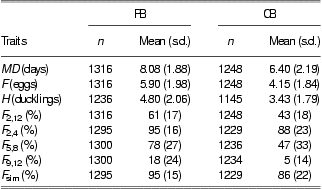
The basic statistics of the traits studied here can be found in Table 1. The results confirmed that the duration of fertility is longer in PB than in the inter-generic CB. For example, the MD in PB was 8.08 days v. 6.40 days in CB. Overall fertility over days 2 to 12 was 61% in PB and 43% in CB.
Basic statistics of the traits analysed in PB and in CB
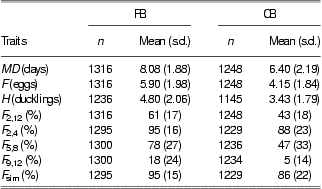
PB = pure breeding; CB = crossbreeding; MD = maximum duration of fertility; F and H = number of fertile eggs and of hatched ducklings after a single insemination; AI = artificial insemination; F 2,12, F 2,4, F 5,8 and F 9,12 = fertility rates over days 2 to 12 after AI, 2 to 4, 5 to 8 and 9 to 12, respectively; F sim = fertility rate at a frequency of two AIs/week.
Change in egg fertility after AI
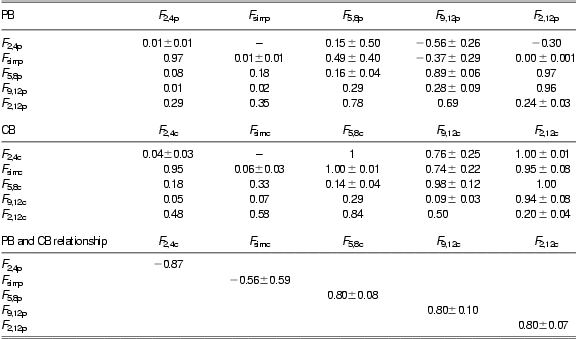
Overall fertility was broken down into early (F 2,4), intermediate (F 5,8) and late fertility (F 9,12). F sim, the fertility rate at a simulated frequency of two AIs per week, is another indicator of early fertility. Phenotypic correlations of fertility between these sub-periods are given in Table 2 for each breeding scheme. The pattern of correlations between sub-periods was quite similar in PB and CB. It revealed a low phenotypic link, if any, between the early (F 2,4) and later fertility, and particularly with F 9,12, an indicator of persistency. Correlations between F 5,8 and F 9,12 were themselves limited to ∼0.30 values in both breeding schemes. The breeding schemes differed, however, in terms of the correlation of each component with the overall fertility. Early fertility (F sim, for example) had a higher correlation to overall fertility in CB (r = 0.58) than in PB (r = 0.35). In contrast, late fertility was more correlated to overall fertility in PB (r = 0.69) than in CB (r = 0.50).
Parameters of fertility rates in different sub-periods after AI: (1) within a breeding scheme (upper and middle part of the table): heritability (diagonal), phenotypic correlations (under diagonal) and genetic correlations (above diagonal); (2) purebred–crossbred genetic correlations (lower part of the table)
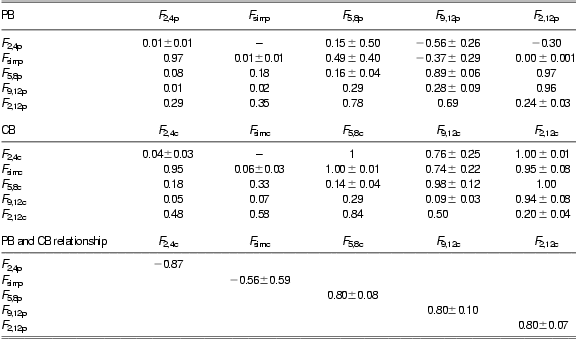
AI = artificial insemination; PB = pure breeding; CB = crossbreeding; F 2,4, F 5,8, F 9,12 and F 2,12 are the fertility rates for days 2 to 4, 5 to 8, 9 to 12 and 2 to 12 after AI, respectively; F sim(=0.5 (F 2,4 + F 2,5)) is the fertility rate at a simulated frequency of two AI per week. The subscripts p and c correspond to PB and CB, respectively.
Genetic correlations without standard errors correspond to non-convergent analyses.
Phenotypic correlations between various DFP-related traits
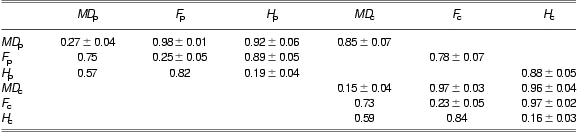
The phenotypic correlations between DFP traits (Table 3) were generally high and were very similar for both PB and CB: between MD and F, 0.75 and 0.73, respectively; between MD and H, 0.57 and 0.59, respectively; and between F and H, 0.82 and 0.84, respectively.
Estimates (±s.e.) of heritability (diagonal), genetic correlations (above diagonal) and phenotypic correlations (under diagonal) for MD, F and H for PB (subscript p) and for CB (subscript c)
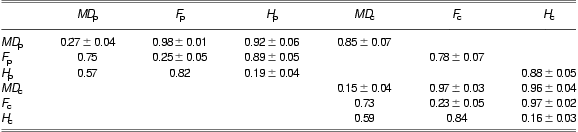
MD = maximum duration of fertility; F = the number of fertilised eggs; H = the number of hatched ducklings; PB = pure breeding; CB = crossbreeding.
As a duck repeats a given trait three times in its reproductive cycle, the correlation between these repeated performances (repeatability) can be estimated. All estimates were in the range of 0.22 to 0.35. Again, the repeatability estimates were quite close in both breeding schemes: for MD, 0.29 and 0.32 in PB and CB, respectively; for F, 0.31 and 0.35, respectively; and for H, 0.30 and 0.22, respectively.
Genetic variability: comparison between PB and CB
The heritability for MD (Table 3) in PB (0.27) was significantly higher than in CB (0.15). The number of fertile eggs after a single insemination had similar heritability estimates in PB and in CB (0.25 and 0.23, respectively). Overall fertility rates (F 2,12) had the same pattern of heritability (0.24 and 0.20, respectively; Table 2). The number of hatched ducklings also had similar heritability estimates in both breeding schemes (0.19 in PB and 0.16 in CB).
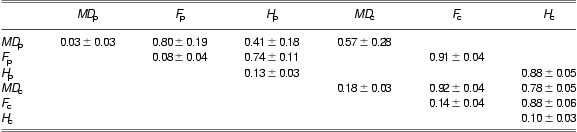
Regarding MD p and, to a lesser extent, F p, the permanent environmental effects (Table 4) had little impact on the total variance (3% and 8%, respectively). The contribution was higher for the other traits studied, amounting to 10% to 17%. In particular, MD was more highly influenced by permanent environmental effects in CB than in PB. On the other hand, H p and H c were very similar with respect to the balance of the heritable v. non-heritable part of the variance because of the female duck. For H p, their respective proportions of the total variance were 19% v. 13%; for H c, they were 16% v. 10%.
Estimates (±s.e.) of the ratio of permanent environmental variance to total variance (diagonal) and correlations between traits for permanent environmental effects (above diagonal) for MD, F and H for PB (subscript p) and for CB (subscript c)
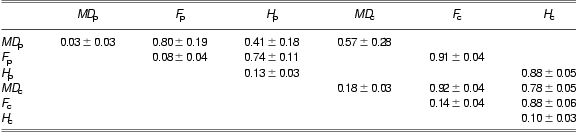
MD = maximum duration of fertility, F = the number of fertilised eggs; H = the number of hatched ducklings; PB = pure breeding; CB = crossbreeding.
The genetic correlations between MD, F and H were high in both breeding schemes, all estimates being >0.89. The correlations for permanent environmental effects between traits were also high in both breeding schemes, except between MD p and H p.
Rates of early fertility (F 2,4 and F sim) had a vey low heritability in both breeding schemes with, however, a trend for higher values in CB (0.04 and 0.06 v. 0.01 and 0.01; Table 2). In contrast, a higher heritability was observed for intermediate fertility (F 5,8) in both breeding schemes and for late fertility (F 9,12) in PB. The pattern of the genetic correlations between initial and later fertility seems to depend on the breeding scheme: an independence of initial fertility with later fertility was observed in PB, whereas high positive correlations (>0.74) were found in CB. As a consequence, initial fertility was genetically unlinked to overall fertility in PB, whereas it was highly correlated in CB (rg = 0.95). Intermediate and late fertility rates were highly correlated to each other in both breeding schemes.
Genetic and permanent environmental correlations between the same traits expressed in PB and in CB
The genetic correlations between the expression of the same trait in PB and in CB were high for the three traits analysed, MD, F and H, in the range of 0.78 to 0.88 (Table 3). This parameter is referred to as the purebred–crossbred genetic correlation in the text and written as rg pc. The overall fertility rate (F 2,12) also displayed a high value for rg pc (means ± s.e.: 0.80 ± 0.07; Table 2).
Concerning the components of F 2,12, rg pc was not different from zero for initial fertility, whereas it was >0.80 for intermediate, late and overall fertility (Table 2).
The correlations of permanent environmental effects for the expression of one trait in PB and in CB were as high as the genetic correlations, except for the correlation between MD p and MD c (0.57 ± 0.28).
Discussion
Comparison with other species
Genetic parameters for PB can be compared with those available in other poultry species, which are, in fact, restricted to the laying hen. Our heritability estimate for MD p (0.27 ± 0.04) is close to the realised heritability of 0.21 obtained by Pingel (Reference Pingel1990), based on seven selection generations, but higher than the estimates of 0.15 obtained by Beaumont et al. (Reference Beaumont, Millet, Le Bihan-Duval, Kipi and Dupuy1992) when averaged over estimation methods and generations. Our heritability estimate for H p (0.19) is close to the one (0.18) estimated by Beaumont (Reference Beaumont1992). The very high genetic correlations between MD, F and H found in our study were also observed by Beaumont (Reference Beaumont1992).
Comparison with other studies in duck hybridisation
Our estimates of heritability for duration of fertility in common ducks inseminated with semen from Muscovy drakes tended to be lower than those obtained by Poivey et al. (Reference Poivey, Cheng, Rouvier, Tai, Wang and Liu2001) in two strains (selected and control) of Tsaiya common ducks in the course of a selection experiment: for MD c, 0.15 v. 0.25 on average over the two Tsaiya strains; for F c, 0.23 v. 0.28; and for H c, 0.16 v. 0.18. Our estimates of the genetic correlations between these traits were higher than 0.96, whereas the estimates from Poivey et al. (Reference Poivey, Cheng, Rouvier, Tai, Wang and Liu2001) ranged from 0.82 to 0.96, depending on the strain and the pair of traits considered.
Variance components and genetic correlations for PB v. CB
Duration of fertility traits was expressed in two breeding schemes, PB and CB. The genes controlling these traits were thus expressed in two different biological environments, able to induce genetic-by-environment interactions. Such interactions can be expressed by a different h 2 depending on the environment and by a purebred–crossbred genetic correlation different from 1 (Brun, Reference Brun1982).
In the present study, the heritability for MD is significantly higher in the case of PB. Another fertility trait investigated in a closely related strain, the fertility rate over 4 weeks with two inseminations per week, showed the reverse pattern, with a higher heritability for CB (Brun and Larzul, Reference Brun and Larzul2003). The insemination rate of two AIs per week, however, put the maximum fertility in the 3- to 4-day period after AI to the test, rather than its persistence. The trend observed in our experiment for a higher heritability of F 2,4 and F sim for CB makes it possible to reconcile the two studies.
In contrast to heritability, the part of variance of MD because of permanent environmental effects was higher for CB. We are tempted to attribute this to the difficulty to control AI in hybridisation. The success of insemination with semen from another species would be more sensitive to the place where the semen is deposited than with semen from the same species. However, the repeatability estimates (encompassing genetic and permanent environmental variances) are similar in both breeding schemes, which do not support such an interpretation.
Surprisingly, and despite a high genetic correlation with MD, the traits F and H showed no such heritability difference between PB and CB, nor such an unbalance between genetic additive and permanent environmental variances. We have found no explanation for these results so far.
As of this time, the only study concerning the purebred–crossbred relationship in common duck reproduction (Brun and Larzul, Reference Brun and Larzul2003) reported a low value of rg pc for fertility with two AIs/week (rg pc = 0.49). Our corresponding value (i.e. rg pc for F sim) was even smaller and not different from zero (−0.56 ± 0.59). The high values obtained in the present study for rg pc of MD and the other DFP-related traits were unexpected. First, the high differences in the mean values of DFP traits between the two breeding schemes suggested quite different traits. Second, the existence of a species-specific barrier to sperm transport in the vagina, along with the existence of surface antigenicity of the sperm membrane revealed in the chicken (Steele and Wishart, Reference Steele and Wishart1992) could result in interactions between the female duck genital tract and the sperm type, and thus give a value different from 1 for rg pc. The discrepancy between the fairly low value of rg pc for fertility in two AIs/week and the high value after a single AI confirms that we are dealing with two different traits, the former involving initial fertility and the latter specifically involving the persistence of fertility. In laying hens divergently selected for duration of fertility, Brillard et al. (Reference Brillard, Beaumont and Scheller1998) showed that fertility persistence was linked to the sperm storage capacity of the hens, with more sperm storage tubules in the high line, a histo-anatomical trait. If such a trait was involved in the duck, this could explain the high rg pc found in the current study for duration of fertility. This high value was confirmed by the ‘realised correlation’ observed in a selection experiment on another criterion of DFP (Brun et al., Reference Brun, Mialon-Richard, Dubos and Guy2006). The selection criterion was the number of live mule embryos obtained at the limited rate of one insemination per week. This high value suggests that many of the same genes are involved in the duration of fertility for both PB and CB.
Fertility rates at different sub-periods after AI showed the same trend in both breeding schemes: low heritability values in the early period but higher ones in the intermediate and late ones. The number of days of egg collection taken into account (3 days in the early period v. 4 days for the other two) could explain part of the difference. Another part of the difference could be because of the fact that later fertility put duration of fertility to the test, with the higher heritability of histo-anatomical traits, whereas early fertility did not and thus displayed low heritability values, as is the rule for fertility traits in animal species (David, Reference David2008). It seems, however, that initial fertility has a somewhat different status depending on the breeding scheme: initial fertility was less correlated to later and to overall fertility in PB than in CB, both in terms of phenotypic and genetic correlations. The particular status of initial fertility appeared again through the purebred–crossbred genetic correlation. Although the estimation of genetic correlations involving initial fertility in PB may be partly hampered by its very low additive genetic variance and heritability, the phenotypic correlation remains significant. In other words, PB initial fertility is not at all linked to duration of fertility, whereas it tends to be in CB. How can this be interpreted at the biological level? In PB, initial fertility would not be limited by the female sperm storage capacity, as in the case of CB, or only later on after insemination in both breeding schemes.
Our results demonstrate that selection for increased duration of fertility is possible, regardless of the breeding scheme. In order to improve H, the higher heritability of F and its high genetic correlation with H would make indirect selection on F more profitable than direct selection on H. Moreover, such a strategy would be easier to implement than direct selection on the number of hatched ducklings as fertility is assessed earlier, at candling instead of hatching. Moreover, any gain in one breeding scheme will result in correlated gains in the other one because of high values of the purebred–crossbred genetic correlation.
Conclusion
The variability of DFP-related traits was analysed in common duck females bred by PB or by CB. Although trait expression was dramatically influenced by the breeding scheme, their phenotypic and genetic variability were quite similar in both breeding schemes. The purebred–crossbred genetic correlations were high for all traits, suggesting that most of the genes that influence duration of fertility in both PB and CB are the same. Noticeable differences between the two breeding schemes, however, were observed: (1) MD was more influenced by permanent environmental effects in CB; and (2) the initial fertility (obtained over days 2 to 4 after insemination) was independent of duration of fertility in PB, whereas it showed some link in CB.
Our results either confirm (CB) or demonstrate (PB) that duration of fertility can be improved by genetic selection because of fairly high heritability values. In both breeding schemes, the number of eggs fertilised after a single insemination can be used as the selection criterion with a favourable correlated response on the number of hatched ducklings. Moreover, any gain in one breeding scheme will have its correlated counterpart in the other one.
Acknowledgements
The authors gratefully acknowledge the staff of the INRA Experimental Farm of Artiguères for its conscientious technical assistance, and the Aquitaine region for its financial support.