Introduction
The potential for non-native species (for simplicity, hereafter termed exotic species) to succeed in their new ranges depends on various factors, and identifying those traits that make exotic species successful is crucial for understanding biological invasions and managing effects they may have on native biodiversity (Falk-Petersen et al. Reference Falk-Petersen, BøhnOdd and Sandlund2006). Pathogens may play an important role in the fate of biological introductions, either facilitating or impairing colonization success (Lafferty et al. Reference Lafferty, Torchin, Kuris, Morand and Krasnov2010; Hatcher and Dunn, Reference Hatcher and Dunn2011). Exotic species may displace native species by bringing novel pathogens to which the exotic species is relatively immune, but to which native species are not adapted and are, therefore, vulnerable (Novel Weapon hypothesis) or exotic species may have left their pathogens in the native range (Enemy Release hypothesis) allowing them to have a higher fitness than native birds (Torchin et al. Reference Torchin, Lafferty, Dobson, McKenzie and Kuris2003; Callaway and Ridenour, Reference Callaway and Ridenour2004; Prenter et al. Reference Prenter, MacNeil, Dick and Dunn2004). The latter hypothesis is particularly likely when parasites in the novel range are specialized in the native hosts, increasing the probability of exotic species not being parasitized in their novel distribution range. In contrast, if pathogens in the novel range do parasitize exotic species, then the potential for a successful biological invasion may be weakened, and native species may even benefit from a dilution effect as a consequence of the infection of non-native hosts (Ostfeld and Keesing, Reference Ostfeld and Keesing2000).
Whenever successful exotic species have a reduced parasite richness compared with the native species in their novel range, it is important to understand whether this advantage is due to the Enemy Release hypothesis, or simply due to exotic species being naturally little parasitized. The Enemy Release hypothesis predicts that the parasite diversity of a species is significantly lower in its non-native than in its native range, while for the second hypothesis it is expected that the parasite diversity in the native range is also low and does not differ in comparison with the exotic range (Hatcher and Dunn, Reference Hatcher and Dunn2011). To distinguish between both scenarios, it is important to compare parasitism in the native and introduced range, taking into account that habitat and community differences may also affect parasite prevalence (Pérez-Rodríguez et al. Reference Pérez-Rodríguez, Fernández-González, de la Hera and Pérez-Tris2013; Clark et al. Reference Clark, Clegg and Lima2014). Therefore, it is important to undertake a robust survey of parasite prevalence in the native range in order to discern between the above scenarios. In this paper, we present data on a successful introduced bird species, quantify the prevalence of vector-transmitted parasites and test concurrent hypotheses relevant for evaluating whether parasites may have influenced the success of this introduction.
Our model system is the recent introduction of the common waxbill (Estrilda astrild) in the Iberian Peninsula and subsequent range expansion. The common waxbill is a small finch native to sub-Saharan Africa, which is traded as a pet bird and has invaded several regions of the world (Stiels et al. Reference Stiels, Schidelko, Engler, Elzen and Rödder2011). It is a highly gregarious species, gathers in flocks year-round, inhabits open habitats in the proximity of water, and feeds on herbaceous seeds. The largest invasion of waxbills in Europe started in the 1960s at several locations along the Portuguese coastline, and gradually expanded to most of Portugal and is also advancing to areas in SW and NW Spain. The expansion in Portugal was well documented (Reino and Silva, Reference Reino and Silva1998; Reino, Reference Reino2005; Sullivan et al. Reference Sullivan, Davies, Reino and Franco2012) and it now encompasses a range of ecological conditions (e.g. altitude, climate seasonality) as well as sites colonized for longer and with higher population densities, and sites colonized more recently and with lower population densities (reviewed in Cardoso and Reino, in press).
We focused on haemosporidian parasites (Sporozoa: Haemosporida), as these are one of the most well-known groups of parasitic protists, with a large taxonomic and ecological diversity, and commonly infect birds, squamate reptiles, turtles and mammals (Martinsen et al. Reference Martinsen, Perkins and Schall2008) in every terrestrial habitat of all continents except Antarctica. Avian haemosporidians comprise three main genera: Haemoproteus, Plasmodium and Leucocytozoon, transmitted by different types of vectors, respectively, hippoboscid flies and biting midges, mosquitoes, especially those of the genus Culex and Simuliidae black flies (Valkiūnas, Reference Valkiūnas2005).
A recent survey in four Portuguese wetlands (Ventim et al. Reference Ventim, Mendes, Ramos, Cardoso and Pérez-Tris2012) showed that the common waxbill has a very low prevalence of Plasmodium parasite infections: only one out of 104 birds was infected (0.96% prevalence). This infection was found in a bird in Santo André lagoon (see Fig. 1), which was parasitized with lineage SGS1, a parasite lineage shared with native resident bird species, including the house sparrow (Passer domesticus), tree sparrow (Passer montanus), great reed warbler (Acrocephalus arundinaceus) and the Cetti's warbler (Cetia cetti). These native bird species showed a significantly higher prevalence of Plasmodium and Haemoproteus parasites (Ventim et al. Reference Ventim, Mendes, Ramos, Cardoso and Pérez-Tris2012), showing that parasite host-switching to common waxbills did not occur frequently. In order to support the Enemy Release hypothesis, though, we further need to know if (1) this low prevalence of parasitism occurs in the rest of its introduced range; (2) if it also generalizes to the other important, but not yet screened, genus of haemosporidian parasites (Leucocytozoon), which is transmitted by a different type vectors, Simuliidae black flies (Valkiūnas, Reference Valkiūnas2005); and (3) whether parasite prevalence in the exotic waxbills of Iberia is lower than in their native range.
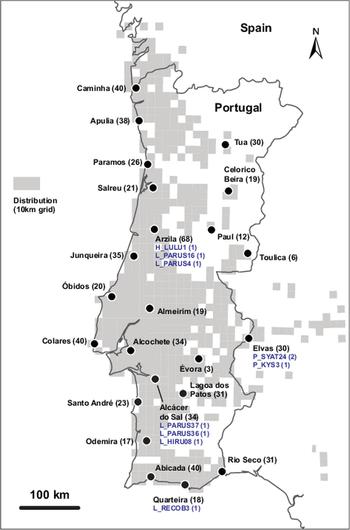
Distribution of the introduced Common Waxbill (Estrilda astrild) in West Iberian Peninsula (shaded grey 10 km grid), the location of the sampled populations (number of surveyed birds in brackets) and identification of the haemosporidian lineages found in each population (number of infected birds in brackets). Data on the distribution from the latest Portuguese and Spanish Atlases on Breeding birds (Marti and Del Moral Reference Martí and Del Moral2003; Equipa Atlas, 2008).

We investigated these three questions by first examining the prevalence and genetic diversity of the whole range of haemosporidian parasites (Plasmodium, Haemoproteus and Leucocytozoon) infecting common waxbills across the introduced metapopulation of waxbills in the Western Iberian Peninsula. Then we examined the published data concerning the prevalence of these parasites in the native range of waxbills, both in the common waxbill and other passerine species in their native communities in Africa. Our aim was to test if the introduced birds were free of local parasites, as opposed to being part of the local cycle of host-parasite interactions, and to understand the role of biogeography to explain these findings.
Materials and methods
We sampled 617 common waxbills in 23 sites across the distribution range in continental Portugal (Fig. 1). Sites were chosen to encompass the range of ecological and demographic variation of the waxbill exotic range in western Iberia, and were sampled in semi-random order during two breeding seasons (2010 and 2011) to avoid correlating date of sampling with ecological differences across sites. Field sites and capture methods are detailed in Carvalho et al. (Reference Carvalho, Leitão, Funghi, Batalha, Reis, Mota, Lopes and Cardoso2013).
A blood sample was taken from each bird with a puncture of the brachial vein and stored in ethanol. DNA was then extracted from whole blood following a silica gel kit protocol. The success of each DNA extraction was verified with primers that amplified a diagnostic avian sex primer set, as described in Carvalho et al. (Reference Carvalho, Leitão, Funghi, Batalha, Reis, Mota, Lopes and Cardoso2013). All samples were tested for infections using two nested polymerase chain reactions, to amplify a fragment of a mitochondrial gene (cytochrome b) from malaria parasites (Hellgren et al. Reference Hellgren, Waldenstrom and Bensch2004). The first PCR (using primers HaemNFI and HaemNR3) amplifies parasite mtDNA from species of Haemoproteus, Plasmodium and Leucocytozoon. The second PCR, amplify Plasmodium and Haemoproteus (primers HaemF and HaemR2) or Leucocytozoon (primers HaemFL and HaemR2L). Positive (bird samples with positive infections endemic of a distant region, the Caucasus) and negative (purified water) controls were used to verify the absence of contamination and the success of each PCR set. All PCR protocols consisted of 0.9 µl of HOT FIREPol Blend Master Mix 10.0 (Solis BioDyne, Estonia), 0.35 µl of each primer, 1 µl of DNA template and nuclease-free water for a total volume of 8.1 µl. The conditions were as follows: 15 min at 95 °C, 37 cycles of 30 s at 95 °C, 30 s at 51 °C and 90 s at 72 °C, followed by 10 min at 72 °C. PCR products were visualized on a 2% agarose gel by electrophoresis. Positive samples were sequenced and run on a 3730xl Genetic Analyzer (Applied Biosystems, the USA) in Macrogen Europe (the Netherlands) and results were edited and assembled in Geneious 8.1 (Biomatters, New Zealand). They were then compared using BLAST algorithms to GenBank and MalAvi (a repository of avian malaria sequences) databases for identification (Bensch et al. Reference Bensch, Hellgren and Pérez-Tris2009; NCBI Resource Coordinators, 2017).
To test if the Enemy Release hypothesis is the most parsimonious explanation for the low parasite prevalence in the waxbills of Iberia, data on parasite prevalence in the native range were compiled from several sources. First, all occurrences in MalAvi were compiled (in August 2017). This database is optimized for the recording of positive infections and, therefore, the number of sampled birds is usually not shown. Therefore, we compiled most of the bibliographical sources where this species was sampled and prevalence can be calculated. This compilation included data on the other Estrilda species to provide more spatial data on the variability of haemosporidian infections in Africa (Supplementary Table 1).
Using the software environment R 3.4.1 (R Core Team, 2017) we tested whether infections are randomly distributed over space, using the tango.stat command from the package DCluster (Tango, Reference Tango1995; Gómez-Rubio et al. Reference Gómez-Rubio, Ferrándiz-Ferragud and Lopez-Quílez2005). 95% confidence intervals for apparent prevalence were calculated using binom.test and prevalence estimates were compared using the prop.test command.
Results
The apparent total prevalence (1.6% with 95% confidence interval = 0.8–3.0%) of infection in waxbills from Iberia was low, with ten infected birds out of 617 individuals, and a total of only nine lineages (six Leucocytozoon, one Haemoproteus and two Plasmodium) of parasites (Fig. 1). The infections were not clustered among sites (Tango's statistics = 0.02, P = 0.152), found in only four of the 23 sites (Supplementary Table 2) and no lineage of parasites was found at more than one site. Multiple genera of parasites were only found in one site (Arzila), where the number of sampled birds was largest (68 birds). The lineage of Plasmodium (SGS1) discovered by Ventim et al. (Reference Ventim, Mendes, Ramos, Cardoso and Pérez-Tris2012) in a common waxbill in Santo André was not found in our survey (Fig. 1). The MalAvi database shows that all of these lineages were only recorded in the Western Palearctic, with the exception of the Leucocytozoon lineage RECOB3, which was also recorded in the Afrotropic, both in resident and migrants from the Western Palearctic. This lineage is the most generalist, with infections recorded in nine families while most (five) of the other lineages were recorded in only one genus of passerine birds.
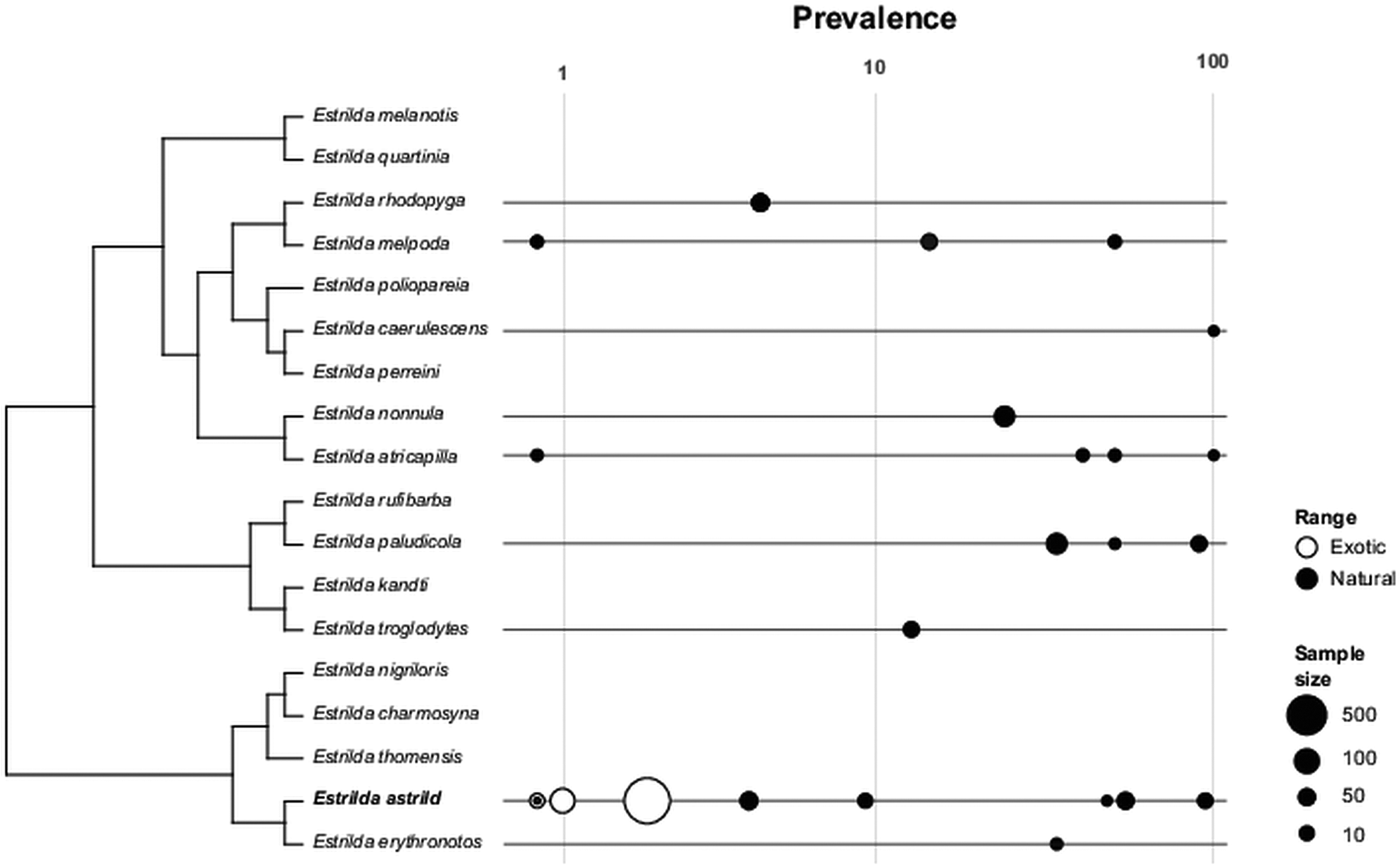
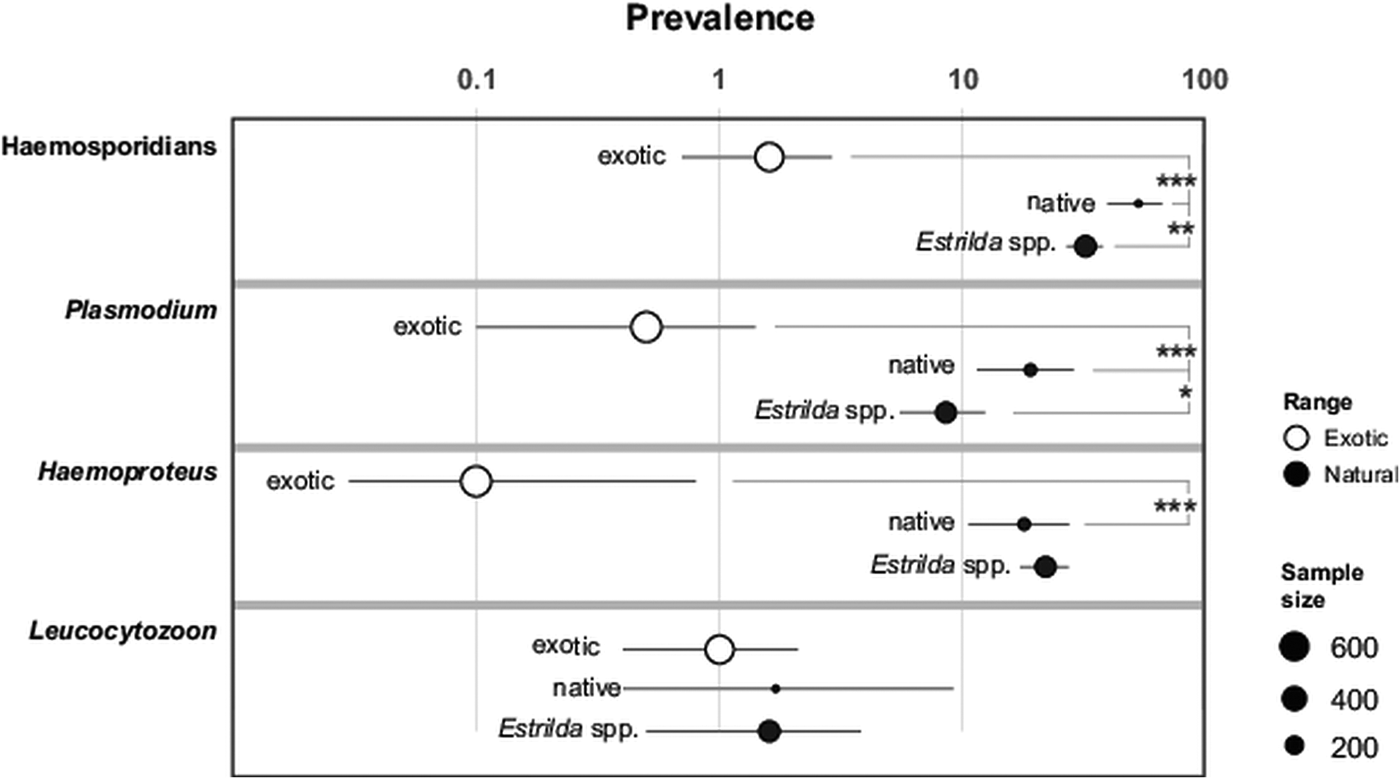
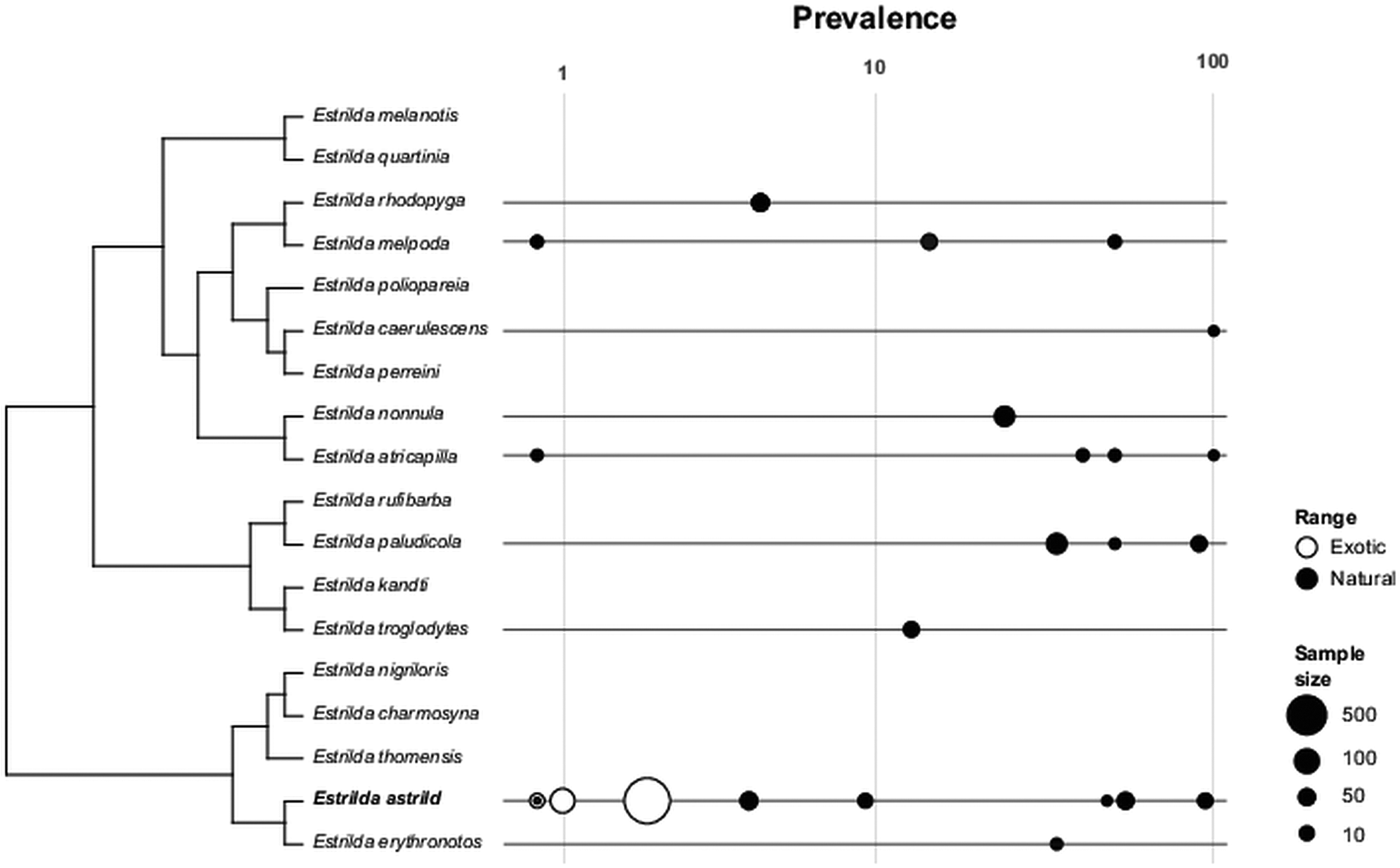
The MalAvi database contains 1459 records of lineages in sub-Saharian African birds, and the genus Estrilda had 11 infections recorded in 51 birds (four Plasmodium, four Haemoproteus and three Leucocytozoon), with three of those parasite lineages (Plasmodium BUL07 and GRW09 in Malawi and Tanzania, and Leucocytozoon AFR214 in São Tomé) found in a total of 34 individual common waxbills (Bensch et al. Reference Bensch, Hellgren and Pérez-Tris2009). Furthermore, compilation of positive records of haemosporidian infection from the primary literature, ranging from microscopy to genetic surveys (Supplementary Table 1), shows apparent prevalence from zero to 93% in the native range of common waxbills, excluding islands populations (pooled apparent prevalence = 52.5%) (Fig. 2 and Supplementary Table 3). The prevalence in exotic (pooled apparent prevalence = 1.6%) is significantly lower than in natural ranges (Fig. 3 and Supplementary Table 3) while the overall prevalence in native populations of common waxbills is significantly higher than in the whole Estrilda spp. (pooled apparent prevalence = 31.8%). Further analysis at the parasite genus level shows that the prevalence of Plasmodium and Haemoproteus infections is also significantly lower in exotic grounds than in native grounds while the prevalence of Leucocytozoon is not significantly different (Fig. 3 and Supplementary Table 3). The prevalence of Plasmodium infections is significantly higher in common waxbills than across all Estrilda spp. while there were no significant differences in the prevalence of Haemoproteus and Leucocytozoon infections (Fig. 3 and Supplementary Table 3).
Prevalence (logarithmic scale) of all compiled information from native (black circles) and exotic (white circles) populations for all species in the genus Estrilda (see Supplementary Table for details). Species are ordered according to their phylogeny from BirdTree.org, derived from 1000 trees (see ‘Methods’ section for details).
Pooled prevalences with 95% confidence intervals (logarithmic scale) of all exotic and native populations of common waxbills and also for all the genus Estrilda. The statistical significance for all significant comparisons of prevalences is shown. Significance levels are symbolized by *P < 0.05; ** P < 0.01; ***P < 0.001.

Discussion
The prevalence of waxbill haemosporidian infections throughout their distribution in Portugal was very low (<2%) and included several haemosporidian lineages (almost as many lineages as the number of infected birds) that are all known from the Western Palearctic and none exclusive from Africa. Taking into account that MalAvi still shows a bias towards screening in west Palearctic in comparison with sub-Saharan Africa, these results suggest that haemosporidian infections of common waxbills in Iberia are stochastic and sporadic, probably dependent on small-scale variations on habitat, native hosts and the vector community. Indeed, all the positive infections appear to be opportunistic and originated from the native hosts, due to their randomness and lack of biogeographical pattern [including also the one infection recorded by Ventim et al. (Reference Ventim, Mendes, Ramos, Cardoso and Pérez-Tris2012)]. Contrary to waxbills, screening of native birds from Iberia (six species, 972 individuals) from the same habitats revealed widespread infection by SGS1 (Ventim et al. Reference Ventim, Mendes, Ramos, Cardoso and Pérez-Tris2012), supporting the hypothesis that common waxbills are not regularly infected by the most prevalent haemosporidian parasites in Iberia.
To understand if the low prevalence of parasitism in waxbills results from an Enemy Release process, it is important to show that waxbills are more heavily parasitized in their native range. Otherwise, they may show low infection rates due to, for example, a strong immune system or behavioural avoidance of vectors (Mendes et al. Reference Mendes, Piersma, Lecoq, Spaans and Ricklefs2005). The compilation of MalAvi data from sub-Saharan Africa shows that infections are more common there than in the exotic range. Data from MalAvi is not conclusive because it comprises studies with different collection and laboratory screening protocols (e.g., a bias towards screening Plasmodium, more than Leucocytozoon and Haemoproteus), and often lacks sufficient comparison with sympatric avian species (Outlaw et al. Reference Outlaw, Harvey, Drovetski and Voelker2017). Nonetheless, our compilation of haemosporidian infection records from Estrilda spp. in the literature shows the prevalence of infection varying from zero to 100% (Supplementary Table 1), with an average prevalence higher than in Iberia. These differences between the native and exotic ranges are mostly due to changes in the prevalence of Plasmodium and Haemoproteus genera. However, data from the native range vary in nature, from microscopic to molecular screening, and from very specific times, spatial and taxa sampling to more widespread screenings. It is therefore difficult to disentangle parasite species richness and prevalence and, without a robust experimental design to analyse the importance of time, space and taxonomy on parasite prevalence and richness, it is difficult to prove unequivocally that the native populations of waxbills do not show lower infection rates than the other co-occurring species.
The most parsimonious explanation appears to be that the haemosporidians that parasitize waxbills in Africa ‘missed the boat’ for the biological invasion in Iberia. Most likely this was due to the nature of the waxbill introductions in Iberia, which were preceded by the trade of birds from Africa and widespread captive breeding for the pet market (Cardoso and Reino, Reference Cardoso, Reino, Queiroz and Pooley2018). In this context, it is very likely that the birds released into the wild were bred in captivity in Portugal, reducing the probability of carrying vector-mediated parasites from their native range. This species has been a common pet species in Portugal, perhaps due to the connection of Portugal to its former African colonies (Mozambique and Angola), from where this species is native (Stiels et al. Reference Stiels, Schidelko, Engler, Elzen and Rödder2011). However, it is not known if the founder birds were originally captured in African populations and brought to Portugal or were descendants born already in captivity in Portugal. The latter is more likely, since the number of birds from Africa that were translocated to maintain the trade of waxbills in Portugal may have only been high at the beginning, before the establishment of a large number of reproductive pairs in captivity in Portugal. This scenario is somewhat different from the introduction of common waxbills in Brazil, which were taken from Africa in slave ships and released into the wild at least since the late XIX century (Sick, Reference Sick1997). In contrast to the absence of African haemosporidian lineages in the waxbills in Portugal, waxbills in Brazil retain some of their Old World acarofauna, rather than being infected by Neotropical mites (Hernandes and OConnor, Reference Hernandes and OConnor2017). Unfortunately, no data is available concerning haemosporidian infections in Brazil. It is quite conceivable that mites did not ‘miss the boat’, since they do not require a vector for transmission, and perhaps because birds transported to Brazil may have been released soon after into the wild. It would be interesting to screen the mite community in Iberian birds to understand the impact of captivity prior to founding events, as a bottleneck for parasites.
Our comprehensive survey showed that exotic common waxbills in Iberia have a very low prevalence of haemosporidian infections, a factor that could be important to understand their success expanding throughout most of Western Iberia. It was already known that the ecological niche of this species in Iberia only overlapped marginally with those of native species (Batalha et al. Reference Batalha, Ramos and Cardoso2013), and we also found that the prevalence of haemosporidian infections is, on average, higher in common waxbills in their native range than in Iberia, which is consistent with the Enemy Release hypothesis. These two factors (ecological distinctiveness from native passerines and release from parasites) need to be integrated in order to understand how they may have facilitated this expansion. Nonetheless, we reiterate that a robust test of this hypothesis would also require data on the prevalence of malaria in other, sympatric species from the waxbill native range, which is still difficult to obtain since the MalAvi database is focused on parasite genetic diversity and not on epidemiological information (i.e. data are available on positive infections, but it is not mandatory to report information on individuals with negative results). We hope that this kind of article stimulates the publication of negative screenings, as a key procedure to obtain a better knowledge of tropical haemosporidian epidemiology for a range of passerine species, which would allow improved tests of the Enemy Release hypothesis in common waxbills and other exotic passerines.
Acknowledgements
Work with waxbills was done under permits 04/2010/CAPT and 45/2011/CAPT from the Instituto da Conservação da Natureza e da Biodiversidade. RJL conceived the study, analysed and interpreted the data. GCC and HB carried out the sampling of birds. JC and HB carried out the molecular laboratory work. RJL and GCC drafted the manuscript. All authors read and approved the final manuscript. We thank Carlos Carvalho and Sandra Reis for help during fieldwork and labwork, and we thank Raquel Xavier, Ana Perera and two anonymous reviewers for valuable comments on the manuscript.
Financial support
This work was funded by grants PTDC/BIA-BEC/ 098414/2008 and PTDC/BIA-EVF/116758/2010, and fellowships SFRH/BPD/40786/2007, SFRH/BPD/46873/2008, SFRH/BPD/84141/2012 and SFRH/BPD/110165/2015, funded by FCT/MEC and POPH/QREN/FSE.
Supplementary material
The supplementary material for this article can be found at https://doi.org/10.1017/S0031182018000331