Introduction
Growing antimicrobial resistance (AMR) is one of the most significant public health threats in modern times. It is estimated that AMR leads to approximately 23,000 deaths in the US and 25,000 deaths in the European Union (EU).Reference Renwick, Brogan and Mossialos1 New treatments to address this growing resistance are urgently needed, yet the pipeline of novel antibiotics is extremely limited.2 If the current increase in AMR rates continues and new tools to combat AMR are not developed, the health and economic burden on society could be significant.Reference O'Neil3 There is increasing global attention to AMR at the United Nations, World Health Organization, G7 and G20, World Economic Forum, and OECD. The pharmaceutical industry has also made commitments to address AMR.4 These groups have all recognized the need for new incentives to facilitate increased antibiotic R&D as well as to enable availability and access to innovative antibiotics to treat AMR. Given the global diversity of health systems and types of antibiotics required, our perspective is that these incentives will likely need to be tailored to the local context and priorities; there is no one-size-fits-all solution to address the multi-level challenges of antimicrobial innovation.
Reasons for Uncertain Return on Investment for Novel Antibiotics
The reasons for the decline in antibiotic research and development (R&D) are manifold, including scientificReference Silver5 and regulatoryReference Rex, Goldberger, Eisenstein and Harney6 challenges, as well as limited returns for novel antibiotics7 once approved.
With regards to the economic challenges, firstly, novel antibiotics are generally undervalued by reimbursement systems relative to their societal value and public health benefits as Health Technology Assessment (HTA) agencies do not fully recognize these elements in current assessment frameworks.8 The antibiotics market is dominated by generic products, which are considered to be effective for the majority of patients who are not infected by resistant pathogens. To facilitate antibacterial development and enable feasible development of new agents that can proactively address emerging resistance before it is widespread, regulators accept non-inferiority clinical trial designs for approval decisions for novel antibiotics. This means that clinical differentiation versus standard of care, a key requirement to achieve favorable benefit assessments by European HTA agencies and hospitals, is difficult, which negatively impacts pricing and reimbursement negotiations.
Secondly, once they have received marketing authorization, novel antibiotics are generally used sparingly to preserve effectiveness, particularly since infections caused by resistant bacteria may be initially rare. There is often limited availability/use of diagnostics and limited local surveillance data on resistance to guide clinical decision making regarding antibiotic treatment choice. Additionally, reimbursement systems can restrict or discourage the use of newer medicines. Antibiotics used to treat serious infections in the hospital setting are generally funded through Diagnostic Related Groups (DRGs) both in Europe and the US. DRGs are lump sum payments and can vary considerably depending on the primary patient diagnosis for which the hospital is reimbursed. As the DRG payments are constant and meant to reimburse for all procedures related to a particular diagnosis, including drug costs, hospitals are unable to recuperate costs when using novel and costly antibiotics. This often results in significant restrictions by hospitals when making formulary listing decisions and patients may be denied early and appropriate treatment due to budget constraints.
And finally, there are additional challenges with estimating the market size due to considerable uncertainty associated with predicting the rates at which multi-drug resistance will arise.Reference Sommer, Munck, Toft-Kehler and Andersson9
All of these factors contribute to limited and uncertain returns for new antibiotics relative to other therapeutic areas and declining private investment in antibiotic R&D.Reference Kinch10 To address these challenges, governments have recognized the need to put policies in place that: (1) promote sustainable investment in innovation to combat AMR and provide a competitive return on investment; and (2) drive appropriate use, making novel antibiotics available to patients who need them, while also preserving their effectiveness for future patients.
Potential Actions to Stimulate Antibiotic R&D
Renwick et al.11 provide a systematic review of available literature and have identified 46 unique incentive strategies that were designed to potentially stimulate antibiotic R&D. As expected, all models have their pros and cons and some additionally rely on sustainable sources of funding.
Several groups, including DRIVE-AB,12 the AMR Review,Reference O'Neil13 Chatham House,Reference Outterson14 Boston Consulting Group,Reference Chorzelski15 the pharmaceutical industry,16 and othersReference Goldhammer, Mitchel, Parker, Anderson and Sahil17 have attempted multi-dimensional approaches to evaluate innovative economic solutions that may provide appropriate incentives for stakeholders to invest in antibiotic R&D.
Common recommendations in these reviews include: additional “push” funding (e.g., grants, tax credits) to directly cover the cost of antimicrobial R&D combined with some form of de-linked “pull” mechanism (e.g., Market Entry Reward, transferable exclusivity, insurance models) to reward developers for successfully bringing a new product to market.
These novel de-linked “pull” mechanisms reduce the proportion of developer revenue/return derived from antibiotic sales volume and may decrease payer and developer uncertainty. In some cases these incentives would require significant changes to current reimbursement systems or new systems to establish eligibility and the magnitude of the de-linked payment.Reference Daniel, Schneider and McClellan18 Such incentives could be useful to reduce developer uncertainty for antibiotics targeting pre-defined resistance profiles that could emerge over time and have very low expected use. However, they may not be appropriate for stimulating R&D for all types of antibiotics. These models reduce developer uncertainty by shifting risk to the payer, which must accurately predict resistance patterns and future innovation needs. This is no easy task. If these predictions are incorrect, de-linked incentives could fund innovation that is not well aligned to future needs. To a certain extent, these challenges may be mitigated by the implementation of partially de-linked models, where some proportion of developer revenue is still derived from unit-based sales. This lowers the upfront financial commitment and risk to payers, works within existing reimbursement systems, and enables health market dynamics to facilitate competition and encourage innovation through differentiation.
Some of these reviews on antibiotic incentives19 have recognized the benefits of other incentive mechanisms, including those that could work within the structure of current health care systems. Some key examples of these types of incentives are described below: reimbursement reform, value-based pricing, and value assessment reform.
Reimbursement Reform
The current Diagnosis-Related Group (DRG)-based hospital reimbursement system in the U.S. and most of Europe imposes a significant economic constraint on antibiotics used to treat serious infections in the hospital settings. As mentioned previously, DRGs provide a set payment to hospitals for a given patient diagnosis, encompassing labor and non-labor costs including pharmaceuticals. This often results in significant restrictions on the more expensive novel antibiotics by hospitals when making formulary listing decisions as the cost of these expensive products may not be fully covered by the DRG payments. As a result, patients may be denied early and appropriate treatment, which has been shown to reduce morbidity and mortality,Reference Viale, Giannella, Lewis, Trecarichi, Petrosillo and Tumbarello20 due to budgetary considerations. Reforms are needed to reimburse the novel antibiotic separately from the bundled payment. Several proposals have been made in the US (DISARM Act) and Europe to implement these changes.
Value-Based Pricing
Value-based pricing (VBP) models for medicines are risk-sharing arrangements intended to align pricing and/or payments for medicines to the benefits they provide to patients and health care systems. An example of VBP models is indication-based arrangements when benefits vary significantly across patient segments (e.g., different indications for the same medicine or personalized medicines). Another is performance-based risk-sharing arrangements when the potential outcomes of the medicine in the real-world setting are uncertain (e.g., due to accelerated approvals, or difficulty in predicting which patients are likely to respond). VBP could be an attractive solution for antibiotics because of the potential to structure incentives to promote stewardship while creating reasonable commercial return to antibiotics R&D.Reference Kesselheim and Outterson21 It also maintains current market-based forces and competition between companies with new antibiotics to drive innovation, as the prices charged per antibiotic are set independently. Specific proposals on VBP models include a dual-pricing model (Diagnosis Confirmation Model22) and a population-based model (Priority Antimicrobial Value and Entry Award23).
Value Assessment Reform
Reform to the current value assessment methodology is fundamental to enable successful implementation of the above models since the size of the rewards (delinked models) or prices (value-based pricing) should be commensurate with the benefits that antibiotics bring to the patients, health care systems, and society. The value of novel antibiotics is under-recognized because certain societal values of antibiotics are often not captured within current Health Technology Assessment (HTA) frameworks. In the European AMR Action Plan24 that was launched in June 2017, the European Commission committed to “develop new or improved methodological HTA approaches and foster methodological consensus-building.” Various researchers, including DRIVE-AB and the Office of Health Economics,Reference Schaffer, West, Towse, Henshall, Mestre-Ferrandiz, Masterton and Fischer25 have recommended that the unique attributes of novel antibiotics should be considered in reimbursement decision making, in a way which captures the full range of benefits these important technologies bring to patients, the health care system, and society. Otherwise, the value of these essential medicines could continue to be substantially under-recognized, leading to inadequate reward and continuous declining innovation to address the rising AMR problem. They propose that value assessments for novel antibiotics include the following:
A sensitivity analysis, as appropriate, of the impact of resistance to the new antibiotic, both initially and over time
Population-level analysis
Not only the direct costs and direct benefits associated with treating one patient with an antibiotic, where relevant, but also the following benefits:
- indirect benefits from avoided transmission
- diversity benefits from the protective effects on existing antibiotics currently in use26
DRIVE-AB found that some of these value elements proposed have previously been discussed qualitatively by HTA bodies when evaluating antibiotics, but are not yet formally captured via modelling.27 The recommendations from this research and the call in the EU AMR Action Plan create some momentum for national HTA and reimbursement authorities in Europe to begin to integrate these recommendations into their value frameworks.
Different Solutions for Different Antibiotics
To best understand how different solutions are needed, it is important to understand what factors impact antibiotic use in clinical practice at the hospital level. The ultimate decision to treat with a particular antibiotic will likely depend on the type of antibiotic (broad spectrum versus narrow spectrum/pathogen specific antibiotics) being considered as well as local MDR rates for the suspected pathogen(s). As illustrated by Figure 1, an antibiotic is likely to be used empirically only in cases where MDR rates in that setting (national, regional, local or even ward level) are considered to be high. If the MDR rates are considered to be low, empiric use is less likely as there will be situations where cheaper alternatives will be recommended to clinicians in guidelines while waiting for a confirmatory MDR diagnosis, which currently takes approximately 3-5 days. In situations, where MDR rates are extremely low, use is likely to be severely restricted as the antibiotic will only be used in emergency cases following confirmatory diagnosis or in cases where all treatments have failed.
Antibiotic Use in Clinical Practice Depends on the Type of Antibiotics as well as Population Size

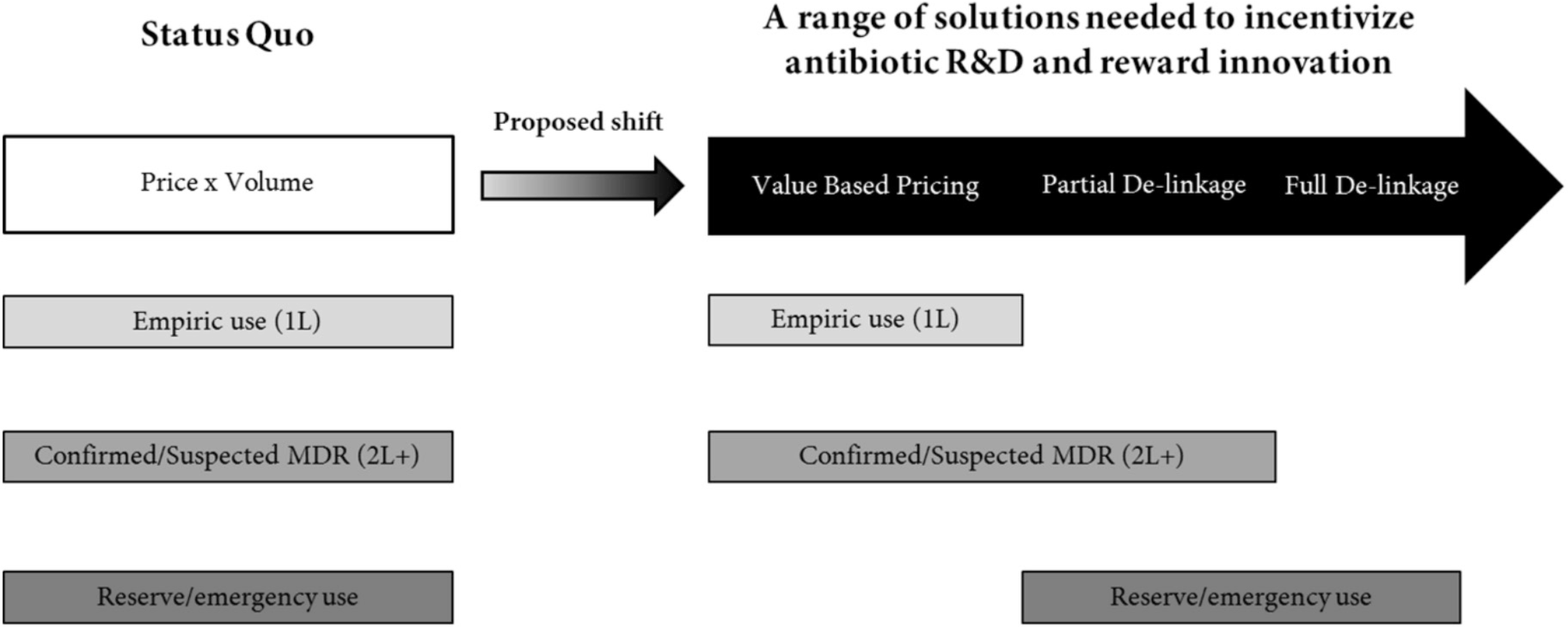
In those cases where resistance rates are low and/or the incidence of the pathogen(s) is not considered to be substantial, the likelihood of restricting use, only in patients who are either confirmed or highly suspected of an MDR infection or fail prior lines of therapy, is greater. In such cases, especially those where use is likely to be extremely low (emergency cases), a de-linkage model may be an appropriate solution to encourage investment.
In comparison, antibiotics that are used or expected to be used in earlier lines of treatment (and result in a sufficiently large patient population) are likely to generate substantially more revenue for pharmaceutical manufacturers compared to antibiotics that are likely to be used sparingly (in a small number of patients). However, empiric use prior to diagnostic confirmation is likely to result in hospitals/payers having to pay for the antibiotic even when used in those patients who did not present with resistant strains. Therefore, VBP models could be potential solutions to ensure (1) appropriate and accountable stewardship and (2) increased budget certainty for hospitals and payers.
We illustrate this approach in Figure 2, which demonstrates how the system could move from the status quo to a “range of solutions” to incentivize different types of antibiotics depending on the way in which they are likely to be used in clinical practice (as depicted in Figure 1; antibiotics expected to be used in the empiric, confirmed/suspected or reserve/emergency setting).
The Range of Solutions Needed to Incentivize Antibiotic R&D and Reward Innovation
(R&D = research & development; 1L = first-line; 2L = second-line)

Further consideration of the appropriate solution may also be needed depending on the setting, e.g., developed versus low income countries, hospitals with advanced infrastructure versus those with basic infrastructure etc.
As mentioned previously, it is difficult to forecast the future market size for any antibiotic, including market evolution over the product's patent life, given the difficulty associated with estimating the evolution of resistance with certainty. A prerequisite (and complexity) of the Market Entry Reward model is that it would require willing funder(s) and sustainable source(s) of funding several years in advance of market entry to ensure that the incentive exists at the time of development. It is important to maintain some level of shared risk between governments/payers and the pharmaceutical industry in order to drive continued innovation. In fully de-linked models, the public sector assumes significant risk because it “picks winners” early, often before key characteristics of products are fully understood or in absence of data on emerging resistance — this may not be optimal use of public resources. The continued investment that comes with partially de-linked, shared-risk models drives continued investment into new indications and the generation of more data on appropriate use of novel products. Given that risks are not uniform across product life-cycles/markets, the previously mentioned challenges of setting eligibility criteria and reward sizes ex ante, and concerns over the long-term funding sustainability, delinked incentives like Market Entry Rewards may not be appropriate to reward innovation for all types of antibiotics. Instead, through the additional consideration of value based pricing as well as partial de-linkage models, appropriate solutions can be fit to different antibiotics while minimizing risk.
There Is No One-Size-Fits-All and a Range of Incentives Is Needed
As described above, there are many challenges to the sustainable investment in antimicrobial R&D. And there are many different proposals to address these challenges. From our perspective, there is no single solution to incentivizing antibacterial innovation that is suited to every country: a range of mechanisms that are fit-for-purpose and designed to address specific antibiotic market challenges is needed. These incentives should:
Stimulate investment along the product life cycle: A suite of both “push” and “pull” incentives will likely be needed to stimulate investment across the product life cycle. These should be tailored to the context and political realities of each region/country. For example, combined together, a suite of incentives could reduce the cost of clinical development (tax credits), provide financial return early in the product life cycle when use is expected to be low (Market Entry Reward), and address barriers to appropriate use and facilitate market-based incentive mechanisms (reimbursement reform).
Account for health system differences: While the global-level attention on AMR has been useful, solutions for incentivizing R&D and promoting appropriate use will likely come from the local level. These delivery and incentive financing mechanisms will need to be well-integrated into the health systems where antibiotics are used. As countries have adopted many different health care and financing systems, any single incentive model is unlikely to be appropriate for all settings or capable of resolving all antibiotic R&D challenges.
Incentivize different types of products: As discussed in the previous section, certain incentive models may be more appropriate for different types of antibiotics (broad vs pathogen-specific, small vs. large population size). A wide range of tools will be needed to address AMR and slow the spread of resistance.
Balance what can be implemented now within existing systems vs. mid/long-term incentives: Implementation of some of the novel “pull” mechanisms may be complex and require major modifications to current procurement and reimbursement structures, significant resource mobilization, and greater coordination across different stakeholders. Realistically, these changes will take time and may only be implemented on a mid- to long-term basis. Investment decisions on R&D for tomorrow's novel antibiotics are being taken today. While novel incentive mechanisms are being explored, action is needed now to address current reimbursement challenges for novel antibiotics that undermine confidence in R&D for future antibiotics. There are several concrete actions national authorities can take to address the economic challenges of antibiotic R&D within existing systems: the development of HTA processes to better capture the societal value of antibiotics and reimbursement reform to remove access barriers posed by bundled-payment mechanisms that discourage the appropriate use of novel antibiotics within hospitals due to cost constraints. There is no “ideal” incentive model and all models have their pros and cons; the perfect should not be the enemy of the good.
It is unlikely that a “one size fits all” solution will be the way forward. Instead, different solutions are needed depending on the type of antibiotic, the evolution of resistance over time, likely use in clinical practice, and the health care setting under consideration. Reforms are also needed to eliminate access barriers associated with bundled payment mechanisms (DRGs) for novel antibiotics that currently pose constraints on hospital budgets when making appropriate treatment decisions. In addition, HTA authorities must continue the debate on how to fully capture the societal value of novel antibiotics, which may not be adequately captured within existing assessment framework. It is important for policymakers, payers, and the medical community to collaborate in order to address the current gaps in the market for antibiotics.
Conclusions
AMR is on the rise while the pipeline of new and innovative antibiotics is limited. Appropriate economic incentives are needed to stimulate antibiotic R&D and encourage pharmaceutical innovation. It is unlikely that a “one size fits all” solution will be the way forward. Instead, different solutions are needed depending on the type of antibiotic, the evolution of resistance over time, likely use in clinical practice, and the health care setting under consideration. Reforms are also needed to eliminate access barriers associated with bundled payment mechanisms (DRGs) for novel antibiotics that currently pose constraints on hospital budgets when making appropriate treatment decisions. In addition, HTA authorities must continue the debate on how to fully capture the societal value of novel antibiotics, which may not be adequately captured within existing assessment framework. It is important for policymakers, payers, and the medical community to collaborate in order to address the current gaps in the market for antibiotics. This should be done through the facilitation of legal, regulatory, and funding processes as well as identifying pragmatic ways to implement appropriate solutions at the local, regional and global levels. If governments can create market conditions where there is a predictable and sustainable return on investment, the pharmaceutical industry and private investors have demonstrated their willingness to take on the necessary risk and uncertainty that comes with the development of an approved medicine. These market conditions can be created through both novel incentive mechanisms, such as Market Entry Rewards, and reforms to existing mechanisms, such as reimbursement and health technology assessment reform. Governments and policymakers should consider a wide range of incentives and work with industry to implement them.