Pageantry is a collaboration between Denise Uyehara and Sri Susilowati, between two very different war-related family histories, two ethnicities, two distinctive performance styles and corporeal sensibilities. Uyehara is a performance artist whose family originated in Okinawa. Her works, usually text-based solo pieces, sometimes with multimedia usage and sometimes with movements, are by nature interdisciplinary and multicultural. Susilowati is a traditional Indonesian dancer by training, a choreographer who integrates modern and traditional, classical aesthetics and contemporary politics. Her training in Jaipongan (traditional dance of Western Java) gives her stage presence a clear ethnic and cultural framework in the eyes of a Western audience. Uyehara, on the other hand, tends to use her body as a blank canvas to be drawn or projected on, as a tool for free association.
War
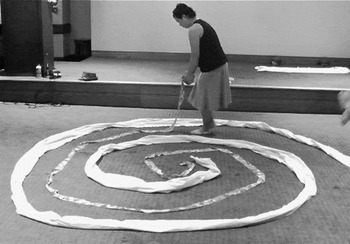
Two women, with their backs to us, swing in silence, left to right, right to left, like willows in the wind. They pick up a piece of white cloth, on which is projected a black-and-white image of Japanese families leaving for an internment camp. Sound of wind, lonely and desolate. Two very long scarves, one white, one multicolour, form two concentric coils on the downstage floor. The two women roll up the long scarf, little by little, slowly and gingerly. Sound of a military aeroplane mixed with nightclub music replaces the wind. They move faster and faster, unwinding the circle in a panic. They make the rolled-up scarves into a bundle. It is a wrapped baby, a small sack of rice, something precious and essential, something hidden, something they are going to lose. The war has begun.
The War – the Pacific War and the Second World War – is the first thing that Pageantry introduces to its audience. The war has touched both artists in very different ways: Uyehara's family, like other Japanese Americans, was sent to an internment camp during the Second World War.Footnote 1 Susilowati's family, on the other hand, lived under Japanese occupation in Indonesia during the war. The militant colonizers in Asia and the victims of racial discrimination in the US share the same name: Japanese. The war has reconstructed the racial order of American performing arts through erasure and denial; reracialized dancing bodies become the casualties of the War.
Denise Uyehara in Pageantry, UCLA, 2008. (Photograph courtesy of the UCLA Center for Performance Studies.)

Deracialization
‘This is how you plié’, Uyehara demonstrates her ‘Western’ body while Susilowati displays her Asianness in her exquisite hand gestures. ‘This is how you do the first position’. As the bodies are confined to their separate formalized/racialized movements, Uyehara says, ‘This is your life going nowhere’. Exciting nightclub music. The two shake their hips. Sizzling moves, hips circling and throbbing.Footnote 2 A loud smack on a plump romp! Music stops. Uyehara speaks in a man's voice: ‘Honey, where did you learn those moves? Mi-chi-o I-to? Never heard of him. Show me your legs.’ Susilowati lifts up her skirt. ‘You are in!’ says the man.
The clash of East and West, art and sensuality in Pageantry is introduced in this second sequence to mark the erasure, the forgetting of Michio Ito (1892–1961), a native of Japan who learned traditional Japanese dance and later studied at the Dalcroze Institute at Hellerau. His association with W. B. Yeats and Ezra Pound (in The Hawk's Well), his studio in New York and connection with Ted Shawn and Jack Cole in Hollywood, all helped produce and popularize orientalized fantasies. In 1929, during the Great Depression, he staged The New World Symphony, a grand pageant at the Rose Bowl with two hundred dancers, a symphony orchestra, choruses and five thousand people in attendance. By the 1930s, he had consolidated a reputation for his work, based on a synthesis of Kabuki exoticism and German expressionism, and was well connected to elite European and American modern dance circles. In times of peace, his masculinity hid behind his exotic ethnicity and made him a welcoming oriental ‘third sex’ – ambiguous, inscrutable, hermaphroditic,Footnote 3 but nevertheless exotic and artistic; however, wartime Japanese militarism proved resistant to such castrating fantasies from the West. Japanese masculinity had to be further contained, controlled or altogether transformed into American patriotism. Unsuccessful racial transformation resulted in total erasure: deportation.Footnote 4
Ruth St Denis, Ito's contemporary, who also incorporated her Eastern ‘inspiration’, would later become a symbol of American modern dance. Ito's fate, on the other hand, was very different because he could not unmark his ethnic body when deracialization became a must during the war. His legacy, like the ethnic ‘shame’ of internment memories, is deliberately forgotten and erased from American dance history.Footnote 5
Reracialization
The man (Uyehara) says: ‘We've got to change your stage name. The one you got is bad for business. How about Miss . . . ChopSuey? ChopSuey, kind of catchy! How about Miss . . . DejaVu? How about Miss . . . DingaLing? The man is ecstatically repeating his own fantastic inventions of oriental stage names; meanwhile, the woman (Susilowati) holds the bundle, dancing her traditional dance in a serious manner. Her dance becomes more melodramatic; her elaborate Indonesian hand gestures and footwork blend into the romantic Western background music. Uyehara puts on a hat and transforms herself into a film noir hero. Susilowati joins her in the noir world; they dance a duet. Sound of cabaret music and enthusiastic applause. Susilowati is throwing kisses, bowing, curtsying to her imaginary audience. She is well loved!
The seeds Ito scattered sprouted and grew into ‘distorted’ plants. After his deportation, many of his female students became nightclub dancers, including Uyehara's great-aunt, whose stage name was Miss DingDong! Sensual movement, high slits, alluring smiles, exotic stage names . . . Japanese women successfully deracialized themselves under the collective stage name of ‘Oriental Girls’.
Traditional Japanese mask dance, traditional Japanese music. The dancer (Uyehara) opens the black kimono top, showing a white shirt inside. When wearing a kimono, one needs to wrap the left side over the right side; only a corpse is dressed with the right side over the left. Uyehara quickly opens the kimono, closes it, opens it, closes it, taking turns to wear it in the way of life and in the way of death. Finally the kimono is wide open, and the image of a Japanese girl in a kimono, dancing in the desert landscape, is projected onto her white body. While the racialized body dances in the Internment-like loneliness and desperation, Susilowati appears, in her fantastically exotic costume (sarong, long scarf, and two-foot tall feather headdress), dancing to the melodramatic music. The music goes faster and she becomes more flirtatious; sits on the laps of spectators. She has transformed herself into the ultimate object of sexual pleasure.
While Uyehara's kimono connects the audience to the sombre rituals of life and death in Japanese tradition, Susilowati's costume leaves the door ajar to the realm of sexual pleasure with a tease of ethnic exoticism. As she becomes more exoticized, she becomes less racialized and much more desirable. The exoticized, sexualized, but racially non-specific body is the ultimate object of desire.
Rupture
Sensual hip movement, delicate supple hands, flirtatious glances, exotic costumes. She is Miss DingDong, Miss DejaVu, Miss ChopSuey. She survives not by being herself, but being the ultimate oriental desire. The music stops but she continues to dance. In her orientalized costume she gradually de-orientalizes herself, little by little, through her traditional dance movements, through her whispering of Indonesian dance terms. In the moment of rupture, she relocates her body in her memory, she reconnects her gestures to her discipline; her emotion to her ethnicity. For now, no one is consuming her. She dances for herself.
Pageantry ends with the possibility of rupture: of opening up American dance history and of challenging the context of the Actions of Transfer event and its co-sponsor, the Hemispheric Institute of Performance and Politics; it specifically intervenes in ideas of ‘international’ (read: not local), ‘hemispheric’ (read: north–south kind of crossing, not east–west fusion), and ‘political’ (read: contemporary politics, not cultural memory). Performed by Asian women local to the conference site, Pageantry insists on opening up and interrogating the place (or displacement) of Asians in the Americas.
Considered in a larger context, Asians in the Americas suggest exotic sojourners; they are not indigenous, not native, and sometimes not even considered local. When did Asians come to the Americas? Was it after the immigration reform in the 1960s or before the Chinese Exclusion Act in 1882? Perhaps it was during the Gold Rush of the 1850s, or in the 1500s as part of the coolie trade between Asia, Europe and the New World? Or when the continents of Asia and America were still connected? Neither scholarly writings nor the wildest ethnic imperialism can change the public notion of Asians being transient and non-American: they have just arrived or are about to leave, and their visible ethnicity prevents them from setting down roots, despite generations of residence. Their well-preserved family and cultural memories forever extend their status as diasporic and bar them from being native.
Pageantry further challenges the notion of Americanness. While Ito's contemporary Isadora Duncan and Ruth St Denis became synonyms of ‘American’ modern dance by incorporating foreign or ethnic elements, Ito was erased from American dance history. His disciples had to fake their ‘friendly’ ethnicity, and contemporary local Asian artists like third-generation Uyehara still have to fight for native legitimacy. The ‘Asian’ rupture in the performance, in the conference and in American histories and contemporary societies gives us a chance to pause and to ponder the discourse of race and ethnicity. The female dancing body offers an even greater possibility of rupture: the seamless transformation in movement and the tantalizing effect of costume invite the audience to savour the pleasure of dance through an ethnic fluidity and artistic hybridization that were available only to female dancers during the war. The rupture within and without Pageantry gives the power back to the female dancing bodies. Dance continues, even in a time of crisis.