




No CrossRef data available.
HOUSEHOLD ECONOMIC SPECIALIZATION AND SOCIAL DIFFERENTIATION: The stone-tool assemblage at El Palmillo, Oaxaca
Published online by Cambridge University Press: 01 July 2004
Abstract
This paper examines the stone-tool assemblage recovered from excavations of six Classic-period residential terraces at El Palmillo, a terraced hilltop community in the eastern arm of the Valley of Oaxaca. Based on this analysis, stone-tool production and the processing of xerophytic plants—most important, maguey—were found to be important household craft industries at the site. Yet certain craft activities were practiced in only a few households, while others were enacted more widely but in varying intensities or degrees. This house-to-house variability in production implies a reliance on a system of economic integration in which domestic units at El Palmillo exchanged specific goods with other households at the site as well as more broadly. Through comparison of domestic units, we also found that exotic obsidian and semiprecious stone artifacts were distributed differentially between households, although the extent of the differentiation was less marked than might have been expected at one of the largest Classic-period settlements in the Valley of Oaxaca. Together, these findings point toward a high degree of horizontal, socioeconomic interconnection and integration among household units at El Palmillo.
Information
- Type
- Research Article
- Information
- Copyright
- © 2004 Cambridge University Press
In pre-Hispanic Mesoamerica, households constituted a fundamental unit of economic production and sociopolitical organization (Balkansky et al. 1997; Feinman 1999; Feinman and Nicholas 1993, 1995; Hirth 1993a). Yet we know relatively little about the range of economic activities in which Mesoamerican households engaged or the diverse ways in which these domestic units were socially and economically articulated into larger communities and networks. We are only beginning to understand the different ways in which these domestic units that were part of larger communities and polities varied socially and economically.
Stone tools are ubiquitous in the archaeological record. For pre-Hispanic Mesoamerica, stone remained the principal productive technology up to the Spanish Conquest. Because stone artifacts often vary in form, use, physical attributes, and source material, they frequently have served to identify different craft activities; craftworkers not only make stone tools (craft goods in themselves) but also employ them to manufacture other goods (Aldenderfer 1991a; Hayden 1987; Keeley 1980; Lewenstein 1991; Misner 1993; Sievert 1992). By investigating the differential distributions of stone materials, archaeologists also have examined questions regarding the subsistence and craft activities in which households engaged. Broader questions dealing with variability among households, both in terms of access to goods and economic and social differences, also have been studied (Hirth 1993b). With these attributes, stone tools provide an important means through which to examine work and access distinctions among domestic units.
In this paper, we focus on the Valley of Oaxaca, a core region of pre-Hispanic political and demographic importance situated in the highlands of southern Mexico (Palerm and Wolf 1957). More specifically, we examine five domestic units at the large Classic-period (a.d. 200–800) community of El Palmillo, a terraced hilltop site at the eastern edge of the Tlacolula subvalley. With an emphasis on stone materials recovered in domestic contexts, we investigate the nature and diversity of residentially situated subsistence and craft activities. The study of stone materials in conjunction with other artifacts becomes a platform to unravel some of the activities that occurred in most, if not all, El Palmillo houses, as well as those that were more spatially limited. We also look at the distribution of stone artifacts across the excavated terraces to assess possible differences in house-to-house access and status. This research outlines the economic foundations of El Palmillo, a town at the fringes of the Classic-period Zapotec polity (Figure 1), which at that time was centered at the city of Monte Albán (roughly 50 km to the west). At the same time, we attempt to gain a better understanding of how domestic units were interconnected into larger social and economic groupings in pre-Hispanic Oaxaca and beyond in the ancient Mesoamerican world.

State of Oaxaca, showing the location of the Valley of Oaxaca and places mentioned in the text.
THE VALLEY OF OAXACA AND EL PALMILLO
The Valley of Oaxaca was dominated for more than a millennium (ca. 500 b.c.–a.d. 750) by Monte Albán—a hilltop capital and one of Mesoamerica's first cities—situated at the hub of the valley's three arms (Blanton 1978; Caso et al. 1967). With a large number of terraces arranged on the slopes of the hill and surrounding a core of monumental architecture, Monte Albán, by virtue of its size and monumentality, has long attracted archaeological interest. Yet archaeological perspectives on Monte Albán come principally from excavations conducted on the Main Plaza, the civic-ceremonial core at the apex of the city (Caso 1982), and a systematic survey of the entire site that was undertaken several decades ago (Blanton 1978). Until Ernesto González Licón's (2003) recent investigation of a dozen houses at Monte Albán, only a handful of houses at the site had been excavated and published (Kuttruff and Autry 1978; Winter 1974).
Regional archaeological surveys have recorded many other settlements across this large Y-shaped valley (Blanton et al. 1982; Kowalewski et al. 1989). These systematic investigations first reported and described El Palmillo (Kowalewski et al. 1989:226, 239) as one in a ring of terraced ridgetop towns that straddled the topographic limits of the Valley of Oaxaca (to the east and the south) during the Early Classic period (Feinman 1997; Feinman and Nicholas 1990, 1999; Feinman et al. 1985). In fact, roughly two-thirds of the Valley's Classic-period residents lived in such hilltop communities (Kowalewski et al. 1989). Yet until the 1990s, few Classic-period archaeological sites (and no terraced settlements) outside Monte Albán had been intensively mapped or excavated (although Laura Finsten [1995] completed a detailed survey of a significant sample of terraces at the large hilltop site of Jalieza).
In 1990, Gary Feinman and Linda Nicholas (1993, 1995; Feinman et al. 1993) undertook archaeological excavations at the Ejutla site, a large, multicomponent settlement located in alluvial terrain at the southern end of the Valley of Oaxaca (Figure 1). Over the course of four field seasons they exposed a Classic-period domestic compound and the immediate surrounding area, finding that the inhabitants of this residential complex actively engaged in a wide range of craft activities (Feinman and Balkansky 1997; Feinman and Nicholas 1993, 1995, 2000a; Feinman et al. 1993; Middleton et al. 2002). Many of the items the artisans produced were destined for exchange (marine-shell ornaments, onyx artifacts, and ceramic vessels and figurines), although some appear to have been manufactured more for immediate use, including stone microdrills for perforating the worked shell in the manufacture of ornaments (Feinman and Nicholas 1993, 1995; Middleton 1998).
To examine further the nature of production and consumption in Classic-period households, we then turned our attention to terraced sites, specifically El Palmillo. Situated high above the valley floor, the investigation of a large sample of residential units is somewhat easier to achieve at terraced hilltop sites (than at those settlements on the valley floor such as Ejutla). Furthermore, the location of settlements, such as El Palmillo, in remote, elevated, marginal areas, well above the more fertile bottomlands (Kirkby 1973), generated questions about the economic underpinnings of the inhabitants of such piedmont and mountain sites. With the Classic-period population at El Palmillo likely exceeding the agricultural productivity of the immediately surrounding terrain (based on estimated maize yields; Nicholas 1989), questions exist regarding how the inhabitants at El Palmillo and perhaps other such communities supported themselves.
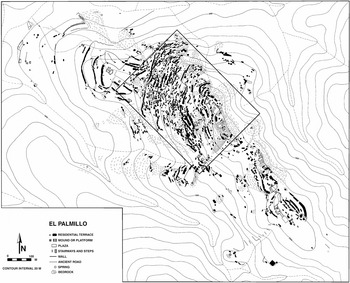
El Palmillo was first visited and mapped systematically during the 1980s as part of a regional survey of the Valley of Oaxaca (Kowalewski et al. 1989). In the late 1990s, Feinman and Nicholas directed an intensive terrace-by-terrace surface investigation of the site (Feinman and Nicholas 2000b, 2004b). They mapped more than 1,400 terraces at El Palmillo, making it the largest Classic-period terraced site in the eastern Tlacolula Valley (and one of the largest sites in the valley at that time). Tightly packed on the steep western face of the hill, the terraces at the site are arranged in concentric rings, often sharing terrace walls (Figure 2). This layout would have served to channel (and, at times, likely impede) the movement of people into and out of the site core, located on the apex of the hill (Feinman and Nicholas 2004b:98).

El Palmillo map. Area inside box is enlarged in Figure 3.
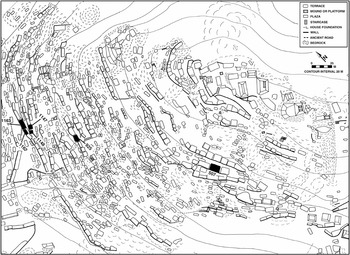
Surface findings from the regional and intensive surveys yielded architectural indications of residential architecture and artifactual residues of productive activities on many of the terraces (Feinman and Nicholas 2004b; Kowalewski et al. 1989). With a focus on households and the domestic economy, we have excavated six terraces at El Palmillo (Figure 3). We began in 1999 and 2000 with four adjacent terraces (1147, 1148, 1162, and 1163) located close to the base of the hill, where we uncovered three residential complexes (Feinman et al. 2001). (Terraces 1147 and 1148, the two smallest terraces, began as separate entities that subsequently were incorporated into a single residential complex comparable in size to the other terraces. We treat them as one unit in our analyses.) Each complex consists of several rooms around three sides of a small patio (Feinman, Nicholas, and Haines 2002:Figure 5). The rooms had foundation walls of cut and shaped stone and floors of lime plaster. Each terrace had been rebuilt several times, with the residential occupations spanning several centuries. Associated domestic features include hearths, two ovens for roasting maguey, human burials placed under house and patio floors, and debris from several craft activities mixed in with domestic refuse.

Plan of El Palmillo showing the location of the excavated terraces.
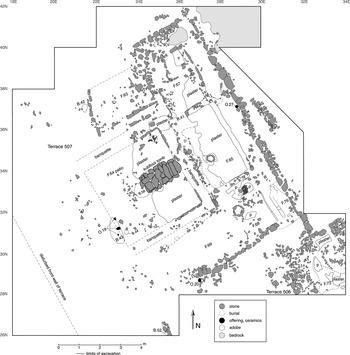
In 2001 and 2002, we exposed two additional terraces (Terraces 925 and 507) located farther upslope but still below the site's public core (Figure 3; Feinman, Nicholas, and Haines 2002; Feinman, Nicholas, Haines, and Clark 2002). Here we encountered two more residential complexes that, while similar in size and layout to those on the lower terraces, were a bit more elaborate architecturally. The residential complexes on these two terraces centered on small patios with floors and narrow banquettes made of lime plaster (Figure 4; Feinman, Nicholas, and Haines 2002:Figure 6). Each residence also housed (in the uppermost occupational level) a small domestic subfloor tomb. Although we observed refuse from the same basic suite of activities as on the lower terraces, we noted variation in the artifactual assemblages that point to different emphases in craft activities. Taken together, our sample of five residential units from three different areas of the settlement provides the opportunity to assess both similarity and variation in household activities across the community as well as the degree and nature of differences in patterns of consumption and access among households at El Palmillo.

Final residential complex on Terrace 507.
To discover the spatial arrangement of households and their associated features and debris, the terrace-excavation strategy at El Palmillo has been to clear large contemporaneous surfaces. Excavations on each terrace were started with a test unit or small trench to identify relevant stratigraphic changes and pinpoint important features or living surfaces. We then expanded these trenches in a series of contiguous 2- × 2-m units arranged in a grid across the surface of each terrace. On a specific terrace, excavations continued until a side wall (defining the edge of a terrace) or a new set of rooms that was part of a new patio group was reached. Although well-preserved architecture was left in place, excavations continued through lower surfaces until bedrock was reached. All deposits below the upper colluvial fill were screened through either .25- or .125-inch wire mesh, depending on the nature of the material and context. Additional samples from a number of locations on each terrace were taken for flotation, soil analysis, and carbon dating.
As part of the 2001 field season, William Middleton undertook a botanical survey at El Palmillo and a nearby hill that served as a “control site” (Middleton et al. 2001). Although the plant community on El Palmillo comprises many species that are common in eastern Tlacolula, the dense concentration of so many economically useful xerophytic plants on the site today, centuries after its abandonment, is not repeated on nearby hills. Many plants that provide edible fruit or leaves, such as Opuntia pilifera (nopal) and Myrtillocactus schenckii (garumbullo), are present in greater abundance at El Palmillo; other plants, such as several Agave species, or maguey, and Yucca periculosa, a palm-like plant called palmillo, all of which are sources of food/fruit and/or fiber, grow at the site but not on the control hill. Although eight species of Agave thrive today in the Tlacolula Valley, it is unusual to find more than two or three distinct species in the same location (Sánchez López 1989:34). Specific varieties often prefer narrow, specific locales and microenvironments (Gentry 1982). Yet all eight of these species can be found on El Palmillo; we suspect that some of the magueys were initially moved to the hill and fostered there by the site's pre-Hispanic residents (e.g., Hodgson 2001). The range and abundance of economically important xerophytic plants at El Palmillo would seem to be a vestige of pre-Hispanic patterns of use and exploitation (Feinman, Nicholas, and Haines 2002, 2005).
Our work at El Palmillo gives us an opportunity to investigate many different facets of Classic-period economy and social organization in the Valley of Oaxaca. Using information gathered from five houses (all of roughly similar size [both the residential complex and the area of excavation] and length of occupation), we address questions regarding the economic organization at hilltop terrace sites (specifically, how did the inhabitants make a living?). Given the hilltop location of the houses and the limited flat space on the terraces, some refuse undoubtedly was disposed of or washed away from all the terraces. Yet considerable quantities of both domestic and craft debris remained as deposits on the terraces. Thus the five domestic units that we examine are suitable for comparison and contrast. We also explore the ways in which households interrelated economically and sociopolitically with one another (were there status differences between households?). On a larger scale, we endeavor to understand how terraced sites were articulated into the larger network of settlement in the Valley of Oaxaca during the Classic period, when Monte Albán reached its greatest size and monumentality. Here we probe these questions through a distributional study of the stone (and other artifact) assemblages from excavated terraces at El Palmillo. We frame our comparative analyses to determine not only the basic activities on which the site's residents depended to sustain themselves but also how these productive tasks (as well as patterns of consumption and, perhaps, status) varied from house to house.
EL PALMILLO'S STONE ASSEMBLAGE
Stone Assemblage Composition
Geologically, the Valley of Oaxaca is diverse, consisting primarily of Precambrian gneisses and schists, Mesozoic limestones, and Middle Tertiary volcanic tuffs known as ignimbrites (Flannery 1986:31; Smith 1983:13; Whalen 1971:4). The eastern part of the Tlacolula Valley is volcanic, with ignimbrite formations interlaced with numerous chert deposits suitable for use as raw materials (Flannery 1986:31; Kirkby et al. 1986; Smith 1983:13; Whalen 1971:4). At El Palmillo, a range of these stone materials, including ignimbrite and chert, would have been available (Feinman and Nicholas 2004b). Yet the inhabitants of the site did not depend solely on local stone resources, having access through exchange to a variety of other nonlocal stone (the most numerically important was obsidian).
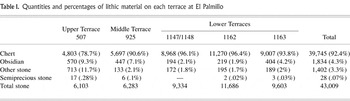
Chert is the most common raw material in the stone assemblage, accounting for 92% (almost 40,000 pieces) of the roughly 43,000 stone objects recovered from the six excavated terraces (Table 1). As chert can form in a wide range of geological contexts, color and quality can vary significantly within and between local sources (Luedtke 1992; Parry 1987:19). Because of this variability, what we call chert broadly includes silicified sandstones such as quartzite that have similar properties and were used for making similar suites of tools (Luedtke 1992:5). At El Palmillo, one of the most common chert sources is a dull red that occurs in small veins that interlace the bedrock on the main part of the hill (Feinman and Nicholas 2004b:91). Although chert resources are readily accessible at El Palmillo, much of the material is of poor quality, a factor that did not keep the site's residents from using it to make a range of stone artifacts.
Quantities and percentages of lithic material on each terrace at El Palmillo

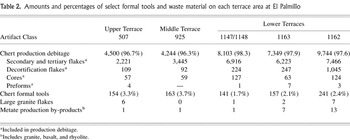
Debris and production debitage (the by-products of intentional knapping activities; see Inizan et al. 1992) constitute the majority of the chert material at El Palmillo (Table 2). Many of these pieces were used as expedient or informal tools, the primary criterion of which is an edge suitable for the current task (Aldenderfer et al. 1989:56; Andrefsky 1998:30). Chert was a key resource in the manufacture of chipped-stone tools at El Palmillo, including many of the formal tools (objects created on preconceived templates [Andrefsky 1998:30; Sievert 1992:31]) in the assemblage. Few ground-stone implements were made from chert.
Amounts and percentages of select formal tools and waste material on each terrace area at El Palmillo

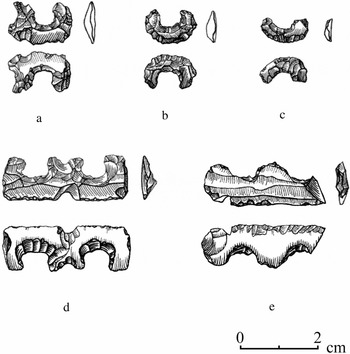
Obsidian, although a substantially smaller component of the assemblage (4.3%), constitutes the second most numerous single class of stone materials (Table 1). As no obsidian sources have been identified in the Valley of Oaxaca (Finsten 1995:75), all the obsidian at El Palmillo was imported from outside the region. Virtually all the obsidian artifacts at El Palmillo are formal tools (N = 1,721; 95.6%), especially prismatic blades (N = 1,693). Some blades had been fashioned into S-shaped or crescent eccentrics (Figure 5).

Obsidian eccentrics from El Palmillo: (a–c) from Terrace 507 Burial 53; (d–e) from Terrace 507.
Other fairly common stone materials at El Palmillo include basalt, granite, and rhyolite (Table 1, “Other Stone”). These stone varieties are either available locally (on or adjacent to the site) or in nearby areas of the Tlacolula Valley. These raw materials were used primarily for ground-stone tools, although a few chipped-stone tools were made from such materials.
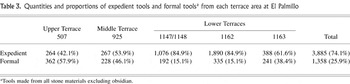
Despite the range of stone materials found at the site, local chert debris and debitage that often became the platform for expedient tools dominate the El Palmillo stone assemblage. Of the more than 5,000 tools (formal and expedient; Table 3) manufactured from chert and other stone (excluding obsidian), roughly 75% are expedient in nature. Such expedient stone tools constitute the majority of stone implements in many collections in the Valley of Oaxaca and other parts of Mesoamerica (e.g., Drennan 1976; Flannery and Winter 1976; Hole 1986; Misner 1993:125–127; Parry 1987:53; Sievert 1992). To identify expedient tools at El Palmillo, we used a 10× jeweler's loupe to examine the production debitage and debris for signs of use wear (following Keeley 1980).
Quantities and proportions of expedient tools and formal toolsa from each terrace area at El Palmillo

Economic and Subsistence Activities at El Palmillo
With a focus on the stone-tool assemblage, we have attempted to define the economic activities carried out by many, if not most, households at the site, as well as other select production activities that might have been more localized in their distribution. The production of craft goods has been identified as a key aspect of the economy of terraced sites, particularly those in the arid eastern parts of the valley (Feinman and Nicholas 2000b, 2004b; Kowalewski et al. 1989:241–245). During the regional and intensive surveys in the eastern arm of the valley, surface artifactual debris associated with craft activities (such as defective ceramic pieces or wasters and spindle whorls in addition to stone working debris) was observed on terrace surfaces. Such items often occurred in association with building stone and exposed foundation walls indicative of residential architecture (Feinman and Nicholas 2004b; Kowalewski et al. 1989). Interestingly, elsewhere in Mesoamerica expedient tools have been used predominately for craft production rather than in basic food-preparation tasks (Aldenderfer et al. 1989).
Stone working long has been hypothesized as a likely economic focus for the pre-Hispanic residents of the eastern Tlacolula Valley (Hester and Heizer 1972; Holmes 1897; Lorenzo and Messmacher 1966; Robles 1994; Williams and Heizer 1965). In this arm of the valley, the inhabitants easily could have exploited numerous deposits of chert and other suitable stone materials. At El Palmillo, some pre-Hispanic inhabitants manufactured stone tools. Production debitage constitutes a significant part of the chert assemblage and includes a sizable number of primary, or decortification, flakes (Table 2). Given the large quantities of decortification flakes recovered, the inhabitants at El Palmillo actively processed and worked chert. Stone tools, along with tool blanks and preformed cores (also found at El Palmillo), could have been exchanged among households at the site and circulated to other parts of the valley.
The pre-Hispanic stone tools recovered in eastern Tlacolula vary in certain key respects from those recovered elsewhere in the Valley of Oaxaca. Specialized stone scrapers for xerophytic plant processing constitute a significant segment of tool assemblages in this sector of the valley (Feinman and Nicholas 2004b; Feinman et al. 2001; Feinman, Nicholas, and Haines 2002; Feinman, Nicholas, Haines, and Clark 2002; Hester and Heizer 1972; Holmes 1897; Robles 1994). At the same time, microdrills, common tools at the Ejutla site in the southern part of the valley (Feinman and Nicholas 1993, 2000a, 2004a; Feinman et al. 1993) as well as at Preclassic sites in the northern or Etla Valley (Parry 1987), are all but absent in eastern Tlacolula (for a preliminary comparison of stone assemblages at Ejutla and El Palmillo, see Feinman and Nicholas 2004a.)
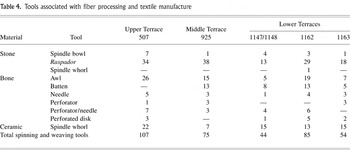
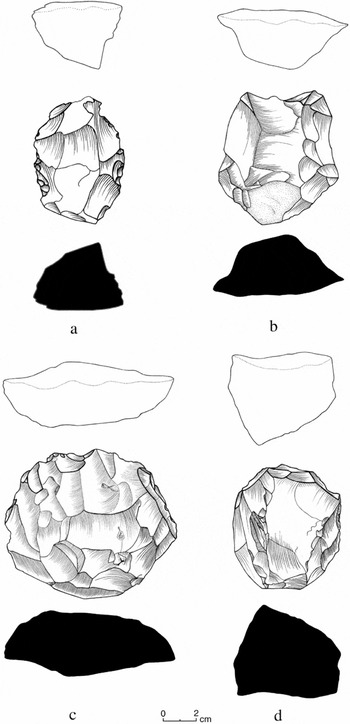
Raspadores are one of the tool varieties most characteristic of the eastern Tlacolula stone assemblage (Hester and Heizer 1972; Robles 1994). These large specialized scrapers are abundant at El Palmillo, where they occur in association with all the excavated households (Table 4). Although often crudely made (Figure 6), raspadores have long been considered effective in extracting fibers from maguey leaves, or pencas (Hester and Heizer 1972). The importance of maguey as a pre-Hispanic economic resource has been documented for Aztec times when it served as food, drink, and raw material for a variety of craft goods (Brumfiel 1991; Evans 1990; Nichols et al. 2000; Parsons 2001). Fibers from the plant (ixtle) could be processed into a variety of goods (including textiles, rope, sandals, nets), some of which were exchanged in Mesoamerica during the later Postclassic period (Parsons and Parsons 1990; Sahagún 1961 [ca. 1570]:73–74, 83–84).
Tools associated with fiber processing and textile manufacture


Sample of raspadores from El Palmillo: (a) Terrace 1162; (b) Terrace 1163; (c, d) Terrace 507.
The production of maguey fiber (and possibly cloth) appears to have been a significant household craft activity at El Palmillo (Feinman, Nicholas, and Haines 2002). Spindle whorls—most in the size range typically used to spin coarse maguey fibers (Parsons and Parsons 1990:177; Parsons 1972)—are found in all the excavated households (Table 4; Feinman et al. 2001; Feinman, Nicholas, and Haines 2002; Feinman, Nicholas, Haines, and Clark 2002). Other weaving tools found on several terraces include small stone “bowls” for holding the distal end of the spindles, similar in design to those depicted in the Codex Mendoza and Codex Florentine (Anawalt 1981:11; Berdan and Anawalt 1992:54; Sahagún 1954 [ca. 1570]:49, Plate 75, 1969 [ca. 1570]:201, Plate 30; Table 4). Many of the bone tools recovered during excavations (e.g., battens, awls, needles, and several perforated disks that may have been used as spindle whorls) also were associated with a fiber industry (Feinman, Nicholas, Haines, and Clark 2002). Based on the house-to-house differences in the bone-tool assemblages and the different sizes of spindle whorls associated with each house, we suspect that all households made maguey products, at least in part for exchange.
Although many households at El Palmillo appear to have engaged in stone working and xerophytic plant processing, each domestic unit did not carry out the same suite of productive activities, a pattern of house-to-house variation also noted at Monte Albán (Misner 1993:32; see also Blanton 1978). Even where different El Palmillo households carried out similar productive tasks, those activities did not have equal importance in each residential unit. For example, given the greater abundance of decortification flakes on the lower terraces, households there engaged more actively in stone-tool production (Table 2). Antler billets (N = 7)—key implements in the manufacture of stone tools (Aldenderfer 1991b; Parry 1987:42)—are found only on the lower group of terraces (Feinman, Nicholas, Haines, and Clark 2002; Middleton et al. 2002). Households on these lower terraces also had the most chert cores (314 of 430 in the collections, roughly 73%) and preforms, or tool blanks (11 of 15, 78%). We observed a similar pattern in a preliminary analysis of microdebitage in the .5–2 mm heavy fraction. The analyzed sediment from the lower terraces contained three to four times as many microflakes and other minute pieces of chert debris per kilogram.
While most households at El Palmillo engaged in some stone working, on the two upper terraces this activity may have largely involved retouching or sharpening existing pieces (Hester and Heizer 1972), or “nodule smashing” (in the sense of Boksenbaum 1980) to create expedient tools. In contrast, the residents of the lower terraces appear to have been more intensively involved in the manufacture of formal tools (and possibly preforms and cores) that were intended for house-to-house exchange. Large granite flakes and a greater abundance of metate fragments (especially of granite) also were found on Terrace 1162; these residents also likely fashioned ground-stone tools.
Like stone working, other craft industries varied from house to house. Although present in the tool assemblages of all households, raspadores are more abundant on Terraces 507, 925, and 1162 (Table 4). Interestingly, although the residents of Terrace 925 possessed a large number of raspadores, they had the fewest spindle whorls of any household (N = 7) and only one small stone spindle bowl. In contrast, there are 25 complete or partial whorls on Terrace 507 and an average of 17 whorls (mostly ceramic but also a few of bone and stone) on each of the lower terraces (Terraces 1147/1148, 1162, and 1163). Thus, although the inhabitants of Terrace 925 are likely to have processed maguey on par with the residents of Terrace 507, they may have engaged less actively in spinning than did the residents of other households. Other bone tools on Terrace 925 (e.g., awls and needles) may have been used in the manufacture of other maguey-based craft goods such as baskets or sandals, and the occupants of Terrace 925 may have made such goods.
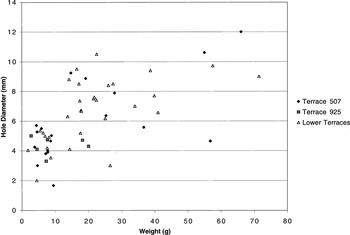
Yet the amount of material spun is not the only axis of variation when it comes to spinning activities at El Palmillo. The residents of the upper terraces (925 and 507) generally used lighter whorls with smaller hole diameters (Feinman, Nicholas, and Haines 2002; Feinman, Nicholas, Haines, and Clark 2002; Figure 7). Studies of textile production in ancient Mesoamerica combined with ethnographic research have illustrated that variation in the hole diameter of spindle whorls affects the thickness (and therefore quality) of the spun thread (Parsons and Parsons 1990; Parsons 1972). Larger whorls are used to spin coarse maguey fibers, whereas smaller whorls are more suitable for spinning cotton and fine maguey thread. Fine threads and textiles produced from either of these plants likely were valued more highly than cloth made from coarser maguey threads (Berdan 1987:244–245) spun with the larger whorls found in greater proportions on the lower terraces.

Spindle whorls at El Palmillo. The smaller whorls were probably for spinning fine maguey or cotton threads; the larger whorls, for coarser maguey fiber.
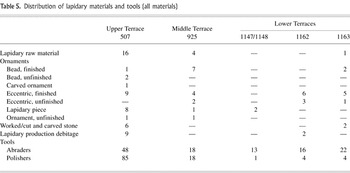
Lapidary craft production also appears to be an activity practiced only by specific households. Evidence for this craft industry includes both unfinished or broken goods (beads and ornaments) and tools that could be used to manufacture these items (abraders and polishers; Adams 2002:213; Charlton 1993; Charlton et al. 1993; Hayden 1987:Table 5.2). On Terrace 507, we found a larger number of stone artifacts that show abrasion or polishing wear (Table 5), as well as the only two unfinished beads in the El Palmillo collections. These beads are part of a collection of 11 unfinished and miscellaneous lapidary items and six pieces of worked stone recovered from this domestic context. These 17 items contrast sharply with the two unfinished stone pieces found on both Terrace 925 and Terrace 1147/1148 and the total of two pieces of worked stone recovered from the lower terrace group. Terrace 507 also yielded more production debris from ornamental or precious stone (N = 9) and pieces of other nonlocal materials suitable for ornaments (N = 16). On the lower terraces, we recovered only two pieces of ornamental stone debitage, a few unfinished obsidian eccentrics, and one piece of potential lapidary material (Table 5).
Distribution of lapidary materials and tools (all materials)

As at Ejutla, production for exchange at El Palmillo was situated in domestic units. Although all households used local sources of stone and xerophytic plants, such as maguey, the particular suite of economic activities varied from house to house. For example, the spinning of fine fiber was more important on Terrace 507, as were certain kinds of lapidary production. Residents of Terrace 925 also spun fine thread but on a more limited basis, focusing instead on weaving cloth or making other perishable maguey (or other fiber) products such as rope, sandals, or baskets. Residents on the lower terraces (1147/1148, 1162, and 1163) specialized in stone working and likely supplied neighboring households with tools, preforms, and possibly cores from which expedient tools could be chipped. As the finished products from several of these specialized craft industries are present in other El Palmillo residences, house-to-house exchange of craft products seems to have been a key aspect of the intrasite economy.
Patterns of Access, Consumption, and Social Organization
To this point, we have drawn on our findings to examine the distribution of productive activities at El Palmillo. Yet an examination of the stone and other artifacts at the site also provides a means to compare patterns of consumption and economic access across the site. A definition of these differences among domestic units can help unravel the nature of status distinctions at the site, thereby further informing our perspective on the intracommunity organization of El Palmillo and other hilltop settlements in Oaxaca.
Based on our excavations, the residents of the uppermost excavated household had greater amounts of exotic obsidian than did their neighbors farther down slope, with the quantities of obsidian increasing as one ascends the site (Table 1). On Terrace 507 (the uppermost terrace), obsidian constituted a larger proportion of the total stone assemblage (9.3%), with more total pieces recovered (N = 507) than on any other terrace. In contrast, at the bottom of the hill, the occupants of Terraces 1147/1148 and 1162 had access to less than half the amount of obsidian (194 and 291 pieces, respectively) than the residents of Terrace 507.
The upper households had greater access to semiprecious stone (Table 1). None of the burials on the lower terraces included stone beads, whereas four greenstone beads (all associated with burials) were recovered on Terrace 925 (Figure 8; Feinman et al. 2001; Feinman, Nicholas, and Haines 2002). The residents of Terrace 507 possessed three beads (one finished and two unfinished) and many finished obsidian eccentrics (Table 5). Although obsidian eccentrics are present on several other terraces, many of them are unfinished, whereas all nine eccentrics on Terrace 507 are finished. Even though these differences in access to exotic and ornamental stone are not marked, they are consistent.

Illustration of ornaments from different terraces at El Palmillo: (a) unfinished greenstone ornament from Terrace 507; (b–e) greenstone beads from Terrace 925; (f) chert bead from Terrace 925.
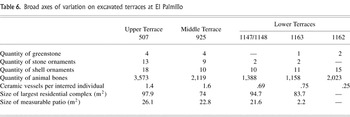
The greater access to ornamental and exotic stone noted for the occupants of Terraces 925 and 507 corresponds to architectural and other evidence that seems to signal a status gradient that varied from the bottom to the top of the site (Table 6; Feinman, Nicholas, and Haines 2002; Feinman, Nicholas, Haines, and Clark 2002). This pattern is similar to what has been noted at Monte Albán (Blanton 1978:77; Misner 1993:45). The residential complex on the uppermost terrace is a bit larger than those below, and patio size increases slightly from the lower terraces to the highest. On a per capita basis, interments on Terraces 507 and 925 included more grave goods than burials on terraces below. Subfloor tombs have been found in association only with the final occupational surfaces on the two highest terraces. The quantity of animal bones in refuse (possibly indicating greater meat consumption) also tends to increase from the bottom of the hill to the top. Nevertheless, the extent of the differences along each of these dimensions of variation is not marked. Access and status appear to have increased as one moves upslope, but the distinctions are rather subtle.
Broad axes of variation on excavated terraces at El Palmillo

IMPLICATIONS AND CONCLUSIONS
This study, focused on domestic assemblages of stone artifacts recovered on residential terraces at El Palmillo, contributes to an expanding empirical perspective on household organization and economy in ancient Mesoamerica (Manzanilla 1986; Plunket 2002; Santley and Hirth 1993; Wilk and Ashmore 1988). At the same time, it provides a terrace-based vantage of these hilltop communities, which formed a major component of the Valley of Oaxaca settlement system during the Classic-period apex of the Monte Albán polity. More specifically, our analyses illustrate that domestic units at the hilltop terrace site of El Palmillo produced a range of craft goods at least partly for exchange. Although reliant primarily on locally available stone sources along with xerophytic plants, each residential unit at El Palmillo appears to have made a slightly different range of craft goods, which it then exchanged with other households at the site and likely beyond. In consequence, El Palmillo residents do not appear to have produced merely for their own immediate needs. At the same time, they procured goods (such as obsidian) from other communities or regions, even from outside the Valley of Oaxaca.
In our sample from El Palmillo, access to certain craft goods, such as stone ornaments and exotic obsidian, varied among households. Consumption of these products increased from the bottom to the top of the hill, in line with other axes of variation that indicate that those living closer to the top of site likely had higher status. Yet these differences in consumption and residential life are more graded and subtle than extreme.
An examination of production and consumption together provides added support for interhousehold exchange at El Palmillo. Beads made from ornamental or semiprecious stone were present only on Terraces 507 and 925. Chert cores and tools produced on the lower terraces and ground-stone tools made on Terrace 1162 also could have supplied households elsewhere at the site, while xerophytic plant products, including fine and coarse cloth, probably were exchanged from one domestic unit to another. Elsewhere, we proposed that a broad open plaza near the base of El Palmillo that lacked monumental architecture may have served as a marketplace (Feinman and Nicholas 2004a, 2004b:98). Several paths up from the bottom of the hill intersect at this open area. This open area, near major access routes, is similar to a large open plaza at Monte Albán that has been interpreted as a marketplace (Blanton 1978:86). If the open area at El Palmillo served as an arena for exchange, then domestic exchanges easily could have attracted the participation of people at neighboring sites.
Whatever the specific mechanisms of circulation, household units at El Palmillo were closely linked economically. Yet the interconnections among households went beyond production and exchange. Adjacent terraces at the site are tightly packed, often sharing retaining walls. Numerous ramps and paths link nearby terraces, with low side walls often separating contiguous terrace units. At the same time, the terraces share a basic residential plan, while the excavated household units are not that variable in overall size. With the minimal differences in access to exotics and the small distinctions in burial accoutrements, there appears to have been significant house-to-house horizontal integration among domestic units at El Palmillo. Strong horizontal links among houses contrast with the small size of the structures, platforms, and plazas at the apex of the site. For such a large population center, the public buildings at El Palmillo are not particularly massive; this also may indicate that low-level horizontal links were emphasized in the socioeconomic integration of this settlement.
Based on our findings, we infer that the households at El Palmillo functioned as the focal point for the manufacture of goods for exchange and that households formed the foundation of the settlement's economic system. These households were not homogeneous producers of domestically consumed items but manufactured specialized craft items for interhousehold exchange. Moreover, these house-to-house transactions integrated households into a complex series of economic and sociopolitical networks that saw domestically produced craft goods exchanged both within settlements and on a larger, valleywide scale. Continued investigations will allow us to further our understanding of pre-Hispanic households, both in Oaxaca and beyond, along with the Classic-period economic and social networks in which these residences functioned.
RESUMEN
En la Mesoamérica prehispánica, los grupos domésticos han sido reconocidos por mucho tiempo como unidades claves en la producción económica y la organización social. Aún así, poco es lo que se conoce sobre el rango de actividades económicas que practicaban los grupos domésticos mesoamericanos, o sobre las diversas formas en que estas unidades domésticas estaban articuladas social y económicamente dentro de las comunidades y las redes de interacción. Este artículo examina el conjunto de los artefactos líticos recolectados en las excavaciones de seis terrazas residenciales del periodo clásico en el sitio El Palmillo, una comunidad en la cima de un cerro en el este del sub-valle de Tlacolula.
En base a este análisis, la producción de artefactos de piedra y el procesamiento de plantas xerófitas, especialmente maguey, representaban la base económica de todas las unidades domésticas que fueron excavadas. Núcleos y herramientas de sílex fueron manufacturados principalmente en las terrazas más bajas y herramientas grandes de piedra pulida en la Terraza 1162, mientras que el hilado y tejido de textiles hechos de maguey fino o de algodón fueron las actividades claves en la Terraza 507. Aunque la evidencia para la producción de lapidaria se encontró únicamente en la Terraza 507, se obtuvieron cuentas hechas de piedras ornamentales o preciosas en las Terrazas 507 y 925. Variaciones en las especialidades de producción artesanal proveen la base para la integración económica de las unidades domésticas donde los productos circulan entre las residencias de El Palmillo y otras comunidades.
También examina las diferencias en la distribución de los artefactos de piedra. Se encuentra que las unidades domésticas más cercanas al centro del sitio en la cima del cerro tienen una mayor abundancia de obsidiana y otras materias primas preciosas no locales que los vecinos de elevaciones más bajas. Estas diferencias en el acceso a los artefactos de piedras preciosas o de gran elaboración artesanal corresponden a ejes de variación en los cuales los ocupantes de las terrazas superiores eran enterrados con más ofrendas mortuorias y tenían más acceso a carne que los residentes de las terrazas inferiores. Sin embargo, la extensión de estas diferencias en acceso a todos estos productos parece ser menos marcado de lo esperado en una de las comunidades más grandes del periodo clásico en el Valle de Oaxaca.
Esta falta de distinción social grande entre las unidades domésticas de El Palmillo en conjunto con el alto grado de interdependencia económica entre estas unidades sugiere que existió un alto grado de integración horizontal entre las unidades residenciales del sitio. Esta interdependencia está reflejada también arquitectónicamente por el arreglo de las casas en grupos compactados y densos con muros de contención mutuos y múltiples rampas y caminos de acceso. El alto grado de interdependencia doméstica horizontal puede proveer un medio para el entendimiento de porqué un asentamiento del tamaño de El Palmillo no tuvo un centro cívico-ceremonial no más monumental.
ACKNOWLEDGMENTS
The authors acknowledge the National Science Foundation for its essential support awarded to Gary Feinman for investigations at El Palmillo (SBR-9805288). We also thank the National Geographic Society, the H. John Heinz III Fund of the Heinz Family Foundation, and the Field Museum. This research would not have been possible without the dedicated assistance of our Oaxacan and North American field, laboratory, and museum crews, to whom we are grateful for all their hard work. Jennifer Clark, Lora Lee Fry, Adam Leon, William D. Middleton, Jennifer Ringberg, and Jill Seagard have made particularly significant contributions over the years. Richard Blanton, William Fowler, and three anonymous reviewers provided helpful comments on an earlier draft of this paper. We are deeply indebted to the Instituto Nacional de Antropología e Historia of Mexico, the Centro Regional of Oaxaca, and the local authorities of Santiago Matatlán for the necessary permissions to implement these field studies and their support throughout the course of this research. Finally, we dedicate this work to all the people of Mitla and Matatlán, who have facilitated our efforts in so many wonderful ways and allowed us to become a part of their world. Their untiring assistance and encouragement throughout the years has made our effort gratifying in so many significant respects.
References
REFERENCES
Adams, Jenny L.
2002
Ground Stone Analysis: A Technological Approach.
University of Utah Press,
Salt Lake City.
Aldenderfer, Mark
1991a
Functional Evidence for Lapidary and Carpentry Craft Specialties in
the Late Classic of the Central Peten Lakes Region.
Ancient Mesoamerica
2:205–214.Google Scholar
Aldenderfer, Mark
1991b
The Structure of Late Classic Lithic Assemblages in the Central
Petén Lakes Region, Guatemala. In
Maya Stone Tools, edited by
Thomas R. Hester and
Harry J. Shafer, pp.
119–142.
Monographs in World Archaeology, No. 1.
Prehistory Press,
Madison, WI.
Aldenderfer, Mark,
Larry R. Kimball, and
April Sievert
1989
Microwear Analysis in the Maya Lowlands: The Use of Functional Data
in a Complex-Society Setting.
Journal of Field Archaeology
16:47–60.Google Scholar
Anawalt, Patricia Rieff
1981
Indian Clothing Before Cortes: Mesoamerican Costumes from the
Codices.
University of Oklahoma Press,
Norman.
Andrefsky, William, Jr.
1998
Lithics: Macroscopic Approaches to Analysis.
Cambridge University Press,
Cambridge.
Balkansky, Andrew K.,
Gary M. Feinman, and
Linda M. Nicholas
1997
Pottery Kilns of Ancient Ejutla, Oaxaca, Mexico.
Journal of Field Archaeology
24:139–160.Google Scholar
Berdan, Frances F.
1987
Cotton in Aztec Mexico: Production, Distribution, and Uses.
Mexican Studies/Estudios Mexicanos
3:235–262.Google Scholar
Berdan, Frances F., and
Patricia R. Anawalt
1992
The Codex Mendoza.
University of California Press,
Berkeley.
Blanton, Richard E.
1978
Monte Albán: Settlement Patterns at the Ancient Zapotec
Capital.
Academic Press,
New York.
Blanton, Richard E.,
Stephen A. Kowalewski,
Gary M. Feinman, and
Jill Appel
1982
Monte Albán's Hinterland, Part I: The Prehispanic
Settlement Patterns of the Central and Southern Parts of the Valley of
Oaxaca, Mexico.
Museum of Anthropology, Memoirs No. 15.
University of Michigan,
Ann Arbor.
Boksenbaum, Martin W.
1980
Basic Mesoamerican Stone-Working: Nodule Smashing?
Lithic Technology
9:12–26.Google Scholar
Brumfiel, Elizabeth
1991
Weaving and Cooking: Women's Production in Aztec Mexico. In
Engendering Archaeology: Women and Prehistory, edited by
Joan M. Gero and
Margaret W. Conkey, pp.
224–251.
Blackwell,
Oxford.
Caso, Alfonso
1982
El tesoro de Monte Albán.
Memorias del Instituto Nacional de Antropología e Historia,
Mexico City.
Caso, Alfonso,
Ignacio Bernal, and
Jorge R. Acosta
1967
La cerámica de Monte Albán.
Instituto Nacional de Antropología e Historia, Memoria 13.
Mexico City.
Charlton, Cynthia O.
1993
Obsidian as Jewelry: Lapidary Production in Aztec Otumba, Mexico.
Ancient Mesoamerica
4:231–243.Google Scholar
Charlton, Cynthia O.,
Thomas H. Charlton, and
Deborah L. Nichols
1993
Aztec Household-Based Craft Production: Archaeological Evidence
from the City-State of Otumba, Mexico. In
Prehispanic Domestic Units in Western Mesoamerica: Studies of the
Household, Compound, and Residence, edited by
Robert S. Santley and
Kenneth G. Hirth, pp.
147–171.
CRC Press,
Boca Raton, FL.
Drennan, Robert D.
1976
Fábrica San José and Middle Formative Society in the
Valley of Oaxaca.
Museum of Anthropology, Memoirs No. 8.
University of Michigan,
Ann Arbor.
Evans, Susan T.
1990
The Productivity of Maguey Terrace Agriculture in Central Mexico
During the Aztec Period.
Latin American Antiquity
1:117–132.Google Scholar
Feinman, Gary M.
1997
Macro-Scale Perspectives on Settlement and Production in Ancient
Oaxaca. In
Economic Analysis Beyond the Local System, edited by
Richard E. Blanton,
Peter N. Peregrine,
Deborah Winslow, and
Thomas D. Hall,
pp.
13–42.
Monographs in Economic Anthropology No. 13.
University Press of America,
Lanham, MD.
Feinman, Gary M.
1999
Rethinking Our Assumptions: Economic Specialization at the
Household Scale in Ancient Ejutla, Oaxaca, Mexico. In
Pottery and People: Dynamic Interactions, edited by
James M. Skibo and
Gary M. Feinman, pp.
81–98.
University of Utah Press,
Salt Lake City.
Feinman, Gary M., and
Andrew K. Balkansky
1997
Ceramic Firing in Ancient and Modern Oaxaca. In
Prehistory and History of Ceramic Kilns, edited by
Prudence Rice, pp.
129–147.
American Ceramic Society,
Westerville, OH.
Feinman, Gary M., and
Linda M. Nicholas
1990
At the Margins of the Monte Albán State: Settlement Patterns
in the Ejutla Valley, Oaxaca, Mexico.
Latin American Antiquity
1:216–246.Google Scholar
Feinman, Gary M., and
Linda M. Nicholas
1993
Shell Ornament Production in Ejutla: Implications for
Highland–Coastal Interaction in Ancient Oaxaca.
Ancient Mesoamerica
4:103–119.Google Scholar
Feinman, Gary M., and
Linda M. Nicholas
1995
Household Craft Specialization and Shell Ornament Manufacture in
Ejutla, Mexico.
Expedition
37(2):14–25.Google Scholar
Feinman, Gary M., and
Linda M. Nicholas
1999
Reflections on Regional Survey: Perspectives from the
Guirún Area, Oaxaca, Mexico. In
Settlement Pattern Studies in the Americas: Fifty Years since
Virú, edited by
Brian R. Billman and
Gary M. Feinman, pp.
172–190.
Smithsonian Institution Press,
Washington, DC.
Feinman, Gary M., and
Linda M. Nicholas
2000a
High-Intensity Household-Scale Production in Ancient Mesoamerica:
A Perspective from Ejutla, Oaxaca. In
Cultural Evolution: Contemporary Viewpoints, edited by
Gary M. Feinman and
Linda Manzanilla, pp.
119–142.
Kluwer Academic,
New York.
Feinman, Gary M., and
Linda M. Nicholas
2000b
Intensive Survey of Hilltop Terraced Sites in Oaxaca, Mexico.
Antiquity
74(283):21–22.Google Scholar
Feinman, Gary M., and
Linda M. Nicholas
2004a
Unraveling the Prehispanic Highland Mesoamerican Economy:
Production, Exchange, and Consumption in the Classic Period Valley of
Oaxaca. In
Archaeological Perspective on Political Economies, edited by
Gary M. Feinman and
Linda M. Nicholas, pp.
167–188.
University of Utah Press,
Salt Lake City.
Feinman, Gary M., and
Linda M. Nicholas
2004b
Hilltop Terrace Sites of Oaxaca, Mexico: Intensive Surface Survey
at Guirún, El Palmillo, and the Mitla Fortress.
Fieldiana: Anthropology, n.s., no. 37.
Field Museum of Natural History,
Chicago,
in press.
Feinman, Gary M.,
Linda M. Nicholas, and
Helen R. Haines
2002
Houses on a Hill: Classic Period Life at El Palmillo, Oaxaca.
Latin American Antiquity
13:251–277.Google Scholar
Feinman, Gary M.,
Linda M. Nicholas, and
Helen R. Haines
2005
Classic Period Agricultural Intensification, Subsistence
Techniques, and Domestic Life at El Palmillo, in the Valley of
Oaxaca. In
Landscapes of the Past and Future: Human Impacts Research in the
21st Century, edited by
Christopher Fisher and
Tina Thurston.
Kluwer Academic,
New York,
in press.
Feinman, Gary M.,
Linda M. Nicholas, and
William D. Middleton
1993
Craft Activities at the Prehispanic Ejutla Site, Oaxaca, Mexico.
Mexicon
15:33–41.Google Scholar
Feinman, Gary M.,
Linda M. Nicholas, and
William D. Middleton
2001
Domestic Life at Classic Period Hilltop Terrace Sites: Perspectives
from El Palmillo, Oaxaca.
Mexicon
23:42–48.Google Scholar
Feinman, Gary M.,
Linda M. Nicholas,
Helen R. Haines, and
Jennifer A. Clark
2002
El Palmillo: Una perspectiva doméstica del período
Clásico en el Valle de Oaxaca.
Final report of the 2002 field season prepared for the Instituto
Nacional de Antropología e Historia,
Mexico City.
Feinman, Gary M.,
Stephen A. Kowalewski,
Laura Finsten,
Richard E. Blanton, and
Linda Nicholas
1985
Long-Term Demographic Change: A Perspective from the Valley of
Oaxaca, Mexico.
Journal of Field Archaeology
12:333–362.Google Scholar
Finsten, Laura
1995
Jalieza, Oaxaca: Activity Specialization at a Hilltop Center.
Publications in Anthropology No. 48.
Vanderbilt University,
Nashville, TN.
Flannery, Kent V.
1986
Guilá Naquitz in Spatial Temporal, and Cultural Context. In
Guilá Naquitz: Archaic Foraging and Early Agriculture in
Oaxaca, Mexico, edited by
Kent V. Flannery, pp.
31–42.
Academic Press,
New York.
Flannery, Kent V., and
Marcus Winter
1976
Analyzing Household Activities. In
The Early Mesoamerican Village, edited by
Kent V. Flannery, pp.
34–47.
Academic Press,
San Diego.
Gentry, Howard S.
1982
Agaves of Continental North America.
University of Arizona Press,
Tucson.
González Licón, Ernesto
2003
Social Inequality at Monte Albán Oaxaca: Household Analysis
from Terminal Formative to Early Classic.
Unpublished Ph.D. dissertation,
Department of Anthropology, University of Pittsburgh.
Hayden, Brian
1987
Past to Present Uses of Stone Tools and Their Effects on
Assemblage Characteristics in the Maya Highlands. In
Lithic Studies Among the Contemporary Maya Highlands, edited by
Brian Hayden, pp.
160–234.
University of Arizona Press,
Tucson.
Hester, Thomas R., and
Robert F. Heizer
1972
Problems in the Functional Interpretation of Artifacts: Scraper
Planes from Mitla and Yagul, Oaxaca.
University of California Archaeological Research Facility
14:107–123.Google Scholar
Hirth, Kenneth G.
1993a
The Household as an Analytical Unit: Problems in Method and
Theory. In
Prehispanic Domestic Units in Western Mesoamerica: Studies of the
Household, Compound, and Residence, edited by
Robert S. Santley and
Kenneth G. Hirth, pp.
21–36.
CRC Press,
Boca Raton, FL.
Hirth, Kenneth G.
1993b
Identifying Rank and Socioeconomic Status in Domestic Contexts: An
Example from Central Mexico. In
Prehispanic Domestic Units in Western Mesoamerica: Studies of the
Household, Compound, and Residence, edited by
Robert S. Santley and
Kenneth G. Hirth, pp.
121–146.
CRC Press,
Boca Raton, FL.
Hodgson, Wendy C.
2001
Taxonomic Novelties in American Agave (Agavaceae).
Novon
11:410–416.Google Scholar
Hole, Frank
1986
Chipped-Stone Tools. In
Guilá Naquitz: Archaic Foraging and Early Agriculture in
Oaxaca, Mexico, edited by
Kent V. Flannery, pp.
97–139.
Academic Press,
New York.
Holmes, William A.
1897
Archaeological Studies among the Ancient Cities of Mexico: Part II,
Monuments of Chiapas, Oaxaca, and the Valley of Mexico.
Field Colombian Museum Anthropology Series, Vol. 1, No. 1.
Chicago.
Inizan, Marie-Louise,
Hélène Roche, and
Jacques Tixier
1992
Technology and Terminology of Knapped Stone. Préhistoire de
la Pierre Taillée Tome 3.
Translated by Alan Lee.
Cercle de Recherches et d'Etudes Préhistoriques,
Nanterre, and
Centre National de la Recherche Scientifique,
Meudon.
Keeley, Lawrence H.
1980
Experimental Determination of Stone Tool Uses.
University of Chicago Press.
Kirkby, Anne V.T.
1973
The Use of Land and Water Resources in the Past and Present Valley
of Oaxaca, Mexico.
Museum of Anthropology, Memoirs No. 5.
University of Michigan,
Ann Arbor.
Kirkby, Michael J.,
Anne V. Whyte, and
Kent V. Flannery
1986
The Physical Environment of the Guilá Naquitz Cave Group.
In
Guilá Naquitz: Archaic Foraging and Early Agriculture in
Oaxaca, Mexico, edited by
Kent V. Flannery, pp.
43–61.
Academic Press,
Orlando, FL.
Kowalewski, Stephen A.,
Gary M. Feinman,
Laura Finsten,
Richard E. Blanton, and
Linda M. Nicholas
1989
Monte Albán's Hinterland, Part II: The Prehispanic
Settlement Patterns in Tlacolula, Etla, and Ocotlán, the Valley
of Oaxaca, Mexico.
Museum of Anthropology, Memoirs No. 23.
University of Michigan,
Ann Arbor.
Kuttruff, Carl, and
William O. Autry, Jr.
1978
Test Excavations at Terrace 1127. In
Monte Albán: Settlement Patterns at the Ancient Zapotec
Capital,
by Richard E. Blanton, pp.
403–415.
Academic Press,
New York.
Lewenstein, Suzanne
1991
Woodworking Tools at Cerros. In
Maya Stone Tools: Selected Papers from the Second Maya Lithic
Conference, edited by
Thomas R. Hester and
Harry J. Shafer, pp.
239–249.
Monographs in World Archaeology No. 1.
Prehistory Press,
Madison, WI.
Lorenzo, José Luís, and
Miguel Messmacher
1966
Aspectos físicos del Valle de Oaxaca.
Revista Mexicana de Estudios Antropológicos
16:49–63.Google Scholar
Luedtke, Barbara E.
1992
An Archaeologist's Guide to Chert and Flint.
Archaeological Research Tools 7.
Institute of Archaeology, University of California, Los Angeles.
Manzanilla, Linda (editor)
1986
Unidades habitacionales mesoamericanas y sus áreas de
actividad.
Universidad Nacional Autónoma de México,
Mexico City.
Middleton, William D.
1998
Craft Specialization at Ejutla, Oaxaca, Mexico: An Archaeometric
Study of the Organization of Household Craft Production.
Unpublished Ph.D. dissertation,
Department of Anthropology, University of Wisconsin, Madison.
Middleton, William D.,
Gary M. Feinman, and
Linda M. Nicholas
2001
An Investigation of the Use of Xerophytic Plant Resources in the
Economy and Subsistence of El Palmillo, Oaxaca, Mexico.
Project report submitted to the Heinz Family Foundation,
Pittsburgh.
Middleton, William D.,
Gary M. Feinman, and
Linda M. Nicholas
2002
Domestic Faunal Assemblages from the Classic Period Valley of
Oaxaca, Mexico: A Perspective on the Subsistence and Craft
Economies.
Journal of Archaeological Science
29:233–249.Google Scholar
Misner, Elizabeth Jane
1993
The Stone Tools of Monte Albán: Surface-Collected Lithics
from a Prehistoric Urban Context.
Unpublished Ph.D. dissertation,
Department of Anthropology, University of Georgia, Athens.
Nicholas, Linda M.
1989
Land Use in Prehispanic Oaxaca. In
Monte Albán's Hinterland, Part II: The Prehispanic
Settlement Patterns in Tlacolula, Etla, and Ocotlán, the Valley
of Oaxaca, Mexico,
by Stephen A. Kowalewski, Gary M. Feinman, Laura Finsten, Richard
E. Blanton, and Linda M. Nicholas, pp.
449–505.
Museum of Anthropology, Memoirs No. 23.
University of Michigan,
Ann Arbor.
Nichols, Deborah L.,
Mary Jane McLaughlin, and
Maura Benton
2000
Production Intensification and Regional Specializations: Maguey
Fibers and Textiles in the Aztec City-State of Otumba.
Ancient Mesoamerica
11:267–297.Google Scholar
Palerm, Angel, and
Eric R. Wolf
1957
Ecological Potential and Cultural Development in Mesoamerica.
Pan American Union Social Science Monograph
3:1–37.Google Scholar
Parry, William J.
1987
Chipped Stone Tools in Formative Oaxaca, Mexico: Their Procurement,
Production, and Use.
Museum of Anthropology, Memoirs No. 20.
University of Michigan,
Ann Arbor.
Parsons, Jeffrey R.
2001
Agave. In
Archaeology of Ancient Mexico and Central America: An Encyclopedia,
edited by
Susan T. Evans and
David L. Webster, pp.
4–7.
Garland,
New York.
Parsons, Jeffery R., and
Mary H. Parsons
1990
Maguey Utilization in Highland Central Mexico: An Archaeological
Ethnography.
Museum of Anthropology, Anthropological Papers No. 82.
University of Michigan,
Ann Arbor.
Parsons, Mary H.
1972
Spindle Whorls from the Teotihuacan Valley, Mexico. In
Miscellaneous Studies in Mexican Prehistory,
by Michael W. Spence, Jeffrey R. Parsons, and Mary H. Parsons,
pp.
45–79.
Museum of Anthropology, Anthropological Papers No. 45.
University of Michigan,
Ann Arbor.
Plunket, Patricia
2002
Domestic Ritual in Ancient Mesoamerica.
Cotsen Institute of Archaeology, Monograph 46.
University of California,
Los Angeles.
Robles García, Nelly M.
1994
Las canteras de Mitla, Oaxaca: Tecnología para la
arquitectura monumental.
Publications in Anthropology No. 47.
Vanderbilt University,
Nashville, TN.
Sahagún, Bernardino de
1954
[ca. 1570]
The Florentine Codex: General History of the Things of New Spain. Book 8:
Kings and Lords. Translated and edited by
Arthur J.O. Anderson and
Charles E. Dibble.
School of American Research,
Santa Fe, and
University of Utah Press,
Salt Lake City.
Sahagún, Bernardino de
1961
[ca. 1570]
The Florentine Codex: General History of the Things of New Spain. Book
10: The People. Translated and edited by
Arthur J.O. Anderson and
Charles E. Dibble.
School of American Research,
Santa Fe, and
University of Utah Press,
Salt Lake City.
Sahagún, Bernardino de
1969
[ca. 1570]
The Florentine Codex: General History of the Things of New Spain. Book 6:
Rhetoric and Moral Philosophy. Translated and edited by
Arthur J.O. Anderson and
Charles E. Dibble.
School of American Research,
Santa Fe, and
University of Utah Press,
Salt Lake City.
Sánchez López, Alberto
1989
Oaxaca tierra de maguey y mezcal.
Instituto Technológico de Oaxaca,
Oaxaca, Mexico.
Santley, Robert S., and
Kenneth G. Hirth (editors)
1993
Prehispanic Domestic Units in Western Mesoamerica: Studies of the
Household, Compound, and Residence.
CRC Press,
Boca Raton, FL.
Sievert, April Kay
1992
Maya Ceremonial Specialization: Lithic Tools from the Sacred Cenote
at Chichén Itzá, Yucatán.
Monographs in World Archaeology No. 12.
Prehistory Press,
Madison, WI.
Smith, C. Earle
1983
The Valleys of Oaxaca, Nochixtlán, and Tehuacán. In
The Cloud People: Divergent Evolution of the Zapotec and Mixtec
Civilizations, edited by
Kent V. Flannery and
Joyce Marcus, pp.
13–17.
Academic Press,
New York.
Whalen, Michael
1971
Lithic Resources in the Valley of Oaxaca, Mexico: A Report to the
Phoenix Memorial Laboratory and the Museum of Anthropology, University
of Michigan.
Manuscript on file,
Division of Analytical Collections, Museum of Anthropology,
University of Michigan, Ann Arbor.
Wilk, Richard, and
Wendy Ashmore (editors)
1988
Household and Community in the Mesoamerican Past.
University of New Mexico Press,
Albuquerque.
Williams, Howel, and
Robert F. Heizer
1965
Geological Notes on the Ruins of Mitla and Other Oaxacan Sites,
Mexico.
Contributions of the University of California Archaeological
Research Facility
1:41–54.Google Scholar
Winter, Marcus
1974
Residential Patterns at Monte Albán, Oaxaca, Mexico.
Science
186:981–987.Google Scholar
El Palmillo map. Area inside box is enlarged in Figure 3.
Plan of El Palmillo showing the location of the excavated terraces.
Final residential complex on Terrace 507.
Quantities and percentages of lithic material on each terrace at El Palmillo
Amounts and percentages of select formal tools and waste material on each terrace area at El Palmillo
Obsidian eccentrics from El Palmillo: (a–c) from Terrace 507 Burial 53; (d–e) from Terrace 507.
Quantities and proportions of expedient tools and formal toolsa from each terrace area at El Palmillo
Tools associated with fiber processing and textile manufacture
Sample of raspadores from El Palmillo: (a) Terrace 1162; (b) Terrace 1163; (c, d) Terrace 507.
Spindle whorls at El Palmillo. The smaller whorls were probably for spinning fine maguey or cotton threads; the larger whorls, for coarser maguey fiber.
Distribution of lapidary materials and tools (all materials)
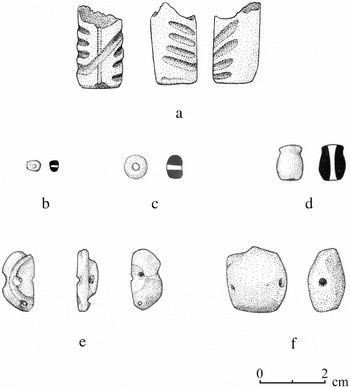
Illustration of ornaments from different terraces at El Palmillo: (a) unfinished greenstone ornament from Terrace 507; (b–e) greenstone beads from Terrace 925; (f) chert bead from Terrace 925.
Broad axes of variation on excavated terraces at El Palmillo
 You have
Access
- 19
- Cited by