One's body is only valuable if purified through service. If one knew how impure the body is, how could one ever attach great importance to it for its own sake? It is nothing but a conglomeration of filth; that is, a bag of phlegm, tears, urine, and excrement.
Suzuki Shōzan, Selected Writing of Suzuki Shōzan, 1667From that inarticulate orifice, and out of undifferentiated flatulence, he has mastered breathing, diction, and phrasing, and he has contrived to reproduce the varied effects of vocal coloring and all of the twelve classical scales. He has, then, incomparably greater talent between his buttocks than these third-rate musicians have between their lips . . . This favorable comparison holds up not only with respect to musicians, but vis-à-vis any number of incompetent wretches in other fields of contemporary endeavor.
Hiraga Gennai, On Farting, 1774INTRODUCTION
Recent work on cultural politics has tended to draw on the concept of “cultural resistance, particularly resistance of a decentered sort—those dispersed everyday acts that thwart conventions, reverse valuations, or express the dominated's resentment of their domination,” without exploring these acts’ relations with “powerful institutional nodes,” most notably “states.”Footnote 1 This approach seems facile for it commonly lacks a cogent explanation of why and how the regulation of outwardly inconsequential cultural practices often occupies such a central place in the state's efforts to maintain social order and public mores, and ultimately to defend its own political and ideological legitimacy. This essay seeks to demonstrate a new approach—both historical and theoretical—to the understanding of the dynamics of politics and culture through the example of Japan's early modern period (1603–1868).
The essay focuses on the political capital of Tokugawa Japan, Edo (present-day Tokyo), and examines the interface between distinct forms of literary and visual representation and the configuration of social order (status hierarchy and division of labor), as well as moral and ideological discourses that were conducive to the reproduction of the order. What marked this interface was a sharp dissonance between the official and the popular conceptions and uses of the body. The Tokugawa bakufu, Japan's early modern regime, had since its establishment fundamentally distrusted the body—its desire and excess—and thus considered its regulation an integral part of the complex set of strategies required to construct and maintain social order. Within two decades of its rise to power, the bakufu implemented a series of policies aiming to regulate popular spectacles that threatened to subvert the specific meaning and function it sought to endow on the body. Kabuki dancing (kabuki odori)—the early form of female kabuki performance initiated by Okuni of Izumo and her troupe—was outlawed because its transvestism and “unduly” erotic choreography were viewed as inciting “debaucheries among high and low” and perturbing core moral values which the bakufu exalted to consolidate new social order.Footnote 2 A new form of kabuki (wakashū kabuki) that used male youths in place of banned female dancers met with the same repressive measures. Tokugawa authorities judged the youths’ erotic female impersonations to be “corrupt,” “perverse,” and “licentious,” and accused the young actors of enticing their patrons to commit the “irremissible sins of male–male love.”Footnote 3 The kabuki-mono – which in its literary sense meant a person with idiosyncratic appearance and unrestrained or nonconformist behavior – from whom the term “kabuki” was said to be derived, also became targets around the same time. These men and women roved the streets of castle towns with ostentatious appearances and, at times, insolent behavior and were apprehended by the authorities for spreading “lawlessness” and disrupting “public morals.”Footnote 4 Other entertainers such as itinerant female shamans, blind street diviners, fishmongers, and puppeteer-prayer nuns, who performed both religious and sexual services during the medieval period, were also forced to settle in fringe areas of castle towns, transportation nodes, or commercial routes as part of the bakufu's policies of regulating and institutionalizing “brothels.”Footnote 5 By the mid-seventeenth century, all of these itinerant entertainers and “delinquents” would be incorporated as bottom rungs in the social hierarchy: as outcasts called hinin (nonhuman), a status equivalent to that of beggars and vagrants. They would be confined within the walls of prisons or such specially designated areas as entertainment districts located at the margins of cities, so that “their perilous influence on the larger social whole” could be contained.Footnote 6
Despite the Tokugawa bakufu's fitful attempts to segregate and contain the undesirable body, by the early eighteenth century there emerged through popular literary and visual imaginations in the major castle towns, in particular Edo, a variegated, novel representation of the body that was antithetical to the official conception of the ideal body. The popular imagination privileged unproductive, idle bodies immersed in the culture of play associated with various forms of entertainment that had been regulated, if not proscribed, and reviled by the bakufu for diffusing “follies” and “debaucheries.”Footnote 7 The authorities took punitive measures, albeit fitfully, against those who produced, disseminated, and consumed the new forms of culture and entertainment, but people in Edo continued to explore and celebrate the new possibilities that these playful and provocative bodily images presented.
But what were the historical implications or connotations of the proliferation of a novel representation of the body that defied the officially prescribed body? Did it suggest that the bakufu's earlier strategies of building and maintaining social order through the domestication of the body had lost their efficacy? Did it also, then, represent a new historical conjuncture in which the mechanism of the bakufu's power and domination was rendered obsolete? If so, what were the historical conditions that contributed to the waning potency of Tokugawa rule? Furthermore, did the new representation of the body constitute part of the growing historical consciousness that recognized the increasingly conspicuous and irreparable disjuncture between the ideological premise and the ongoing social and economic transformations of Tokugawa Japan, a consciousness articulated by critically minded intellectuals from the early eighteenth century onward?Footnote 8 If so, how did popular cultural imaginations of the body communicate such a consciousness?
THE CONFIGURATION OF THE BODY UNDER THE TOKUGAWA REGIME
What guided the bakufu's strategies during its formative years to contain the undesirable body represented by kabuki, kabuki-mono, and semi-religious itinerant entertainers was its commitment to creating a populace whose daily endeavors would be devoted to the task of preserving societal harmony, a task that the bakufu proclaimed to be the most fundamental moral duty for every single person living in Tokugawa Japan. The way one was expected to perform this duty varied, depending on one's designated place in society. During Tokugawa times, every individual was born with a predetermined status and a particular occupation that corresponded to that status within the matrix of hereditary social relations. From the womb to the tomb, individuals carried supposedly unalterable markers, or “social tattoos,” that signified their permanent belonging to a given group and social function.Footnote 9
This highly rigid classificatory system was devised to institute and perpetuate the hierarchical arrangement of authority and to facilitate the interdependent relations of material production. Peasants and artisans were allotted productive work and merchants served a distributive function, while the ruling samurai held bureaucratic responsibility for monitoring and regulating the mechanisms of production and distribution. In practice, of course, these distinctions were not always observed with strict consistency; functions of manual labor and commerce were more frequently merged in the same person from the eighteenth century onward.Footnote 10 But the general distinction was not on that account to be overlooked.Footnote 11 The classificatory scheme set up by the founders of Tokugawa Japan to organize people into different status categories and to require them to perform assigned responsibilities constituted an essential part of the system of rule designed to lubricate the social hierarchy's interdependent relations.
Given this particular configuration of social relations of production, the bakufu swiftly discerned that the body—especially that of the common person—should be understood exclusively in terms that were both moral and utilitarian: the body was valuable only as an instrument satisfying through its productive function the moral imperative to preserve social unity. Measuring commoners’ existential worth by how—and how much—they contributed through industrious devotion to the social whole, the bakufu placed peasantry engaging in the most laborious work higher than artisans and merchants in the status hierarchy and relegated the merchants whose work was considered least onerous to the bottom of the formal hierarchy.Footnote 12 And, underneath the formal structure, there was the populace—entertainers, prostitutes, and vagrants—bearing the outcast status of “nonhuman” whose activities were considered utterly unproductive by the regime. The hierarchy therefore reflected the bakufu's core ideological value that the productiveness of one's body was the indication of one's moral worth.
It is no coincidence that around the same time as the bakufu set out to contain the undesirable body—the early seventeenth century—influential bakufu ideologues such as Suzuki Shōzan (1579–1655) began extensively writing and promulgating their deprecating views of the body. Suzuki, a Zen Buddhist monk and ardent spokesperson for the bakufu, theorized the body in an absolutely negative light and limited its meaning and function to an idea of duty that called for industrious devotion to the well-being of the whole. In his essays, Suzuki pressed the idea that the cardinal truth for humans to accept was the utter worthlessness of their bodies. “[H]ow could one ever attach great importance to [the body]? It is nothing but a conglomeration of filth,” Suzuki asserted.Footnote 13 Furthermore, he continued, “the body is compounded of suffering,” but people “believe it to be a source of pleasure . . . Where does suffering come from? Only from love of the body.”Footnote 14 For Suzuki, the body was not only impure and filthy, but it was also plagued by desires and passions, and this disturbing truth was the underlying cause of human beings’ distressing conditions. “It all too often happens that the sensual self becomes the fortified headquarters of the desires. Then the mind becomes an unenlightened master [that produces] bad karma and destroys the self. Such a mind is our enemy. This body is a bag of desires.”Footnote 15 Low as filth, and destructive as an enemy, the body should be perceived in a positive light only if it strived to fulfill the moral duty of preserving societal harmony; for this effort to be effective, the corporeality of man's existence ought to be regulated—even negated—by its spirituality. Ascetic life realized through rigorous self-discipline thereby was a precondition for one to perform the public duty, or “service,” as Suzuki put it.Footnote 16
Underpinning the official conception of the body, as exemplified in Suzuki, was language that drew a sharp distinction between the mind and the body. Abstract thought and moral cultivation were regarded as the expression of the individual's higher self and the higher reality, while sensual or corporeal experience was an inevitable yet lower reality—a shifting, uncertain, disorderly world of appearances, ephemeral and uncontrollable. This binary formulation divided the world into a high mental reality and a low material reality, stripping the mortal body of its spiritual truths and assimilating it into the mass of things. Yet, because humans were schematized as beings possessing minds, who thus occupied a status superior to that of animals, they were figured as residing in an ambivalent place between the mental and the material. If the mortal body was completely assimilated into the mental, human reality was sacred, but that reality was profane insofar as the body was held captive by the sensual. Thus the ideologues of the Tokugawa bakufu insisted that the higher reality of the mind had to vanquish the body and its senses—or at least regulate them by subordinating them to its sovereignty.
These stark binary oppositions of mind and body paralleled the ideological notion that the ruling class embodied the higher realm of the mental self, while commoners belonged to the lower realm of the corporeal self. Much as the mind was given a sovereign position from which it could make the body conform to its commands and its truths, the samurai class assumed a position enabling it to rule and regulate the common classes. In the latter half of the seventeenth century, Yamaga Sokō (1622–85), a samurai turned Confucian scholar who offered a theoretical elaboration on samurai identity in The Way of Samurai (Shidō, 1665), explained the relationship between ruler and subject as follows:
should there be someone in the three classes of common people [peasants, artisans and merchants] who transgresses against these moral principles [loyalty, duty, and respect], the samurai summarily punishes him and thus upholds proper moral principles in the land . . . The three classes of common people make him their teacher and respect him. By following his teachings, they are enabled to understand what is fundamental and what is secondary.Footnote 17
In this characteristic depiction by the samurai class, common people were pronounced incapable of moral conduct, self-discipline, and self-reliance and had therefore to obey the moral and intellectual injunctions of the ruling elites.
It was this official rhetoric of commoners’ lack of moral competence and of their troubling propensity toward corporeal pleasure that made it imperative to impose stringent regulations on the body and make it serve the social whole as a productive instrument. The mind–body binary oppositions thus legitimated the logic of absolute social hierarchy and the division of labor between the ruling samurai and the common people: because of their superior moral and intellectual capacity, the samurai were suited to rule through mental work, whereas the commoners must abide by their rulers’ directives through manual work—material production and distribution—due to their intrinsic moral and intellectual shortcomings. The ideological discourse providing a rationale for the legitimization of a static, frozen social hierarchy worked to anchor nonsamurai subjects to an instrumental body expected to perform, through the punctilious observance of austerity and frugality, a singular duty: providing the material conditions necessary for the samurai's existence and dominance.
Daniel Botsman's elucidation of the symbolic function of the body in “the complex set of strategies of ordering society and exercising power” affirms the significant status given to the body within the ideological structure of the Tokugawa polity.Footnote 18 By setting up a multilayered system of corporeal punishments, including the public display of criminals’ severed heads, Botsman argues, the bakufu aimed to domesticate the body to reflect the social order positively in its appearance and conduct. When the body hovered over or traversed the boundary between order and disorder, the bafuku took the prompt and extreme measure of stamping upon it the brutal marks of punishment so as to bring it back into conformity with the expectations of “appropriate” behavior. Thus the horrifying spectacle of tortured and executed bodies realized the dual effect of maintaining social order and valorizing the moral authority and physical power that the samurai regime held over the rest of society. The body, in short, played the decisive role in reproducing the normative order as a concrete sign through which order and disorder in their oppositional nexus played against each other. Botsman perceptively calls this mechanism of social control the bakufu's “system of bodies-as-signs.”Footnote 19
What needs to be added to Botsman's semiotic analysis of the body is the question of how the system of “bodies-as-signs” was intertwined inseparably with the moral imperatives of the productive body. The samurai regime's rendering of the body as a physical manifestation of norms and rules reflected the keen awareness that the regime's long-term survival depended on the extent to which the body could be successfully conceptualized and mobilized as a productive force. The bakufu's obstinate efforts to enforce sumptuary laws and decrees of frugality (shisso, ken'yaku) and loyalty–duty (chū-kō) were aimed not only at shoring up the symbolic relations of status, but also at ensuring the sustained material production through the body's reification of austerity and discipline.Footnote 20 Given the fact that representations of rigid binary oppositions such as mind/body, reason/passion, order/disorder, ruler/subject were all linked closely to the representation of another binary, mental/manual work, it is essential to interrogate the complex relations of the symbolic and the material for our understanding of how social order was organized and power was exercised during the Tokugawa period.Footnote 21
To probe further the implications of the new bodily images that emerged against the discursive economy of Tokugawa ideology and the bakufu's strategies of containment, it would be useful here to recall Fredric Jameson's dialectical formulations of ideology. Jameson draws in part on György Lukacs's concept of ideology as a form of synecdoche, a form that takes the part for the whole; that is, that renders a partial, limited view as representing a totality. This view of social totality that prevails among the bourgeoisie is, for Lukacs, a dire effect of socioeconomic conditions—reification—that structurally constrain that class's thought and action by dislocating and fragmenting its experiences. Lukacs's theory of ideology differs from that of an orthodox Marxism in that it defines ideology as a symptom of the objective circumstance called reification whereas the orthodoxy views it as a form of false consciousness in the sense of a lie or illusion about the reality in which people live. In other words, for Lukacs, ideology is immanent in and an essential condition for the functioning of received reality. Jameson draws on Lukacs in taking ideology not as simply a lie or an illusion but “as the approximation of some truth about the totality that, given the limitations always imposed by the historical process, stands in for the deeper truth it exists to deny.”Footnote 22 But Jameson takes a further step, by following an Althusserian notion of History, to reconceive Lukacs's idea of the totality/History by defining it as an “absent cause,” too complex an entity to be encapsulated or contained by any forms of representation.Footnote 23 In this regard, any sweeping claim to the complete intelligibility of the totality, or any ideal representation of it, is an ideological gesture. Indeed, for Jameson, ideology always seeks to put a closure to the incertitude of History and to contain it within the limits of its own terms of coherence while “repressing the unthinkable which lies beyond its boundaries.” Jameson thus defines ideology as “strategies of containment.”Footnote 24
The strategies of containment can be in turn, according to Jameson, “unmasked by confrontation with the ideal of totality” – that is, thinking through the unthinkable – because the limitations of the ideal are made visible only when what the ideal represses (the unthinkable) is articulated.Footnote 25 What makes Jameson's theory of ideology particularly valuable for my interpretations of the cultural politics of late Tokugawa Japan is his recognition of totality as an uncanny effect of representation whose ideal projection is a constitutive element of social order and yet one that simultaneously remains vulnerable to threats posed by what the projection represses or marginalizes—often material realities of socioeconomic overdetermination and cultural forms articulating such realities that fundamentally contradict the representation's internal logic of coherence. This theorization of ideology helps us understand why the bakufu and intellectuals viewed the blatant celebration and valorization of “idle” bodies—an essential figure of the unthinkable—in Edo popular culture as undermining its projection of Tokugawa society as a harmonious, self-enclosed, perfectly functioning universe.
In Tokugawa Japan, the ideal of totality was articulated through a politically composed version of the theory of “cosmic–human unity” (tenjin sōkan setsu). Referring to Hayashi Razan (1583–1657), a Neo-Confucian scholar who contributed to the early formation of Tokugawa ideology, Herman Ooms summarizes his theory of the social order as follows:
The order . . . is a hierarchical social order where the upper and the lower, the exalted and the vulgar, keep their place, just as in nature, where Heaven is above and Earth is below. The Sage Kings who received Heaven originally defined this hierarchical stability as the fundamental principle of Heaven and Earth, the will of Heaven.Footnote 26
Assuming an uninterrupted continuum between extraterrestrial and earthly worlds, the ideologues of the bakufu projected timeless and inviolable images of the cosmos onto the human social order, and thereby presented the new order of things as naturally given. This strategy was intended to purge any possibility of social mobility and transformation and the recognition of such a possibility by effecting a “genesis amnesia,” in which the fortuitous and treacherous formations of the new polity were consigned to oblivion.Footnote 27 The founders of the bakufu, having emerged from the plight of extreme social fluidity and fragmentation called gekokujō (“the lower supplanting the upper”) characteristic of the Warring States periods that had lasted for a century, were haunted by the terrifying possibility of everlasting civil warfare and were therefore determined, by enacting the self-occultation of its historical origins, to establish an incontestable system of perpetual power under the name of the Great Peace (taihei no yo). Bringing peace and stability to the war-worn society provided the Tokugawa regime with a politically and ideologically viable ground for proclaiming its rise to power to be a Heavenly mandate. By approximating the unprecedented achievement of unifying the country, the new state fashioned itself in the image of an inviolable, righteous, and benevolent ruler who faithfully followed direct injunctions from Heaven. Accordingly, the new hierarchical configuration of social order was transposed onto a cosmic plane, which aided in restructuring the post-warring society in such a way as to make individual subjects understand their lives or experiences in relationship not to the process of social formation, but to transpersonal and immutable realities that existed beyond the vicissitudes of history. The theory of the cosmic–human unity offered, in short, a totalizing vision of society in which corporeal realities were reified as part of Nature, and history was thus denied or repressed.
The Tokugawa authorities’ attempts to build the new system of totality through the projection of eternal time and natural order were linked closely with the assumptions it held about economy: first, the bakufu considered the accumulation of wealth “a zero-sum game” because “wealth could only be redistributed, not created”;Footnote 28 second, wealth could consequently be accumulated only through coercive means such as taxation or self-disciplinary means such as hard work and thrift; lastly, given the view of wealth as limited and scarce resources, wealth must be redistributed not on the ground of an egalitarian principle but in line with the hierarchical arrangement of authority. This view of subsistence economy was most clearly elucidated in 1725 by Ogyū Sorai (1666–1728), a renowned Confucian scholar who served as an adviser to the fifth shogun Tokugawa Tsunayoshi (1646–1709) and wrote extensively about politics in the last decade of his life:
The amount of goods to be produced is generally limited. How much rice can be produced in the entire land of Japan? How much millet can be produced? How much lumber can be made available? Every good in this world has limited quantity. Those of fine quality are especially few, while coarse goods are many. Therefore, it would be perfectly logical to establish institutions whereby one has people of venerable status use the fine goods (from clothing, to food, to housing) and those of base status the poor goods because the number of the former by nature is small while that of the latter is large; that is, the fewer people use the fewer things and the more numerous people use the more numerous things. All the things available in this country will be used to the full extent by all the people to satisfy their needs.Footnote 29
It comes as no surprise that based on this economic principle the Tokugawa authorities regarded conspicuous or exorbitant consumption as inimical to, even destructive of, societal unity and stability. Sorai summarized this view in the same treatise:
If our institutions [whereby wealth is distributed according to the status hierarchy] fail, a vast number of lowly people will start acquiring fine goods, which will result in dramatic increase in the price of commodities . . . Furthermore, because it causes confusions to the order of high and low, it will open up a path to conflicts from which all kinds of vices will be born . . . The world becomes sumptuous without institutional [arrangement and authority] because it is people's natural sentiment to relish extravagance.Footnote 30
Because the Tokugawa state and its advisers understood economy primarily as conservation and distribution of limited resources by way of reproducing given social relations of production, and saw undue expenditure not as beneficial but as inimical to the economy, they understood sumptuary regulations as the most logical and efficacious measure to retain the equilibrium of production and consumption. Edicts were regularly issued to curtail waste or excess by urging people to exercise “self-discipline in all matters of consumption” and to retain the level of production vital for the well-being of society by demanding that they “maximize labor available through cooperation” within a community.Footnote 31 By promoting frugality and communal loyalty–duty as the foundational virtues for commoners’ everyday conduct and enforcing these virtues through decrees and punishments, the Tokugawa authorities intended to purge the “unproductive expenditures” represented by activities honoring the pleasure of play such as spectacles, fashion, street vogue, and burlesque art and literature, which in their view “have no end beyond themselves.”Footnote 32 They hoped that commoners would grasp and abide by the idea that consumption was acceptable only if it took place within the limits of justifiable utilitarian ends—consuming no more than the volume necessary for their subsistence without upsetting maximum productivity, and that transgressing the limits meant a serious deviation from and disruption to the moral imperatives of societal harmony. Forestalling the body's fall into the world of unwarranted expenditure was crucial, therefore, to the bakufu for its success in sustaining social order. Allowing the real or imagined body to defy its moral imperatives implied a pernicious contradiction to the regime's ideological postulate—or “the ideal of totality,” in Jameson's words—fashioned to sustain the mechanism of rule.
From the mid-eighteenth century onward, the Tokugawa bakufu was indeed increasingly faced with the possibility of losing the power to sustain the mechanism of rule, with the emergence of bodies that flouted the moral duty of productivity. The burgeoning material allure and relative freedom of urban life, which contrasted with the growing misery of rural areas resulting from famines and heavy taxes, impelled peasants to flee their villages. This led to the formation of large vagrant populations in the major castle towns, especially Edo. In 1692 the official number of vagrants in Edo was 5,366; that number had grown to 13,266 by 1837.Footnote 33 As the total population of Edo reached over one million by the mid-eighteenth century and as sixty percent of this figure consisted of common people, the increase in the vagrant population indicated that approximately one in every fifty or sixty commoners was identified categorically as a vagrant in the early nineteenth century. From the late 1780s onward, when the number of vagabonds coming to Edo increased dramatically due to the devastating Tenmei famine (1782–7), Matsudaira Sadanobu (1758–1829), the senior counselor for the shogun at the time, embarked on an aggressive policy of repatriating vagrant peasants to their native lands (under a law entitled Order for the Return of Unregistered and Wild Beggars to Their Former Native Places) and created the Stockade of Labor, a workhouse in which vagrants and criminals were classified as one and the same—a common threat to social stability—and put into a program of “rehabilitation” to be molded into fully functional workers. Despite such attempts to resuscitate mechanisms of social control and sustain societal harmony, the bakufu succeeded neither in bringing a halt to the inflow of fleeing peasants into Edo from nearby villages nor in containing the allure of pleasure and play that urban popular culture exuded beyond the borders of Edo. Officials’ frustrations and anxieties were well conveyed in the following order issued at the time of two major ideological and political campaigns—in 1799 soon after the Kansei Reform of 1787–93 and in 1839 just before the Tempo Reforms of 1841–3:
Under the pretext of holding annual fairs and festivals, some people in villages perform plays imitating kabuki and make a profit. In addition, there are villagers who invite itinerant traders, who bring in goods [comic books and ukiyo-e prints] that are wasteful of both time and thrift and are detrimental to the morality of village life. Others, who invite outcasts [itinerant entertainers] spreading through lascivious mirth and levity the undesirable influences of pleasure and play, must also be punished. This sort of transgression naturally encourages peasants to cease their cultivation and to create more wasteland, and eventually leads them to impoverishment. As a result, peasants are forced out of their villages and migrate to cities. Urban performances such as kabuki and jōruri [puppet plays] must therefore be strictly prohibited in villages.Footnote 34
This statement not only confirmed the bakufu's most basic ideological proposition that morality and productivity formed in conjunction the basis of social unity, it also revealed officials’ fear of the challenge to the established order of things posed by the new, proliferating forms of urban culture and entertainment. Characterizing urban popular culture as intrinsically immoral due to its propensity to foster a penchant for pleasure and play over the venerable virtues of thrift and hard work, the edict was aimed at containing the “vice” of popular culture in the city proper to keep it out of the countryside. The language of the Tokugawa authorities unequivocally condemned urban popular culture, with its power to entice people out of their assigned stations and social functions, for throwing into disarray the mechanism of reproduction of social relations.Footnote 35
The bakufu's repeated attempts to halt declining productivity and reclaim social control through the discourse of moral discipline proved futile. Buyō Inshi (dates unknown), presumably a samurai serving his lord in Edo or a samurai-turned-Confucian-scholar residing in the city, observed in the second decade of the nineteenth century that the ruling samurai class's loss of moral authority and social control was patently obvious, and the distinction between the rulers and ruled was not merely blurring but actually disappearing:
Even though townspeople and city idlers are said to be filthy and inferior, they are so only in name. They are in reality the winners of our time, for they enjoy the fruits of unprecedented prosperity and continue to influence every aspect of our social life with their culture of debauchery . . . It is increasingly common for samurai to choose to become townspeople, willingly renouncing their status and opting to live among these lowly people. Even peasants, violating our sacred law, leave their home villages for larger cities to live like townspeople . . . The entire world has fallen into the hands of the townspeople. From samurai to peasants, everyone imitates their lifestyles, manners, and appearance. Who could have anticipated such a dramatic dissolution of our sacrosanct moral order at the time of the Tokugawa system's founding?Footnote 36
The new historical realities of a world-turned-upside-down engendered by urban culture provided the social conditions for Edo commoners to forge a subculture that flouted—even negated—the official discourse of the social hierarchy's inviolability. It was in this very context that literary and visual representations of the idle body surged forth in the popular imagination, presenting an exigent state in which the “empty formalism” and untenable logic of the ideal of totality were exposed.Footnote 37
URBAN SPACE AND THE HETEROGENEOUS
It is of great importance that these new bodily images sprang from the “low” city, as officials called it, an urban space where the culture of “unproductive expenditure” drove economic life. Storytellers, street musicians, jugglers, dancers, mimes, puppeteers, food vendors, barbers, diviners, itinerant shamans, souvenir peddlers, and teahouse girls gathered and entertained large crowds of people of all social statuses with “bizarre,” “obscure,” and “vulgar” spectacles.Footnote 38 They made a living out of nothing but their skills and bodies, which could not be instrumentalized to serve the moral imperatives of material production. Authorities denounced the entertainers and their festive vulgarity as the source of dissipation and disorder, relegating them to the outcast categories of “idlers” and “nonhuman.”
Yet it was these “unproductive” spaces that began to function as magnetic centers, to an unprecedented scale, for the vital cultural production and consumption of the latter half of the eighteenth century. These spaces consisted of such an intensely heterogeneous commingling of all kinds of people (from samurai to townspeople to prostitutes to beggars) and goods (from provincial products to exotic foreign items) that one contemporary observer marveled, “So many different styles and customs, and such diverse faces, in crowds too dense to push through—has Edo emptied the houses of the provinces?”Footnote 39 These riotous gatherings and in-mixings of “high” and “low” transgressed the social boundaries designed to mirror the official logic of status distinctions, encouraging forms of discourse that fostered the interaction of divergent and competing values and perspectives. The transgressive excitement of the market and entertainment districts for the subordinate classes was therefore not a result of their “otherness” or “marginality” to official discourse, as some theorists of subculture often suggest, but an effect that resembled what M.M. Bakhtin called “carnival” in reference to social dynamics in creating “contact zones” where dialogical interaction or interpenetration of high and low unfold.Footnote 40 The districts encouraged the new social formation and fostered a complex process of dislocating and defamiliarizing Tokugawa norms and customs.
What contributed more to the effect of defamiliarization was the ruling elites’ ambivalent and contradictory attitudes toward the culture of play. Despite their moralistic condemnation of urban culture, samurai were also drawn to its allure. As Buyō's remarks show, the spaces of spectacles (theaters, streets, and pleasure quarters) and the lifestyles associated with them engrossed not only the townspeople, but also samurai, to such an extent that many chose to renounce or jeopardize their social status in indulging in them. In the same treatise, Buyō added that “feeling envious of the townspeople who indulge themselves in pleasure and play, samurai plunge into the lifestyle of the rich even though their stipend is meager. As a result, they put themselves in serious debts and ruin their life and posterity.”Footnote 41 Furthermore, shoguns or shoguns-to-be made frequent visits to the Sensōji Buddhist Temple which functioned as a hub of both prayer and play, as Nam-lin Hur explains, despite the Tokugawa ideologues and Confucian critics’ condemnation of the intermingling of these seemingly contradictory activities.Footnote 42 Matsudaira Sadanobu (1758–1829), an architect of the Kansei Reform of the 1790s that tightened control over prevalent commercialism and popular entertainments in places like Sensōji and Ryōgoku, vilified them for corrupting the minds of both high and low with moral debauchery, dissipation, and idleness.Footnote 43 Yet Tokugawa Ienari (1773–1841), the eleventh shogun, under whom Sadanobu implemented the reform, cherished the places as one of Edo's great attractions and as sources of Edo's vitality and creative energy. Ienari made regular visits to the amusement sites of the Sensōji Temple to see a wide variety of entertainments. In 1803, after the resignation of Sadanobu due to his failed and unpopular Kansei Reform, he accompanied his son to the temple and spent a day enjoying a freak show, an acrobatic performance, street music, mimes, and a magic show. Moreover, before ascending to the position of shogun, Ienari visited the Asakusa district around the temple at least twice a year from 1784 to 1787.Footnote 44 It was also a common practice for shoguns’ wives to organize day trips to Asakusa. Ienari's wives frequently visited the temple and its entertainment places, usually accompanied by thirty to fifty attendants. Samurai of lesser status were also drawn to these vibrant parts of Edo. Matsudaira Kanzen (1767–1833), a lord of the Wakasa domain, was presumably a most enthusiastic Asakusa goer. He completed a multivolume history of the Sensōji Temple and its environs in 1813, recording in great detail the shops, shopkeepers and their famous delicacies, and entertainers. It is clear from these volumes that Kanzen took great joy in visiting the 280 shops and tasting all of their popular products. The diary of Sakai Hanjiro, a samurai retainer serving the lord of Kishū, described his tour around the Asakusa and Ryōgoku areas in 1860:
We arrived at the Sensōji Temple in the afternoon, and after praying to Kannon [a Buddhist deity of compassion], we saw a famous ghost show. As a brief evening shower passed by, we popped into a store and ate a dish of broiled eels, yams, and octopus with sake. In Yoshiwara, we saw the procession of Oiran [a courtesan of the highest rank] for the first time, and then enjoyed watermelon. We headed to Ryōgoku, where we saw a wicked show [a show of male–female intercourse]. It was fun.Footnote 45
These examples of samurai's ambivalent and contradictory attitudes toward the spaces of idleness demonstrated the ruling class's inability to retain the clear demarcations between high and low, sacred and profane, or mind and body as a mode of social control.
Contributing further to the bakufu's inability to implement a draconian policy toward the culture was the dilemma it faced in coping with a large number of Edo's poorest commoners. Implementation of strict sumptuary measures (in 1818, 1820, 1823, 1828, and so on) and edicts banning prostitution, pornography, gambling, alcohol, and entertainments always resulted in economic recessions affecting the poorest stratum of urban commoners. Popular culture constituted an important source of income for this group of people, and therefore the bakufu could not adopt a radically repressive measure against it. Clearly, what the bakufu vilified as “unproductive expenditure” actually constituted an indispensable part of the productive economy in late Tokugawa society.Footnote 46 For the samurai class, then, the “low” city's culture of play meant both repulsion and fascination, excess and necessity, twin poles of a self-contradictory standpoint that undercut that class's claims of inviolability and immutability for the principle of distinction and exposed its ineptitude in regulating the culture of the townspeople within the limits of the totality it hoped to project and institute.
The ruling class's failure in social control did not suggest, however, that the interaction of high and low in these entertainment districts dissolved completely the power relations delineating social hierarchies. Rather, such interaction offered rulers one of the rare opportunities to exalt their power and authority in front of urban commoners through pompous display of privileges.Footnote 47 Whenever the shogun and his family made a visit, the Sensōji Temple was overhauled and redecorated, and special rituals were performed under the name of protecting the polity from calamities and misfortunes. The time-honored Buddha statue, usually kept sealed in the main hall, was made available to public prayer and viewing only on the occasion of their visit. The privileges attached to their excursions worked to endow them with a divine and magnanimous aura, invoking their putative link with the Heavenly realm. Furthermore, while touring the entertainment sites, the shogun and his family remained shielded from the gaze of commoners, viewing both entertainers and townspeople from inside their splendidly decorated palanquins. Their contact with the townspeople was characterized by the symbolic physical distance, a position from which they might gaze on the populace, but not be gazed on, inducing a sense of distinction and reverence. The carefully choreographed spectacle of the shōgun's absent presence was a common tactic, as Timon Screech reminds us, frequently used by the bakufu to heighten the mystique of the ruler.Footnote 48 The interaction of high and low thus promoted both a liberation from and a permeation by power. The “pleasurable play of shifting solidarity with others” was liberating, as if the heterogeneous gatherings and interactions in the entertainment and market districts had dispensed with the hierarchy separating the rulers from the ruled.Footnote 49 Yet the districts also provided the ruling elites with strategically opportune moments to further consolidate the principle of distinction between high and low.
It was these spaces of multilayered, dynamic and contradictory social intercourse that inspired the producers of popular culture to visualize imaginary situations where the values and perspectives of high and low came in direct contact and conflict with one another. Drawing on the districts’ “low” languages, performances, and gestures, which radiated the energy of cheerful vulgarity riding roughshod over ruling-class civilities, popular writers, woodblock artists and playwrights forged a culture of comic, satiric, and grotesque forms that pitted bodily excess—or “filth,” in Suzuki Shōzan's terms—against dominant norms and authoritarian words. This vulgar materialism of the body became a foremost principle for late Tokugawa literary and artistic imagination and representation, subjecting piety, humility, servility, and loyalty to parody, ridicule, and blasphemy. The satirical fiction of Hiraga Gennai (1728–79), which often valorized the vulgar body as a way to reject legitimating discourses of social hierarchy, serves as a case in point.Footnote 50
THE BODY THAT SUBVERTS: ARTICULATING THE UNTHINKABLE
On Farting (Hōhiron, 1774) and On Farting, Part 2 (Hōhiron Kōhen, 1777) were arguably the best-known of all of Hiraga Gennai's satirical fictions exploring themes of dialogic encounter between high and low in Ryōgoku, one of Edo's most popular market and entertainment districts. On Farting portrayed a spirited dispute between a samurai and Gennai himself over a peasant-turned-popular-entertainer called the “fart-ist” (heppiri otoko), a real historical figure who amused the crowds with his “artistic” manipulation of flatulence in the late 1770s (Fig. 1).Footnote 51 The fart-ist of the story is one of the many late eighteenth-century migrants to Edo who, as discussed above, fled their villages to find a new means of survival in the city's thriving popular culture and came to constitute a major segment of society officially classified as “vagrants” and “idlers.” The entertainer's background and means of subsistence represent the possibility of a life antithetical to and disruptive of the official paradigm of productivity as moral. By accentuating the fart-ist's symbolic value, Gennai deployed him as a metaphor effective in calling into question the very ideological premise—the primacy of mind over body—that legitimated social hierarchies. The dialogue between Gennai and the samurai begins with the issue of propriety. The samurai objects,
This man sets up shop in the midst of a public place and positively flaunts something that most normal people are deeply ashamed of. Utterly disgusting! . . . You should recall what the true sages have taught us in the classical texts . . . We should not so much as overhear or witness indecencies from afar, let alone commit them—that is what the true sages teach us.Footnote 52
Gennai replies,
All things that lie between Heaven and Earth array themselves naturally into categories of high and low, lofty and base. Among them, surely the lowest of the low, the basest of the base, are urine and excrement. In China they have various pejorative figures of speech in which things are compared to “ordure,” “coprolite,” etc., while in Japan we simply say of things we don't care for that they are “like shit.” Yet, this loathsome filth, we should not forget, is turned into fertilizer and thereby nourishes the millions. Farts are different in this respect, it is true, being but the extraneous by-products of the perpetrators’ quest for progressive relief from intestinal distress.Footnote 53
He continues,
Not even fit for fertilizer, they are totally useless, if a wonderfully apt attribute to confer on corrupt scholars, as indeed Shidoken [a real popular storyteller who entertained the people with vulgar stories and gestures] has done, with considerate originality, in his epithet “the Conpyewcianists” [heppiri jusha, or farting Confucians]. But to take this thing that is, beyond all else in the world, utterly useless and make of it such a great success that, aside from the main theaters, other shows have had to shut down for the lack of spectators—it is no mean feat, and ample proof of the little fellow's powers of invention in having arrived at all those intricate variations on a single theme.Footnote 54
Gennai applauds the fart-ist's ingenious innovation to argue against the samurai's assertion that theatrical performances should be “an instrument for pacifying the people, and for elucidating the proper relations” between ranks in the social hierarchy.Footnote 55 Whenever a spectacle portrays a deviation from established righteousness and propriety, the samurai argues irately, “it must do so as a stern admonition” and a cautionary tale that such a deviation will be met, without exception, with retribution or severe punishment.Footnote 56 This is the sole reason, asserts the samurai, “why our government allows popular entertainments to exist.”Footnote 57 Despite the samurai's agitated remarks, Gennai—with no pretensions of moral condemnation—continues to praise the fart-ist's use of flatulence as a form of legitimate art, thus refusing to support an authoritarian conception of spectacle.
Fartist.

In this dialogue, Gennai used farting and the fart-ist to pit conflicting values against one another. For the samurai, they represent a serious offense against the official conception of propriety and social order, whereas for the character Gennai they embody wisdom and creativity. The two agree that a fart is nothing but a useless discharge, even in comparison with excrement: it certainly does not qualify as the kind of physical work officially sanctioned as productive, let alone as the mental work vital for the governance of Tokugawa society. However, they diverge sharply on what the fart-ist's use of the discharge implies. For the samurai, it signifies the antithesis of what the “true sages” taught as human decency and etiquette. But for Gennai, the great success of this “little fellow” is nothing other than a triumph of wisdom and creativity, for he has made a useless excess into music with “intricate variations on a single theme.” Gennai's windy rhetoric aimed to expose and accentuate the problematic nature of official decorum and the system of classification dividing high and low. By claiming to discover ingenuity and creativity in the fart-ist's utterly unproductive activity, he sought to dislocate the perceived legitimacy of the establishment's conventions, subverting the official order of things—high and low—upheld in the normative discourse.
As the story unfolds, it becomes clear that the target of Gennai's satire is the various domains of “high culture,” its custodians, and its mode of reproduction. Gennai first questions what he sees as the problem of the reproductive mode of aesthetic practice in high culture. By declaring that the fart-ist's flatulence functions as a new kind of language—an alternative to words as sounds shaped and enunciated from the mouths of musicians—Gennai seeks to undermine the authority of tradition given to various schools of vocal art:
Plenty of pupils join up, equipped with proper mouths and proper vocal chords; they dutifully receive from their teachers direct transmission of the tradition . . . They may cackle and caw with abandon like so many crows and herons on their nightly fray and faithfully mouth the stanzas they have been taught, but their renditions fail to bring a single spark of life to the old ballads . . . This man here, however, without benefit of any mentor or any oral transmission, has had to create his art through his ingenuity alone. From that inarticulate orifice, and out of undifferentiated flatulence, he has mastered breathing, diction, and phrasing, and he has contrived to reproduce the varied effects of vocal coloring and all of the twelve classical scales. He has, then, incomparably greater talent between his buttocks than these third-rate musicians have between their lips.Footnote 58
Gennai's logic is that although a fart by itself may seem useless, the fart-ist has developed it into a far more creative musical instrument than the voice for articulating melodies and rhythms. The fart becomes a new and commendable nonverbal form of articulation, actually preferable to established oral forms of language. This new language consists not of words, but of inventive rhythms and melodies of flatulence: things in which the traces and burdens of tradition are absent. For Gennai, this language manifests genuine innovation precisely because it is not subject to the command of tradition, through which elite culture legitimizes and reproduces itself. By contrast, pupils who abide by the traditional authority of the musical schools are unable to break conventions and bring life to their singing.
Gennai's provocative rhetoric was probably a parody of the Confucian theory that held music to be one of the essential means for cultivating the spiritual harmony. Ogyū Sorai, referring to Confucius’ remarks on music, wrote in his Discourse on Names (Benmei, 1721), “music is used to attain harmony.”Footnote 59 Defining music and rites as inseparable from each other, Sorai asserts that “rites (and music) regulate inner spirit . . . (and) maintain normal flow (of life).”Footnote 60 For Sorai and Confucian scholars in general, music as a method of realizing internal harmony was an integral part of a larger discourse on effective statecraft, namely how to preserve an orderly society without resorting to coercive and oppressive measures. By comparing the Confucian notion of spiritual cultivation to the most vulgar kind of activity and praising the latter, Gennai displaced the instrumentalist idea that music was a means to achieve societal harmony through its self-disciplinary or self-regulatory effect on the corporeal self. Through this inversion of the upper and lower strata of the body—fart superseding voice, and the fart-ist “singing” better through his anus than established musicians through their mouths—Gennai effectively undermined the authority of the intellectual discourse on the primacy of mind over body and demonstrated how the mind–body binary functioned to legitimize the official view of social cohesion as the highest moral goal.
Gennai's argument with the samurai then extends into the problematic state of knowledge production in late Tokugawa society:
This favorable comparison holds up not only with respect to musicians, but vis-à-vis any number of incompetent wretches in other fields of contemporary endeavor. The scholars buried in cast-off scraps of continental learning; the philologists who dabble in classical Chinese poetry and prose, cloaking themselves in the most threadbare shreds of Han Yü or Li Tsung-yüan, which they mistake for the full robes; our nativist poets who travel nowhere in search of inspiration, preferring to sit back and wait for grains of rice to stick to the soles of their feet. Then there are the doctors, whether of the old school or of the latter-day post-Sung faction, powerless to cure the diseases they claim to treat; who, whenever influenza strikes, can only stand by idly as all their patients die.Footnote 61
Gennai asserts that sinophiles, nativist scholars, poets, and physicians—being unimaginative, inflexible, and, above all, uncreative—can only turn to the received authority of the ancients or to the futile medical knowledge of the more recent past. For Gennai, the real problem is their uncritical immersion in conventions of learning that are utterly incapable of meeting the practical needs of the people. Gennai consistently argued that true creativity means a compassionate capacity to save others from suffering in such difficulties as the famines, poverty, and illnesses that were rampant in late Tokugawa society. In another essay, Slandering (Soshirigusa, 1777), Gennai vehemently denounced defenders of high culture, such as samurai leaders, Confucian scholars, Buddhist monks, and physicians, for indulging themselves in “empty theories” and “meaningless polemics” without effectual measures against the increasing woes of ordinary people.Footnote 62 In On Farting, Part 2, after describing the samurai's role in society as killing, cheating, and robbing, Gennai went so far as to call samurai worn-out “parasites” whose survival depended entirely on the labor—that is, the creative work—of artisans, peasants, and merchants, whom they exploited. He also described them as “robbers” who stole money from commoners in the guise of taxation (zei dorobō).Footnote 63 With his deployment of the “idle” body and commendation of its “productivity,” as opposed to the ruling elite's impotence and immorality, Gennai suggested that the assumed primacy of mind over body provided the Tokugawa establishment not only with a rhetorical tactic to justify their dominant place in society, but also with an alibi to hide the reality of their dysfunctional, paralytic, parasitic, and illegitimate existence.
Kitagawa Utamaro's illustrated story The Future (Sorekara Iraiki, 1784), which depicted an encounter between a samurai and a beggar in his “hut” in Ryōgoku, took up a subject related to Gennai's On Farting (Fig. 2).Footnote 64 It calls attention to the ruling elites’ “flawed” and “hypocritical” high–low distinction by exposing, through visual and verbal representations of inverted relations of high and low, the dependency and dysfunction of the classes. The beggar is clearly marked as an outcast sandal repairer called setta. During early modern times, the bakufu categorized setta as nonhuman vagrant outcasts, as they often belonged to the class of unwanted village migrants.Footnote 65 The samurai visiting the beggar's hut to repair his sandals appears to be a typical retainer living in Edo to serve his master. In contrast to the caption, “A beggar's hut,” the illustrated hut appears to confirm the beggar's prosperity, as it is a modest but respectable dwelling decorated with flowers and a scroll painting. The beggar, wearing poor and tattered clothing, nonetheless occupies a position superior to the well-dressed samurai, who is kneeling down to ask for his help. The samurai uses honorific language to ask the setta respectfully if it would be possible for him to mend the sandals today, and if not, if one of his disciples might do it. In typical samurai language, the setta replies, “I am extremely busy these days, so I will find you a disciple who could meet your request.”Footnote 66 The samurai expresses unlimited gratitude to the setta for his kindness and compassion.
The Future.

The inverted hierarchy of the samurai and beggar is clearly delineated by their upended language and manner of interaction. The comical and scandalous disjunctions between their appearance and substance accentuate the realities of the parasitic existence of samurai in the arena of material production and everyday survival. The samurai cannot ensure his sustenance without relying on the labor and production of commoners of the lowest status. The story calls into question the Tokugawa bakufu's ideological premise positing the primacy of mind over body, as the samurai's privileging of the mind and thus his exemption from material production are rendered the basis of his utter incompetence and parasitic dependency on the very commoners he disdains. The precise logic that allows the samurai to claim superiority here operates as a reason for relegating him to a subordinate position in the social hierarchy. The title of the story, The Future, reinforces the biting tone of the satire as it implies the ruined prospects of the ruling elites.
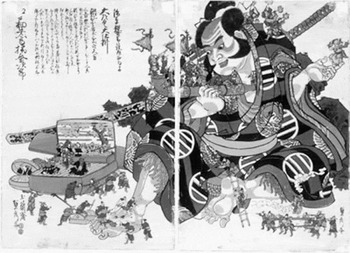
Utagawa Kuniyoshi's illustrated Asahina's Adventure in the Islands of Little People (Asahina Kojima Asobi, 1843) offers another transgressive dialogic encounter between samurai and commoners in a “low” district of Edo, Asakusa (Fig. 3).Footnote 67 Kuniyoshi's illustration renders the procession of the daimyō (rulers of domains) as a parade of “little people,” as the caption says, in front of the giant figure of a popular legendary warrior called Asahina. Widely popularized through war tales such as Azuma Kagami, Asahina was originally an iconic warrior of extraordinary physical strength and bravery in kabuki plays and ukiyo-e prints in the eighteenth century. One play characterized him as “possessing extraordinary power like a god, and once attacked by enemies, leaving none alive.”Footnote 68 Asahina's popularity grew in the early nineteenth century, especially through the wide circulation of adventure stories in which he became a Gulliver-like figure traveling all over the world, even to imaginary places such as the island of “little people.” Taking this theme for his illustration, Kuniyoshi depicted the warrior hero as a yakko, an outlaw and occasionally a laborer working primarily for the samurai class. The yakko's origins could be traced back to the seventeenth century, when these mercenaries enjoyed a commanding presence as “social bandits” who organized bands distinguished by their outlandish appearance and violent, antisocial behavior.Footnote 69 Some historians argue that the yakko was a kind of kabuki-mono, who became the target of the bakufu's strategies of containment during the first half of the seventeenth century.Footnote 70 In any case, their gang activities and fearless demeanor provided kabuki playwrights and woodblock print artists with ample inspiration for popular stories and images of iconic otokodate: “gallant, valorous young men of common origins who stepped forth in times of trouble to defend fellow merchants and artisans against injustice.”Footnote 71 By the early nineteenth century, cultural representations of yakko as brave, righteous, and compassionate had been widely accepted among lower-class commoners.
Asahina's Adventure in the Islands of Little People. By Permission of the Museum of Salt and Tobacco, Tokyo.

The spectacle of Asahina-yakko's body lying rudely in front of the high-ranking samurai's procession (daimyō gyōretsu) and his comical and jolly demeanor, indicating that he thinks of the procession as a toy to play with, insults the respectability of samurai, in a manner that resonates with Gennai's depiction of the fart-ist. Asahina's gigantic pipe is pointing, in a gesture of ridicule, directly at the daimyō hidden and protected in the palanquin. In contrast to Asahina-yakko's playful motions and animated expressions, the daimyō's retainers walk methodically, with a homogeneous appearance and posture, as though they are trapped in lifeless uniformity without pliability or adaptability. This insult is further accentuated by the yakko's grotesque and imposing physicality, which invokes the symbolic meanings of otokodate—bravery, righteousness, and compassion.
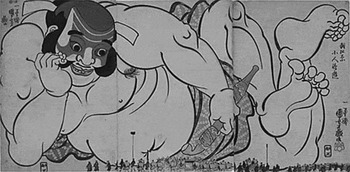
Kuniyoshi's fantastic representation of inversion and subversion was not entirely a product of his ingenuity as an artist of comic images.Footnote 72 It was based on an actual event, in which a high-ranking samurai demanded that the townspeople remove a giant bamboo doll of Asahina exhibited in the fairground of the Sensōji Temple when the figure interrupted his excursion to the area (Fig. 4).Footnote 73 The townspeople did obey the samurai's order, but their frustration with the higher authority's intervention lingered. Kuniyoshi's illustration was an attempt not only to recapture this moment of collision between high and low, but also to suggest an imaginary scene that placed samurai and commoners in a dialogic encounter. The representation of this encounter obviously distorts the relative sizes of Asahina-yakko and the samurai, and it is precisely this exaggeration of their bodies that enhances the illustration's effect of inverting the received order of things. The illustration brilliantly conflates the real event and the imagination to effect a symbolic subversion. The physically imposing hero embodying the popular values of righteousness and compassion looks down upon the “little” samurai. This imaginary encounter transformed the procession ritual, a spectacle of distinction that normally served to emphasize the high-ranking samurai's splendor, into an object of the hero's mockery. In Kuniyoshi's visual representation, the pageantry of the ruling elites became the subject of comedy and derision. By imagining the world turned upside down, Kuniyoshi's Asahina ridiculed and trivialized the ruling class's putative superiority and dominance.
The Giant Asahina. By Permission of the Museum of Salt and Tobacco, Tokyo.

In all of these examples, “lowly” bodily motifs invert the order of high and low that underpinned the established social hierarchy of Tokugawa Japan. In particular, the scandalous valorization of the “idle” body that sprang from the culture of “unproductive expenditure” as a productive force rendered unnatural the official conception of productivity and the very idea of the ruling elite's legitimacy that depended on it. In Gennai's story, the performer who made a living out of “filth”—farting—featured not only as the sharpest prong of an assault on the established morality of thrift and hard work, but also as a categorical negation of the ruling class's cherished self-image as the custodian of mind, morality, and knowledge. Utamaro's beggar exposed the parasitic existence of a samurai by making him grovel for a pair of broken sandals. And Kuniyoshi's outlaw laborer called into question the presumed grandeur and superiority of the samurai by dwarfing their bodies.
The political potency of these representations of an inverted world resided in their symbolic power to unhinge and deconstruct, through their articulation of the unthinkable, the Tokugawa bakufu's transcendental claims of high and low distinctions. By creating heterogeneous meanings and images of the body that were irreducible to the paradigm of the productive body as moral, popular literary and visual texts disrupted the perpetual and inviolable images of the official order. At the same time, they generated the novel perspective that the categories of social classification were not sacrosanct, but arbitrarily constructed for a particular purpose; that is, to naturalize and legitimize the world views representing the interests of the ruling class. Gennai's vehement attack on the elite for their ineptitude and lack of creativity, Utamaro's eloquent depiction of the samurai's parasitic existence, and Kuniyoshi's biting satire of the samurai's self-congratulatory grandeur constructed a critical perspective that, underneath the unquestionable truth of social hierarchies, the ruling class was fundamentally illegitimate.
CONCLUSION
That a symbolic struggle between the official and popular cultures took place, from the mid-eighteenth century on, over the meaning of corporeal “productivity” has important historical implications. It demonstrates that eighteenth-century Tokugawa society underwent an epochal transformation, occasioned by the emergence of a social condition in which multiple modes of production began to compete and contradict each other—a condition which Louis Althusser calls “overdetermination.”Footnote 74 Until the late seventeenth century, an agrarian mode of production (rice) constituted the foundational premise upon which the social order and moral values, which were conducive to the order, were articulated, while commercial economy (money) was given an ancillary role in facilitating, through distribution, the working of the premise. But, by the turn of the eighteenth century, the money economy seemed to have supplanted the agrarian economy. Under this new economy, consumption, or “wasteful expenditure,” was no longer viewed as counter to production, but as an essential element of productivity. The fact that common people's transgressive imaginations were grounded in and enabled by the spaces governed by the economy of spectacle and its consumption carried serious political implications for the Tokugawa authorities. In these milieus, it was not the moral principle of austerity, hard work, and loyalty–duty, but the production and consumption of play and pleasure that served as the basis for subsistence. All sorts of people were drawn into this sphere of new economic and cultural forms that celebrated the possibility of identities, or subject positions, that had not existed within the received political and ideological paradigm. These spaces for heterogeneous social formation thwarted the principles of status distinction, and made possible literary and visual imaginings of dialogic encounter between high and low. Popular literary and visual works brought the decorum of the samurai class into relativizing and contestatory dialogue with the “vulgar” discourses of the market and entertainment districts, and thereby achieved the dramatic displacement of the ostensibly inviolable primacy of rice over money and mind over body. It was in such “a dynamic state of low-ascending and high-descending” in both symbolic and socioeconomic domains, “a state in which the established order of things” began to wane, that new figures of the body emerged prominently as the site where the disjuncture and contradictions between ideological premise and social reality were forcefully articulated.Footnote 75
V. N. Volosinov explicates the political implications of this kind of semiotic operation. He argues that all signs have two faces: “Any current curse word can become a word of praise, any current truth must inevitably sound to many other people as the greatest lie.” “This inner dialectic quality of the sign,” he continues, “comes out fully in the open only in times of social crises or revolutionary changes.”Footnote 76 It was indeed no accident that the inversion of dominant categories and values through the idle body appeared as one potent mode of addressing and evaluating a multitude of contradictions at a time when a deepening sense of crisis beset Tokugawa Japan. The politics of Edo popular culture then stemmed precisely from its symbolic potency to amplify and condense the sense of the “dissolution of (the existing) unity” through its brazen declaration of the bankruptcy of the moral imperatives of status identities and socioeconomic functions.Footnote 77 Literary and visual representations of the idle body as productive in both economic and symbolic terms signified a “weakest link,” to borrow Lenin's words, of the social totality, which underscored overdetermined social realities and thereby posed a serious challenge to the reified conception of cosmic–human unity.Footnote 78 The political significance of a culture can be properly gauged only if ideology is construed as “a complex, conflictive field of meaning”—“a realm of contestation and negotiation in which meanings and values are stolen, transformed, appropriated across the frontiers of different classes and groups, surrendered, repossessed, reinforced.”Footnote 79