INTRODUCTION
Since the late 1980s, there has been a move away from timber-centred views of forests, with increased recognition of the vast number of non-timber forest products (NTFPs) available from forests and their critical importance to the lives and livelihoods of rural communities (Myers Reference Myers1988; Peters et al. Reference Peters, Gentry and Mendelsohn1989). While timber extraction requires the removal of entire trees, NTFP extraction potentially provides sustainable use and increased benefits to local communities (Nepstad & Schwartzman Reference Nepstad and Schwartzman1992; Panayotou & Ashton Reference Panayatou and Ashton1992; Evans Reference Evans, Hladik, Hladik, Linares, Pagezy, Semple and Hadley1993). The potential to simultaneously address issues of forest sustainability and local livelihoods led to much discussion about the creation of sustainable and economically viable ‘extractive reserves’ (Nepstad & Schwartzman Reference Nepstad and Schwartzman1992) and ‘working forests’ (Zarin et al. Reference Zarin, Alavalapati, Putz and Schmink2004).
This excitement has been tempered by a spate of studies that indicate associated dangers of excessive forest degradation (Padoch Reference Padoch1992; Godoy & Bawa Reference Godoy and Bawa1993; Murali et al. Reference Murali, Shankar, Uma Shaanker, Ganeshaiah and Bawa1996; Peters Reference Peters, Ruís-Pérez and Arnold1996). Thus, the income provided by working forests and extractive reserves may not prove sustainable over the long term, reach the communities for whom it is meant or achieve equitable distributions of benefits (Godoy et al. Reference Godoy, Wilkie, Overman, Cubas, Cubas, Demmer, McSweeney and Brokaw2000; Ribot Reference Ribot and Zerner2000; Sheil & Wunder Reference Sheil and Wunder2002; Sunderlin Reference Sunderlin2006). Yet, NTFP extraction may provide critical opportunities for linking income generation with forest conservation under appropriate conditions, which need to be further explored in detail (Sheil & Wunder Reference Sheil and Wunder2002; Zarin et al. Reference Zarin, Alavalapati, Putz and Schmink2004).
NTFPs play a significant role in India, where dense rural populations live in close proximity to biodiversity-rich forests (Tewari Reference Tewari1994; Shahabuddin & Prasad Reference Shahabuddin and Prasad2004; Bawa et al. Reference Bawa, Joseph and Setty2007); extraction is widespread and contributes significantly to household incomes (Kothari et al. Reference Kothari, Suri and Singh1995; Kumar & Saxena Reference Kumar, Saxena and Lele2002; Rai Reference Rai2003; Bawa et al. Reference Bawa, Joseph and Setty2007). Over 3000 plant species have been recorded as providing sources of economically significant NTFPs across India (Tewari Reference Tewari1994, in Shahabuddin & Prasad Reference Shahabuddin and Prasad2004), over 130 species are used in a single district in southern India (Hegde et al. Reference Hegde, Hegde and Hegde2000). The use and sale of NTFPs forms a central component of rural life in forested Indian landscapes (Bawa et al. Reference Bawa, Joseph and Setty2007) and provides significant local economic and livelihood benefits.
Although there are communities that still use traditional harvesting practices which are not damaging to plant life (Mehra Reference Mehra2006; Schreckenberg et al. Reference Schreckenberg, Marshall, Newton, Velde, Rushton and Edouard2006; Rist et al. Reference Rist, Shaanker, Milner-Gulland and Ghazoul2008), there is increasing evidence of NTFPs being harvested in unsustainable ways, leading to the degradation of forest quality and often resulting in ecosystem simplification (Shahabuddin & Prasad Reference Shahabuddin and Prasad2004). While access to NTFPs is determined by policies at national and state levels (for example right to harvest some NTFP species of central India is determined by the Indian Forest Act 1927 and Panchayat Extended to Scheduled Areas Act 1996), levels of extraction are mainly influenced by rules and regulations formed at the local level by local institutions like Joint Forest Management Committees (JFMCs) and the norms of traditional institutions.
Joint Forest Management (JFM) is one of the most extensive programmes of decentralization adopted by the Government of India. Under JFM, forest management committees are formed at the village level, often with all households as members of the general body. A JFM committee (JFMC) is expected to formulate rules for regulating forest use, and forest protection from outsiders. In 2002, the Government of India federated the existing JFMCs as groups under Forest Development Agencies (FDAs) based at various forest divisions, mainly to integrate benefits from various governmental rural development programmes.
A complex array of factors mediate the sustainable harvest of NTFPs. Understanding of the contexts that shape the management of forests for NTFP extraction is hindered by the lack of information on relationships between these various factors (Shahabuddin & Prasad Reference Shahabuddin and Prasad2004; Xu & Wilkes Reference Xu and Wilkes2004; Belcher et al. Reference Belcher, Ruís-Pérez and Achdiawan2005). Comparison of 61 cases from Asia, Africa and Latin America has demonstrated that access to markets, local institutions and resource-use play critical roles in determining levels of NTFP use (Ruís-Pérez et al. Reference Ruís-Pérez, Belcher, Achdiawan, Alexiades, Aubertin, Caballero, Campbell, Clement, Cunningham, Fantini, Foresta, Fernandez, Gautam, Martinez, Jong, Kusters, Kutty, Lopez, Fu, Martinez-Alfaro, Nair, Ndoye, Ocampo, Rai, Ricker, Schreckenberg, Shackleton, Shanley, Sunderland and Youn2004; Belcher et al. Reference Belcher, Ruís-Pérez and Achdiawan2005). As people develop closer links with the market, they tend to maximize economic opportunities by specializing in the sale of NTFP products (Ruís-Pérez et al. Reference Ruís-Pérez, Belcher, Achdiawan, Alexiades, Aubertin, Caballero, Campbell, Clement, Cunningham, Fantini, Foresta, Fernandez, Gautam, Martinez, Jong, Kusters, Kutty, Lopez, Fu, Martinez-Alfaro, Nair, Ndoye, Ocampo, Rai, Ricker, Schreckenberg, Shackleton, Shanley, Sunderland and Youn2004). In Vietnam, NTFP collection for commercial sale decreases with increasing distance from major provincial markets (Quang & Anh Reference Quang and Anh2006).
Is this true for other parts of the world as well? Further, what does the direction of the relationship between access to market and forest dependence imply for forest quality; are forests that have higher levels of dependence on NTFP extraction more degraded? This outcome, though likely, is not inevitable; for example, improved access to markets can also result in better protection due to increased stakes for the local people (Agrawal & Yadama Reference Agrawal and Yadama1997). Local institutions have the capacity to act as important mediators in the relationship between NTFP dependence and forest condition (Tewari Reference Tewari2006; Bawa et al. Reference Bawa, Joseph and Setty2007). Indeed, it is almost impossible to understand the impacts of NTFP extraction in many developing nations without considering the context of the local institutional setup within which they operate (Xu & Wilkes Reference Xu and Wilkes2004; Nygren et al. Reference Nygren, Lacuna-Richman, Keinänen and Alsa2006).
Ostrom (Reference Ostrom1990) has defined institutions as ‘sets of working rules that are used to determine who is eligible to make decisions in some arena, what actions are allowed or constrained’. Institutions encourage cooperation and collective action and reduce transaction costs (Heltberg Reference Heltberg2002). Local monitoring and sanctioning are critical components of an effective forest institution (Agrawal & Yadama Reference Agrawal and Yadama1997; Ghate & Nagendra Reference Ghate and Nagendra2005; Ostrom & Nagendra Reference Ostrom and Nagendra2006; Holmern et al. Reference Holmern, Muya and Røskaft2007), which when combined with clear and unambiguously defined forest management boundaries and secure tenure leads to protection of forests even under rather adverse conditions (Dietz et al. Reference Dietz, Ostrom and Stern2003; Ostrom & Nagendra Reference Ostrom and Nagendra2006). Yet local institutions often appear to have held out more promise than is borne out by reports of performance, particularly when externally imposed by government agencies with their own goals that may differ from community interests (Kumar Reference Kumar2002; Sunderlin Reference Sunderlin2006).
This study attempts to understand the relationship between market proximity and NTFP dependence, to see if there is a relationship between NTFP extraction and forest condition, and to assess how this relationship is mediated by the presence of strong or weak local forest institutions. Specifically, we address the following questions: (1) Are settlements that are better connected to local markets more dependent on NTFP extraction, or less dependent? (2) Are settlements that have a greater dependence on NTFP extraction more likely to have degraded forests? (3) How do local institutions strengthen or weaken this relationship?
Our study area is located in an area of high poverty and forest dependence in the dry tropical forest belt of central India. By 1976, the Indian Commission on Agriculture had estimated that collection of NTFPs contributed to 250 million man-days of employment and proper management of NTFP collection activity had potential of generating a minimum employment of 1000 million man-days by the turn of 20th century. Despite a series of government policies that provide local village administration with wide-ranging powers relating to ownership and administration of NTFPs, most communities located close to forests continue to live a life of deprivation and extreme poverty (Sunderlin et al. Reference Sunderlin, Angelson, Belcher, Burgers, Nasi, Santosa and Wunder2005; Mehta & Shah Reference Mehta and Shah2003; Poffenberger et al. Reference Poffenberger, McGean, Khare, Poffenberger and McGean1996, Khare et al. Reference Khare, Sarin, Saxena, Patil, Vania, Satyanarayana and Bathla2000). Thus, the questions we pose are critical to improve understanding of how to draft more effective policies for forest management.
METHODOLOGY
Study area
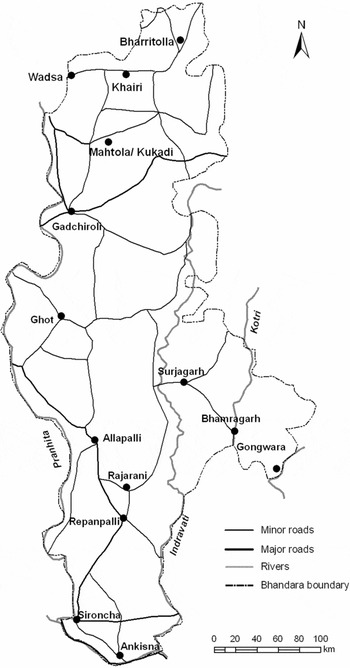
We studied three villages, namely Khairi, the twin villages of Mohtola and Kukadi (henceforth Mohtola/Kukadi) and Bharritola located in Gadchiroli district (Maharashtra State) in the dry tropical forest belt of central India (Fig. 1). The three settlements are agrarian, have similar socioeconomic settings and differ primarily in terms of proximity to the forest or market, thus allowing assessment of the factors that affect dependence on NTFP with respect to distance from the market. Gadchiroli district has 90% forest cover (and supplies 61% of state forest yield), and is dominated by indigenous communities with high levels of poverty and a low development index. Forest contributes a large proportion of district household income, directly through use of forest products, or indirectly through wage income in forestry-related activities.
Map of study area showing the distance of the three study villages from the market in Wadsa.

Wadsa, the major provincial market for the three villages, is an old town that contains a long- established inter-state market and major trading centre for food grains and forest products. Income and employment opportunities are greater in Wadsa than other towns in the vicinity of the three villages.
Field sampling
The study undertaken in 2005–2006 used a number of research instruments to capture information on aspects of NTFP dependence and use, forest condition and institutional strength. Two of the authors of this paper were directly involved in data collection in the field. The data collection team also contained knowledgeable older individuals and youths from each village. We selected these individuals on the basis of information provided by local community members.
Household data
We found no major variation in the extent and type of forest dependence and occupation between households, which were relatively similar in economic, ethnic and cultural aspects. Thus, a simple random sampling technique was used to select sample households. Ten per cent of the households in each village were sampled to assess forest dependence by imputing the value of the volume of NTFPs collected and sold, and the proportion of total income earned from NTFPs.
Information on NTFPs harvested
A total of 103 individuals actively involved in collection of NTFPs were interviewed through the household survey. Information on NTFPs harvested from the forest was gathered through detailed discussions with these knowledgeable individuals (both male and female) from the three villages.
Forest plots
Forest condition was assessed using 10 m circular plots, within which plant species identity, height and girth were recorded for all species >10 cm diameter at breast height (DBH). Within each of these, a 3 m circular plot was used to collect information on saplings and shrubs <10 cm DBH. A 1 m circular nested plot was used to collect information on seedlings and herb species. All plots were sampled from the areas that were under the protection of the local forest association of each village. Thirty forest plots were randomly distributed in Khairi, 25 plots in Mohtola/Kukadi forest and 30 plots in Bharritola forest. Quantitative forest plot data were used to evaluate differences in species richness, sapling and tree abundance, and tree volume.
Each forest plot was also qualitatively graded in terms of observed levels of erosion, insect damage and livestock impact. Qualitative information on soil erosion was recorded using visual observations on a 1–3 scale, where 1 implied no erosion, 2 referred to minor soil erosion, when surface vegetation and humus layer were absent and the top soil was noticeably loose as a layer, and 3 referred to major erosion, with large gullies present in barren soil. Presence of insect damage was recorded based on visual observations. Presence of livestock was based on observations of livestock, faeces, signs of grazing on vegetation and/or presence of tracks in the sample plots. Information regarding plot condition included the presence of garbage, evidence of harvesting activities (such as number of cut stems and whether they were freshly cut), evidence of natural disturbances, proximity to clearings or developments (such as a road or house), any observed species of interest in or around the plot and its relative abundance, location and apparent condition. Based on this, we compared the degree of destructive or extractive human and livestock impact in all three forests.
A nonparametric one-tailed Mann-Whitney U test (α = 0.05) was used to assess if there were significant differences between forests in terms of these quantitative and qualitative variables.
Local institutions
Information on aspects of local institutional rules was gathered using protocols developed by the International Forestry Resources and Institutions (IFRI) research programme (Ostrom & Nagendra Reference Ostrom and Nagendra2006). The research protocols used in-depth discussions with knowledgeable individuals to gather information about institutional aspects to gauge its strength/maturity. This included the history of the forest association, composition of the institution, participation of community members, rules used to manage the forest, monitor it and sanction violators, and performance of the rules. Information was also collected on the forest products gathered from the area, the presence of other supporting external state and non-state organizations, and other relevant information.
RESULTS
Connectivity to the market
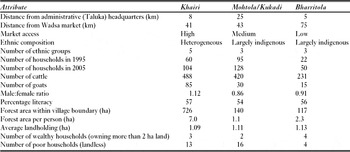
Of the three study villages, Khairi was the closest to the market and had the strongest market links (Fig. 1). Khairi is 41 km from Wadsa and < 1 km from the state highway, has an all-weather road and high frequency of public transport buses plying between Wadsa and Khairi. Mohtola/Kukadi is located 43 km from Wadsa. Although only 2 km further from Wadsa than Khairi, the villages are located 3 km from the state highway in the transportation direction of Gadchiroli, and their connectivity to Wadsa is poorer. Despite being the district headquarters, Gadchiroli is a relatively underdeveloped town, with increasing insurgent activities that have adversely impacted forest-based economic activities like tendu (Diospyros melanoxylon) leaf collection and bamboo harvesting. Bharritola is furthest from Wadsa market, being 75 km away, with only a fair weather road and low frequency of public transport.
While Khairi was the only village with a heterogeneous population of five different ethnic groups, Bharritola and Mohtola/Kukadi were largely tribal communities dominated by the Gond tribe (Table 1). The population in Khairi increased by over 70% over a period of 10 years, while in a corresponding time period there was an increase of 30% in Mohtola/Kukadi and nearly 120% in Bharritola. Per household livestock population (that grazes in the forest) was similar across villages. The number of households owning > 2 ha of agricultural land was highest in Bharritola, followed by Khairi and Mohtola/Kukadi. But the area of land under cultivation was lowest in Bharritola, as the land in this village is largely barren (Table 1).
Description of the three study villages.

NTFPs extracted from the forest
For all the communities, the forest represented an important source of fuelwood, food, timber and various other products of economic, domestic, cultural and religious significance. It also provided vital inputs for agricultural activities, by way of organic insecticides and fertilizers, and fodder for livestock. Villagers associated rich forest cover with soil and water conservation, high rainfall and good climate.
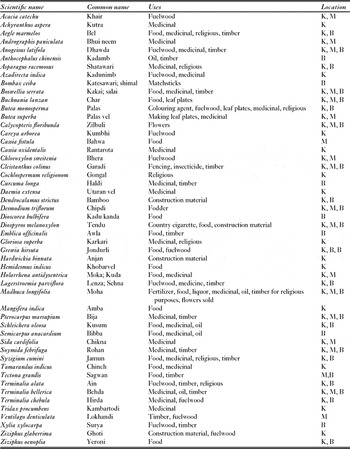
Fifty-six NTFPs were used by the three villages for personal consumption and for sale. In all, 36 NTFP species were used in Bharritola, 32 in Mohtola/Kukadi and 30 in Khairi. However, in Khairi, NTFPs were mostly for personal consumption, while, in Bharritola, NTFPs were also sold commercially. In Bharritola, variety in NTFP use was in terms of both number of species and number of different plant parts, resulting in a higher number of uses. For example, in Bharritola, people not only used the wood of sagwan (Tectona grandis), but also sold the seeds, which was not the case in other two villages. Additionally, other than the common use (personal consumption and sale) of moha (Madhuca longiolia) fruits and flowers in the three villages, the people of Bharritola extracted the fruit oil, and used the oil cake as manure among other uses. Across all three villages, extractions from the forest met 75% of total fodder needs, 100% of fuelwood and timber requirements, and 25% of food and green manure needs. Leaf litter from the forest was used as manure. The wide range of products from the forest used demonstrated the central importance of the NTFP harvest (Table 2).
Non-timber forest products collected from the forest. K = Khairi, M = Mohtola/Kukadi, B = Bharritola.

Economic dependence on NTFPs
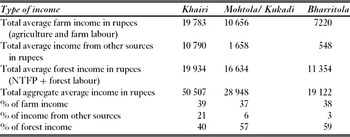
Income levels were highest in Khairi, although the sizes of land holdings were comparable across the three villages (Tables 1 and 3). Of the three villages, only Khairi had access to irrigation facilities; this was reflected in higher average agricultural income (consumption plus sales) in Khairi. Similarly, non-farm non-forest employment opportunities existed to a greater extent in Khairi. In contrast, Bharritola had the least income from non-farm non-forest sources. The differential access to off-farm employment between these three villages was reflected in their dependence on forest for NTFPs as well as employment from forest-related activities. Households in Khairi were least dependent on income from forests (both computed and imputed values of NTFPs), with only 40% of income from NTFP sales, while 57% of the income of Mohtola/Kukadi households and 58% of the income of Bharritola households came from NTFP sales. In Bharritola, a large proportion of total income came from forest labour (12% compared to 2% and 5% in Mohtola/Kukadi and Khairi, respectively) for the Forest Department (for example logging, fire line preparation, plantation and weeding). This income was seasonal and unreliable, being dependent on Forest Department working plans, availability of government funds and the degree of threat from insurgent activities.
Average household income by source in Indian rupees and as a percentage (1 rupee = US$0.02, October 2008).

Local institutions
All three villages indicated that the forest had decreased in extent and deteriorated in quality over time. Awareness of this change and its negative impacts on their daily lives, along with efforts by local individuals (in Bharritola), non-governmental organizations (in Mohtola/Kukadi) and Government officials (in Mohtola/Kukadi and Khairi), had led to the formation of JFMCs in all locations. The JFMCs of all three study villages were members of the FDA based at Wadsa Forest Division office. The two main activities of the associations were to guard the forest and to undertake plantation activities with the help of the Forest Department. In terms of structure, the three associations were similar, consisting of executive and general bodies. The general body elects the executive body (EB) every five years and has the power to impeach the EB in case of any wrongdoing. The EBs of Khairi and Mohtola/Kukadi were well represented across class, caste and gender while, in Bharritola, women were poorly represented. All three communities indicated that they had started to face scarcity of forest products owing to unrestricted harvesting in approximately the early 1990s.
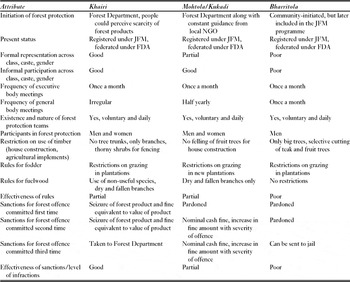
These three communities demonstrated different degrees of institutional maturity, based on their awareness of the JFM programme, participation in forest protection activities, rule formulation and rule adherence (Table 4). Khairi represented the strongest forest institution, with a strong sense of ownership by the local community, substantial participation of women in the executive body and in monitoring activities, regular patrolling, rules limiting the harvest of forest products and, perhaps most critical, an effective system of graduated sanctions (Ostrom Reference Ostrom2005). In contrast, Mohtola/Kukadi and Bharritola had initiated regular monitoring activities, but had been unable to sanction offenders as effectively as Khairi.
Attributes of local institutions. JFM = Joint Forest Management, FDA = Forest Development Agency, NGO = non-governmental organization.

Bharritola is isolated from the Forest Department's division headquarters in Wadsa, and located in a region of extreme insurgent activities, which had made it difficult for the community to carry out effective monitoring and patrolling, and for the external agencies to extend its support. In contrast, the proximity of Khairi to Wadsa had resulted in increased frequency of visits by forest officials, their guidance in rule formation and support in implementation of rules, especially to control timber poaching by outsiders. Khairi and Mohtola/Kukadi JFMCs also had an added advantage of increased social capital, where these households had built on a shared sense of community in other collective religious and cultural activities, despite being socially heterogeneous. In contrast, collective action is low in Bharritola, despite being a homogenous and relatively smaller user group. Although the community had self-initiated forest conservation work, high dependence on forest to supplement low income from agriculture and other non-forest sources may have raised difficulties in monitoring and sanctioning.
Forest quality
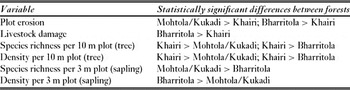
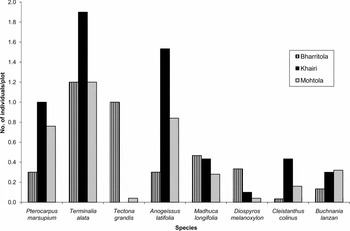
Khairi, the village with the lowest NTFP dependence and the greatest access to the market, had the least soil erosion and livestock damage as well as greatest tree species diversity (Table 5). Khairi forest also appeared to have had a high proportion of individuals across a majority of the dominant tree species, especially Pterocarpus marsupium, Terminalia alata, Anogeissus latifolia and Cleistanthus colinus (Fig. 2). Although these are all hardwood species used for fuelwood (Table 3), they had remained relatively abundant in this forest. The total absence of Tectona grandis (teak), a high-value timber tree species, from this forest could be due to extensive tree felling before protection was initiated. Bharritola appeared to be most disturbed of the three forests in terms of erosion, livestock and insect damage (Table 5).
Differences between villages in terms of forest condition.

Number of trees per plot for the eight most common species, across the three study villages. Black = Khairi, grey = Mohtola, striped = Bharritola.

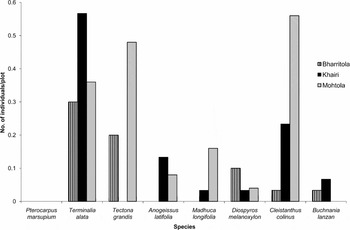
Sapling abundance was low in all three forests. Saplings of Pterocarpus marsupium were not present in any of the plots (Fig. 3). Across all three forests, the two most economically important NTFP species, namely Diospyros melanoxylon (tendu) and Madhuca longifolia (moha), were severely impacted by harvesting, with much lower levels of tree and sapling abundance compared to the other species.
Number of saplings per plot for the eight most common species, across the three study villages. Black = Khairi, grey = Mohtola, striped = Bharritola.

Moha saplings were completely absent in the Bharritola plots, reflecting overharvesting and inadequate regeneration. In other forests as well, the levels of regeneration appeared to be far less than required for maintaining a diverse and healthy ecosystem similar to that currently present in the tree layer of each of the forests, with very low seedling-tree regeneration ratios (Fig. 3) compared to those expected for healthy forests (Ganesan & Siddappa Setty Reference Ganesan and Siddappa Setty2004).
There were no significant differences between Khairi and the other forests at the scale of the 3 m plots. Bharritola had greater density but lower diversity than Mohtola/Kukadi in the 3 m plots. Combined with Figure 3, this indicated that certain species in Bharritola were displaying high levels of regeneration in the sapling layer.
DISCUSSION
Given the difficulties inherent in collecting standardized data sets for multidisciplinary monitoring of institutional, economic and forest conditions in developing countries (Ostrom & Nagendra Reference Ostrom and Nagendra2006), the present data set is comparable in size to similar studies (Banana & Gombya-Ssembajjwe Reference Banana, Gombya-Ssembajjwe, Gibson, McKean and Ostrom2000; Batistella et al. Reference Batistella, Brondizio and Moran2000; Nagendra Reference Nagendra2002; Uma Shaanker et al. Reference Uma Shaanker, Ganeshaiah, Krishnan, Ramya, Meera, Aravind, Kumar, Rao, Vanraj, Ramachandra, Gauthier, Ghazoul, Poole and Chinnappa Reddy2004; Ghate & Nagendra Reference Ghate and Nagendra2005; Nagendra et al. Reference Nagendra, Karna and Karmacharya2005; Quang & Ahn Reference Quang and Anh2006).
We found a clear relationship between the degree of proximity to the market and NTFP dependence. Khairi, with greatest market access, had the highest per household income levels, with a substantial contribution from non-farm non-forest employment sources, and least NTFP dependence. Bharritola, the most isolated village, had the lowest household incomes and the highest NTFP dependence, representing other villages with low market access due to less accessible transportation elsewhere that have high NTFP dependence owing to lack of other off-farm and off-forest livelihood opportunities (Bista & Webb Reference Bista and Webb2006). Mohtola/Kukadi fell somewhere between these two village situations. This corroborates other indications that when communities have other sources of income and livelihood, they are less likely to rely on forest (Agrawal et. al. Reference Agrawal, Yadama, Andrade and Bhattacharya2006; Quang & Anh Reference Quang and Anh2006; Sadashivappa et al. Reference Sadashivappa, Suryaprakash and Vijaya Krishna2006).
Yet NTFPs played a critical role in the lives and livelihoods of the residents of all three villages, and were used for a variety of subsistence, medicinal, cultural and religious uses. Commercial logging of all species is prohibited in the state, but NTFP extraction for local use and sale represented a major proportion of people's livelihoods, and a major contributor to forest degradation. The two most economically important NTFP species were tendu (Diospyros melanoxylon; for leaves) and moha (Madhuca longifolia; for flowers and fruits). Overharvesting can lead to death of mature individuals and limited regeneration. Further, the process of harvesting itself can lead to impacts on forest. For instance, the main damage to tendu trees is due to lopping to reduce tree height and reduce the labour involved in leaf collection. Fires are routinely set to clear the forest floor while harvesting moha flowers. Trails of the forest are used heavily by people entering for NTFP harvesting and also damage the forest.
We found that in villages where NTFP dependence was greater, there was more forest degradation. While local institutions have played an important role in assisting forest protection in all three villages, Khairi had the strongest institution, further strengthening the relationship between distance to market and forest quality. This is in large part due to its proximity to the Forest Department's division headquarters in Wadsa. Further, both Khairi and Mohtola/Kukadi JFMCs could build on already high levels of social capital developed from collective religious and cultural activities. This had helped these villages to develop strong local level governance institutions, assisting the sustainable use of natural resources (Bista & Webb Reference Bista and Webb2006).
The dual impact of reduced forest dependence and presence of a strong JFM institution was visible in Khairi. Levels of plot erosion and livestock damage were lower, and tree species richness and tree density greater in this forest compared to Mohtola/Kukadi and Bharritola. Other studies have found that control of illegal grazing and regeneration are more likely in areas close to main towns, mainly because government officials are able to monitor and guide the functioning of the forest protection committee with more ease (Agrawal et al. Reference Agrawal, Yadama, Andrade and Bhattacharya2006). Awareness created by external agencies like the Forest Department or NGOs helps communities impose lower ecological costs even when their dependence on NTFPs is high (Uma Shaanker et al. Reference Uma Shaanker, Ganeshaiah, Krishnan, Ramya, Meera, Aravind, Kumar, Rao, Vanraj, Ramachandra, Gauthier, Ghazoul, Poole and Chinnappa Reddy2004).
Yet levels of regeneration appeared disturbingly low in all three forests. The two most economically important NTFP species, tendu and moha, had been severely impacted by harvesting in all sites. Yet, interviews with all three communities indicated that while the forest may still be degraded, the impact and benefits of forest protection were visible to them. Even in Bharritola, where the forest institution was perhaps the weakest, forest products were now more easily available, women had to walk a shorter distance to collect fuelwood and bamboo had regenerated. Migration of people during non-agricultural months had also declined due to the employment provided through FDA by taking up plantations.
High dependence on forest products and especially on NTFPs has continued in Bharritola as a result of the lack of market-based off-farm off-forest employment opportunities. Thus, the need for institution building is the greatest in Bharritola. Programmes like those of JFM and the FDAs need to be specifically targeted at villages like these. The inequitable allotment of forest area to rural communities further exacerbates the situation. Although Bharritola had the highest forest dependence, it had the least forest area allotted to the JFM committee, as compared to Khairi which had the lowest forest dependence. This inequitable allotment in forest area should be heeded and modified.
Collection of NTFPs is labour intensive, and their collection for income-earning activities is often attributed to a lack of alternate reliable sources of income, and their provision of an economic buffer during times of crisis (Wunder Reference Wunder2001; Nygren et al. Reference Nygren, Lacuna-Richman, Keinänen and Alsa2006). Although many households depend on NTFP sale for income generation, the collection of NTFP products is highly seasonal and often unreliable. Thus, it is important that the Forest Department provides inputs to the JFMCs to help them plan and organize NTFP collection and sale to ensure sustainable extraction (Wunder Reference Wunder2001). However, marketing/commercialization of NTFPs can be successful if the activity is transparent, equitable and sustainable, with important implications for poverty reduction and better resource management. Government intervention can assist greatly in providing communities with greater technical inputs for better resource management as well as provision of better transport and communication to improve access to market (Schreckenberg et. al. Reference Schreckenberg, Marshall, Newton, Velde, Rushton and Edouard2006). It is only through such efforts that villages like Bharritola will be able to escape from their high dependence on the forest, consequent degradation of the resource and further decrease in income. A federation of JFMCs as institutions under the FDA programme can help the communities break this cycle by shifting their dependence from primary products like NTFPs to either value-added forest products, or to off-forest off-farm options of income and employment.
ACKNOWLEDGEMENTS
We thank the IFRI at Indiana University for funding (to SHODH) and a Society in Science: Branco Weiss fellowship (to Harini Nagendra). We acknowledge the cooperation of Mr Ramarao (Deputy Conservator of Forest, Wadsa Forest Division) and his staff. Our special thanks to the residents of the three villages for their patience, cooperation and hospitality during the study.