Every day, couples deal with challenges that are directly or indirectly related to their relationship, likely resulting in stress for both partners. The detrimental consequences of stress on psychological and physiological health (Thoits, Reference Thoits2010), as well as its negative effects on relationship functioning (Umberson & Montez, Reference Umberson and Montez2010), are now well known. Therefore, romantic partners’ willingness to help each other reduce their stress is of utmost importance for their relationship's wellbeing. This is known as dyadic coping, which refers to the ways in which couples manage stressful events as a team and to the support base that each partner provides for the other (Bodenmann, Reference Bodenmann1997). Factors such as personal vulnerabilities and characteristics (e.g., gender) are known to have an important impact on dyadic coping (e.g., Haring, Hewitt, & Flett, Reference Haring, Hewitt and Flett2003; Levesque, Lafontaine, & Bureau, Reference Levesque, Lafontaine and Bureau2017). The goal of the current study was to further the research on dyadic coping by examining two personal characteristics — namely, romantic attachment and romantic perfectionism — as potential predictors of self-perceived dyadic coping in a large community sample of mixed-sex couples, as well as to examine the mediating role that romantic perfectionism might play in the link between attachment insecurity and dyadic coping.
Romantic Attachment and Dyadic Coping
Romantic attachment is a ubiquitous predictor of relationship functioning and constitutes a valuable framework for exploring the processes involved in intimate relationships (Mikulincer & Shaver, Reference Mikulincer and Shaver2016). The attachment system is intended to increase an individual's sense of security, particularly in time of stress or need, through proximity-seeking behaviours towards a caring other such as the romantic partner (Bowlby, 1969/Reference Bowlby1982). Attachment insecurity in adulthood is defined by two underlying dimensions: attachment-related anxiety and avoidance (Brennan, Clark, & Shaver, Reference Brennan, Clark, Shaver, Simpson and Rholes1998). Attachment-related anxiety, underlying a negative working model of self, reflects a fear of abandonment and rejection by one's romantic partner. It is associated with the hyperactivation of the attachment system, which may translate into close monitoring of one's partner, excessive demands for attention and reassurance, as well as clinging and controlling behaviours. Anxiously attached individuals behave this way in an attempt to increase closeness and maintain intimacy with their partner, as they feel their behaviour will reduce the likelihood of being abandoned (Mikulincer & Shaver, Reference Mikulincer and Shaver2016). Attachment-related avoidance, underlying a negative working model of others, reflects general discomfort with closeness and fear of intimacy with one's romantic partner. It is associated with the deactivation of the attachment system, which may translate into a lack of self-disclosure, compulsive self-reliance, and an unwillingness to meet the partner's intimacy needs. Avoidantly attached individuals behave this way in an attempt to maintain emotional distance with their partner and keep their attachment needs at bay (Mikulincer & Shaver, Reference Mikulincer and Shaver2016). Attachment security is characterised by low levels of attachment-related anxiety and avoidance. Securely attached individuals are comfortable with closeness and interdependence, and they trust their partner and expect them to be responsive to their needs (Mikulincer & Shaver, Reference Mikulincer and Shaver2016).
According to attachment theory, there exists a close link between an individual's attachment disposition and their ability to regulate their emotions (Bowlby, 1969/Reference Bowlby1982, Reference Bowlby1973) and cope during stressful events (Mikulincer & Shaver, Reference Mikulincer and Shaver2016). It is well known that attachment security influences affect regulation strategies (Mikulincer, Shaver, & Pereg, Reference Mikulincer, Shaver and Pereg2003); affect regulation is a broader construct, which encompasses, but is not limited to, emotion regulation and coping (Gross & Thompson, Reference Gross, Thompson and Gross2007). Interestingly, although deactivating and hyperactivating strategies lead to opposite emotional experiences (i.e., suppression vs. intensification), both result in dysfunctional emotion regulation and interfere with adequate coping (Mikulincer & Shaver, Reference Mikulincer and Shaver2016). In addition to emotion regulation, internal working models also seem to shape how people cope with stressful situations within the context of intimate relationships (Mikulincer & Shaver, Reference Mikulincer, Shaver, Cassidy and Shaver2008). Attachment theory suggests that securely attached individuals tend to cope with stress by engaging in problem solving and by getting support from attachment figures when necessary, whereas insecurely attached individuals may use more inadequate coping strategies (Mikulincer & Shaver, Reference Mikulincer, Shaver, Cassidy and Shaver2008). Attachment insecurity is associated with both difficulties in emotion regulation and dyadic coping strategies. However, given that emotion regulation can be thought of as an intrapersonal strategy to deal with stress, and dyadic coping is conceptualised as an interpersonal behavioural strategy to reduce stress, it is likely that dyadic coping is influenced by both partners’ own individual emotion regulation skills. Thus, considering that effective dyadic coping is a process involving both partners’ responses to each other's distress (Bodenmann, Reference Bodenmann, Revenson, Kayser and Bodenmann2005), it is possible that partners of individuals with high levels of insecure attachment will respond to their partners’ hyperactivated or deactivated strategies using more negative dyadic coping strategies themselves. Support for this hypothesis comes from studies showing that partners of insecurely attached individuals respond more negatively to them in stressful situations compared to partners of securely attached individuals (Campbell, Simpson, Kashy, & Rholes, Reference Campbell, Simpson, Kashy and Rholes2001; Simpson, Rholes, & Nelligan, Reference Simpson, Rholes and Nelligan1992). Consistent with the theory, a few empirical studies demonstrate a significant association between insecure romantic attachment and lower use of dyadic coping or less optimal forms of dyadic coping (e.g., Fuenfhausen & Cashwell, Reference Fuenfhausen and Cashwell2013; Levesque et al., Reference Levesque, Lafontaine and Bureau2017). These findings suggest that romantic attachment is useful in exploring couples’ ways of coping with stress, and the mechanisms by which these variables are related should be explored further.
Romantic Perfectionism as a Mediator
Of interest is the potential mediating role of romantic perfectionism in the association linking romantic attachment and dyadic coping. Romantic perfectionism can be defined as rigid and unrealistic standards for oneself and one's partner in a romantic relationship (Hewitt & Flett, Reference Hewitt and Flett1989). Burns (Reference Burns1980, Reference Burns1983) suggested that a general tendency for perfectionism can be damaging to a marriage because perfectionists tend to react defensively to criticism, withdraw to hide perceived imperfections, and apply high standards to their partners, which can create disappointment in the relationship. Attachment theory suggests that individuals high in attachment-related anxiety would exhibit both self-oriented and partner-oriented romantic perfectionism. For instance, because they fear rejection and suffer from chronic self-doubt, these individuals may strive to meet high self-imposed standards of behaviours in the relationship (i.e., self-oriented perfectionism) in an effort to reduce the perceived risk of abandonment by their partner. Individuals high in attachment-related anxiety also have an excessive need for reassurance and affection, which may also result in imposing high standards of behaviours in the relationship on the partner (i.e., partner-oriented perfectionism). Manifestations of these high standards that they impose on their partner include highly demanding or critical behaviour. In contrast, individuals high in attachment-related avoidance may be prone to partner-oriented perfectionism only. These individuals mainly rely on deactivating attachment strategies aimed at maintaining a safe distance in their interpersonal relationships (Mikulincer & Shaver, Reference Mikulincer and Shaver2016). Accordingly, unrealistic expectations and the resulting dissatisfaction born of partner-oriented perfectionism would serve this purpose and justify them maintaining emotional detachment and minimising closeness with their partner.
Supporting the theory, research shows that insecure attachment is related to both maladaptive general perfectionism (e.g., Andersson & Perris, Reference Andersson and Perris2000; Brennan & Shaver, Reference Brennan and Shaver1995; Flett et al., Reference Flett, Hewitt, Mosher, Sherry, Macdonald and Sawatzy2001; Gnilka, Ashby, & Noble, Reference Gnilka, Ashby and Noble2013; Rice & Lopez, Reference Rice and Lopez2004; Rice & Mirzadeh, Reference Rice and Mirzadeh2000; Wei, Heppner, Russell, & Young, Reference Wei, Heppner, Russell and Young2006; Wei, Mallinckrodkt, Russell, & Abraham, Reference Wei, Mallinckrodt, Russell and Abraham2004) and romantic perfectionism (Çerkez, Reference Çerkez2017; Fritts, Reference Fritts2012; Lopez, Fons-Scheyd, Morúa, & Chaliman, Reference Lopez, Fons-Scheyd, Morúa and Chaliman2006; Ulu & Tezer, Reference Ulu and Tezer2010). In their longitudinal study, Lopez et al. (Reference Lopez, Fons-Scheyd, Morúa and Chaliman2006) also found that the perception of one's romantic partner as inadequate to meet expectations over time was associated with both attachment-related anxiety and avoidance.
Setting high standards of behaviour for oneself and others is likely related to the way individuals manage adversity, and these unrealistic expectations may prove to be a poor coping strategy in such circumstances. To this effect, maladaptive forms of general perfectionism have been consistently associated with poor general coping skills (e.g., Dunn, Whelton, & Sharpe, Reference Dunn, Whelton and Sharpe2006; Macedo et al., Reference Macedo, Marques, Quaresma, Soares, Amaral, Araújo and Pereira2017; O'Connor & O'Connor, Reference O'Connor and O'Connor2003). For instance, while other-oriented perfectionism was found to be linked with authoritarian, exploitative and dominant behaviours, and with other-directed blame (Hewitt & Flett, Reference Hewitt and Flett1991), self-oriented perfectionism has been found to be associated with outwardly directed anger, as well as angry hostility (Hill, McIntire, & Bacharach, Reference Hill, McIntire and Bacharach1997). In couple relationships, maladaptive coping strategies used to deal with recurring relationship problems have been found to mediate the association between romantic perfectionism and poor marital functioning (Haring et al., Reference Haring, Hewitt and Flett2003). Specifically, Haring and colleagues (2003) found that partners who believed that their spouse expected perfection from them were more likely to use negative coping skills. Moreover, unrealistic expectations of one's spouse was associated with the use of conflictual coping strategies in women, but not in men. In this same study, wives’ high other-oriented perfectionism was associated with their husbands’ higher use of conflict and self-interest coping strategies, and husbands’ higher other-oriented perfectionism was associated with their wives’ higher use of avoidance as a coping strategy. These results suggest the presence of possible partner effects between an individual's perfectionism and their partner's negative dyadic coping. That is, partners’ reactions to each other's stress (i.e., dyadic coping) are likely interconnected. Hence, because individuals with high levels of perfectionisms use more negative and conflictual coping strategies, it is possible that their partners will also be more likely to respond to these behaviours using similar negative coping strategies. As such, partners’ dyadic coping is also likely to involve more negative strategies.
A thorough search of the relevant literature yielded one study that investigated the relation among romantic attachment, general perfectionism, and general coping together. Wei et al. (Reference Wei, Heppner, Russell and Young2006) conducted a longitudinal study that examined two time points, which were two months apart, to explore these variables in a sample of 372 predominantly single undergraduate students. They found that the initial levels of attachment-related anxiety and avoidance predicted future ineffective coping through future maladaptive perfectionism. Wei et al.’s (Reference Wei, Heppner, Russell and Young2006) study did not examine self-oriented perfectionism and other-oriented perfectionism. The present research is one of the few studies (e.g., Haring et al., Reference Haring, Hewitt and Flett2003; Lopez et al., Reference Lopez, Fons-Scheyd, Morúa and Chaliman2006; Stoeber, Reference Stoeber2012, Reference Stoeber2015; Stoeber, Harvey, Almeida, & Lyons, Reference Stoeber, Harvey, Almeida and Lyons2013) that have examined a multidimensional conceptualisation of perfectionism, namely self-oriented perfectionism and other-oriented perfectionism, which are two dimensions of romantic perfectionism.
The Current Study
To build upon existing findings, this study aimed to evaluate the links among romantic attachment, romantic perfectionism, and self-perceived dyadic coping at both the individual (i.e., actor effects) and interpersonal levels (i.e., partner effects) using a dyadic approach (i.e., actor-partner interdependence model; Kenny, Kashy, & Cook, Reference Kenny, Kashy and Cook2006). This study is original due to its use of measures that assess constructs specific to the romantic context instead of more general measures of coping and/or perfectionism. Of interest is the mediating role of romantic perfectionism in the association between romantic attachment and dyadic coping. This mediation model adds to the existing literature that usually places a larger emphasis on the direct association between attachment insecurity and poor dyadic outcomes. This study also goes beyond the typical college sample by using a large community-based sample of mixed-sex couples.
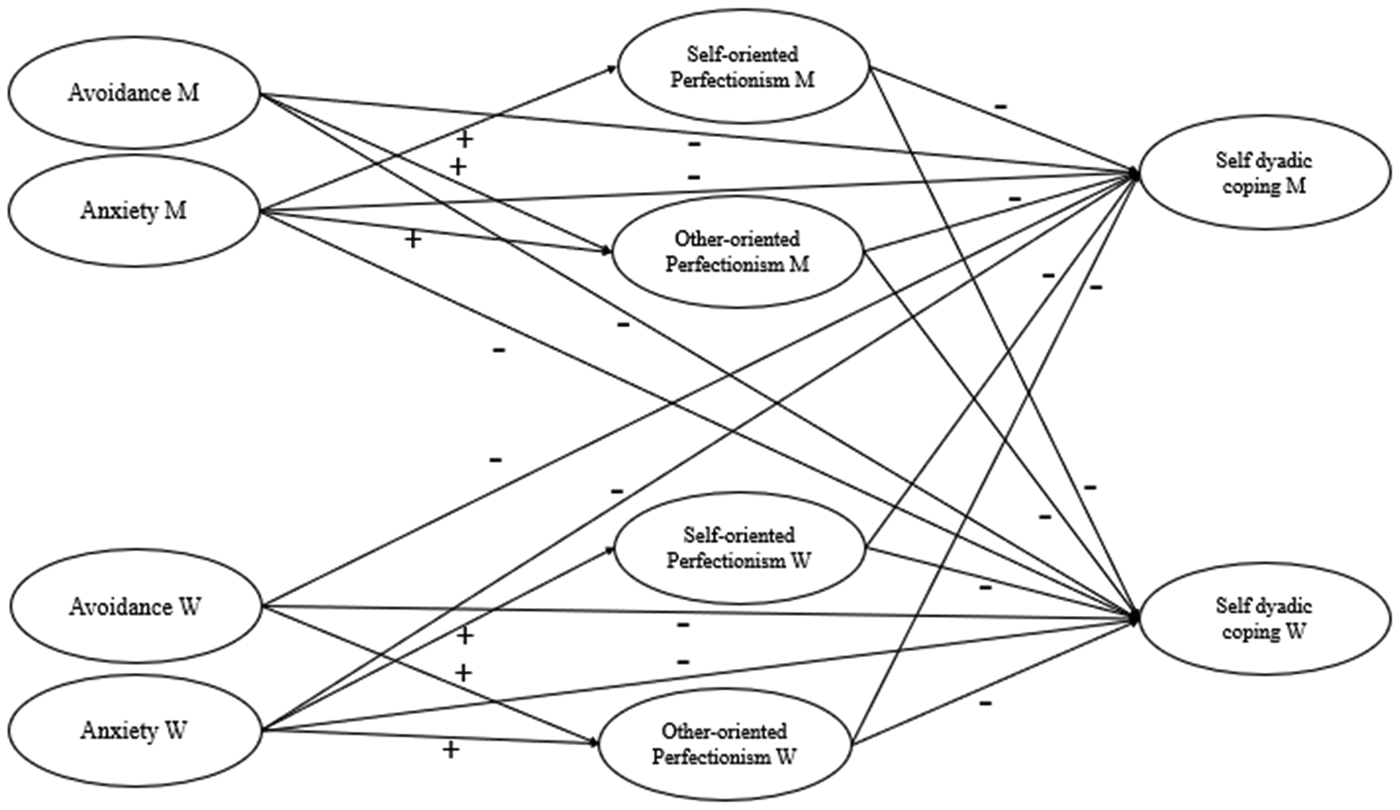
We hypothesised that: (a) romantic attachment insecurities (i.e., attachment-related anxiety and avoidance) would be associated with both partners’ poorer self-perceived dyadic coping (i.e., actor and partner effects); (b) attachment-related anxiety would be associated with greater self- and other-oriented romantic perfectionism, whereas attachment-related avoidance would be associated with greater other-oriented romantic perfectionism only (i.e., actor effects); (c) greater self- and other-oriented romantic perfectionism would be related to both partners’ poorer self-perceived dyadic coping (i.e., actor and partner effects); and (d) self- and other-oriented romantic perfectionism would mediate the association between one's attachment insecurities and both partners’ self-perceived dyadic coping. The hypothesised model, including hypotheses (a), (b) and (c), is illustrated in Figure 1. For lack of theoretical and empirical basis, we did not expect an association between an individual's attachment insecurities and their partner's romantic perfectionism, and thus these partner effects were not tested.
Hypothesised path model of the relationship between attachment insecurity and self-perceived dyadic coping

Method
Participants and Procedures
We recruited a community sample of 170 mixed-sex couples to participate in a large study on relationship functioning. To be eligible to participate, partners needed to have been in a heterosexual relationship for at least 12 months (M = 6 years; range = 1–59 years) and been living with their partner for a minimum of 6 months (M = 4 years; range = 6 months to 55 years). These criteria ensured that couples were in a stable relationship and had daily experiences together. Most couples were in a common-law relationship (62%), 19% were married, and 12% had children with their current partner. Participants’ mean age was 30 years (range = 19–78 years). The majority of participants were Caucasian (84%), had a university degree (60%), and had an average individual annual income of CAN$44,175. Participants were recruited through local newspapers, posters, and local bridal events. Couples completed the battery of questionnaires independently as part of the larger study. Each couple received CAN$40 in compensation for their time.
Measures
Sociodemographic information
Participants provided personal (e.g., age, education, income) and relationship-related information (e.g., marital status and duration).
Experiences in Close Relationships (ECR; Brennan et al., Reference Brennan, Clark, Shaver, Simpson and Rholes1998)
The ECR is a 36-item measure of romantic attachment insecurity that assesses two dimensions: attachment-related anxiety (e.g., ‘I worry that romantic partners won't care about me as much as I care about them’) and attachment-related avoidance (e.g., ‘I get uncomfortable when a romantic partner wants to be very close’). Each subscale comprises 18 items, and responses are rated on a 7-point Likert-type scale. Subscale scores are obtained by averaging their respective items; higher scores reflect greater attachment-related anxiety or avoidance. Excellent reliability was previously reported for both subscales (Fraley, Waller, & Brennan, Reference Fraley, Waller and Brennan2000). In the current study, alpha coefficients were .91 for attachment-related anxiety and .92 for attachment-related avoidance.
Romantic Relationship Perfectionism Scale (RRPS; Matte & Lafontaine, Reference Matte and Lafontaine2012)
The RRPS is a 14-item measure of romantic perfectionism that assesses two dimensions: self-oriented romantic perfectionism (e.g., ‘I am afraid of making mistakes in conversations with my significant other’) and other-oriented romantic perfectionism (e.g., ‘To be worthy of a relationship with me, my significant other should live up to my expectations’). Each subscale comprises seven items, and responses are rated on a 7-point Likert-type scale. Subscale scores are obtained by summing their respective items; higher scores reflect greater self-oriented or other-oriented romantic perfectionism. The RRPS demonstrated good convergent validity with other measures of perfectionism and romantic perfectionism (Matte & Lafontaine, Reference Matte and Lafontaine2012). In the current study, alpha coefficients were .70 for self-oriented romantic perfectionism and .75 for other-oriented romantic perfectionism.
Dyadic Coping Inventory (DCI; Bodenmann, Reference Bodenmann2008)
The DCI was used to assess self-perceived dyadic coping. This scale measures three aspects of dyadic coping: one's own dyadic coping, the partner's dyadic coping, and perceptions of common dyadic coping. One's own dyadic coping and the partner's dyadic coping each comprise four subscales, while common dyadic coping only comprises one subscale. The current study solely focuses on one's own attempts to reduce the partner's stress. As such, three of the four subscales measuring one's own dyadic coping were used: supportive dyadic coping (e.g., ‘I express to my partner that I am on his/her side’), delegated dyadic coping (e.g., ‘I take on things that my partner would normally do in order to help him/her out’), and negative dyadic coping (e.g., ‘I blame my partner for not coping well with stress’). The fourth subscale, stress communication (e.g., ‘I tell my partner openly how I feel and that I would appreciate his/her support’), was excluded as it measures communication of one's stress to the partner, and does not reflect one's attempts to reduce the partner's stress. A global self-perceived dyadic coping score can be calculated by aggregating scores from these three subscales. Items are rated on a 5-point Likert-type scale and higher scores indicate greater overall dyadic coping. A previous study reported good reliability coefficients for supportive dyadic coping, delegated dyadic coping, and negative dyadic coping, and demonstrated preliminary evidence of concurrent validity of the DCI (Levesque, Lafontaine, Caron, & Fitzpatrick, Reference Levesque, Lafontaine, Caron and Fitzpatrick2014). In the current study, the alpha coefficient was .81.
Results
Preliminary Analyses
Missing values, outliers, and normality
Missing values (less than 1% of the dataset, missing at random) were replaced using single imputation through expectation maximisation. This method was selected for its numerous advantages over more traditional methods, particularly the ability to maximise power by predicting values rather than eliminating them (Widaman, Reference Widaman2006). Multivariate outliers were identified using the Mahalanobis distance (p < .05) and one couple was removed from subsequent analyses due to extreme data. Multivariate normality was evaluated using DeCarlo's (Reference DeCarlo1997) multivariate skewness and kurtosis coefficients. Bootstrapping (500 samples) was used in the principal analyses to account for the multivariate non-normality and to calculate indirect effects (mediation analyses; Preacher & Hayes, Reference Preacher, Hayes, Hayes, Slater and Snyder2008).
Descriptive analyses
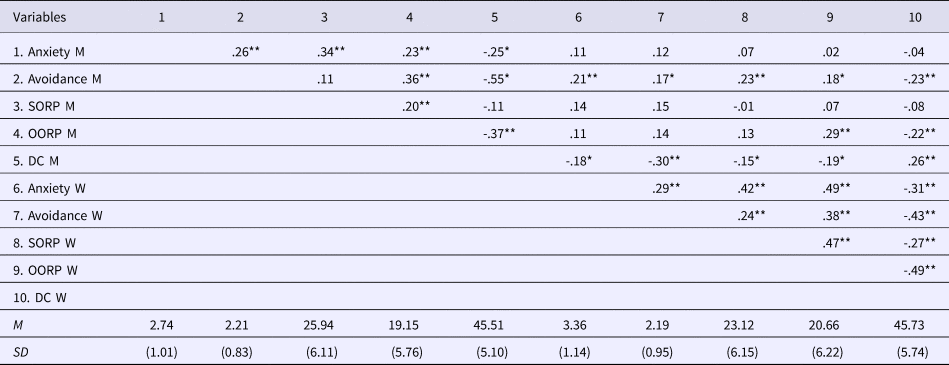
Means, standard deviations, and correlations for all variables are presented in Table 1. A repeated measures multivariate analysis of variance was used to identify possible gender differences among attachment insecurity, romantic perfectionism, and dyadic coping variables. Women reported more attachment-related anxiety, F(1, 168) = 31.18, p < .001, and other-oriented romantic perfectionism, F(1, 168) = 7.54, p = .007, than men, whereas men reported more self-oriented romantic perfectionism, F(1, 168) = 17.75, p < .001. We also conducted correlation analyses to identify any associations among age, duration of the relationship, and study variables. These analyses yielded no significant associations. Preliminary zero-order correlations showed several significant associations in the expected direction among the attachment insecurity, romantic perfectionism and dyadic coping variables, both within the individual and across partners. Distinguishability of the dyad members was also tested by setting equal across the dyad members the parallel means (m) and variances (v) of the predictor variables, the actor effects (a), the partner effects (p), the intercepts (i), and the error variances (ev). The resulting model provides us an omnibus test of the distinguishability of the dyad members. Results demonstrated that the dyad members should be treated as distinguishable, χ2(31) = 640.18, p = .000, comparative fit index (CFI) = .00, root mean square error of approximation (RMSEA) = .34, 90% CI [.32, .37].
Correlations, Means, and Standard Deviations for Men's and Women's Romantic Attachment Insecurity, Romantic Perfectionism, and Dyadic Coping Scores

Note: Anxiety = attachment-related anxiety, Avoidance = attachment-related avoidance, SORP = self-oriented romantic perfectionism, OORP = other-oriented romantic perfectionism, DC = self-perceived dyadic coping, M = men, W = women.
*p < .05. **p < .01.
Main Analyses
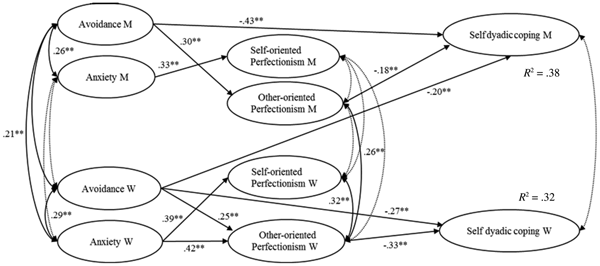
Using the maximum likelihood estimation method, path analyses based on the actor-partner interdependence model (Kenny et al., Reference Kenny, Kashy and Cook2006) were conducted in AMOS 25 (Arbuckle, Reference Arbuckle2017) to examine the mediation role of self- and other-oriented romantic perfectionism in the association between romantic attachment insecurity and dyadic coping. Given the significant correlations between men's and women's attachment-related anxiety and avoidance, these exogenous variables were correlated. Moreover, error terms between partners’ romantic perfectionism variables, as well as between partners’ dyadic coping variables, were correlated. The model tested actor, partner, and indirect effects in the associations among romantic attachment insecurity, romantic perfectionism, and self-perceived dyadic coping (see Figure 2). All possible direct paths and indirect effects between individuals’ attachment insecurity, perfectionism, and self-perceived dyadic coping were tested using bootstrapping estimates, with the exception of the partner effects between attachment insecurity and romantic perfectionism. For parsimony purposes, only significant direct paths are shown in Figure 2. To assess the goodness of fit of the models to the data, three indices were used (Kline, Reference Kline2016): the chi-square value (χ2; non-significant values usually indicate a model that fits the data well), the CFI (values greater than .90 indicate a reasonable fit and values close to .95 or higher indicate a model that fits the data well), and the RMSEA (values of .06 or less indicate a model that fits the data well). Our findings suggested that the model was a good fit for the data, χ2(8) = 8.58, p = .379, CFI = .99, RMSEA = .02, 90% CI [0.00, 0.09].
Path analyses showing the mediation role of romantic perfectionism in the association linking romantic attachment insecurity and self-perceived dyadic coping in men and women. Only significant direct paths are presented. Standardised path coefficients are shown. M = men, W = women.

Actor effects
As predicted, a negative association between attachment-related avoidance and dyadic coping was observed in both men and women. Contrary to expectation, there was no direct association between attachment-related anxiety and dyadic coping. As predicted, men's and women's attachment-related anxiety predicted greater self- and other-oriented romantic perfectionism (other-oriented romantic perfectionism was marginally significant in men, p = .059), whereas attachment-related avoidance predicted greater other-oriented romantic perfectionism only. Furthermore, as expected, other-oriented romantic perfectionism negatively predicted self-perceived dyadic coping for both genders. However, contrary to our expectation, self-oriented romantic perfectionism was unrelated to self-perceived dyadic coping.
Partner effects
Only one hypothesised partner effect was observed. As expected, women's attachment-related avoidance negatively predicted men's self-perceived dyadic coping. No such relation was found for women's attachment-related anxiety. Contrary to our expectations, in both men and women, romantic perfectionism was not related to the partner's self-perceived dyadic coping. In addition, men's romantic attachment was not associated with women's self-perceived dyadic coping.
Indirect effects
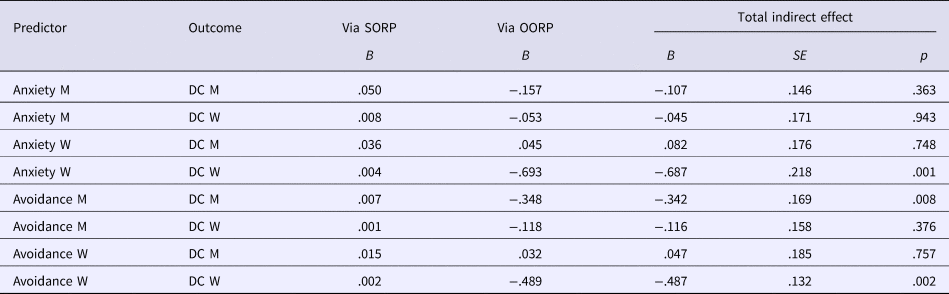
As presented in Table 2, three hypothesised mediation processes were found. In both men and women, other-oriented romantic perfectionism partially mediated the link between their own attachment-related avoidance and dyadic coping. In women, other-oriented romantic perfectionism fully mediated the link between their own attachment-related anxiety and self-perceived dyadic coping.
Indirect Effects of Romantic Attachment Insecurity on Self-Perceived Dyadic Coping

Note: Regression coefficients reported are unstandardised. Anxiety = attachment-related anxiety, Avoidance = attachment-related avoidance, DC = self-perceived dyadic coping, SORP = self-oriented romantic perfectionism, OORP = other-oriented romantic perfectionism, M = men, W = women.
Discussion
The present study was designed to extend previous research by using the actor-partner interdependence model to examine the mediating role of romantic perfectionism in the intrapersonal and interpersonal associations between romantic attachment and self-perceived dyadic coping in a large community sample of couples. This study also addresses the limitations of past studies; most of the research to this date has used general measures of coping and/or perfectionism, rather than measures pertaining to the romantic context specifically. Moreover, past studies tended to focus on individual and intrapersonal analytic strategies. Such an approach does not consider the couple as the unit of analysis, which limits our understanding of the dyadic complexity of the couple system. Our findings generally supported our hypotheses and are congruent with existing literature that suggests a link between attachment insecurity and general perfectionism (Andersson & Perris, Reference Andersson and Perris2000; Flett et al., Reference Flett, Hewitt, Mosher, Sherry, Macdonald and Sawatzy2001; Rice & Lopez, Reference Rice and Lopez2004; Wei et al., Reference Wei, Mallinckrodt, Russell and Abraham2004), as well as between general perfectionism and poor coping in the marital context (Haring et al., Reference Haring, Hewitt and Flett2003).
As hypothesised, men and women high in attachment-related avoidance reported more perfectionistic tendencies toward their romantic partner, which was then associated with their own poor dyadic coping in times of adversity. Due to their discomfort with closeness and overall negative model of others, avoidantly attached individuals expect their partner to disappoint them, so they set the bar too high, thus setting their partners for failure. These expectations are likely to concomitantly reinforce their negative view of others and modulate their perception of their coping efforts as a couple. That is, these individuals may not be motivated to provide support to their partner or participate in joint efforts to cope with a stressor, as they perceive their partner as inadequate because of their other-oriented perfectionism. To this effect, Feeney and Collins (Reference Feeney and Collins2001) suggested that individuals with high levels of attachment-related avoidance lack in both skills and motivation to provide adequate support to their partner. Moreover, several studies have found that these individuals are less likely to be supportive toward their partner (e.g., Collins, Guichard, Ford, & Feeney, Reference Collins, Guichard, Ford, Feeney, Mikulincer and Goodman2006; Feeney & Hohaus, Reference Feeney and Hohaus2001; Simpson, Rholes, Oriña, & Grich, Reference Simpson, Rholes, Oriña and Grich2002). It is also possible that individuals high in attachment-related avoidance are less likely to be satisfied with their partner's coping effort, or perceive their partner's coping efforts in a positive light, given that their expectations of their partner's behaviour are unrealistic. In line with this hypothesis, individuals with high levels of attachment-related avoidance have reported that they received less support from their partner (Kane et al., Reference Kane, Jaremka, Guichard, Ford, Collins and Feeney2007). However, even after accounting for these mediational effects, attachment-related avoidance remained a significant negative predictor of self-perceived dyadic coping. Individuals with high levels of avoidance are known to withdraw during periods of stress, as their attachment system deactivates (Mikulincer & Shaver, Reference Mikulincer and Shaver2016). Hence, they may be unlikely to perceive themselves as a member of an actively coping partnership, explaining their own poorer dyadic coping.
As predicted, attachment-related anxiety was also similarly associated with these variables, but this was true for women only. That is, women high in attachment-related anxiety also endorsed more perfectionistic tendencies toward their partner, which was then related to their perception that they have more difficulty coping as a team when under stress. However, these linkages are likely attributable to different mechanisms than those pertaining to attachment-related avoidance. Mainly, due to their chronic fear of being rejected by their significant other, individuals with high levels of attachment-related anxiety may hold high expectations for their partners as a function of their rigidity, hypersensitivity, and tendency to interpret ‘imperfect’ behaviour from the partner as a sign of abandonment or threat to their relationship. This hypersensitivity and associated high standards of behaviour for their partner may increase their difficulty in relying on their partner in times of stress (Mikulincer & Shaver, Reference Mikulincer and Shaver2016). It is possible that as a result of entertaining unachievable standards for their partner, anxiously attached individuals are prone to dissatisfaction and perceive that their partner is unable to meet their standards when it comes to making efforts to deal with difficult situations as a couple. This dissatisfaction may reduce their own motivation to contribute to joint efforts to address common stressors, hence their perception that they themselves also provide poorer support to their partner during times of stress. Mechanisms explaining the association between other-oriented romantic perfectionism and poor self-perceived dyadic coping remain to be explored.
As expected, attachment-related anxiety was positively associated with self-oriented romantic perfectionism, whereas attachment-related avoidance was not. As a result of their chronic self-focused worries, individuals high in attachment-related anxiety (as opposed to individuals high in attachment-related avoidance) may be more likely to set high and rigid standards for their own behaviours, as a way of appearing more attractive and lovable to their partner. Indeed, this could be a way to compensate for their negative representations of themselves and decrease the likelihood that their partner will see their ‘true’ imperfect or defective self. Contrary to our expectations, however, these high self-imposed standards were unrelated to anxiously attached individuals’ self-perceived dyadic coping. Some studies reported an association between self-oriented general perfectionism and adaptive coping (e.g., Flett, Hewitt, Blankstein, & O'Brien, Reference Flett, Hewitt, Blankstein and O'Brien1991), while others linked this type of perfectionism with maladaptive coping (e.g., Hewitt, Flett, & Endler, Reference Hewitt, Flett and Endler1995), or suggested a relation between self-oriented general perfectionism and both adaptive and maladaptive forms of coping (Flett, Russo, & Hewitt, Reference Flett, Russo and Hewitt1994). It may be that in some circumstances, low levels of self-oriented romantic perfectionism allow for more focus on effective coping, whereas in other contexts, high levels of self-oriented romantic perfectionism motivate the individual to engage in effective coping with their partner. Thus, the association between these two variables should be examined further, investigating contextual variables (e.g., dyadic stressors internal and external to the relationship) as potential moderating factors of this association. Alternatively, as preliminary analyses showed small negative bivariate correlations between self-oriented romantic perfectionism and self-perceived dyadic coping, it is also possible that other-oriented perfectionism accounts for more variance in the perception of coping efforts, hence leaving little variance to be explained by self-oriented perfectionism.
With respect to partner effects, high attachment-related avoidance in women was associated with their male partner reporting lower self-perceived dyadic coping, suggesting that when men are paired with an avoidantly attached female partner, they do not rely on the dyad as much to cope with stressors. Traditional gender roles may help explain this finding. More specifically, attachment-related avoidance in women is incongruent with the traditional female role, in which women tend to invest in nurturing and maintaining relationships (Gottman, Reference Gottman1994; Huston, Surra, Fitzgerald, & Cate, Reference Huston, Surra, Fitzgerald, Cate, Duck and Gilmour1981). As such, male partners of women high in attachment-related avoidance may have more difficulty teaming up with a more withdrawn avoidant partner (i.e., low self-dyadic coping) and may either feel inadequate or lack motivation to participate in dyadic coping efforts with their partner.
Limitations, Future Directions, and Conclusions
The current study addresses several gaps in the literature on the role of perfectionism and coping in the context of romantic relationships. It also adds to the body of research identifying attachment insecurity as a risk factor for poor coping strategies (Hesse, Reference Hesse, Cassidy and Shaver1999) and linking perfectionism to poor relationship outcomes (Habke, Hewitt, Fehr, Callander, & Flett, Reference Habke, Hewitt, Fehr, Callander and Flett1997; Martin & Ashby, Reference Martin and Ashby2004; Matte & Lafontaine, Reference Matte and Lafontaine2012; Shea, Slaney, & Rice, Reference Shea, Slaney and Rice2006). Nevertheless, this study presents some limitations. First, results are only based on self-report measures. Second, the correlational nature of this research precludes making inference about causation and establishing a chronological sequence in the observed associations. Third, the statistical program used to conduct the main analyses (AMOS 25) does not provide tests of specific indirect effects, thus limiting the interpretation of null findings. Finally, the assessment of dyadic coping was not tied to any specific stressful event, and thus it is possible that the generalisation across several unspecific stressful events may have obscured possible associations between variables. Future studies could use other assessment methods such as behavioural observations, daily diaries, or physiological measurements with different samples (e.g., same-sex couples and couples in therapy). In addition, longitudinal designs could be used to further establish the link between attachment, perfectionism, and coping in a romantic context.
While the intrapersonal and dyadic mechanisms at the basis of optimal dyadic coping in couples have yet to be thoroughly explored, our findings support this endeavour. Overall, our findings offer preliminary evidence supporting the notion that holding unrealistic expectations for one's romantic partner (i.e., romantic perfectionism) mediates the association between romantic attachment insecurity and poor self-perceived dyadic coping. These findings bear theoretical implications informing clinical interventions. Decreasing attachment insecurity in the couple relationship may lead to better emotional connection between the partners, thus promoting more optimal ways to cope with attachment triggers. Rather than resorting to hyperactivation or deactivation strategies in a rigid way, co-regulation may allow individuals to soften their views of self and others, thus reducing high expectations (or the impact of these expectations) on the couple. These lower and more realistic expectations could result in better dyadic coping. Emotionally focused couples therapy, which focuses on the negative interaction patterns that are present in distressed couple relationships and conceptualizes this in terms of emotional disconnection and insecure attachment (Johnson, Reference Johnson2004), may be rather pertinent to this effect. Through EFT, re-establishing attachment security could lead to better dyadic coping.
Author note
This study was supported by the Social Sciences and Humanities Research Council of Canada (grant numbers 0100-410-2004, 752-2010-2642). This study was part of Melody Matte's doctoral dissertation. Melody passed away a few days before her thesis defence in 2011. She will be forever remembered by her supervisor and lab mates. There are no known conflicts of interest. The authors assert that all procedures contributing to this work comply with the ethical standards of the relevant national and institutional committees on human experimentation and with the Helsinki Declaration of 1975, as revised in 2008.