Introduction
The childcare workforce has received considerable attention from the UK government in recent years. This is partly as a result of childcare scandals which have focused attention on failures among those working with vulnerable children (for example, Laming, Reference Laming2003), and partly in response to long-standing problems of recruitment and retention in this field (Eborall, Reference Eborall2005; Children's Workforce Development Council, 2006). The Every Child Matters: Change for Children programme (HM Government, 2003) has made ‘workforce reform’ a key area for action. The creation of a Children's Workforce Development Council in 2005 and the publication of a Children's Workforce Strategy, which aims to ‘build a world-class workforce for children and young people’ (HM Government, 2005a), have taken this work forward.
The ‘children's workforce’ stretches across many professional and organisational boundaries, but the focus in this article is on four particular groups who provide ‘social care’ services for vulnerable children or young people and their families:
• residential social workers working in children's homes
• family support workers, working either in social work teams or family centres
• foster carers working either for a local authority or an independent foster agency, and
• childminders working with children placed and paid for by social services, often known as ‘community’ or ‘sponsored’ childminders.
A key aspect of the modernisation agenda for the childcare workforce in England is to develop greater integration between the different types of work with children, and greater flexibility for workers to move within and between them. The importance of developing an integrated workforce strategy for those providing services to vulnerable children and their families was acknowledged in a report published soon after the Every Child Matters Green Paper, which recommended that ‘the future strategy needs to identify a map of the whole workforce and career pathways to ensure that the focus is on how services need to be delivered in the new integrated approach, rather than on specific functions and roles’ (Topss England, 2003: 54).
One element of this workforce strategy has been to define a ‘common core’ of skills and knowledge intended to apply to all those working with children and young people, whatever their level, occupation or setting (HM Government, 2005b). The six main areas are effective communication, knowledge of children and young people's development, safeguarding and promoting welfare, supporting transitions, multi-agency working and information sharing. The common core is already being used by some providers to inform their training delivery (Harrison, Reference Harrison2006). It will form part of an integrated qualifications framework for the children's workforce, to be in place by 2010, that is intended to facilitate movement across different work streams and job roles. Specialist job-specific skills and understandings will still be required for different roles, but the aim is that a shared body of skills will support the development of a more integrated workforce:
We need to identify what is common about the work we do together and create a flexible workforce that wants to stay working with children, one that sees a long-term career in the workforce – a career that could mean doing different types of work over time but building on skills as social care workers and social workers. (Harrison, Reference Harrison2006: 17–18)
A large-scale survey, carried out for the DfES in 2005 to test how far the Every Child Matters agenda was affecting ideas and practice, asked a wide range of workers with children and young people if they agreed or disagreed with a statement that ‘it is difficult to move between different types of jobs across different children's and young people's services’ (Deakin and Kelly, Reference Deakin and Kelly2006). Respondents, who included foster carers, residential care workers and childminders, were more likely to disagree (45 per cent) than agree (38 per cent) that it was difficult to move, which suggests that there is a perception, at least, of flexibility within work with children.
Previous research has also provided some objective evidence of workers moving between care sectors and types of care work, possibly in search of better working conditions, particularly better remuneration. For example, one study found that two thirds of day nursery staff had moved within the childcare and early years field (Cameron et al., Reference Cameron, Owen and Moss2001). A survey of childminders who had ceased childminding reported that one third had moved to other childcare-related jobs, and a further third thought they might do so in the future (Mooney et al., Reference Mooney, Knight, Moss and Owen2001). Almost a quarter (23 per cent) of all foster carers in another survey were working or had worked in a child-related occupation (Bebbington and Miles, Reference Bebbington and Miles1990), and a study of carers offering short breaks to families with a child in need found that over two thirds had extensive previous experience of working with children (Aldgate and Bradley, Reference Aldgate and Bradley1999). Often, however, information is collected about turnover but not about what leavers go on to do. For example, the most recent social care workforce survey collected information on the destinations of leavers and the origins of starters, but for field social workers only (Local Government Association, 2006).
Despite policies to promote flexibility among the childcare workforce, there has been very little research examining the extent to which childcare workers might want to move between different types of care work, nor how this might relate to their stage in the life-course or how they make sense of their trajectories over time. Different types of work may prove attractive to people at different times of their lives. For example, childminding tends to be undertaken by women when their own children are young (Mooney et al., Reference Mooney, Knight, Moss and Owen2001), while foster care may be started when carers and their children are older. Indeed, the ageing of the foster care workforce combined with difficulties in recruiting new carers has created concerns over the ability of councils to offer children a choice of appropriate placements (Fostering Network, 2004; Morgan, Reference Morgan2005). Within the social care workforce, those working in children's homes tend to be younger than average, and this sector of the workforce has the highest proportion of staff aged under 40 (45 per cent) and the lowest proportion aged over 50 (25 per cent) (Local Government Association, 2006).
A report by the Children's Workforce Development Council in 2006 concluded that the majority of the childcare workforce was not yet ready to ‘respond quickly and productively to a modernisation process’ (CWDC, 2006: 4) and recommended that the Children's Workforce Network develop strategies ‘to encourage greater workforce mobility and remove artificial barriers to entry and exit’. The report suggests that the main barrier to moving between jobs is the specific training and qualification requirements that each requires, and the plethora of different qualifications and awarding bodies operating in the sector. While training and qualifications are undoubtedly important, we focus in this article on other more subtle factors that might affect workers’ ability and willingness to move between different types of childcare work. To do so we draw on selected findings from a three-year government-funded study which, uniquely, compared personal accounts of employment histories, current experiences and future intentions from four different types of worker with vulnerable children in England. The full results of the study are reported elsewhere (Brannen et al., Reference Brannen, Statham, Mooney and Brockmann2007).
The study
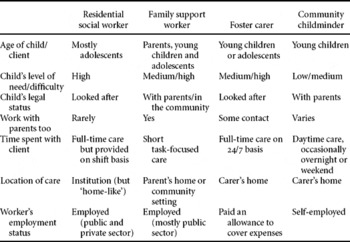
The selection of the four worker types (residential social workers, family support workers, foster carers and community childminders) was guided by both theoretical and policy considerations. They provided a number of contrasts, for example in the site of care, the likely life-course stage of the carer and the employment status of the worker. All are central to the provision of services for vulnerable or disadvantaged children and their families, yet at least two of the groups (family support workers and community childminders) have received very little attention from researchers. Their work shares some common features, for example relatively low rates of pay and – until recently at least – few requirements for formal qualifications (CWDC, 2006). However, there is also considerable diversity between the four groups on a number of dimensions that may affect the ease with which workers move between different types of child care work. These include the age group with whom the carer works, the extent of the child's needs, whether the child is looked after or supported within their own family of origin, whether the work involves parents as well as children or young people, the location where care work takes place and the time period over which care is provided (Table 1).
Dimensions of care work

The research project, which was undertaken for the Department for Education and Skills by the Thomas Coram Research Unit, adopted a multi-method approach that combined both quantitative and qualitative methods, including use of biographical narrative interviews to allow childcare workers to tell their own stories about their work and family lives (Wengraf, Reference Wengraf2001). Most of the fieldwork was undertaken in two local authorities: a London borough and a large county council in the south of England, although five additional authorities were recruited, including a northern metropolitan authority, in order to ensure sufficient numbers of family support workers and community childminders. The aim was to sample 150 workers within each of the four worker types across the public, voluntary and private sector as appropriate. This number, or close to it, was achieved for all workers except community childminders, who proved the most difficult to find. Authorities were not able to identify this group easily unless there was an organised scheme for placing vulnerable children with childminders, and many of the ten authorities approached had no such scheme and were unable to help.
For data protection reasons, the postal questionnaire was distributed by local authority or independent agency managers to all childcare workers in the selected groups (where there were more than 150 in a target group, for example in the case of local authority foster carers, managers were provided with instructions for random selection). Respondents returned their questionnaires directly to the research team. After a reminder, the overall response rate was 56 per cent. The 305 respondents included 83 residential social workers drawn from nine homes (three in each of the public, private and voluntary sectors); 84 family support workers drawn from across three authorities; 74 foster carers of whom approximately half worked for an independent agency and the remainder for one of the two main local authorities; and 64 community childminders drawn from five authorities, although 42 per cent came from one northern authority. The foster carers all cared for non-related children, rather than for children of family or friends.
Two surveys were conducted a year apart (early 2004 and early 2005) with the same set of respondents, in which most questions were structured and pre-coded. The first was a postal survey, which included questions about intentions to stay in or leave the work, as well as background information about the workers such as their gender, age, ethnicity, level of qualifications and length of time in their current job.Footnote 1 Respondents from the postal survey who agreed to further contact (almost two thirds) were followed up one year later, with a telephone interview addressing actual loss from and movement within the childcare workforce and the reasons for this. Twenty four biographical case study interviews were also undertaken during the intervening year, involving six workers from each of the four groups selected on a number of criteria relevant to the focus of the study, including life-course phase, gender and ethnicity and type of employer. These provided a wealth of data on how and why individual care workers entered and developed their employment careers within the context of their whole lives. Finally, a series of semi-structured interviews was conducted with the senior and middle managers of the workers participating in the survey (16 interviews in total, across the public, private and voluntary sectors). These manager interviews explored policy and practice concerning recruitment, retention, training and support, including any policies to enable or encourage workers to develop their careers and move between different types of care work with vulnerable children. In the remainder of this article, we draw together these different sources of data to consider how far they support current policies to develop a more flexible, integrated childcare workforce in England.Footnote 2
Findings
Type of work and life-course phase
Deciding to enter childcare work was often part of a complex chain of events and contexts in which people lived their lives. The in-depth case studies identified five main routes into childcare work:
• a particular life-course phase (such as having young children and needing to combine family responsibilities with care work in the home);
• significant life events such as bereavement or divorce or difficult experiences with their own children;
• voluntary work as a route out of full-time motherhood into childcare work;
• a recommendation from a professional, family member or friend; or
• serendipity: just being in the right place at the right time, such as when a person worked in a non-care occupation but was located in a social services context and was attracted to work with children.
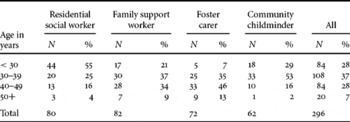
Of particular relevance when considering flexibility across the childcare workforce is the extent to which there was a link between life-course phase and entering a particular type of childcare work. Evidence from the postal survey of 305 childcare workers supported such a link. Different groups of workers reported starting their occupation at different ages. In contrast to residential social workers and community childminders, foster carers were more likely to be aged 40 or over when they started fostering, with family support workers following behind them in age terms (see Table 2). The residential social workers in the survey were least likely to be parents, while community childminders were most likely to have young children.
Age started in occupation by type of worker

Note: 9 missing cases.
On the basis of the biographical interviews, it seemed that the start of a career in child care was prompted by a particular life-course phase in the majority (17 out of 24) of cases. A few carers went into childcare work straight from school, either via a training course or directly into care work. For others, the entry into care work was a strategy for managing work and family life during the transition to parenthood. Most of the care workers were women from working-class backgrounds who had few qualifications. Becoming a mother with a young child constrained what they were able to do in terms of paid work, especially where they had little labour market experience and could not afford to pay for childcare. Thus, some women opted to become a childminder or foster carer, working in their homes while bringing up their own children. In other cases, the entry of their own children into school or secondary school, or their older children leaving home signalled the decision to move into the labour market and into care work outside the home. This later entry into (childcare) work was common among women from older groups.
Preference for working with particular groups
Personal histories and preferences also influenced decisions to enter a particular type of childcare work. Many of the case-study workers expressed a strong preference for working with a particular client group, such as children of a certain age, gender or level of need, and it seemed that this would restrict their willingness to move between types of care work. For example, residential social worker A had started her care work in an army crèche but had found after volunteering in a youth club that she much preferred the challenge of working with teenagers. This had led her into working in a children's home:
The little uns are good, it's nice to see them, but there's only so much you can do with the little ones and that. Where with the older ones, there's a lot more you can do with them.
Community childminders, on the other hand, frequently referred to their enjoyment of working with babies and young children. Childminder O, who had an 18 year old son as well as a five year old daughter, definitely did not want to work with teenagers: ‘they become difficult then and [pause] and just, they're so headstrong’.
A foster carer, C, preferred placements of boys to girls, partly because of her concerns about the impact of self-harming or sexually active behaviour on her own 15 year old daughter, but also because she had experienced more success with boys and thought that her rural location was less suitable for girls ‘who have got to be in town every five minutes’. She felt that she had ‘done my baby bit. I would rather have the older child. And that's where my success rate has been.’ Family support worker M was likewise drawn to working with difficult male adolescents, whom she regarded as ‘my forte’. She said that she was especially able to relate to this group because of her experiences with her own sons, and relished the challenge that this particular client group provided.
Other care workers had started off providing a particular kind of care, such as short-term foster placements for teenagers, but then realised that this did not suit their family circumstances. G and her husband had begun their fostering career with an independent agency providing emergency placements when their own children were young, but after four such placements had failed, they decided instead to foster a 12 year old girl with an autistic spectrum disorder on a long-term basis. They had found it difficult to look after volatile teenagers while bringing up their own small children.
If you're looking after little children who get up at 6 o'clock in the morning and you've got grown up children that are sort of being very angry and running away and doing stupid things, it just actually puts too much pressure.
The above examples suggest that government policy to encourage greater movement within the childcare workforce may have limited success when particular types of work are chosen due to personal circumstances and preferences. This was further supported by analysis of case-study workers’ responses to vignettes depicting movement between types of childcare work, and to a question about the notion of a ‘core worker’ able to work in a variety of settings with vulnerable children and young people. There was general acceptance among the case-study interviewees of the value of a common core of knowledge for all those working with children, and support in principle for the idea of greater flexibility across different types of childcare work.
However, many of those interviewed did not themselves want to be doing a different type of childcare work. Their responses when presented with specific situations in the vignettes tended to emphasise the differences rather than the similarities between the four types of work, such as the commitment needed to take on a foster child, or the different knowledge needed by someone caring for babies and young children compared to someone supporting young people or care leavers. Residential social worker A, for example, thought that the age differences of the children cared for would make it difficult to move between residential care (her current job) and community childminding, since residential care was mostly with older children and ‘early years is a totally different category’. She had thought about fostering, but would not want to provide continuous care since ‘with residential work you leave it and you come home, your work's done, it's one of those [jobs] you can turn off from’. Three of the six sponsored childminders interviewed in depth had also considered fostering, but had not pursued this because they feared that the emotional stress of parting from a child that had become a part of their life would be too difficult.
Commitment to work with children
On the other hand, our study did provide evidence of considerable flexibility and movement over time between types of work with children, especially in work with children within a similar age range. Among respondents to the postal survey, over half (52 per cent) had moved to their current post from another type of care work, sometimes with adults but more often with children and young people. More than three quarters (78 per cent) had previous childcare experience in a different setting, such as pre-school playgroup worker, classroom assistant, nursery nurse or youth worker. Family support workers appeared to have the greatest variety of experience, with half having worked in three or more different childcare roles. Some of this flexibility was life-course related, and reflected progression of care workers’ careers as mothers or as workers.
Also providing support for the notion of a ‘career’ in work with children was a strong commitment to working with children and families, particularly those that were vulnerable or needed additional support. This emerged as a consistent theme throughout this study. It was evident in the case-study interviews, where workers spoke about the satisfaction they obtained from feeling they could make a difference to children's lives, and in the survey data where few wanted to move away from working with children, even if they also expressed dissatisfaction with various aspects of the work.
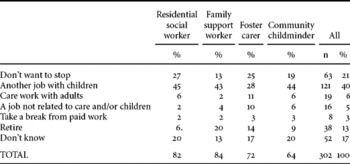
In the Time One postal survey, for example, childcare workers were asked whether they saw their future in their current type of work as short- or long-term (five years or more), how long they thought they would stay, how often they thought about giving up, and whether they would continue in care work with children if they left. The results indicated a high level of commitment to work with vulnerable children, alongside some uncertainty about future plans. Almost two thirds described their future in the work as long-term and more than four in ten thought they would still be doing the same type of work in five years, while around a third did not know. Only 11 per cent of childcare workers had ‘often’ thought of giving up, and almost a third said that they had done so ‘hardly ever or not at all’. When asked what they would do if they did leave their current job, the majority of respondents either did not want to stop what they were doing (21 per cent) or would take another job working directly with children (40 per cent). Only 5 per cent thought that they would work outside care work, although 6 per cent might change to caring for adults (Table 3).
What would do if left residential care, family support, foster care or childminding: postal survey

Approximately a year after completing the postal survey, follow-up telephone interviews were carried out with those respondents who had agreed to further contact, which was just under two thirds of the total. Excluding those who provided no contact details and those who were selected for case-study interviews, 87 per cent of potential follow-up interviews were achieved, with 34 residential social workers, 36 family support workers, 35 community childminders and 24 foster carers (129 interviews in total). The great majority (82 per cent) were still in the same type of work a year later, although residential social workers were more likely than the other three groups to have moved on. Of the small number who had left, two thirds were still working with children or families. Three childminders were no longer offering local authority placements but were still providing childcare for working parents, and two family support workers had left to do a social work degree or diploma but were doing their placements in children's services. Two of the leavers had retired, four (who had all been working in children's homes) were still doing care work but with adults, and only one of those who had left had moved into a completely different area of work, in the music business.
Given that the majority of those who had moved to a different type of work in the year after the postal survey had remained in care work, it was not surprising to find that most of them believed that their previous job had provided them with skills that were useful in their current work. Patience, understanding children with difficult or challenging behaviour, communication and relationship skills were all mentioned as transferable between the different types of work, reflecting some of the competencies defined in the Common Core of Skills and Knowledge (HM Government, 2005b).
When the leavers were asked about their future work plans, there was evidence of contextual and situational reasons for movement between different types of care work with children, as well as movement in pursuit of career development. For example, a young woman who had left residential social work since first contacted and was now working in a private day nursery, was motivated by a sense of professional development and saw this work as a stepping stone to work in a primary school as a classroom assistant. But she also felt that in her mid-20s she had been too young to cope with the emotionally, mentally and physically stressful work in a children's home. A family support worker who had just begun a social work degree hoped to work for a charity providing direct play therapy with abused children after she qualified. A childminder who had stopped accepting local authority placements intended to return to social work when her youngest child started school. Another community childminder had stopped this work to train to be a teacher, and a third was exploring the idea of fostering now that she had a larger house and her own children would soon leave home.
Continuing engagement with care work was also evident among childcare workers who were still in the same type of work at the time of the follow-up survey, but who reported that they had considered leaving during the previous year. When asked what they had considered doing instead, over half (18 out of 32) said they would still be working with children or young people, and most of the rest had not had particular plans or ideas. Residential social workers mentioned jobs such as care work in a children's hospice or with disabled children, social work with children (but not residential), and work in a respite children's home. Family support workers expressed a preference for jobs involving some kind of therapeutic or counselling work, such as play therapy, counselling abused children or psychotherapy. A quarter of childcare workers who had considered leaving (8 out of 32) had thought about moving into care work with adults instead, such as working with adults with learning disabilities or mental health needs. Only four were considering moving out of care work altogether, and three of these were residential social workers.
Employer perspectives on workforce mobility
Managers with responsibility for the four different groups of workers were asked about policy and practice within their organisation concerning movement between types of work with children and young people. Overall, there was little evidence from these interviews that managers had yet developed strategies for encouraging flexibility across the childcare workforce as a whole. This reflects the findings of a recent local government workforce survey, where for example only 22 per cent of local authorities reported undertaking workforce planning for workers in children's homes, and just 9 per cent said that they were developing career pathways for this group (LGA, 2006).
In the current study, some initiatives were being developed for family support workers, who were seen as a crucial group in responding to the change agenda for children's services set in motion by Every Child Matters. These initiatives included support for obtaining additional qualifications so family support workers could progress to children's social work, and new arrangements to spend part of their time working in different settings such as schools and doctors’ surgeries or within different social work teams. Managers of all four types of worker described training and development opportunities to help workers progress within their current role, but little consideration appeared to have been given to how different roles might fit together, or to how horizontal as well as vertical progression within the childcare workforce might be encouraged, perhaps as a way of helping workers to manage work/family responsibilities at different stages of their lives.
A number of managers were positive in principle about greater transferability between types of work with children and could see its relevance in the light of more integrated children's services. From the employers’ perspective, reasons given for encouraging such flexibility included potential benefits to recruitment, and an improved and more efficient service. One manager, when describing how several experienced community childminders had recently moved on to other childcare work, described this as a ‘good loss’ which would promote the community childminding scheme in a wider field, and noted that ‘every service needs people that develop’. It was suggested that experience of a variety of types of childcare work would result in ‘a more rounded person in terms of professional skills’ and hence a better service for children, as well as perhaps reducing burnout among staff.
However, other managers cited factors that they thought discouraged a policy of flexibility and movement within the childcare workforce. One was worker preferences, which as we have seen in the interviews with workers themselves also emerged as a factor discouraging mobility. For example, there was a perception that foster carers often took up this work because they wanted home-based work and so would not be interested in other types of childcare work. A common theme in interviews with managers across all four types of worker was that there were two groups of unqualified workers: those who were keen to progress and possibly branch out into new areas, and those who wanted to remain as they were. The latter group could find encouragement to diversify or to acquire new qualifications threatening, and managers in both authorities where the role of family support workers was being extended noted that it was important not to devalue existing roles by creating new opportunities.
A second factor, cited especially by service managers, was a fear of either poaching or losing staff. Given the widely acknowledged difficulties in recruiting and retaining staff for care work with children, it is perhaps not surprising that some managers expressed a desire to ‘hold on to their own’, although it could be argued that the approach of the community childminder manager described above might be more effective in attracting and retaining staff in the longer term. Foster carers in particular were rarely mentioned as a possible source of recruits for other types of care work, which may reflect the priority given to retaining existing foster carers within the service. For example, one local authority fostering service manager explained that developing care careers for foster carers was not a priority: ‘there's other issues that you need to look at before [looking at] what else they can offer or what jobs they can move on to’.
A third challenge perceived by managers to increased mobility among the childcare workforce was structural factors such as the disparity in pay and conditions between different types of childcare work. The human resources manager in one local authority in the study, where workplace structures were beginning to be reviewed ‘to make sure that we have the ability to progress people rather than [them] having to leave to be promoted’, suggested that pay banding was a key issue in enabling cross-sector movement. If pay bands were made wider, he argued, people could be encouraged to move more easily between types of work with children without pay loss or change of salary scale. Another senior manager, from a different local authority, believed that the status differences between different types of work with children would also prove an obstacle to greater mobility. Although she said she would like to believe that a common core of qualifications would begin to break down these demarcations, she was not hopeful that this would happen.
Conclusion
The findings of this study suggest that the government's strategy to develop a more flexible, integrated childcare workforce needs to go beyond constructing an integrated qualifications framework, important though this may be. In this article, we have presented some evidence of transferable skills and movement between types of work with children as well as reasons why people choose certain types of work: for example, their life stage, location, preferred age of child, and own personality or needs. Where this is the case, as when people with older or grown up children decide to foster children and to look after older age groups, or when a community childminder wants to look after young children when she has her own at home, recruitment needs to be targeted, matching people to type of work. More attention could be paid to the connections between individuals’ work and family lives, and to the multiplicity of factors that influence decisions about entering – and moving within – the childcare workforce. Opportunities to gain first-hand experience of different types of childcare work could be a powerful way of encouraging workers to branch out into other types of work with children. This had been the case for a number of family support and residential social workers in our study, where placements undertaken as part of a social work degree or diploma had opened up possibilities that might not previously have been considered.
Increased flexibility and encouragement to develop ‘careers’ in work with children – for example, by offering professional training – can increase opportunities and make the work more attractive and financially rewarded. However, care needs to be taken not to lose the existing strengths of the workforce. For example, we found cases of family support workers who felt undervalued because they did not choose to train in social work (a possibility for some) yet felt they were doing equally important and demanding work.
When childcare workers do move on, it is usually to another type of care work with children or young people. This finding provides support for policies to develop a more integrated childcare workforce. Studies of recruitment and retention among childcare workers have tended to highlight the difficulties in attracting and keeping workers within a particular job. However, the fact that this movement is mostly within – rather than out of – the childcare workforce should perhaps be regarded as a strength rather than a problem, provided that it does not compromise continuity of care for individual children. In this study, local authority children's services managers were beginning to develop strategies to extend the role of certain groups who were seen as key to the remodelling agenda, such as family support workers. What was less in evidence was a broader consideration of the needs of the childcare workforce as a whole, and of ways in which career pathways could be developed horizontally as well as vertically between different types of work with children and young people.
Acknowledgements
This research was originally commissioned by the Department of Health and became the responsibility of the Department for Education and Skills when children's social care was transferred between departments. The views expressed in this article are those of the authors and do not necessarily reflect those of either Department.