INTRODUCTION
Thousands of parents grapple with the death of a child each year in the United States (Kochanek et al., Reference Kochanek, Kirmeyer and Martin2012). Many more parents care for children with life-threatening conditions (LTCs), and, each day, thousands of these children are within months of death (Feudtner et al., Reference Feudtner, Hays and Haynes2001; Freibert, Reference Freibert2009). Such statistics are important as we consider the impact of a child's illness and eventual death upon his or her siblings, parents, family, and community of friends and healthcare providers.
Parents do the vast majority of caregiving for children with LTCs and suffer physically, emotionally, and financially as a result (Carnevale et al., Reference Carnevale, Alexander and Davis2006; Kreicbergs et al., Reference Kreicbergs, Lannen and Onelov2007; MacDonald & Callery, Reference MacDonald and Callery2008; Kars et al., Reference Kars, Grypdonck and van Delden2011). They also experience psychological distress over the course of their child's disease, especially as such conditions approach late stage or are recognized as being incurable (Rosenberg et al., Reference Rosenberg, Dussel and Kang2013). The work of parenting may lead to psychological distress, especially since most children with an LTC who are enrolled in pediatric palliative and hospice care (PPHC) services are alive for over a year and often spend much of their last year of life at home (Feudtner et al., Reference Feudtner, Kang and Hexem2011; Institute of Medicine, 2014). The numbers suggest that children and families manage the care of their children through episodic contact with providers who may not fully grasp the wider context in which families make their healthcare-related decisions for their ill child, care for healthy siblings, and make family-related decisions.
A gap in our knowledge exists regarding parenting children with an LTC and their healthy siblings. Uncovering what it means to be a parent at this extraordinary time is important to understanding their goals, decision making, and caregiving. For instance, how do palliative care services fit into their beliefs about parenting not only a child with an LTC but also their other children? Parents strive for a sense of normality within the context of their child's condition in order to dually parent and care for the ill child and that child's healthy siblings (Carnevale et al., Reference Carnevale, Alexander and Davis2006; MacDonald & Callery, Reference MacDonald and Callery2008; Hendricks-Ferguson, Reference Hendricks-Ferguson2008; Monterosso et al., Reference Monterosso, Kristjanson and Phillips2009; Bousso et al., Reference Bousso, Misko and Mendes-Castillo2012; Kars et al., 2012). Thus, understanding the juxtaposition of a normative family function (parenting) in the context of an extraordinary situation (LTC) will illuminate the ways in which parents enact their parenting role, care for their children, and define the goals or beliefs that guide their parenting of all the children in their family.
As healthcare policy (Miller et al., Reference Miller, LaRagione and Kang2012) reinforces the need for more equitable use of PPHC, the needs of parents who have children who have an LTC and healthy siblings are an obvious priority. Understanding the needs of families is a foundation for interventions that will enable optimal use of PPHC. Such interventions can assist families as they manage an ill child's condition, meet the needs of healthy siblings, and assist in achieving family and parenting goals (Heller & Solomon, Reference Heller and Solomon2005; Hinds et al., Reference Hinds, Oakes and Hicks2009). Therefore, the research questions driving this study include the following:
-
1. How is parenting children with an LTC described by the parents themselves during or shortly following hospitalization of a child?
-
2. How is parenting the healthy siblings then described by these same parents?
Parenting in the Context of Childhood LTC
Parents suffer significant physical, emotional, and psychological distress as they care for and anticipate losing a beloved child (Kreicbergs et al., Reference Kreicbergs, Lannen and Onelov2007; Rosenberg et al., Reference Rosenberg, Dussel and Kang2013). In addition, relationships within a family system change and members of the family may experience stress, psychological distress, and negative emotions related to these relationship challenges. Such changes in individuals and the family might not be evident to the healthcare providers caring for an ill child, especially if the parents are meeting all of their healthcare-related role expectations.
Siblings of a child with an LTC might suffer because of changes in the sibling relationship, eventual loss of the sibling, and potential physical and emotional separation from the parent (Alderfer et al., Reference Alderfer, Long and Lown2010; Degeneffe & Olney, Reference Degeneffe and Olney2010). Parents often recognize that caring for an ill child can impact the healthy siblings, and they want to learn how to help them through this experience (Davies, Reference Davies2005; Alderfer et al., Reference Alderfer, Long and Lown2010; Bingen et al., Reference Bingen, Kupst and Himelstein2011). While less is known about siblings in the context of PPHC, recent research indicates that siblings of children with specialized healthcare needs experience more functional impairment, problems with interpersonal relationships, and psychopathology than siblings of unaffected children (Goudie et al., Reference Goudie, Havercamp and Jamieson2013). In addition, researchers who study bereaved siblings have begun to uncover the particular challenges facing these children, including psychological distress, academic issues, and altered social relationships (Gerhardt et al., Reference Gerhardt, Fairclough and Grossenbacher2012; Rosenberg et al., Reference Rosenberg, Postier and Osenga2015). Thus, illuminating what parents perceive siblings to need in the context of PPHC is an important first step in creating services and educating front-line clinicians to support the whole family.
In addition, caring for a child with an LTC poses significant risks for family financial and social resources (Carnevale et al., Reference Carnevale, Alexander and Davis2006; Knapp & Contro, Reference Knapp and Contro2009; Bingen et al., Reference Bingen, Kupst and Himelstein2011; Dussel et al., Reference Dussel, Bona and Heath2011; Bona et al., Reference Bona, Dussel and Orellana2014). These risks stem from lost employment, the costs of travel and other expenses related to the ill child's healthcare needs, and increased use of healthcare resources for themselves after the child dies (Kreicbergs et al., Reference Kreicbergs, Lannen and Onelov2007). Dussel and colleagues (2011) found that close to 20% of American families fall below the national poverty line because of caring for a child with incurable cancer.
Taken together, we can see that understanding parenting in the context of a child's LTC is an important avenue to improving communication with families around the transition to PPHC, to enhancing understanding of what resources families deem necessary, and to supporting families as they make healthcare decisions. In those families where the death of the child is inevitable, understanding parenting and supporting parents in reaching their goals of being “good parents” (Hinds et al., Reference Hinds, Oakes and Hicks2009) to their children may mitigate some of the physical and mental health effects experienced as they live on without that child.
METHODS
This study was informed by Bronfenbrenner's (Reference Bronfenbrenner1979) socio-ecological model and Horowitz's (Reference Horowitz1995) critical components of the parenting framework, in that the normative aspects of parenting were viewed within the social ecology of the hospital, home, and community. The method employed in our study was qualitative description, which emphasizes “staying close to the words of the participants” (Sandelowski, Reference Sandelowski2000, p. 336) in order to describe and elucidate an understudied phenomenon. The study was conducted at a large children's hospital and at a university in the Mid-Atlantic region of the United States. Approval from the institutional review boards of both institutions was obtained prior to study initiation.
Participating parents were recruited from intensive care units, oncology departments, and palliative care teams after collaboration with unit-based experts. Parents were eligible for the study if they were older than 21 years of age, spoke English, were the parent of a child with a life-threatening illness and at least one other healthy child, and lived with the ill child and siblings at least half the time. Parents were not eligible if they were less than 21 years old, did not speak English, if their child had died prior to the interview, or if the child was otherwise healthy and hospitalized for an acute illness or injury. We employed maximum variation purposive sampling in order to obtain a sample that was diverse in terms of medical condition, ill child health status, and family composition (Patton, Reference Patton and Patton2002). The first author visited the inpatient units across the day, evening, and night shifts on both weekdays and weekends.
Each parent consented to participation after the study was explained, questions were answered, and time for consideration was provided. Most interviews were conducted at the child's bedside or in a conference room on the inpatient unit where the child was admitted. Four parents were interviewed over the telephone because their ill children were discharged to home prior to data collection. The authors have extensive experience conducting qualitative interviews both in person and on the telephone. Mechanisms to facilitate participation of parents in pediatric palliative care research were included in the study protocol to encourage participation and were supported by experts in the field, such as flexible interviewing time, location, and format (Hinds et al., 2007). Each interview lasted approximately 60 to 90 minutes. Each participant was given or mailed a retail gift card for $20 at the conclusion of the interview. The semistructured interview guide was constructed using the guiding frameworks. Sample interview questions included, “What is most important to you in being a parent to [ill child's name]?” and “What is most important to you in being a parent to [each healthy child in the family]?” Recruitment ended when the dataset reached saturation.
Interviews were digitally recorded and immediately transferred to a secure university-based research drive and also to an encrypted file on the investigator's personal computer. Once the digital media were transferred to these secure sites, the file was deleted from the digital recording device. A pseudonym was provided for all participants in the study and for all children and family members mentioned. Interviews were transcribed verbatim. Transcripts (20%) were then compared with the audiotapes to ensure accuracy. Two parents who cared for their children with a life-threatening illness (LTI) reviewed the interview guide before participants were recruited. Participant interviews were conducted from February of 2013 to November of 2013.
We utilized Atlas.ti (v. 7.0) data analysis and research software. Data from parents were inductively analyzed to create case summaries and identify descriptive or topical categories. Our guiding frameworks sensitized the initial code list but did not exclude possibilities for new codes to emerge (Sandelowski, Reference Sandelowski2000). Using this initial code list, coding categories and themes were developed from the data through a process of constant comparative analysis (Sandelowski, Reference Sandelowski2000; Sandelowski & Borroso, Reference Sandelowski and Barroso2002; Reference Sandelowski and Barroso2003; Corbin & Strauss, Reference Corbin and Strauss2014). Categories provided a foundation writing a codebook that consisted of coding definitions, application guidelines, and data that identified the codes as they emerged and changed during analysis. After coding the data, codes and categories were organized and analyzed to further describe the relationships among them and to develop themes. Ongoing refinement of the categories, their application, and the emerging themes was discussed during weekly meetings with the senior study team and, as needed, with content experts. Measures to maintain qualitative rigor (Guba, Reference Guba1981) included an audit trail, a fieldwork journal, member checks, maximum variation sampling, a thick description of parenting, and review of data and analysis with the qualitative analysis group and a senior qualitative methods expert.
RESULTS
Sample Demographics
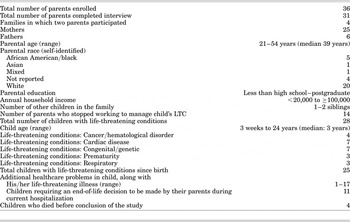
The demographics of the sample are provided in Table 1. Participants included 31 parents (including 4 couples) of 28 children with LTCs. Some 36 parents enrolled in the study. Five parents did not complete the interview: two enrolled but became ineligible because their ill child died prior to data collection, one withdrew because of feeling overwhelmed by her child's illness, and two were later found to be ineligible because their children did not live with them on at least a part-time basis. Some 27 parents declined participation, mostly citing a lack of time, increased stress, and the sensitive nature of the topic. Parents from the same family were interviewed separately.
Demographics of participants

Parenting in the Context of Childhood Life-Threatening Conditions: Themes
Four themes emerged from the interview data that describe parenting children with an LTC and their healthy siblings. The four themes describe how parents strove to maintain an emotional connection with all of their children, maintained family connections, knew their children, and worked to diminish suffering for all their children, respectively, as well as how they changed as a parent.
Theme 1: Parents Strive to Maintain an Emotional Connection to all of Their Children
Parent–child connection
Parents expressed a desire and duty to foster relationships with all of their children. Parents wanted their ill and healthy children to feel connected to the family, cherished by their parents, and appreciated as individuals. A first step in understanding parenting in this context was to consider the depth of love, concern, and connection parents described about all of their children. As one mother noted, “my girls are everything to me.”
These connections, for both ill and healthy children, are a foundation from which all other actions arise. For their ill children, these connections are manifested by maintaining close physical proximity in the hospital and, often, at home, and ensuring the best possible healthcare. Parents accomplished this by managing the illness and supporting the child as their health deteriorated or they moved along the illness ↔ wellness continuum. Parents described these actions as manifestations of love that allowed them to better know their child as they changed over the course of the illness or in response to a new therapy. One mother of a 3-year-old child with ventilator dependency and cerebral palsy described how she had to learn about her child with disabilities in a way that was different from her other children. This mother learned through observation and spending time with the child:
I've learned that love is a lot of it … Just from being by her side. I learned that a child like Avery needs more attention. You need to be by their side more. In order for them to feel the love, you just need to be right there, all the time. I learned that … spiritually I can feel her, like from my common sense, I guess. (Yvonne)
For their healthy children, parents manifested this connection by creating a “safe space” where healthy siblings can talk about their fears, questions, and frustrations about the experience of having a sibling with an LTC or about their lives in general. In this space, parents described taking steps to decrease feelings of exclusion or neglect, spending high-quality time together that focused on the sibling's interests, and prepared for the sibling's next developmental phase. Parents worked to maintain these connections when there was geographical proximity (the ill child was being treated in the same metropolitan area where the family resided) or great distance (when the ill child was being treated in a different region or nation from where the family resided). These actions promoted connection by deepening the parent's knowledge about the child and strengthening previously existing bonds to communicate to the child that “we are all in this together.” One mother of a 1-year-old child with chronic pulmonary disease and a 3-year-old healthy child described promoting this connection with the healthy sibling by devoting short bursts of high-quality time to her. She emphasized being present with the sibling and limiting the distractions of the intensive care unit and the world of illness management:
To be present. Whenever she is up here and we get to spend time together, it's to be totally focused on her if I can. It's small stuff … For a few hours, it was no talk of the hospital, no checking phones, no computer, and no other distraction. It was just fun and silliness—100% Bridget [healthy sibling] time. (Georgia)
Another mother described maintaining connection with her healthy children by trying to be attuned to their needs, acknowledging how this situation was hard for them, and creating a space for them to talk with her about their feelings:
Creating a safe space for everyone has been vital … to be who you are and to voice your feelings, whether or not they are socially acceptable. There's no right or wrong feeling, and … I want to know who you are, and I don't want you to get lost in all of this, because it's hard. (Kimberly)
Through these previously described actions, parents attempted to decrease the suffering of their ill and healthy children and demonstrated concern for their well-being. To accomplish this, parents described the constant mental back-and-forth work of being present and attuned to one space, yet also thinking about, planning for, and reflecting on the needs of the other child(ren) in the other space—a constant mental dance. For example, during one interview a mother took three different phone calls from the school principal of one of her healthy children who had been bullied at school. The mother wanted to address the situation and advocate for the sibling even though she was with the ill child in a critical care unit.
Ill child–healthy sibling connection
Parents also described promoting the relationship between siblings in order to connect the children to each other. Two mothers described how their children with longstanding LTIs “could be easily forgotten about” by their siblings and how they worked to keep the ill child an active part of the family. Some parents also expressed fears that the siblings would lose their connection to each other and took measures to promote this bond, such as connecting the siblings over a technological medium (e.g., FaceTime, Skype) or face-to-face visits during hospitalization. One father traveled six hours weekly to escort a healthy sibling to the hospital so that she could spend time with her ill younger sister. One couple, parents of a critically ill twin, described physically connecting their new family of four as soon as possible so that the siblings could bond. As the mother noted,
The minute one of them was unhooked from the wires to go home, we immediately put them together, and to me that was really important, that they— we all be together, the four of us, as soon as possible [so that the babies would have a chance to bond]. (Sarah)
Parents expended much physical, emotional, and cognitive energy to maintain and strengthen connections within the family unit and with each child. While parents described this expenditure as arising from love of the children and living out their role as parent, they also described experiencing negative emotions in caring for and maintaining connection within the family. They described feeling stressed or overwhelmed by trying to meet the needs of all children in the family, as well as sadness about the general experience of living with a chronic LTC and its effects upon all their children. One mother described her experience caring for her youngest child, who was born with severe congenital cardiac defects, and her older child while her husband was stationed overseas for work thus: “I was so stressed. I just cried all the time. It was all on me.”
While love is a foundation for the rigorous physical, emotional, and cognitive work parents do on behalf of all their children, the actions and experiences rooted in love and caring can often be stressful. Love and the desire for connection was a foundation from which parenting actions grew, but living out this connection and acting on this love was sometimes painful. Parents were drawn into interactions or situations in which they may have experienced frustration, anger, stress, and sadness.
Theme 2: Parents Learn About Their Children Through Observation and Interpretation of Cues and Use These Cues to Devise Parenting Strategies
Parents described a process of observing their children's physical and emotional health state, development, and personality in order to learn more about them. This reading and interpretation provided a way for parents to connect to and engage with their children and respond to their needs as perceived by the parent.
Parenting strategies—ill children
Considering the ill children, parents spoke about a constant vigilance of the child's health status and mental fine-tuning of caregiving work. As one father reported, “all of the time, it's literally a 24/7 job, her medical care in your mind, kind of tweaking as needed.” Throughout this study, parents described looking for changes in their child as a way of marking their illness state. In the context of the child's hospitalization, parents frequently monitored vital signs, child engagement in activities, child appearance, and whether or not the child was acting “like him/herself.” Parents often interacted with healthcare providers to gain their insights and probe more about the best ways to help their ill child heal or arrive back to baseline. Parents also described using their intuitive sense of parenthood to learn more about their child and develop the right strategy. Another mother described this as a skill she had honed over the course of her child's life. Through her discovery of touch as a way to connect with the child, who was both blind and deaf, this mother had learned about her child, how to communicate with her, and how to comfort her:
Skin to skin was a big thing in the NICU, and I know her survival was probably because I was there. It's important for me to touch her, change her diaper, and be a part of her care … so it's not scary for her. I don't know how she feels … I am just trying to cover all my bases and make sure it's like normal for her so she doesn't see the big transition between home and hospital. This is why I can't leave her, because then there's no home feel, ‘cause I’m home in a way. (Brenda)
While this work seems like an expected extension of parenting all children, the experience of reading cues and interpreting in the context of a pediatric LTC can be stressful, overwhelming, and bring about feelings of sadness or guilt. One mother described caring for her 24-year-old child who was nonverbal, and the stressful nature of reading the child's cues is evident in her words:
If Christine could talk, that would be my dream, because then I don't have to try and second guess everything all the time. If she could just say, “Oh, my God, mom, my ear is killing me,” life would be so much easier. I could be watching Christine suffer and racking my brains and not know what the heck it is, and then all of sudden I finally figure it out. It happens day in and day out. (Olivia)
Parenting strategies—healthy sibling(s)
Parents described meeting the healthy sibling “where they are” developmentally through a number of avenues. These strategies included: working to ensure the child was “known,” reading the child's cues and responding accordingly, acknowledging the child's growing capabilities, and supporting continued growth and development to progress to the next phase of personhood. Interestingly, this was enacted and carried out differently depending on the sibling's age and developmental level. For example, parents of school-age and younger children described knowing the child's personality, likes, and dislikes, and reading and responding to the child's cues. As one mother reported, she attempted to meet the needs of both young children, often simultaneously, which can be very hard in an intensive care setting. She described simultaneously being cognizant of the older sister's routine and fulfilling her toddler-aged needs, while trying to be present in the NICU for the ill child and being available to hold and observe him:
Making sure I listen to Sofia's needs, making sure she eats, and takes naps … while being there for baby. It's really hard to have a small child who is with you all day long and then another child in the hospital. I try to give her a break on the weekends, so that she can have a chance to do normal stuff. (Vanessa)
Parents of adolescents and young adult siblings described supporting the adolescents in their important activities (e.g., attending cheerleading competitions or soccer games), in finding meaningful work, in negotiating relationships, and in supporting the young person's strengths and contributions to the family. One mother described enacting parenting of her early-adolescent children differently. She built on a strength and favorite activity of the 11-year-old sibling by giving her freedom to cook, since she observed how the child could act responsibly. This reflected the mother's desire to meet the child where she was developmentally and acknowledge her capabilities. Parents also described supporting siblings' interests as much as possible and not holding them back:
They are capable of so much more than you give them credit for … and I probably learned that about five years ago, like when Hailey is standing on a stool next to me cooking dinner. That's what she wants. I trust her. Sometimes we do want to shelter our kids, and sometimes we don't want to give them those experiences. (Wendy)
Theme 3: Parents Work to Minimize Suffering in all of Their Children by Their Own Child-Centered Efforts and by Pulling in Outside Resources
Influenced by the health and emotional state of all their children, parents sought to minimize suffering and mitigate the negative aspects of LTCs for each child. They used their observations to develop parenting strategies that communicated connection and love to all their children. These strategies were enacted in several ways by parents: they did it themselves or they pulled in outside resources.
Child-centered work
Child-centered work includes many of the expected parenting functions (e.g., cleaning, feeding) as well as illness-directed care for ill children. One mother, whose child was dependent on a ventilator and developmentally disabled, described her child-centered work as intense, but she reported having a routine that made the work less daunting: “There's kind of this pattern that we follow throughout the day, and it's that routine that makes it doable and makes it comfortable … I think that's what saves us, honestly.” Considering the healthy siblings, parents focused their attention on the parts of the sibling's life that they perceived as important (e.g., school, extracurricular activities) that they could individually influence. For example, one father described conversing with an older sibling each night via Skype to ensure that homework was done and test her knowledge of concepts recently learned in school.
Parents described caring for children with an LTC and their healthy siblings as intensive, physical, emotional, and cognitive labor that was often overwhelming or stressful. Parents were often fearful of misreading a cue or mismanaging the ill child's condition and reported stress provoked by the gravity of the situation. Parents also described the stress of uncertainty that accompanied caring for a child with a life-threatening condition. Erika described the stress and uncertainty involved in caring for her 3-year-old child with complex congenital cardiac disease thus:
I just think about losing her all the time—all the time. Right now, as far as her heart, we're not really doing anything about it. We're just letting it be, and then we'll just deal with the problems as they come, and I never know exactly when her heart's just gonna stop. (Erika)
Resource-centered work
Resource-centered work is the work within and across systems that parents do in order to move the child toward less suffering. Such work includes advocacy within the school and healthcare systems, arrangement and management of home healthcare services, and working with insurance companies and bureaucratic bodies to ensure adequate care for the ill child. One mother of a 3-year-old child and two teenagers described how she took matters into her own hands when she felt her home health agency was sending unprepared clinicians:
One of the biggest things, with a trach-and-vent kid, is getting quality nursing care and finding the best nurse that not only can do her job but loves Ava and loves what she does … The agencies will send out anybody. I got nurses where they didn't even know trach and vent, but the thing is, I do my own interview when the nurses come to my house … and that helped us a lot.
Parents also described working to maintain normality for all the children in their family, especially the healthy ones. They expressed a desire to maintain things as normal as possible as a way to ameliorate the impact of the LTC, minimize separation of family, and lessen the potential suffering experienced by siblings because of the situation. Normality was generally maintained in two ways. Parents either adapted the sibling's environment to keep them physically close and connected to the parent or pulled in extended family and friends to carry out parenting duties so that everyday consistency was maintained. For example, grandparents cared for healthy siblings so that the healthy siblings could continue to live in their own house, stay in school, and participate in extracurricular activities while the ill child was hospitalized. This effort at maintaining normality involved working within and across systems to ensure that siblings' needs were met and that the child was progressing along the expected developmental path:
Instead of going to the NICU every day, which I would love to do because with the baby being sick I hate being separated from him, … but at most every other day we will go to the NICU. It's important to me that my two year old has time with her parents and not just her grandparents. (Francesca)
The level of care rendered by families (like making sure life-sustaining medications were delivered consistently or constantly negotiating within the family and healthcare systems) was intensive and laborious. This, combined with the uncertainty of the child's LTC, was described by parents as overwhelming and stressful.
Theme 4: Parents Describe Changes in Themselves and Changes in Their Parenting the Ill and Healthy Children as a Result of Caring for a Child with an LTC
Parents described changes in their parenting and general world outlook because of having a child who had contracted an LTC. While many parents of healthy children described changes within themselves, parental development can come into stark relief in the context of a childhood LTC.
Changed as a person
Parents described changes in perspective and demeanor as a result of caring for their ill child. As one mother explained, the child with the LTC became the gauge for the parents' outlook: “When she is doing better, I am doing better.” In addition, parents described the ways in which they had changed over time as a result of caring for the ill child, managing his or her illness, and juggling the needs of all the children in the family. One mother described how the entire family was changed as a result of taking care of the ill child:
Cancer is a family disease. She has cancer. I feel like I have it. I wear it. I feel like I'm dying, you know. My husband wears it. It affects all of us. (Valerie)
Changed as a parent
Parents also described how caring for their ill child influenced parenting a healthy child. Most reported a sense of appreciation for the healthy siblings, gratitude for their potential to achieve expected milestones, and focused on deepening relationships with the healthy siblings. One mother described how the things that were important to her as a parent changed over the course of having a child with an LTI. For instance, the focus of her parenting was now different. She emphasized making sure her children felt loved, that they did the things they enjoyed and continued to develop, and that they felt comfortable sharing their feelings:
Prior to having any children in the hospital, I was more like … textbook mom … having play dates. Now our priorities are the feelings and the people that you are, in developing your character versus all the externals … If I depended on those day-to-day activities, the normal parent things that parents do to have relationships with my children, I wouldn't be able to have that. (Kimberly)
This growth and development as a parent could be simultaneously painful and eye-opening. As parents described the ways in which they changed as people and as parents through caring for a child with an LTC, they also described feeling sad about the “loss of normal” (Kimberly), about the lack of time they could spend with their other children, and their need to put their own career and personal aspirations aside in order to care for all their children. One mother described how she had grown as a person through the experiences of caring for her children, especially her 10 month old, born with an LTC. Although she gained deeper confidence in herself, the process was overwhelming. In the process of caring for her ill child, this mother experienced a move from another country, separation from her other children, loss of income, and setbacks for the ill child. She (Bianca) stated, “I think that life doesn't send you anything more than you are capable of handling. So in a way I am grateful that I know that I am capable of this and much more. But I really would prefer if life took its fist off my face.”
The bidirectional nature of parenting is demonstrated through Bianca's words. Parents were deeply affected by their ill child's health and emotional state. In turn, parents adapted to the needs of the child and worked to decrease his or her suffering. In terms of the healthy siblings, parents described approaching parenting from a different perspective. For example, some described the fragility of life, the specialness of each day, and appreciation for health as ideas that influenced their parenting of healthy siblings. This personal growth can come at a cost to all family members. As clinicians work with families over the course of a child's illness, these developmental histories might provide important insight into parents' experiences and the context within which they make decisions.
DISCUSSION
In the extraordinary context of parenting a child with an LTC, the parents in our sample tried to achieve goals that may appear ordinary: they wanted all of their children to experience love and connection within the family; they strove to become experts in their children through intimate observation of each child and interpretation of his or her behaviors; and they sought to minimize any suffering experienced by their children. Not surprisingly, parents described changes in themselves as a result of being a parent to both the ill child and their healthy siblings. For the parents in this sample, ensuring that their children felt loved and not forgotten was the crux of their parenting and served as a foundation for parenting action. For example, in order to convey their love and connection, parents “pushed the healthcare team” to find new ways to alleviate a child's suffering or created a schedule to visit the ill child based on the needs of the healthy sibling.
While parents described a desire to maintain a connection with their children that was rooted in love and concern, they also experienced the downsides of living out this connection. Parents described experiencing negative emotions in the context of caring for all the children in their family across the home, hospital, and community settings. They described feeling frustrated with the healthcare system, feeling stressed or overwhelmed by the care and attention needed by all of their children, and feeling sad about the potential effects of the life-threatening condition on all of their children. The downsides of love and connection can be pain or negative emotions that parents experienced as they care for all of their children, attempted to promote children's well-being, and anticipated loss of the ill child or loss of participating in the milestones of the healthy siblings. An unintended consequence of enduring parental love and consistent parental engagement might be psychological distress regarding their impending loss. This is supported by the work of Rosenberg and colleagues (2013), who found that 10 to 20% of the parents of children with persistent and late-stage cancer experienced severe psychological distress. This juxtaposition and complexity of emotions may be surprising to clinicians caring for an ill child if parents consistently portray an outwardly positive or negative affect. For example, parents of children receiving pediatric palliative care services who used more positive interview language and expressions actually had lower positive affect scores on the Positive and Negative Affect Scale (Hexem et al., Reference Hexem, Miller and Carroll2013).
The work and trajectory of parenting ill children and healthy siblings looked different. As the condition changed for the ill child, parents incorporated new skills into their parenting or caregiving repertoire, and this work attempted to move children toward a state of diminished suffering. Parents also engaged with various systems (e.g., family, the healthcare system, and the insurance/bureaucratic systems) in order to move the child in the direction they desired. Parents also awaited the next deterioration, when they might need to adapt, adjust, and reevaluate the child's situation, their subsequent parenting actions and goals, and how they would enact their role throughout the various systems in which they engage as parent to this child. This description of development and change across time is similar to the typology and time phases of chronic illness described by Rolland (Reference Rolland1987). This also supports the process of re-goaling described by Hill and colleagues (Reference Hill, Miller and Walter2014), who found that parents of children with an LTC adjusted their goals according to changes in their child's condition.
For healthy siblings, parenting work mirrored a more normative trajectory. This trajectory was marked by attempts to maintain normality and routine, connection with the child through observation and communication, adaptation to changes in the child, work to diminish the adverse effects of having an ill sibling upon the child, and allowing the child the independence to grow and develop while the parents watch from the sidelines. Parents used strategies to assert to their healthy children that they were loved as much as the ill child, that they were not forgotten, and that the parent could meet the demands of the job. This is corroborated by several studies in which parents of children with an LTI wanted to maintain a sense of normality for their families and sought to help their other children through the experience of having an ill sibling (Carnevale et al., Reference Carnevale, Alexander and Davis2006; MacDonald & Callery, Reference MacDonald and Callery2008; Hendricks-Ferguson, Reference Hendricks-Ferguson2008; Monterosso et al., Reference Monterosso, Kristjanson and Phillips2009; Bousso et al., Reference Bousso, Misko and Mendes-Castillo2012). Since most children receiving pediatric palliative care services have at least one sibling (Feudtner et al., Reference Feudtner, Kang and Hexem2011), understanding this blend of cognitive, emotional, and physical daily work that parents do for all of their children is essential.
While parents yearned to maintain normality or the ordinariness of family life, the process of parenting both ill and healthy children in this context can be transformative—what is ordinary one day (i.e., taking a healthy child for a walk) becomes extraordinary (i.e., flying a healthy child to the hospital so that you can take him/her for a walk outside of the intensive care unit where you have been staying with their ill sibling). The process was transformative in that parents described small changes over time in the child's condition and required care. The care became more intense, yet it was incorporated into family life and normalized. Despite the normalization of this care, the numerous tasks and heightened intensity demanded time and attention and may detract from other family responsibilities. The lives of everyone in the family, parents and children, were changed by this experience because everyday parental goals, decisions, and caregiving carried the weight of life or death. This ongoing transformation, and the psychological distress that accompanies it, may not be visible to the clinicians caring for the ill child. This transformation in parenting, however, provides the context in which families operate and make decisions that affect all of their children.
Parents described the extraordinary work they performed on behalf of their ill children as woven over time into the fabric of family life and part of their expected work of parenting. The expectations parents had for themselves heightened. Parents in such circumstances were often supported and coached by the healthcare providers to become experts in their child's condition and commended when they could organize their family around the illness and manage the child's illness in a manner that met or exceeded the expectations of the healthcare providers. The expectations of illness management may be met at the expense of connection and deepened relationships with other family members. Thus, healthcare providers may inadvertently influence how parents create higher expectations of themselves and the decisions parents make about the distribution of parental time, energy, and resources (Thorne, Reference Thorne1993). As responsibilities are added to the treatment plan for a child with an LTC, healthcare providers expect consistent high-quality care from parents so they may feel they are fulfilling their duty to be “good parents” (Hinds et al., Reference Hinds, Oakes and Hicks2009) for their ill child. What is the cost of this normalization for other members of the family?
Parents may experience psychological distress from doing the extraordinary work of parenting, which may affect how they care for both ill and healthy children (Rosenberg et al., Reference Rosenberg, Dussel and Kang2013). Decreased parental availability to all children in the family may diminish how information is transferred and communicated within the family. Recent research with siblings of children who died of cancer noted that the bereaved siblings may experience increased psychological distress when they perceive that they were not prepared for the death, that communication was poor in the family, and that they did not have a chance to say goodbye properly (Rosenberg et al., Reference Rosenberg, Postier and Osenga2015). In addition, almost 75% of donor siblings of children undergoing stem cell transplantation wished they had received more information about the transplantation process and did not feel as though there was a choice in their being a donor (Pentz et al., Reference Pentz, Alderfer and Pelletier2014). Taken together, we can see that, while the parents are carrying out the extraordinary work necessary to care for their ill child, important discussions and reflections with other children in the family may not occur.
The present study has several important limitations. While we were able to recruit a diverse sample for the study, some important voices were less represented. We sought to include more fathers and African-American participants since both groups are less visible in the parenting literature (Mooney-Doyle et al., Reference Mooney-Doyle, Deatrick and Horowitz2015). Fathers and African-American participants each account for approximately 20% of the study sample. In addition, we only recruited parents who read and spoke English for our study. Nonetheless, the study sample was diverse in terms of parent and child age, ill child diagnosis and hospital unit in which they received care, ill child illness severity, parent socioeconomic class, self-identified ethnicity, and family structure. This served to enhance the qualitative rigor of our study.
CONCLUSION
Parents do extraordinary work in order to achieve seemingly ordinary goals, yet these goals are profound and lie at the heart of what it means to be a parent to both a child with a life-threatening condition and his or her healthy siblings. The goals of connecting to one's children, getting to know them deeply, and making things better for them propel parents to action. These actions, however, may be invisible to individuals intimately involved with the family at this juncture, most notably the other family members and the healthcare providers caring for the ill child. This exploration of how parents of children with an LTC prioritize and attempt to balance the needs of all of their children illuminates the work of parenting, which ripples throughout the family and its community. Increased understanding of children with an LTC and their families can positively influence the connection between families, help provide the appropriate services to meet their needs, and promote a healthcare policy that supports these services.
ACKNOWLEDGMENTS
We thank the families who participated in our study. We also thank Drs. Chris Feudtner, Salimah Meghani, and Connie Ulrich for support of Dr. Mooney-Doyle's dissertation work as members of her dissertation committee under the guidance of Dr. Deatrick.
FUNDING
The authors acknowledge receipt of the following financial support for the research, authorship, and/or publication of this article. The National Institutes of Health/National Institute for Nursing Research Ruth L. Kirschstein National Research Service Award (5F31-NR011533-03 PI: Mooney-Doyle) supported our study. Dr. Mooney-Doyle is also currently supported by an institutional training grant (T32NR007100 PI: Sommers).