Introduction
Type 2 diabetes is one of the most common non-communicable diseases globally, affecting more than 422 million people (World Health Organization, WHO; 2018). It is also the most prevalent condition among older adults. Current estimates indicate that more than 25 percent of Americans aged 65 and older have diabetes (Centers for Disease Control and Prevention, CDC; 2020; Sesti et al., Reference Sesti, Incalzi, Bonora, Consoli, Giaccari, Maggi and Ferrara2018). With rapid growth of the elderly population in the United States (U.S), it is estimated that diabetes will likely reach pandemic levels: increasing from its current rate of one in 10 people to 1 in 3 people by 2050 (CDC, 2020). Adoption and maintenance of physical activity (PA) are critical in the prevention and self-management of diabetes (Li et al., Reference Li, Zhou, Ma, Liang, Fonseca and Qi2021; Qian et al., Reference Qian, Walkup, Chen, Brubaker, Bond and Richey2021). Concerningly, as few as 25 percent of older Americans with diabetes engage in PA (Janevic et al. Reference Janevic, McLaughlin and Connell2013; Zhao et al., Reference Zhao, Ford, Li and Balluz2011). The American Diabetes Association (2017) recommends the assessment of medical, mental, social, functional geriatric domains to guide interventions with older adults with diabetes. These guidelines align well with the WHO’s International Classification of Disability, Health, and Functioning (ICF, 2001) multi-disciplinary physical health assessments and interventions (Ruaro et al., Reference Ruaro, Ruaro and Guerra2014) as and care of those with diabetes (Ruof et al., Reference Ruof, Cieza, Wolff, Angst, Ergeletzis, Omar, Kostanjsek and Stucki2004). To date, however, the relative influence of physical, personal, and environmental variables in older adults managing their type 2 diabetes remains unclear (Pan & Ward, Reference Pan and Ward2015).
ICF Applied to PA and diabetes management
The WHO ICF framework is an integrative model of three health conditions (body structure and functions, activities, and participation) and two contextual conditions (environmental and personal factors) to optimize personal functioning. The relationship between these components is dynamic and complex. That is, aspects of body functions and structure (including physiological and psychological functions) interact with the physical, social, and attitudinal environment in which people live and conduct their lives, as well as individual personal factors (including gender, race, educational level, coping styles, et cetera) to influence participation outcomes. The application of each ICF component to diabetes management, specifically, is discussed in more detail below (see also Figure 1).
Mapping physical activity participation in persons with diabetes onto the WHO ICF (2001).

Body functions and structure and activity-participation factors
Regular PA helps to lower body mass index (BMI), a key risk factor for type 2 diabetes (Zhao et al., Reference Zhao, Ford, Li and Balluz2011). Increased PA contributes to improved glycemic control (Ferland et al., Reference Ferland, Brassard and Poirier2007), reduced cardiovascular risk (Chen et al., Reference Chen, Pei, Kuang, Chen, Chen and Li2015), and increased insulin sensitivity (Kasumov et al., Reference Kasumov, Solomon, Hwang, Huang, Haus, Zhang and Kirwan2015). Notably, older adults with symptoms of depression and cognitive impairment are less likely to engage in PA, placing them at heightened risk of experiencing complications from type 2 diabetes (Kasumov et al., Reference Kasumov, Solomon, Hwang, Huang, Haus, Zhang and Kirwan2015). Similarly, those with visual or hearing impairment and those living with chronic pain are more likely to be physically inactive, increasing the risk of adverse events, such as heart disease and nerve damage (Gispen et al., Reference Gispen, Chen, Genther and Lin2014; Inoue et al., Reference Inoue, Kawashima, Hiratsuka, Nakano, Tamura, Ono and Yamada2018). These findings highlight the need to consider physical, psychological, and cognitive capacity as key indicators of morbidity for diabetes (Alcantara et al., Reference Alcantara, De Souza, De Oliveira and Pinhal2018).
Environmental factors
Controlling for body function and structure, financial means, accessibility of health care services, and social supports all play a critical role in the successful management of a chronic condition such as diabetes mellitus (Alcantara et al., Reference Alcantara, De Souza, De Oliveira and Pinhal2018). Social support, in particular, is associated with greater access to health care services and higher PA by older adults (Murano et al., Reference Murano, Asakawa, Mizukami, Takihara, Shimizu and Imai2014). Whether the social environment gradient effects explain PA among older adults with type 2 diabetes relative to personal and physical function remains to be determined. Recent evidence suggests that social networks, particularly immediate family, are particularly crucial to activity and participation among older adults with diabetes (Alcantara et al., Reference Alcantara, De Souza, De Oliveira and Pinhal2018) – although the contribution of formal supports, including those provided by the wider community, remains under-researched (Awad, & Alghadir, Reference Awad and Alghadir2013; Wildeboer et al., Reference Wildeboer, Stallinga and Roodbol2020).
Personal factors
Little is known about how personality influences physical health conditions (Chan et al., Reference Chan, Wanigatunga, Terracciano, Carlson, Bandeen-Roche, Costa, Simonsick and Schrack2021; Henning et al., Reference Henning, Berg, Cengia, Hansson, Spuling and Wettstein2021; Murray & Booth, Reference Murray and Booth2015). Personal factors that explain higher PA among people with diabetes include younger age, male gender, being white/Caucasian, single, having a higher level of income and higher level of education (McGuire et al., Reference McGuire2014; Plotnikoff et al., Reference Plotnikoff, Taylor, Wilson, Courneya, Sigal, Birkett and Svenson2006; Zhao et al., Reference Zhao, Ford, Li and Balluz2011). However, there is also evidence that people with diabetes with higher educational attainment engage less in PA (Wanko et al., Reference Wanko, Brazier, Young-Rogers, Dunbar, Boyd, George and Cook2004). Older adult men had poorer glucose control than older adult women (Mantantzis et al., Reference Mantantzis, Drewelies, Duezel, Buchmann, Steinhagen-Thiessen, Wagner, Raz, Lindenberger, Demuth and Gerstorf2020). Personality of extraversion was associated with higher levels of PA compared to higher neuroticism (Canada et al., Reference Canada, Stephan, Sutin and Terracciano2020; Saklofske et al., Reference Saklofske, Austin, Rohr and Andrews2007; Wilson & Dishman, Reference Wilson and Dishman2015). Conscientiousness is a stable predictor of health behaviors and outcomes over time (Murray & Booth, Reference Murray and Booth2015; Wilson & Dishman, Reference Wilson and Dishman2015). Higher conscientiousness was associated with increased physical activity, perhaps from the association with higher self-regulation predisposition (Murray & Booth, Reference Murray and Booth2015; Sutin et al, Reference Sutin, Stephan, Luchetti, Artese, Oshio and Terracciano2016). Extraversion and openness to experience were comparatively less predictive of health outcomes compared to conscientiousness and neuroticism (Strickhouser et al., Reference Strickhouser, Zell and Krizan2017). However, there is also evidence to suggest that extraversion, neuroticism, and openness tend to decrease as people age (Donnellan, & Lucas, Reference Donnellan and Lucas2008; McCrae et al., Reference McCrae, Costa, Ostendorf, Angleitner, Hřebíčková, Avia and Smith2000; Wortman et al., Reference Wortman, Lucas and Donnellan2012), while agreeableness and conscientiousness increased (Debast et al., Reference Debast, van Alphen, Rossi, Tummers, Bolwerk, Derksen and Rosowsky2014), of which the association with PA in older adults with type 2 diabetes is less known.
The present study
In sum, the individual and combined contribution of biopsychosocial factors in diabetes management by older adults merits further investigation. A framework such as the ICF can be used to describe the functional profile of this group. Using predictive modeling based on the ICF (see Figure 1), we proposed the following research question: What is the relative importance of body function and structure, activity and participation, environmental, and personal factors in predicting PA among a U.S. population of older adults with type 2 diabetes? It is anticipated that the findings will help to endorse the practical utility of the ICF in diabetes management, including which ICF categories are relevant to the assessment of a patient’s functioning status and, in this instance, potential treatment targets for PA interventions.
Research Design and Methods
Sources of data and procedure
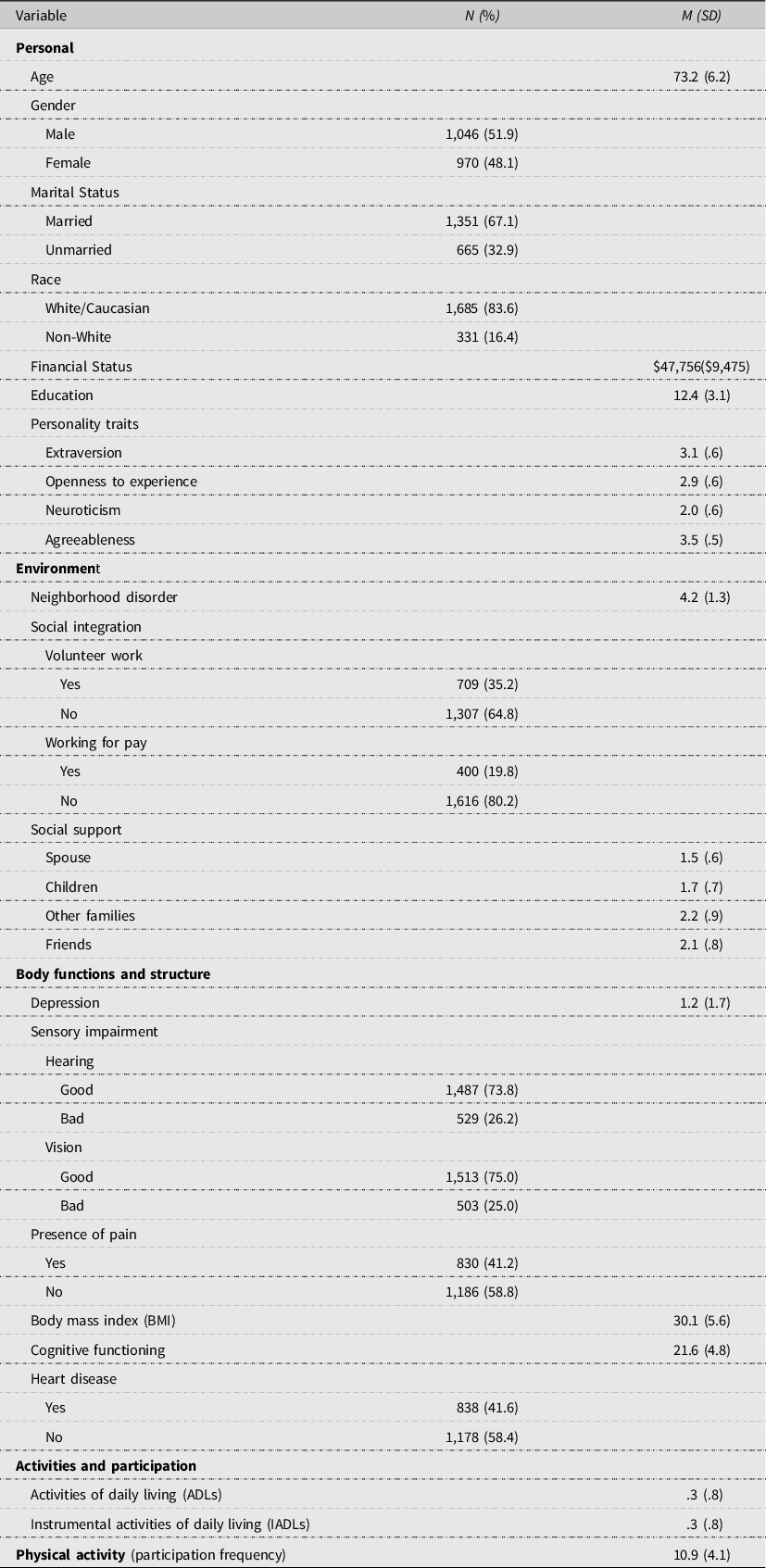
We utilized secondary data on 2016 older adults with type 2 diabetes from the Health and Retirement Study (HRS) and the RAND Center for the Study of Aging (RAND HRS data files, version P) (https://hrsdata.isr.umich.edu/data-products). We pooled together the data from the HRS and RAND HRS, resulting in 31,145 unique cases. We restricted the respondents to those who were diagnosed with type 2 diabetes (n = 22,193 remaining). After excluding all cases with missing values for any variable, we resulted in a final sample of 2,016 older adults for the analysis. Table 1 presents the characteristics of the 2,016 respondents. The sample was primarily male, married, and identified as white/Caucasian. The majority had also completed high school education.
Sample characteristics (N = 2016)

Measures
Our criterion variables were frequency and intensity of PA participation. Our predictor variables, framed by the WHO ICF, included body structure and function, activity limitations, environmental, and personal factors.
Criterion variable
Frequency and intensity of PA participation
The HRS uses three items to measure frequency of (a) vigorous PA (running or jogging, swimming, cycling et cetera), (b) moderate PA (e.g., gardening, cleaning the car, walking et cetera), and (c) light PA (e.g., vacuuming, laundry, or home repair). These items are scored on a 5-point scale from 1 = hardly ever or never to 5 = every day. We assigned a weight of 1.2 to light, 1.4 to moderate, and 1.8 to vigorous using an average metabolic equivalent (Li et al., Reference Li, White, O’Shields, McLain and Merchant2019). The PA sum score ranges from 4.4 to 22, so that higher scores reflect more frequent PA participation.
Predictor variables
Body structure and function
Body structure and function variables included depressive symptom severity, sleep quality, presence of pain, sensory functions, and BMI, also included was the 8-item Center for Epidemiologic Studies Depression Scale (Yes/No probable depression). Scores range from 1 to 8 with higher scores representing higher depression symptomatology (Cronbach’s α = .82). In addition, two sensory functions: eyesight and hearing acuity were self-rated and dichotomized into excellent/very good/good scores (recoded as 1) or fair/poor (recoded as 0). The presence of pain (1 = yes, 0 = no) and BMI (kg/m2) was also measured.
Cognitive ability involved a summary score (ranging from 0–35) from tests of word recall number skills, date object naming (naming objects based on their functions or features), and president/vice-president naming (reporting names of the current American president and vice-president). Higher scores indicate better cognitive function. Cardiovascular health was measured with a single item, with respondents indicating if they had been diagnosed with a heart condition (yes/no).
Activity limitations and participation restrictions
Difficulty in performing activities of daily living (ADL) (e.g., dressing, bathing, eating; 0 = no, 1 = yes) (Cronbach’s α = .71) as well as instrumental activities of daily living (IADLs) (e.g., preparing meals, shopping for groceries, making phone calls, managing money, and taking medications; 0 = no, 1 = yes) (Cronbach’s α = .63) were measured.
Environmental factors
This category included three broad constructs: the physical and social features of one’s neighborhood, social integration, and social support. The neighborhood disorder measure included four items (e.g., vandalism, trash, vacant buildings, and safety), each rated on a 7-point scale (1 -strongly disagree to 7- strongly agree). We reverse-scored the items for vandalism, trash, and vacant buildings so that higher scores signal the breakdown of order and social control (Cronbach’s α = .79). For the social integration measure, time spent in the last 12 months doing volunteer work, as well as whether they worked for pay, were considered (1 = yes, 0 = no). The social support measure focused on social relationship qualities with one’s partner, children, other relatives, and friends (i.e., 3 items per relationship source), with scores ranging from 1 (low) to 4 (high). (Cronbach’s α range = .78 – .86).
Personal factors
Age (in years), gender (male, female), race/ethnicity (white/Caucasian, non-white/Caucasian), marital status (married, unmarried), financial status (all assets minus total amount of debts), and years of education were reported. In addition, five personality traits on the Midlife Development Inventory Personality scales (MDIP: Lachman et al., Reference Lachman and Weaver1997) were included: extraversion, openness to experience, neuroticism, agreeableness, and conscientiousness (Cronbach’s α range = .71 – .81). The Conscientiousness scale subsequently yielded a low Cronbach’s alpha in this study (α = .48) so was removed from the analysis.
Statistical analyses
We utilized the Statistical Package for the Social Sciences (SPSS) version 24.0 to compute hierarchical regression models to predict PA participation. Following the procedures by Craney and Surles (Reference Craney and Surles2002), we computed variance inflation factors (VIF) checks to rule out multicollinearity issues, observing VIFs below 2 for all predictors, which is acceptable for regression analysis. Moreover, the largest bivariate correlations were less than .80, further strengthening our use of stepwise multiple regression (see Pallant, Reference Pallant2010).
Variables were entered into the regression model, guided by the ICF literature (Alcantara, et al. Reference Alcantara, De Souza, De Oliveira and Pinhal2018; Seaton & Brown, Reference Seaton and Brown2018). Specifically, we entered age, followed by gender, marital status, race/ethnicity, socio-economic affordances (financial status and education), and individual predispositions (personality traits). Next, we added environmental variables (neighborhood disorder, social integration, and social support) followed by body structure and function (depression, sensory impairment, presence of pain, BMI, and cognitive functioning, heart disease) and, finally, activity and participation variables (ADLs and IADLs).
Results
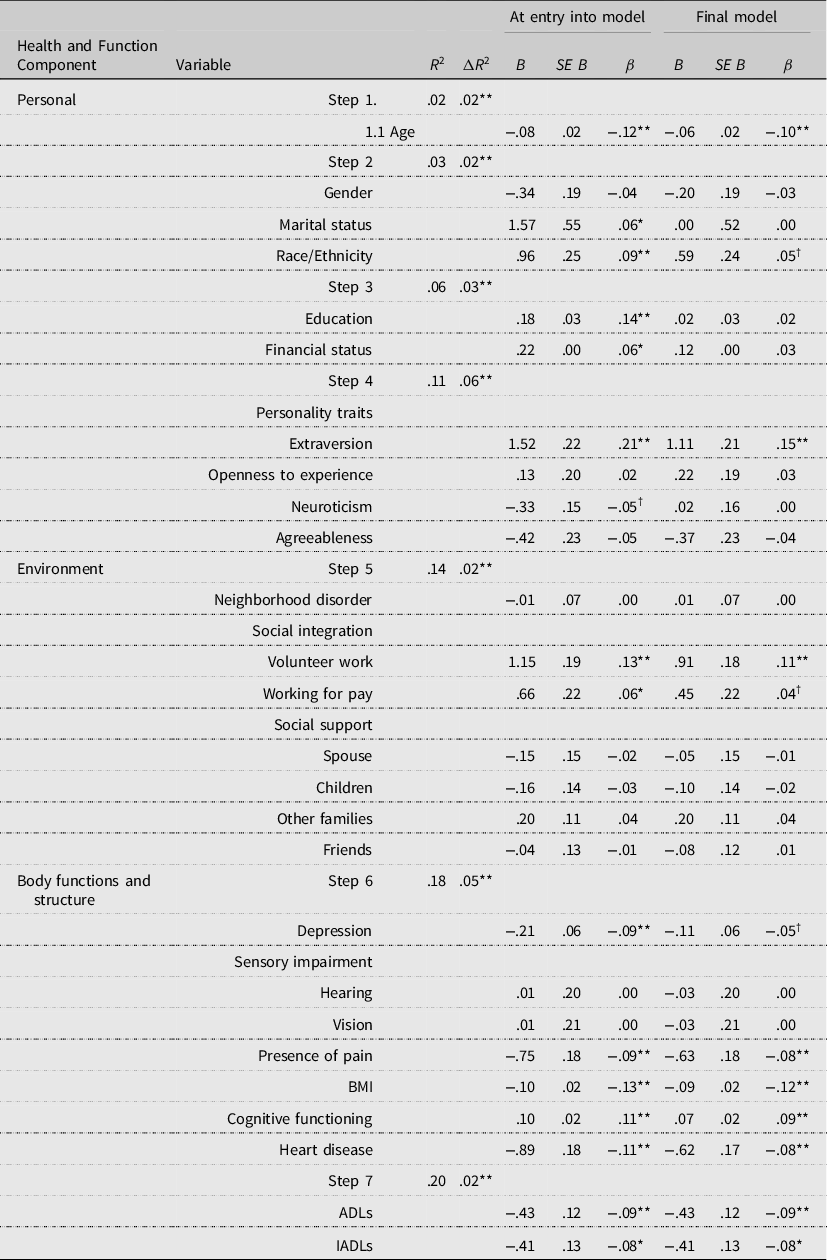
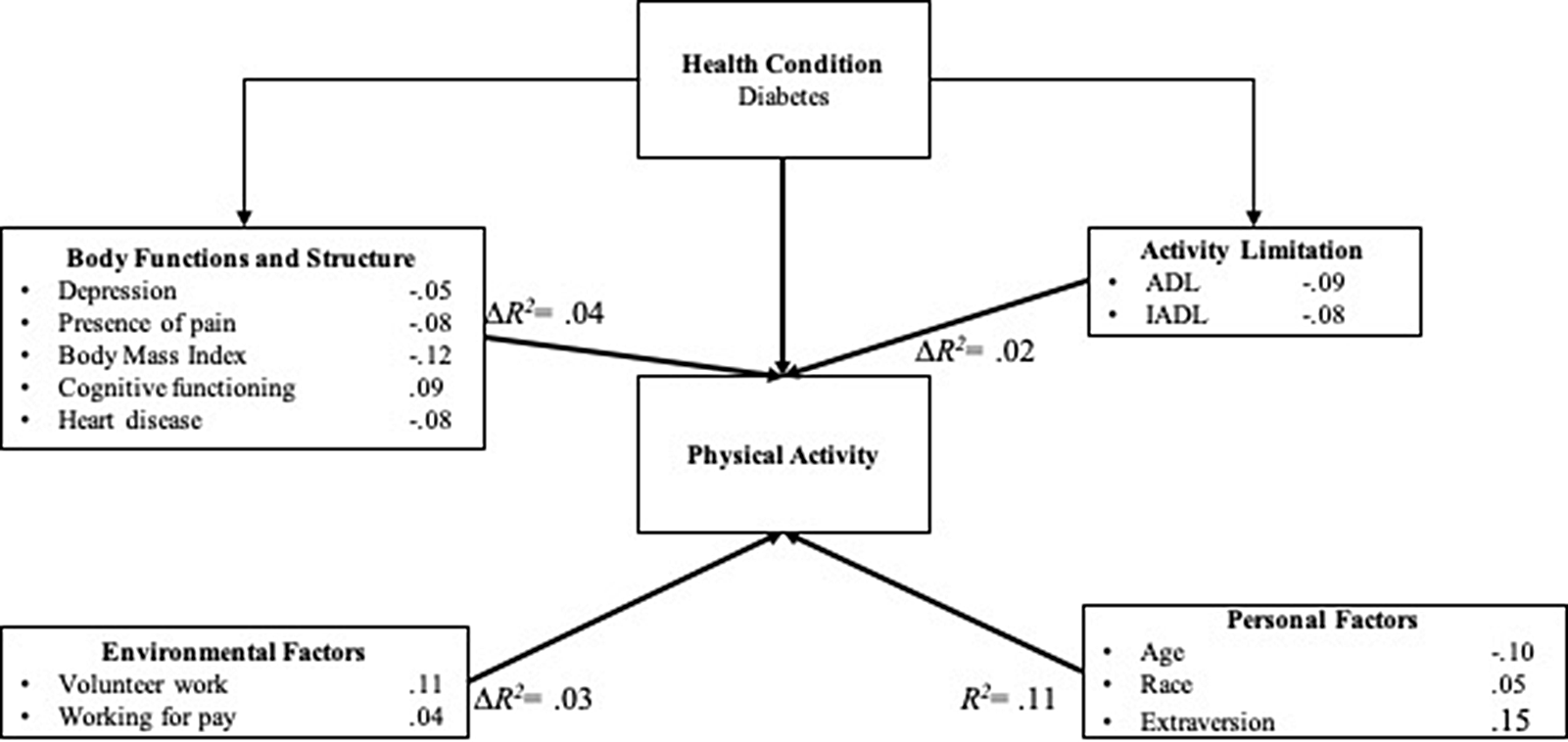
We present individual ICF categories in order of their incremental ratio, to highlight the relative contribution of each to PA participation by older adults with type 2 diabetes (see Table 2). After, we present a final model on the contribution of the most explanatory variables (Figure 2).
Hierarchical regression analysis for prediction of PA participation (N = 2,016)

Note. F(26, 1989) = 19.04, p = .000 for the full model; ΔF(1, 2014) = 30.75, p = .000 for Step 1; ΔF(3, 2011) = 11.30, p = .000 for Step 2; ΔF(2, 2009) = 28.07, p = .000 for Step 3; ΔF(5, 2004) = 25.55, p = .000 for Step 4; ΔF(7, 1997) = 7.45, p = .000 for Step 5; ΔF(6, 1991) = 18.95, p = .000 for Step 6; ΔF(2, 1898) = 19.75, p = .236 for Step 7.
† p < .05, *p ≤ .01, **p ≤ .001.
Predicting physical activities among older adults with diabetes: A odel based on the WHO ICF.
Note. These results highlight significant contributions of individual predictors of the final model.

Personal predictors
Demographics
Age accounted for significant, albeit small, proportion of the variance in PA scores (R = .12, R 2 = .02, F (1, 2014) = 30.75, p = .000): those aged less than 60 years with diabetes reported a high frequency of PA (β = −.12, t (2015) = −5.55, p = .000). The addition of demographic variables in the second step increased the variance accounted for by a modest percentage (R = .18, R 2 = .03, ΔR 2 = .02, ΔF (3, 2011) = 11.30, p = .000): older adults with diabetes who were married (β = .06, t(2012) = 2.86, p = .004) and identified as white/Caucasian (β = .09, t(2015) = 3.88, p = .000) were more likely to participate in PA.
Socio-economics
In the third step, we entered financial status and education, with both contributing to an increase in PA scores (R = .24, R 2 = .06, ΔR 2 = .03, ΔF (2, 2009) = 28.07, p = .000). Those with greater personal income (β = .06, t (2010) = 2.80, p = .005) and higher educational qualifications (β = .14, t (2010) = 6.11, p = .000) were more likely to engage in PA.
Predispositions
At the fourth step, we entered personality traits (extraversion, openness to experience, neuroticism, and agreeableness). In combination, these personality variables accounted for 6% of the explained variance in PA scores, beyond that explained by the demographic and socio-economic covariates entered in the first, second and third steps (R = .34, R 2 = .11, ΔR 2 = .06, ΔF(5, 2004) = 25.55, p = .000). Standardized partial regression coefficients revealed that those with extroverted tendencies (β = .21, t (2005) = 7.02, p = .000) and low neuroticism (β = −.05, t (2005) = −2.17, p = .03) self-reported higher PA.
Environmental predictors
In the fifth step, we entered neighborhood disorder, volunteer work, and work for pay, followed by the four individual sources of social support: spouse, children, other families, and friends. Although the combined contribution of these variables was significant (R = .37, R 2 = .14, ΔR 2 = .02, ΔF (7, 1997) = 7.45, p = .000), their individual contribution was not. In particular, those who volunteered (β = .13, t (1998) = 6.13, p = .000) and/or worked for pay (β = .06, t (1998) = 3.16, p = .003) reported high levels of PA. Notably, social support variables were not identified as significant predictors.
Body functions and structure predictors
In the sixth step, we entered depressive symptoms, hearing impairment, vision impairment, the presence of pain, BMI, and cognitive functioning – resulting in a significant result (R = .43, R 2 = .18, ΔR 2 = .05, ΔF(6, 1991) = 18.95, p = .000). In particular, those with lower levels of depressive symptoms (β = −.09, t(1992) = −3.84, p = .000), no pain (β = −.09, t(1992) = −4.14, p = .000), low BMI (β = −.13, t(1992) = −6.35, p = .000), and better cognitive functioning (β = .11, t(1992) = 4.75, p = .000) reported higher PA. Similarly, those with no history of heart disease (β = −.11, t (2005) = −5.02, p = .000) were more likely to engage in PA. Sensory impairments did not, however, predict PA participation (p > 05).
Activity and participation predictors
In the final step, we entered ADLs and IADLs in the equation, with both significantly contributing to PA participation (R = .45, R 2 = .20, ΔR 2 = .02, ΔF(2, 1989) = 19.75, p = .000). Those with fewer functional limitations (ADLs β = −.09, t(1990) = −3.43, p = .001; IADLs β = −.08, t(1990) = −3.09, p = .002) had a higher frequency of PA.
Most predictive ICF variables
In the final regression model (see Figure 2), a combination of biopsychosocial variables were identified as significant predictors, namely: age (β = −.10, t(1990) = −4.25, p = .000), race (β = −.05, t(1990) = 2.47, p = .014), extraversion (β = .15, t(1990) = 5.26, p = .000), heart disease (β = −.08, t(1990) = −3.63, p = .000), volunteer work (β = .11, t(1990) = 4.96, p = .000), working for pay (β = .04, t(1990) = 2.09, p = .037), depressive symptoms (β = −.05, t(1990) = −1.97, p = .049), presence of pain (β = −.08, t(1990) = −3.49, p = .000), BMI (β = −.12, t(1990) = −5.71, p = .000), and cognitive functioning (β = .09, t(1990) = −5.71, p = .000). In combination, these variables accounted for 20% of the variance in PA participation, after controlling for all other predictors. Extraversion remained the strongest predictor.
Discussion
This study identified a number of biopsychosocial factors, framed by the ICF, implicated in PA for a population cohort of US adults with type 2 diabetes. A critical finding was the significant role of extraversion as a trait effect in PA participation, identified here as a potent asset for PA among older adults – beyond that suggested by socio-demographics. This is consistent with previous studies, with extraverted individuals known to seek social participation, which may involve physical activities with others (Saklofske et al., Reference Saklofske, Austin, Rohr and Andrews2007; Sutin et al., Reference Sutin, Stephan, Luchetti, Artese, Oshio and Terracciano2016; Tolea et al. Reference Tolea, Terracciano, Simonsick, Metter, Costa and Ferrucci2012; Wilson & Dishman, Reference Wilson and Dishman2015; Zhao et al., Reference Zhao, Ford, Li and Balluz2011). This finding suggests that while extraversion may decline at older age (see Wortman et al, Reference Wortman, Lucas and Donnellan2012), it remains a robust influence on health behaviors. However, the direction of causality between personality and physical activity appears bi-directional personality traits may predispose to physical activity (or inactivity), which changes personality traits may occur from current physical (in)activity (Stephan et al., Reference Stephan, Sutin, Bayard, Križan and Terracciano2018). Understanding the mediators and moderators of the relationship between personality and PA in older adults with diabetes is warranted, given the limited strength of these findings (see also Strickhouser et al., Reference Strickhouser, Zell and Krizan2017). Nonetheless, personality assessments may provide data for health-self management by older adults beyond knowing their socio-demographics (Canada et al., Reference Canada, Stephan, Sutin and Terracciano2020; Murray & Booth, Reference Murray and Booth2015).
That body functions and structure factors of low BMI, depression, absence of pain, and higher cognitive functioning were also predictive. Depressive symptoms can result in low energy or apathy, which, in turn, decrease the likelihood of participating in PA (Plotnikoff et al., Reference Plotnikoff, Taylor, Wilson, Courneya, Sigal, Birkett and Svenson2006; Wanko et al., Reference Wanko, Brazier, Young-Rogers, Dunbar, Boyd, George and Cook2004; Zhao et al., Reference Zhao, Ford, Li and Balluz2011). The relationship is, however, circular: older adults who engage in light to moderate PA are less likely to report depressive symptoms (Ku et al., Reference Ku, Fox, Chen and Chou2012; Loprinzi, Reference Loprinzi2013). Similarly, people with higher BMI and pain levels are less physically active due to their lower daily energy expenditure levels (Paterson, & Warburton, Reference Paterson and Warburton2010).
Among the environmental variables, volunteer and paid work were identified as significant environmental predictors of PA. Opportunities for ongoing community engagement, through volunteering and work participation, would, inevitably, increase the frequency of PA among older adults with type 2 diabetes. This community engagement effect is similar to that reported in previous studies (Foy et al., Reference Foy, Vitolins, Case, Harris, Massa-Fanale, Hopley and Gaspari2013; Murano et al., Reference Murano, Asakawa, Mizukami, Takihara, Shimizu and Imai2014). Work participation also increases incidental exercise (Thorpe et al., Reference Thorpe, Healy, Winkler, Clark, Gardiner, Owen and Dunstan2012). These same opportunities can provide older adults a sense of purpose, accomplishment, and fulfillment, all of which help to promote PA (Robinson & Lachman, Reference Robinson and Lachman2020). However, our finding that neighborhood disorder and social support did not predict PA is rather counter-intuitive. Neighborhood safety and infrastructure are known to influence PA participation (Fisher et al., Reference Fisher, Li, Michael and Cleveland2004; Portacolone et al., Reference Portacolone, Perissinotto, Yeh and Greysen2018). Proximity to utilitarian and recreational destinations with accessible walking paths increased walking frequency of older adults (Sugiyama et al., Reference Sugiyama, Cerin, Mridha, Koohsari and Owen2018). Social support also influences PA participation across the life span (Smith et al., Reference Smith, Banting, Eime, O’Sullivan and Van Uffelen2017). Further study with better-targeted measures (see Gottlieb, & Bergen, Reference Gottlieb and Bergen2010) would yield would clarify these contrary findings.
Practice implications
Older adults with diabetes have 10, 20, or more remaining productive life years and require evidence-informed support to reduce their risks from diabetes complications (LeRoith, & Halter, Reference LeRoith and Halter2020). The current findings highlight the value of the ICF in guiding multidisciplinary assessment and interventions for older adults with diabetes. This includes the importance of considering personal predispositions to PA participation (Canada et al., Reference Canada, Stephan, Sutin and Terracciano2020). Lifestyle-oriented interventions that take into account personality differences could help promote physical activity levels (see also Canada et al., Reference Canada, Stephan, Sutin and Terracciano2020; Chen et al., Reference Chen, Pei, Kuang, Chen, Chen and Li2015). Perceived sense of control over one’s life was associated with higher PA among older adults (Robinson & Lachman, Reference Robinson and Lachman2018, Reference Robinson and Lachman2020). When designing such interventions, it is equally important to take into account the individual’s physical health and functioning and cognitive abilities as these may impede or facilitate PA (Janevic et al., Reference Janevic, McLaughlin and Connell2013).
Our findings also suggest a need to encourage older adults to seek ways to remain actively engaged in multiple roles – particularly opportunities for volunteering and paid employment. Volunteering is mutually beneficial: not only does volunteering make the community a better place to live, but there are personal health benefits to mood, stress, and general physical functioning (Anderson et al., Reference Anderson, Damianakis, Kröger, Wagner, Dawson, Binns and Cook2014; Librett et al., Reference Librett, Yore, Buchner and Schmid2005; Klinedinst and Resnick, Reference Klinedinst and Resnick2016). Volunteering, in moderation, could be an effective public health intervention for older adults (Bjälkebring et al., Reference Bjälkebring, Henning, Västfjäll, Dickert, Brehmer, Buratti, Hansson and Johansson2021). Similarly, paid employment provides opportunities for older adults to remain physically active in addition to access to resources for PA participation that suits their personal circumstances (Thorpe et al., Reference Thorpe, Healy, Winkler, Clark, Gardiner, Owen and Dunstan2012).
Although we found sensory impairments to not predict PA among the older adults, the availability of street lights, absence of steep slopes, access to public transportation, presence of pedestrian bridges over active roads, aesthetics features, street connectivity, presence of sidewalks, and benches/sitting facilities is important (Cerin et al., Reference Cerin, Nathan, Van Cauwenberg, Barnett and Barnett2017) – particularly given that people with type 2 diabetes are at elevated risk for sensory impairments over.
Methodological limitations
The current findings carry a number of limitations. First, we drew a sample from across databases in order to yield a larger sample for this exploratory cross-section design analysis. Examining the study variables longitudinally, with case control and experience sampling (Murray & Booth, Reference Murray and Booth2015), would further clarify the relationships we report here. Second, we excluded information on conscientiousness in their analyses, due to a lack of internal consistency in the current sample. This is a major limitation, given previous findings showing associations of conscientiousness and health (behaviors). Future studies should seek to include information on (facets of) conscientiousness in their analyses. We also acknowledge the low explained variance of 20% as a limitation to be addressed by future studies utilizing the same or different data set in a similar population. Moreover, exploring is high/low extraversion as a moderator of factors in the ICF model might provide evidence for targeted clinical interventions adaptive to personality type. Third, self-report data are susceptible to response bias, including social desirability effects. That is, respondents may have over-reported their PA participation in order to “look good.” Future studies might consider adopting objective PA measures (e.g., electrometers or accelerometers) to supplement self-report data. Finally, while the ICF provides a multidimensional framework for guiding our analysis, the fit between this framework and data set was somewhat exploratory, constraining the choice regarding the measures for ICF components.
Conclusion
Using secondary data from a representative sample of older Americans, we mapped PA participation onto the WHO ICF, a biopsychosocial model that frames health management more holistically than alternative approaches that focus on a limited set of health and function factors. We found personality traits of higher extraversion to be the most predictive factors of PA participation. Younger age, being Caucasian white, engaging in volunteer or paid work, reduced depression and pain, and cognitive functioning were also predictors, albeit to a lesser extent. Our findings suggest that framing PA interventions for older adults on the ICF can help to provide directions on priority components for person-centric interventions. Such interventions should take into account personal predispositions and opportunities for community engagement as key facilitators to PA participation.
Acknowledgements
We acknowledge the Inter-university Consortium for Political and Social Research for the Health and Retirement Study data repository for this study. Health and Retirement Study, public use dataset. Produced and distributed by the University of Michigan with funding from the National Institute on Aging (grant number NIA U01AG009740). Ann Arbor, MI, (2021).
Funding Information
This study received no funding from any agency or organization.
Ethics Approval Statement
This study is a secondary data analysis of publicly available data from the Health and Retirement Study held by the University of Michigan and requires no ethics approval to research use.
HIPAA Identifiers
This manuscript based on a secondary data set reports de-identified data and does not contain any individual person’s data in any form or case reports needing consent for publication.
Conflicts of Interest
The authors declare no conflict of interest.
Competing Interests
The authors declare no competing interests.