Quaternary ammonium-based (Quat) products are among the most widely used disinfectants, and they are commonly used in healthcare facilities in the United States for disinfection of inanimate surfaces.Reference Rutala and Weber 1 – Reference Gerba 3 Recently, a few studies have raised concerns regarding the ability of various types of wipers, towels, and wipes to bind Quat disinfectants, resulting in decreased disinfectant efficacy.Reference MacDougall and Morris 2 , Reference Bloss, Meyer and Kampf 4 , Reference Engelbrecht, Ambrose and Sifuentes 5 In our facility, microfiber wipers are normally used for applying disinfectants to surfaces, but cotton towels are used when insufficient microfiber wipers are available. As part of a review of practices utilized by our environmental services department, we conducted a study to evaluate the impact on Quat concentrations of different types of wiping materials used for environmental disinfection, and we identified variations in Quat concentrations delivered by dispensing stations.
METHODS
The study was conducted in a tertiary university-affiliated hospital. Environmental Services personnel filled 3 buckets with a Quat-based disinfectant currently used by the hospital. The disinfectant, a concentrated solution of alkyl dimethyl ammonium chloride and dodecyl dimethyl ammonium chloride with a pH of 8.0, is dispensed from wall-mounted distribution stations that mix the product with water to achieve an appropriate in-use concentration. Initially, 3 types of wiping materials were included in the study: (1) commercially available microfiber wipers composed of 80% polyester and 20% polyamide (CPI-Creative Products, Pittsburgh, PA), (2) cotton towels, and (3) disposable wipes occasionally used for product application (type A; KimTech Wettask, Kimberly-Clark, TX). First, 30 microfiber wipers were placed in 1 bucket, 30 cotton towels were placed in another, and a roll of disposable wipes was placed in another. Every 5 minutes for the first 30 minutes, 3 wipers, towels, or wipes were removed from each respective bucket. This procedure was then repeated every 30 minutes for a total time of 4 hours. At each time point, excess solution was wrung from each respective set of wipers, towels, and wipes, and the respective solutions expressed were tested using quaternary ammonium compound test strips (Hydrion, Micro Essential Lab, Brooklyn, NY). The average concentration of each solution was recorded. Based on the initial results obtained, a second type of disposable wipe designed specifically for use with disinfectants (type B; KimTech, Wettask model 6211) was evaluated using the same method.
Statistical analysis was performed using the repeated-measures ANOVA method using MedCalc software. Quat concentrations in fluid expressed from wiping materials at different points in time were entered as the repeated-measurements variable (ie, within-subject factor), and wiping material type was entered as the grouping variable (ie, between-subject factor).
When obtaining the Quat product from a dispensing station, we noted that the Quat concentration was substantially below the level claimed by the vendor. Dispensing stations are designed to dispense 0.5 ounce of concentrated disinfectant per gallon of water, yielding an in-use concentration of 800 ppm. As a result, an audit of 33 disinfectant dispensing stations was conducted to measure Quat concentrations delivered.
RESULTS
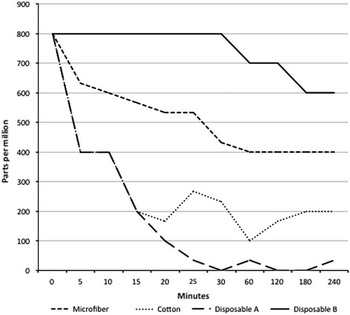
After the first 3 wiping materials had been submerged in the disinfectant solution for 5 minutes and then wrung out, the Quat concentrations in the respective solutions expressed were reduced by 21% in microfiber wipers and by 50% in both cotton towels and type A disposable wipes (Figure 1). Within 30 minutes, the average Quat concentration of solution expressed from the 3 wiping materials remained stable, respectively, for the following 3 hours: microfiber wipers at 400 ppm, cotton towels at 200 ppm, and disposable wipes near zero. On several occasions, microfiber wipers and disposable wipes soaked in disinfectant for >30 minutes were tested. Test strips were pressed between layers of the microfiber wipers and disposable wipes, respectively, and the Quat concentrations were recorded. Immediately following this process, the microfiber wipers, and disposable wipes were used to apply the disinfectant product to the surface of a table, and additional test strips were then immediately pressed against the respective surfaces while they were still wet. Test strips pressed between layers of the wiping materials and those pressed against their respective wet surfaces revealed equal concentrations. For microfiber wipers, the Quat concentration was 400 ppm in both locations; with type A disposable wipes, the Quat concentration was <100 ppm in both locations. Following the aforementioned studies, we evaluated a second type of disposable wipe (type B) designed specifically for use with disinfectants. Our test revealed that Quat concentrations remained in the 600–700 ppm range in the type B wipes after submersion in disinfectant for up to 4 hours (Figure 1).
Quaternary ammonium concentrations in fluid expressed from microfiber wipers, cotton towels, and 2 types of disposable wipes (types A and B) soaked for varying lengths of time in an in-use concentration of a commercial quaternary ammonium disinfectant.

Statistical analysis of Quat concentrations obtained from the 4 types of wipes revealed statistically significant differences between the wiping material types (P<.001) and within-subject effects (P<.001). A statistically significant interaction between material type × Quat concentration was detected (P<.001), confirming the common assumption that differences in measured concentrations depend in part on the wiping material.
Disinfectant solutions obtained from the 33 dispensing stations audited had Quat concentrations of <200 ppm from 7 stations, 200–400 ppm from 17 stations, and 400–600 ppm from 6 stations. In addition, 2 stations contained no concentrated disinfectant and 1 station was inoperative. Investigation by the disinfectant vendor revealed that variations in water pressure at dispensing stations and certain design issues in the dispensing system were responsible for the variations in the concentration of Quat dispensed. Installation of water-pressure regulators on each dispensing station and modifications of the flow-control devices in jugs of concentrated disinfectant by the vendor resulted in Quat concentrations of ≥800 ppm in dispensed solutions.
DISCUSSION
Our investigation identified several unique issues related to the use of Quat-based disinfectants in our facility, including significant binding of the disinfectant by several types of wiping material. Unlike previous studies, the Quat disinfectant used in the current study differed from that used by Engelbrecht et al,Reference Engelbrecht, Ambrose and Sifuentes 5 and it was likely different than that used by MacDougall et al.Reference MacDougall and Morris 2 Furthermore, the microfiber wipers we used were from a different manufacturer than those tested by Engelbrecht et al.Reference Engelbrecht, Ambrose and Sifuentes 5 Despite these differences, our results confirm and extend the findings reported in a few previous studies demonstrating binding of Quat disinfectants to various wiping materials.Reference MacDougall and Morris 2 , Reference Engelbrecht, Ambrose and Sifuentes 5
Differences between our results and the findings of others may be explained by the disinfectant chemical composition, pH, and the degree of positive charge of the disinfectant product being evaluated. Furthermore, the composition of microfiber wipers may affect the degree of binding of Quat-based disinfectants.
We were surprised that the type A wipes that we initially tested bound the disinfectant to a greater degree than cotton towels under our test conditions. Subsequent investigation revealed that the type A disposable wipe, which is occasionally used by environmental services, was designed for use with solvents rather than disinfectants and had a composition that promoted binding of Quat-based solutions. Testing of the type B disposable wipe (designed for use with disinfectant solutions) revealed minimal binding. Our findings are consistent with previous studies showing relatively little Quat-binding by some wipes while others have a strong binding effect.Reference MacDougall and Morris 2 We believe that this important phenomenon is not widely recognized by environmental services and infection prevention personnel.
Another unique aspect of our study was the discovery that differences in water pressure in various parts of the hospital and issues related to the design of the disinfectant dispenser system resulted in wide variations of the Quat concentrations obtained from disinfectant dispensers. We are aware of only 1 previous study in which “fixed-volume” dispensers used to dispense disinfectant solutions yielded concentrations that differed greatly from predicted levels.Reference Sander and Ladenstein 6
Our study has several limitations, including the fact that the study was performed in a single facility. Also, we documented that the Quat concentrations of disinfectant solution expressed from microfiber wipers, cotton towels, and 1 type of disposable wipe were considerably below the concentration (660 ppm) that the manufacturer used to establish efficacy of its product against healthcare-associated pathogens. However, we did not conduct microbiological tests to determine whether the low concentrations of Quat in the disinfectant product released from the 3 wiping materials resulted in less effective reduction of bacterial counts on surfaces. Notably, Engelbrecht et alReference Engelbrecht, Ambrose and Sifuentes 5 found that Quat concentrations in the range of 100–200 ppm (similar to those noted in our study) failed to meet efficacy standards when tested using the Association of Analytical Communities (AOAC) 961.02 Germicidal Spray test. Because studies of the frequency with which cotton towels are used to apply disinfectants in other hospitals have been limited in scope, the extent to which our findings regarding cotton towels are generalizable is unclear.Reference Sifuentes, Gerba, Weart, Engelbrecht and Koenig 7
Finally, our Environmental Services personnel submerge microfiber wipers in disinfectant for minutes to hours until they are removed for use, which may result in greater binding of the Quat disinfectant to these wipers than the “dip and wipe” method, wherein microfiber wipers are submerged in disinfectant solution for only 5–10 seconds before being removed and used to wipe surfaces. 8
In conclusion, healthcare facilities utilizing Quat-based disinfectants should be aware that some wipers, towels, and wipes may reduce the Quat concentration applied to surfaces to well below the concentration promoted as effective by the manufacturer. Also, it may be reasonable for hospitals utilizing dispensing stations to periodically test concentrated solutions of disinfectant mixed with water to verify that appropriate in-use concentrations of product are being dispensed.
ACKNOWLEDGMENTS
Financial support. None reported. There was no financial support provided for this study.
Potential conflicts of interest. J.M.B. has received a research grant from Diversy Care, and serves as a consultant to 3M Company and Clorox Company. All other authors report no conflicts of interest relevant to this article. A.B. is now with Charlotte Hungerford Hospital, Torrington, Connecticut.