“Poetry, particularly yours, is butterfly hunting, even if you have no butterflies to catch,” says literary critic and translator Bahā' al-Din Khorramshāhi during his conversation with Bizhan Jalāli. “The poetry of Shāmlu is lion wrestling, [one that happens] within the confines of a cage or circus … the robust and bitter poetry of Shāmlu is as belligerent and difficult as Jalāli’s is gentle and simple, and it goes without saying that Jalāli’s poetry is simple yet inimitable.”Footnote 1 The poetic corpora of Shāmlu and Jalāli confront one another, Khorramshāhi adds, yet they do not stand in opposition. The critic gives us no answers as to why he reads a sense of confrontation between their oeuvres. Khorramshāhi’s statement may be entirely unsubstantiated, but I maintain that it reveals a peculiar form of sociologism which dominated literary debates in Iran in the 1960s and 1970s. By sociologism I refer to the formation of a discourse that holds representation and reflection as key concepts in characterizing literature. During a highly heterogeneous process, the social and political function of poetry became the determining factor in criticism of texts. Such criticism may very well be attentive to the aesthetic, formal and linguistic themes in its evaluation of literary texts, but it is necessarily literature’s commitment to and engagement with political affairs and social ideals that predominate in the literary discourse. In this light, the rhetoric of Khorramshāhi’s comparison only illuminates the historiographical debates and tensions that inform the way Shāmlu (d. 2000) and Jalāli (d. 1999) have been canonized in Persian poetry today.
Ahmad Shāmlu’s literary career serves as a backdrop against which Khorramshāhi wants readers to understand Jalāli’s verse. The image of wrestling lions serves as an analogy for Shāmlu’s lifelong negotiation with a poetic voice robust enough to critique repressive political structures and articulate his humanistic vision. Juxtaposed with a lion wrestler, Jalāli’s poetry is personified as a butterfly hunter with an all but empty net. What is implied here is the poet’s non-involvement in political debates. Such comparison unmistakably evokes the discourse of literary commitment, known as taʿahhod-e adabi in Persian. Most literary histories characterize the decades between the 1940s and 1970s in Iran as a period during which cultural production, particularly poetry, was informed by the poetics of literary commitment. As with all literary traditions, the question of poetry’s service to society has been the subject of debate in different historical periods of Persian literary culture. One can argue that in the decades before the Iranian Revolution of 1979, the discourse of literary commitment gains more urgency and primacy for many poets and literati. However, such an assumption is not central to this essay’s analysis, for the social relevance of poetry and the anxiety of commitment are not peculiar to this era and its literary circles.
The question of commitment, in all its intellectual and aesthetic variance, has often been placed in episodic frameworks.Footnote 2 Episodic readings may raise broad questions and point in the direction of general trends in Persian poetry by examining the ideological presuppositions of each dominant literary discourse; however, they necessarily occlude the aesthetic and ideological complexity of literary communities and their participants. The life of each literary discourse neatly begins and ends with its designated period while the resonances of its afterlife are left unexamined by the linear certainty of episodic approaches. Such frameworks stabilize the project of literary modernism, at once a dynamic and selective process, on the level of widely used topoi and metaphors. Literary commitment should be seen as an open-ended and multifaceted discourse with numerous historical and aesthetic points of intersection. It is a discursive activity with a wide spectrum wherein each poet offers uniquely different points of reconciliation and contestation between their poetics and politics.Footnote 3
Iran’s literary scene in the 1960s and 1970s is marked by highly contentious conversations on a number of pressing questions: to what genealogy (if any) does a modern poet hark back? Is modernism an aspect of social or artistic articulation? How does poetry strive for relevance? In the period under study, Iranian literary culture primarily registered poetic modernism in its dominant articulation of literary commitment. I do not intend to rehash general ideas on commitment; instead I will examine how the poetic trajectory and reception of a single poet—Bizhan Jalāli—intersects with the intellectual and poetic underpinnings of committed circles. The twists and turns of Jalāli’s poetics do not speak directly but rather laterally to committed articulations of modernism. After discussing how his work shifts our understanding of modernism, I will place Jalāli in his literary milieu by analyzing the way his work has been received by poets, anthologists and commentators. Jalāli’s literary career is marked by two distinct periods. As the contours of literary commitment radically change in the 1980s and 1990s, another image of Jalāli emerges. Once marginalized for his perceived apolitical disposition, he is championed and valorized as an honest poet for his “non-commitment.” As such, this essay is as much about literary historiography as it is about Jalāli’s poetry. Before we begin our discussion, it is vital to offer a definition of poetic modernism in its Persian iteration.
Much like literary commitment, there is no single and comprehensive definition of literary modernism. In fact there are more questions than answers—for instance to what extent does modernity, a social project, intersect with literary modernism? Providing a satisfactory answer to that question is beyond the scope of this paper. That said, I maintain that there is a distinct project of Persian literary modernism which has been the subject of extensive research, notably in Ahmad Karimi-Hakkak’s Recasting Persian Poetry and Amr Taher Ahmed’s La Révolution Littéraire. Nimā Yushij’s (d. 1960) poetic interventions, Karimi-Hakkak argues, were only the culmination of the previous generation of poets’ and literary critics’ modernizing visions that signaled thematic, prosodic and formal departures from the system of Persian poetry as it had been codified and practiced in the nineteenth century. Building on the methodology forged by Recasting Persian Poetry, Amr Taher Ahmed carefully unpacks the role of translation from French poetry in providing Persian with a host of new literary models, concepts and imagery which such figures as Mohammad-Taqi Bahār (1951), Gholām-Reza Rashid Yāsemi (1951) and others appropriated for the purpose of their own literary projects.Footnote 4 These two studies point us in the direction of a highly heterogeneous process that entails negotiating with European influence on the one hand and the conventions of pre-modern Persian poetry on the other.
This paper treats modernism as an ever-evolving project whose key characteristics are selectively animated or muted by different literary discourses. I examine Jalāli’s poetic modernism vis-à-vis the dominant discourses that have attempted to govern the reading of his poetry. What my approach admittedly has in common with episodic narratives is the notion of selective modeling. Jalāli had been all but ignored by episodic approaches that model particular poets and works as representative of a certain literary discourse. In this essay, I have primarily analyzed Jalāli’s poems in the context of the central debates of his time, which is a selective modeling of his poetic oeuvre. However, while I have identified key characteristics as distinct to his modern project (e.g. metapoetic and minimalist components of his poetry), I have not closed the door on other readings of his poetry. I am less concerned with proving why Jalāli is a modern poet, but instead map the multifaceted process through which a rhetoric of poetic modernism is forged. While modernism remains as elusive as ever, I analyze the literary mechanisms and social circumstances that create the effects of modernism.
Poetics of Marginalized Modernism
Jalāli did not directly participate in debates on literary commitment, a general tendency that has become the basis for his characterization by critics as “apolitical” and “uncommitted.” All the same, his poetic practice, particularly in his earlier collections Days (1962) and Our Hearts and the World (1965), has been directly informed by his understanding of modern poetics. In other words, his poetry speaks to the conflicting trends and visions of literary modernism in twentieth century Iran. Jalāli’s preferred medium is sheʿr-e sepid, a form that does not employ any rhyme or meter scheme.Footnote 5 His poems are untitled and their composition embodies no trace of the meter and irregular rhyming patterns of Nimāic prosody, often characterized as the emblem of modern Persian verse. Critics often conflate his poetry with its rhetorical impression: the absence of dazzling diction and complicated verbiage, the poems’ unadorned phraseology and straightforward voice. The simplicity and directness of his poetry are rarely understood in the context of the poet’s conscious efforts to create a rhetoric of unconventionality and establish an alternative voice against the backdrop of modern practices. Jalāli’s figurative language gives an impression of simplicity in a literary scene that tended to champion a hyper-allusive, allegorical, vague and at times surreal language that proved inaccessible for many uninitiated readers of poetry. These championed practices required that the reader utilize prior knowledge in order to effectively decode a poem’s socio-political referents. Each modern poet exercised liberty in their cultivation of symbolic, metaphoric and allegorical expression. That said, the new interpretive community, whose profile we will examine later in the essay, attempted to shift the public literary taste toward a coded and cryptic literary idiom. In 1992, Jalāli directly commented on his commitment to simplicity:
My poems are simple and easy to read; they have derived from everyday Persian. It goes without saying that this should not be regarded as a [distinct] quality. Poetry, in my opinion, should be simple and use direct expression. But since most modern poems are not easy to read, the simplicity and flow of my poems can be regarded as their quality. They are natural, born as a result of a genuine urge and not derived from the desire to create a literary work.Footnote 6
Jalāli counters the discourse of commitment and its relation to poetic creation by co-opting the concept of “natural.” While for many committed figures the cultivation of symbolic and allegorical expression is poetry’s natural function toward social relevance, Jalāli implicitly questions the extent to which readers can understand and decode such works. Here Jalāli places his poetic quality directly against the backdrop of modern poetics. However, his drive for simplicity and directness has not always created its intended effect. Karimi-Hakkak, Jalāli’s first English translator, comments on the poet’s “zealot desire” for clarity: “[his poems] sometimes are decidedly anticonventional in form and stark in meaning. The danger, however, lies in the tendency for this kind of poetry … to degenerate into little more than pieces of prose aphorism and pseudo-philosophical aperçus.”Footnote 7 Let us consider the following poem from Ruz’ha (Days), his first collection published in 1962: “my God / every night is a journey into eternity / every day / every moment of the day / is a journey into eternity.” The poem establishes its central concept (the present is eternal), its poetic moment, in the first two lines: “every night is a journey into eternity.” The poem then goes on to repeat the same notion in the next three lines without adding to or altering our understanding of it. In later collections, primarily published in the 1990s, Jalāli strove for greater balance between his commitment to directness and his drive for poeticism.
Jalāli’s early commitment to clarity also eludes its “original” context and its relation to poetics of commitment. Any discussion of his work should place his stylistic affinities within broader poetic trends. Poetry (she‘r) has often been defined in opposition to prose (nasr) in contemporary Persian literary criticism. Consequently, the impulse to dismiss Jalāli’s verse as prose-like is prevalent in the 1970s and 1980s. For instance, in the edited and expanded version of Reza Barāheni’s Talā dar Mes (Gold in the Copper), published in 1992, the author takes a poem by Jalāli, removes its line breaks, then poses a rhetorical question: what makes this poetry?Footnote 8 Having compared it to cotton candy in the 1960s, Barāheni dismisses Jalāli’s work as prose in the early 1990s. While I refrain from making a value judgment regarding the aesthetic value of prose or poetry, the critic’s pejorative tone certainly implies such judgment (hence my choice of the term dismissal) and illuminates the oppositional tension between poetry and prose.Footnote 9 I have opted for “poetry” to frame Jalāli’s writings primarily because that is how Jalāli understands his own work. A close examination of how his oeuvre communicates its qualities, without confining it under any one rubric, will expand our understanding of different modern trends in Persian poetry.
Jalāli’s verse shares many elements with minimalism. His language is economical; most of his poems consist of thirty or fewer words while his longer poems rarely exceed sixty words. He employs repetition as a musical technique. Yā (or) and va (and) appear repeatedly in his poems, sometimes accompanied with the adverb of time gāh (at times). They also mark the beginning of a new idea. The poem’s appearance on paper frames it as a poem and differentiates it from prose text. Readers of classical forms have conceptualized poetry as two syllabically equal mesrā‘ (in some cases hemistichs do not have equal numbers of syllables) that constitute a beyt (line or unit). Each beyt stands above the other and creates an asymmetrical typography. Nimā is the first Persian-language poet who has radically changed the typographical structure of Persian poetry and consequently reconceptualized readers’ relationships with poetry. Although he does not adhere to Nimāic prosody, Jalāli’s poetry also signals rupture from the tradition of Persian poetry through its appearance. Nimā places his breaks where an idea ends whereas Jalāli tends to pay less attention to his content. When asked to justify his practice of enjambment, Jalāli indicated that he imagines poetry to cascade on paper like rain.Footnote 10 His poetry is highly aware of its graphic layout, and plays a significant role in communicating its modern quality.
In an essay on poetic minimalism, Gerald Janecek writes:
we note that Minimalism makes use of quite humble linguistic materials, the verbal equivalent of found objects, and makes very good and provocative use of them. It forces us by the devices of art to pay attention to these humble materials and discover riches in them.Footnote 11
Jalāli not only seeks aesthetic value in the smallest elements of language, but also defamiliarizes our relationship with ordinary objects and themes and their assigned meanings. Recurring words such as walls, trees, papers, words, poetry and beloved, all served a different function than what committed poems attempted to articulate. In the wake of the Iranian Revolution (1977‒79), as with all social uprisings, activists and protesters assigned new functions and meanings to ordinary objects. Protesters climbed trees to monitor the movement of soldiers. Newspapers were used to transmit revolutionary messages and distribute information about clandestine meetings. Walls were no longer mere dividers; they were rendered an open canvas that reflected the movement’s aspirations and objections. While the political climate encouraged readers to respond to the newfound meaning of such objects, Jalāli avoids this shifting context. Walls in his poetry bear the memory of bygone days, or the smile of a beloved friend:
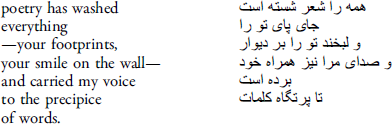
Poem selected from Naqsh-e Jahān [Image of the world], Morvārid, 2001, pg 254.
In an environment where many were actively redefining their social landscape by seeking new functions in the service of the movement, Jalāli rediscovered unemphasized narratives of his surroundings on his own terms. He perceived the act of composing poetry to be a force of nature, like a flood that washes everything that stands in its path. His poetry is all but an effort to fully portray, understand and reconcile with the forces of nature. But as much as Jalāli the poet proclaims to stand entirely outside of his socio-political milieu, elements of minimalism in his poetry can still be seen as a conscious reaction to the crafting of a hyper-allusive and esoteric poetic language and the resulting politicization of the arts in Iran. To better understand his point, we must elucidate how Jalāli viewed himself in relation to Nimā and his followers, and where Jalāli has been placed within the world of modern Persian poetry by literary historians.
The Anxiety of Belonging
Imagining Nimā as the solitary figure who has single-handedly forged a new literary movement against his resolute opponents constitutes an important trend which remains operative as a basis for the conceptualization of literary modernism in Iran. Nimā, generally regarded as the “father” and “founder” of modern Persian poetry, has drawn a group of poets who have consciously affiliated themselves with him. While post-structuralist studies have challenged presumptions that claim Nimā as the sole founder of she‘r-e now, the new poetic movement is still examined in the context of Nimā and those placed in his lineage.Footnote 12 If we accept that the impact of Nimā’s poetic interventions has been far and wide in the Persian-speaking world, we have to consider alternative networks of affiliation that seek connection with Nimā’s project. In other words, each network delineates different relations and responses to Nimā’s poetic vision. Here I will consider Jalāli’s case.
Commentary on Bizhan Jalāli has characterized his poetry as “timeless” and “ahistorical” for it does not “represent” or “respond” to the historical events of his time. Those who adhere to the topicality of poetry as a primary marker of modernism view Jalāli as “uprooted” from his literary tradition. “These are strange times,” Simin Behbahāni writes, “good for those like Jalāli who can disregard what happens around us; I have not been able to. They have either grabbed me by the collar or I have grabbed them by theirs.”Footnote 13 This problematic trend has resulted in an anxiety of belonging as evident in the theoretical questions that are embedded in such commentaries: in what literary tradition is Jalāli’s poetry “rooted?” in what modern lineage can he be placed? I do not suggest that Jalāli did not belong to any literary movement, but rather attempt to examine the basis of his inclusion among modern poets. For instance, one can argue that Az Nimā ta bʿad’s rhetoric of modernism, as evident in its title, places its poetic visions and styles broadly in Nimā’s lineage. One may ask: does Jalāli consciously seek connection with Nimā? How does he articulate his position? In order to put these questions in conversation with Jalāli’s literary career, we turn to the poet’s biography.
Jalāli completed his elementary and secondary education in Tabriz and Tehran. For several years, he studied physics at the University of Tehran and natural sciences in Toulouse and Paris. It was in Toulouse that he wrote his first poems in 1949 in French and Persian (his French poems remain unpublished). Jalāli was among the last groups of students who were sent abroad on a government scholarship. His studies were left unfinished due to his passion for poetry which led him to obtain a bachelor’s degree in French literature from the University of Tehran in 1955. His professional life took different trajectories. He filled various positions at Tehran high schools, managing Iranshahr High School’s laboratory and teaching English and French elsewhere. Having earned a professional certificate in anthropology from the Musée de l’Homme in Paris, he worked for the Iranian Ministry of Culture’s anthropology museum. Funded by the French Institute of Technology in Tehran, he completed a year-long training in oil economics in Paris, and was later employed by the National Iranian Petrochemical Company where he worked until his retirement in 1981. Before he was recognized as a poet in the 1960s, Jalāli was primarily known through his maternal family. His uncle, Sādeq Hedāyat, was a famed writer whose novel The Blind Owl captured Jalāli’s imagination. He sporadically met with his uncle in Paris until the latter’s suicide in 1951.
His six-year stay in France afforded Jalāli critical distance from the political upheavals of Iran leading up to the 1953 coup. The French literary scene provided him with alternative poetic models through which he rethinks the question of modernism in the Persian literary tradition. Whenever asked about his poetic affiliations, Jalāli responded to the literary influence of French poetry. A collection of Baudelaire’s work was the first book of poetry he owned. In the summer of 1949, Jalāli met Paul Éluard after attending his talk on littérature engagée in Paris. Although he was generally informed of literary developments in Iran,Footnote 14 it was not until his return to Iran in the mid-1950s that he came in contact with she‘r-e now. He writes:
When I left Iran I did not know Nimā. I encountered him upon my return and it was not an important discovery for I had already become familiar with the last century of modern French poetry. I admit my encounter with Nimā as a poet has always been tiring for me, and as far as his influence on my poetry is concerned, there is none.Footnote 15
Although Jalāli deems Nimā’s poetic intervention timely and significant, he does not associate with the modern league; he declares an entirely independent path:
The problem is that I have never been able to get along with Iran’s intellectual type. It is a type of third world intellectualism, and rightly so for we are third world. However it is both a disadvantage and an advantage. This alienation has led me to pursue an independent path. For instance, I overlooked Nimā’s work […] and honestly I could not quite get the Nimāic meter right. I would read [his work] out loud without noticing that it had a meter. Its language was difficult, and I felt it was not going to get me anywhere. It took me years to realize Nimā’s importance. I wish to emphasize a point about Nimā and that is his simple and sound view toward nature. This is extremely rare in our classical literature.Footnote 16
Ahmad Rezā Ahmadi’s conversation with Jalāli was published in 1992, almost four decades after the poet’s initial encounter with Nimā and she‘r-e now. We should not be distracted by whether or not Jalāli’s emphasis on poetic autonomy is a direct response to his alienation from the literary circles of the 1960s and 1970s. Rather we should ask: what type of literary scene does Jalāli encounter in the mid-1950s in Iran? Persian poetry had witnessed a transformative shift of balance between “old” and “new.” The extent to which the inherited poetic tradition was rejected varied; all the same alternative poetic systems were offered. Responding to a long process of modernism, Nimā articulated a concept of poetic change that resonated with a generation of poets and literary critics. The literary idiom that attempted to dominate the concept of modernism in its early decades was by and large oppositional. A close affinity with the political struggles of that generation has come to mark poetic modernism. Jalāli’s career presents us with an alternative narrative wherein it is possible to have participated in the articulation of modernism without seeking connection with Nimā on the one hand or engaging the poetics of commitment on the other. Now we return to examine Jalāli’s poetics.
Rhetoric of (Non-)Representation: Jalāli’s Poetic “I”
[A]m I to speak of my personal “I” for readers or absorb their collective “I” and become a voice for others. There is a distinct difference [between these “I’s”] here. (Mehdi Akhavān-Sāles)Footnote 17
The poetic “I” is more than a grammatical and linguistic entity, and articulates the public and private, the political and philosophical. As I will later argue, the modernism of the 1960s and 1970s deemed social relevance a yardstick for composing and reading poetry. Assuming a collective voice was seen as one way of achieving relevance. Not all modern poems insist upon their representative rhetoric, but many Iranian literary critics have laid stress on a collective voice and invited readers to read “I” as “we.” The implications of such approaches on the reading of modern poetry remain relatively understudied. It is against this background that I contextualize Jalāli’s poetic speaker.
Jalāli’s poetic speaker does not articulate a collective voice; his poetic subject is unrepresentative and fragmented. At a time when the poetic “I” is encouraged to be read as “we,” the singular is political in its flight from the collectivist poetic persona. One way Jalāli gestures toward an individualistic voice can be seen in his use of man, the Persian first person singular. Unlike English, pronouns are grammatically and semantically unnecessary in Persian. Jalāli’s insistence on including man in so many of his poems performs his subjective universality. In the 1980s and 1990s critics began to consider Jalāli’s poetic speaker as part of a larger movement and its efforts to define the voice and vision of the modern poet. Critics may not necessarily recognize his poetic speaker as an ideological challenge to the cultural formation of modernism, nevertheless they have identified his poetic persona vis-à-vis the poetics of commitment. Kāmyār Ābedi writes, “The poetic ‘I’ only gains meaning when existence is placed at the center of its attention pointing toward immortality … time in the poems of Jalāli reach the threshold of nonexistence. Time is invisible in his poetry; it is timelessness.”Footnote 18 Whether Jalāli’s speaker is formed as a conscious effort to liberate itself from the rhetoric of commitment or as timeless meditation on human existence, it is important to note that this individualized approach is one of the things that makes Jalāli’s poetry modern. Here, I will consider the following poem:
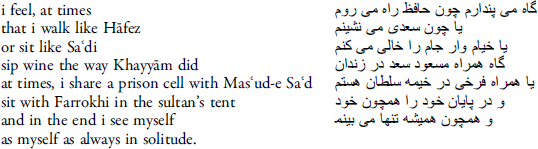
Poem selected from Naqsh-e Jahān [Image of the world], Morvārid, 2001, pg 155.
Jalāli’s speaker places himself in the lineage of canonical poets. Although they are primarily known for their poetry, he shares experiences with them that bind most humans together beyond the act of composing verse. These experiences evoke competing and conflicting narratives of Persian literary history. For instance, Saʿdi is known to have traveled extensively while Hāfez rarely left his native Shiraz. Yet Jalāli imagines himself “sitting” like Saʿdi and “walking” like Hāfez. Khayyām is associated with a cup, an unmistakable reference to the central place of wine in his robāʿiyāt. Masʿud-e Saʿd is remembered for his habsiyāt (prison poems) composed in the Ghaznavid prison while his contemporary, Farrukhi, thrived as a panegyrist in the same court. In this short poem, the Persian literary tradition appears, as experienced by a modern poet, in its political and artistic complexity. Jalāli’s poetic “I” actively feels and perceives aspects of the life of these celebrated figures and suggests there is more than sharing a literary heritage that forms their connection. This is distinctly different from modern poets’ engagement with canonical figures mainly for the purpose of forging a rhetoric of continuity or rupture from the poetic canon. Jalāli’s walking Hāfez is different from Shāmlu’s irreverent and non-believing Hāfez.Footnote 19 Jalāli keeps both Masʿud-e Saʿd and Farrokhi company while Barāheni (at least in the 1960s) turns Masʿud into a champion of committed poetry and dismisses Farrokhi as an elitist court poet. Jalāli’s poetic persona neither rejects nor endorses the literary past; he consciously moves past it and finds himself, at the end, in solitude. It is in this solitude that he ponders the very nature of poetry.
Poetry in Lyric: Reflections on Sheʿr
The twentieth century has witnessed the production of a critical body of texts, integral to the modern practice, that elucidates and defines poetry, its role and place today. This quality is manifest in the oeuvre of Nimā. His epistolary prose pieces elucidate his poems and reflect on the question and practice of writing modern poetry. Even though his poetological writings match his poetic oeuvre in size, until the 1990s no systematic study in English had undertaken the critical study of Nimā’s theories.Footnote 20 The question of poetics is the subject of many modern poems as well. In other words, in such works poetry becomes aware of its own status as verse and actively reflects on its signs and frames. Few modern poets have as many poems on poetry as Bizhan Jalāli. On Poetry and Encounters, his collections published respectively in 1998 and 2001, feature such poems while many others are scattered among different collections. Jalāli’s metapoetic works have thus far not been critically studied.
Metapoetry broadly refers to poems whose central subjects are poetry and poetics. Jalāli meditates on the relation between poetry and its pursuit. He personifies poetry and gives it full agency. Jalāli characterizes his verse as though it were something other than just writing. It often seems that it is interchangeable—at least in his perception of it—with his very being: “my beloved is poetry / each time i pen a verse, / Union.” Vesāl, or union, conjures mystical associations. The term is used to characterize the union of the seeker with his/her God or beloved in Sufi writings. Vesal entails a process of detaching from one’s lifestyle and adhering to stages of a spiritual journey. Jalāli reappropriates the loaded term to illuminate his own pursuit: poetry. The union of the poet and poetry is far from final or stable; it exposes the vulnerability of the seeker and his fragile pursuit in an ongoing battle to define his relation to his elusive beloved: sheʿr. In his other poems, Jalāli shows how fleeting his union with poetry is, wherein he has no ownership over his work and is constantly defeated by the task of composing poetry:
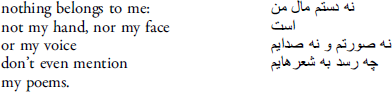
Poem selected from Naqsh-e Jahān [Image of the world], Morvārid, 2001, pg 271.
Jalāli’s speaker cannot own his poems as each time they slip away from his hands. Sometimes he lives with his poetry and even takes it out for fresh air while other times it is poetry that lives in his stead. Sometimes he uses poetry to confront death while at other times he derives his poems from death or even dies in them. He may tell us where he finds poetry, but he ends up empty handed:

Poem selected from Didār'hā [Encounters]. Morvārid, 2001.
The syntax here is admittedly ambiguous: beh jang-e sheʿr raftan. Is the speaker going to war for poetry’s sake—that is, fighting a war of poetry and not against poetry? In light of Jalāli’s other metapoetic works wherein he characterizes the act of composition as a battle (e.g. poetry as “battlefield” or “adversary”), I am inclined to imagine the poetic speaker going to war against poetry. The speaker engages in a war to tame and overcome sheʿr, and comes back all but defeated. But the experience of writing poetry involves more than just defeat; it means loss for a poet whose subject bears more life than his words. In this case, the poetic subject has to sacrifice living to give life to an ode on its beauty.
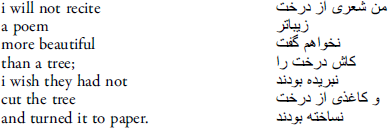
Poem selected from Naqsh-e Jahān [Image of the world], Morvārid, 2001, pg 244.
Jalāli’s metapoetic works speak to one another in many ways. If studied as a poetic corpus, they also speak to the popular assumptions and theories about poetry. As mentioned before, modern poets have composed a varied body of writing that seeks to define poetry. A critical examination of interviews, monographs and manifestos written in the twentieth century point to highly divergent views and visions on poetry. One may find a common framework in these writings as many of them seek to define the essence of poetry. As we will see later, many committed poets argue that the essence of poetry lies in its social function. Then there was a wave of anti-commitment poets who attempted to liberate poetry from its imagined essence. In their effort to divorce poetry from its social function, these poets inevitably sought to locate an essence in poetry. In a poetic tradition that has set to define itself anew, the question of defining poetry is critical. I argue that Jalāli’s metapoetry has abandoned the modern search for an essence, instead it wrestles with poetry as a free and elusive entity:

Poem selected from Naqsh-e Jahān [Image of the world], Morvārid, 2001, pg 154.
The poetic speaker constantly chases the poetic moment, but only arrives in the midst of his own daily life. In other words, there is no trace of the divinely inspired moment in Persian literary culture, the prophet-like poet, the original creator, imagined to be connected with the world beyond. In Jalāli, readers find many sources of poetic inspiration, divine and mundane, spontaneous and premeditated. These moments of creation exist side by side without ever being privileged or displaced by an absolute source of origin. One vision places agency in the hands of the poet who is aware of language and its limitations. Another vision characterizes the poet as a passive recipient helplessly left at poetry’s mercy. Consider these two poems:
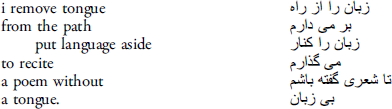
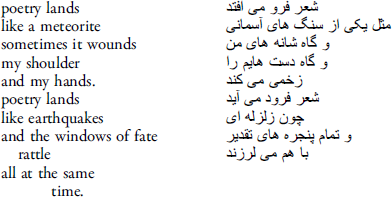
Jalāli’s metapoetic works have yet to be critically considered as part of the modern practice of poetological writing. Whether we return his poems to their immediate cultural and social moment or not, his metapoetry will continue speaking to its broader contexts as part of a global conversation on poetry, its creation and reception.
Caution! Form at Work: Negotiating Poetic Translatability
The discussion of Jalāli’s poetry in English will not be complete without a critical consideration of the problem of translation, often relegated to a marginal note in literary analyses. A group of poets, translators and literary enthusiasts gathered on 30 October 1992 to discuss Jalāli’s oeuvre.Footnote 21 In attendance were Ahmadi and Shams Langarudi, among many others. The group unanimously concluded that Jalāli’s poetry is easily translatable, particularly compared to other modern works. ʿOmrān Salāhi, one participant, argues that “Jalāli’s poetry is not adorned by poetic craft, a quality that contributes to its translatability.”Footnote 22 The participants further argued that poetic form, primarily conceptualized in Persian as consisting of systematic meter, poses one of the more difficult challenges of translation. As discussed earlier, Jalāli’s form is not dictated by the rules of pre-modern Perso-Arabic prosody nor is it shaped by ʿaruz-e Nimāʾi, or Nimāic prosody. Its non-adherence to metrical patterns, classical or modern, is seen as an advantage for the translator. It is the “absence of artifice and musicality,” the participants reiterated, that makes Jalāli’s poetry move so “comfortably” from one language to another.
However, I will argue that these poets and critics have necessarily conflated poetic effect with poetic practice. It is not that Jalāli’s poetry lacks artifice, form or literary adornment, but rather it adopts particular devices, some of which we have examined, in order to make such effects seem simple, straightforward and sincere. It is also important to note that Jalāli does not abandon form, but rather departs from inherited, ready-made formal schemas. While his poetics communicate change to many Persian readers, English could render invisible those qualities that make Jalāli a unique poet in the source language. Jalāli’s form takes shape in a composite process that involves elements of minimalism and refrains from metrical patterns. Persian poetic modernism (admittedly not in all cases) signals a rupture from the regular metrical structures of classical prosody. Whether one defends or questions this departure, its transformative implications for Persian literary culture are undeniable. Jalāli’s sentiment captures the importance of this intervention:
Once the foundation of a millennium-old poetic tradition is broken [by virtue] of broken meters and incomplete rhyming patterns, unfortunately we will witness a type of destruction that will in all likelihood have disastrous implications. The next stage is to do away with all meters and rhymes: no meter, no rhyme. The following stage is to break sentences with no logical line breaks, or perhaps to place each word on a separate line. Eventually it may lead to a deaf and dumb story between the poet and his audience and reader. But we will inevitably stage a return. If today we show irreverence by composing free verse is because we have no other way. It is justified.Footnote 23
In spite of its original context, Jalāli’s form appears as established and standard to most English readers who are accustomed to speech rhythms and free verse. Having co-translated Jalāli’s poems with Adeeba Shahid Talukder, I will detail our engagement with his verse. If a poem in translation is like a road, we, as its translators, have searched for an English-language sign that reads: “Caution! Form at Work.” In other words, we have attempted to defamiliarize patterns that are otherwise automatic for English-speaking eyes. In order to approximate the uniqueness of Jalāli’s form, we have attempted to foreignize, using Venuti’s popularized term, the poem’s typography by justifying the text to the right. It also slows down the reader and calls attention to its structure. By disorienting the English reader, we hope to move closer to the poetic qualities of Jalāli’s work in Persian. A lowercase “i,” a style pioneered by e. e. cummings, both reflects the individualistic gesture of Jalāli’s poetic speaker and its flight from the universal “I.” Initially, we had opted for a style of enjambment and punctuation more familiar to English readers, but later removed all stanza breaks and commas/colons to approximate Jalāli’s lack of punctuation. We hope that through these measures some of Jalāli’s poetics resurface in English. The following versions feature some of these decisions previously described:
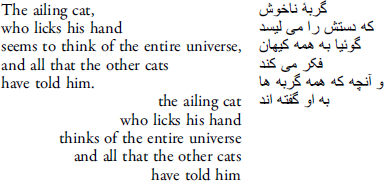
Poem selected from Naqsh-e Jahān [Image of the world], Morvārid, 2001, pg 192.
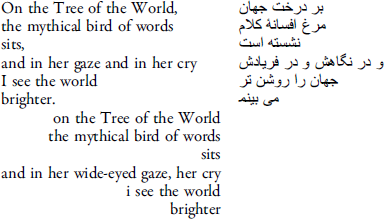
Poem selected from Naqsh-e Jahān [Image of the world], Morvārid, 2001, pg 78.
Having discussed aspects of translating Jalāli, I wish to problematize the superficial understanding of translatability predicated on the false notion that his poetry lacks form and artifice. The argument that Jalāli’s poems will move easily and effortlessly into any language also fails to consider the reception of his work in the target language, one that varies in each language. As previously discussed, some of Jalāli’s key poetic qualities (e.g. enjambment, lack of punctuation, direct and clear voice) will necessarily be mediated by the pervasiveness and distinct trajectory of non-metrical short poems in English. Some readers may disagree with certain measures taken here to animate Jalāli’s Persian poetics in English translation, but these accommodations, while far from final, will displace such simplistic and reductive formulations as “Jalāli’s poetry is easily translatable” and initiate a bilateral and critical conversation on poetic translatability. It is our ultimate hope that bilingual readers will be able to trace our translation to its rightful source, the poetry of Bijan Jalāli.
In the next section, I will return Jalāli to his social and literary milieu in order to better understand why he was ignored for so long and how he has reemerged as a popular poet.
Emergence of an Interpretive Community
The circle of poets affiliated with Nimā (d. 1960) in the 1950s through the 1970s circulated and popularized his vision of poetic modernism and actively participated in the formation of a modern poetic canon. This small yet consequential circle has included Shāmlu, Mehdi Akhavān-Sāles (d. 1990), Forugh Farrokhzād (d. 1967), Reza Barāheni (b. 1935) and many others. Understanding the role of these figures not just as poets but also as critics and anthologists or, broadly put, canon-makers, who formed an interpretive community, is integral to the project of poetic modernism in Persian. In Recasting Persian Poetry, Ahmad Karimi-Hakkak examines the exegesis of Nimā’s poetry and its role in crafting a rhetoric of poetic intervention. Nimā’s innovations in his prolific literary career have changed the visual appearance and sonic landscape of Persian poetry. He departed from the ‘aruz of classical forms and introduced lines of varying lengths as well as sporadic rhyming patterns. Nimā’s poetic interventions, however elucidated or weighed in the context of Persian literary tradition, communicated a break to a generation of poets who came after him. Amongst this generation, poets such as Shāmlu engaged Nimā personally and sought his mentorship. Many others in the Persian-speaking world affiliated their literary modernism to (their perception of) Nimā’s poetic system; they interpreted and commented on his poetry. As Karimi-Hakkak has convincingly argued, critics such as Ehsān Tabari (d. 1989) and Akhavān-Sāles introduced Nimā’s vision in the vein of their own ideological struggles. Aspiring to establish their own poetics of modernism against the literary regime of the 1940s and 1950s, they discovered Nimā in their own poetic image. Karimi-Hakkak writes,
In time, the discourse solidified into the specific sociolect of the modern voices which emerged in the 1950s and early 1960s and which sought to legitimate the tradition of she‘r-e now with sociopolitical interpretations of literary texts. Thus, a whole new interpretive culture emerged wherein poetry was read primarily with the purpose of deciphering the poet’s political views, its abstractions and ambiguities attributed to a perennial case of absence of freedoms, particularly those relating to free expression of ideas through poetry.Footnote 24
The emergence of this interpretive community and its insistence on placing the poetic text within its social context is seen as one of the hallmarks of poetic modernism in the 1960s and 1970s in Iran. The figure of the poet undergoes major changes in the image and vision of each modern poet. The poet, who may have once been viewed, as Karimi-Hakkak asserts, as the “wise [man] of the tribe dispensing moral advice and pointing to the path of worldly happiness and salvation” is now framed as the collective voice of a particular era, addressing pressing social concerns and at times bearing the brunt of expressing cultural critique.Footnote 25 This period’s literary debates delineate new social criteria for the modern poet and rewrite the millennial tradition of Persian poetry to reflect their vision of the “sociality of poetry.” Subsequently, the corpus of Persian literary tradition, in all its diversity and complexity, is subsumed under the amorphous rubric of “classical” literature.
Barāheni’s Talā dar Mes, a seminal study of modern poetics published in 1968, played an important role in solidifying the discourse of commitment in Iran. Barāheni’s introduction, entitled “Today’s Poet and Critic,” does not begin with Nimā or any other modern figure, Persian or international. He writes: “The poet of our era, ladies and gentlemen of today, must never lose sight of the corpse of Ferdowsi, that farmer of Tus, as it was leaving the gates of Rezān a thousand years ago.”Footnote 26 The critic alludes to a widely circulated anecdote about the tenth century poet: Ferdowsi, having fallen out of favor at the Ghaznavid court, is denied a burial site in his own land.Footnote 27 Whether or not this story is accurate seems unimportant here. Why does Barāheni begin his manifesto of modern poetry with Ferdowsi’s imagined social and political marginalization? From Ferdowsi to Hasanak the Vizier to Mas’ud Sa‘d Salmān to Amir Kabir, Barāheni attempts to forge the distinct poetic genealogy to which he harks back.Footnote 28 Inherited by Barāheni are historical Persian figures whose social and literary marginalization he valorizes and exemplifies. Although the concept of literary tradition remains highly contentious amongst modern figures, Barāheni’s rewriting of Persian literary tradition through the vein of his own political struggles is prevalent in most modern circles, as with all literary movements.Footnote 29 Barāheni and his cohorts selectively created a poetic genealogy with an impulse to discover “modern” concerns in canonical texts.Footnote 30 Few poems capture the imagined social and literary crisis of Persian literary culture better than Shāmlu’s “A Poetry That Is Life,” featured in his collection Fresh Air, published in 1957. The poem’s first stanza, as translated by Samad Alavi, professes the modern crisis of Persian poetry as imagined by a committed poet:
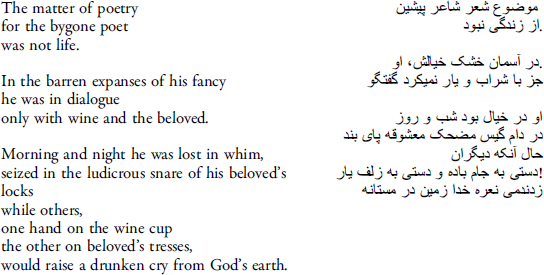
However, the poem’s confrontational tone makes it an anomaly in Shāmlu’s oeuvre. “A Poetry That Is Life” articulates the modern rhetoric of crisis as much as it hides the poet’s own preoccupations with canonical figures such as Hāfez throughout his life.Footnote 31 The creation of a poetic genealogy is integral to the project of modernism on the one hand and for the formation of a rhetoric of commitment on the other. Talā dar Mes contributes to the formation of this idiom by translating its vision of committed art to a new ethos of literary criticism. However, it is important to note that Barāheni’s committed approach to literary criticism, even in Talā dar Mes alone, remains highly heterogeneous. Dismissing art for art’s sake as “betrayal” in lieu of human suffering, Barāheni’s introduction signals a rupture in the reception of artistic production in Persian. He does so by emphasizing the relevance and timeliness of his message, as evident in his lexicon: “our epoch,” “ladies and gentlemen of today,” “the contemporary critic.” All critics, he states, should participate in the formation of a new tradition as opposed to worshiping what they have automatically inherited. Writers and critics alike should infuse their world with other cultures, as opposed to limiting themselves to the cultures of Iran.Footnote 32 However, the author’s mobilizing manifesto does not suggest that a poem should compromise its aesthetic performance in order to communicate its social commitment. Any socially committed poem, he argues, must be “elevated” by its aesthetic dimensions. The tension between shoʿār (sloganeering) and she‘r (true poetry) was a spirited debate central to the poetics of commitment. Overall, Barāheni’s ethos of literary criticism is centered upon shaping a collective consciousness attuned to the realities and experiences of Iranian streets. Artists, he proclaims, must experience the street where history and society throb and pulsate. Having carved a place for the modern critic, Barāheni places all “creative persons” in three groups: ” Those residing in ivory towers with their heads buried in the snow, the oppressive and powerful fascists who turn a blind eye to suffering [of others], and the socially and historically minded, [who are] responsible, engaged and committed.”Footnote 33
Barāheni’s controversial declaration, often examined by episodic accounts as the quintessential narrative of aesthetic purposiveness, is all but one shade of commitment. Barāheni himself does not adopt a unified approach in his reading of different poets. He is at times far more attentive to formal and linguistic elements when reading one poet (e.g. Forugh Farrokhzād) and inclined to make ideological value judgments when discussing another poet (e.g. Sohrāb Sepehri). A comprehensive analysis of Barāheni’s work alone shows, as dominant as poetics of commitment were at this period, there was never a single, unifying vision of how to be an engagée poet or critic.Footnote 34
Many poets who in one way or another engaged the poetics of taʿahhud did not adhere to the aesthetics of commitment as prescribed by Talā dar Mes. Uninvolved in partisan politics, Yadollah Royā’i (b. 1932) was incarcerated for his political activism following the coup of 1953. He began composing poetry in his early twenties and became an active figure on the literary landscape of the 1960s. He cofounded the Rawzan publishing house and, in collaboration with Shāmlu, started the literary periodical Bāru in 1966. The publication, which combined the pen names of its founders (Bāmdād and Royā), was banned by the state after several issues. In 1969, having published Deltangi’hā, his third book of poetry, Royā’i and a group of poets, playwrights and filmmakers published the manifesto of sheʿr-e hajm (Poetry of Space), which he translated as espacementalisme. Released just a year after the publication of Talā dar Mes, Roya’i and his cohorts directly respond to what they deem a partisan and politicized type of commitment:
She‘r-e hajm avoids the deceit of ideology and the business of commitment. If it assumes any responsibility it is solely directed at its own actions which are revolutionary and conscious. If it speaks of any commitment, it refers to one that is not [primarily] engaged but engaging for she‘r-e hajm does not pursue partisan commitment. It is a prophecy to one’s internal self. It is from this [inward prophecy] that commitment takes on and gives its direction. Therefore, even before she‘r-e hajm becomes engaged, it makes [one] engaged.Footnote 35
While it is common to think of she‘r-e hajm as a nonpolitical trend that set out to challenge the dominant equation of commitment and its attempt to identify it with the project of poetic modernism, it must be noted that resisting the posture of committed circles and constructing a poetic subject that proclaimed to be disengaged yet engaging is inevitably political. Royā’i’s manifesto, written over three months of conversation held in the homes of different artists, should be read as an attempt to craft a literary idiom robust enough to register greater nuance beyond Talā dar Mes’ designations of “committed” versus “noncommitted.”Footnote 36 In the process, Royā’i does not necessarily do away with the commonly charged lexicon of committed circles but rather co-opts them for their own aesthetic project. She‘r-e hajm is only responsible, he writes, for its own actions, being bidār [vigilant] and enqelābi [revolutionary]—terms that had gained currency in the 1960s and 1970s. He also distinguishes between engagée and engageant and identifies she‘r-e hajm with the latter, which demonstrates Royā’i’s preoccupation with aesthetic development.Footnote 37 Any critical examination of literary commitment will have to consider counter-movements such as she‘r-e hajm that formed their own rhetoric of poetic subversion.
Within this dynamic literary scene, many poets did not engage the poetics of commitment in any way or form. Jalāli is only one instance. His limited social visibility meant that only those who personally knew him were able to seek his opinion about the literary climate in general and the reception of his poetry in particular. Jalāli rarely gave any interviews before the 1990s and did not read his poetry in public or private circles. He was born in Tehran in 1927 during the reign of Rezā Shāh Pahlavi (r. 1925‒41). In his lifetime, he witnessed events of historical magnitude that shaped Iranian national and political culture in the twentieth century: the rapid modernization under Rezā Shāh and his son, Muhammad Rezā Shāh (r. 1953‒79); the 1953 coup ousting Mohammad Mosaddeq and the ensuing period of autocratic rule; the 1979 Revolution; and the Iran‒Iraq War (1980‒88). But it would be reductive to see Jalāli’s literary life as a direct testimony of such historical events. Jalāli’s verse does not lend itself to the furtherance or remembrance of political events. His poetry was often critiqued in relation to his lack of political involvement. In his discussion of Sohrāb Sepehri’s poetry (d. 1980), Barāheni mentions Jalāli as a side note and rejects both their work, for they merely maintain a deceptive facade.Footnote 38 Barāheni then offers a series of comparisons to establish his case. Jalāli’s verse, he writes, is like cotton candy, two meters of which can be reduced to a single bite. Sepehri’s poetry is like soap foam while Jalāli’s work resembles popcorn: you could fill your pockets with it but not your stomach. In other words, their work may appear attractive and solid but lacks real substance. Such views were not uncommon. Commenting on Jalāli’s poetry, Parviz Mohājer (d. 1975) writes:
Even if we consider other (non-aesthetic) points of view, Jalāli’s poetry still falls in the category of mediocre poets today. This is for no other reason than the ideas that run through his works, and we should take serious pride in not sharing them: the ideas of a man who has closed his eyes to the flash of gunfire and his ears to boots striking the ground. It seems he has neither seen Auschwitz nor Palestine. These are the ideas of a man who does not feel any shame when he looks in the mirror. These are the ideas of a man who has never had to bear the shame or the name of others, the shame of those who at night beg for their children’s food from barracks, the name of those whose [pursuit of] poetry—not the type Jalāli writes—has left their children wandering hungry in the streets. Inevitably, the poems that are born from such ideas [as Jalāli’s] are not even the cry of justice of a fearful man who may tell tales of “the bombs that fell when we were asleep,” and, with awareness of “the pear’s fall in this age of steel’s ascension,” raises his shivering and hopeful hands toward a force from which perhaps [all that is] ugly or beautiful has been derived. Therefore, the mysticism of Jalāli is not grounded in any time or place and at times even foments doubt and irresolution.Footnote 39
Mohājer’s commentary broadly captures the ethos articulated by Talā dar Mes’ introduction: refusal to take a socially defined political stance demonstrates lack of political engagement and disregard for the pressing social anxieties of one’s time. Jalāli was clearly seen by many critics as an uncommitted figure whose poetry did not merit any consideration. This reception, along with Jalāli’s own private lifestyle, meant that his verse was overlooked by most literary journals and popular magazines in the 1960s and 1970s. Jalāli began writing poetry in the late 1940s but went on to publish only three books of poetry between 1962 and 1971. The bulk of his oeuvre—nine collections out of which five were released posthumously—was published between 1983 and 2004. Jalāli’s early work found itself surrounded by interpretations, such as Mohājer’s, that attempted to regulate the reader’s encounter with his work. Such commentaries were all but one feature of larger efforts to form and regulate a distinct literary taste, one that derived from a particular ethos of literary criticism, which was at times unmistakably infused with a confrontational rhetoric of commitment.
Jalāli was not the only figure whose poetry found itself accompanied with a literary discourse wrought with politics. As seen above, Mohājer also alludes to Sepehri, who was known both as painter and poet. Even though the critic does not mention his name, Mohājer’s allusions would have been understood by initiated readers of modern poetry. Mohājer draws a taunting comparison between Jalāli and Sepehri, implying that the former is even more divorced from such social atrocities as genocide and ethnic cleansing than Sepehri. Mohajer quotes two lines from Sepehri’s Beh bāgh-e hamsafarān (To the Garden of Fellow Wayfarers) selected from his 1967 collection Hajm-e sabz (The Green Space). What is particularly curious is that Mohājer has deliberately or inadvertently altered the poem; the original line reads: “the bombs that fell when I was asleep.” The commentator’s version has replaced the first person with the collective we: “the bombs that fell when we were asleep.” If deliberate, this alteration demonstrates the critic’s willingness to negate the poet’s personal “I.” In other words, Mohājer’s “we” attempts to move Sepehri’s “I” toward an acceptable model in which the poetic subject is representative of a collective, hence engaged.
Labeled as uncommitted, the poetic vision of Jalāli and Sepehri, as well as many others, often did not receive critical consideration in the 1960s and 1970s.Footnote 40 Arguably, their poetics of modernism, articulated in conversation with their dynamic literary scene, were marginalized by a belligerent model of commitment. Poets such as Jalāli who function outside the established literary circles are overlooked at worst or footnoted at best by episodic approaches that set to trace ideological presuppositions of dominant discourses such as commitment. Also discarded and ignored by episodic narratives are many other versions and visions of commitment as well as the unique processes in which each poet reconciles their poetics with the politics of literary modernism.Footnote 41 Apart from having been included in a few English-language anthologies, Jalāli’s poetry has thus far fallen into the cracks of literary scholarship.Footnote 42 In the next section, we will examine an anthology, edited and compiled by Forugh Farrokhzād, that reconciles poetic modernism with the dominant literary discourse of commitment that set to provide the sole definition of being modern. Farrokhzād, as we will see, anthologized Shāmlu, Sepehri, Royā’i and Jalāli, representing not a single vision of modernism, but a spectrum of modernisms.
Poet as Anthologist
My poems’ main substance is my suffering. I believe a true teller must have that substance. I compose poetry for my suffering’s sake. Form and lexicon, rhyme and meter have been my tools at all times. I have had to change them so that they will be in harmony with my suffering and that of others. (Nimā, Iranian Writers’ Congress)Footnote 43
By the late 1960s, the generation of poets who had responded to Nimā’s poetic interventions had come of age. A modern literary idiom, one dimension of which is the formation of a new interpretive community, handed down the millennial tradition of Persian poetry in the mode of its imagined connection with social life. The topicality of poetry, defined as a poetic discourse willing to address social issues, was itself always subject to debate. The literary scene of the 1960s and 1970s cultivated different debates on a number of compelling issues: do we write for a readership? What does our poetic “I” represent?Footnote 44 In an effort to unpack these conversations, scholars have often considered manifestos, while anthologies have received less critical attention. The genre of manifesto signals a moment of change in all literary conventions and is an integral part of the modern rhetoric of crisis. The form of anthology, an equally important dimension of the modern practice, performs distinctly different functions. The anthology attempts to seamlessly hide its editorial process of editing, selecting, rearranging and excluding works in order to persuade readers of its cohesive poetic vision. While all anthologies share broad common characteristics, their specific literary context and practice may point in different directions. I will focus on a particular anthology.
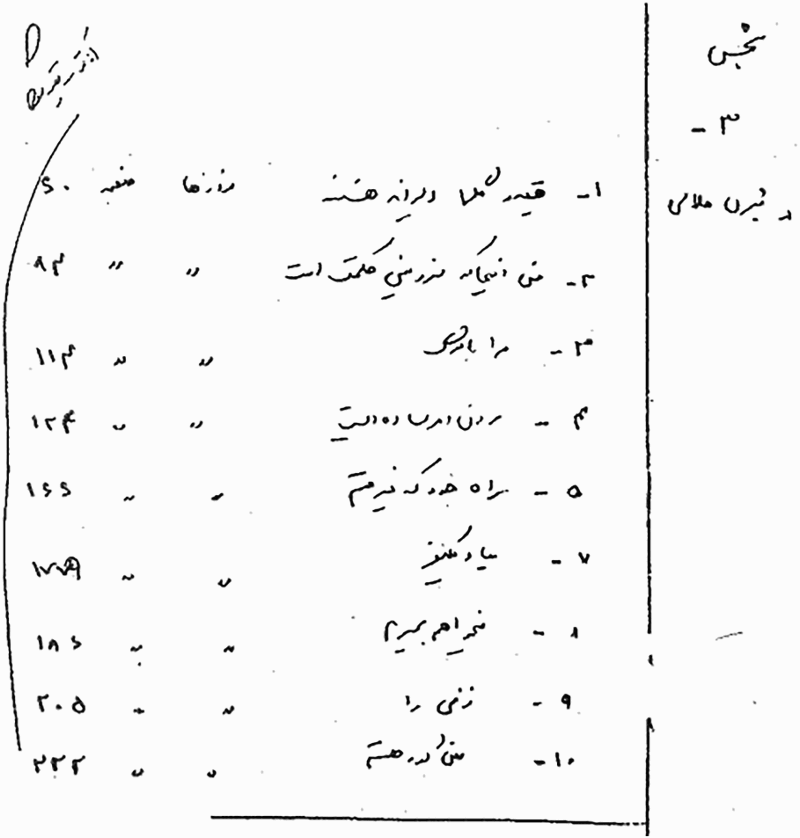
In a varied artistic career that lasted less than two decades, Forugh Farrokhzād published four books of poetry between 1955 and 1964 (one released posthumously in 1974); directed a short film, The House Is Black; translated into Persian works by German and English poets and playwrights; and compiled an anthology of contemporary Persian poetry, entitled Az Nimā ta bʿad (Nimā and Afterwards), published posthumously in 1968. Az Nimā ta bʿad is one of the first anthologies of a generation of poets who are considered today as canonical figures of modern Persian verse. Even more important is the poet’s role as an anthologist, an aspect of Farrokhzād’s career that has been relegated to the status of a curious footnote.Footnote 45 The anthology features 112 poems by thirteen poets, including poems by Jalāli and Shāmlu (see Figure 1).Footnote 46 In his preface, Majid Rawshangar recounts his conversation with Farrokhzād during the planning of the book. He writes, “I suggested that we gather the work of figures whose poetic field bears the seeds of Nimā, those that have created something and are still active.” Rawshangar was particularly hesitant; he felt such a collection could cause controversy. Farrokhzād, however, was convinced that “those who will whine already have enough excuses [to do so], they won’t need this collection.”Footnote 47 She did not live to justify her selection or see how her cohorts received the collection.
Laying out Az Nimā ta bʿad
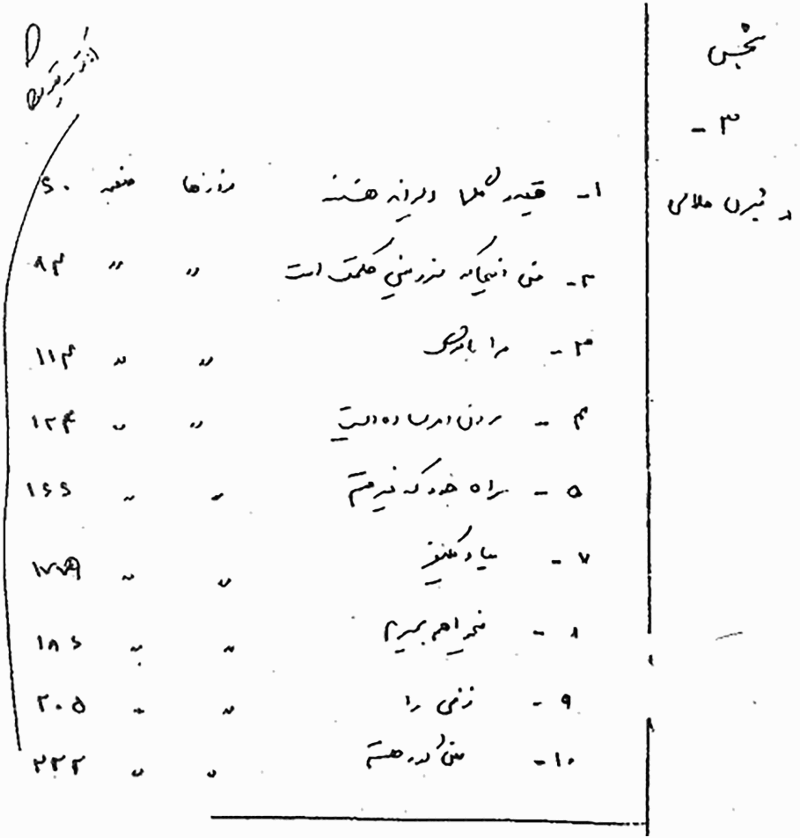
But why compile an anthology? The answer is twofold. The form of anthology is both endemic to Persian and a prevalent feature of modern practice in the twentieth century. In its sense of recollecting, tazkerahs are similar to the anthology in that they recollect poems and commit them to memory. It is an act of remembrance, as its Arabic root (dh-k-r) implies. The twentieth century witnessed the production of a large corpus of anthologies across different literary traditions. The efforts of poet-anthologists such as Marinetti, Pound, Gerardo Diego and Breton in the first half of the twentieth century created a multifaceted and intertextual web of methodologies and approaches to the rewriting and recollection of literary movements. In Persian, numerous bargozidehs or anthologies of poetry appeared in this period. This trend continued in the latter part of the twentieth century. Adonis compiled and edited Dīwān al-shi‘r al-‘arabī in the late 1960s in Beirut.Footnote 48 In Kabul, Khāl Mohammad Khastah (d. 1973), a Persian-language poet and litterateur from Bukhara, published Moʻāserin-e sokhanvar in 1960 and Yādi az raftagan in 1965, the latter around the same time as Az Nimā ta bʿad. Farrokhzād would have been aware of the popularity of the anthology due to her travels and interest in literary translation.
Farrokhzād’s Az Nimā ta bʿad entered the dynamic literary scene of the 1960s and 1970s wherein the figure of the poet and poetic practice were vigorously debated. As seen in Talā dar Mes and the manifesto of she‘r-e hajm, certain poets chose their camps while each interpretive community set to rewrite the Persian literary tradition in its own image. Many refrained from choosing camps and participating in these debates altogether. Aware of its contentious nature, Az Nimā ta bʿad set out to recollect the works of Iran’s living poets (with the exception of Nimā who had passed earlier). It presented a new corpus of poetry and heralded the arrival of a new poetic vision to its readers. Unlike most tazkerahs, Farrokhzād offers no philological, aesthetic or historical insights. In fact the poems are not accompanied with any type of commentary. Some sections begin with a quote from the poet while others are blank. Readers are left on their own to directly encounter each poem and decipher its contexts and meanings. Those unfamiliar with the literary history of this period would not be able to infer the debates surrounding the reception of poems. For instance, Shāmlu’s “A Poetry That Is Life,” often read as a manifesto of committed poetry, resides in the same collection as Sepehri’s “Water,” derided by Shāmlu for its “lack of social awareness.” Few uninitiated readers would remember Shāmlu’s scathing comment on Sepehri’s poem in literary journals.Footnote 49 In other words, Farrokhzād’s editorial principles function as a mediator, searching for a common denominator between modern poetics.
Even though no one criterion frames her anthology, the question of meter remains central to it. Although many modern figures—including Farrokhzād—have composed poems adhering to the prosody of classical forms, here she has only anthologized works of free verse: lines of varying lengths and irregular or no use of rhyme, poems with irregular metrical patterns or none at all.Footnote 50 The composition of a new ‘aruz, in its immense diversity, is the focus of the anthology. Az Nimā ta bʿad’s modernism is primarily marked by the changing of poetic form while the topicality of poetry is afforded no visibility. This framework allows for the inclusion and consideration of Jalāli’s poetic vision as part of the process of modernism. Farrokhzād’s inclusionary rubric becomes even more important considering the anxieties involved in imagining Jalāli as part of the canon of modern Persian poetry. In the 1990s the tide began to drastically turn. Jalāli’s “non-commitment,” once deemed his vice, became a virtue.
From Marginalization to Valorization: Jalāli’s Poetry Today
In its frame, the culture will place the portrait of a citizen willing and able to validate or vilify the culture by filtering his or her impressions of it through personal perceptions. To see the events that preoccupy the society registered in poetic works signifies a growing harmony between the poet’s role as an individual human being and as a citizen. (Ahmad Karimi-Hakkak)Footnote 51
The 1980s transformed the discussion of literary commitment, a discourse that has largely (if not exclusively) been identified with the intellectual spectrum of leftist thought in Persian literary culture. The revolution’s outcome led to a feeling of profound disillusionment among many writers. The majority of those involved in the individual and institutional struggles of writers against censorship and political alienation were either silenced or driven into exile by the new regime. Supported by the state, the maktabi literary trend, committed to furthering its own ideological causes, emerged in the 1980s and 1990s. The emergence of critical approaches to the study of the relations between literature and politics led to a long process of self-reflection. Such figures as Barāheni and Mohammad Mokhtāri (d. 1998) revisited their earlier assumptions and convictions. Talā dar Mes, republished in 1992, no longer featured Barāheni’s polemical introduction. Barāheni “dispenses with the revolutionary rhetoric of 1968,” Alavi writes, “replacing the battle-worn imagery or ‘ivory towers,’ ‘gallows’ and ‘the street’ with a more muted and introspective reflection on literature’s social dimension.”Footnote 52 Barāheni went on to dismiss the poetics of literary commitment altogether in an essay entitled “Why I am no longer a Nimāic Poet.” Both inside and outside of Iran today, many critics and poets appear as committed to reject the question of commitment as they once were to cultivate it. Many proponents of such a view argue that the predominance of commitment leads to the subordination of literature to sociopolitical discourses.Footnote 53 This schematic simplifies (if not overlooks) the heterogeneous and composite processes in which each writer weaves their poetics into politics. This polemical turn to the aesthetic dimensions of a literary work as a standalone discourse imagined to be divorced from its sociopolitical routes reaffirms Alavi’s assertion that commitment “refers to an on-going, unresolved debate in Persian poetics, not a discrete literary-historical phenomenon.”Footnote 54 It is within this shifting context that Jalāli is remade in the image of a new interpretive community.
Jalāli is celebrated today as a rediscovered poet. In the 1990s alone more commentaries and interviews focused on his life and work than in his entire literary career.Footnote 55 He began to release his unpublished poems from the 1970s. The Gardun Literary Award, presented to Jalāli in 1996, attests to the growing recognition of his literary productivity. In 2000, Kāmyār Ābedi edited a compilation of essays and commentary, entitled Zamzameh’i barā-ye abadiyat (A Whisper for Eternity), an outstanding collection that engages various aspects of his oeuvre. Jalāli’s verse has been translated into a number of languages including French, Italian, Arabic and Kurdish. A literary award, presented to several poets and literary critics, including Simin Behbahāni, has been established in recognition of Jalāli’s work. Toward the end of his literary career, Jalāli also began to reach out to his readership. He was a regular visitor at the café Shukā in Tehran—a meeting place for writers and literati owned by the playwright Yārʿali Pur-Moqdam—and often engaged young literary enthusiasts in conversation about poetry.
Jalāli’s verse was framed by one generation as uncommitted, elitist and divorced from its social anxieties while another generation, having now come of age, hails him as an honest and introspective poet who has been ignored by his politicized milieu.Footnote 56 In A Whisper for Eternity, Ābedi celebrates “the lyrics of a poet who at times was subject to the criticism or attack of literary critics for his declaration of independence which for many was absolutely unjustifiable. This was at an age when the written word was revered only for its commitment to serve the human telos of reaching justice.”Footnote 57 Jalāli is seen, returning to Khorramshāhi’s analogy, as a butterfly hunter with an empty net. Both generations have made Jalāli in their own image: one is an apolitical poet who fails to register the anxieties of his time in verse and the other is a sensitive soul whose poetic whispers come to us from a timeless continuum. Yet my efforts to return Jalāli to his social and literary context and highlight his marginalized poetics of modernism are also a selective modeling of his poetic oeuvre. But I hope that such modeling will result in a critical consideration of his work as part of the history of poetic modernism in Persian.
This paper has deliberately kept biographical considerations of the poet to a minimum. But one may ask at the end, who is Bizhan Jalāli? His friends describe him as gentle and humble, an embodiment of his poetry. “When you met him, and if you didn’t know he was a poet, you would never be able to find out. He never talked about it; although he always engaged you in a deep conversation about many things,” writes Goli Emami. The death of Shahriyār, the son of close family friends, constituted a colossal loss for him. Jalāli was a devout animal lover and shared his home with dogs and cats. He never married and is survived by his brother and nephew, Mehrdad Jalāli and Jahāngir Hedāyat, who have had a hand in the publication and promotion of his posthumous work. In December 1999, Jalāli went into a coma and was not to meet the new millennium.
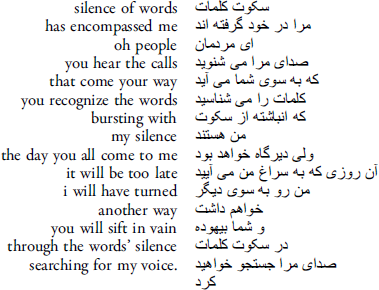
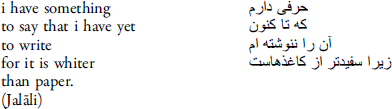
Poem selected from Sheʿr-e Sokut [The verse of silence], Morvārid, 2002, pg. 40.